Material Science
Composites
By Yokesh D
3rd Yr. BE EEE SW
PSG College of Technology
Coimbatore – 641 004
COMPOSITES
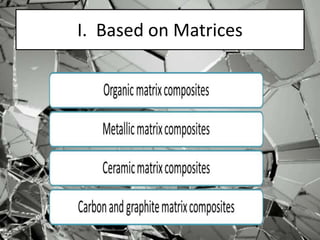
Classification based on Matrices
What are composites?
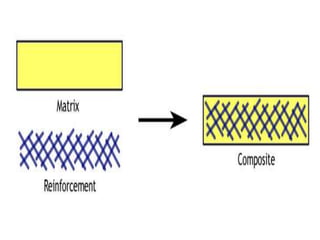
A Composite material is a material made from
two or more constituent materials with
significantly different physical or chemical
properties that, when combined, produce a
material with characteristics different from the
individual components
(or)
Artificially produced multiphase materials
(or)
Design materials with properties better than
those of conventional materials
In their broadest form, composites are
materials consist of two or more constituents.
The constituents are combined in such a way
that they keep their individual physical phases
and are not soluble in each other or not to
form a new chemical compound.
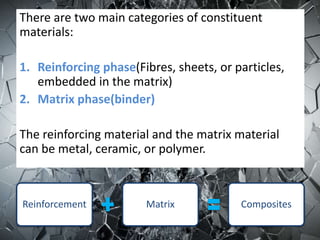
There are two main categories of constituent
materials:
1. Reinforcing phase(Fibres, sheets, or particles,
embedded in the matrix)
2. Matrix phase(binder)
The reinforcing material and the matrix material
can be metal, ceramic, or polymer.
Reinforcement Matrix Composites
Matrix
• Provides the bulk form of the part or product made
of the composite material
• Holds the imbedded phase in place, usually enclosing
and often concealing it
• When a load is applied, shares the load with the
secondary phase
• Determine inter-laminar shear strength, damage
tolerance, in-plane shear strength, processing
capacity , heat resistance of composites.
Reinforcement
The reinforcements
impart their special
mechanical and
physical properties to
enhance the matrix
properties.
(A black carbon fiber
used as reinforcement
compared with human
hair)
Why Composites:
• The new material may be preferred for many
reasons:
 stronger,
 lighter,
 less expensive
when compared to traditional materials
• The properties and performance of composites
are far superior to those of the constituents
History
Composites have played an important role
throughout human history
• Plywood - 3400 BC by the Ancient
Mesopotamians; gluing wood at different angles
gives better properties than natural wood
• Concrete was described by Vitruvius, writing
around 25 BC in his Ten Books on Architecture
• Cartonnage layers of linen or papyrus soaked in
plaster dates to the First Intermediate Period of
Egypt c. 2181–2055 BC and was used for death
masks
• Cob (material) Mud Bricks, or Mud Walls, (using
mud (clay) with straw or gravel as a binder), used
for thousands of years.
• In the 12th century A.D., Mongol warriors used
composite materials (bamboo, silk, cattle tendons
and horns, and pine resin) to craft Archery bows
that were swifter and more powerful than those
of their rivals
• Papier-mâché, a composite of paper and glue,
has been used for hundreds of years
• The first artificial fibre reinforced
plastic was Bakelite which dates to 1907
Now a days composites are used mostly
everywhere.
Classification of
composites
Composite materials are commonly classified at
following two distinct levels:
1. The first level of classification: is usually
made with respect to the matrix constituent
2. The second level of classification: made with
respect to geometry of reinforcement
I. Based on Matrices
II. Based on geometry of
reinforcements
1.Fiber reinforced composites
2.Laminar composites
3.Particulate composites
Let us see in brief about various
types of reinforced composites
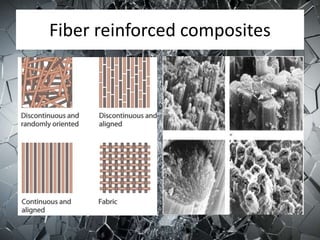
1.Fiber reinforced composites
A fibre-reinforced
composite (FRC) is
a composite building
material that consists of
three components:
(i) the fibers as the
discontinuous or dispersed
phase,
(ii) the matrix as the
continuous phase, and
(iii) the fine interphase
region, also known as the
interface.
Fiber reinforced composites
Microscopic view of fiber reinforced
composties
Scanning electron
micro-graphs of various
fiber architectures.
a) woven
polyethylene
fibers;
b) braided glass
fibers;
c) woven
(bidirectional) glass
fibers;
d) unidirectional glass
fibers
Laminar composites
• a composite laminates is
an assembly of layers
of fibrous composite
materials which can be
joined to provide
required engineering pro
perties, including in-plane
stiffness, bending
stiffness, strength,
and coefficient of thermal
expansion.
Particulate composites
• They are composed of
particles distributed or
embedded in a matrix
body.
• The particles may be
flakes or in powder
form.
• Concrete and wood
particle boards are
examples of this
category.
• Now, let us see in detail about the
classification of composites based
on composite matrices
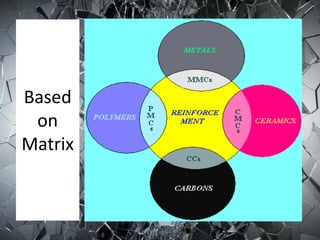
Classification based on Matrices
Based
on
Matrix
Composites
Organic Matrix
Composites
(OMC)
Polymer Matrix
Composites
Thermoset
Thermoplastic
Rubber
Carbon Matrix
Composites
Metal Matrix
Composites
(MMC)
Ceramic Matrix
Composites
(CMC)
Organic Matrix Composites
Organic Matrix Composites(OMC)
• In this the matrix material is an Organic
compound
• Eg: Asphalt concrete, Dental composite,
Syntactic foam
• The Matrix is made up of either a Polymer or
Carbon or both.
• Thus it is subdivided into two categories:
a. Polymer matrix Composites and
b. Carbon matrix composites
a. Polymer Matrix Composites(PMC)
• It consists of a Polymer (Resin) Matrix
combined with the reinforcing dispersed
phase.
• Polymer Matrix Composites are very popular
due to their low cost and simple fabrication
methods
• Thus, they are the most widely used
composites than any other type.
• There are two main types of PMC’s:
i. Thermosets and
ii. Thermoplastics
i. Thermosets
• Thermosets have qualities such as a well-bonded
three-dimensional molecular structure after
curing.
• Changing the basic composition of the resin is
enough to alter the conditions suitably for curing
and determine its other characteristics.
• They can be retained in a partially cured
condition too over prolonged periods of time,
rendering Thermosets very flexible.
• Thus, they are most suited as matrix bases for
advanced conditions fibre reinforced composites
Thermosets
Thermosetting polymer
Glass fibers in Thermosetting
polymer matrix(TEM image)
ii. Thermoplastics
• Thermoplastics have one- or two-dimensional
molecular structure and they tend to at an
elevated temperature and show exaggerated
melting point.
• Another advantage is that the process of
softening at elevated temperatures can
reversed to regain its properties during
cooling, facilitating applications of
conventional compress techniques to mould
the compounds.
SEM images of Thermoplastic polymer
matrix microstructure
• Resins reinforced with
thermoplastics now
comprised an emerging
group of composites.
• The theme of most
experiments in this area
to improve the base
properties of the resins
and extract the greatest
functional advantages
from them in new
avenues, including
attempts to replace
metals in die-casting
processes
b. Carbon Matrix Composites
• They are combination of carbon-fibre
reinforcement in an all carbon matrix
• Light weight and exceptional strength due to
stiffness of carbon fibres
• Their dimensional stability, laser hardness, and
low outgassing also make them ideal candidates
for various space structural applications.
• Material of choice for severe-environment
applications
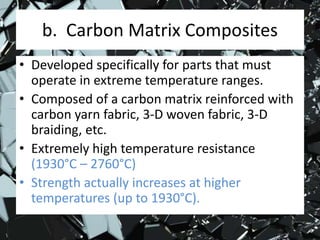
b. Carbon Matrix Composites
• Developed specifically for parts that must
operate in extreme temperature ranges.
• Composed of a carbon matrix reinforced with
carbon yarn fabric, 3-D woven fabric, 3-D
braiding, etc.
• Extremely high temperature resistance
(1930°C – 2760°C)
• Strength actually increases at higher
temperatures (up to 1930°C).
Carbon matrix composites
Metal Matrix Composites
Metallic Matrix Composites(MMC)
• MMCs are advanced class of structural
materials consisting of non-metallic
reinforcements incorporated into the metallic
matrix.
• MMCs are widely used in engineering
applications where the operating temperature
lies in between 250 ºC to 750 ºC.
• High strength, fracture toughness and
stiffness are offered by metal matrices than
other composites
• They can withstand elevated temperature in corrosive
environment than polymer composites
• Most metals and alloys could be used as matrices
• Require reinforcement materials which need to be
stable over a range of temperature and non-reactive
• Generating a wide interest in research fraternity, are
not as widely in use as their plastic counterparts
• Examples:
i. White cast iron
ii. Hardmetal (carbide in metal matrix)
iii. Metal-intermetallic laminate
• Matrix materials: Aluminium, Titanium,
Copper, Magnesium and Super alloys.
• Reinforcement materials: Silicon carbide,
Boron, Molybdenum and Alumina
Titanium, Aluminium and magnesium are the
popular matrix metals currently in vogue, which
are particularly useful for aircraft applications.
MMC Microstructures
(Mono filaments)
MMC Microstructures
(Whiskers/short fibers)
MMC Microstructures
(Particles)
MMC - disadvantages
• Metal matrices are poor in chemical and
mechanical compatibility with the
reinforcements.
• The chemical inertness of the reinforcement
(usually a fibre) at modest resin-fabrication
temperatures and large elastic compliance of the
matrix are the chemical and mechanical
incompatibility problems.
• Metal matrix composites are harder to fabricate
then the resin-matrix composites.
Ceramic Matrix Composites
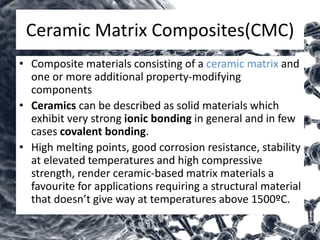
Ceramic Matrix Composites(CMC)
• Composite materials consisting of a ceramic matrix and
one or more additional property-modifying
components
• Ceramics can be described as solid materials which
exhibit very strong ionic bonding in general and in few
cases covalent bonding.
• High melting points, good corrosion resistance, stability
at elevated temperatures and high compressive
strength, render ceramic-based matrix materials a
favourite for applications requiring a structural material
that doesn’t give way at temperatures above 1500ºC.
Crystalline and non crystalline
ceramics
Ceramic Matrix Composites(CMC)
• Naturally, ceramic matrices are the obvious
choice for high temperature applications.
• CMCs are commonly reinforced with fiber which
adds mechanical strength to the ceramic matrix
• Reinforcing fibre composition (carbon, quartz,
alumina, etc.) can be selected and tuned based
on thermal and electrical needs
• Fibre architecture (chopped, woven, braided,
etc.) can be tailored to address specific
mechanical design criteria
Ceramic Matrix Composites(CMC)
• To further refine and enhance performance, particulate
fillers such as silicon carbide or zirconia can be added
to modify both surface and bulk properties.
• Family of materials that can successfully withstand
temperatures above that of the most advanced high
temperature polymers and metals, while at the same
time being resilient to the chipping and shattering
associated with common monolithic ceramics.
• Examples:
i. Bone (hydroxyapatite reinforced with collagen fibres)
ii. Cermet (ceramic and metal)
iii. Concrete …
Ceramic Matrix Composites(CMC)
Ceramic Matrix Composites
Disadvantages of CMC’s
The two main reasons for slow adoption of CMCs
into both military and industrial applications are
• High costs
• Long lead times associated with CMC production
and machining.
Expensive raw materials, manually intensive batch
processing and costly fiber interfacing techniques
are just a few of the reasons why CMCs are much
more expensive than their monolithic counterparts.
Comparison between different
composites
Advantages of composites
Composites can be very strong and stiff, yet very
light in weight, so ratios of strength-to-weight and
stiffness-to-weight are several times greater than
steel or aluminium.
• High specific strength and
• High specific stiffness
• Long fatigue life
• High creep resistance
Advantages of composites
• Low coefficient of thermal expansion
• Low density
• Low thermal conductivity
• Better wear resistance
• Improved corrosion resistance
• Better temperature dependent behaviour
Disadvantages of composites
• Anisotropic - this may be an advantage or a
disadvantage
• Polymer-based composites are subject to attack
by chemicals or solvents
• Expensive
• Manufacturing methods for shaping composite
materials are often slow and costly
• Compared to metals, composites have relatively
poor bearing strength.
Composite failure
• Shock, impact, or repeated cyclic
stresses can cause the laminate to
separate at the interface between
two layers, a condition known
as delamination.
• Individual fibres can separate from
the matrix e.g. fibre pull-out.
• Failure of a brittle ceramic matrix
composite occurred when the
carbon-carbon composite tile on
the leading edge of the wing of
the Space Shuttle
Columbia fractured when
impacted during take-off
Applications
In Aerospace:
• Carbon fiber is the most
widely used composite
fiber in aerospace
applications.
• Aramid fibers, on the
other hand, are widely
used for constructing
leading and trailing edge
wing components and
very stiff, very light
bulkhead, fuel tanks and
floor
Space shuttle
• Aluminium and Magnesium
metallic composites are used
for their light weight
• Thermal Protection
System(TPS)
• Reinforced carbon–
carbon (RCC), used in the
nose cap, the chin area
between the nose cap and
nose landing gear
doors( 1,260 °C (2,300 °F))
Automobile:
• Engines bodies,
• Piston,
• cylinder,
• connecting rod,
• crankshafts,
• bearing materials,
• brake discs etc..
Construction
• Concrete is the most common
artificial composite material of
all and typically consists of
loose stones (aggregate) held
with a matrix of cement.
Inexpensive material, not
compress or shatter even
under quite a large
compressive force
• Plywood-A laminar composite
• FRP-Fiber reinforced plastics
used in Bridge structures
Medical Application
• Orthopedic applications:
bone fixation plates, hip
joint replacement, bone
cement, and bone grafts
• External Prosthetics
• Composite materials are
used in clinical practice to
restore anterior and
posterior teeth.
• X ray tables, mammogram
sheets etc.…
Other applications
• Industry
• Marine
• Power transmission towers
• Military applications
• Sports equipments
• And many more….
THANK YOU

Composites

  • 1.
    Material Science Composites By YokeshD 3rd Yr. BE EEE SW PSG College of Technology Coimbatore – 641 004
  • 2.
  • 3.
  • 4.
    A Composite materialis a material made from two or more constituent materials with significantly different physical or chemical properties that, when combined, produce a material with characteristics different from the individual components (or) Artificially produced multiphase materials (or) Design materials with properties better than those of conventional materials
  • 5.
    In their broadestform, composites are materials consist of two or more constituents. The constituents are combined in such a way that they keep their individual physical phases and are not soluble in each other or not to form a new chemical compound.
  • 6.
    There are twomain categories of constituent materials: 1. Reinforcing phase(Fibres, sheets, or particles, embedded in the matrix) 2. Matrix phase(binder) The reinforcing material and the matrix material can be metal, ceramic, or polymer. Reinforcement Matrix Composites
  • 7.
    Matrix • Provides thebulk form of the part or product made of the composite material • Holds the imbedded phase in place, usually enclosing and often concealing it • When a load is applied, shares the load with the secondary phase • Determine inter-laminar shear strength, damage tolerance, in-plane shear strength, processing capacity , heat resistance of composites.
  • 8.
    Reinforcement The reinforcements impart theirspecial mechanical and physical properties to enhance the matrix properties. (A black carbon fiber used as reinforcement compared with human hair)
  • 10.
    Why Composites: • Thenew material may be preferred for many reasons:  stronger,  lighter,  less expensive when compared to traditional materials • The properties and performance of composites are far superior to those of the constituents
  • 11.
  • 12.
    Composites have playedan important role throughout human history • Plywood - 3400 BC by the Ancient Mesopotamians; gluing wood at different angles gives better properties than natural wood • Concrete was described by Vitruvius, writing around 25 BC in his Ten Books on Architecture • Cartonnage layers of linen or papyrus soaked in plaster dates to the First Intermediate Period of Egypt c. 2181–2055 BC and was used for death masks
  • 13.
    • Cob (material)Mud Bricks, or Mud Walls, (using mud (clay) with straw or gravel as a binder), used for thousands of years. • In the 12th century A.D., Mongol warriors used composite materials (bamboo, silk, cattle tendons and horns, and pine resin) to craft Archery bows that were swifter and more powerful than those of their rivals • Papier-mâché, a composite of paper and glue, has been used for hundreds of years • The first artificial fibre reinforced plastic was Bakelite which dates to 1907 Now a days composites are used mostly everywhere.
  • 14.
  • 15.
    Composite materials arecommonly classified at following two distinct levels: 1. The first level of classification: is usually made with respect to the matrix constituent 2. The second level of classification: made with respect to geometry of reinforcement
  • 16.
    I. Based onMatrices
  • 17.
    II. Based ongeometry of reinforcements 1.Fiber reinforced composites 2.Laminar composites 3.Particulate composites
  • 18.
    Let us seein brief about various types of reinforced composites
  • 19.
    1.Fiber reinforced composites Afibre-reinforced composite (FRC) is a composite building material that consists of three components: (i) the fibers as the discontinuous or dispersed phase, (ii) the matrix as the continuous phase, and (iii) the fine interphase region, also known as the interface.
  • 20.
  • 21.
    Microscopic view offiber reinforced composties Scanning electron micro-graphs of various fiber architectures. a) woven polyethylene fibers; b) braided glass fibers; c) woven (bidirectional) glass fibers; d) unidirectional glass fibers
  • 22.
    Laminar composites • acomposite laminates is an assembly of layers of fibrous composite materials which can be joined to provide required engineering pro perties, including in-plane stiffness, bending stiffness, strength, and coefficient of thermal expansion.
  • 24.
    Particulate composites • Theyare composed of particles distributed or embedded in a matrix body. • The particles may be flakes or in powder form. • Concrete and wood particle boards are examples of this category.
  • 25.
    • Now, letus see in detail about the classification of composites based on composite matrices
  • 26.
  • 27.
  • 28.
    Composites Organic Matrix Composites (OMC) Polymer Matrix Composites Thermoset Thermoplastic Rubber CarbonMatrix Composites Metal Matrix Composites (MMC) Ceramic Matrix Composites (CMC)
  • 29.
  • 30.
    Organic Matrix Composites(OMC) •In this the matrix material is an Organic compound • Eg: Asphalt concrete, Dental composite, Syntactic foam • The Matrix is made up of either a Polymer or Carbon or both. • Thus it is subdivided into two categories: a. Polymer matrix Composites and b. Carbon matrix composites
  • 31.
    a. Polymer MatrixComposites(PMC) • It consists of a Polymer (Resin) Matrix combined with the reinforcing dispersed phase. • Polymer Matrix Composites are very popular due to their low cost and simple fabrication methods • Thus, they are the most widely used composites than any other type.
  • 32.
    • There aretwo main types of PMC’s: i. Thermosets and ii. Thermoplastics
  • 33.
    i. Thermosets • Thermosetshave qualities such as a well-bonded three-dimensional molecular structure after curing. • Changing the basic composition of the resin is enough to alter the conditions suitably for curing and determine its other characteristics. • They can be retained in a partially cured condition too over prolonged periods of time, rendering Thermosets very flexible. • Thus, they are most suited as matrix bases for advanced conditions fibre reinforced composites
  • 35.
    Thermosets Thermosetting polymer Glass fibersin Thermosetting polymer matrix(TEM image)
  • 36.
    ii. Thermoplastics • Thermoplasticshave one- or two-dimensional molecular structure and they tend to at an elevated temperature and show exaggerated melting point. • Another advantage is that the process of softening at elevated temperatures can reversed to regain its properties during cooling, facilitating applications of conventional compress techniques to mould the compounds.
  • 38.
    SEM images ofThermoplastic polymer matrix microstructure
  • 39.
    • Resins reinforcedwith thermoplastics now comprised an emerging group of composites. • The theme of most experiments in this area to improve the base properties of the resins and extract the greatest functional advantages from them in new avenues, including attempts to replace metals in die-casting processes
  • 40.
    b. Carbon MatrixComposites • They are combination of carbon-fibre reinforcement in an all carbon matrix • Light weight and exceptional strength due to stiffness of carbon fibres • Their dimensional stability, laser hardness, and low outgassing also make them ideal candidates for various space structural applications. • Material of choice for severe-environment applications
  • 41.
    b. Carbon MatrixComposites • Developed specifically for parts that must operate in extreme temperature ranges. • Composed of a carbon matrix reinforced with carbon yarn fabric, 3-D woven fabric, 3-D braiding, etc. • Extremely high temperature resistance (1930°C – 2760°C) • Strength actually increases at higher temperatures (up to 1930°C).
  • 42.
  • 43.
  • 44.
    Metallic Matrix Composites(MMC) •MMCs are advanced class of structural materials consisting of non-metallic reinforcements incorporated into the metallic matrix. • MMCs are widely used in engineering applications where the operating temperature lies in between 250 ºC to 750 ºC. • High strength, fracture toughness and stiffness are offered by metal matrices than other composites
  • 45.
    • They canwithstand elevated temperature in corrosive environment than polymer composites • Most metals and alloys could be used as matrices • Require reinforcement materials which need to be stable over a range of temperature and non-reactive • Generating a wide interest in research fraternity, are not as widely in use as their plastic counterparts • Examples: i. White cast iron ii. Hardmetal (carbide in metal matrix) iii. Metal-intermetallic laminate
  • 46.
    • Matrix materials:Aluminium, Titanium, Copper, Magnesium and Super alloys. • Reinforcement materials: Silicon carbide, Boron, Molybdenum and Alumina Titanium, Aluminium and magnesium are the popular matrix metals currently in vogue, which are particularly useful for aircraft applications.
  • 48.
  • 49.
  • 50.
  • 51.
    MMC - disadvantages •Metal matrices are poor in chemical and mechanical compatibility with the reinforcements. • The chemical inertness of the reinforcement (usually a fibre) at modest resin-fabrication temperatures and large elastic compliance of the matrix are the chemical and mechanical incompatibility problems. • Metal matrix composites are harder to fabricate then the resin-matrix composites.
  • 52.
  • 53.
    Ceramic Matrix Composites(CMC) •Composite materials consisting of a ceramic matrix and one or more additional property-modifying components • Ceramics can be described as solid materials which exhibit very strong ionic bonding in general and in few cases covalent bonding. • High melting points, good corrosion resistance, stability at elevated temperatures and high compressive strength, render ceramic-based matrix materials a favourite for applications requiring a structural material that doesn’t give way at temperatures above 1500ºC.
  • 54.
    Crystalline and noncrystalline ceramics
  • 55.
    Ceramic Matrix Composites(CMC) •Naturally, ceramic matrices are the obvious choice for high temperature applications. • CMCs are commonly reinforced with fiber which adds mechanical strength to the ceramic matrix • Reinforcing fibre composition (carbon, quartz, alumina, etc.) can be selected and tuned based on thermal and electrical needs • Fibre architecture (chopped, woven, braided, etc.) can be tailored to address specific mechanical design criteria
  • 56.
    Ceramic Matrix Composites(CMC) •To further refine and enhance performance, particulate fillers such as silicon carbide or zirconia can be added to modify both surface and bulk properties. • Family of materials that can successfully withstand temperatures above that of the most advanced high temperature polymers and metals, while at the same time being resilient to the chipping and shattering associated with common monolithic ceramics. • Examples: i. Bone (hydroxyapatite reinforced with collagen fibres) ii. Cermet (ceramic and metal) iii. Concrete …
  • 57.
  • 58.
  • 59.
  • 60.
  • 61.
    Disadvantages of CMC’s Thetwo main reasons for slow adoption of CMCs into both military and industrial applications are • High costs • Long lead times associated with CMC production and machining. Expensive raw materials, manually intensive batch processing and costly fiber interfacing techniques are just a few of the reasons why CMCs are much more expensive than their monolithic counterparts.
  • 62.
  • 63.
    Advantages of composites Compositescan be very strong and stiff, yet very light in weight, so ratios of strength-to-weight and stiffness-to-weight are several times greater than steel or aluminium. • High specific strength and • High specific stiffness • Long fatigue life • High creep resistance
  • 64.
    Advantages of composites •Low coefficient of thermal expansion • Low density • Low thermal conductivity • Better wear resistance • Improved corrosion resistance • Better temperature dependent behaviour
  • 65.
    Disadvantages of composites •Anisotropic - this may be an advantage or a disadvantage • Polymer-based composites are subject to attack by chemicals or solvents • Expensive • Manufacturing methods for shaping composite materials are often slow and costly • Compared to metals, composites have relatively poor bearing strength.
  • 66.
    Composite failure • Shock,impact, or repeated cyclic stresses can cause the laminate to separate at the interface between two layers, a condition known as delamination. • Individual fibres can separate from the matrix e.g. fibre pull-out. • Failure of a brittle ceramic matrix composite occurred when the carbon-carbon composite tile on the leading edge of the wing of the Space Shuttle Columbia fractured when impacted during take-off
  • 67.
    Applications In Aerospace: • Carbonfiber is the most widely used composite fiber in aerospace applications. • Aramid fibers, on the other hand, are widely used for constructing leading and trailing edge wing components and very stiff, very light bulkhead, fuel tanks and floor
  • 68.
    Space shuttle • Aluminiumand Magnesium metallic composites are used for their light weight • Thermal Protection System(TPS) • Reinforced carbon– carbon (RCC), used in the nose cap, the chin area between the nose cap and nose landing gear doors( 1,260 °C (2,300 °F))
  • 70.
    Automobile: • Engines bodies, •Piston, • cylinder, • connecting rod, • crankshafts, • bearing materials, • brake discs etc..
  • 71.
    Construction • Concrete isthe most common artificial composite material of all and typically consists of loose stones (aggregate) held with a matrix of cement. Inexpensive material, not compress or shatter even under quite a large compressive force • Plywood-A laminar composite • FRP-Fiber reinforced plastics used in Bridge structures
  • 72.
    Medical Application • Orthopedicapplications: bone fixation plates, hip joint replacement, bone cement, and bone grafts • External Prosthetics • Composite materials are used in clinical practice to restore anterior and posterior teeth. • X ray tables, mammogram sheets etc.…
  • 73.
    Other applications • Industry •Marine • Power transmission towers • Military applications • Sports equipments • And many more….
  • 74.