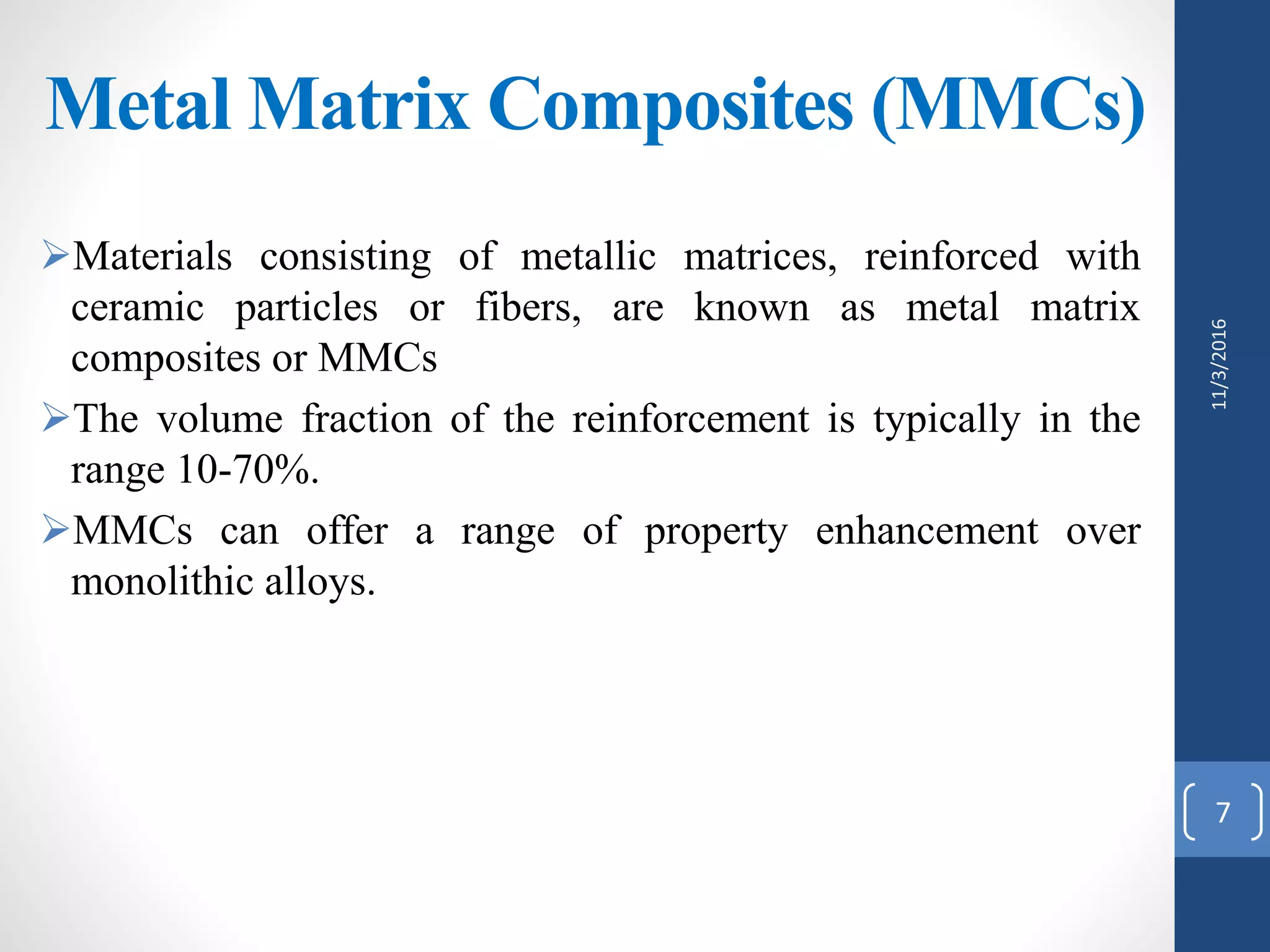
METALMATRIXCOMPOSITES
Presented by: Trinh Van Ba
Nguyen Ngoc Linh
Hanoi University of Science and Technology
Powder Metallurgy Lab
CONTENTS.
INTRODUCTION
 Composite
 Classification of Composites
 Metal Matrix Composites (MMC)
INTERFACES COMPOSITEs
 Mechanical bonding
 Electrostatic bonding
 Chemical bonding
 Reaction or interdiffusion bonding
PROCESSING OF METAL MATRIX COMPOSITES
 Powder metallugry 2
11/3/2016
INTRODUCTION
Composites are composed of two or more different materials
to obtain a combination of properties not available in either
of the materials.
Usually one material forms a continuous matrix while the
other provides the reinforcement.
The two materials must be chemically inert with respect to
each other so no interaction occurs on heating until one of
the components melts.
An exception to this condition is a small degree of
interdiffusion at the reinforcement-matrix interface to
increase bonding.
3
11/3/2016
CLASSIFICATION
Composites
Metal Matrix
Composites
Ceramic
Matrix
Composites
Polymer
Matrix
Composites
4
11/3/2016
Functions of the Matrix Material
Provides the bulk form of the part or product made of
the composite material
Holds the imbedded phase in place, usually enclosing
and often concealing it
When a load is applied, the matrix shares the load with
the secondary phase, in some cases deforming so that
the stress is essentially born by the reinforcing agent
5
11/3/2016
Functions of the Reinforcing Phase
Function is to reinforce the primary phase
Imbedded phase is most commonly one of the following
shapes:
 Fibers
 Particles
 Flakes
In addition, the secondary phase can take the form of an
infiltrated phase in a skeletal or porous matrix – Example:
a powder metallurgy part infiltrated with polymer
6
11/3/2016
Metal Matrix Composites (MMCs)
Materials consisting of metallic matrices, reinforced with
ceramic particles or fibers, are known as metal matrix
composites or MMCs
The volume fraction of the reinforcement is typically in the
range 10-70%.
MMCs can offer a range of property enhancement over
monolithic alloys.
7
11/3/2016
Metal Matrix Composites (MMCs)
A metal matrix reinforced by a second phase
Reinforcing phases:
 Particles of ceramic (these MMCs are commonly called
cermets)
 Fibers of various materials: other metals, ceramics, carbon,
and boron
8
11/3/2016
Metal Matrix Composites (MMCs)
Metal matrix composite materials have found application in
many areas of daily life for quite some time.
Materials like cast iron with graphite or steel with a high
carbide content, as well as tungsten carbides, consisting of
carbides and metallic binders, also belong to this group of
composite materials.
Metal matrix composites become interesting for use as
constructional and functional materials, if the property profile
of conventional materials either does not reach the increased
standards of specific demands, or is the solution of the
problem.
9
11/3/2016
Metal Matrix Composites (MMCs)
The reinforcement of metals can have many different objectives;
 Increase in yield strength and tensile strength at room
temperature and above while maintaining the minimum ductility
or rather toughness,
 Increase in creep resistance at higher temperatures compared to
that of conventional alloys,
 Increase in fatigue strength, especially at higher temperatures,
 Improvement of thermal shock resistance,
 Improvement of corrosion resistance
 Increase in Young’s modulus,
 Reduction of thermal elongation.
10
11/3/2016
Advantages
Light Weight
Performance at higher temperatures
High Strength
Low Density, Better wear resistance
11
11/3/2016
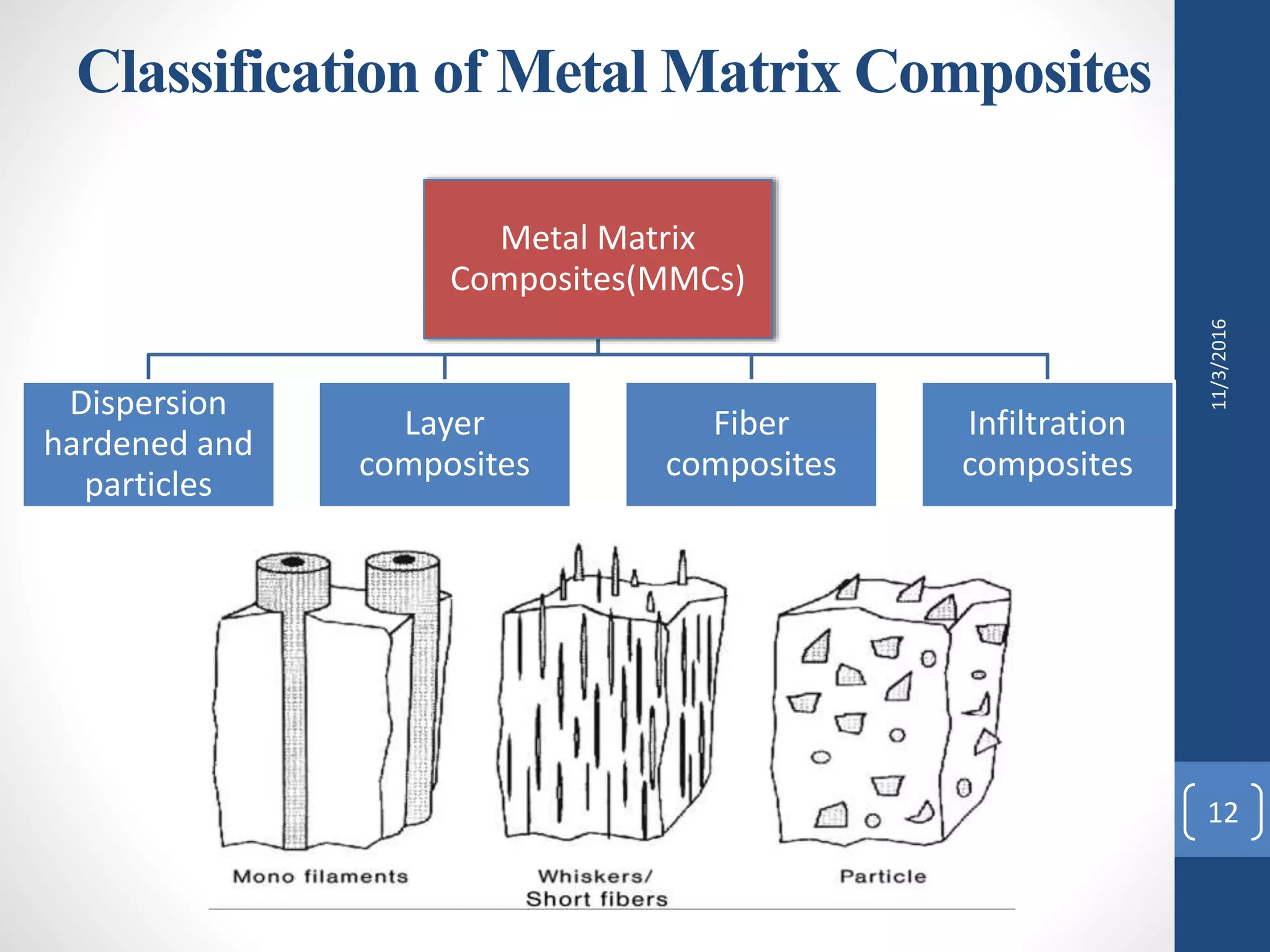
Classification of Metal Matrix Composites
Metal Matrix
Composites(MMCs)
Dispersion
hardened and
particles
Layer
composites
Fiber
composites
Infiltration
composites
12
11/3/2016
Reinforcements for Metal Matrix
Composites
These demands can be achieved only by using non-metal
inorganic reinforcement components. For metal reinforcement
ceramic particles or, rather, fibers or carbon fibers are often used.
13
11/3/2016
Interfaces (Bonding)
There is always an interface between constituent phases in a
composite material †
For the composite to operate effectively, the phases must bond
where they join at the interface
14
11/3/2016
 Interfaces between phases in a composite material: (a) direct
bonding between primary and secondary phases; (b) addition of a
third ingredient to bond the primary phases and form an interphase.
Interfaces (Bonding)
Interphase consisting of a solution of primary and secondary
phases
Interfaces and interphases between phases in a composite
material: (c) formation of an interphase by solution of the
primary and secondary phases at their boundary.
11/3/2016
15
Interfaces (Bonding)
11/3/2016
16
Why are Reinforcement matrix interfaces important?

Such large differences are shared through the interface.
Stresses acting on the matrix are transmitted to the fiber across the
interface.
 The interfacial bond can influence
• Composite strength
• Modes of failure
• Young’s modulus
• Interlaminar shear strength
• Compressive strength
• Environmental resistance
• Structural stability at elevate temperatures
• Fracture and fatigue behavior
Interfaces (Bonding)
11/3/2016
17
Wettability
 Is defined the extent where a liquid will spread over a solid
surface
 During the manufacturing process, the matrix is often in the
condition where it is capable of flowing or its behavior is like a
liquid
 Good wettability means that the liquid (matrix) will flow over
the reinforcement, covering every ‘bump’ and ‘dip’ of the rough
surface of reinforcement and displacing all air.
 Wetting will only occur if the viscosity of the matrix is not too
high.
 Interfacial bonding exists due to the adhesion between the
reinforcement and the matrix (wetting is good)
Interfaces (Bonding)
11/3/2016
18
 All surfaces have an associated energy and the free energy per
unit area of the solid-gas, liquid-gas and solid-liquid are γSG,
γLG and γSL,
 θ is called the contact angle. May be used as a measure of the
degree of the wettability
Interfaces (Bonding)
11/3/2016
19
 Types of interfacial bonding at interface
 Mechanical bonding
 Electrostatic bonding
 Chemical bonding
 Reaction or inter-diffusion bonding
Interfaces (Bonding)
Depending on degree of roughness of fiber surface †
Larger surface area may also increase strength of chemical
bond.
11/3/2016
20
Mechanical bonding
The bond formed between chemical groups on the reinforcement
surfaces and compatible groups in the matrix
Strength of chemical bonding depends on the number of bonds per
unit area and the type of bond
11/3/2016
21
Interfaces (Bonding)
Chemical bonding
Diffusion and entanglement of molecules
11/3/2016
22
Interfaces (Bonding)
Reaction or interdiffusion bonding
Occur when one surface is positively charged and the other is
negatively charge (refer to the figure)
Interactions are short range and only effective over small
distances of the order of atomic dimensions
Surface contamination and entrapped gases will decrease the
effectiveness of this bonding
11/3/2016
23
• Electrostatic bonding
Interfaces (Bonding)
Processing of Metal Matrix
Composites
Metal matrix composites materials can be produced by
many different techniques.
The focus of the selection of suitable process engineering
is the desired kind, quantity and distribution of the
reinforcement components (particles and fibers), the matrix
alloy and the application.
By altering the manufacturing method, the processing and
the finishing, as well as by the form of the reinforcement
components it is possible to obtain different characteristic
profiles, although the same composition and amounts of
the components are involved.
11/3/2016
24
Method
Processing
Liquid-State
Casting or liquid
infiltration
Squeeze casting
or pressure
infiltration
In Situ
Processes
Solid-State
Diffusion
Bonding
Deformation
Powder
Processing
Sinter-Forging
Deposition
Techniques
11/3/2016
25
Solid-State Processes
Powder Processing
• Powder metallurgy: Science of producing metal powders
and making finished /semifinished objects from mixed or
alloyed powders with or without the addition of nonmetallic
constituents
• Steps in powder metallurgy : Powder production,
Compaction, Sintering, Secondary operations
11/3/2016
26
11/3/2016
27
Elemental or Alloy
metal powders
Additives
(lubricants or binders)
Blending and
Mixing
Compacting
Sintering
Optional Secondary
Finishing
Optional Secondary
Manufacturing
Finished Powder
Metallurgy Product
Production of powders
11/3/2016
28
Powder
production
method
Physical
methods
Chemical
methods
Mechanical
methods
Production of powders
• Cheapest of the powder production methods.
• These methods involve using mechanical forces such as
compressive forces, shear or impact to facilitate particle size
reduction of bulk materials. Ex: Milling
• Milling: During milling, impact, attrition, shear and
compression forces are acted upon particles
• Impact : Striking of one powder particle against another
occurs.
• Attrition : The production of wear debris due to the rubbing
action between two particles.
• Shear: Cutting of particles resulting in fracture.
• Compression :The particles are broken into fine particles by
squeezing action in compression
11/3/2016
29
Mechanical methods
Production of powders
• Main objective of milling: Particle size reduction (main
purpose), Particle size growth, shape change, agglomeration
(joining of particles together), solid state alloying,
mechanical or solid state mixing, modification of material
properties.
• Mechanism of milling: Changes in the morphology of
powder particles during milling results in the following
events.
• Micro forging
• Fracture
• Agglomeration
• Deagglomeration
11/3/2016
30
Production of powders
• Micro forging: Individual particles or group of particles are
impacted repeatedly so that they flatten with very less change
in mass
• Fracture : Individual particles deform and cracks initiate and
propagate resulting in fracture
• Agglomeration : Mechanical interlocking due to atomic
bonding or vande Waals forces
• Deagglomeration : Breaking of agglomerates
• The different powder characteristics influenced by milling are
shape, size, texture, particle size distribution, crystalline size,
chemical composition, hardness, density, flowability,
compressibility, sinterability, sintered density
11/3/2016
31
Production of powders
11/3/2016
32
The particle are work hardened, the fracture mechanism are
predominate the cold weld, thus particles size decreased
the particles weld together due to the impacts of grinding balls to
form larger particle
The start power are soft, easy flattened as flake
11/3/2016
33
Blending and Mixing
• Blending : mixing powder of the same chemical
composition but different sizes.
• Mixing : combining powders of different chemistries.
• Blending and mixing are accomplished by mechanical
means:
Blending and Mixing
• Except for powders, some other ingredients are usually
added:
Lubricants: to reduce the particles-die friction
Binders: to achieve enough strength before sintering
Deflocculants : to improve the flow characteristics
during feeding
11/3/2016
34
Compaction
• Blended powers are pressed in dies under high pressure to form
them into the required shape. The work part after compaction is
called a green compact or simply a green.
11/3/2016
35
Compaction
• As a result of compaction, the density of the part, called the
green density is much greater than the starting material density,
but is not uniform in the green. The density and therefore
mechanical properties vary across the part volume and depend on
pressure in compaction.
11/3/2016
36
Sintering
• Compressed metal powder is heated in a controlled-
atmosphere furnace to a temperature below its melting
point, but high enough to allow bounding of the particles:
• Purpose : to increase strength & hardness of a green
compact
• Principal variables : temperature ( generally within 70 –
90% of the melting point of metal or alloy), time (10 min.
– 8 hours) & furnace atmosphere
• Sintering process is concerned with
• diffusion (surface of particles as temperature rises)
• densification (decreases porosity, increases particle contact area)
• recrystallization & grain growth (between particles at the contact
area)
11/3/2016
37
Sintering
• The primary driving force for sintering is not the fusion
of material, but formation and growth of bonds between
the particles, as illustrated in a series of sketches showing
on a microscopic scale the changes that occur during
sintering of metallic powders.
11/3/2016
38
Sintering
11/3/2016
39
FINISHING / SECONDARYOPERATIONS
1.Sizing : cold pressing to improve dimensional accuracy
2.Coining or pressing :
• cold working process, to press details into surface
• condensation of sintered product
3.Impregnation:
• impregnation with heated oil (self lubricated bearings)
• oil fills the pores of the part
4.Infiltration:
• placement of slug of a lower melting point metal against the
sintered part
• infiltration of molten metal by capillary action
• pores are filled with a molten metal
5.Heat treatment , Plating, Painting
11/3/2016
40
Advantages
• Elimination/reduction of machining
• High production rates
• Complex shapes can be produced
• Wide composition variations are possible
• Wide property variations are possible
• Scrap is eliminated or reduced
11/3/2016
41
Disadvantages
• High cost of powder material & tooling
• Less strong parts than wrought ones
• Less well known process
11/3/2016
42
References
• http://www.iitg.ernet.in/engfac/ganu/public_html/Powderme
tallurgy.pdf
• http://www.oidb.mu.edu.tr/Icerik/metalurji.mu.edu.tr/Sayfa/
Metal_Matrix_Composites_1.pdf
• http://uotechnology.edu.iq/appsciences/material/Lacture_ma
terial/four_class/composite%20material/part%204.pdf
• http://wwwold.me.gatech.edu/jonathan.colton/me4210/pow
der.pdf
11/3/2016
43
11/3/2016
44
Thank You For Listening
and Any Question ?

Metal matrix composites

  • 1.
    METALMATRIXCOMPOSITES Presented by: TrinhVan Ba Nguyen Ngoc Linh Hanoi University of Science and Technology Powder Metallurgy Lab
  • 2.
    CONTENTS. INTRODUCTION  Composite  Classificationof Composites  Metal Matrix Composites (MMC) INTERFACES COMPOSITEs  Mechanical bonding  Electrostatic bonding  Chemical bonding  Reaction or interdiffusion bonding PROCESSING OF METAL MATRIX COMPOSITES  Powder metallugry 2 11/3/2016
  • 3.
    INTRODUCTION Composites are composedof two or more different materials to obtain a combination of properties not available in either of the materials. Usually one material forms a continuous matrix while the other provides the reinforcement. The two materials must be chemically inert with respect to each other so no interaction occurs on heating until one of the components melts. An exception to this condition is a small degree of interdiffusion at the reinforcement-matrix interface to increase bonding. 3 11/3/2016
  • 4.
  • 5.
    Functions of theMatrix Material Provides the bulk form of the part or product made of the composite material Holds the imbedded phase in place, usually enclosing and often concealing it When a load is applied, the matrix shares the load with the secondary phase, in some cases deforming so that the stress is essentially born by the reinforcing agent 5 11/3/2016
  • 6.
    Functions of theReinforcing Phase Function is to reinforce the primary phase Imbedded phase is most commonly one of the following shapes:  Fibers  Particles  Flakes In addition, the secondary phase can take the form of an infiltrated phase in a skeletal or porous matrix – Example: a powder metallurgy part infiltrated with polymer 6 11/3/2016
  • 7.
    Metal Matrix Composites(MMCs) Materials consisting of metallic matrices, reinforced with ceramic particles or fibers, are known as metal matrix composites or MMCs The volume fraction of the reinforcement is typically in the range 10-70%. MMCs can offer a range of property enhancement over monolithic alloys. 7 11/3/2016
  • 8.
    Metal Matrix Composites(MMCs) A metal matrix reinforced by a second phase Reinforcing phases:  Particles of ceramic (these MMCs are commonly called cermets)  Fibers of various materials: other metals, ceramics, carbon, and boron 8 11/3/2016
  • 9.
    Metal Matrix Composites(MMCs) Metal matrix composite materials have found application in many areas of daily life for quite some time. Materials like cast iron with graphite or steel with a high carbide content, as well as tungsten carbides, consisting of carbides and metallic binders, also belong to this group of composite materials. Metal matrix composites become interesting for use as constructional and functional materials, if the property profile of conventional materials either does not reach the increased standards of specific demands, or is the solution of the problem. 9 11/3/2016
  • 10.
    Metal Matrix Composites(MMCs) The reinforcement of metals can have many different objectives;  Increase in yield strength and tensile strength at room temperature and above while maintaining the minimum ductility or rather toughness,  Increase in creep resistance at higher temperatures compared to that of conventional alloys,  Increase in fatigue strength, especially at higher temperatures,  Improvement of thermal shock resistance,  Improvement of corrosion resistance  Increase in Young’s modulus,  Reduction of thermal elongation. 10 11/3/2016
  • 11.
    Advantages Light Weight Performance athigher temperatures High Strength Low Density, Better wear resistance 11 11/3/2016
  • 12.
    Classification of MetalMatrix Composites Metal Matrix Composites(MMCs) Dispersion hardened and particles Layer composites Fiber composites Infiltration composites 12 11/3/2016
  • 13.
    Reinforcements for MetalMatrix Composites These demands can be achieved only by using non-metal inorganic reinforcement components. For metal reinforcement ceramic particles or, rather, fibers or carbon fibers are often used. 13 11/3/2016
  • 14.
    Interfaces (Bonding) There isalways an interface between constituent phases in a composite material † For the composite to operate effectively, the phases must bond where they join at the interface 14 11/3/2016  Interfaces between phases in a composite material: (a) direct bonding between primary and secondary phases; (b) addition of a third ingredient to bond the primary phases and form an interphase.
  • 15.
    Interfaces (Bonding) Interphase consistingof a solution of primary and secondary phases Interfaces and interphases between phases in a composite material: (c) formation of an interphase by solution of the primary and secondary phases at their boundary. 11/3/2016 15
  • 16.
    Interfaces (Bonding) 11/3/2016 16 Why areReinforcement matrix interfaces important?  Such large differences are shared through the interface. Stresses acting on the matrix are transmitted to the fiber across the interface.  The interfacial bond can influence • Composite strength • Modes of failure • Young’s modulus • Interlaminar shear strength • Compressive strength • Environmental resistance • Structural stability at elevate temperatures • Fracture and fatigue behavior
  • 17.
    Interfaces (Bonding) 11/3/2016 17 Wettability  Isdefined the extent where a liquid will spread over a solid surface  During the manufacturing process, the matrix is often in the condition where it is capable of flowing or its behavior is like a liquid  Good wettability means that the liquid (matrix) will flow over the reinforcement, covering every ‘bump’ and ‘dip’ of the rough surface of reinforcement and displacing all air.  Wetting will only occur if the viscosity of the matrix is not too high.  Interfacial bonding exists due to the adhesion between the reinforcement and the matrix (wetting is good)
  • 18.
    Interfaces (Bonding) 11/3/2016 18  Allsurfaces have an associated energy and the free energy per unit area of the solid-gas, liquid-gas and solid-liquid are γSG, γLG and γSL,  θ is called the contact angle. May be used as a measure of the degree of the wettability
  • 19.
    Interfaces (Bonding) 11/3/2016 19  Typesof interfacial bonding at interface  Mechanical bonding  Electrostatic bonding  Chemical bonding  Reaction or inter-diffusion bonding
  • 20.
    Interfaces (Bonding) Depending ondegree of roughness of fiber surface † Larger surface area may also increase strength of chemical bond. 11/3/2016 20 Mechanical bonding
  • 21.
    The bond formedbetween chemical groups on the reinforcement surfaces and compatible groups in the matrix Strength of chemical bonding depends on the number of bonds per unit area and the type of bond 11/3/2016 21 Interfaces (Bonding) Chemical bonding
  • 22.
    Diffusion and entanglementof molecules 11/3/2016 22 Interfaces (Bonding) Reaction or interdiffusion bonding
  • 23.
    Occur when onesurface is positively charged and the other is negatively charge (refer to the figure) Interactions are short range and only effective over small distances of the order of atomic dimensions Surface contamination and entrapped gases will decrease the effectiveness of this bonding 11/3/2016 23 • Electrostatic bonding Interfaces (Bonding)
  • 24.
    Processing of MetalMatrix Composites Metal matrix composites materials can be produced by many different techniques. The focus of the selection of suitable process engineering is the desired kind, quantity and distribution of the reinforcement components (particles and fibers), the matrix alloy and the application. By altering the manufacturing method, the processing and the finishing, as well as by the form of the reinforcement components it is possible to obtain different characteristic profiles, although the same composition and amounts of the components are involved. 11/3/2016 24
  • 25.
    Method Processing Liquid-State Casting or liquid infiltration Squeezecasting or pressure infiltration In Situ Processes Solid-State Diffusion Bonding Deformation Powder Processing Sinter-Forging Deposition Techniques 11/3/2016 25
  • 26.
    Solid-State Processes Powder Processing •Powder metallurgy: Science of producing metal powders and making finished /semifinished objects from mixed or alloyed powders with or without the addition of nonmetallic constituents • Steps in powder metallurgy : Powder production, Compaction, Sintering, Secondary operations 11/3/2016 26
  • 27.
    11/3/2016 27 Elemental or Alloy metalpowders Additives (lubricants or binders) Blending and Mixing Compacting Sintering Optional Secondary Finishing Optional Secondary Manufacturing Finished Powder Metallurgy Product
  • 28.
  • 29.
    Production of powders •Cheapest of the powder production methods. • These methods involve using mechanical forces such as compressive forces, shear or impact to facilitate particle size reduction of bulk materials. Ex: Milling • Milling: During milling, impact, attrition, shear and compression forces are acted upon particles • Impact : Striking of one powder particle against another occurs. • Attrition : The production of wear debris due to the rubbing action between two particles. • Shear: Cutting of particles resulting in fracture. • Compression :The particles are broken into fine particles by squeezing action in compression 11/3/2016 29 Mechanical methods
  • 30.
    Production of powders •Main objective of milling: Particle size reduction (main purpose), Particle size growth, shape change, agglomeration (joining of particles together), solid state alloying, mechanical or solid state mixing, modification of material properties. • Mechanism of milling: Changes in the morphology of powder particles during milling results in the following events. • Micro forging • Fracture • Agglomeration • Deagglomeration 11/3/2016 30
  • 31.
    Production of powders •Micro forging: Individual particles or group of particles are impacted repeatedly so that they flatten with very less change in mass • Fracture : Individual particles deform and cracks initiate and propagate resulting in fracture • Agglomeration : Mechanical interlocking due to atomic bonding or vande Waals forces • Deagglomeration : Breaking of agglomerates • The different powder characteristics influenced by milling are shape, size, texture, particle size distribution, crystalline size, chemical composition, hardness, density, flowability, compressibility, sinterability, sintered density 11/3/2016 31
  • 32.
    Production of powders 11/3/2016 32 Theparticle are work hardened, the fracture mechanism are predominate the cold weld, thus particles size decreased the particles weld together due to the impacts of grinding balls to form larger particle The start power are soft, easy flattened as flake
  • 33.
    11/3/2016 33 Blending and Mixing •Blending : mixing powder of the same chemical composition but different sizes. • Mixing : combining powders of different chemistries. • Blending and mixing are accomplished by mechanical means:
  • 34.
    Blending and Mixing •Except for powders, some other ingredients are usually added: Lubricants: to reduce the particles-die friction Binders: to achieve enough strength before sintering Deflocculants : to improve the flow characteristics during feeding 11/3/2016 34
  • 35.
    Compaction • Blended powersare pressed in dies under high pressure to form them into the required shape. The work part after compaction is called a green compact or simply a green. 11/3/2016 35
  • 36.
    Compaction • As aresult of compaction, the density of the part, called the green density is much greater than the starting material density, but is not uniform in the green. The density and therefore mechanical properties vary across the part volume and depend on pressure in compaction. 11/3/2016 36
  • 37.
    Sintering • Compressed metalpowder is heated in a controlled- atmosphere furnace to a temperature below its melting point, but high enough to allow bounding of the particles: • Purpose : to increase strength & hardness of a green compact • Principal variables : temperature ( generally within 70 – 90% of the melting point of metal or alloy), time (10 min. – 8 hours) & furnace atmosphere • Sintering process is concerned with • diffusion (surface of particles as temperature rises) • densification (decreases porosity, increases particle contact area) • recrystallization & grain growth (between particles at the contact area) 11/3/2016 37
  • 38.
    Sintering • The primarydriving force for sintering is not the fusion of material, but formation and growth of bonds between the particles, as illustrated in a series of sketches showing on a microscopic scale the changes that occur during sintering of metallic powders. 11/3/2016 38
  • 39.
  • 40.
    FINISHING / SECONDARYOPERATIONS 1.Sizing: cold pressing to improve dimensional accuracy 2.Coining or pressing : • cold working process, to press details into surface • condensation of sintered product 3.Impregnation: • impregnation with heated oil (self lubricated bearings) • oil fills the pores of the part 4.Infiltration: • placement of slug of a lower melting point metal against the sintered part • infiltration of molten metal by capillary action • pores are filled with a molten metal 5.Heat treatment , Plating, Painting 11/3/2016 40
  • 41.
    Advantages • Elimination/reduction ofmachining • High production rates • Complex shapes can be produced • Wide composition variations are possible • Wide property variations are possible • Scrap is eliminated or reduced 11/3/2016 41
  • 42.
    Disadvantages • High costof powder material & tooling • Less strong parts than wrought ones • Less well known process 11/3/2016 42
  • 43.
    References • http://www.iitg.ernet.in/engfac/ganu/public_html/Powderme tallurgy.pdf • http://www.oidb.mu.edu.tr/Icerik/metalurji.mu.edu.tr/Sayfa/ Metal_Matrix_Composites_1.pdf •http://uotechnology.edu.iq/appsciences/material/Lacture_ma terial/four_class/composite%20material/part%204.pdf • http://wwwold.me.gatech.edu/jonathan.colton/me4210/pow der.pdf 11/3/2016 43
  • 44.
    11/3/2016 44 Thank You ForListening and Any Question ?