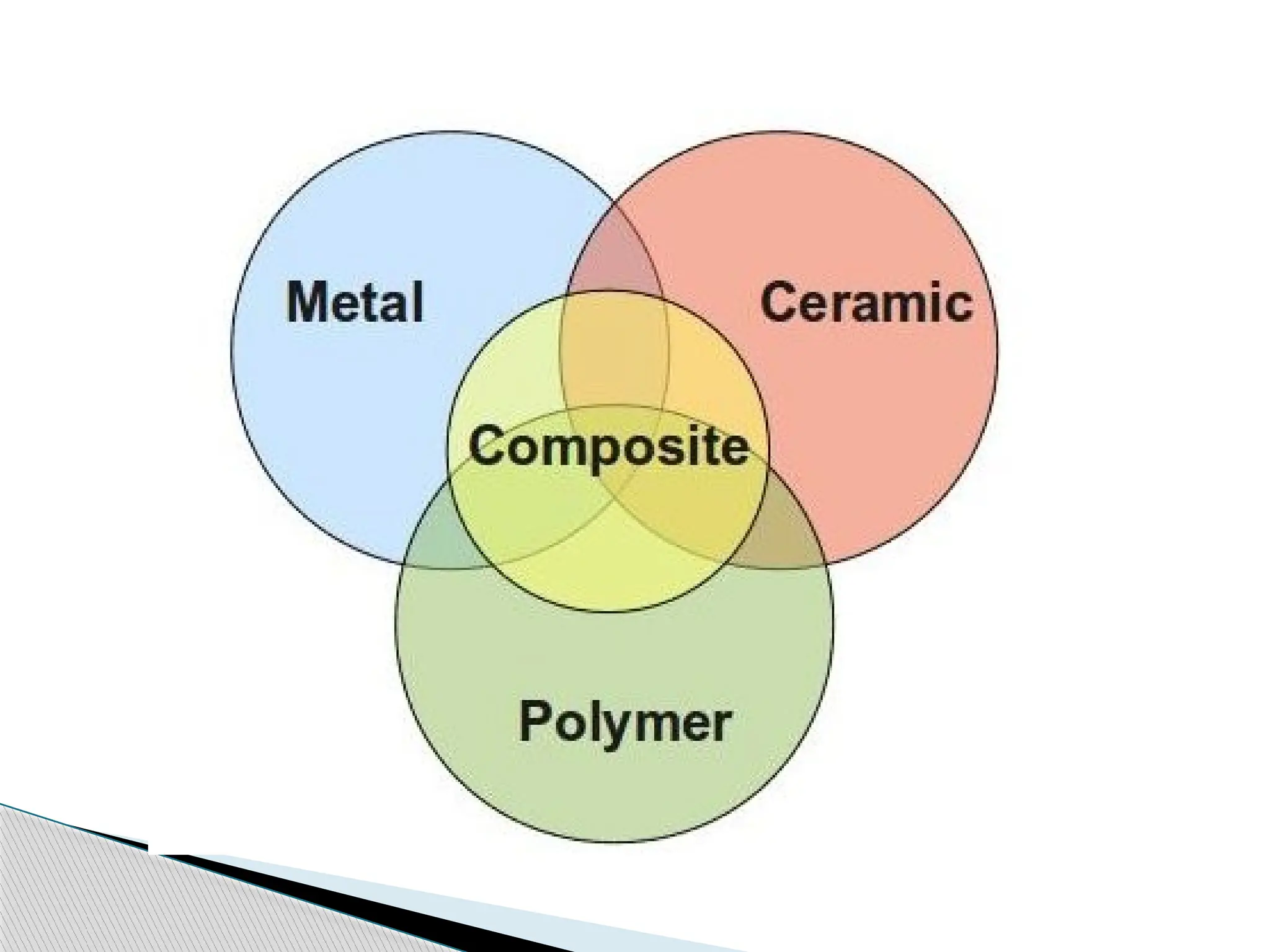
A Compositematerial is a material system composed of two
or more macro constituents that differ in shape and chemical
composition and which are insoluble in each other.
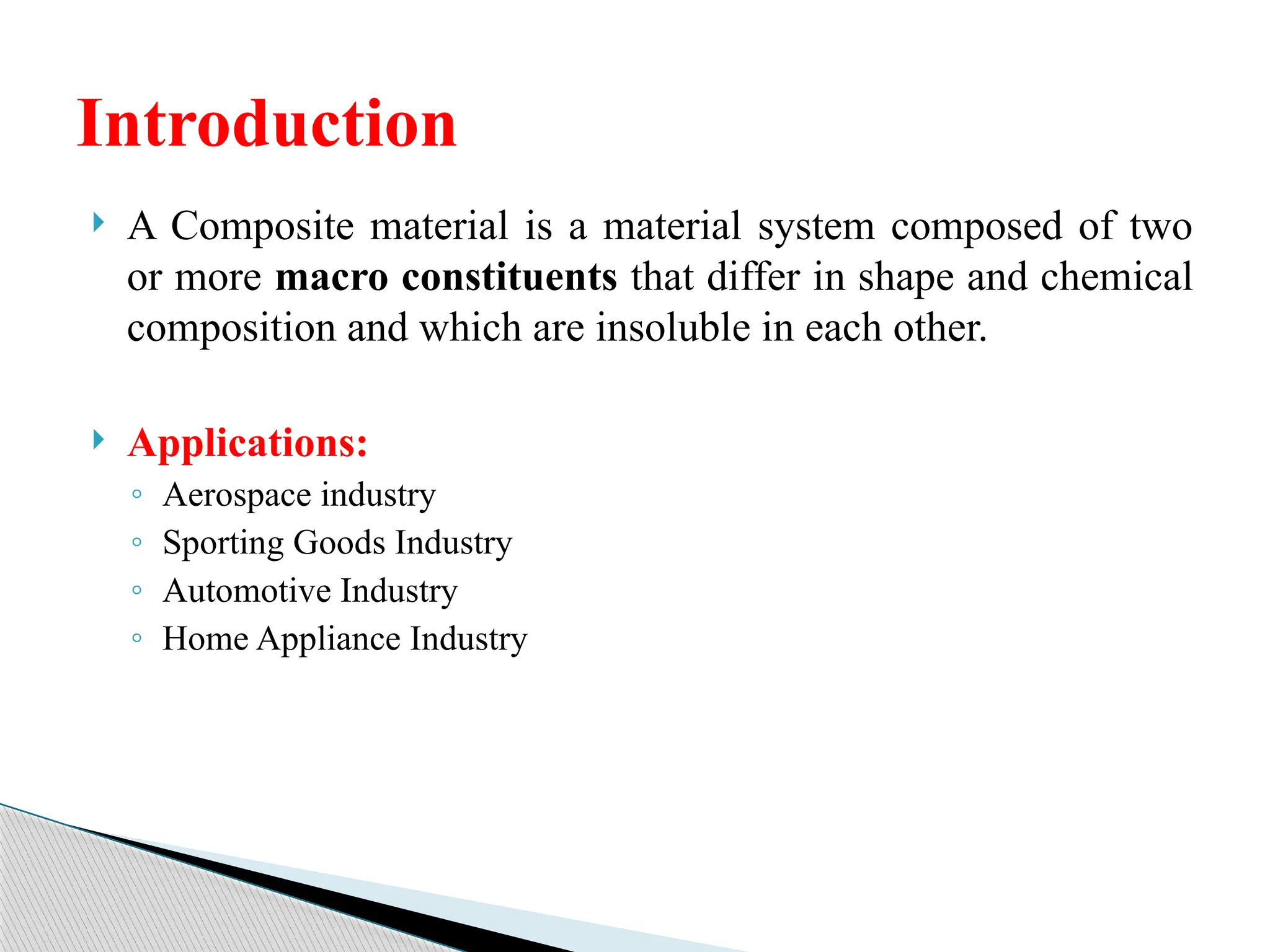
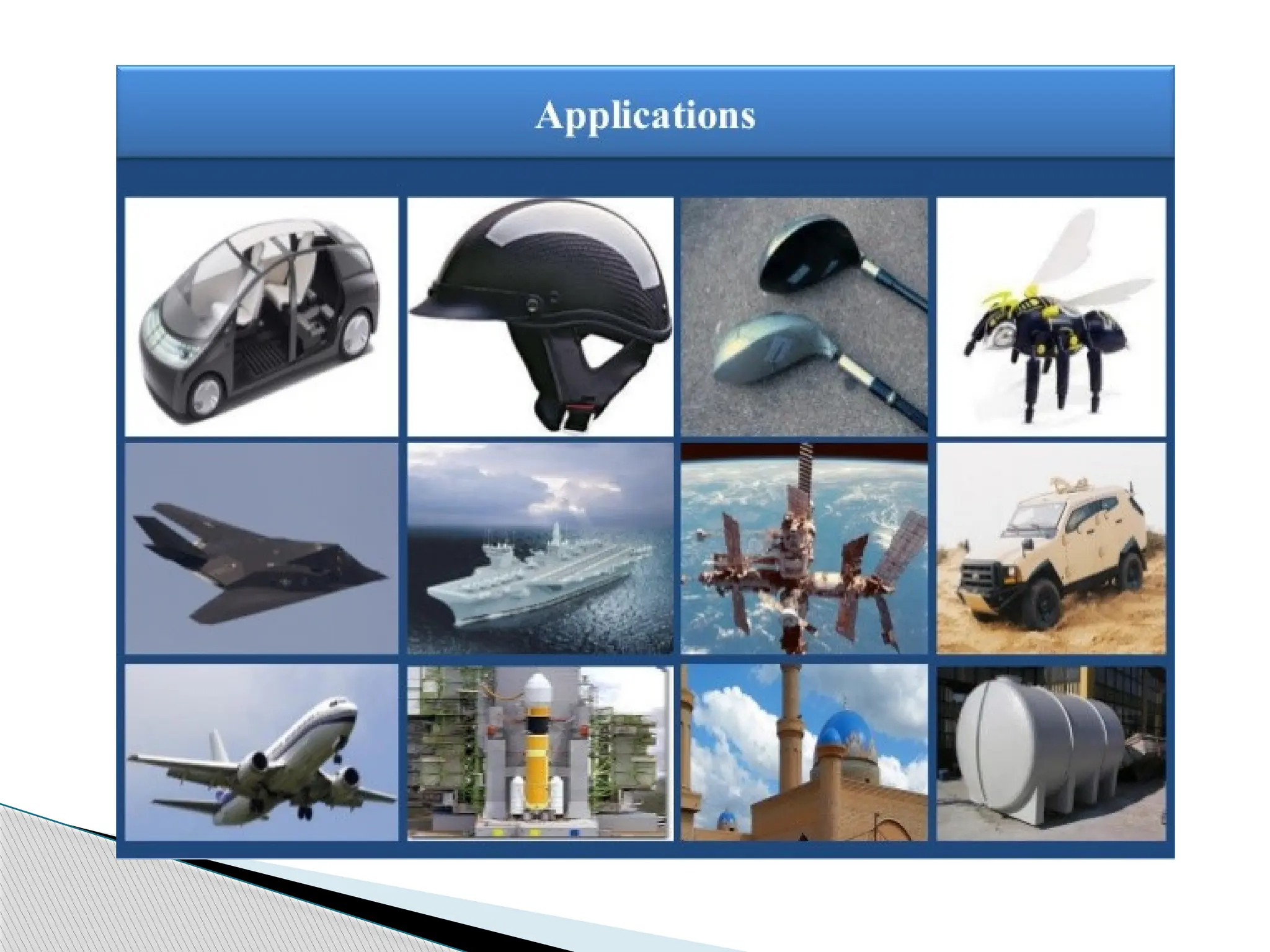
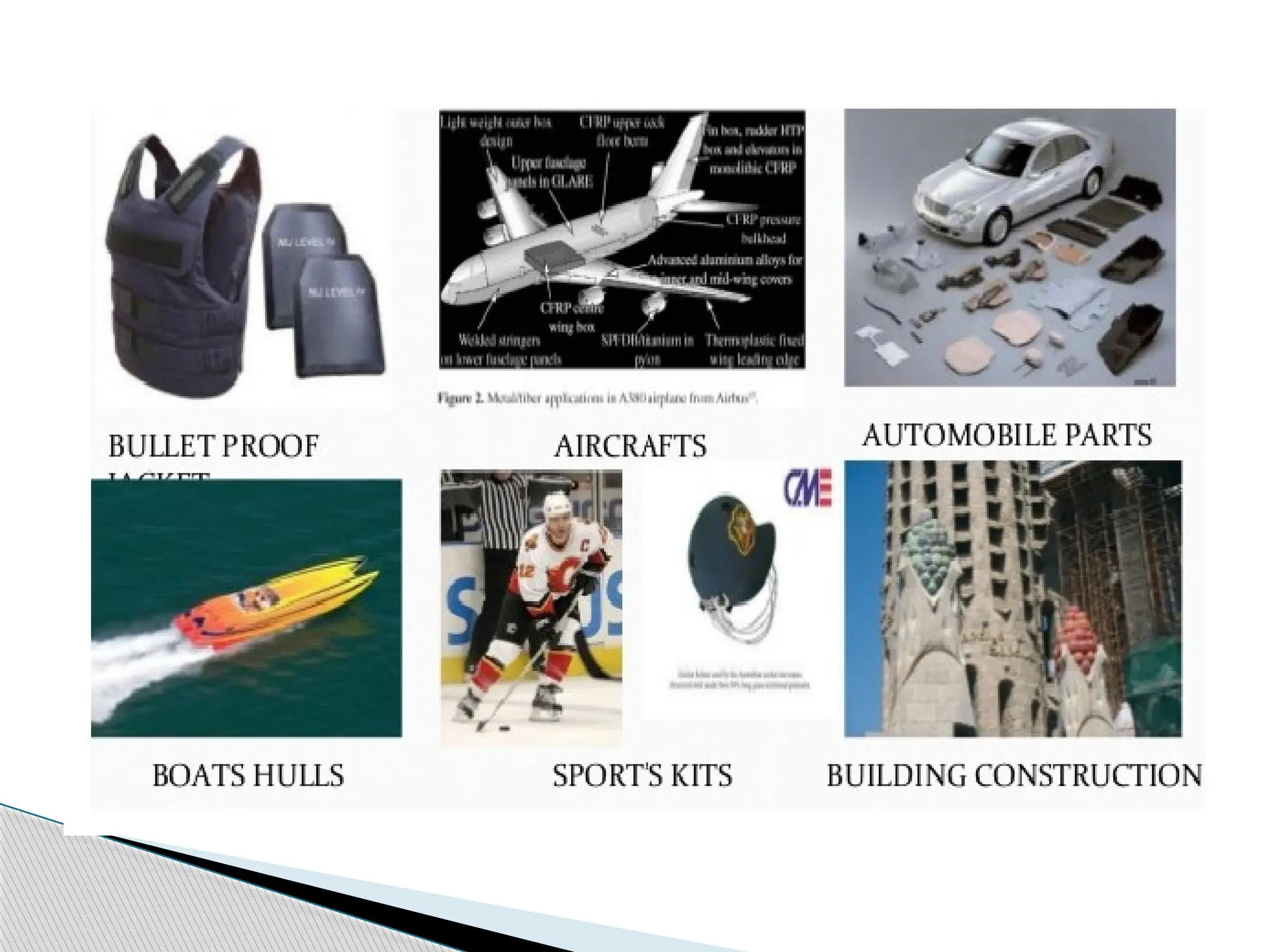
Applications:
◦ Aerospace industry
◦ Sporting Goods Industry
◦ Automotive Industry
◦ Home Appliance Industry
Introduction
5.
High AspectRatio
Better Fatigue properties than for engineering metals
High Toughness
High Corrosion resistance
Possible to achieve combinations of properties not attainable
with metals, ceramics, or polymers alone
Advantages
6.
Attacked byChemicals like Acid, Base, Acetone etc.
Composite materials are generally expensive
Low production rate
High cost as compared to conventional metals
Disadvantages
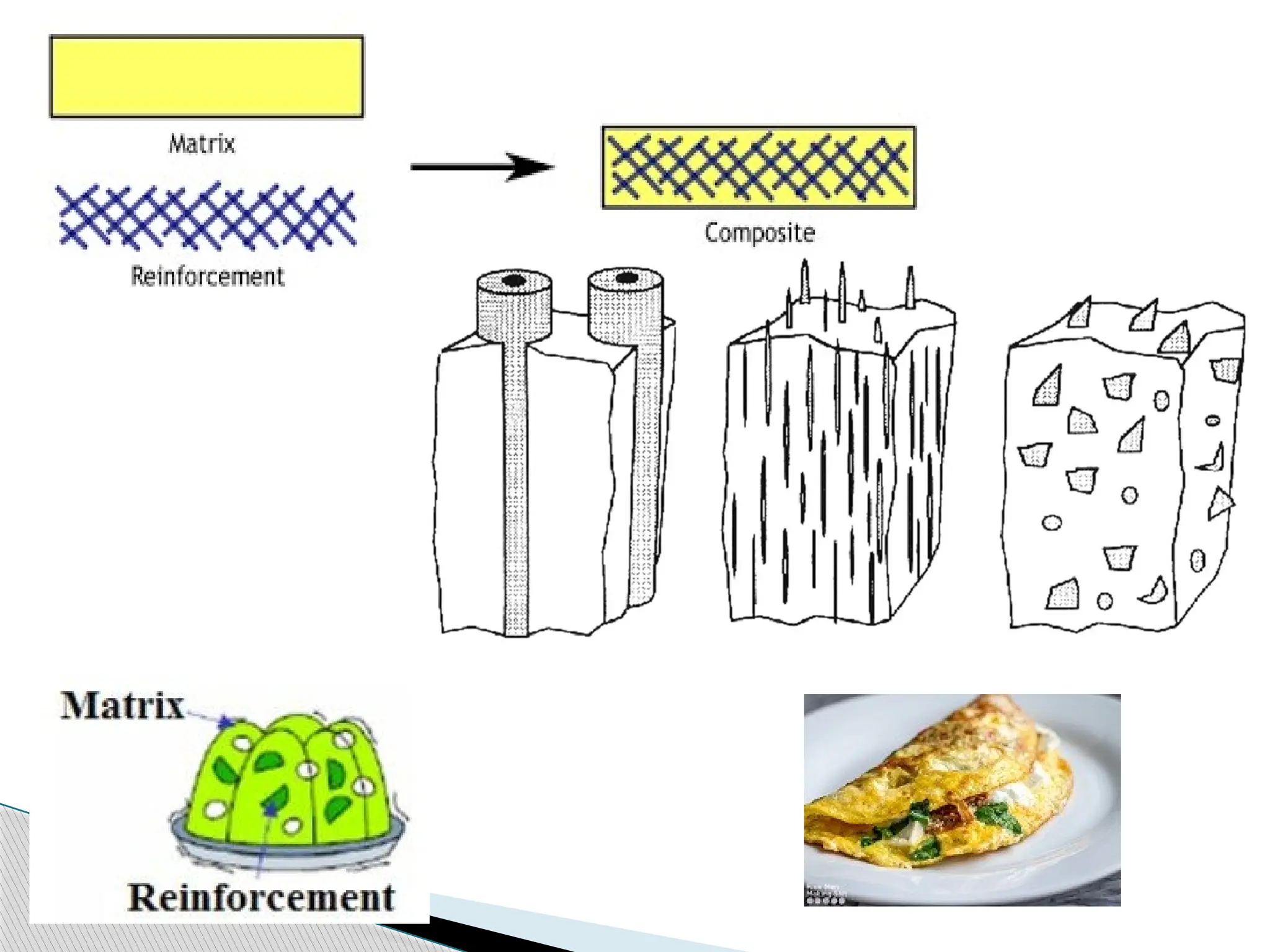
Matrix:
The continuousphase
Purpose is to:
transfer stress to other phases
protect phases from environment
Classification: MMC, CMC, PMC
Reinforcement:
Purpose: enhance matrix properties.
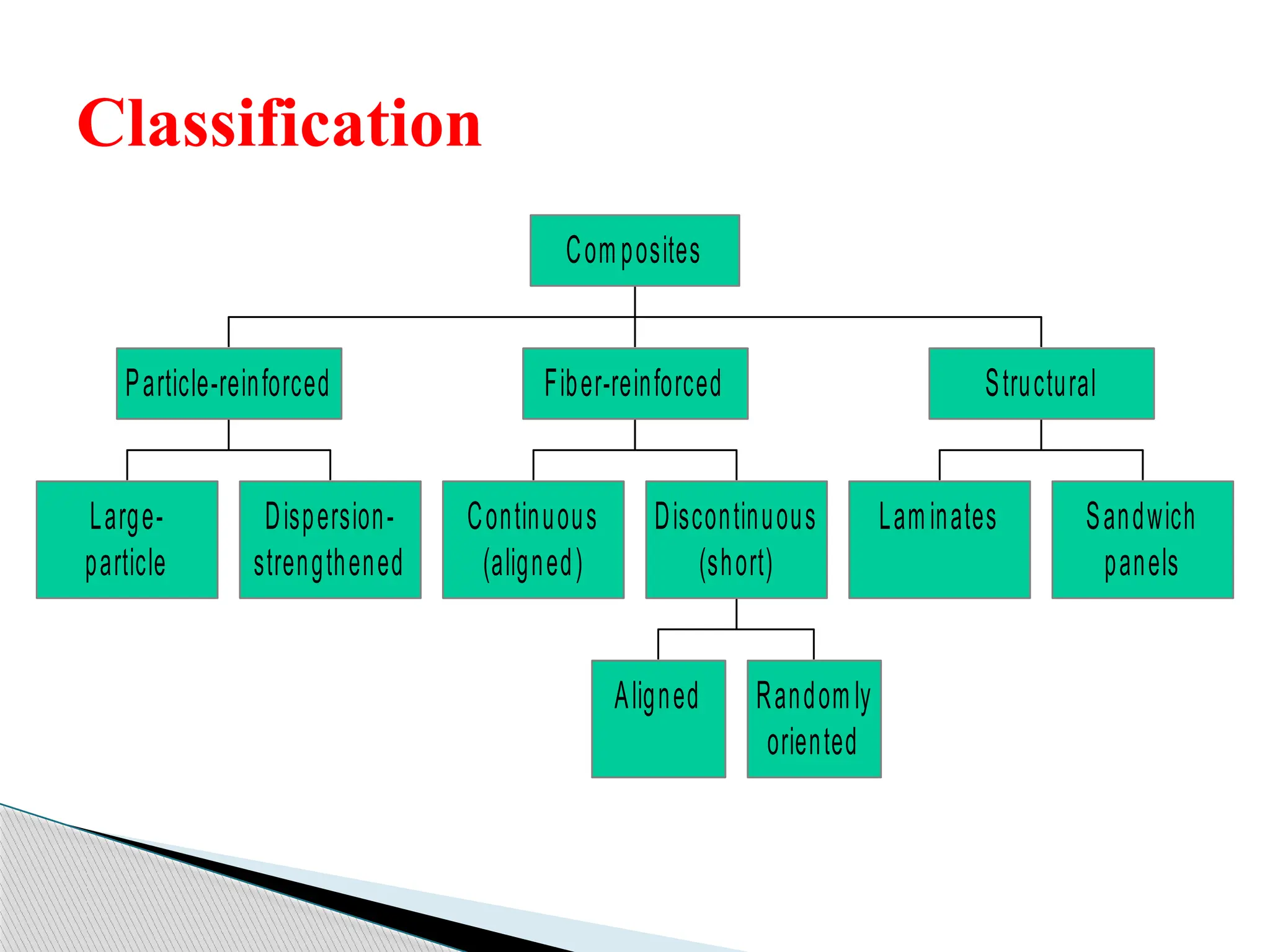
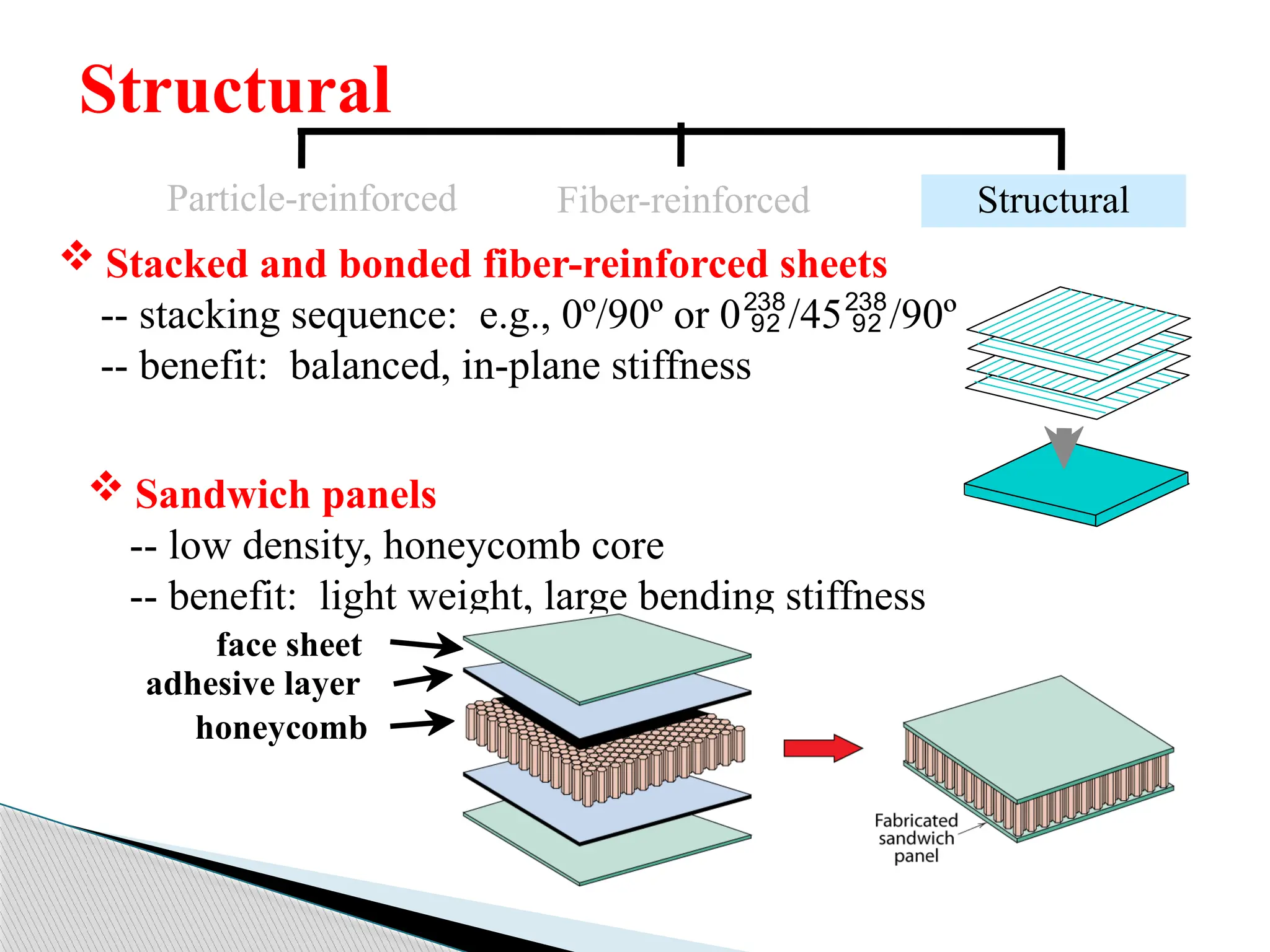
Classification: Particle, fiber, structural
11.
Protect phasesfrom environment
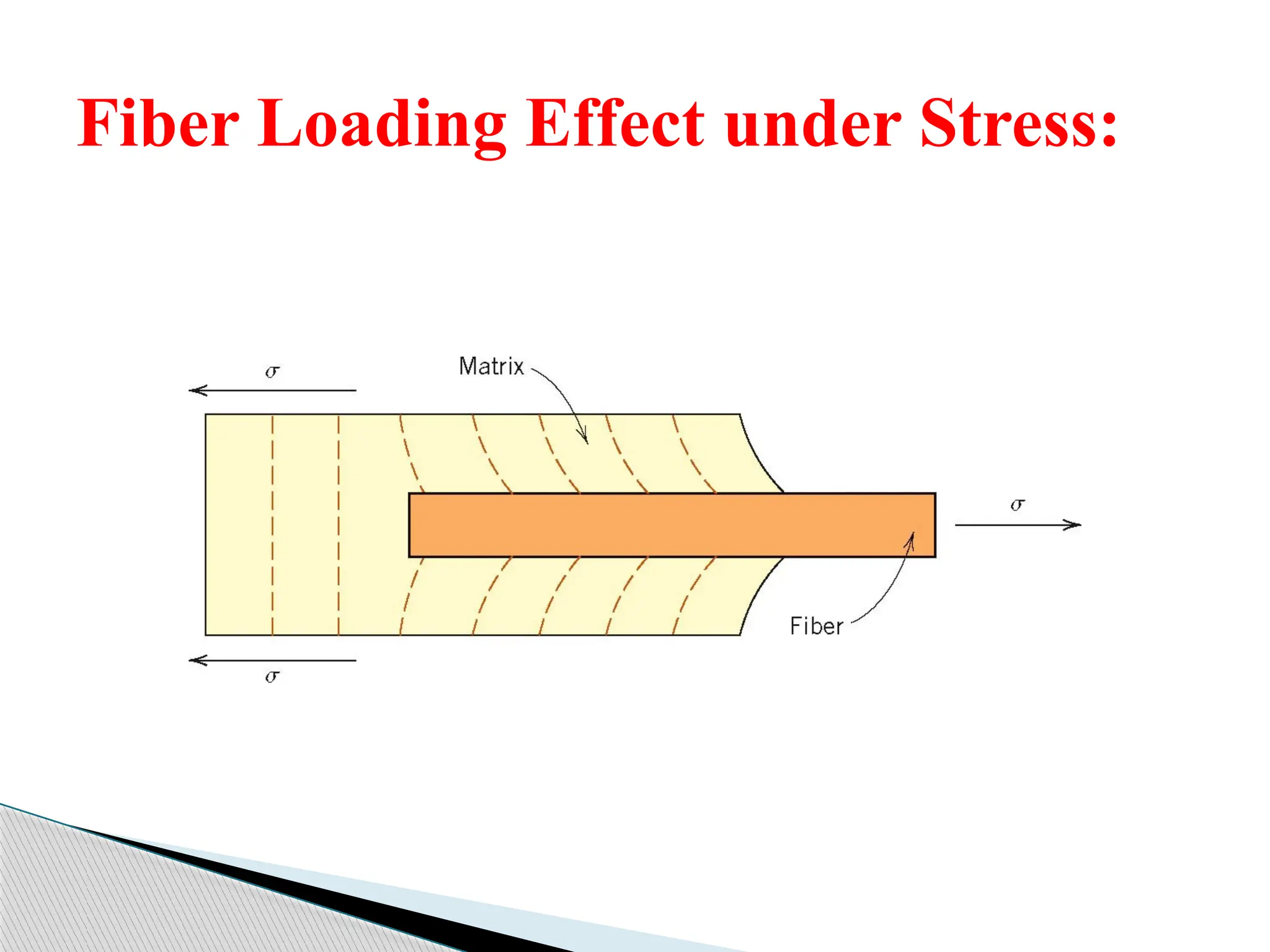
Transfer Stresses to phases
Holds the imbedded phase in place, usually enclosing and
often concealing it
When a load is applied, the matrix shares the load with the
secondary phase, in some cases deforming so that the stress is
essentially born by the reinforcing agent
Functions of the Matrix Material
12.
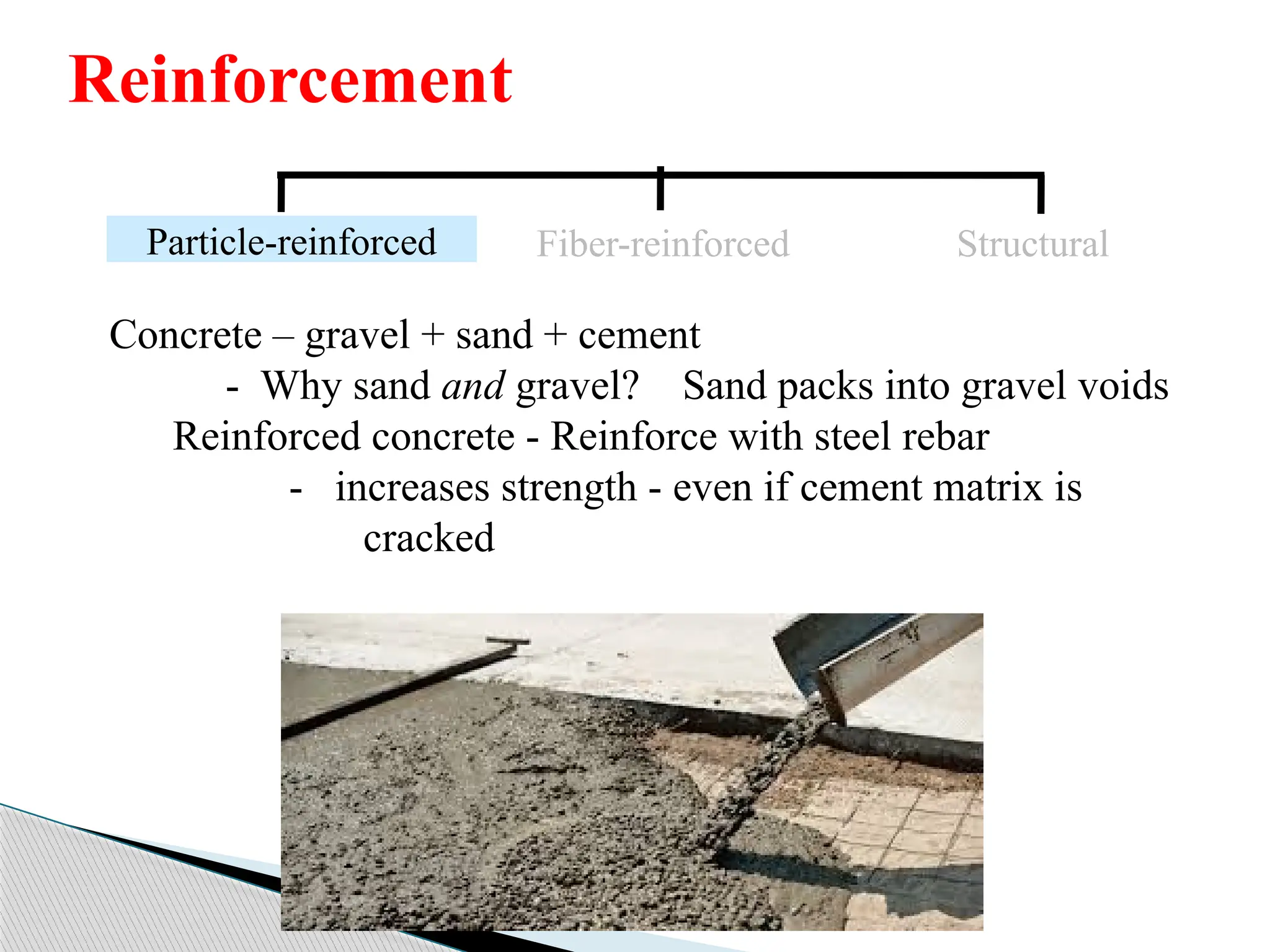
Concrete – gravel+ sand + cement
- Why sand and gravel? Sand packs into gravel voids
Reinforced concrete - Reinforce with steel rebar
- increases strength - even if cement matrix is
cracked
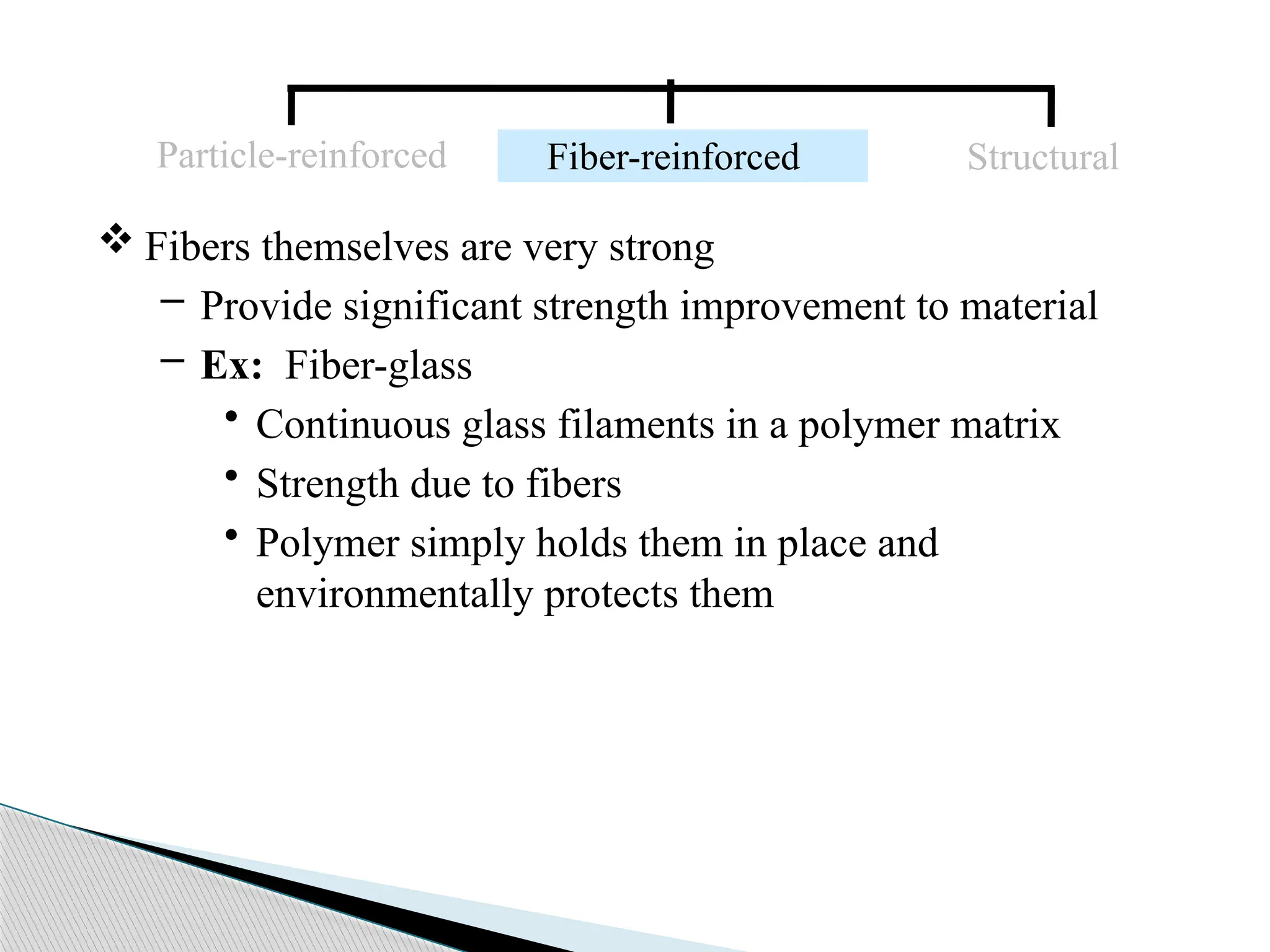
Particle-reinforced Fiber-reinforced Structural
Reinforcement
13.
Fibers themselvesare very strong
– Provide significant strength improvement to material
– Ex: Fiber-glass
• Continuous glass filaments in a polymer matrix
• Strength due to fibers
• Polymer simply holds them in place and
environmentally protects them
Particle-reinforced Fiber-reinforced Structural
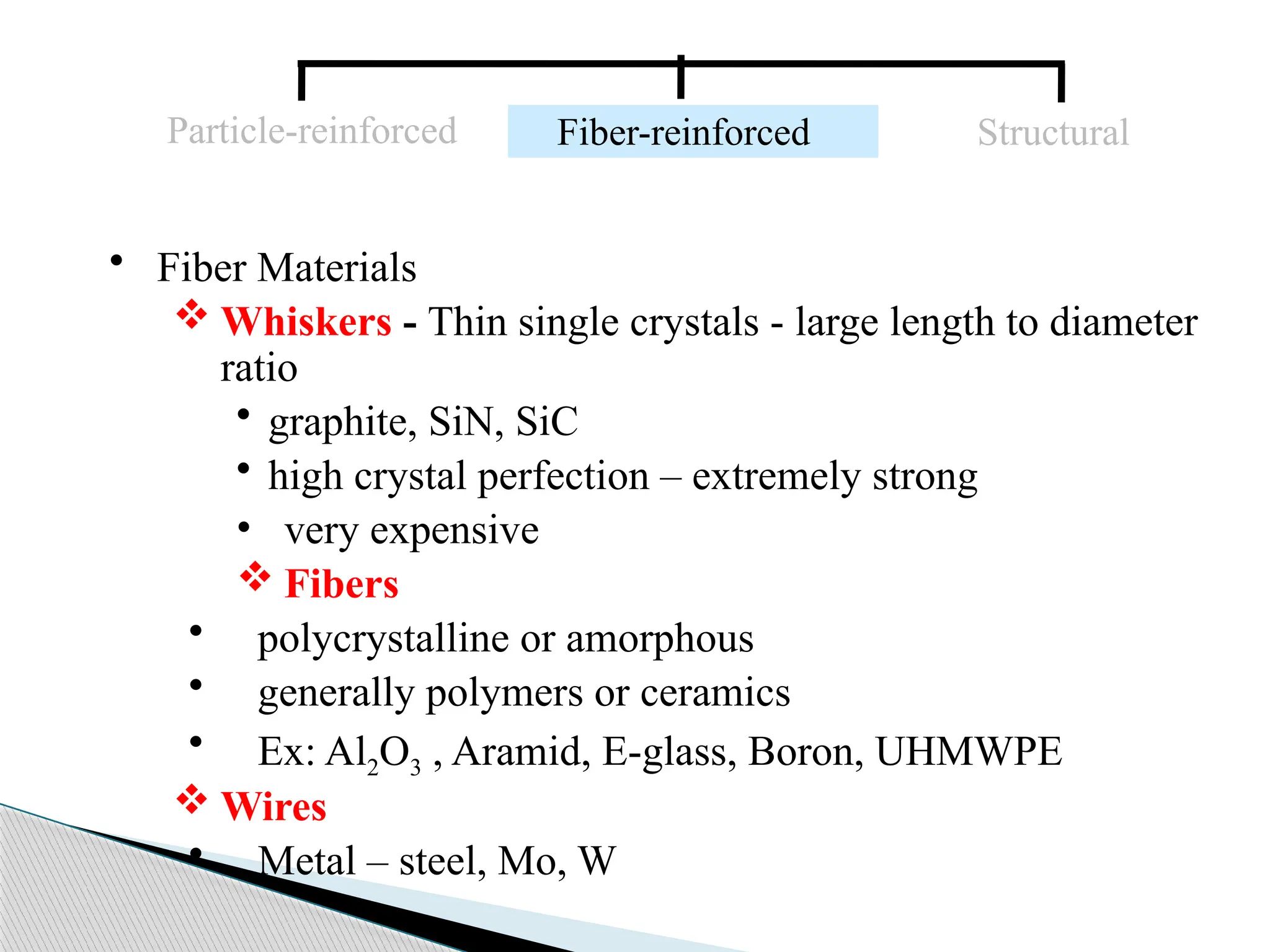
• Fiber Materials
Whiskers - Thin single crystals - large length to diameter
ratio
• graphite, SiN, SiC
• high crystal perfection – extremely strong
• very expensive
Fibers
• polycrystalline or amorphous
• generally polymers or ceramics
• Ex: Al2O3 , Aramid, E-glass, Boron, UHMWPE
Wires
• Metal – steel, Mo, W
Particle-reinforced Fiber-reinforced Structural
Metal Matrix Composites(MMCs)
A metal matrix reinforced by a second phase
Reinforcing phases:
Particles of ceramic (these MMCs are commonly
called cermets)
Fibers of various materials: other metals, ceramics,
carbon, and boron
19.
Cermets
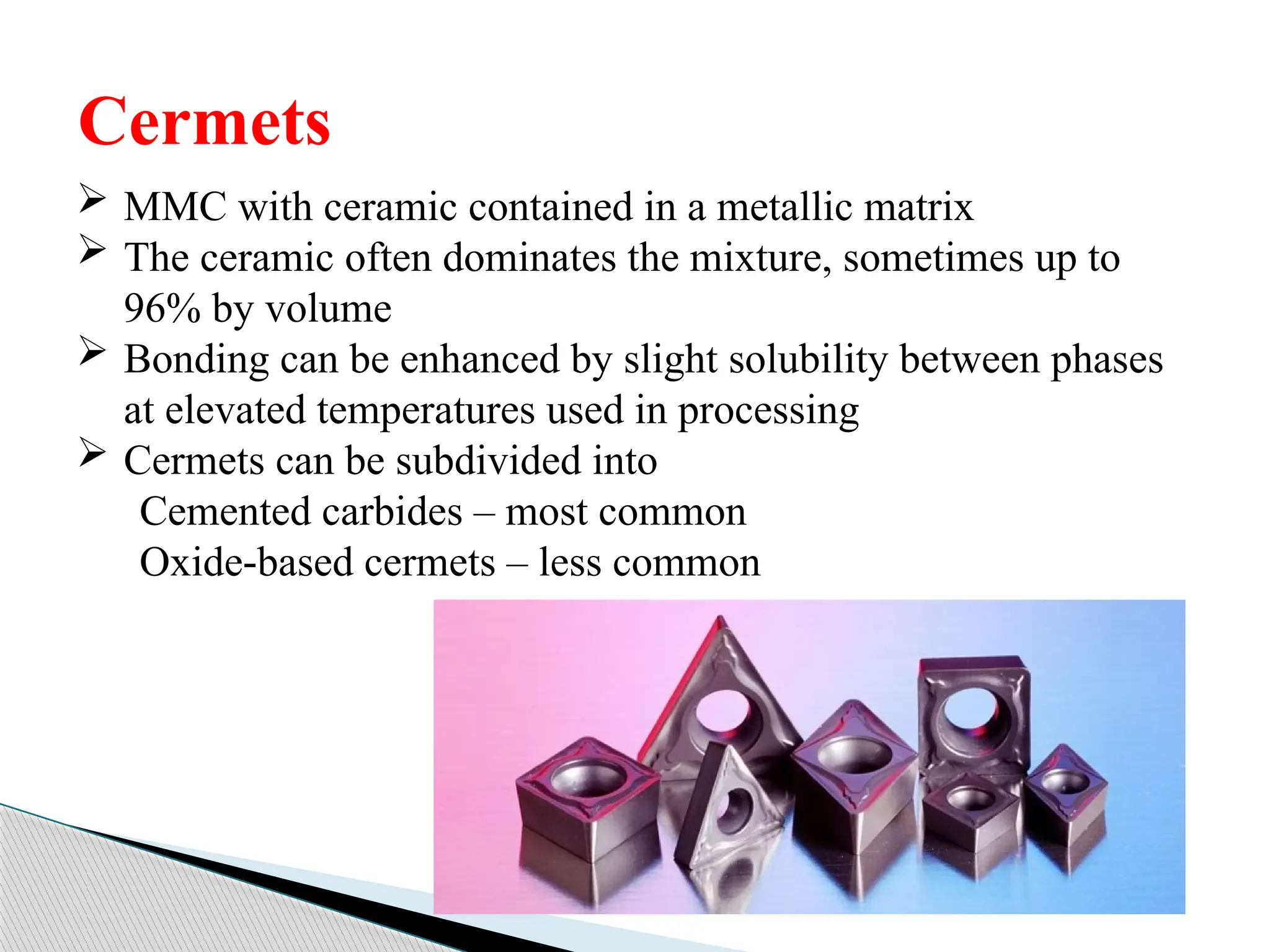
MMC withceramic contained in a metallic matrix
The ceramic often dominates the mixture, sometimes up to
96% by volume
Bonding can be enhanced by slight solubility between phases
at elevated temperatures used in processing
Cermets can be subdivided into
Cemented carbides – most common
Oxide based cermets – less common
‑
20.
Cemented Carbides
Oneor more carbide compounds bonded in a metallic
matrix
The term cermet is not used for all of these materials,
even though it is technically correct
Common cemented carbides are based on tungsten
carbide (WC), titanium carbide (TiC), and chromium
carbide (Cr3C2)
Tantalum carbide (TaC) and others are less common
Metallic binders: usually cobalt (Co) or nickel (Ni)
21.
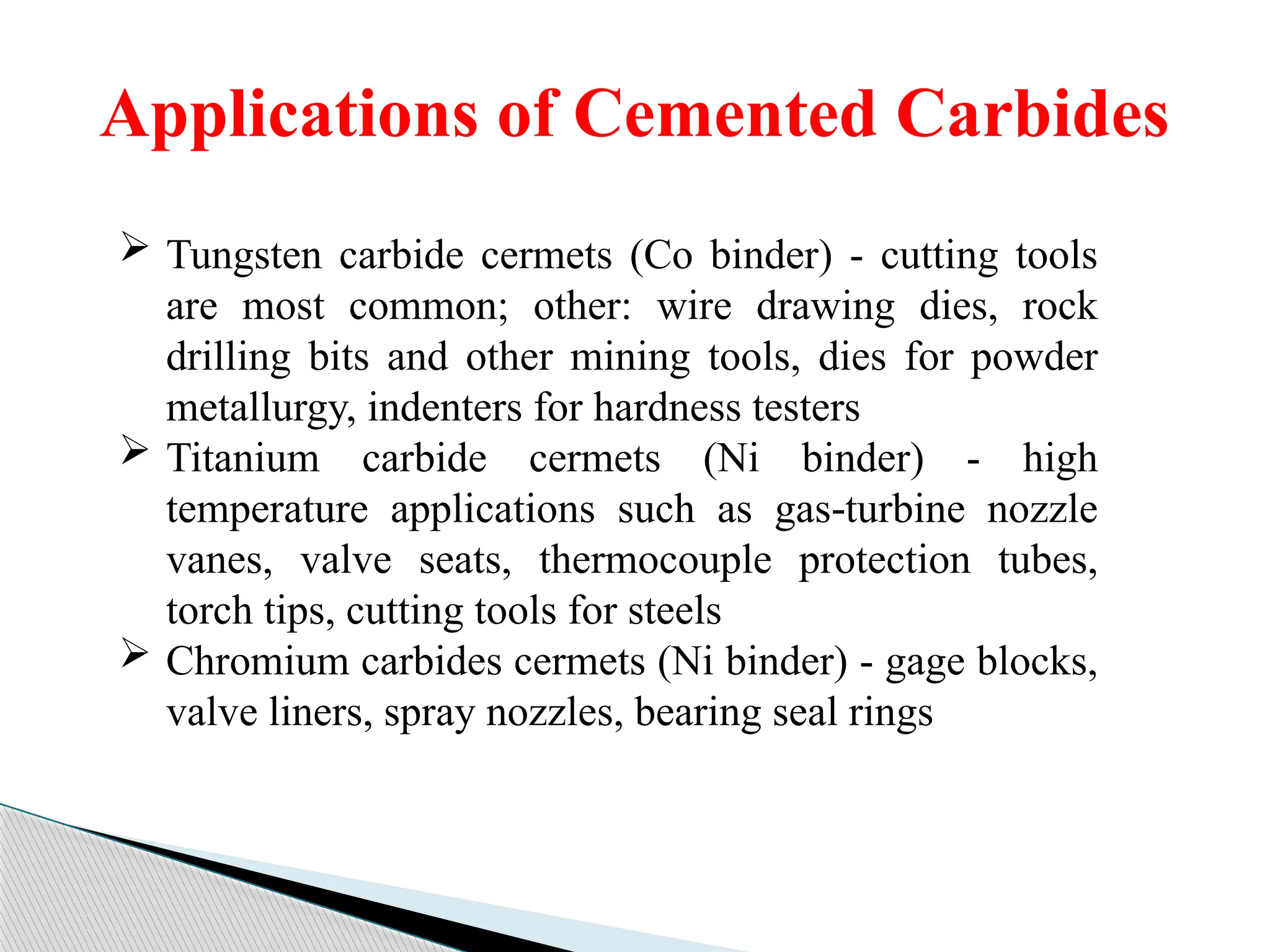
Applications of CementedCarbides
Tungsten carbide cermets (Co binder) - cutting tools
are most common; other: wire drawing dies, rock
drilling bits and other mining tools, dies for powder
metallurgy, indenters for hardness testers
Titanium carbide cermets (Ni binder) - high
temperature applications such as gas turbine nozzle
‑
vanes, valve seats, thermocouple protection tubes,
torch tips, cutting tools for steels
Chromium carbides cermets (Ni binder) - gage blocks,
valve liners, spray nozzles, bearing seal rings
22.
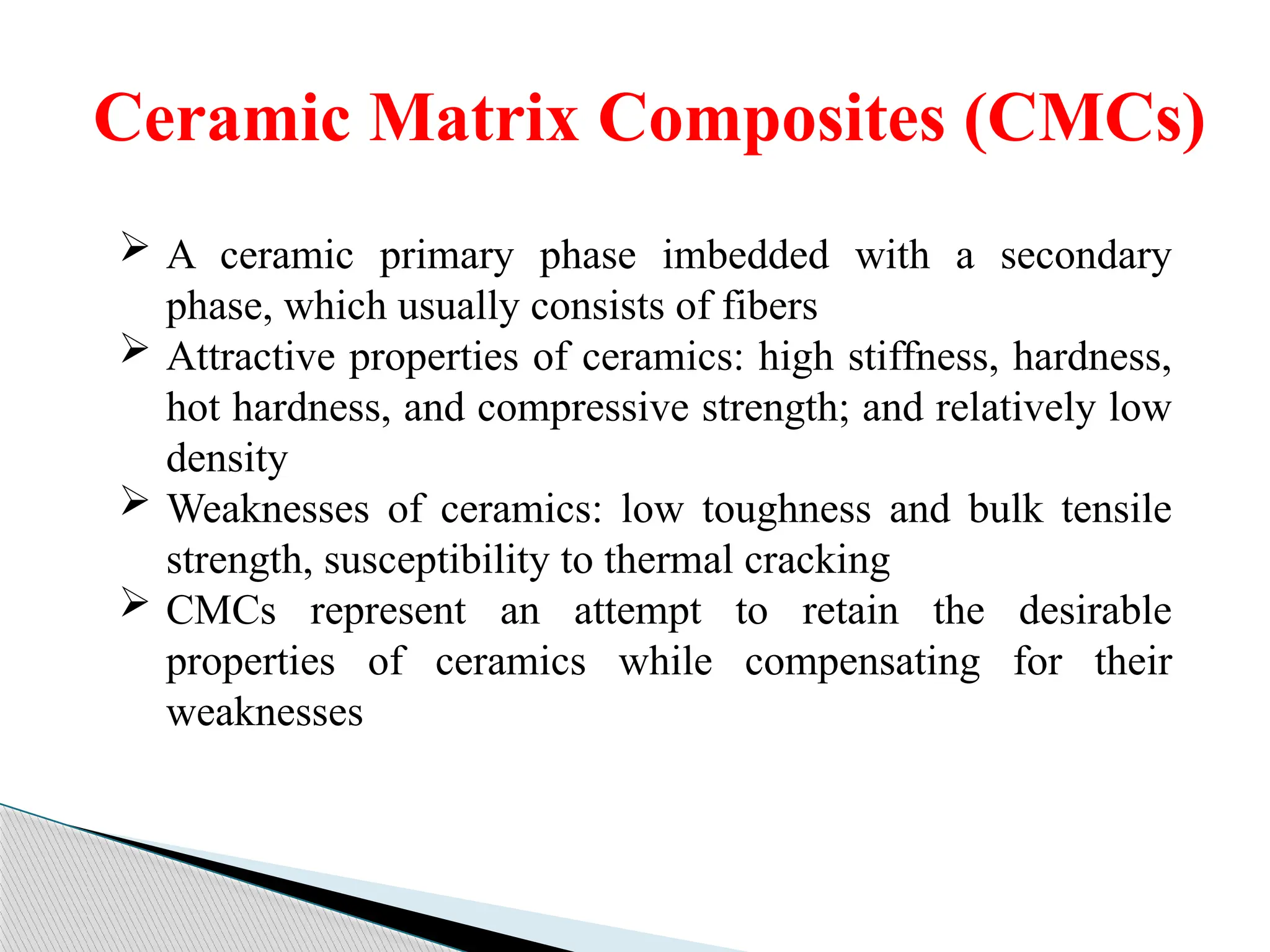
Ceramic Matrix Composites(CMCs)
A ceramic primary phase imbedded with a secondary
phase, which usually consists of fibers
Attractive properties of ceramics: high stiffness, hardness,
hot hardness, and compressive strength; and relatively low
density
Weaknesses of ceramics: low toughness and bulk tensile
strength, susceptibility to thermal cracking
CMCs represent an attempt to retain the desirable
properties of ceramics while compensating for their
weaknesses
23.
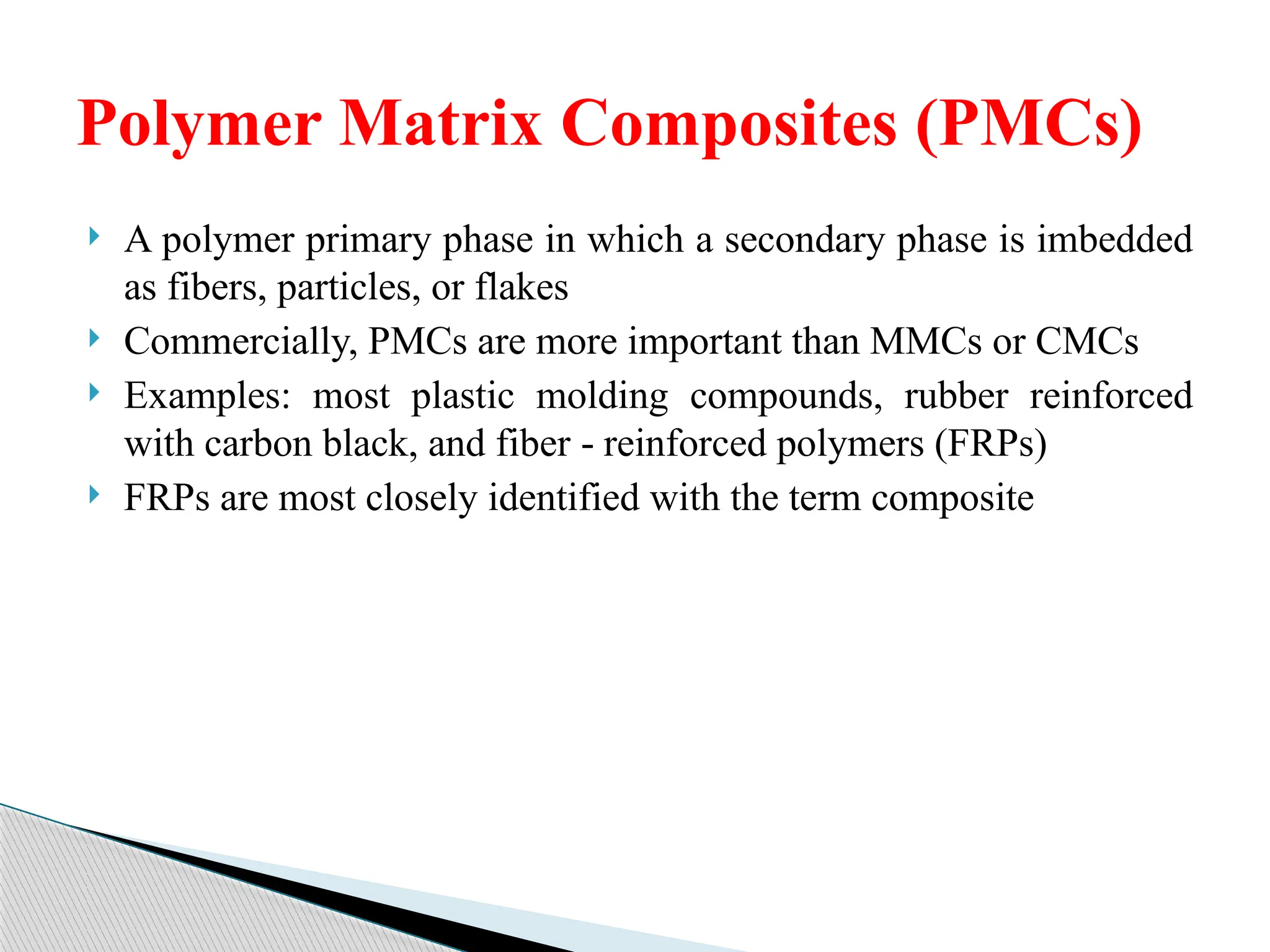
A polymerprimary phase in which a secondary phase is imbedded
as fibers, particles, or flakes
Commercially, PMCs are more important than MMCs or CMCs
Examples: most plastic molding compounds, rubber reinforced
with carbon black, and fiber reinforced polymers (FRPs)
‑
FRPs are most closely identified with the term composite
Polymer Matrix Composites (PMCs)
24.
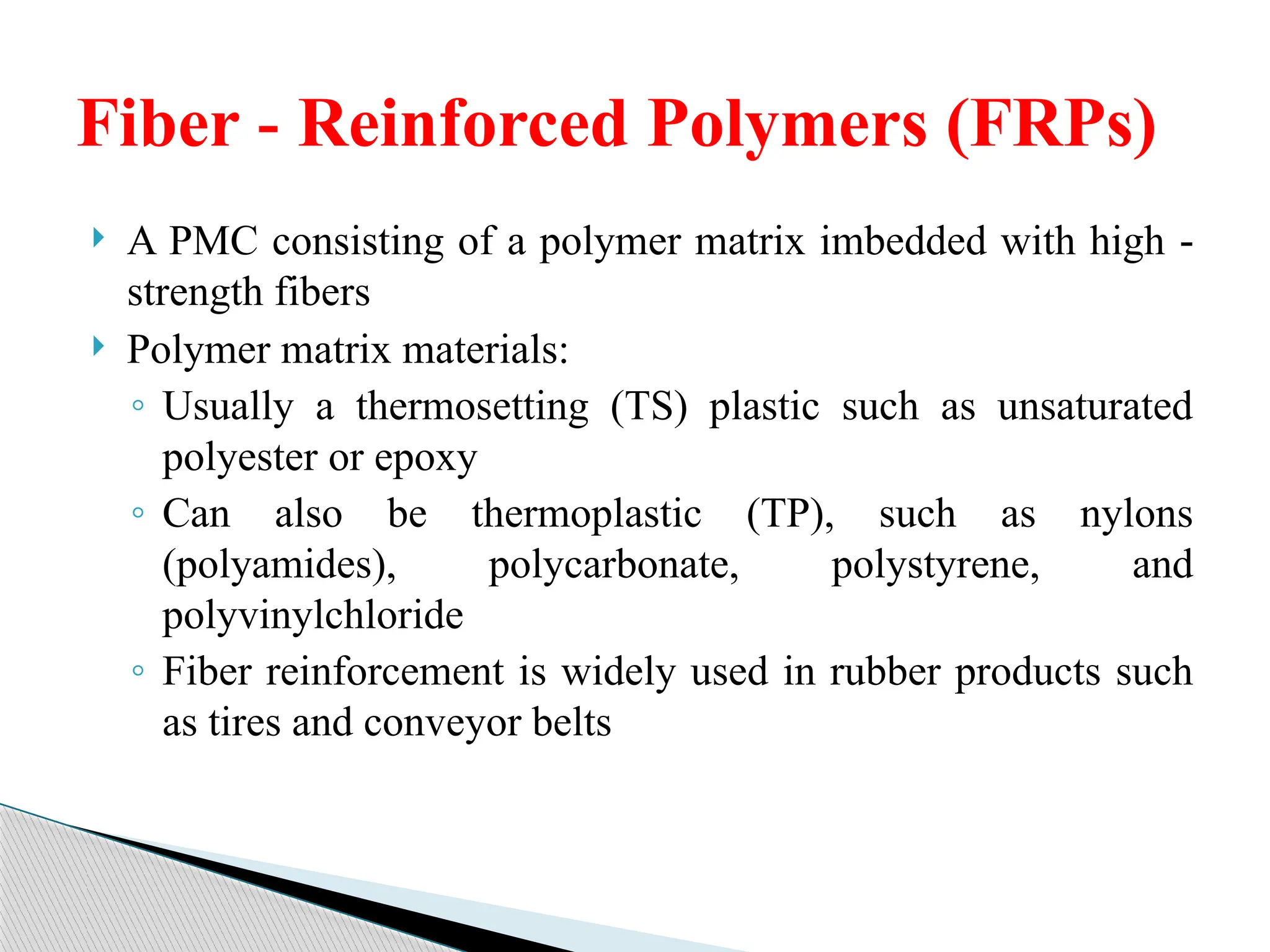
A PMCconsisting of a polymer matrix imbedded with high ‑
strength fibers
Polymer matrix materials:
◦ Usually a thermosetting (TS) plastic such as unsaturated
polyester or epoxy
◦ Can also be thermoplastic (TP), such as nylons
(polyamides), polycarbonate, polystyrene, and
polyvinylchloride
◦ Fiber reinforcement is widely used in rubber products such
as tires and conveyor belts
Fiber Reinforced Polymers (FRPs)
‑
25.
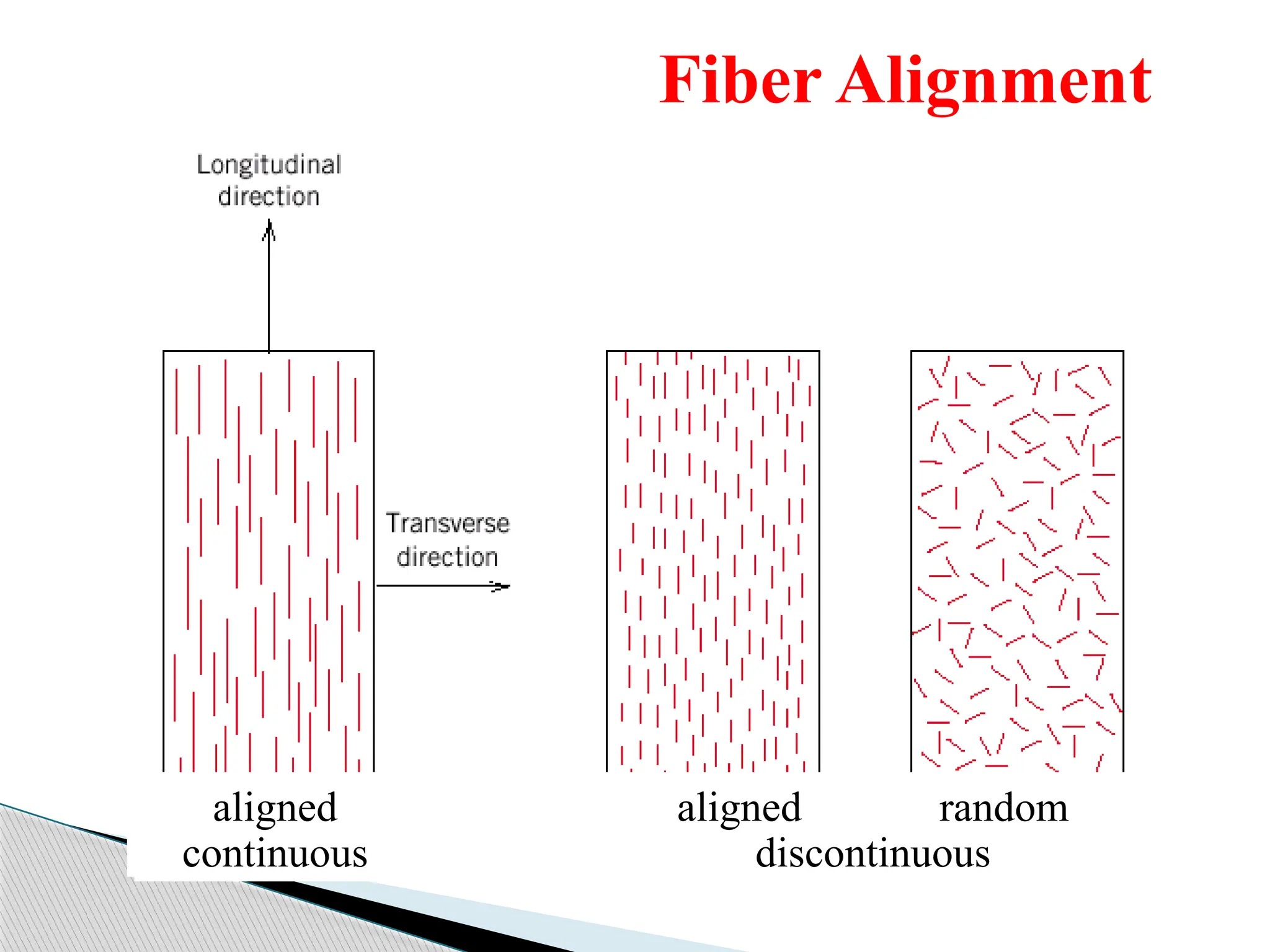
Various forms:discontinuous (chopped), continuous, or woven
as a fabric
Principal fiber materials in FRPs are glass, carbon, and Kevlar
49
Less common fibers include boron, SiC, and Al2O3, and steel
Glass (in particular E glass) is the most common fiber
‑
material in today's FRPs; its use to reinforce plastics dates
from around 1920
Fibers in PMCs
26.
Most widelyused form of FRP is a laminar structure, made by
stacking and bonding thin layers of fiber and polymer until
desired thickness is obtained
By varying fiber orientation among layers, a specified level of
anisotropy in properties can be achieved in the laminate
Applications: parts of thin cross section, such as aircraft
‑
wing and fuselage sections, automobile and truck body panels,
and boat hulls
Common FRP Structure
27.
High strengthto weight and modulus to weight ratios
‑ ‑ ‑ ‑
Low specific gravity - a typical FRP weighs only about 1/5 as
much as steel; yet, strength and modulus are comparable in
fiber direction
Good fatigue strength
Good corrosion resistance, although polymers are soluble in
various chemicals
Low thermal expansion - for many FRPs, leading to good
dimensional stability
FRP Properties
28.
Aerospace –much of the structural weight of today’s airplanes
and helicopters consist of advanced FRPs
Automotive – somebody panels for cars and truck cabs
◦ Continued use of low-carbon sheet steel in cars is evidence
of its low cost and ease of processing
Sports and recreation
◦ Fiberglass reinforced plastic has been used for boat hulls
since the 1940s
◦ Fishing rods, tennis rackets, golf club shafts, helmets, skis,
bows and arrows.
FRPApplications
29.
In additionto FRPs, other PMCs contain particles, flakes, and
short fibers as the secondary phase
Called fillers when used in molding compounds
Two categories:
◦ Reinforcing fillers – used to strengthen or otherwise
improve mechanical properties
Examples: wood flour in phenolic and amino resins; and
carbon black in rubber
◦ Extenders – used to increase bulk and reduce cost per unit
weight, but little or no effect on mechanical properties
Other Polymer Matrix Composites
30.
The twophases are typically produced separately before being
combined into the composite part
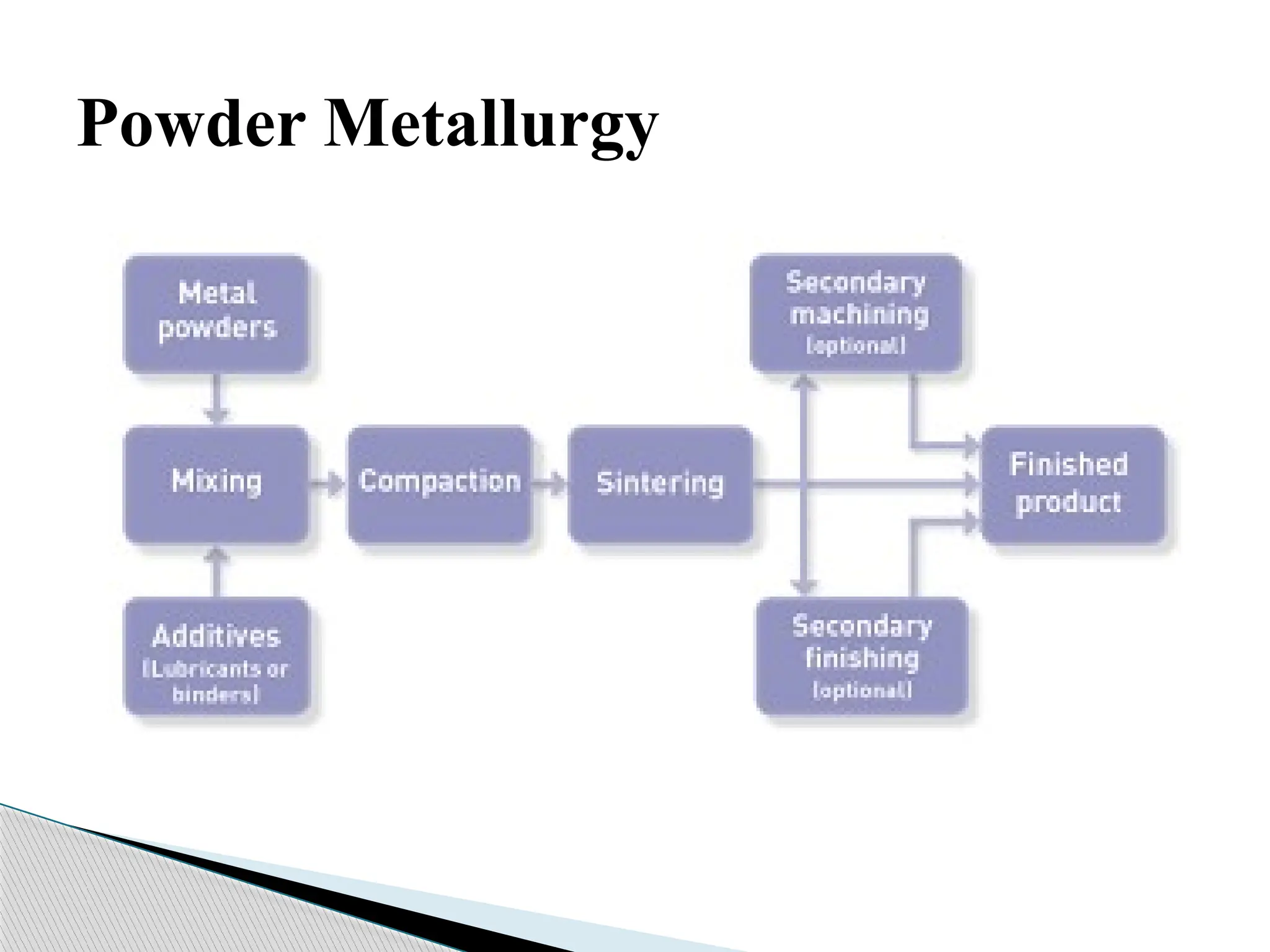
Processing techniques to fabricate MMC and CMC
components are similar to those used for powdered metals and
ceramics
Molding processes are commonly used for PMCs with
particles and chopped fibers
Specialized processes have been developed for FRPs
Processing of Composite Materials
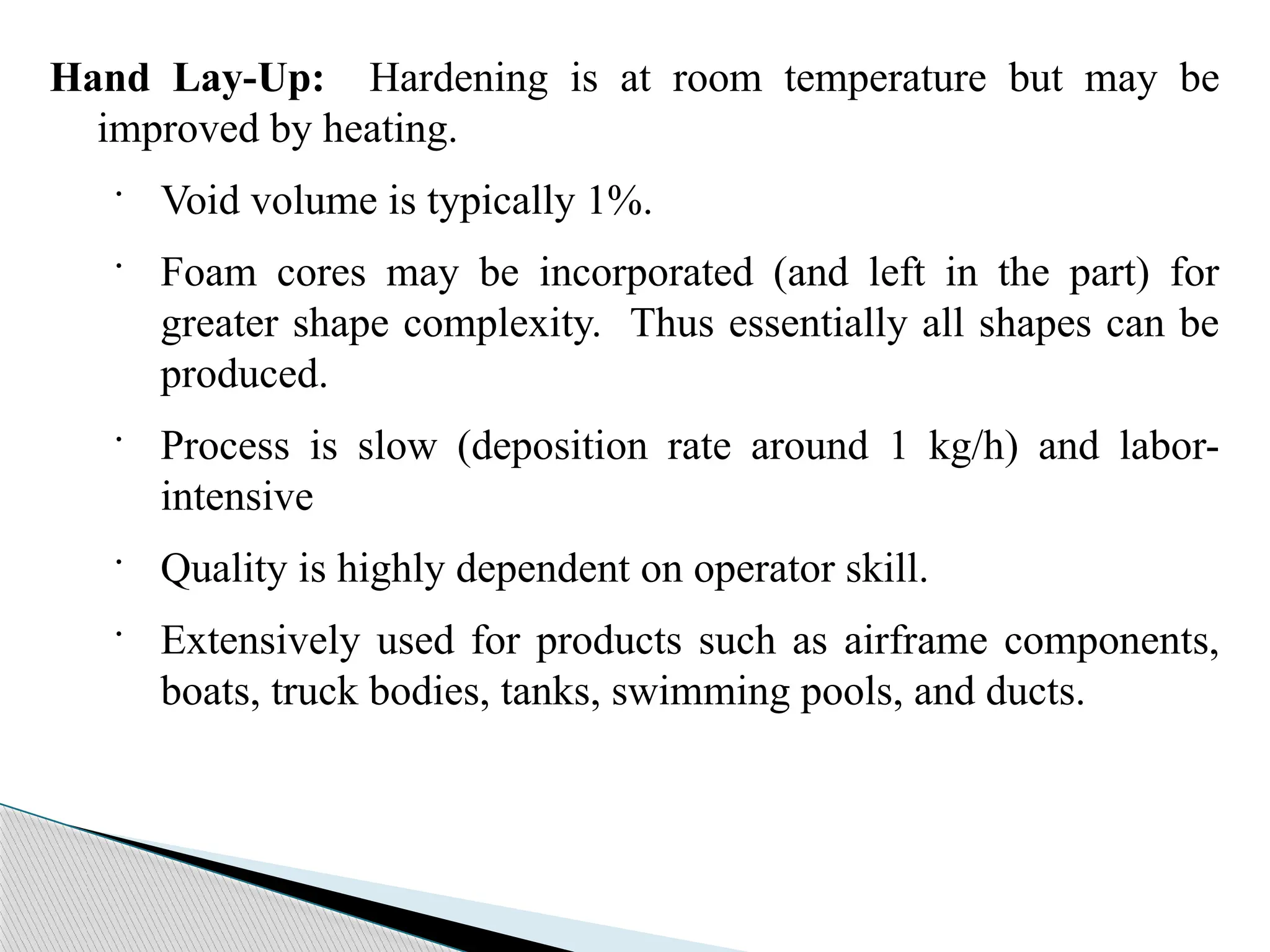
Hand Lay-Up: Hardeningis at room temperature but may be
improved by heating.
· Void volume is typically 1%.
· Foam cores may be incorporated (and left in the part) for
greater shape complexity. Thus essentially all shapes can be
produced.
· Process is slow (deposition rate around 1 kg/h) and labor-
intensive
· Quality is highly dependent on operator skill.
· Extensively used for products such as airframe components,
boats, truck bodies, tanks, swimming pools, and ducts.
• Composites areclassified according to:
-- the matrix material (CMC, MMC, PMC)
-- the reinforcement geometry (particles, fibers, layers).
• Particulate-reinforced:
-- Elastic modulus can be estimated.
-- Properties are isotropic.
• Fiber-reinforced:
-- Elastic modulus and TS can be estimated along fiber dir.
-- Properties can be isotropic or anisotropic.
• Structural:
-- Based on build-up of sandwiches in layered form.
Summary