
Definition:
Polymer Matrix Composite (PMC) is the material consisting of a polymer (resin) matrix
combined with a fibrous reinforcing dispersed phase.
Why we used the term “Resin” and what it mean????
Is it polymer???
Wikipedia answer it as ,
Polymer is a large molecule consisting of many repeating subunits. Resin is a solid or
viscous material which gives a polymer after curing. Resins can be synthetic or natural
and generally are mixtures of organic compounds. After polymerizarion or curing,
resins form polymers.
4 October 2019 1
Polymer Matrix Composite
Why we used Matrix Resin??
Advantage and functions of Matrix Resin:
1. Provide a uniform distribution of the structural and environmental load to
the reinforcing fiber through a good adhesion to and a strong interface
with the reinforcement .
2. Protect the surface of the composite against abrasion , wear and tear, and
corrosion , all of which can initiate fracture.
3. Absorb the impact loads and minimize stress concentrations by enhancing
the fracture toughness.
4. Resist high temperature and withstand repeated cycling of operation ,
especially under hygroscopic conditions and thus prevent or delay the
onset of microcracking in the composite.
4 October 2019 2
Types of Resins:
Chemically the Matrix Resins may be classified into two categories.
1. Thermosetting Resins and
2. Thermoplastic Resins
Thermosetting Resins:
Basically thermosetting resins are telechelic oligomers , which are hardened by heating and
cannot be remolded.
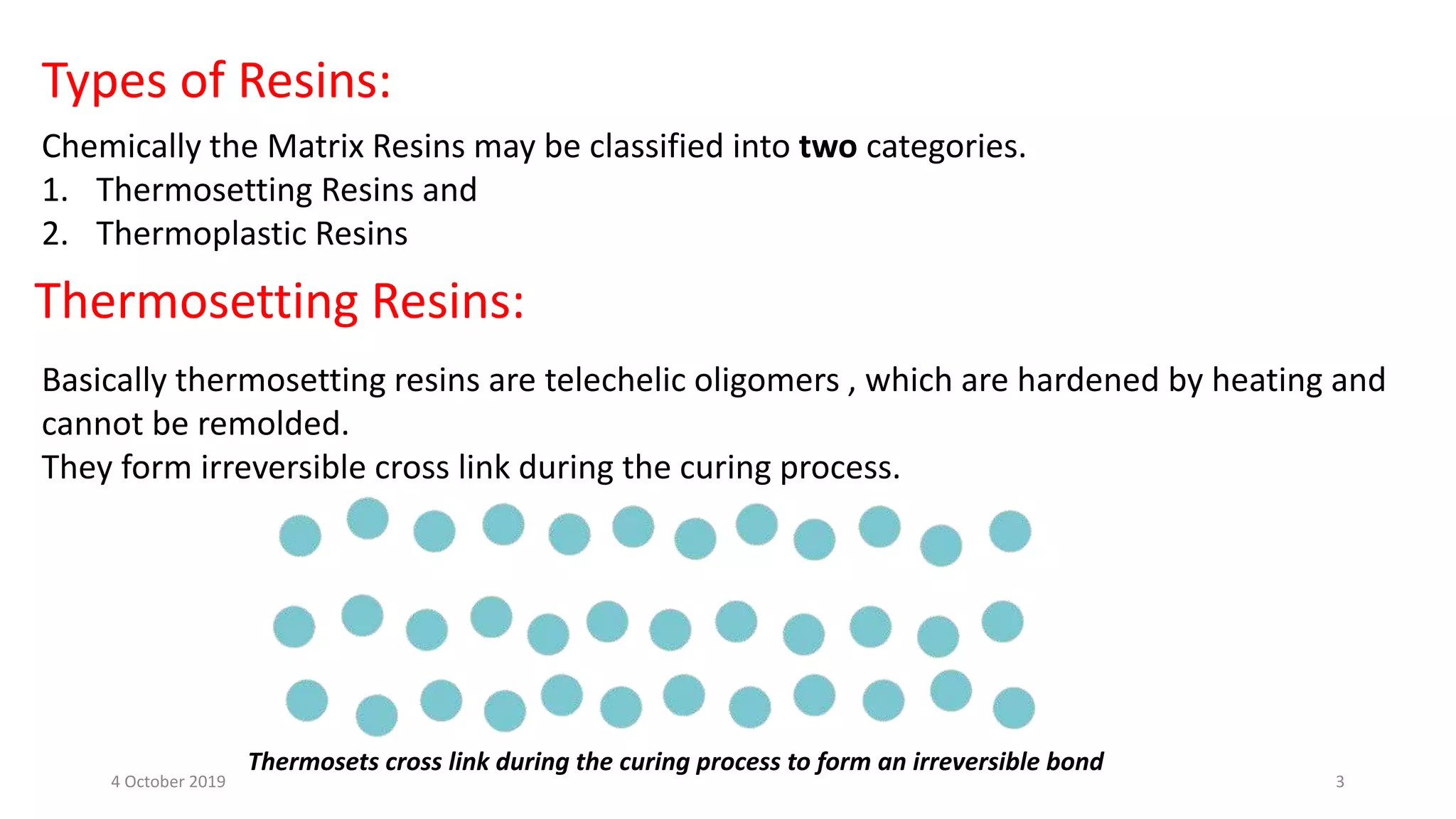
They form irreversible cross link during the curing process.
Thermosets cross link during the curing process to form an irreversible bond
4 October 2019 3
Common types of resins:
 Epoxy Resins
 Phenolic Resins ( PF Resins)
 Polyimides Resins
 Cyanate Resins
4 October 2019 4
Epoxy Resins
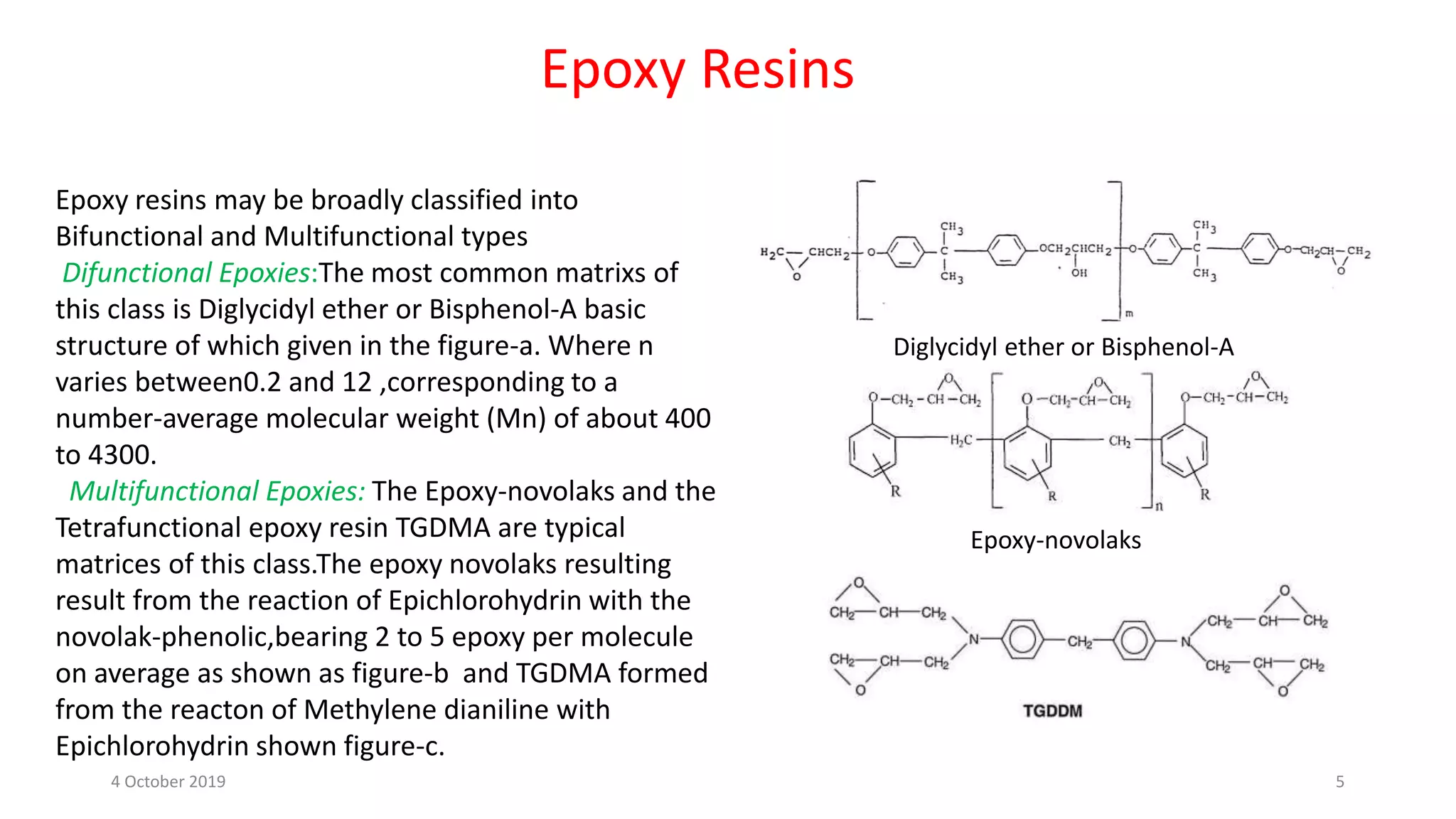
Epoxy resins may be broadly classified into
Bifunctional and Multifunctional types
Difunctional Epoxies:The most common matrixs of
this class is Diglycidyl ether or Bisphenol-A basic
structure of which given in the figure-a. Where n
varies between0.2 and 12 ,corresponding to a
number-average molecular weight (Mn) of about 400
to 4300.
Multifunctional Epoxies: The Epoxy-novolaks and the
Tetrafunctional epoxy resin TGDMA are typical
matrices of this class.The epoxy novolaks resulting
result from the reaction of Epichlorohydrin with the
novolak-phenolic,bearing 2 to 5 epoxy per molecule
on average as shown as figure-b and TGDMA formed
from the reacton of Methylene dianiline with
Epichlorohydrin shown figure-c.
Diglycidyl ether or Bisphenol-A
Epoxy-novolaks
4 October 2019 5
Phenolic Resins (PF Resins)
Phenol Resins are one of the oldest commercial
matrices identified with the composites industry.
Nowadays its used in special purpose such as
aircraft application.PF Resins are prepared in two
ways,
1.By an acid catalyzed reaction of phenol with less
than a molar ratio of formaldehyde (<0.85)
yielding a low melting thermoplastic solid known
as a NOVOLAK.
2.By a base catalyzed reaction of phenol with
excess formaldehyde (>3.0) to form a medium
molecule weight liquid ,which can be heat cured or
cure by acid or base to yield tightly cross linked PF
matrices. The overall reaction sequence is shown
figure-a
Crosslinked resin
4 October 2019 6
Polyimides
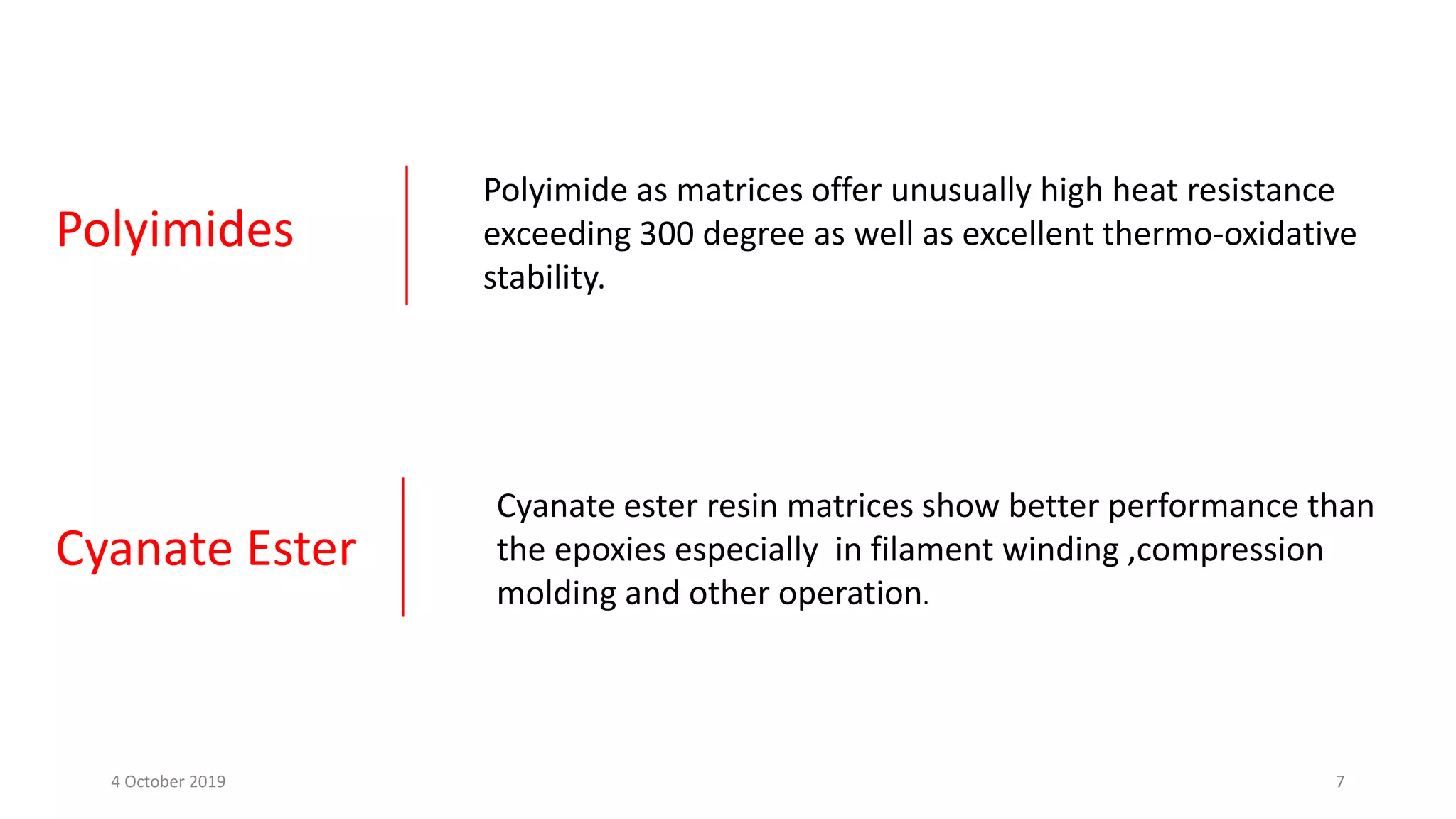
Polyimide as matrices offer unusually high heat resistance
exceeding 300 degree as well as excellent thermo-oxidative
stability.
Cyanate Ester
Cyanate ester resin matrices show better performance than
the epoxies especially in filament winding ,compression
molding and other operation.
4 October 2019 7
Thermoplastic Resin
Description:
Thermoplastic resins are raw, unshaped polymers that turn to liquid when
heated and turn solid when cooled. They can be repeatedly remelted and
remolded.
Catagories:
Polyaryl Ethers
Thermoplastic Polyimides
Polyarylene sulfides
4 October 2019 8
Polyaryl Ethers (PAE)
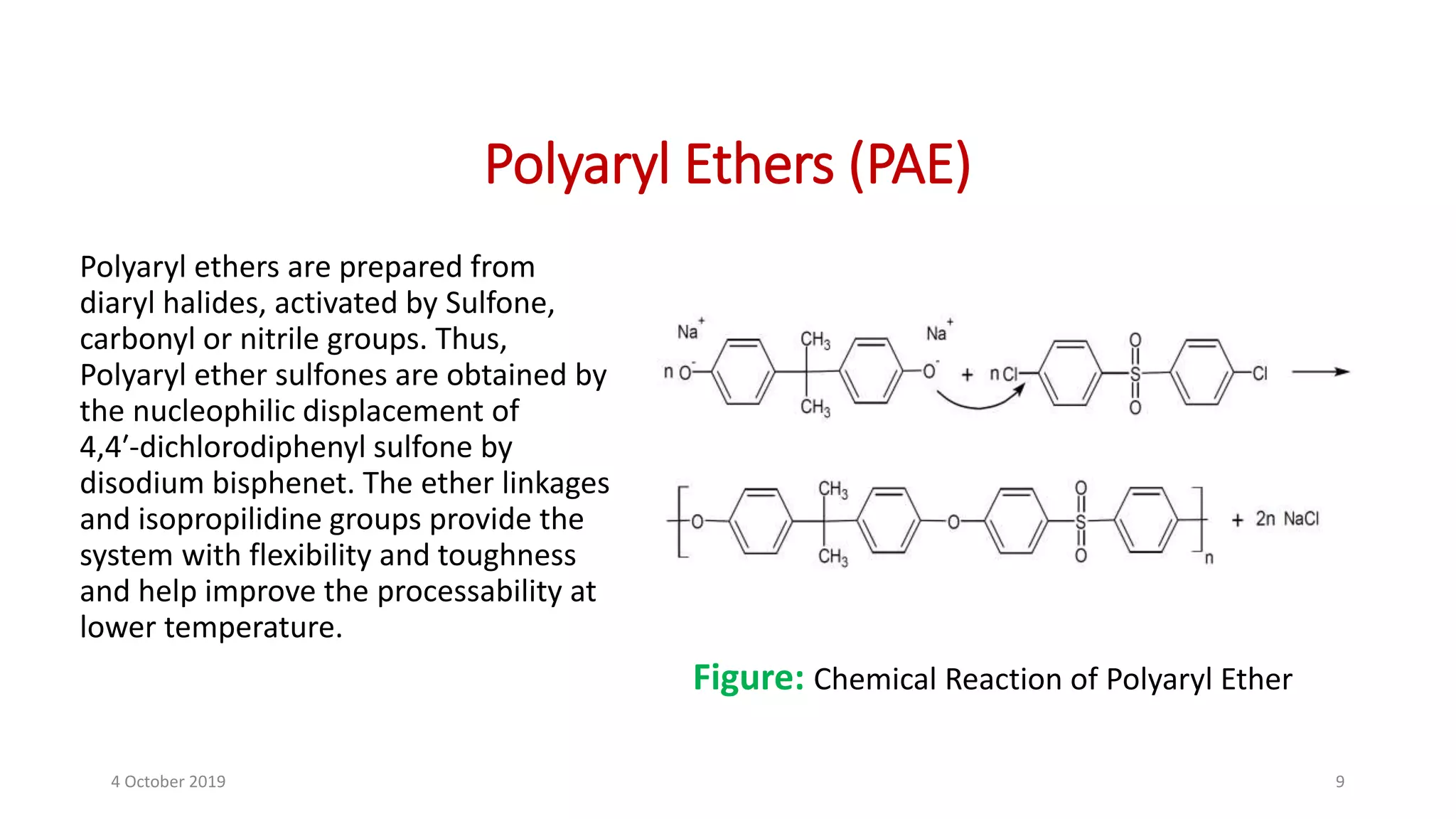
Polyaryl ethers are prepared from
diaryl halides, activated by Sulfone,
carbonyl or nitrile groups. Thus,
Polyaryl ether sulfones are obtained by
the nucleophilic displacement of
4,4′‐dichlorodiphenyl sulfone by
disodium bisphenet. The ether linkages
and isopropilidine groups provide the
system with flexibility and toughness
and help improve the processability at
lower temperature.
Figure: Chemical Reaction of Polyaryl Ether
4 October 2019 9
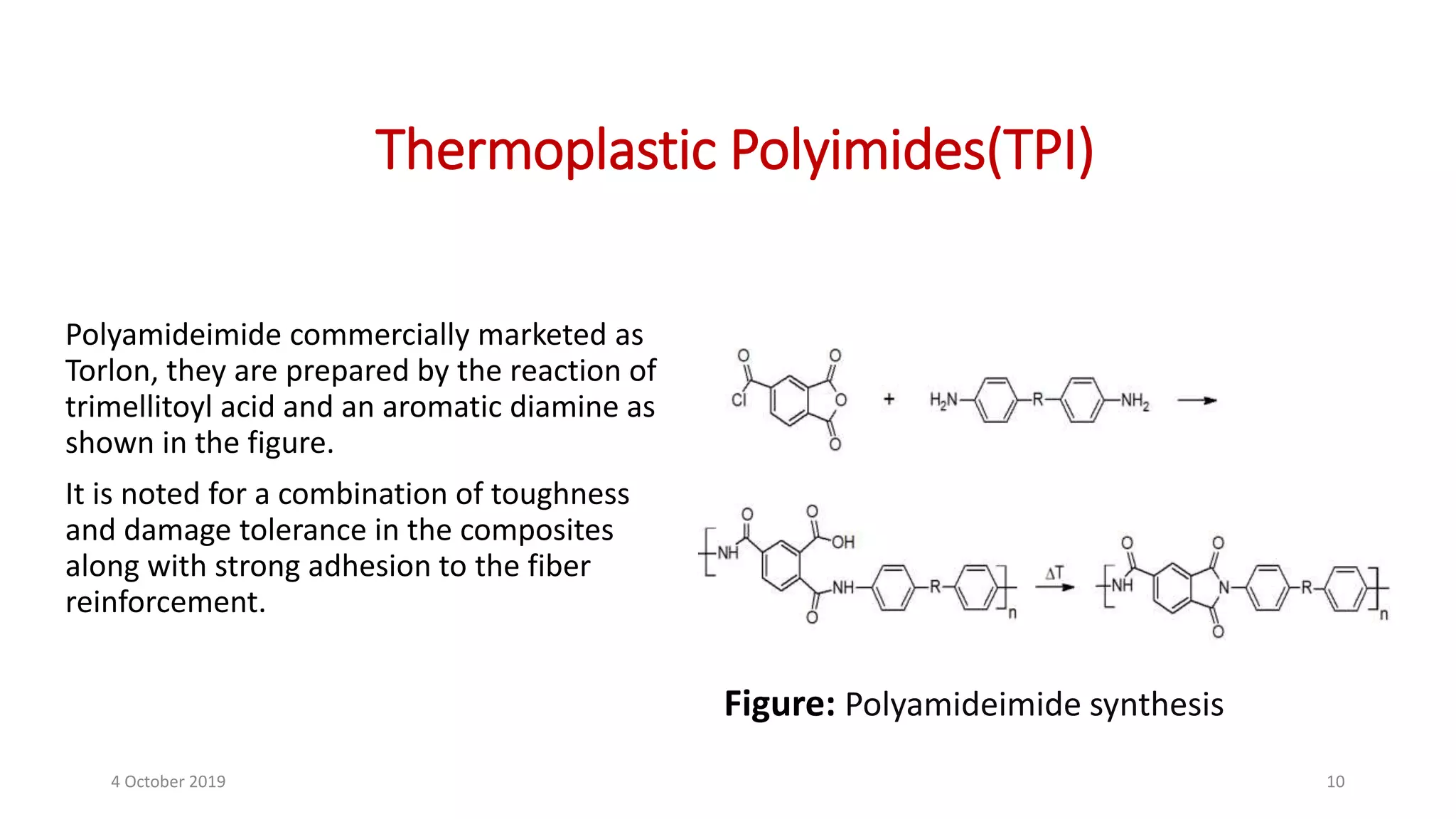
Thermoplastic Polyimides(TPI)
Polyamideimide commercially marketed as
Torlon, they are prepared by the reaction of
trimellitoyl acid and an aromatic diamine as
shown in the figure.
It is noted for a combination of toughness
and damage tolerance in the composites
along with strong adhesion to the fiber
reinforcement.
Figure: Polyamideimide synthesis
4 October 2019 10
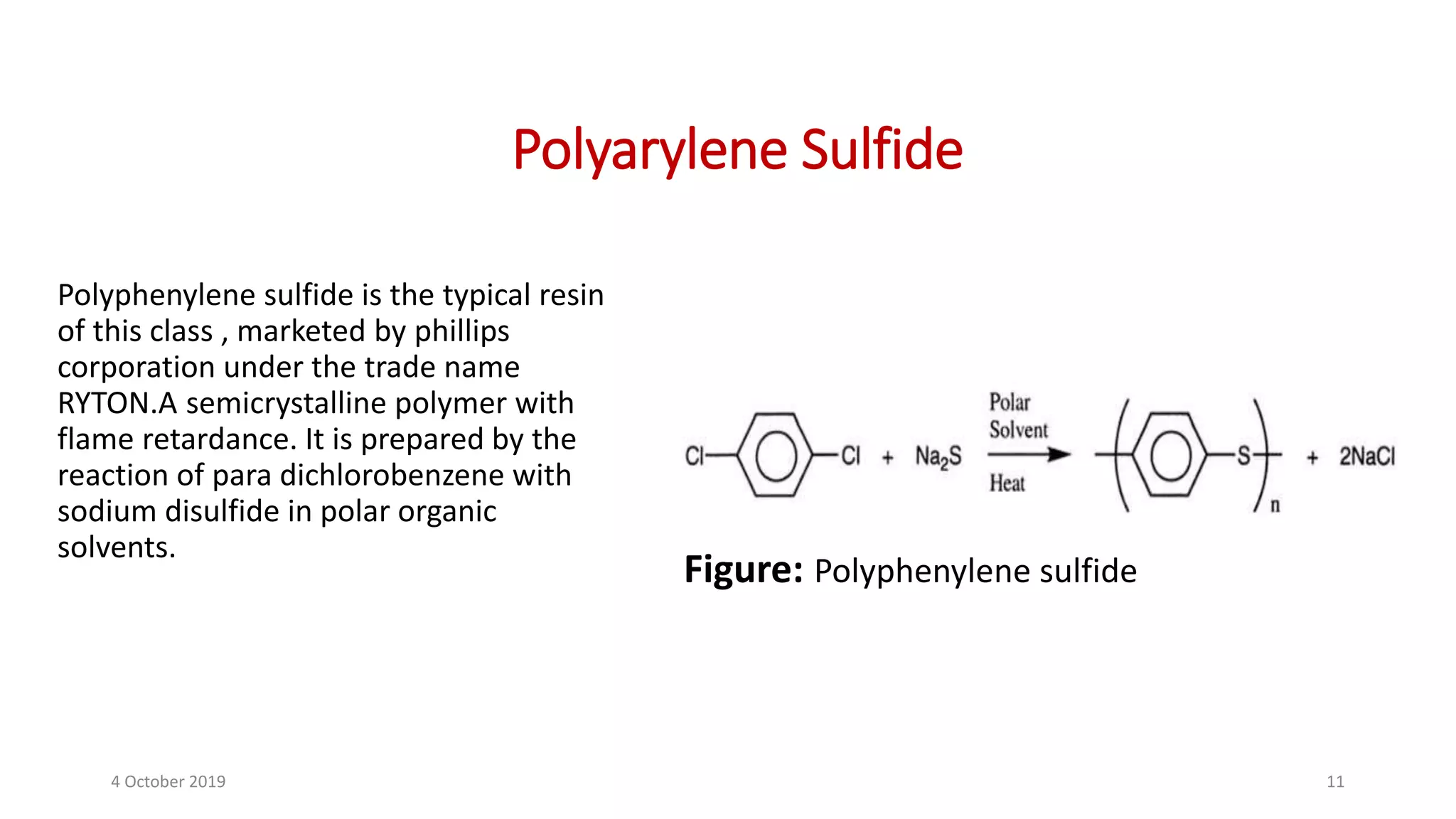
Polyarylene Sulfide
Polyphenylene sulfide is the typical resin
of this class , marketed by phillips
corporation under the trade name
RYTON.A semicrystalline polymer with
flame retardance. It is prepared by the
reaction of para dichlorobenzene with
sodium disulfide in polar organic
solvents.
Figure: Polyphenylene sulfide
4 October 2019 11
• Molecular composites may be regarded as rigid rod polymeric
materials as reinforcements , dispersed in a random coil polymer
matrix.
Molecular composite:
4 October 2019 12
Molecular entanglement ,as with Kevlar fibers and nylon-6 matrix.
Grafting , as with the flexible epoxy polymer grafted on to a Kevlar
backbone.
Block copolymerization effected between the hard and soft
segments.
How can we make molecular composite?
4 October 2019 13
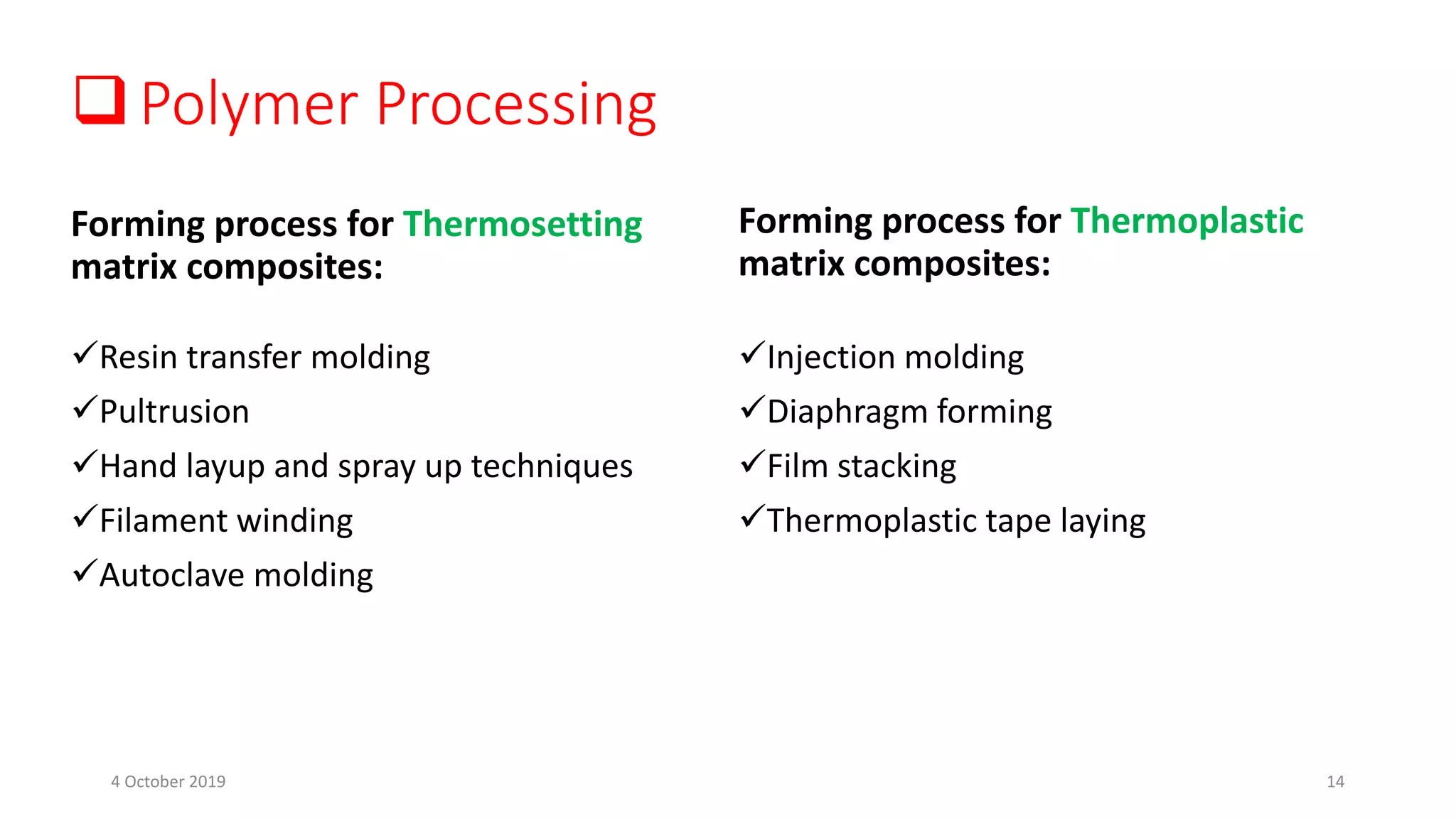
Polymer Processing
Forming process for Thermosetting
matrix composites:
Resin transfer molding
Pultrusion
Hand layup and spray up techniques
Filament winding
Autoclave molding
Forming process for Thermoplastic
matrix composites:
Injection molding
Diaphragm forming
Film stacking
Thermoplastic tape laying
4 October 2019 14
Resin Transfer Molding
• In which fiber preform or dry fiber reinforcement is packed into a mold
cavity that has the shape of the desired part and then supply the matrix to
form the product.
• A close molding process.
• Molding unit has two halves namely upper half mold (core) and lower half
mold (cavity)
4 October 2019 15
Resin Transfer Molding
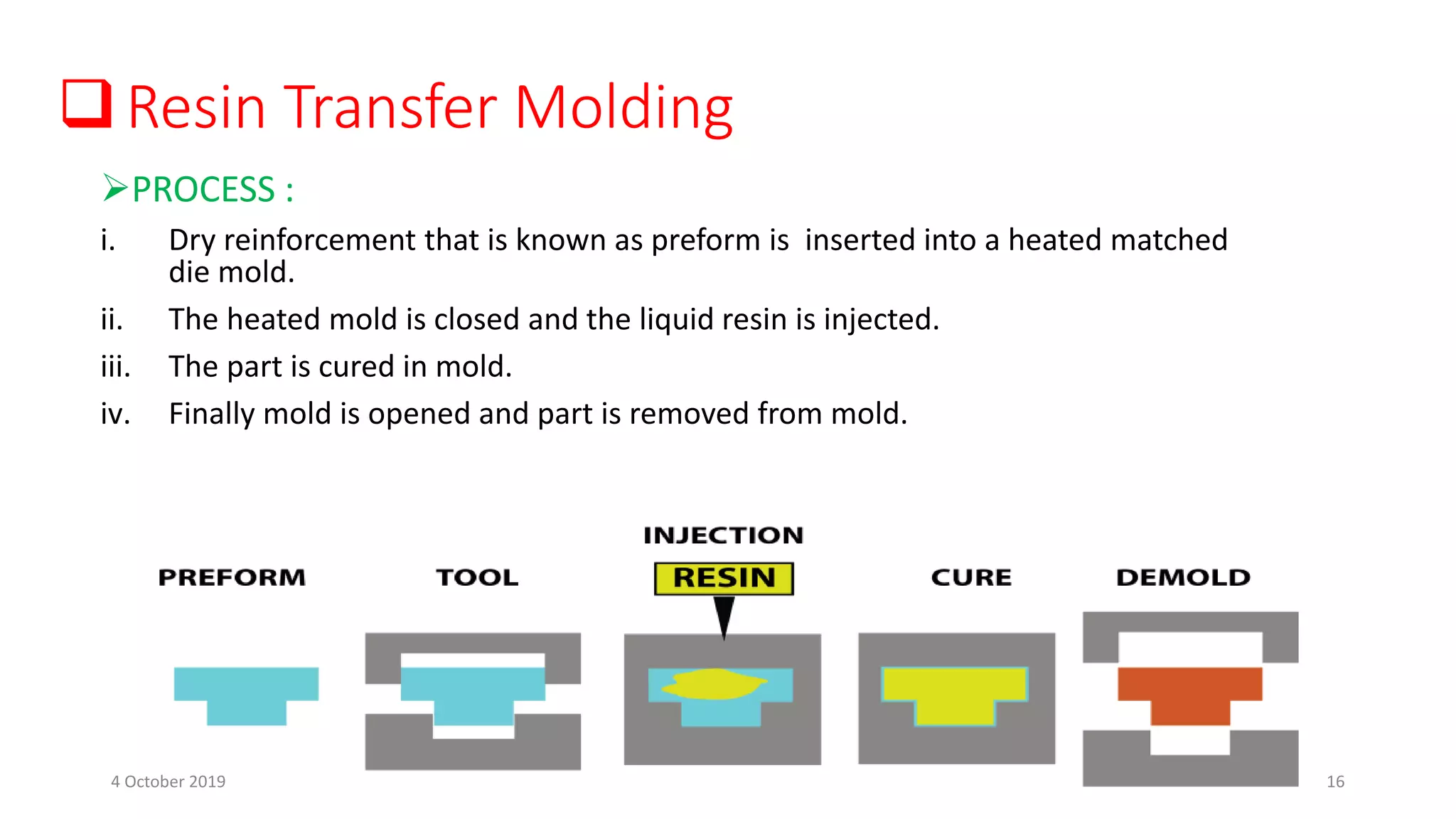
PROCESS :
i. Dry reinforcement that is known as preform is inserted into a heated matched
die mold.
ii. The heated mold is closed and the liquid resin is injected.
iii. The part is cured in mold.
iv. Finally mold is opened and part is removed from mold.
4 October 2019 16
Resin Transfer Molding
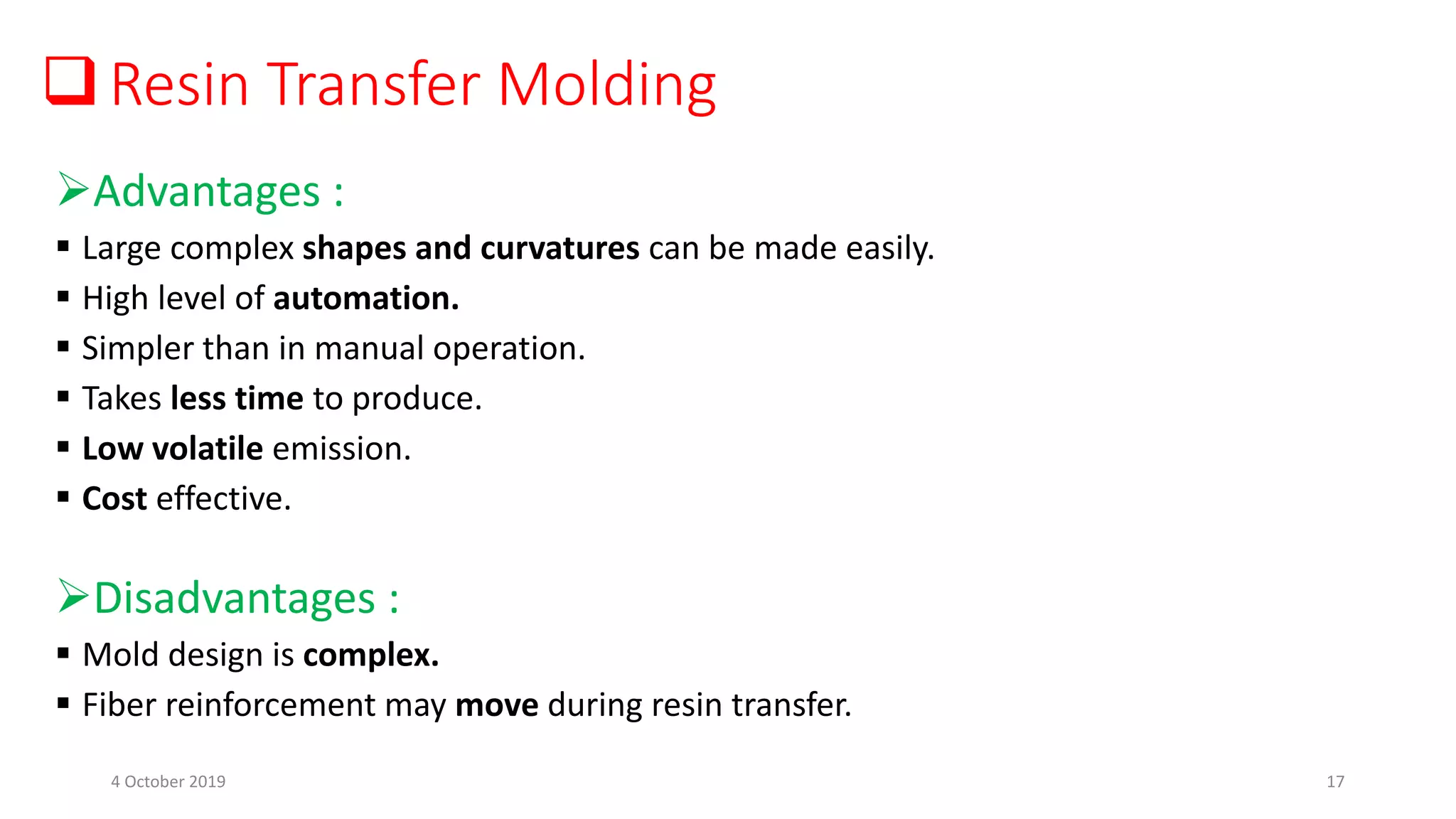
Advantages :
 Large complex shapes and curvatures can be made easily.
 High level of automation.
 Simpler than in manual operation.
 Takes less time to produce.
 Low volatile emission.
 Cost effective.
Disadvantages :
 Mold design is complex.
 Fiber reinforcement may move during resin transfer.
4 October 2019 17
Injection Molding
4 October 2019 18
Injection Molding
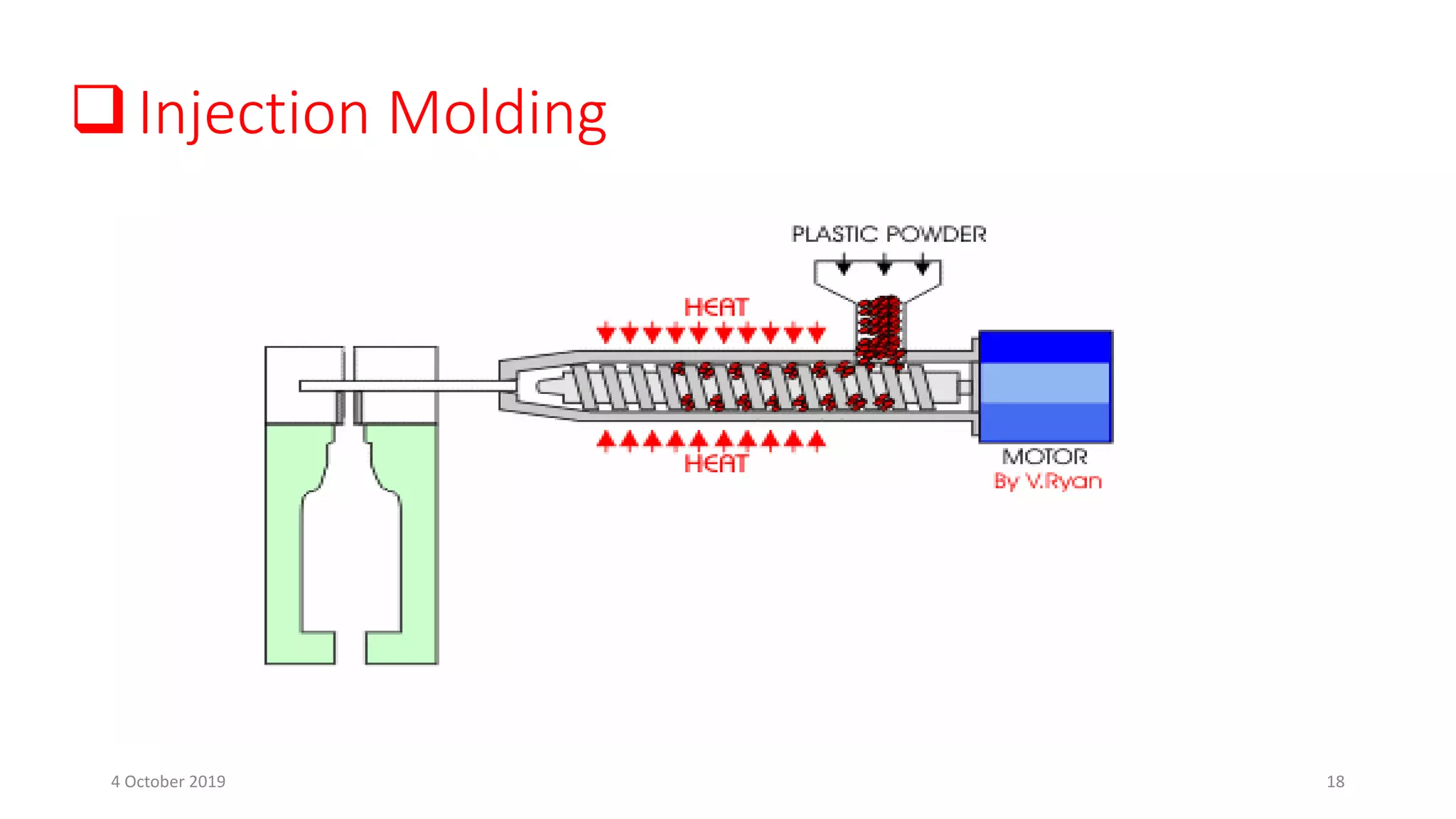
• Closed mold process.
• Polymer-fiber mixture in form od pellets is fed through a hopper.
• The material is then conveyed forward by a feeding screw and forced into a split mold,
filling its cavity through a feeding system with sprue gate and runners.
• Reciprocating screw since it not only rotates but also moves forward and backward
according to the steps of molding cycle.
• It acts as a ram in the filling step.
• Then retracts backward in molding step.
• Heating elements , placed over the barrel , soften and melt the polymer.
• The mold is equipped with a cooling system providing controlled cooling and
solidification of the material.
4 October 2019 19
Injection Molding
Advantages :
 Process can be fully automated.
 High productivity & quality.
 Price less low.
4 October 2019 20
 Application of PMCs
Aerospace & Military Aircraft:
 About 50% of advanced composites are used in aerospace industries in USA.
 The primary matrix materials used in this application are Epoxies, And the most common
reinforcements are Carbon/graphite(e.g.Kevlar), And high stiffness glass fibers.
 # So the Question is,, Why do they use PMCs?
 Compared to metals, the principle advantages in Aerospace applications are their superior
specific strength and stiffness, resulting in weight savings of 10 to 60 percent over metal
designs.
4 October 2019 21
 Application of PMCs
Aerospace & Military Aircraft:
4 October 2019 22
APPLICATION OF PMCs
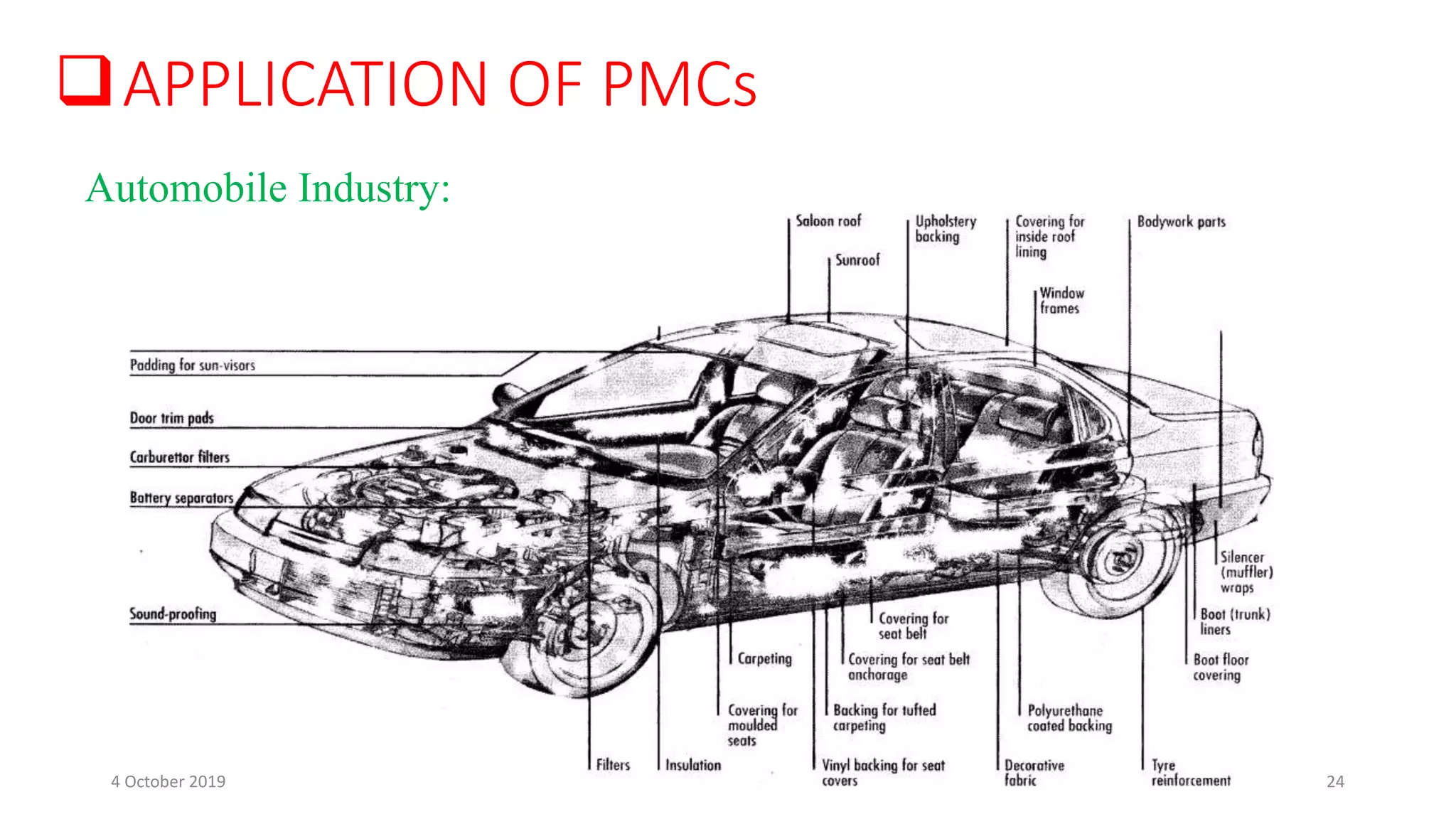
• The principle motivation for introducing PMCs is cost savings, Because
the industry is mature and highly competitive
• Because of greatly improved corrosion resistance PMC automobiles
could last 20 or more years compared to the current average vehicle
lifetime.
• Because of light weight , the gasoline cost will be reduced.
Automobile Industry:
4 October 2019 23
APPLICATION OF PMCs
Automobile Industry:
4 October 2019 24
APPLICATION OF PMCs
Construction:
A potentially high volume market for PMCs lies in construction
applications specially in…Construction of
• Buildings
• Bridges
• Housings
• Lampposts
• Highway culverts etc.
4 October 2019 25
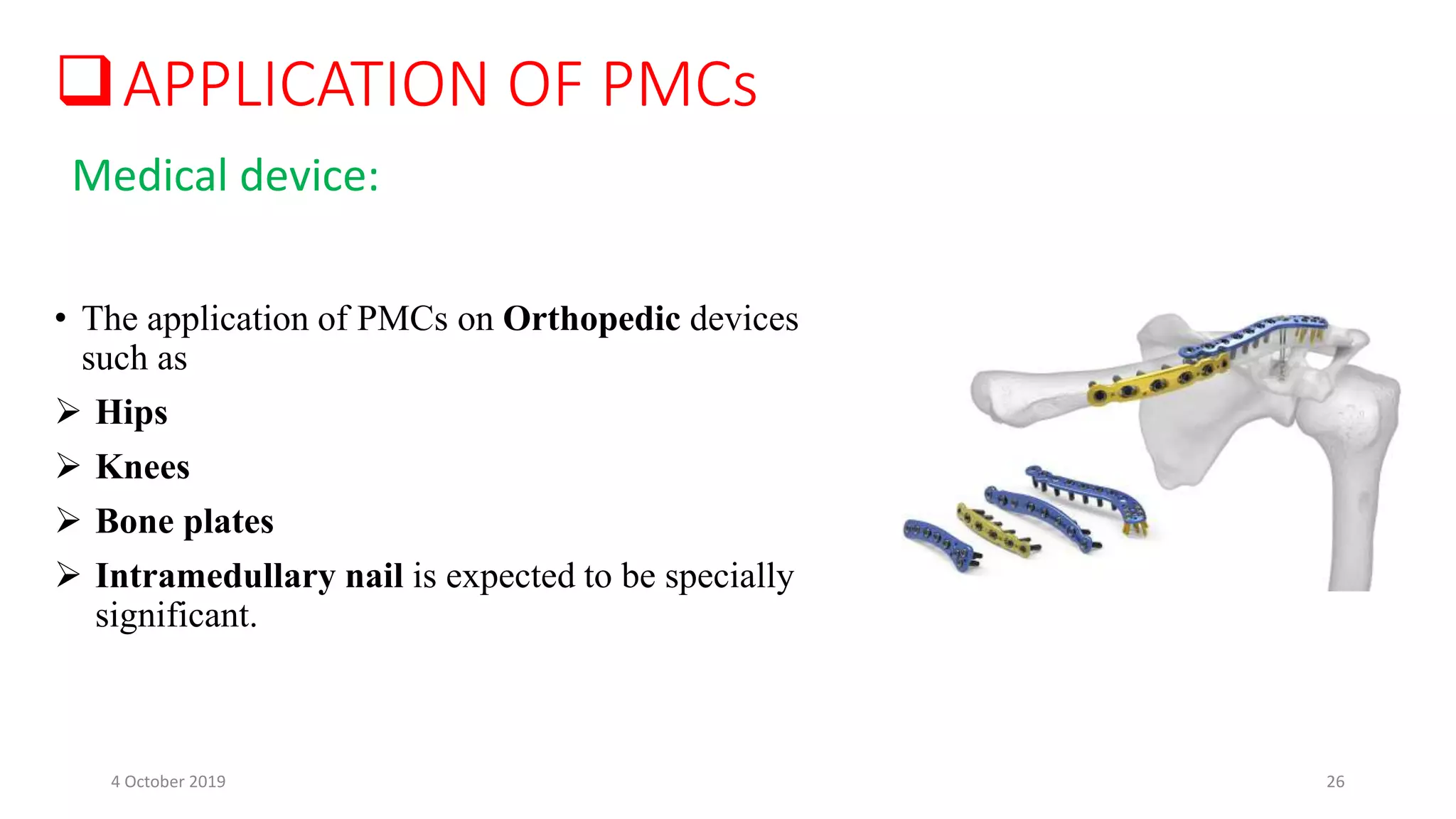
• The application of PMCs on Orthopedic devices
such as
 Hips
 Knees
 Bone plates
 Intramedullary nail is expected to be specially
significant.
APPLICATION OF PMCs
Medical device:
4 October 2019 26
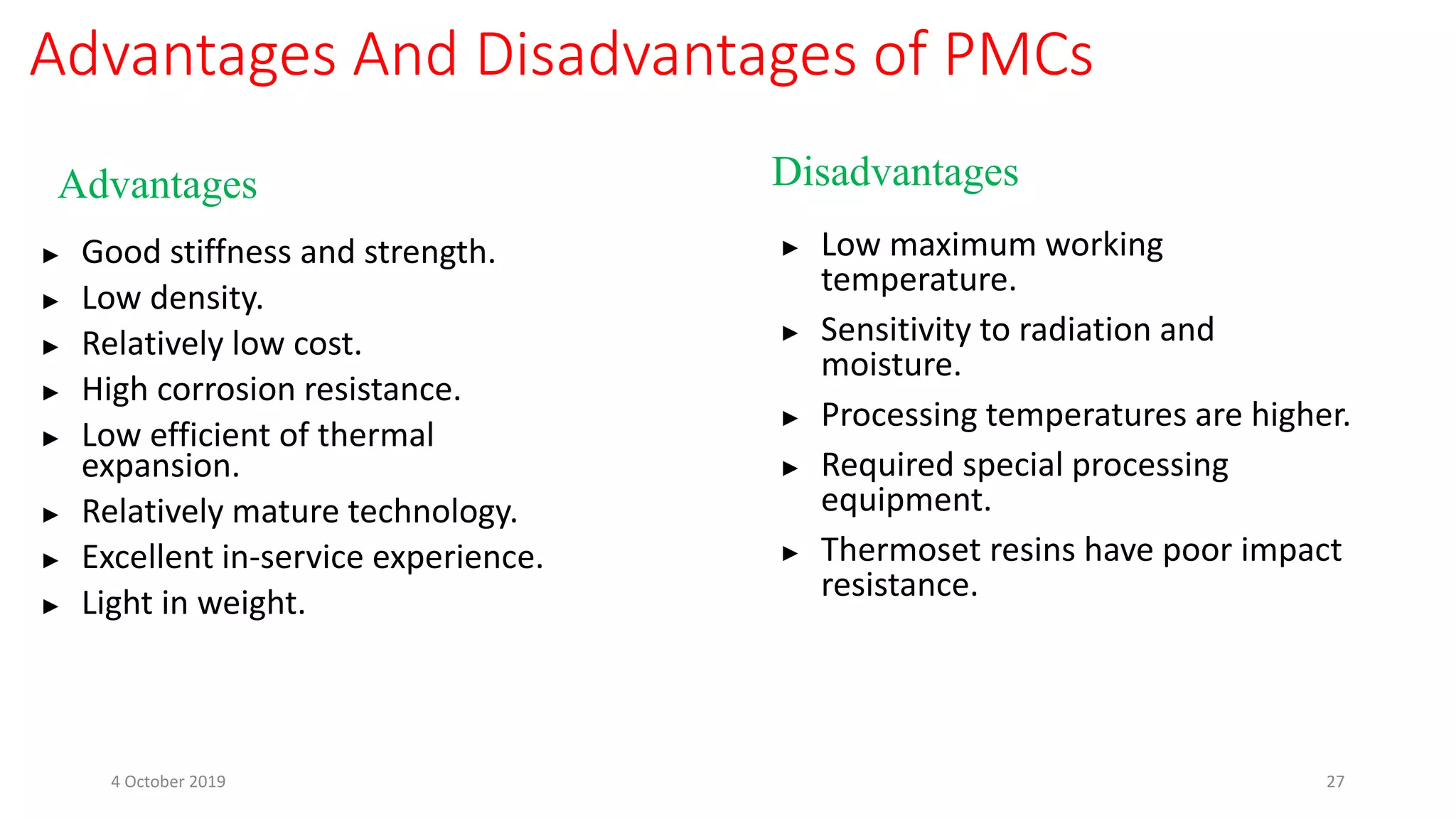
Advantages And Disadvantages of PMCs
Advantages Disadvantages
► Good stiffness and strength.
► Low density.
► Relatively low cost.
► High corrosion resistance.
► Low efficient of thermal
expansion.
► Relatively mature technology.
► Excellent in-service experience.
► Light in weight.
► Low maximum working
temperature.
► Sensitivity to radiation and
moisture.
► Processing temperatures are higher.
► Required special processing
equipment.
► Thermoset resins have poor impact
resistance.
4 October 2019 27
In 21st century, we are in need of light but stronger materials. From
automobile to aerospace, medical, military technology and even in
household, we need heavy duty, corrosion resistance materials.
And the use of composite in these sectors are really good initiative
and day by day The field sector is getting stronger. Among all the
composites PMC have a strong place due to its specialization.
Conclusion
4 October 2019 28
References:
We took help from
Book
Composite Materials –S.C. Sharma
Website
https://en.wikipedia.org
https://www.quora.com/
https://www.sciencedirect.com/topics/chemistry/epoxy-resin
https://www.britannica.com/technology/polymer-matrix-composite-material
https://link.springer.com/article/10.1007/s11837-018-2917-x
4 October 2019 29
Thank you all for being with us
4 October 2019 30

Polymer matrix composite

  • 1.
    Definition: Polymer Matrix Composite(PMC) is the material consisting of a polymer (resin) matrix combined with a fibrous reinforcing dispersed phase. Why we used the term “Resin” and what it mean???? Is it polymer??? Wikipedia answer it as , Polymer is a large molecule consisting of many repeating subunits. Resin is a solid or viscous material which gives a polymer after curing. Resins can be synthetic or natural and generally are mixtures of organic compounds. After polymerizarion or curing, resins form polymers. 4 October 2019 1 Polymer Matrix Composite
  • 2.
    Why we usedMatrix Resin?? Advantage and functions of Matrix Resin: 1. Provide a uniform distribution of the structural and environmental load to the reinforcing fiber through a good adhesion to and a strong interface with the reinforcement . 2. Protect the surface of the composite against abrasion , wear and tear, and corrosion , all of which can initiate fracture. 3. Absorb the impact loads and minimize stress concentrations by enhancing the fracture toughness. 4. Resist high temperature and withstand repeated cycling of operation , especially under hygroscopic conditions and thus prevent or delay the onset of microcracking in the composite. 4 October 2019 2
  • 3.
    Types of Resins: Chemicallythe Matrix Resins may be classified into two categories. 1. Thermosetting Resins and 2. Thermoplastic Resins Thermosetting Resins: Basically thermosetting resins are telechelic oligomers , which are hardened by heating and cannot be remolded. They form irreversible cross link during the curing process. Thermosets cross link during the curing process to form an irreversible bond 4 October 2019 3
  • 4.
    Common types ofresins:  Epoxy Resins  Phenolic Resins ( PF Resins)  Polyimides Resins  Cyanate Resins 4 October 2019 4
  • 5.
    Epoxy Resins Epoxy resinsmay be broadly classified into Bifunctional and Multifunctional types Difunctional Epoxies:The most common matrixs of this class is Diglycidyl ether or Bisphenol-A basic structure of which given in the figure-a. Where n varies between0.2 and 12 ,corresponding to a number-average molecular weight (Mn) of about 400 to 4300. Multifunctional Epoxies: The Epoxy-novolaks and the Tetrafunctional epoxy resin TGDMA are typical matrices of this class.The epoxy novolaks resulting result from the reaction of Epichlorohydrin with the novolak-phenolic,bearing 2 to 5 epoxy per molecule on average as shown as figure-b and TGDMA formed from the reacton of Methylene dianiline with Epichlorohydrin shown figure-c. Diglycidyl ether or Bisphenol-A Epoxy-novolaks 4 October 2019 5
  • 6.
    Phenolic Resins (PFResins) Phenol Resins are one of the oldest commercial matrices identified with the composites industry. Nowadays its used in special purpose such as aircraft application.PF Resins are prepared in two ways, 1.By an acid catalyzed reaction of phenol with less than a molar ratio of formaldehyde (<0.85) yielding a low melting thermoplastic solid known as a NOVOLAK. 2.By a base catalyzed reaction of phenol with excess formaldehyde (>3.0) to form a medium molecule weight liquid ,which can be heat cured or cure by acid or base to yield tightly cross linked PF matrices. The overall reaction sequence is shown figure-a Crosslinked resin 4 October 2019 6
  • 7.
    Polyimides Polyimide as matricesoffer unusually high heat resistance exceeding 300 degree as well as excellent thermo-oxidative stability. Cyanate Ester Cyanate ester resin matrices show better performance than the epoxies especially in filament winding ,compression molding and other operation. 4 October 2019 7
  • 8.
    Thermoplastic Resin Description: Thermoplastic resinsare raw, unshaped polymers that turn to liquid when heated and turn solid when cooled. They can be repeatedly remelted and remolded. Catagories: Polyaryl Ethers Thermoplastic Polyimides Polyarylene sulfides 4 October 2019 8
  • 9.
    Polyaryl Ethers (PAE) Polyarylethers are prepared from diaryl halides, activated by Sulfone, carbonyl or nitrile groups. Thus, Polyaryl ether sulfones are obtained by the nucleophilic displacement of 4,4′‐dichlorodiphenyl sulfone by disodium bisphenet. The ether linkages and isopropilidine groups provide the system with flexibility and toughness and help improve the processability at lower temperature. Figure: Chemical Reaction of Polyaryl Ether 4 October 2019 9
  • 10.
    Thermoplastic Polyimides(TPI) Polyamideimide commerciallymarketed as Torlon, they are prepared by the reaction of trimellitoyl acid and an aromatic diamine as shown in the figure. It is noted for a combination of toughness and damage tolerance in the composites along with strong adhesion to the fiber reinforcement. Figure: Polyamideimide synthesis 4 October 2019 10
  • 11.
    Polyarylene Sulfide Polyphenylene sulfideis the typical resin of this class , marketed by phillips corporation under the trade name RYTON.A semicrystalline polymer with flame retardance. It is prepared by the reaction of para dichlorobenzene with sodium disulfide in polar organic solvents. Figure: Polyphenylene sulfide 4 October 2019 11
  • 12.
    • Molecular compositesmay be regarded as rigid rod polymeric materials as reinforcements , dispersed in a random coil polymer matrix. Molecular composite: 4 October 2019 12
  • 13.
    Molecular entanglement ,aswith Kevlar fibers and nylon-6 matrix. Grafting , as with the flexible epoxy polymer grafted on to a Kevlar backbone. Block copolymerization effected between the hard and soft segments. How can we make molecular composite? 4 October 2019 13
  • 14.
    Polymer Processing Forming processfor Thermosetting matrix composites: Resin transfer molding Pultrusion Hand layup and spray up techniques Filament winding Autoclave molding Forming process for Thermoplastic matrix composites: Injection molding Diaphragm forming Film stacking Thermoplastic tape laying 4 October 2019 14
  • 15.
    Resin Transfer Molding •In which fiber preform or dry fiber reinforcement is packed into a mold cavity that has the shape of the desired part and then supply the matrix to form the product. • A close molding process. • Molding unit has two halves namely upper half mold (core) and lower half mold (cavity) 4 October 2019 15
  • 16.
    Resin Transfer Molding PROCESS: i. Dry reinforcement that is known as preform is inserted into a heated matched die mold. ii. The heated mold is closed and the liquid resin is injected. iii. The part is cured in mold. iv. Finally mold is opened and part is removed from mold. 4 October 2019 16
  • 17.
    Resin Transfer Molding Advantages:  Large complex shapes and curvatures can be made easily.  High level of automation.  Simpler than in manual operation.  Takes less time to produce.  Low volatile emission.  Cost effective. Disadvantages :  Mold design is complex.  Fiber reinforcement may move during resin transfer. 4 October 2019 17
  • 18.
  • 19.
    Injection Molding • Closedmold process. • Polymer-fiber mixture in form od pellets is fed through a hopper. • The material is then conveyed forward by a feeding screw and forced into a split mold, filling its cavity through a feeding system with sprue gate and runners. • Reciprocating screw since it not only rotates but also moves forward and backward according to the steps of molding cycle. • It acts as a ram in the filling step. • Then retracts backward in molding step. • Heating elements , placed over the barrel , soften and melt the polymer. • The mold is equipped with a cooling system providing controlled cooling and solidification of the material. 4 October 2019 19
  • 20.
    Injection Molding Advantages : Process can be fully automated.  High productivity & quality.  Price less low. 4 October 2019 20
  • 21.
     Application ofPMCs Aerospace & Military Aircraft:  About 50% of advanced composites are used in aerospace industries in USA.  The primary matrix materials used in this application are Epoxies, And the most common reinforcements are Carbon/graphite(e.g.Kevlar), And high stiffness glass fibers.  # So the Question is,, Why do they use PMCs?  Compared to metals, the principle advantages in Aerospace applications are their superior specific strength and stiffness, resulting in weight savings of 10 to 60 percent over metal designs. 4 October 2019 21
  • 22.
     Application ofPMCs Aerospace & Military Aircraft: 4 October 2019 22
  • 23.
    APPLICATION OF PMCs •The principle motivation for introducing PMCs is cost savings, Because the industry is mature and highly competitive • Because of greatly improved corrosion resistance PMC automobiles could last 20 or more years compared to the current average vehicle lifetime. • Because of light weight , the gasoline cost will be reduced. Automobile Industry: 4 October 2019 23
  • 24.
    APPLICATION OF PMCs AutomobileIndustry: 4 October 2019 24
  • 25.
    APPLICATION OF PMCs Construction: Apotentially high volume market for PMCs lies in construction applications specially in…Construction of • Buildings • Bridges • Housings • Lampposts • Highway culverts etc. 4 October 2019 25
  • 26.
    • The applicationof PMCs on Orthopedic devices such as  Hips  Knees  Bone plates  Intramedullary nail is expected to be specially significant. APPLICATION OF PMCs Medical device: 4 October 2019 26
  • 27.
    Advantages And Disadvantagesof PMCs Advantages Disadvantages ► Good stiffness and strength. ► Low density. ► Relatively low cost. ► High corrosion resistance. ► Low efficient of thermal expansion. ► Relatively mature technology. ► Excellent in-service experience. ► Light in weight. ► Low maximum working temperature. ► Sensitivity to radiation and moisture. ► Processing temperatures are higher. ► Required special processing equipment. ► Thermoset resins have poor impact resistance. 4 October 2019 27
  • 28.
    In 21st century,we are in need of light but stronger materials. From automobile to aerospace, medical, military technology and even in household, we need heavy duty, corrosion resistance materials. And the use of composite in these sectors are really good initiative and day by day The field sector is getting stronger. Among all the composites PMC have a strong place due to its specialization. Conclusion 4 October 2019 28
  • 29.
    References: We took helpfrom Book Composite Materials –S.C. Sharma Website https://en.wikipedia.org https://www.quora.com/ https://www.sciencedirect.com/topics/chemistry/epoxy-resin https://www.britannica.com/technology/polymer-matrix-composite-material https://link.springer.com/article/10.1007/s11837-018-2917-x 4 October 2019 29
  • 30.
    Thank you allfor being with us 4 October 2019 30

Editor's Notes

  • #4 Telechelic oligomers:A telechelic polymer or oligomer is a prepolymer capable of entering into further polymerization or other reactions through its reactive end-groups. Curing:Process that produces the toughening or hardening of a polymer material by cross-linking of polymer chains.