GENERAL MATHEMATICS
Function Operations and
Composition of Functions
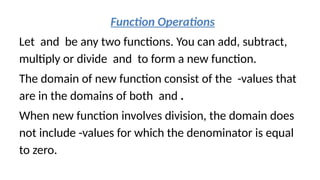
Function Operations
Let and be any two functions. You can add, subtract,
multiply or divide and to form a new function.
The domain of new function consist of the -values that
are in the domains of both and .
When new function involves division, the domain does
not include -values for which the denominator is equal
to zero.
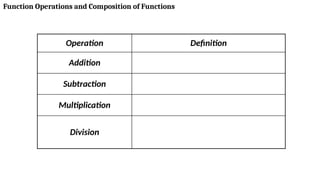
Function Operations and Composition of Functions
Operation Definition
Addition
Subtraction
Multiplication
Division
Function Operations and Composition of Functions
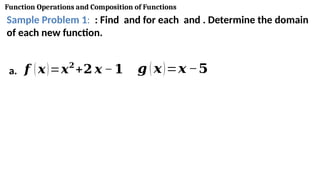
Sample Problem 1: : Find and for each and . Determine the domain
of each new function.
a. 𝒇 (𝒙)=𝒙𝟐
+𝟐 𝒙 −𝟏 𝒈 (𝒙)=𝒙 −𝟓
Function Operations and Composition of Functions
Sample Problem 1: : Find and for each and . Determine the domain
of each new function.
a. 𝒇 (𝒙)=𝒙𝟐
+𝟐 𝒙 −𝟏 𝒈 (𝒙)=𝒙 −𝟓
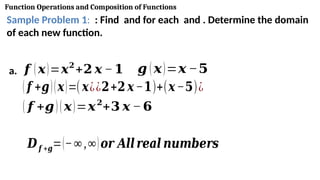
( 𝒇 +𝒈)(𝒙)=(𝒙¿¿𝟐+𝟐 𝒙−𝟏)+(𝒙−𝟓)¿
( 𝒇 +𝒈)(𝒙)=𝒙𝟐
+𝟑 𝒙 −𝟔
𝑫𝒇 +𝒈=(−∞,∞)𝒐𝒓 𝑨𝒍𝒍𝒓𝒆𝒂𝒍 𝒏𝒖𝒎𝒃𝒆𝒓𝒔
Function Operations and Composition of Functions
Sample Problem 1: : Find and for each and . Determine the domain
of each new function.
a. 𝒇 (𝒙)=𝒙𝟐
+𝟐 𝒙 −𝟏 𝒈 (𝒙)=𝒙 −𝟓
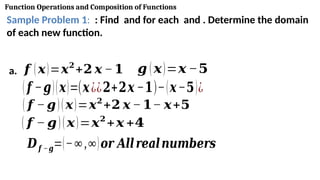
( 𝒇 −𝒈)(𝒙)=(𝒙¿¿𝟐+𝟐𝒙 −𝟏)−(𝒙−𝟓)¿
( 𝒇 −𝒈)(𝒙)=𝒙𝟐
+𝟐 𝒙 −𝟏− 𝒙+𝟓
𝑫𝒇 −𝒈=(−∞,∞)𝒐𝒓 𝑨𝒍𝒍𝒓𝒆𝒂𝒍𝒏𝒖𝒎𝒃𝒆𝒓𝒔
( 𝒇 − 𝒈) ( 𝒙)=𝒙𝟐
+𝒙 +𝟒
Function Operations and Composition of Functions
Sample Problem 1: : Find and for each and . Determine the domain
of each new function.
a. 𝒇 (𝒙)=𝒙𝟐
+𝟐 𝒙 −𝟏 𝒈 (𝒙)=𝒙 −𝟓
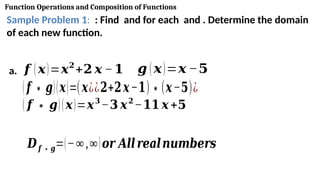
(𝒇 ∗𝒈)(𝒙)=(𝒙¿¿𝟐+𝟐𝒙−𝟏)∗(𝒙−𝟓)¿
( 𝒇 ∗ 𝒈)(𝒙)=𝒙𝟑
−𝟑 𝒙𝟐
−𝟏𝟏 𝒙+𝟓
𝑫𝒇 ∗𝒈=(−∞,∞)𝒐𝒓 𝑨𝒍𝒍𝒓𝒆𝒂𝒍𝒏𝒖𝒎𝒃𝒆𝒓𝒔
Function Operations and Composition of Functions
Sample Problem 1: : Find and for each and . Determine the domain
of each new function.
a. 𝒇 (𝒙)=𝒙𝟐
+𝟐 𝒙 −𝟏 𝒈 (𝒙)=𝒙 −𝟓
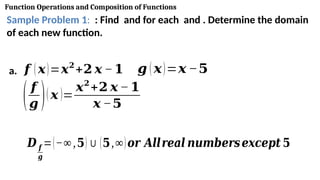
(𝒇
𝒈 )( 𝒙 )=
𝒙𝟐
+𝟐 𝒙 −𝟏
𝒙 −𝟓
𝑫 𝒇
𝒈
=(−∞,𝟓)∪(𝟓,∞)𝒐𝒓 𝑨𝒍𝒍𝒓𝒆𝒂𝒍 𝒏𝒖𝒎𝒃𝒆𝒓𝒔𝒆𝒙𝒄𝒆𝒑𝒕 𝟓
Function Operations and Composition of Functions
Sample Problem 1: : Find and for each and . Determine the domain
of each new function.
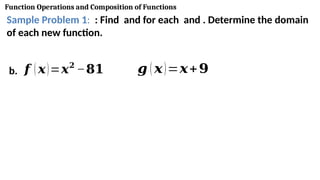
b. 𝒇 (𝒙)=𝒙𝟐
−𝟖𝟏 𝒈 ( 𝒙)=𝒙+𝟗
Function Operations and Composition of Functions
Sample Problem 1: : Find and for each and . Determine the domain
of each new function.
b. 𝒇 (𝒙)=𝒙𝟐
−𝟖𝟏 𝒈 ( 𝒙)=𝒙+𝟗
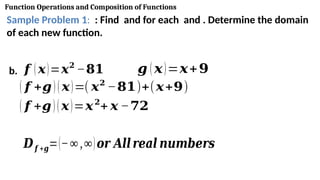
( 𝒇 +𝒈) ( 𝒙)=( 𝒙𝟐
−𝟖𝟏)+(𝒙+𝟗)
( 𝒇 +𝒈) (𝒙)=𝒙𝟐
+ 𝒙 −𝟕𝟐
𝑫𝒇 +𝒈=(−∞,∞)𝒐𝒓 𝑨𝒍𝒍𝒓𝒆𝒂𝒍 𝒏𝒖𝒎𝒃𝒆𝒓𝒔
Function Operations and Composition of Functions
Sample Problem 1: : Find and for each and . Determine the domain
of each new function.
b. 𝒇 (𝒙)=𝒙𝟐
−𝟖𝟏 𝒈 ( 𝒙)=𝒙+𝟗
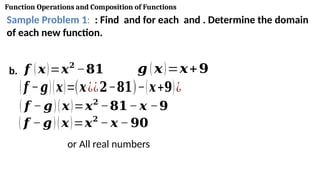
( 𝒇 −𝒈)(𝒙)=(𝒙¿¿𝟐−𝟖𝟏)−(𝒙+𝟗)¿
( 𝒇 −𝒈)(𝒙)=𝒙𝟐
−𝟖𝟏−𝒙 −𝟗
or All real numbers
( 𝒇 −𝒈)(𝒙)=𝒙𝟐
−𝒙 −𝟗𝟎
Function Operations and Composition of Functions
Sample Problem 1: : Find and for each and . Determine the domain
of each new function.
b. 𝒇 (𝒙)=𝒙𝟐
−𝟖𝟏 𝒈 ( 𝒙)=𝒙+𝟗
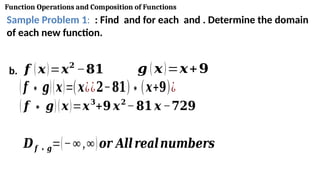
(𝒇 ∗𝒈)(𝒙)=(𝒙¿¿𝟐−𝟖𝟏)∗(𝒙+𝟗)¿
( 𝒇 ∗ 𝒈)(𝒙)=𝒙𝟑
+𝟗 𝒙𝟐
−𝟖𝟏 𝒙−𝟕𝟐𝟗
𝑫𝒇 ∗𝒈=(−∞,∞)𝒐𝒓 𝑨𝒍𝒍𝒓𝒆𝒂𝒍𝒏𝒖𝒎𝒃𝒆𝒓𝒔
Function Operations and Composition of Functions
Sample Problem 1: : Find and for each and . Determine the domain
of each new function.
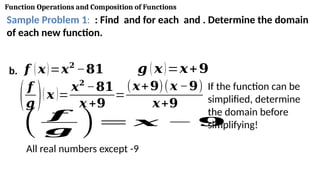
b. 𝒇 (𝒙)=𝒙𝟐
−𝟖𝟏 𝒈 ( 𝒙)=𝒙+𝟗
(𝒇
𝒈 )(𝒙 )=
𝒙𝟐
−𝟖𝟏
𝒙 +𝟗
=
(𝒙+𝟗)(𝒙 −𝟗)
𝒙+𝟗
All real numbers except -9
( 𝒇
𝒈 )= 𝒙 − 𝟗
If the function can be
simplified, determine
the domain before
simplifying!
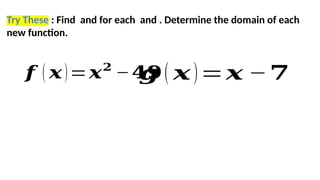
Try These : Find and for each and . Determine the domain of each
new function.
𝒇 ( 𝒙)=𝒙𝟐
−𝟒𝟗
𝒈 ( 𝒙)=𝒙 −𝟕
ANSWERS:
1.
2.
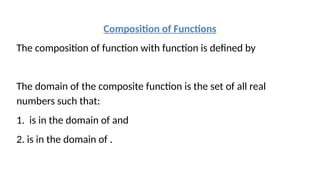
Composition of Functions
The composition of function with function is defined by
The domain of the composite function is the set of all real
numbers such that:
1. is in the domain of and
2. is in the domain of .
Function Operations and Composition of Functions
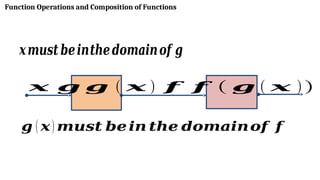
𝒙𝒎𝒖𝒔𝒕 𝒃𝒆𝒊𝒏𝒕𝒉𝒆𝒅𝒐𝒎𝒂𝒊𝒏𝒐𝒇 𝒈
𝒈 ( 𝒙) 𝒎𝒖𝒔𝒕 𝒃𝒆𝒊𝒏 𝒕𝒉𝒆 𝒅𝒐𝒎𝒂𝒊𝒏𝒐𝒇 𝒇
𝒙 𝒈 𝒈 ( 𝒙 ) 𝒇 𝒇 ( 𝒈 ( 𝒙 ))
Function Operations and Composition of Functions
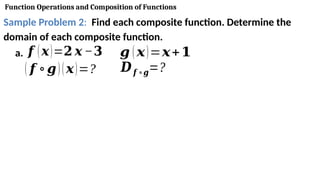
Sample Problem 2: Find each composite function. Determine the
domain of each composite function.
a. 𝒇 (𝒙)=𝟐 𝒙 −𝟑 𝒈 ( 𝒙)=𝒙+𝟏
( 𝒇 ∘𝒈)(𝒙)=? 𝑫𝒇 ∘𝒈=?
Function Operations and Composition of Functions
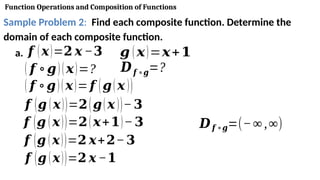
Sample Problem 2: Find each composite function. Determine the
domain of each composite function.
a. 𝒇 (𝒙)=𝟐 𝒙 −𝟑 𝒈 ( 𝒙)=𝒙+𝟏
( 𝒇 ∘𝒈)(𝒙)=? 𝑫𝒇 ∘𝒈=?
( 𝒇 ∘𝒈)(𝒙)=𝒇 (𝒈(𝒙 ))
𝒇 (𝒈 (𝒙))=𝟐(𝒈(𝒙 ))−𝟑
𝒇 (𝒈 (𝒙))=𝟐(𝒙+𝟏)−𝟑
𝒇 (𝒈 (𝒙))=𝟐 𝒙+𝟐−𝟑
𝒇 (𝒈 (𝒙))=𝟐 𝒙 −𝟏
𝑫𝒇 ∘𝒈=(−∞ ,∞)
Function Operations and Composition of Functions
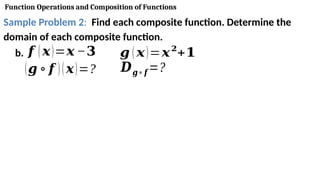
Sample Problem 2: Find each composite function. Determine the
domain of each composite function.
b. 𝒇 (𝒙)=𝒙 −𝟑 𝒈 ( 𝒙)=𝒙𝟐
+𝟏
(𝒈 ∘ 𝒇 )(𝒙)=? 𝑫𝒈∘ 𝒇 =?
Function Operations and Composition of Functions
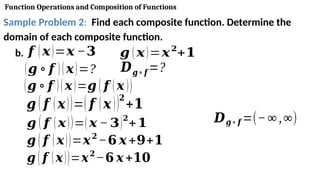
Sample Problem 2: Find each composite function. Determine the
domain of each composite function.
b. 𝒇 (𝒙)=𝒙 −𝟑 𝒈 ( 𝒙)=𝒙𝟐
+𝟏
(𝒈 ∘ 𝒇 )(𝒙)=? 𝑫𝒈∘ 𝒇 =?
(𝒈 ∘ 𝒇 )(𝒙)=𝒈 ( 𝒇 (𝒙 ))
𝒈 ( 𝒇 (𝒙))=( 𝒇 (𝒙))𝟐
+𝟏
𝒈 ( 𝒇 ( 𝒙))=( 𝒙 −𝟑)𝟐
+𝟏
𝒈 ( 𝒇 (𝒙))=𝒙𝟐
−𝟔 𝒙 +𝟗+𝟏
𝒈 ( 𝒇 (𝒙))=𝒙𝟐
−𝟔 𝒙+𝟏𝟎
𝑫𝒈∘ 𝒇 =(−∞ ,∞)
Function Operations and Composition of Functions
Sample Problem 2: Find each composite function. Determine the
domain of each composite function.
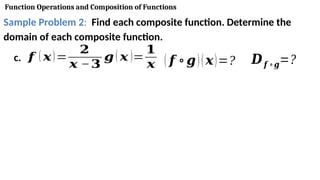
c. 𝒇 ( 𝒙)=
𝟐
𝒙 −𝟑
𝒈( 𝒙 )=
𝟏
𝒙 ( 𝒇 ∘𝒈)(𝒙)=? 𝑫𝒇 ∘𝒈=?
Function Operations and Composition of Functions
Sample Problem 2: Find each composite function. Determine the
domain of each composite function.
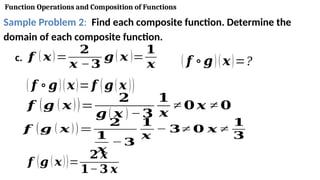
c. 𝒇 ( 𝒙)=
𝟐
𝒙 −𝟑
𝒈( 𝒙 )=
𝟏
𝒙 ( 𝒇 ∘𝒈)(𝒙)=?
( 𝒇 ∘𝒈)(𝒙)=𝒇 (𝒈(𝒙 ))
𝒇 (𝒈 ( 𝒙))=
𝟐
𝒈 ( 𝒙 ) −𝟑
𝟏
𝒙
≠ 𝟎 𝒙 ≠ 𝟎
𝒇 (𝒈 ( 𝒙 ))=
𝟐
𝟏
𝒙
−𝟑
𝟏
𝒙
− 𝟑≠ 𝟎 𝒙 ≠
𝟏
𝟑
𝒇 (𝒈 (𝒙))=
𝟐 𝒙
𝟏−𝟑 𝒙
Function Operations and Composition of Functions
Sample Problem 2: Find each composite function. Determine the
domain of each composite function.
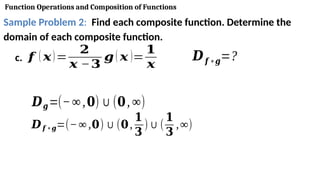
c. 𝒇 ( 𝒙)=
𝟐
𝒙 −𝟑
𝒈( 𝒙 )=
𝟏
𝒙
𝑫𝒇 ∘𝒈=?
𝑫𝒈=(−∞,𝟎)∪(𝟎, ∞)
𝑫𝒇 ∘𝒈=(−∞ ,𝟎)∪(𝟎,
𝟏
𝟑
)∪(
𝟏
𝟑
,∞)
Function Operations and Composition of Functions
Sample Problem 2: Find each composite function. Determine the
domain of each composite function.
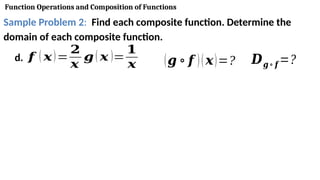
d. 𝒇 ( 𝒙)=
𝟐
𝒙
𝒈( 𝒙 )=
𝟏
𝒙 (𝒈 ∘ 𝒇 )(𝒙)=? 𝑫𝒈∘ 𝒇 =?
Function Operations and Composition of Functions
Sample Problem 2: Find each composite function. Determine the
domain of each composite function.
d. 𝒇 ( 𝒙)=
𝟐
𝒙
𝒈( 𝒙 )=
𝟏
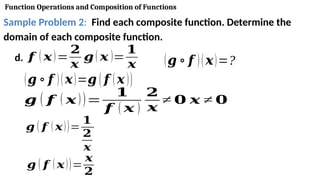
𝒙 (𝒈 ∘ 𝒇 )(𝒙)=?
(𝒈 ∘ 𝒇 )(𝒙)=𝒈 ( 𝒇 (𝒙 ))
𝒈 ( 𝒇 ( 𝒙))=
𝟏
𝟐
𝒙
𝒈 ( 𝒇 ( 𝒙))=
𝒙
𝟐
𝒈 ( 𝒇 ( 𝒙))=
𝟏
𝒇 ( 𝒙 )
𝟐
𝒙
≠ 𝟎 𝒙 ≠ 𝟎
Function Operations and Composition of Functions
Sample Problem 2: Find each composite function. Determine the
domain of each composite function.
d. 𝒇 ( 𝒙)=
𝟐
𝒙
𝒈( 𝒙 )=
𝟏
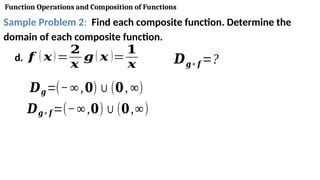
𝒙 𝑫𝒈∘ 𝒇 =?
𝑫𝒈=(−∞,𝟎)∪(𝟎, ∞)
𝑫𝒈∘ 𝒇 =(−∞,𝟎)∪(𝟎,∞)
Function Operations and Composition of Functions
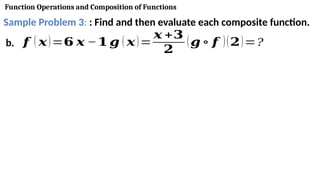
Sample Problem 3: : Find and then evaluate each composite function.
a. 𝒇 ( 𝒙)=√ 𝒙 𝒈 ( 𝒙)=𝒙 −𝟐 ( 𝒇 ∘𝒈)(𝟔)=?
Function Operations and Composition of Functions
Sample Problem 3: : Find and then evaluate each composite function.
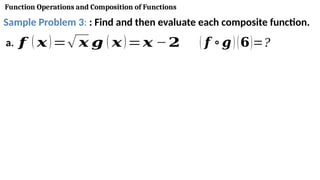
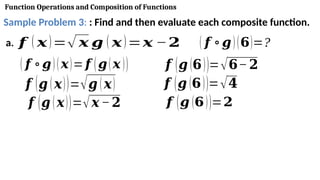
a. 𝒇 ( 𝒙)=√ 𝒙 𝒈 ( 𝒙)=𝒙 −𝟐 ( 𝒇 ∘𝒈)(𝟔)=?
( 𝒇 ∘𝒈)(𝒙)=𝒇 (𝒈(𝒙 ))
𝒇 (𝒈 (𝒙))=√𝒈 (𝒙)
𝒇 (𝒈 (𝒙))=√𝒙−𝟐
𝒇 (𝒈 (𝟔))=√𝟔−𝟐
𝒇 (𝒈 (𝟔))=√𝟒
𝒇 (𝒈 (𝟔))=𝟐
Function Operations and Composition of Functions
Sample Problem 3: : Find and then evaluate each composite function.
b. 𝒇 ( 𝒙)=𝟔 𝒙 −𝟏𝒈 ( 𝒙)=
𝒙 +𝟑
𝟐
(𝒈∘ 𝒇 )(𝟐)=?
Function Operations and Composition of Functions
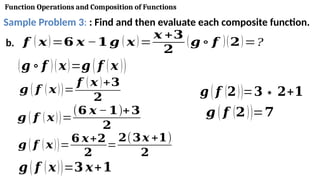
Sample Problem 3: : Find and then evaluate each composite function.
b. 𝒇 ( 𝒙)=𝟔 𝒙 −𝟏𝒈 ( 𝒙)=
𝒙 +𝟑
𝟐
(𝒈∘ 𝒇 )(𝟐)=?
(𝒈 ∘ 𝒇 )(𝒙)=𝒈 ( 𝒇 (𝒙 ))
𝒈 ( 𝒇 ( 𝒙))=
𝒇 ( 𝒙 )+𝟑
𝟐
𝒈 ( 𝒇 ( 𝒙))=
(𝟔 𝒙 − 𝟏)+𝟑
𝟐
𝒈 ( 𝒇 ( 𝒙))=
𝟔 𝒙+𝟐
𝟐
=
𝟐(𝟑𝒙 +𝟏)
𝟐
𝒈 ( 𝒇 (𝒙))=𝟑 𝒙+𝟏
𝒈 ( 𝒇 (𝟐))=𝟑∗𝟐+𝟏
𝒈 ( 𝒇 (𝟐))=𝟕
Function Operations and Composition of Functions
Decomposition of Composite Functions
When you form a composite function, you “compose”
two functions to form a new function. It is also
possible to reverse this process. You can “decompose”
a given function and express it as a composition of
two functions. Although there is more than one way
to do this, there is often a “natural” selection that
comes to mind first.
Function Operations and Composition of Functions
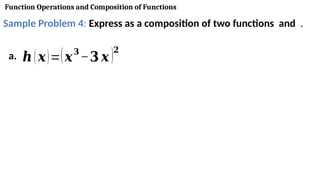
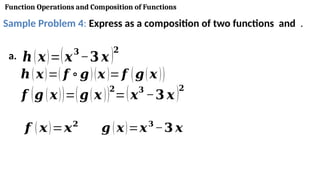
Sample Problem 4: Express as a composition of two functions and .
a. 𝒉(𝒙)=(𝒙𝟑
−𝟑 𝒙)𝟐
Function Operations and Composition of Functions
Sample Problem 4: Express as a composition of two functions and .
a. 𝒉(𝒙)=(𝒙𝟑
−𝟑 𝒙)𝟐
𝒉(𝒙)=( 𝒇 ∘𝒈)(𝒙 )=𝒇 (𝒈(𝒙 ))
𝒇 (𝒈 (𝒙))=(𝒈(𝒙 ))𝟐
=(𝒙
𝟑
−𝟑 𝒙 )𝟐
𝒇 ( 𝒙)=𝒙𝟐
𝒈 (𝒙)=𝒙𝟑
−𝟑 𝒙
Function Operations and Composition of Functions
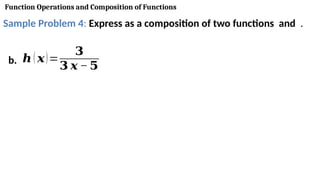
Sample Problem 4: Express as a composition of two functions and .
b. 𝒉 ( 𝒙)=
𝟑
𝟑 𝒙 − 𝟓
Function Operations and Composition of Functions
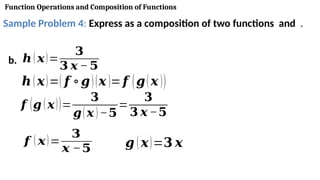
Sample Problem 4: Express as a composition of two functions and .
b. 𝒉 ( 𝒙)=
𝟑
𝟑 𝒙 − 𝟓
𝒉(𝒙)=( 𝒇 ∘𝒈)(𝒙 )=𝒇 (𝒈(𝒙 ))
𝒇 (𝒈 (𝒙))=
𝟑
𝒈(𝒙 )−𝟓
=
𝟑
𝟑 𝒙 −𝟓
𝒇 ( 𝒙)=
𝟑
𝒙 −𝟓 𝒈 (𝒙)=𝟑 𝒙

Function-Operationsand-Compositionof-Functions.pptx

  • 1.
    GENERAL MATHEMATICS Function Operationsand Composition of Functions
  • 2.
    Function Operations Let andbe any two functions. You can add, subtract, multiply or divide and to form a new function. The domain of new function consist of the -values that are in the domains of both and . When new function involves division, the domain does not include -values for which the denominator is equal to zero.
  • 3.
    Function Operations andComposition of Functions Operation Definition Addition Subtraction Multiplication Division
  • 4.
    Function Operations andComposition of Functions Sample Problem 1: : Find and for each and . Determine the domain of each new function. a. 𝒇 (𝒙)=𝒙𝟐 +𝟐 𝒙 −𝟏 𝒈 (𝒙)=𝒙 −𝟓
  • 5.
    Function Operations andComposition of Functions Sample Problem 1: : Find and for each and . Determine the domain of each new function. a. 𝒇 (𝒙)=𝒙𝟐 +𝟐 𝒙 −𝟏 𝒈 (𝒙)=𝒙 −𝟓 ( 𝒇 +𝒈)(𝒙)=(𝒙¿¿𝟐+𝟐 𝒙−𝟏)+(𝒙−𝟓)¿ ( 𝒇 +𝒈)(𝒙)=𝒙𝟐 +𝟑 𝒙 −𝟔 𝑫𝒇 +𝒈=(−∞,∞)𝒐𝒓 𝑨𝒍𝒍𝒓𝒆𝒂𝒍 𝒏𝒖𝒎𝒃𝒆𝒓𝒔
  • 6.
    Function Operations andComposition of Functions Sample Problem 1: : Find and for each and . Determine the domain of each new function. a. 𝒇 (𝒙)=𝒙𝟐 +𝟐 𝒙 −𝟏 𝒈 (𝒙)=𝒙 −𝟓 ( 𝒇 −𝒈)(𝒙)=(𝒙¿¿𝟐+𝟐𝒙 −𝟏)−(𝒙−𝟓)¿ ( 𝒇 −𝒈)(𝒙)=𝒙𝟐 +𝟐 𝒙 −𝟏− 𝒙+𝟓 𝑫𝒇 −𝒈=(−∞,∞)𝒐𝒓 𝑨𝒍𝒍𝒓𝒆𝒂𝒍𝒏𝒖𝒎𝒃𝒆𝒓𝒔 ( 𝒇 − 𝒈) ( 𝒙)=𝒙𝟐 +𝒙 +𝟒
  • 7.
    Function Operations andComposition of Functions Sample Problem 1: : Find and for each and . Determine the domain of each new function. a. 𝒇 (𝒙)=𝒙𝟐 +𝟐 𝒙 −𝟏 𝒈 (𝒙)=𝒙 −𝟓 (𝒇 ∗𝒈)(𝒙)=(𝒙¿¿𝟐+𝟐𝒙−𝟏)∗(𝒙−𝟓)¿ ( 𝒇 ∗ 𝒈)(𝒙)=𝒙𝟑 −𝟑 𝒙𝟐 −𝟏𝟏 𝒙+𝟓 𝑫𝒇 ∗𝒈=(−∞,∞)𝒐𝒓 𝑨𝒍𝒍𝒓𝒆𝒂𝒍𝒏𝒖𝒎𝒃𝒆𝒓𝒔
  • 8.
    Function Operations andComposition of Functions Sample Problem 1: : Find and for each and . Determine the domain of each new function. a. 𝒇 (𝒙)=𝒙𝟐 +𝟐 𝒙 −𝟏 𝒈 (𝒙)=𝒙 −𝟓 (𝒇 𝒈 )( 𝒙 )= 𝒙𝟐 +𝟐 𝒙 −𝟏 𝒙 −𝟓 𝑫 𝒇 𝒈 =(−∞,𝟓)∪(𝟓,∞)𝒐𝒓 𝑨𝒍𝒍𝒓𝒆𝒂𝒍 𝒏𝒖𝒎𝒃𝒆𝒓𝒔𝒆𝒙𝒄𝒆𝒑𝒕 𝟓
  • 9.
    Function Operations andComposition of Functions Sample Problem 1: : Find and for each and . Determine the domain of each new function. b. 𝒇 (𝒙)=𝒙𝟐 −𝟖𝟏 𝒈 ( 𝒙)=𝒙+𝟗
  • 10.
    Function Operations andComposition of Functions Sample Problem 1: : Find and for each and . Determine the domain of each new function. b. 𝒇 (𝒙)=𝒙𝟐 −𝟖𝟏 𝒈 ( 𝒙)=𝒙+𝟗 ( 𝒇 +𝒈) ( 𝒙)=( 𝒙𝟐 −𝟖𝟏)+(𝒙+𝟗) ( 𝒇 +𝒈) (𝒙)=𝒙𝟐 + 𝒙 −𝟕𝟐 𝑫𝒇 +𝒈=(−∞,∞)𝒐𝒓 𝑨𝒍𝒍𝒓𝒆𝒂𝒍 𝒏𝒖𝒎𝒃𝒆𝒓𝒔
  • 11.
    Function Operations andComposition of Functions Sample Problem 1: : Find and for each and . Determine the domain of each new function. b. 𝒇 (𝒙)=𝒙𝟐 −𝟖𝟏 𝒈 ( 𝒙)=𝒙+𝟗 ( 𝒇 −𝒈)(𝒙)=(𝒙¿¿𝟐−𝟖𝟏)−(𝒙+𝟗)¿ ( 𝒇 −𝒈)(𝒙)=𝒙𝟐 −𝟖𝟏−𝒙 −𝟗 or All real numbers ( 𝒇 −𝒈)(𝒙)=𝒙𝟐 −𝒙 −𝟗𝟎
  • 12.
    Function Operations andComposition of Functions Sample Problem 1: : Find and for each and . Determine the domain of each new function. b. 𝒇 (𝒙)=𝒙𝟐 −𝟖𝟏 𝒈 ( 𝒙)=𝒙+𝟗 (𝒇 ∗𝒈)(𝒙)=(𝒙¿¿𝟐−𝟖𝟏)∗(𝒙+𝟗)¿ ( 𝒇 ∗ 𝒈)(𝒙)=𝒙𝟑 +𝟗 𝒙𝟐 −𝟖𝟏 𝒙−𝟕𝟐𝟗 𝑫𝒇 ∗𝒈=(−∞,∞)𝒐𝒓 𝑨𝒍𝒍𝒓𝒆𝒂𝒍𝒏𝒖𝒎𝒃𝒆𝒓𝒔
  • 13.
    Function Operations andComposition of Functions Sample Problem 1: : Find and for each and . Determine the domain of each new function. b. 𝒇 (𝒙)=𝒙𝟐 −𝟖𝟏 𝒈 ( 𝒙)=𝒙+𝟗 (𝒇 𝒈 )(𝒙 )= 𝒙𝟐 −𝟖𝟏 𝒙 +𝟗 = (𝒙+𝟗)(𝒙 −𝟗) 𝒙+𝟗 All real numbers except -9 ( 𝒇 𝒈 )= 𝒙 − 𝟗 If the function can be simplified, determine the domain before simplifying!
  • 14.
    Try These :Find and for each and . Determine the domain of each new function. 𝒇 ( 𝒙)=𝒙𝟐 −𝟒𝟗 𝒈 ( 𝒙)=𝒙 −𝟕
  • 15.
  • 16.
    Composition of Functions Thecomposition of function with function is defined by The domain of the composite function is the set of all real numbers such that: 1. is in the domain of and 2. is in the domain of .
  • 17.
    Function Operations andComposition of Functions 𝒙𝒎𝒖𝒔𝒕 𝒃𝒆𝒊𝒏𝒕𝒉𝒆𝒅𝒐𝒎𝒂𝒊𝒏𝒐𝒇 𝒈 𝒈 ( 𝒙) 𝒎𝒖𝒔𝒕 𝒃𝒆𝒊𝒏 𝒕𝒉𝒆 𝒅𝒐𝒎𝒂𝒊𝒏𝒐𝒇 𝒇 𝒙 𝒈 𝒈 ( 𝒙 ) 𝒇 𝒇 ( 𝒈 ( 𝒙 ))
  • 18.
    Function Operations andComposition of Functions Sample Problem 2: Find each composite function. Determine the domain of each composite function. a. 𝒇 (𝒙)=𝟐 𝒙 −𝟑 𝒈 ( 𝒙)=𝒙+𝟏 ( 𝒇 ∘𝒈)(𝒙)=? 𝑫𝒇 ∘𝒈=?
  • 19.
    Function Operations andComposition of Functions Sample Problem 2: Find each composite function. Determine the domain of each composite function. a. 𝒇 (𝒙)=𝟐 𝒙 −𝟑 𝒈 ( 𝒙)=𝒙+𝟏 ( 𝒇 ∘𝒈)(𝒙)=? 𝑫𝒇 ∘𝒈=? ( 𝒇 ∘𝒈)(𝒙)=𝒇 (𝒈(𝒙 )) 𝒇 (𝒈 (𝒙))=𝟐(𝒈(𝒙 ))−𝟑 𝒇 (𝒈 (𝒙))=𝟐(𝒙+𝟏)−𝟑 𝒇 (𝒈 (𝒙))=𝟐 𝒙+𝟐−𝟑 𝒇 (𝒈 (𝒙))=𝟐 𝒙 −𝟏 𝑫𝒇 ∘𝒈=(−∞ ,∞)
  • 20.
    Function Operations andComposition of Functions Sample Problem 2: Find each composite function. Determine the domain of each composite function. b. 𝒇 (𝒙)=𝒙 −𝟑 𝒈 ( 𝒙)=𝒙𝟐 +𝟏 (𝒈 ∘ 𝒇 )(𝒙)=? 𝑫𝒈∘ 𝒇 =?
  • 21.
    Function Operations andComposition of Functions Sample Problem 2: Find each composite function. Determine the domain of each composite function. b. 𝒇 (𝒙)=𝒙 −𝟑 𝒈 ( 𝒙)=𝒙𝟐 +𝟏 (𝒈 ∘ 𝒇 )(𝒙)=? 𝑫𝒈∘ 𝒇 =? (𝒈 ∘ 𝒇 )(𝒙)=𝒈 ( 𝒇 (𝒙 )) 𝒈 ( 𝒇 (𝒙))=( 𝒇 (𝒙))𝟐 +𝟏 𝒈 ( 𝒇 ( 𝒙))=( 𝒙 −𝟑)𝟐 +𝟏 𝒈 ( 𝒇 (𝒙))=𝒙𝟐 −𝟔 𝒙 +𝟗+𝟏 𝒈 ( 𝒇 (𝒙))=𝒙𝟐 −𝟔 𝒙+𝟏𝟎 𝑫𝒈∘ 𝒇 =(−∞ ,∞)
  • 22.
    Function Operations andComposition of Functions Sample Problem 2: Find each composite function. Determine the domain of each composite function. c. 𝒇 ( 𝒙)= 𝟐 𝒙 −𝟑 𝒈( 𝒙 )= 𝟏 𝒙 ( 𝒇 ∘𝒈)(𝒙)=? 𝑫𝒇 ∘𝒈=?
  • 23.
    Function Operations andComposition of Functions Sample Problem 2: Find each composite function. Determine the domain of each composite function. c. 𝒇 ( 𝒙)= 𝟐 𝒙 −𝟑 𝒈( 𝒙 )= 𝟏 𝒙 ( 𝒇 ∘𝒈)(𝒙)=? ( 𝒇 ∘𝒈)(𝒙)=𝒇 (𝒈(𝒙 )) 𝒇 (𝒈 ( 𝒙))= 𝟐 𝒈 ( 𝒙 ) −𝟑 𝟏 𝒙 ≠ 𝟎 𝒙 ≠ 𝟎 𝒇 (𝒈 ( 𝒙 ))= 𝟐 𝟏 𝒙 −𝟑 𝟏 𝒙 − 𝟑≠ 𝟎 𝒙 ≠ 𝟏 𝟑 𝒇 (𝒈 (𝒙))= 𝟐 𝒙 𝟏−𝟑 𝒙
  • 24.
    Function Operations andComposition of Functions Sample Problem 2: Find each composite function. Determine the domain of each composite function. c. 𝒇 ( 𝒙)= 𝟐 𝒙 −𝟑 𝒈( 𝒙 )= 𝟏 𝒙 𝑫𝒇 ∘𝒈=? 𝑫𝒈=(−∞,𝟎)∪(𝟎, ∞) 𝑫𝒇 ∘𝒈=(−∞ ,𝟎)∪(𝟎, 𝟏 𝟑 )∪( 𝟏 𝟑 ,∞)
  • 25.
    Function Operations andComposition of Functions Sample Problem 2: Find each composite function. Determine the domain of each composite function. d. 𝒇 ( 𝒙)= 𝟐 𝒙 𝒈( 𝒙 )= 𝟏 𝒙 (𝒈 ∘ 𝒇 )(𝒙)=? 𝑫𝒈∘ 𝒇 =?
  • 26.
    Function Operations andComposition of Functions Sample Problem 2: Find each composite function. Determine the domain of each composite function. d. 𝒇 ( 𝒙)= 𝟐 𝒙 𝒈( 𝒙 )= 𝟏 𝒙 (𝒈 ∘ 𝒇 )(𝒙)=? (𝒈 ∘ 𝒇 )(𝒙)=𝒈 ( 𝒇 (𝒙 )) 𝒈 ( 𝒇 ( 𝒙))= 𝟏 𝟐 𝒙 𝒈 ( 𝒇 ( 𝒙))= 𝒙 𝟐 𝒈 ( 𝒇 ( 𝒙))= 𝟏 𝒇 ( 𝒙 ) 𝟐 𝒙 ≠ 𝟎 𝒙 ≠ 𝟎
  • 27.
    Function Operations andComposition of Functions Sample Problem 2: Find each composite function. Determine the domain of each composite function. d. 𝒇 ( 𝒙)= 𝟐 𝒙 𝒈( 𝒙 )= 𝟏 𝒙 𝑫𝒈∘ 𝒇 =? 𝑫𝒈=(−∞,𝟎)∪(𝟎, ∞) 𝑫𝒈∘ 𝒇 =(−∞,𝟎)∪(𝟎,∞)
  • 28.
    Function Operations andComposition of Functions Sample Problem 3: : Find and then evaluate each composite function. a. 𝒇 ( 𝒙)=√ 𝒙 𝒈 ( 𝒙)=𝒙 −𝟐 ( 𝒇 ∘𝒈)(𝟔)=?
  • 29.
    Function Operations andComposition of Functions Sample Problem 3: : Find and then evaluate each composite function. a. 𝒇 ( 𝒙)=√ 𝒙 𝒈 ( 𝒙)=𝒙 −𝟐 ( 𝒇 ∘𝒈)(𝟔)=? ( 𝒇 ∘𝒈)(𝒙)=𝒇 (𝒈(𝒙 )) 𝒇 (𝒈 (𝒙))=√𝒈 (𝒙) 𝒇 (𝒈 (𝒙))=√𝒙−𝟐 𝒇 (𝒈 (𝟔))=√𝟔−𝟐 𝒇 (𝒈 (𝟔))=√𝟒 𝒇 (𝒈 (𝟔))=𝟐
  • 30.
    Function Operations andComposition of Functions Sample Problem 3: : Find and then evaluate each composite function. b. 𝒇 ( 𝒙)=𝟔 𝒙 −𝟏𝒈 ( 𝒙)= 𝒙 +𝟑 𝟐 (𝒈∘ 𝒇 )(𝟐)=?
  • 31.
    Function Operations andComposition of Functions Sample Problem 3: : Find and then evaluate each composite function. b. 𝒇 ( 𝒙)=𝟔 𝒙 −𝟏𝒈 ( 𝒙)= 𝒙 +𝟑 𝟐 (𝒈∘ 𝒇 )(𝟐)=? (𝒈 ∘ 𝒇 )(𝒙)=𝒈 ( 𝒇 (𝒙 )) 𝒈 ( 𝒇 ( 𝒙))= 𝒇 ( 𝒙 )+𝟑 𝟐 𝒈 ( 𝒇 ( 𝒙))= (𝟔 𝒙 − 𝟏)+𝟑 𝟐 𝒈 ( 𝒇 ( 𝒙))= 𝟔 𝒙+𝟐 𝟐 = 𝟐(𝟑𝒙 +𝟏) 𝟐 𝒈 ( 𝒇 (𝒙))=𝟑 𝒙+𝟏 𝒈 ( 𝒇 (𝟐))=𝟑∗𝟐+𝟏 𝒈 ( 𝒇 (𝟐))=𝟕
  • 32.
    Function Operations andComposition of Functions Decomposition of Composite Functions When you form a composite function, you “compose” two functions to form a new function. It is also possible to reverse this process. You can “decompose” a given function and express it as a composition of two functions. Although there is more than one way to do this, there is often a “natural” selection that comes to mind first.
  • 33.
    Function Operations andComposition of Functions Sample Problem 4: Express as a composition of two functions and . a. 𝒉(𝒙)=(𝒙𝟑 −𝟑 𝒙)𝟐
  • 34.
    Function Operations andComposition of Functions Sample Problem 4: Express as a composition of two functions and . a. 𝒉(𝒙)=(𝒙𝟑 −𝟑 𝒙)𝟐 𝒉(𝒙)=( 𝒇 ∘𝒈)(𝒙 )=𝒇 (𝒈(𝒙 )) 𝒇 (𝒈 (𝒙))=(𝒈(𝒙 ))𝟐 =(𝒙 𝟑 −𝟑 𝒙 )𝟐 𝒇 ( 𝒙)=𝒙𝟐 𝒈 (𝒙)=𝒙𝟑 −𝟑 𝒙
  • 35.
    Function Operations andComposition of Functions Sample Problem 4: Express as a composition of two functions and . b. 𝒉 ( 𝒙)= 𝟑 𝟑 𝒙 − 𝟓
  • 36.
    Function Operations andComposition of Functions Sample Problem 4: Express as a composition of two functions and . b. 𝒉 ( 𝒙)= 𝟑 𝟑 𝒙 − 𝟓 𝒉(𝒙)=( 𝒇 ∘𝒈)(𝒙 )=𝒇 (𝒈(𝒙 )) 𝒇 (𝒈 (𝒙))= 𝟑 𝒈(𝒙 )−𝟓 = 𝟑 𝟑 𝒙 −𝟓 𝒇 ( 𝒙)= 𝟑 𝒙 −𝟓 𝒈 (𝒙)=𝟑 𝒙