PRACTICAL 1
TO STUDY DIFFERENT COMPONENTS OF
INTERNAL COMBUSTION ENGINE
HEAT ENGINE
• Heat Engine is a machine which converts heat energy supplied to it into mechanical work
• It does this by bringing a working substance from a higher state temperature to a lower state
temperature
• A heat source generates thermal energy that brings the working substance to the high
temperature state
• Heat energy is supplied to the engine by burning the fuel
Heat Engine working
CLASSIFICATION OF HEAT ENGINE
 INTERNAL COMBUSTION ENGINE (I C ENGINE)
 In IC Engine, combustion of fuel takes place inside the engine cylinder
 Examples: Diesel engine, petrol engine, gas engine
 It produces high temperature and high gas pressure
 Less losses
 High efficiency
I C Engine
 EXTERNAL COMBUSTION ENGINE (E C ENGINE)
 An external combustion engine (EC engine) is a reciprocating heat engine where a working
fluid, contained internally, is heated by combustion in an external source, through the
engine wall or a heat exchanger
 In E C engine, combustion of fuel takes place outside the working cylinder
 Examples: steam engines and steam turbines
 External combustion engines are no longer used in transportation but they continue to be
used in power plants
 Not enough efficient
Steam Engine (E C Engine)
Turbine
CLASSIFICATION OF INTERNAL COMBUSTION
ENGINE
IC Engines are classified into:
1) Cycle of operation ( Number of stroke per cycle)
 Two Stroke Cycle Engines
 Four Stroke Cycle Engine
2) Thermodynamics cycle or Method of Heat addition
 Otto cycle Engines (Combustion at constant volume)
 Diesel cycle Engines (Combustion at constant pressure)
 Semi Diesel Engine (Dual Combustion Engines)
Continued…
3) Types of Fuel used
 Petrol Engine
 Diesel Engine
 Gas Engine
4) Ignition Method
 Spark Ignition (SI)
 Compression Ignition (CI)
5) Cooling System
 Air Cooled Engines
 Water Cooled Engines
Working Animation of Spark ignition Engine
Main Components of I C Engine
1. Cylinder block
 Cylinder is the main body of IC engine
 Cylinder is a part in which the intake of fuel, compression of fuel and burning of fuel take
place
 The main function of cylinder is to guide the piston. It is in direct contact with the products of
combustion so it must be cooled
 For cooling of cylinder, a water jacket (for liquid cooling used in most of cars) or fin (for air
cooling used in most of bikes) are situated at the outer side of cylinder
 At the upper end of cylinder, cylinder head and at the bottom end crank case is bolted. The
upper side of cylinder is consisting a combustion chamber where fuel burns.
 To handle all this pressure and temperature generated by combustion of fuel, cylinder
material should have high compressive strength. So it is made by high grade cast iron. It is
made by casting and usually cast in one piece
Cylinder Block
2. Cylinder head
 The top end of the engine cylinder is closed by means of removable cylinder head
 There are two holes or ports at the cylinder head, one for intake of fuel and other for exhaust.
Both the intake and exhaust ports are closed by the two valves known as inlet and exhaust
valve.
 The inlet valve, exhaust valve, spark plug, injector etc. are bolted on the cylinder head. The
main function of cylinder head is to seal the cylinder block and not to permit entry and exit
of gases on cover head valve engine
 Cylinder head is usually made by cast iron or aluminum. It is made by casting or forging and
usually in one piece
Cylinder head
3. Piston
 Piston is fitted to each cylinder as a face to receive gas pressure and transmit the thrust to
the connecting rod
 It is a prime mover in the engine
 The main function of piston is to give tight seal to the cylinder through bore and slide freely
inside the cylinder
 Piston should be light and sufficient strong to handle gas pressure generated by combustion
of fuel
 So the piston is made by aluminum alloy and sometimes it is made by cast iron because
light alloy piston expands more than cast iron so they need more clearances to the bore
Piston
4. Piston rings
 A piston must be a fairly loose fit in the cylinder so it can move freely inside the cylinder
 If the piston is too tight fit, it would expand as it got hot and might stick tight in the cylinder
and if it is too loose it would leaks the vapor pressure
 To provide a good sealing fit and less friction resistance between the piston and cylinder,
pistons are equipped with piston rings
 These rings are fitted in grooves which have been cut in the piston. They are split at one end
so they can expand or slipped over the end of piston
 Piston rings are made of cast iron of fine grain and high elastic material which is not
affected by the working heat. Sometimes it is made by alloy spring steel.
5. Connecting rod
 Connecting rod connects the piston to crankshaft and transmits the motion and thrust of piston
to crankshaft
 It converts the reciprocating motion of the piston into rotary motion of crankshaft
 There are two end of connecting rod; one is known as big end and other as small end
 Big end is connected to the crankshaft and the small end is connected to the piston by use of
piston pin
 The connecting rods are made of nickel, chrome, and chrome vanadium steels. For small
engines the material may be aluminum
Connecting Rod
6. Crankshaft
 The crankshaft of an internal combustion engine receives the efforts or thrust supplied by
piston to the connecting rod and converts the reciprocating motion of piston into rotary
motion of crankshaft
 The crankshaft mounts in bearing so it can rotate freely
 The shape and size of crankshaft depends on the number and arrangement of cylinders
 It is usually made by steel forging, but some makers use special types of cast-iron such as
spheroidal graphitic or nickel alloy castings which are cheaper to produce and have good
service life
Crankshaft
7. Engine bearing
 Bearings are used to support the moving parts
 The crankshaft is supported by bearing
 The connecting rod big end is attached to the crank pin on the crank of the crankshaft by a
bearing
 A piston pin at the small end is used to attach the rod to the piston is also rides in bearings
 The main function of bearings is to reduce friction between these moving parts
 The sliding type bearing which are sometime called bush is use to attach the connecting rod
to the piston and crankshaft
 The rolling and ball bearing is used to support crankshaft so it can rotate freely
 The typical bearing half is made of steel or bronze back to which a lining of relatively soft
bearing material is applied
Engine Bearing
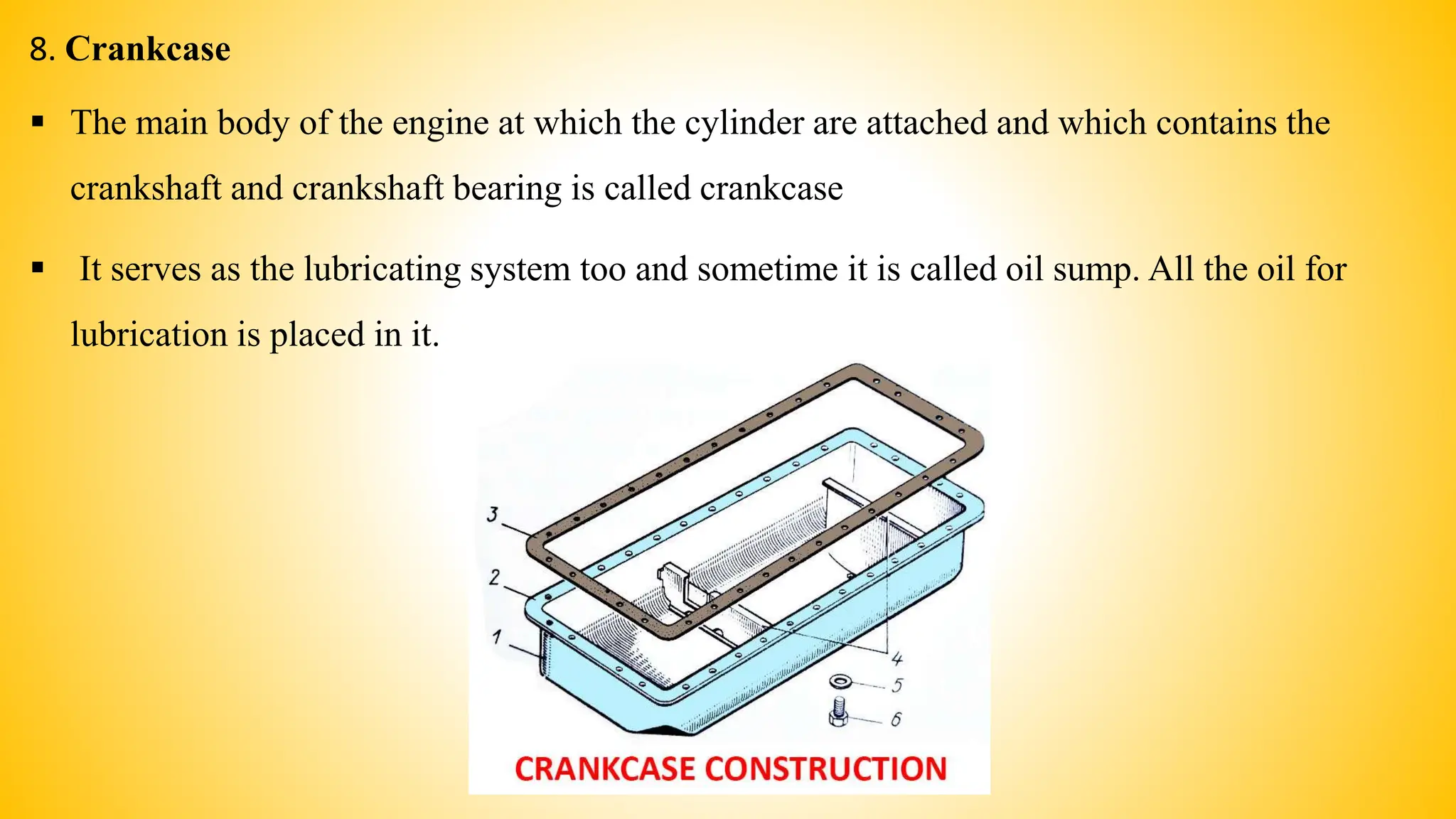
8. Crankcase
 The main body of the engine at which the cylinder are attached and which contains the
crankshaft and crankshaft bearing is called crankcase
 It serves as the lubricating system too and sometime it is called oil sump. All the oil for
lubrication is placed in it.
9. Valves
 To control the inlet and exhaust of internal combustion engine, valves are used
 The number of valves in an engine depends on the number of cylinders
 Two valves are used for each cylinder one for inlet of air-fuel mixture inside the cylinder and
other for exhaust of combustion gases
 The valves are fitted in the port at the cylinder head by use of strong spring. This spring keep
them closed. Both valves usually open inwards
10. Spark plug
 It is used in spark ignition engine
 The main function of a spark plug is to conduct a high potential from the ignition system into
the combustion chamber to ignite the compressed air fuel mixture
 It is fitted on cylinder head
 The spark plug consists of a metal shell having two electrodes which are insulated from each
other with an air gap
 When high potential current supply to spark plug it jumping from the supply electrode and
produces the necessary spark
11. Injector
 Injector is usually used in compression ignition engine
 It sprays the fuel into combustion chamber at the end of compression stroke. It is fitted on
cylinder head
Spark plug
Fuel Injector
11. Manifold
 The main function of manifold is to supply the air fuel mixture and collects the exhaust gases
equally from all cylinder
 In an internal combustion engine two manifold are used, one for intake and other for exhaust
 They are usually made by aluminum alloy
12. Camshaft
 Camshaft is used in IC engine to control the opening and closing of valves at proper timing
 For proper engine output inlet valve should open at the end of exhaust stroke and closed at
the end of intake stroke
 So to regulate its timing, a cam is use which is oval in shape and it exerts a pressure on the
valve to open and release to close
 It is drive by the timing belt which drives by crankshaft. It is placed at the top or at the bottom
of cylinder
Camshaft
Manifold
13. Flywheel
 A flywheel is secured on the crankshaft
 The main function of flywheel is to rotate the shaft during preparatory stroke
 It also makes crankshaft rotation more uniform.
• Piston- low carbon steels or aluminum alloys
• Connecting rod- forged steel, cast steel, or fabricated steel
• Crankshaft- forged steel or cast iron
• Crankcase- iron, aluminum, or magnesium
• Cylinder liner- alloy cast iron
• Spark plug- copper-core electrodes, platinum dip, ceramic
• Cylinder block- cast iron or aluminum alloy
• Inlet valve- Chrome Silicon Alloy Steel
• Exhaust valve- Nickel Silicon Alloy Steel

P 1 COMPONENTS OF ENGINE.pptx

  • 1.
    PRACTICAL 1 TO STUDYDIFFERENT COMPONENTS OF INTERNAL COMBUSTION ENGINE
  • 2.
    HEAT ENGINE • HeatEngine is a machine which converts heat energy supplied to it into mechanical work • It does this by bringing a working substance from a higher state temperature to a lower state temperature • A heat source generates thermal energy that brings the working substance to the high temperature state • Heat energy is supplied to the engine by burning the fuel
  • 3.
  • 4.
    CLASSIFICATION OF HEATENGINE  INTERNAL COMBUSTION ENGINE (I C ENGINE)  In IC Engine, combustion of fuel takes place inside the engine cylinder  Examples: Diesel engine, petrol engine, gas engine  It produces high temperature and high gas pressure  Less losses  High efficiency
  • 5.
  • 6.
     EXTERNAL COMBUSTIONENGINE (E C ENGINE)  An external combustion engine (EC engine) is a reciprocating heat engine where a working fluid, contained internally, is heated by combustion in an external source, through the engine wall or a heat exchanger  In E C engine, combustion of fuel takes place outside the working cylinder  Examples: steam engines and steam turbines  External combustion engines are no longer used in transportation but they continue to be used in power plants  Not enough efficient
  • 7.
    Steam Engine (EC Engine)
  • 8.
  • 9.
    CLASSIFICATION OF INTERNALCOMBUSTION ENGINE IC Engines are classified into: 1) Cycle of operation ( Number of stroke per cycle)  Two Stroke Cycle Engines  Four Stroke Cycle Engine 2) Thermodynamics cycle or Method of Heat addition  Otto cycle Engines (Combustion at constant volume)  Diesel cycle Engines (Combustion at constant pressure)  Semi Diesel Engine (Dual Combustion Engines)
  • 10.
    Continued… 3) Types ofFuel used  Petrol Engine  Diesel Engine  Gas Engine 4) Ignition Method  Spark Ignition (SI)  Compression Ignition (CI)
  • 11.
    5) Cooling System Air Cooled Engines  Water Cooled Engines
  • 12.
    Working Animation ofSpark ignition Engine
  • 13.
    Main Components ofI C Engine 1. Cylinder block  Cylinder is the main body of IC engine  Cylinder is a part in which the intake of fuel, compression of fuel and burning of fuel take place  The main function of cylinder is to guide the piston. It is in direct contact with the products of combustion so it must be cooled  For cooling of cylinder, a water jacket (for liquid cooling used in most of cars) or fin (for air cooling used in most of bikes) are situated at the outer side of cylinder  At the upper end of cylinder, cylinder head and at the bottom end crank case is bolted. The upper side of cylinder is consisting a combustion chamber where fuel burns.  To handle all this pressure and temperature generated by combustion of fuel, cylinder material should have high compressive strength. So it is made by high grade cast iron. It is made by casting and usually cast in one piece
  • 14.
  • 15.
    2. Cylinder head The top end of the engine cylinder is closed by means of removable cylinder head  There are two holes or ports at the cylinder head, one for intake of fuel and other for exhaust. Both the intake and exhaust ports are closed by the two valves known as inlet and exhaust valve.  The inlet valve, exhaust valve, spark plug, injector etc. are bolted on the cylinder head. The main function of cylinder head is to seal the cylinder block and not to permit entry and exit of gases on cover head valve engine  Cylinder head is usually made by cast iron or aluminum. It is made by casting or forging and usually in one piece
  • 16.
  • 17.
    3. Piston  Pistonis fitted to each cylinder as a face to receive gas pressure and transmit the thrust to the connecting rod  It is a prime mover in the engine  The main function of piston is to give tight seal to the cylinder through bore and slide freely inside the cylinder  Piston should be light and sufficient strong to handle gas pressure generated by combustion of fuel  So the piston is made by aluminum alloy and sometimes it is made by cast iron because light alloy piston expands more than cast iron so they need more clearances to the bore
  • 18.
  • 19.
    4. Piston rings A piston must be a fairly loose fit in the cylinder so it can move freely inside the cylinder  If the piston is too tight fit, it would expand as it got hot and might stick tight in the cylinder and if it is too loose it would leaks the vapor pressure  To provide a good sealing fit and less friction resistance between the piston and cylinder, pistons are equipped with piston rings  These rings are fitted in grooves which have been cut in the piston. They are split at one end so they can expand or slipped over the end of piston  Piston rings are made of cast iron of fine grain and high elastic material which is not affected by the working heat. Sometimes it is made by alloy spring steel.
  • 20.
    5. Connecting rod Connecting rod connects the piston to crankshaft and transmits the motion and thrust of piston to crankshaft  It converts the reciprocating motion of the piston into rotary motion of crankshaft  There are two end of connecting rod; one is known as big end and other as small end  Big end is connected to the crankshaft and the small end is connected to the piston by use of piston pin  The connecting rods are made of nickel, chrome, and chrome vanadium steels. For small engines the material may be aluminum
  • 21.
  • 22.
    6. Crankshaft  Thecrankshaft of an internal combustion engine receives the efforts or thrust supplied by piston to the connecting rod and converts the reciprocating motion of piston into rotary motion of crankshaft  The crankshaft mounts in bearing so it can rotate freely  The shape and size of crankshaft depends on the number and arrangement of cylinders  It is usually made by steel forging, but some makers use special types of cast-iron such as spheroidal graphitic or nickel alloy castings which are cheaper to produce and have good service life
  • 23.
  • 24.
    7. Engine bearing Bearings are used to support the moving parts  The crankshaft is supported by bearing  The connecting rod big end is attached to the crank pin on the crank of the crankshaft by a bearing  A piston pin at the small end is used to attach the rod to the piston is also rides in bearings  The main function of bearings is to reduce friction between these moving parts  The sliding type bearing which are sometime called bush is use to attach the connecting rod to the piston and crankshaft  The rolling and ball bearing is used to support crankshaft so it can rotate freely  The typical bearing half is made of steel or bronze back to which a lining of relatively soft bearing material is applied
  • 25.
  • 26.
    8. Crankcase  Themain body of the engine at which the cylinder are attached and which contains the crankshaft and crankshaft bearing is called crankcase  It serves as the lubricating system too and sometime it is called oil sump. All the oil for lubrication is placed in it.
  • 27.
    9. Valves  Tocontrol the inlet and exhaust of internal combustion engine, valves are used  The number of valves in an engine depends on the number of cylinders  Two valves are used for each cylinder one for inlet of air-fuel mixture inside the cylinder and other for exhaust of combustion gases  The valves are fitted in the port at the cylinder head by use of strong spring. This spring keep them closed. Both valves usually open inwards
  • 28.
    10. Spark plug It is used in spark ignition engine  The main function of a spark plug is to conduct a high potential from the ignition system into the combustion chamber to ignite the compressed air fuel mixture  It is fitted on cylinder head  The spark plug consists of a metal shell having two electrodes which are insulated from each other with an air gap  When high potential current supply to spark plug it jumping from the supply electrode and produces the necessary spark 11. Injector  Injector is usually used in compression ignition engine  It sprays the fuel into combustion chamber at the end of compression stroke. It is fitted on cylinder head
  • 29.
  • 30.
    11. Manifold  Themain function of manifold is to supply the air fuel mixture and collects the exhaust gases equally from all cylinder  In an internal combustion engine two manifold are used, one for intake and other for exhaust  They are usually made by aluminum alloy 12. Camshaft  Camshaft is used in IC engine to control the opening and closing of valves at proper timing  For proper engine output inlet valve should open at the end of exhaust stroke and closed at the end of intake stroke  So to regulate its timing, a cam is use which is oval in shape and it exerts a pressure on the valve to open and release to close  It is drive by the timing belt which drives by crankshaft. It is placed at the top or at the bottom of cylinder
  • 31.
  • 32.
  • 34.
    13. Flywheel  Aflywheel is secured on the crankshaft  The main function of flywheel is to rotate the shaft during preparatory stroke  It also makes crankshaft rotation more uniform.
  • 35.
    • Piston- lowcarbon steels or aluminum alloys • Connecting rod- forged steel, cast steel, or fabricated steel • Crankshaft- forged steel or cast iron • Crankcase- iron, aluminum, or magnesium • Cylinder liner- alloy cast iron • Spark plug- copper-core electrodes, platinum dip, ceramic • Cylinder block- cast iron or aluminum alloy • Inlet valve- Chrome Silicon Alloy Steel • Exhaust valve- Nickel Silicon Alloy Steel