Redox Titrations
Muhammad Umer Zafar
Redox Titrations and
methods
• Potassium Permanganate
Titrations
(Permanganometry)
• Iodometry
Muhammad Umer Zafar
Redox Titrations
• Redox titration is a volumetric method
of analysis which relies on oxidation or
reduction of the analyte.
• It involves the titration of an oxidising
agent with a reducing agent.
• An oxidising agent gains electrons
where a reducing agent loses electrons.
Muhammad Umer Zafar
Half Reaction
• It is obtained by the change in
oxidation states of individual substances
involved in the redox reaction.
• Oxidised
red – ne- ⇌
• Reduced
+ ne- ⇌ red
Muhammad Umer Zafar
Half Reaction
• A half reaction does not occur by itself,
it is a coupled reaction.
• Oxidation and Reduction must occur
simultaneously, this type is known as a
redox reaction.
• The couple effect of these reactions
conjugate and behaves in much a same
way when they are in acid-base pairs
Muhammad Umer Zafar
End Point
• End point depends on the agent being
strong or weak. If both agents are
strong then the end point is sharp in
regards to gaining or losing electrons.
• Appropriate indicators along with
electrometric means can be used to
determine the end point. The
characteristics of redox potential are
included in Nernst equation.
Muhammad Umer Zafar
Nernst Equation
E - redox potential of the couple
n - redox capacity (no of electrons and
oxidising agents will take on or a reductant
will supply)
- standard redox potential at 2C
[OX] and [red] - molar conc. of both the
oxidised and reduced forms
a, b - stiochiometric coefficients
Muhammad Umer Zafar
Permanganometry
 Potassium Permanganate is one of
the strongest oxidising agents used for
titrations.
 They do not require indicators,
because they have a very intense
purple colour.
 So to determine the end point an
excess titrant can cause the change in
colour.
 Diluted solution of KMNO4 is pink.
Muhammad Umer Zafar
Permanganometry
 It is being used to determine the
quantity of analyte in an unknown
solution.
 Permanganate reduction is very slow at
room temperature, which can be
enhanced at higher temperatures such
as 70-80 degrees.
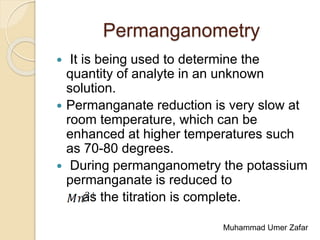
 During permanganometry the potassium
permanganate is reduced to
as the titration is complete.
Muhammad Umer Zafar
Advantages
 Extremely powerful, hence commonly
used.
 Inexpensive
 Readily available
Muhammad Umer Zafar
Disadvantages
 Strong oxidising agent so it reacts with
everything.
 Difficult to store without
decomposition or a change in
concentration.
 It cannot be used as a primary
standard due to its reaction with
contaminants in distilled water.
Muhammad Umer Zafar
Iodometry
 Iodometry, also known
as iodometric titration, is a method of
volumetric chemical analysis, a redox
titration where the appearance or
disappearance of elementary iodine
indicates the end point.
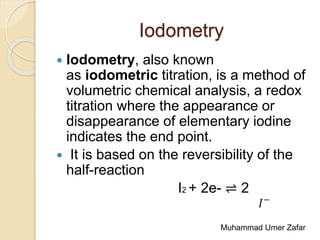
 It is based on the reversibility of the
half-reaction
I2 + 2e- ⇌ 2
Muhammad Umer Zafar
Advantage
 Iodine is a weak oxidising agent can
be used to titrate strong reducing
agents.
 Iodine ion is a mild reducing agent
and serves as the basis for
determining the strong oxidising
agent.
Muhammad Umer Zafar
Disadvantage
 Iodide ion is not used for titration
because it lacks the convenient visual
indicator system, such as
permanganate.
 The speed of reaction is slow.
Muhammad Umer Zafar
Solution
 Sodium thiosulfate is a suitable
titrating agent for all of the above
mentioned three cases
 Analysis of these substances in this
method is called an iodometric method
or iodometry.
 Iodometry cannot be used as primary
standards, as it is not possible to
prepare it directly.
Muhammad Umer Zafar
Redox titrations

Redox titrations

  • 1.
  • 2.
    Redox Titrations and methods •Potassium Permanganate Titrations (Permanganometry) • Iodometry Muhammad Umer Zafar
  • 3.
    Redox Titrations • Redoxtitration is a volumetric method of analysis which relies on oxidation or reduction of the analyte. • It involves the titration of an oxidising agent with a reducing agent. • An oxidising agent gains electrons where a reducing agent loses electrons. Muhammad Umer Zafar
  • 4.
    Half Reaction • Itis obtained by the change in oxidation states of individual substances involved in the redox reaction. • Oxidised red – ne- ⇌ • Reduced + ne- ⇌ red Muhammad Umer Zafar
  • 5.
    Half Reaction • Ahalf reaction does not occur by itself, it is a coupled reaction. • Oxidation and Reduction must occur simultaneously, this type is known as a redox reaction. • The couple effect of these reactions conjugate and behaves in much a same way when they are in acid-base pairs Muhammad Umer Zafar
  • 6.
    End Point • Endpoint depends on the agent being strong or weak. If both agents are strong then the end point is sharp in regards to gaining or losing electrons. • Appropriate indicators along with electrometric means can be used to determine the end point. The characteristics of redox potential are included in Nernst equation. Muhammad Umer Zafar
  • 7.
    Nernst Equation E -redox potential of the couple n - redox capacity (no of electrons and oxidising agents will take on or a reductant will supply) - standard redox potential at 2C [OX] and [red] - molar conc. of both the oxidised and reduced forms a, b - stiochiometric coefficients Muhammad Umer Zafar
  • 9.
    Permanganometry  Potassium Permanganateis one of the strongest oxidising agents used for titrations.  They do not require indicators, because they have a very intense purple colour.  So to determine the end point an excess titrant can cause the change in colour.  Diluted solution of KMNO4 is pink. Muhammad Umer Zafar
  • 10.
    Permanganometry  It isbeing used to determine the quantity of analyte in an unknown solution.  Permanganate reduction is very slow at room temperature, which can be enhanced at higher temperatures such as 70-80 degrees.  During permanganometry the potassium permanganate is reduced to as the titration is complete. Muhammad Umer Zafar
  • 11.
    Advantages  Extremely powerful,hence commonly used.  Inexpensive  Readily available Muhammad Umer Zafar
  • 12.
    Disadvantages  Strong oxidisingagent so it reacts with everything.  Difficult to store without decomposition or a change in concentration.  It cannot be used as a primary standard due to its reaction with contaminants in distilled water. Muhammad Umer Zafar
  • 13.
    Iodometry  Iodometry, alsoknown as iodometric titration, is a method of volumetric chemical analysis, a redox titration where the appearance or disappearance of elementary iodine indicates the end point.  It is based on the reversibility of the half-reaction I2 + 2e- ⇌ 2 Muhammad Umer Zafar
  • 14.
    Advantage  Iodine isa weak oxidising agent can be used to titrate strong reducing agents.  Iodine ion is a mild reducing agent and serves as the basis for determining the strong oxidising agent. Muhammad Umer Zafar
  • 15.
    Disadvantage  Iodide ionis not used for titration because it lacks the convenient visual indicator system, such as permanganate.  The speed of reaction is slow. Muhammad Umer Zafar
  • 16.
    Solution  Sodium thiosulfateis a suitable titrating agent for all of the above mentioned three cases  Analysis of these substances in this method is called an iodometric method or iodometry.  Iodometry cannot be used as primary standards, as it is not possible to prepare it directly. Muhammad Umer Zafar

Editor's Notes

  • #5 Oxidising agent gain electrons it changes from the oxidised to reduced form
  • #6 If an oxidising agent is stronger the reducing agent is weaker or vice versa The number of electrons lost must be equal to the number of electrons gained