Lecture# 7
Date: March 29, 2020
Complexometric Titrations
1
Faculty of science
2020-03-28
3rd Year Students, General- Science
Course Code: 317 Chem.
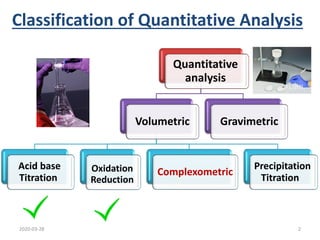
Quantitative
analysis
Volumetric
Acid base
Titration
Oxidation
Reduction
Complexometric
Precipitation
Titration
Gravimetric
Classification of Quantitative Analysis
2020-03-28 2
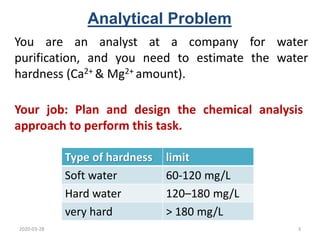
You are an analyst at a company for water
purification, and you need to estimate the water
hardness (Ca2+ & Mg2+ amount).
Your job: Plan and design the chemical analysis
approach to perform this task.
limit
Type of hardness
60-120 mg/L
Soft water
120–180 mg/L
Hard water
˃ 180 mg/L
very hard
Analytical Problem
2020-03-28 3
Complex (Coordination Compound)
Compound results from the combination of metal ion as
(acceptor) with donor molecules (ligand) through coordinated
bonds (donor→ acceptor)
Examples:
Metal ion + Ligand→ Coordination compound (complex)
(Lewis acid) (Lewis base)
Mn+ + L= (L M) Ag NH3
H3N
+
Ag
NH3
NH3
+
[Ag(NH3)2]+
[Fe(SCN)6]3-
2020-03-28 4
Co3+ is the electron acceptor and shares a
pair of electrons with each of N-atom in NH3
For the complex
[Co(NH3)6]3+
Complex Ion = Transition Metal Cation Surrounded by Ligands
Ligand = Molecule or Ions of Nonbonding Electron Pairs
Bonding is Called “Coordination”
2020-03-28 5
A volumetric titration involves the formation of soluble
complex between metal ion (as acceptor) and ligand (as
donor) to form coordination bonds.
Complexometry
NH3
ï‚Ż
NH3 ï‚Ÿï‚ź Cu ï‚Źï‚Ÿ NH3

NH3
Coordination bond
The metal ion is known as Central metal atom.
The anion or neutral molecule is known as Ligand (L)



 2
4
3
3
2
]
)
(
[
4 NH
Cu
NH
Cu
Ligand
2020-03-28 6
Nature of The Acceptor Atom (Metal Ion)
The metallic ion (atom) has stable electronic configuration
It forms additional completed shells by accepting electron
pairs from donor atoms.
‱The number of electron pairs that metal ion share or accept.
Coordination Number:

2
4
)
(OH
Zn
‱It could be 2, 4, 6, depending on the metal ion and its oxidation
number.
‱Independent on the nature of donor atom.
‱The no. of coordinate bonds formed to a metal ion by their
ligands.
  
3
6
3 )
(NH
Fe
+
2020-03-28 7
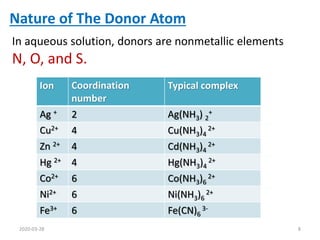
Nature of The Donor Atom
In aqueous solution, donors are nonmetallic elements
N, O, and S.
Typical complex
Coordination
number
Ion
Ag(NH3) 2
+
2
Ag +
Cu(NH3)4
2+
4
Cu2+
Cd(NH3)4
2+
4
Zn 2+
Hg(NH3)4
2+
4
Hg 2+
Co(NH3)6
2+
6
Co2+
Ni(NH3)6
2+
6
Ni2+
Fe(CN)6
3-
6
Fe3+
2020-03-28 8
This classification is according to the no. of sites attached
to the metal ion
1. Unidentate (Monodentate) Ligand or "Simple Ligand"
The ligand attached to metal at one site e.g. H2O, NH3, CN -
, Cl-, I -, Br - (i.e. forming one coordinate bond, or capable
of donating one unshared pair of electrons)
Type of complexing agents (ligands)
H3N Ag NH3
2020-03-28 9
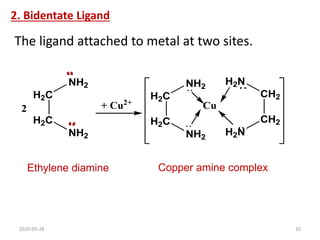
2. Bidentate Ligand
Ethylene diamine
The ligand attached to metal at two sites.
Copper amine complex
H2C
H2C
NH2
NH2
H2C
H2C
NH2
NH2
CH2
CH2
H2N
H2N
Cu
+ Cu2+
2
2020-03-28 10
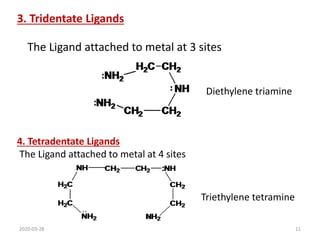
Diethylene triamine
Triethylene tetramine
3. Tridentate Ligands
4. Tetradentate Ligands
The Ligand attached to metal at 4 sites
The Ligand attached to metal at 3 sites
2020-03-28 11
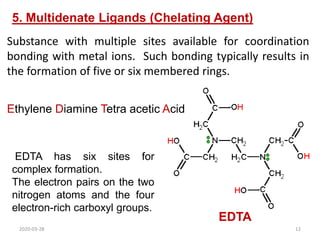
5. Multidenate Ligands (Chelating Agent)
Substance with multiple sites available for coordination
bonding with metal ions. Such bonding typically results in
the formation of five or six membered rings.
EDTA
EDTA has six sites for
complex formation.
The electron pairs on the two
nitrogen atoms and the four
electron-rich carboxyl groups.
Ethylene Diamine Tetra acetic Acid
2020-03-28 12
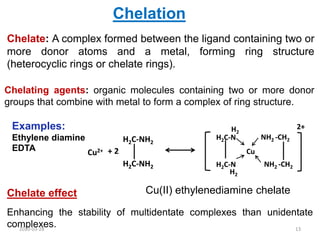
Chelate: A complex formed between the ligand containing two or
more donor atoms and a metal, forming ring structure
(heterocyclic rings or chelate rings).
Chelation
Chelating agents: organic molecules containing two or more donor
groups that combine with metal to form a complex of ring structure.
Cu2+ + 2
H2C-NH2
H2C-NH2
Cu
H2C-N
H2C-N
H2
H2
NH2 -CH2
NH2 -CH2
2+
Chelate effect
Enhancing the stability of multidentate complexes than unidentate
complexes.
Cu(II) ethylenediamine chelate
Examples:
Ethylene diamine
EDTA
2020-03-28 13
Titration With Multidentate Complexers (Chelating
Agents)
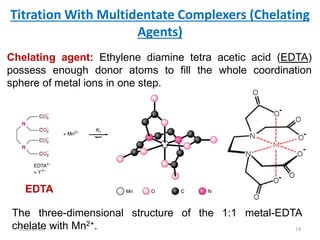
Chelating agent: Ethylene diamine tetra acetic acid (EDTA)
possess enough donor atoms to fill the whole coordination
sphere of metal ions in one step.
The three-dimensional structure of the 1:1 metal-EDTA
chelate with Mn2+.
EDTA
14
2020-03-28
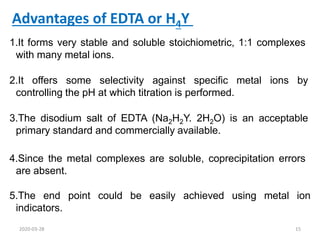
Advantages of EDTA or H4Y
1.It forms very stable and soluble stoichiometric, 1:1 complexes
with many metal ions.
3.The disodium salt of EDTA (Na2H2Y. 2H2O) is an acceptable
primary standard and commercially available.
4.Since the metal complexes are soluble, coprecipitation errors
are absent.
5.The end point could be easily achieved using metal ion
indicators.
2.It offers some selectivity against specific metal ions by
controlling the pH at which titration is performed.
2020-03-28 15



















2
4
2
2
2
2
2
2
2
2
MY
Y
M
H
MY
HY
M
H
MY
Y
H
M
n 12
8
5



pH
pH
pH
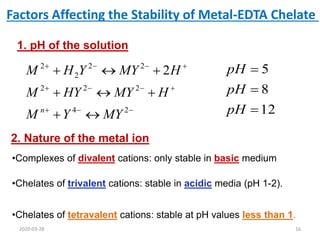
1. pH of the solution
2. Nature of the metal ion
Factors Affecting the Stability of Metal-EDTA Chelate
‱Complexes of divalent cations: only stable in basic medium
‱Chelates of trivalent cations: stable in acidic media (pH 1-2).
‱Chelates of tetravalent cations: stable at pH values less than 1.
2020-03-28 16
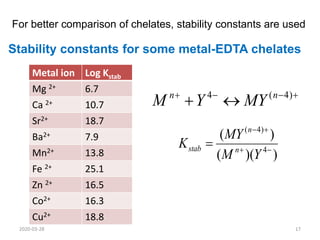
Stability constants for some metal-EDTA chelates
Metal ion Log Kstab
Mg 2+ 6.7
Ca 2+ 10.7
Sr2+ 18.7
Ba2+ 7.9
Mn2+ 13.8
Fe 2+ 25.1
Zn 2+ 16.5
Co2+ 16.3
Cu2+ 18.8





 )
4
(
4 n
n
MY
Y
M
)
)(
(
)
(
4
)
4
(





Y
M
MY
K n
n
stab
For better comparison of chelates, stability constants are used
2020-03-28 17
Titration curves
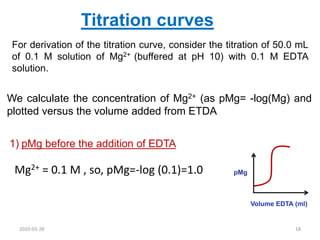
For derivation of the titration curve, consider the titration of 50.0 mL
of 0.1 M solution of Mg2+ (buffered at pH 10) with 0.1 M EDTA
solution.
1) pMg before the addition of EDTA
Mg2+ = 0.1 M , so, pMg=-log (0.1)=1.0
We calculate the concentration of Mg2+ (as pMg= -log(Mg) and
plotted versus the volume added from ETDA
pMg
Volume EDTA (ml)
2020-03-28 18
EDTA
Mg
MV
MV 

2
M
unreacted
MMg
067
.
0
10
50
)
1
.
0
*
10
(
)
1
.
0
*
50
(
2 




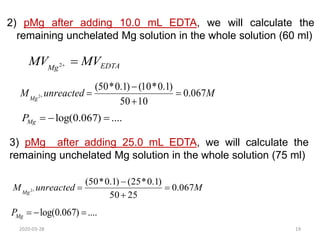
3) pMg after adding 25.0 mL EDTA, we will calculate the
remaining unchelated Mg solution in the whole solution (75 ml)
M
unreacted
MMg
067
.
0
25
50
)
1
.
0
*
25
(
)
1
.
0
*
50
(
2 




2) pMg after adding 10.0 mL EDTA, we will calculate the
remaining unchelated Mg solution in the whole solution (60 ml)
....
)
067
.
0
log( 


Mg
P
....
)
067
.
0
log( 


Mg
P
2020-03-28 19




 2
4
2
MgY
Y
Mg
8
4
2
2
10
0
.
5
)
)(
(
)
(
x
Y
Mg
MgY
Kstab 
 


Substitute at equation Kstab
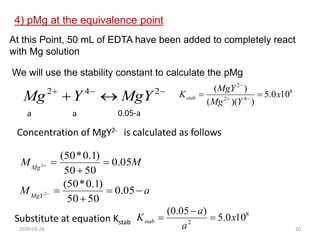
a a 0.05-a
Concentration of MgY2- is calculated as follows
M
MMg
05
.
0
50
50
)
1
.
0
*
50
(
2 



a
MMgY




 05
.
0
50
50
)
1
.
0
*
50
(
2
8
2
10
0
.
5
)
05
.
0
(
x
a
a
Kstab 


4) pMg at the equivalence point
At this Point, 50 mL of EDTA have been added to completely react
with Mg solution
We will use the stability constant to calculate the pMg
2020-03-28 20
8
2
10
0
.
5
)
05
.
0
(
x
a

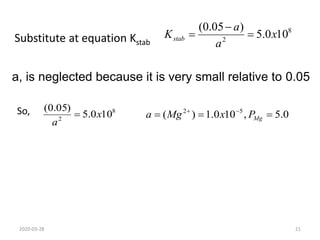
So,
a, is neglected because it is very small relative to 0.05
0
.
5
,
10
0
.
1
)
( 5
2


 

Mg
P
x
Mg
a
Substitute at equation Kstab
8
2
10
0
.
5
)
05
.
0
(
x
a
a
Kstab 


2020-03-28 21
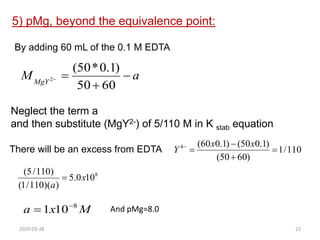
5) pMg, beyond the equivalence point:
a
MMgY




60
50
)
1
.
0
*
50
(
2
Neglect the term a
and then substitute (MgY2-) of 5/110 M in K stab equation
There will be an excess from EDTA 110
/
1
)
60
50
(
)
1
.
0
50
(
)
1
.
0
60
(
4




 x
x
Y
8
10
0
.
5
)
)(
110
/
1
(
)
110
/
5
(
x
a

And pMg=8.0
By adding 60 mL of the 0.1 M EDTA
M
x
a 8
10
1 

2020-03-28 22
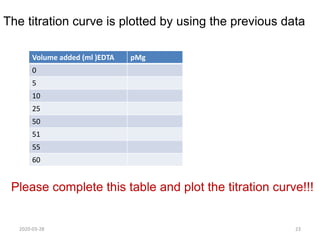
The titration curve is plotted by using the previous data
Volume added (ml )EDTA pMg
0
5
10
25
50
51
55
60
Please complete this table and plot the titration curve!!!
2020-03-28 23
Detection of End Point: use Metal Ion Indicators
‱ Organic dyes with acid-base properties that undergoes a color
change upon proton transfer to/from the dye molecule.
‱ In addition, the dye molecules contains a chelating group that is
joined to the conjugated system responsible to for the color.
‱The success of an EDTA titration depends on the precise
determination of the end point.
‱These indicators responds to a change in pM and thereby
convert the break in pM into the color changes.
‱The most common procedures uses the metal ion indictors.
2020-03-28 24
Characteristics of Metal Ion Indicators
2.The reaction between metal and indicator must be
reversible.
3. The metal-indicator complex should be less stable than the
metal-EDTA complex.
4. The color reaction should be specific or at least selective.
5. Changes its color according to the pH of the medium.
1.Form colored chelates (complexes) and exhibit a different
color in the free form than in the complex form.
Metal-indictor +EDTA Metal-EDTA+ free indicator
2020-03-28 25
Examples of Metal Ion Indicators
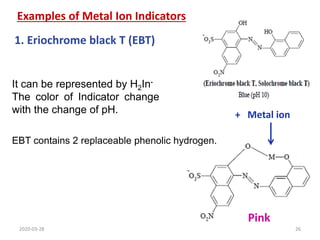
1. Eriochrome black T (EBT)
+ Metal ion
It can be represented by H2In-
The color of Indicator change
with the change of pH.
EBT contains 2 replaceable phenolic hydrogen.
Pink
2020-03-28 26
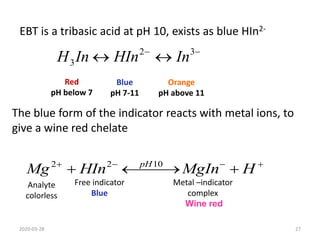
EBT is a tribasic acid at pH 10, exists as blue HIn2-
The blue form of the indicator reacts with metal ions, to
give a wine red chelate






 ï‚ź
ï‚Ź
 H
MgIn
HIn
Mg pH10
2
2
Analyte
colorless
Free indicator
Blue
Metal –indicator
complex
Wine red



 3
2
3 In
HIn
In
H
Red
pH below 7
Blue
pH 7-11
Orange
pH above 11
2020-03-28 27






 ï‚ź
ï‚Ź
 2
2
10
3
HIn
MgY
HY
MgIn pH
Titrant
EDTA
colorless
Metal–EDTA
complex
colorless
Metal –ind.
complex
Wine red
Free indicator
Blue
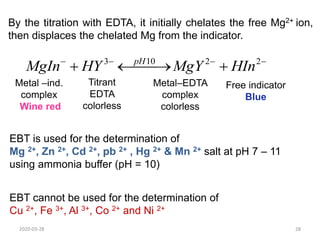
By the titration with EDTA, it initially chelates the free Mg2+ ion,
then displaces the chelated Mg from the indicator.
EBT is used for the determination of
Mg 2+, Zn 2+, Cd 2+, pb 2+ , Hg 2+ & Mn 2+ salt at pH 7 – 11
using ammonia buffer (pH = 10)
EBT cannot be used for the determination of
Cu 2+, Fe 3+, Al 3+, Co 2+ and Ni 2+
2020-03-28 28
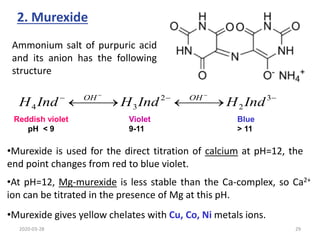
2. Murexide
Ammonium salt of purpuric acid
and its anion has the following
structure
‱Murexide is used for the direct titration of calcium at pH=12, the
end point changes from red to blue violet.
‱At pH=12, Mg-murexide is less stable than the Ca-complex, so Ca2+
ion can be titrated in the presence of Mg at this pH.
‱Murexide gives yellow chelates with Cu, Co, Ni metals ions.




 ï‚ź
ï‚Ź

 ï‚ź
ï‚Ź


3
2
2
3
4 Ind
H
Ind
H
Ind
H OH
OH
Reddish violet
pH < 9
Blue
> 11
Violet
9-11
2020-03-28 29
Metal Color of complex Color of indicator
Ca 2+ Pink violet
Cu 2+ Orange Violet
Co 2+ Yellow violet
Ni 2+ yellow violet
Pink Violet
It is used for the determination of
Ca 2+, Co 2+, Ni 2+, & Cu2+ salts at pH 9-11
Ca 2+ + H3In2- ï‚Ÿï‚ź Ca H2In- + H+
Ca H2In- + H2Y2-+ OH - ï‚Ÿï‚ź CaY 2- + H3In2-+ H2O
2020-03-28 30
Common Metal Ion Indicators
2020-03-28 31
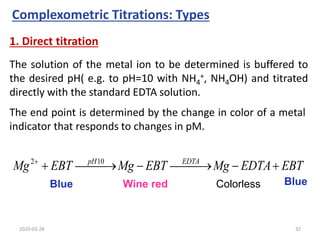
Complexometric Titrations: Types
1. Direct titration
The solution of the metal ion to be determined is buffered to
the desired pH( e.g. to pH=10 with NH4
+, NH4OH) and titrated
directly with the standard EDTA solution.
EBT
EDTA
Mg
EBT
Mg
EBT
Mg EDTA
pH



 ï‚ź



 ï‚ź


 10
2
The end point is determined by the change in color of a metal
indicator that responds to changes in pM.
Wine red
Blue Blue
Colorless
2020-03-28 32
1.M-EDTA complex must be more stable than M-Ind.
complex in buffered medium.
Requirements for Direct EDTA Titrations
2. The compound to be determined is water soluble.
3.The reaction between EDTA and metal must be rapid. If
not, it must be catalyzed.
4. Mn+ should not be precipitated at the pH of titration. If Mn+ is
precipitated as MOH, auxiliary reagent must be added to
prevent pptn. of M n+.
2020-03-28 33
1- pb2+ ion forms precipitate of pb(OH)2 at the pH 10.
During titration of Cu2+ salt in alkaline medium, Cu(OH)2 is ppt.
and the reaction with EDTA becomes slow.
Examples
So, tartaric acid (auxiliary reagent) is added to convert
pb(OH)2 to soluble lead tartarate complex.
2-Sometimes buffer acts as auxiliary reagent
So, by using ammonia instead of alkali hydroxides, the soluble
[Cu(NH3)4]2+ is formed which is less stable than Cu-EDTA and
hence the reaction forward rapidly.
2020-03-28 34
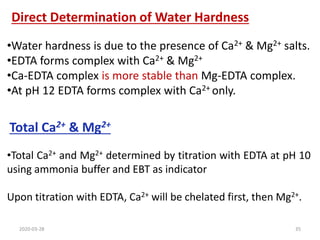
Direct Determination of Water Hardness
Total Ca2+ & Mg2+
‱Total Ca2+ and Mg2+ determined by titration with EDTA at pH 10
using ammonia buffer and EBT as indicator
Upon titration with EDTA, Ca2+ will be chelated first, then Mg2+.
‱Water hardness is due to the presence of Ca2+ & Mg2+ salts.
‱EDTA forms complex with Ca2+ & Mg2+
‱Ca-EDTA complex is more stable than Mg-EDTA complex.
‱At pH 12 EDTA forms complex with Ca2+ only.
2020-03-28 35
2020-03-28 36
Direct titration with EDTA at pH 12 using 8% NaOH and Murexide.
Mg2+ is precipitated as Mg(OH)2 leaving Ca2+ to be titrated with
EDTA
For Mg2+ Total – Ca2+ = Mg2+
For Ca2+ only
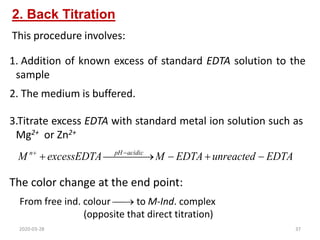
2. Back Titration
3.Titrate excess EDTA with standard metal ion solution such as
Mg2+ or Zn2+
EDTA
unreacted
EDTA
M
excessEDTA
M acidic
pH
n





 ï‚ź

 

This procedure involves:
1. Addition of known excess of standard EDTA solution to the
sample
2. The medium is buffered.
The color change at the end point:
From free ind. colour ï‚Ÿï‚ź to M-Ind. complex
(opposite that direct titration)
2020-03-28 37
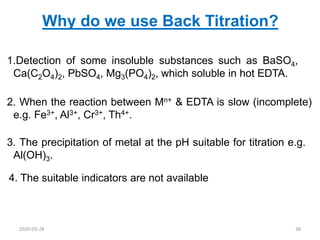
3. The precipitation of metal at the pH suitable for titration e.g.
Al(OH)3.
Why do we use Back Titration?
1.Detection of some insoluble substances such as BaSO4,
Ca(C2O4)2, PbSO4, Mg3(PO4)2, which soluble in hot EDTA.
2. When the reaction between Mn+ & EDTA is slow (incomplete)
e.g. Fe3+, Al3+, Cr3+, Th4+.
4. The suitable indicators are not available
2020-03-28 38
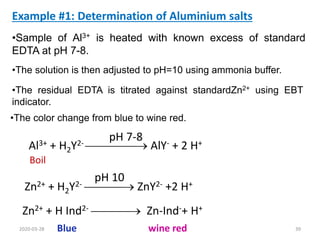
‱Sample of Al3+ is heated with known excess of standard
EDTA at pH 7-8.
Example #1: Determination of Aluminium salts
Blue wine red
Zn2+ + H Ind2- ï‚Ÿï‚Ÿï‚Ÿï‚ź Zn-Ind-+ H+
Zn2+ + H2Y2- ï‚Ÿï‚Ÿï‚Ÿï‚ź ZnY2- +2 H+
pH 10
‱The solution is then adjusted to pH=10 using ammonia buffer.
‱The residual EDTA is titrated against standardZn2+ using EBT
indicator.
‱The color change from blue to wine red.
Al3+ + H2Y2- ï‚Ÿï‚Ÿï‚Ÿï‚Ÿï‚ź AlY- + 2 H+
pH 7-8
Boil
2020-03-28 39
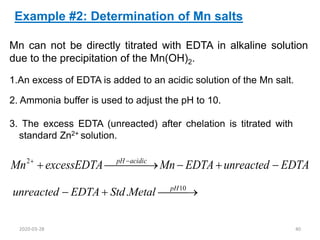
Example #2: Determination of Mn salts
Mn can not be directly titrated with EDTA in alkaline solution
due to the precipitation of the Mn(OH)2.
EDTA
unreacted
EDTA
Mn
excessEDTA
Mn acidic
pH





 ï‚ź

 

2

 ï‚ź


 10
. pH
Metal
Std
EDTA
unreacted
1.An excess of EDTA is added to an acidic solution of the Mn salt.
2. Ammonia buffer is used to adjust the pH to 10.
3. The excess EDTA (unreacted) after chelation is titrated with
standard Zn2+ solution.
2020-03-28 40
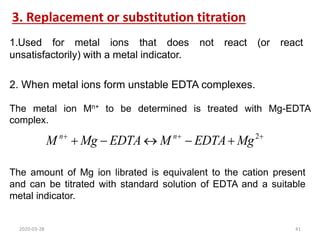
3. Replacement or substitution titration
1.Used for metal ions that does not react (or react
unsatisfactorily) with a metal indicator.







 2
Mg
EDTA
M
EDTA
Mg
M n
n
The amount of Mg ion librated is equivalent to the cation present
and can be titrated with standard solution of EDTA and a suitable
metal indicator.
2. When metal ions form unstable EDTA complexes.
The metal ion Mn+ to be determined is treated with Mg-EDTA
complex.
2020-03-28 41
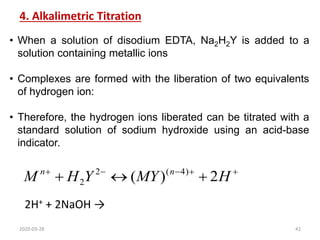
4. Alkalimetric Titration
‱ When a solution of disodium EDTA, Na2H2Y is added to a
solution containing metallic ions
‱ Complexes are formed with the liberation of two equivalents
of hydrogen ion:
‱ Therefore, the hydrogen ions liberated can be titrated with a
standard solution of sodium hydroxide using an acid-base
indicator.







 H
MY
Y
H
M n
n
2
)
( )
4
(
2
2
2H+ + 2NaOH →
2020-03-28 42
Analysis of Metal Ion Mixtures
To increase the selectivity of EDTA, some procedures
could be followed:
EDTA is a very unselective reagent because it complexes
di, tri, and tetra- valent cations.
‱Control of pH of the medium
‱Adjustment of oxidation number of metal ion
‱Using masking and demasking agent
2020-03-28 43
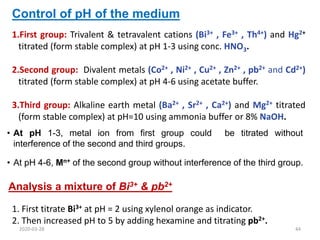
Control of pH of the medium
‱ At pH 1-3, metal ion from first group could be titrated without
interference of the second and third groups.
1.First group: Trivalent & tetravalent cations (Bi3+ , Fe3+ , Th4+) and Hg2+
titrated (form stable complex) at pH 1-3 using conc. HNO3.
2.Second group: Divalent metals (Co2+ , Ni2+ , Cu2+ , Zn2+ , pb2+ and Cd2+)
titrated (form stable complex) at pH 4-6 using acetate buffer.
3.Third group: Alkaline earth metal (Ba2+ , Sr2+ , Ca2+) and Mg2+ titrated
(form stable complex) at pH=10 using ammonia buffer or 8% NaOH.
1. First titrate Bi3+ at pH = 2 using xylenol orange as indicator.
2. Then increased pH to 5 by adding hexamine and titrating pb2+.
Analysis a mixture of Bi3+ & pb2+
‱ At pH 4-6, Mn+ of the second group without interference of the third group.
2020-03-28 44
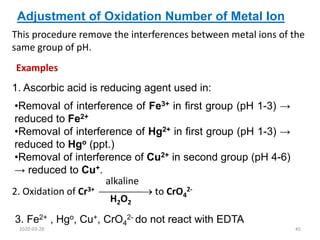
This procedure remove the interferences between metal ions of the
same group of pH.
Adjustment of Oxidation Number of Metal Ion
1. Ascorbic acid is reducing agent used in:
2. Oxidation of Cr3+ ï‚Ÿï‚Ÿï‚Ÿï‚Ÿï‚ź to CrO4
2-
alkaline
H2O2
3. Fe2+ , Hgo, Cu+, CrO4
2- do not react with EDTA
Examples
‱Removal of interference of Fe3+ in first group (pH 1-3) →
reduced to Fe2+
‱Removal of interference of Hg2+ in first group (pH 1-3) →
reduced to Hgo (ppt.)
‱Removal of interference of Cu2+ in second group (pH 4-6)
→ reduced to Cu+.
2020-03-28 45
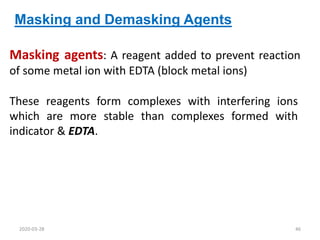
Masking and Demasking Agents
These reagents form complexes with interfering ions
which are more stable than complexes formed with
indicator & EDTA.
Masking agents: A reagent added to prevent reaction
of some metal ion with EDTA (block metal ions)
2020-03-28 46
Masking and demasking agents
(A) Cyanide (KCN)
(B)- Triethanolamine:
(C) Fluoride (NH4F):
Used as a masking agent for Hg2+ to give tetraiodo complex (HgI4)
Used as a masking agent for Ag+, Cu2+, Cd2+, Co2+, Ni2+, Zn2+.
M+ + 4 CN - ï‚Ÿï‚ź [M(CN)4]2-
Used as a masking agent for Fe3+ and Al3+ to give hexafluoro
complex [FeF6]3- and [AlF6]3-
(D)- Iodide (KI):
Used as a masking agent for Fe3+ , Al3+ and Sn2+
2020-03-28 47
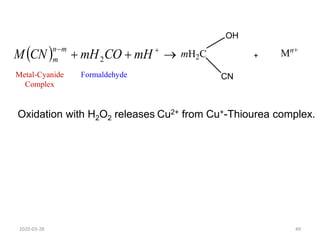
The masking by CN– can be removed by
(mixture of formaldehyde – acetic acid)
- on addition of demasking agent to [Zn(CN)4]2-, Zn is
liberated and titrated.
Demasking Agent
CN
CH
HO
Zn
HCHO
H
CN
Zn 




 


2
2
2
4 4
4
]
)
(
[









 COO
CH
CN
CH
HO
Zn
HCHO
COOH
CH
CN
Zn 3
2
2
3
2
4 4
4
4
4
]
)
(
[
(less stable) (more stable) Cyanohydrin
Example
Reagents that release of a metal ion from a masking agent
2020-03-28 48
  ï‚ź

 

mH
CO
mH
CN
M
m
n
m 2
mH2C
CN
OH
Mn+
Oxidation with H2O2 releases Cu2+ from Cu+-Thiourea complex.
Metal-Cyanide
Complex
Formaldehyde
2020-03-28 49
Reference
2020-03-28 50
Daniel Harris,(2007), “Quantitative Chemical Analysis” 7th
Edition, New York.

Analytical chemistry Analytical chemistr

  • 1.
    Lecture# 7 Date: March29, 2020 Complexometric Titrations 1 Faculty of science 2020-03-28 3rd Year Students, General- Science Course Code: 317 Chem.
  • 2.
  • 3.
    You are ananalyst at a company for water purification, and you need to estimate the water hardness (Ca2+ & Mg2+ amount). Your job: Plan and design the chemical analysis approach to perform this task. limit Type of hardness 60-120 mg/L Soft water 120–180 mg/L Hard water ˃ 180 mg/L very hard Analytical Problem 2020-03-28 3
  • 4.
    Complex (Coordination Compound) Compoundresults from the combination of metal ion as (acceptor) with donor molecules (ligand) through coordinated bonds (donor→ acceptor) Examples: Metal ion + Ligand→ Coordination compound (complex) (Lewis acid) (Lewis base) Mn+ + L= (L M) Ag NH3 H3N + Ag NH3 NH3 + [Ag(NH3)2]+ [Fe(SCN)6]3- 2020-03-28 4
  • 5.
    Co3+ is theelectron acceptor and shares a pair of electrons with each of N-atom in NH3 For the complex [Co(NH3)6]3+ Complex Ion = Transition Metal Cation Surrounded by Ligands Ligand = Molecule or Ions of Nonbonding Electron Pairs Bonding is Called “Coordination” 2020-03-28 5
  • 6.
    A volumetric titrationinvolves the formation of soluble complex between metal ion (as acceptor) and ligand (as donor) to form coordination bonds. Complexometry NH3 ï‚Ż NH3 ï‚Ÿï‚ź Cu ï‚Źï‚Ÿ NH3  NH3 Coordination bond The metal ion is known as Central metal atom. The anion or neutral molecule is known as Ligand (L)     2 4 3 3 2 ] ) ( [ 4 NH Cu NH Cu Ligand 2020-03-28 6
  • 7.
    Nature of TheAcceptor Atom (Metal Ion) The metallic ion (atom) has stable electronic configuration It forms additional completed shells by accepting electron pairs from donor atoms. ‱The number of electron pairs that metal ion share or accept. Coordination Number:  2 4 ) (OH Zn ‱It could be 2, 4, 6, depending on the metal ion and its oxidation number. ‱Independent on the nature of donor atom. ‱The no. of coordinate bonds formed to a metal ion by their ligands.    3 6 3 ) (NH Fe + 2020-03-28 7
  • 8.
    Nature of TheDonor Atom In aqueous solution, donors are nonmetallic elements N, O, and S. Typical complex Coordination number Ion Ag(NH3) 2 + 2 Ag + Cu(NH3)4 2+ 4 Cu2+ Cd(NH3)4 2+ 4 Zn 2+ Hg(NH3)4 2+ 4 Hg 2+ Co(NH3)6 2+ 6 Co2+ Ni(NH3)6 2+ 6 Ni2+ Fe(CN)6 3- 6 Fe3+ 2020-03-28 8
  • 9.
    This classification isaccording to the no. of sites attached to the metal ion 1. Unidentate (Monodentate) Ligand or "Simple Ligand" The ligand attached to metal at one site e.g. H2O, NH3, CN - , Cl-, I -, Br - (i.e. forming one coordinate bond, or capable of donating one unshared pair of electrons) Type of complexing agents (ligands) H3N Ag NH3 2020-03-28 9
  • 10.
    2. Bidentate Ligand Ethylenediamine The ligand attached to metal at two sites. Copper amine complex H2C H2C NH2 NH2 H2C H2C NH2 NH2 CH2 CH2 H2N H2N Cu + Cu2+ 2 2020-03-28 10
  • 11.
    Diethylene triamine Triethylene tetramine 3.Tridentate Ligands 4. Tetradentate Ligands The Ligand attached to metal at 4 sites The Ligand attached to metal at 3 sites 2020-03-28 11
  • 12.
    5. Multidenate Ligands(Chelating Agent) Substance with multiple sites available for coordination bonding with metal ions. Such bonding typically results in the formation of five or six membered rings. EDTA EDTA has six sites for complex formation. The electron pairs on the two nitrogen atoms and the four electron-rich carboxyl groups. Ethylene Diamine Tetra acetic Acid 2020-03-28 12
  • 13.
    Chelate: A complexformed between the ligand containing two or more donor atoms and a metal, forming ring structure (heterocyclic rings or chelate rings). Chelation Chelating agents: organic molecules containing two or more donor groups that combine with metal to form a complex of ring structure. Cu2+ + 2 H2C-NH2 H2C-NH2 Cu H2C-N H2C-N H2 H2 NH2 -CH2 NH2 -CH2 2+ Chelate effect Enhancing the stability of multidentate complexes than unidentate complexes. Cu(II) ethylenediamine chelate Examples: Ethylene diamine EDTA 2020-03-28 13
  • 14.
    Titration With MultidentateComplexers (Chelating Agents) Chelating agent: Ethylene diamine tetra acetic acid (EDTA) possess enough donor atoms to fill the whole coordination sphere of metal ions in one step. The three-dimensional structure of the 1:1 metal-EDTA chelate with Mn2+. EDTA 14 2020-03-28
  • 15.
    Advantages of EDTAor H4Y 1.It forms very stable and soluble stoichiometric, 1:1 complexes with many metal ions. 3.The disodium salt of EDTA (Na2H2Y. 2H2O) is an acceptable primary standard and commercially available. 4.Since the metal complexes are soluble, coprecipitation errors are absent. 5.The end point could be easily achieved using metal ion indicators. 2.It offers some selectivity against specific metal ions by controlling the pH at which titration is performed. 2020-03-28 15
  • 16.
                       2 4 2 2 2 2 2 2 2 2 MY Y M H MY HY M H MY Y H M n 12 8 5    pH pH pH 1. pHof the solution 2. Nature of the metal ion Factors Affecting the Stability of Metal-EDTA Chelate ‱Complexes of divalent cations: only stable in basic medium ‱Chelates of trivalent cations: stable in acidic media (pH 1-2). ‱Chelates of tetravalent cations: stable at pH values less than 1. 2020-03-28 16
  • 17.
    Stability constants forsome metal-EDTA chelates Metal ion Log Kstab Mg 2+ 6.7 Ca 2+ 10.7 Sr2+ 18.7 Ba2+ 7.9 Mn2+ 13.8 Fe 2+ 25.1 Zn 2+ 16.5 Co2+ 16.3 Cu2+ 18.8       ) 4 ( 4 n n MY Y M ) )( ( ) ( 4 ) 4 (      Y M MY K n n stab For better comparison of chelates, stability constants are used 2020-03-28 17
  • 18.
    Titration curves For derivationof the titration curve, consider the titration of 50.0 mL of 0.1 M solution of Mg2+ (buffered at pH 10) with 0.1 M EDTA solution. 1) pMg before the addition of EDTA Mg2+ = 0.1 M , so, pMg=-log (0.1)=1.0 We calculate the concentration of Mg2+ (as pMg= -log(Mg) and plotted versus the volume added from ETDA pMg Volume EDTA (ml) 2020-03-28 18
  • 19.
    EDTA Mg MV MV   2 M unreacted MMg 067 . 0 10 50 ) 1 . 0 * 10 ( ) 1 . 0 * 50 ( 2      3)pMg after adding 25.0 mL EDTA, we will calculate the remaining unchelated Mg solution in the whole solution (75 ml) M unreacted MMg 067 . 0 25 50 ) 1 . 0 * 25 ( ) 1 . 0 * 50 ( 2      2) pMg after adding 10.0 mL EDTA, we will calculate the remaining unchelated Mg solution in the whole solution (60 ml) .... ) 067 . 0 log(    Mg P .... ) 067 . 0 log(    Mg P 2020-03-28 19
  • 20.
         2 4 2 MgY Y Mg 8 4 2 2 10 0 . 5 ) )( ( ) ( x Y Mg MgY Kstab     Substitute at equation Kstab a a 0.05-a Concentration of MgY2- is calculated as follows M MMg 05 . 0 50 50 ) 1 . 0 * 50 ( 2     a MMgY      05 . 0 50 50 ) 1 . 0 * 50 ( 2 8 2 10 0 . 5 ) 05 . 0 ( x a a Kstab    4) pMg at the equivalence point At this Point, 50 mL of EDTA have been added to completely react with Mg solution We will use the stability constant to calculate the pMg 2020-03-28 20
  • 21.
    8 2 10 0 . 5 ) 05 . 0 ( x a  So, a, is neglectedbecause it is very small relative to 0.05 0 . 5 , 10 0 . 1 ) ( 5 2      Mg P x Mg a Substitute at equation Kstab 8 2 10 0 . 5 ) 05 . 0 ( x a a Kstab    2020-03-28 21
  • 22.
    5) pMg, beyondthe equivalence point: a MMgY     60 50 ) 1 . 0 * 50 ( 2 Neglect the term a and then substitute (MgY2-) of 5/110 M in K stab equation There will be an excess from EDTA 110 / 1 ) 60 50 ( ) 1 . 0 50 ( ) 1 . 0 60 ( 4      x x Y 8 10 0 . 5 ) )( 110 / 1 ( ) 110 / 5 ( x a  And pMg=8.0 By adding 60 mL of the 0.1 M EDTA M x a 8 10 1   2020-03-28 22
  • 23.
    The titration curveis plotted by using the previous data Volume added (ml )EDTA pMg 0 5 10 25 50 51 55 60 Please complete this table and plot the titration curve!!! 2020-03-28 23
  • 24.
    Detection of EndPoint: use Metal Ion Indicators ‱ Organic dyes with acid-base properties that undergoes a color change upon proton transfer to/from the dye molecule. ‱ In addition, the dye molecules contains a chelating group that is joined to the conjugated system responsible to for the color. ‱The success of an EDTA titration depends on the precise determination of the end point. ‱These indicators responds to a change in pM and thereby convert the break in pM into the color changes. ‱The most common procedures uses the metal ion indictors. 2020-03-28 24
  • 25.
    Characteristics of MetalIon Indicators 2.The reaction between metal and indicator must be reversible. 3. The metal-indicator complex should be less stable than the metal-EDTA complex. 4. The color reaction should be specific or at least selective. 5. Changes its color according to the pH of the medium. 1.Form colored chelates (complexes) and exhibit a different color in the free form than in the complex form. Metal-indictor +EDTA Metal-EDTA+ free indicator 2020-03-28 25
  • 26.
    Examples of MetalIon Indicators 1. Eriochrome black T (EBT) + Metal ion It can be represented by H2In- The color of Indicator change with the change of pH. EBT contains 2 replaceable phenolic hydrogen. Pink 2020-03-28 26
  • 27.
    EBT is atribasic acid at pH 10, exists as blue HIn2- The blue form of the indicator reacts with metal ions, to give a wine red chelate        ï‚ź ï‚Ź  H MgIn HIn Mg pH10 2 2 Analyte colorless Free indicator Blue Metal –indicator complex Wine red     3 2 3 In HIn In H Red pH below 7 Blue pH 7-11 Orange pH above 11 2020-03-28 27
  • 28.
           ï‚ź ï‚Ź  2 2 10 3 HIn MgY HY MgInpH Titrant EDTA colorless Metal–EDTA complex colorless Metal –ind. complex Wine red Free indicator Blue By the titration with EDTA, it initially chelates the free Mg2+ ion, then displaces the chelated Mg from the indicator. EBT is used for the determination of Mg 2+, Zn 2+, Cd 2+, pb 2+ , Hg 2+ & Mn 2+ salt at pH 7 – 11 using ammonia buffer (pH = 10) EBT cannot be used for the determination of Cu 2+, Fe 3+, Al 3+, Co 2+ and Ni 2+ 2020-03-28 28
  • 29.
    2. Murexide Ammonium saltof purpuric acid and its anion has the following structure ‱Murexide is used for the direct titration of calcium at pH=12, the end point changes from red to blue violet. ‱At pH=12, Mg-murexide is less stable than the Ca-complex, so Ca2+ ion can be titrated in the presence of Mg at this pH. ‱Murexide gives yellow chelates with Cu, Co, Ni metals ions.      ï‚ź ï‚Ź   ï‚ź ï‚Ź   3 2 2 3 4 Ind H Ind H Ind H OH OH Reddish violet pH < 9 Blue > 11 Violet 9-11 2020-03-28 29
  • 30.
    Metal Color ofcomplex Color of indicator Ca 2+ Pink violet Cu 2+ Orange Violet Co 2+ Yellow violet Ni 2+ yellow violet Pink Violet It is used for the determination of Ca 2+, Co 2+, Ni 2+, & Cu2+ salts at pH 9-11 Ca 2+ + H3In2- ï‚Ÿï‚ź Ca H2In- + H+ Ca H2In- + H2Y2-+ OH - ï‚Ÿï‚ź CaY 2- + H3In2-+ H2O 2020-03-28 30
  • 31.
    Common Metal IonIndicators 2020-03-28 31
  • 32.
    Complexometric Titrations: Types 1.Direct titration The solution of the metal ion to be determined is buffered to the desired pH( e.g. to pH=10 with NH4 +, NH4OH) and titrated directly with the standard EDTA solution. EBT EDTA Mg EBT Mg EBT Mg EDTA pH     ï‚ź     ï‚ź    10 2 The end point is determined by the change in color of a metal indicator that responds to changes in pM. Wine red Blue Blue Colorless 2020-03-28 32
  • 33.
    1.M-EDTA complex mustbe more stable than M-Ind. complex in buffered medium. Requirements for Direct EDTA Titrations 2. The compound to be determined is water soluble. 3.The reaction between EDTA and metal must be rapid. If not, it must be catalyzed. 4. Mn+ should not be precipitated at the pH of titration. If Mn+ is precipitated as MOH, auxiliary reagent must be added to prevent pptn. of M n+. 2020-03-28 33
  • 34.
    1- pb2+ ionforms precipitate of pb(OH)2 at the pH 10. During titration of Cu2+ salt in alkaline medium, Cu(OH)2 is ppt. and the reaction with EDTA becomes slow. Examples So, tartaric acid (auxiliary reagent) is added to convert pb(OH)2 to soluble lead tartarate complex. 2-Sometimes buffer acts as auxiliary reagent So, by using ammonia instead of alkali hydroxides, the soluble [Cu(NH3)4]2+ is formed which is less stable than Cu-EDTA and hence the reaction forward rapidly. 2020-03-28 34
  • 35.
    Direct Determination ofWater Hardness Total Ca2+ & Mg2+ ‱Total Ca2+ and Mg2+ determined by titration with EDTA at pH 10 using ammonia buffer and EBT as indicator Upon titration with EDTA, Ca2+ will be chelated first, then Mg2+. ‱Water hardness is due to the presence of Ca2+ & Mg2+ salts. ‱EDTA forms complex with Ca2+ & Mg2+ ‱Ca-EDTA complex is more stable than Mg-EDTA complex. ‱At pH 12 EDTA forms complex with Ca2+ only. 2020-03-28 35
  • 36.
    2020-03-28 36 Direct titrationwith EDTA at pH 12 using 8% NaOH and Murexide. Mg2+ is precipitated as Mg(OH)2 leaving Ca2+ to be titrated with EDTA For Mg2+ Total – Ca2+ = Mg2+ For Ca2+ only
  • 37.
    2. Back Titration 3.Titrateexcess EDTA with standard metal ion solution such as Mg2+ or Zn2+ EDTA unreacted EDTA M excessEDTA M acidic pH n       ï‚ź     This procedure involves: 1. Addition of known excess of standard EDTA solution to the sample 2. The medium is buffered. The color change at the end point: From free ind. colour ï‚Ÿï‚ź to M-Ind. complex (opposite that direct titration) 2020-03-28 37
  • 38.
    3. The precipitationof metal at the pH suitable for titration e.g. Al(OH)3. Why do we use Back Titration? 1.Detection of some insoluble substances such as BaSO4, Ca(C2O4)2, PbSO4, Mg3(PO4)2, which soluble in hot EDTA. 2. When the reaction between Mn+ & EDTA is slow (incomplete) e.g. Fe3+, Al3+, Cr3+, Th4+. 4. The suitable indicators are not available 2020-03-28 38
  • 39.
    ‱Sample of Al3+is heated with known excess of standard EDTA at pH 7-8. Example #1: Determination of Aluminium salts Blue wine red Zn2+ + H Ind2- ï‚Ÿï‚Ÿï‚Ÿï‚ź Zn-Ind-+ H+ Zn2+ + H2Y2- ï‚Ÿï‚Ÿï‚Ÿï‚ź ZnY2- +2 H+ pH 10 ‱The solution is then adjusted to pH=10 using ammonia buffer. ‱The residual EDTA is titrated against standardZn2+ using EBT indicator. ‱The color change from blue to wine red. Al3+ + H2Y2- ï‚Ÿï‚Ÿï‚Ÿï‚Ÿï‚ź AlY- + 2 H+ pH 7-8 Boil 2020-03-28 39
  • 40.
    Example #2: Determinationof Mn salts Mn can not be directly titrated with EDTA in alkaline solution due to the precipitation of the Mn(OH)2. EDTA unreacted EDTA Mn excessEDTA Mn acidic pH       ï‚ź     2   ï‚ź    10 . pH Metal Std EDTA unreacted 1.An excess of EDTA is added to an acidic solution of the Mn salt. 2. Ammonia buffer is used to adjust the pH to 10. 3. The excess EDTA (unreacted) after chelation is titrated with standard Zn2+ solution. 2020-03-28 40
  • 41.
    3. Replacement orsubstitution titration 1.Used for metal ions that does not react (or react unsatisfactorily) with a metal indicator.         2 Mg EDTA M EDTA Mg M n n The amount of Mg ion librated is equivalent to the cation present and can be titrated with standard solution of EDTA and a suitable metal indicator. 2. When metal ions form unstable EDTA complexes. The metal ion Mn+ to be determined is treated with Mg-EDTA complex. 2020-03-28 41
  • 42.
    4. Alkalimetric Titration ‱When a solution of disodium EDTA, Na2H2Y is added to a solution containing metallic ions ‱ Complexes are formed with the liberation of two equivalents of hydrogen ion: ‱ Therefore, the hydrogen ions liberated can be titrated with a standard solution of sodium hydroxide using an acid-base indicator.         H MY Y H M n n 2 ) ( ) 4 ( 2 2 2H+ + 2NaOH → 2020-03-28 42
  • 43.
    Analysis of MetalIon Mixtures To increase the selectivity of EDTA, some procedures could be followed: EDTA is a very unselective reagent because it complexes di, tri, and tetra- valent cations. ‱Control of pH of the medium ‱Adjustment of oxidation number of metal ion ‱Using masking and demasking agent 2020-03-28 43
  • 44.
    Control of pHof the medium ‱ At pH 1-3, metal ion from first group could be titrated without interference of the second and third groups. 1.First group: Trivalent & tetravalent cations (Bi3+ , Fe3+ , Th4+) and Hg2+ titrated (form stable complex) at pH 1-3 using conc. HNO3. 2.Second group: Divalent metals (Co2+ , Ni2+ , Cu2+ , Zn2+ , pb2+ and Cd2+) titrated (form stable complex) at pH 4-6 using acetate buffer. 3.Third group: Alkaline earth metal (Ba2+ , Sr2+ , Ca2+) and Mg2+ titrated (form stable complex) at pH=10 using ammonia buffer or 8% NaOH. 1. First titrate Bi3+ at pH = 2 using xylenol orange as indicator. 2. Then increased pH to 5 by adding hexamine and titrating pb2+. Analysis a mixture of Bi3+ & pb2+ ‱ At pH 4-6, Mn+ of the second group without interference of the third group. 2020-03-28 44
  • 45.
    This procedure removethe interferences between metal ions of the same group of pH. Adjustment of Oxidation Number of Metal Ion 1. Ascorbic acid is reducing agent used in: 2. Oxidation of Cr3+ ï‚Ÿï‚Ÿï‚Ÿï‚Ÿï‚ź to CrO4 2- alkaline H2O2 3. Fe2+ , Hgo, Cu+, CrO4 2- do not react with EDTA Examples ‱Removal of interference of Fe3+ in first group (pH 1-3) → reduced to Fe2+ ‱Removal of interference of Hg2+ in first group (pH 1-3) → reduced to Hgo (ppt.) ‱Removal of interference of Cu2+ in second group (pH 4-6) → reduced to Cu+. 2020-03-28 45
  • 46.
    Masking and DemaskingAgents These reagents form complexes with interfering ions which are more stable than complexes formed with indicator & EDTA. Masking agents: A reagent added to prevent reaction of some metal ion with EDTA (block metal ions) 2020-03-28 46
  • 47.
    Masking and demaskingagents (A) Cyanide (KCN) (B)- Triethanolamine: (C) Fluoride (NH4F): Used as a masking agent for Hg2+ to give tetraiodo complex (HgI4) Used as a masking agent for Ag+, Cu2+, Cd2+, Co2+, Ni2+, Zn2+. M+ + 4 CN - ï‚Ÿï‚ź [M(CN)4]2- Used as a masking agent for Fe3+ and Al3+ to give hexafluoro complex [FeF6]3- and [AlF6]3- (D)- Iodide (KI): Used as a masking agent for Fe3+ , Al3+ and Sn2+ 2020-03-28 47
  • 48.
    The masking byCN– can be removed by (mixture of formaldehyde – acetic acid) - on addition of demasking agent to [Zn(CN)4]2-, Zn is liberated and titrated. Demasking Agent CN CH HO Zn HCHO H CN Zn          2 2 2 4 4 4 ] ) ( [           COO CH CN CH HO Zn HCHO COOH CH CN Zn 3 2 2 3 2 4 4 4 4 4 ] ) ( [ (less stable) (more stable) Cyanohydrin Example Reagents that release of a metal ion from a masking agent 2020-03-28 48
  • 49.
      ï‚ź    mH CO mH CN M m n m 2 mH2C CN OH Mn+ Oxidation with H2O2 releases Cu2+ from Cu+-Thiourea complex. Metal-Cyanide Complex Formaldehyde 2020-03-28 49
  • 50.
    Reference 2020-03-28 50 Daniel Harris,(2007),“Quantitative Chemical Analysis” 7th Edition, New York.