MEWAR UNIVERSITY
Venue:-Department of life science
Topic:- Complex
permanent tissue
Presented to- Ms. Khushi Jain
Presented by- Deepak Kumar
B.Sc(Biotechnology)
MUR2401255
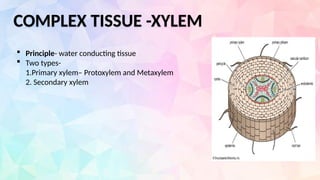
COMPLEX TISSUE -XYLEM
 Principle- water conducting tissue
 Two types-
1.Primary xylem– Protoxylem and Metaxylem
2. Secondary xylem
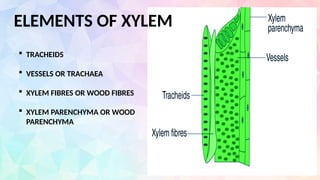
ELEMENTS OF XYLEM
 TRACHEIDS
 VESSELS OR TRACHAEA
 XYLEM FIBRES OR WOOD FIBRES
 XYLEM PARENCHYMA OR WOOD
PARENCHYMA
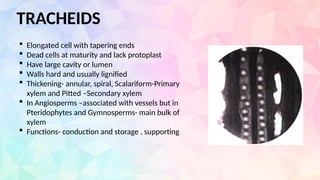
TRACHEIDS
 Elongated cell with tapering ends
 Dead cells at maturity and lack protoplast
 Have large cavity or lumen
 Walls hard and usually lignified
 Thickening- annular, spiral, Scalariform-Primary
xylem and Pitted –Secondary xylem
 In Angiosperms –associated with vessels but in
Pteridophytes and Gymnosperms- main bulk of
xylem
 Functions- conduction and storage , supporting
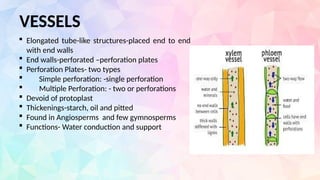
VESSELS
 Elongated tube-like structures-placed end to end
with end walls
 End walls-perforated –perforation plates
 Perforation Plates- two types
 Simple perforation: -single perforation
 Multiple Perforation: - two or perforations
 Devoid of protoplast
 Thickenings-starch, oil and pitted
 Found in Angiosperms and few gymnosperms
 Functions- Water conduction and support
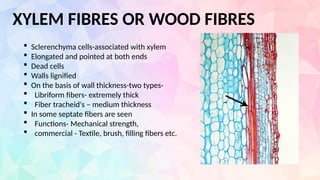
XYLEM FIBRES OR WOOD FIBRES
 Sclerenchyma cells-associated with xylem
 Elongated and pointed at both ends
 Dead cells
 Walls lignified
 On the basis of wall thickness-two types-
 Libriform fibers- extremely thick
 Fiber tracheid's – medium thickness
 In some septate fibers are seen
 Functions- Mechanical strength,
 commercial - Textile, brush, filling fibers etc.
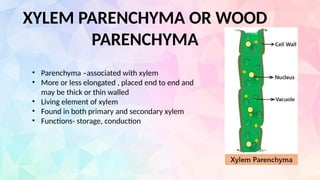
XYLEM PARENCHYMA OR WOOD
PARENCHYMA
• Parenchyma –associated with xylem
• More or less elongated , placed end to end and
may be thick or thin walled
• Living element of xylem
• Found in both primary and secondary xylem
• Functions- storage, conduction
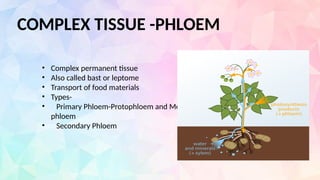
COMPLEX TISSUE -PHLOEM
• Complex permanent tissue
• Also called bast or leptome
• Transport of food materials
• Types-
• Primary Phloem-Protophloem and Meta
phloem
• Secondary Phloem
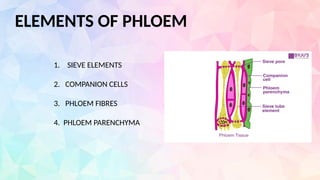
ELEMENTS OF PHLOEM
1. SIEVE ELEMENTS
2. COMPANION CELLS
3. PHLOEM FIBRES
4. PHLOEM PARENCHYMA
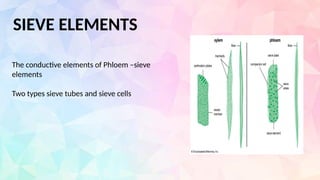
SIEVE ELEMENTS
The conductive elements of Phloem –sieve
elements
Two types sieve tubes and sieve cells
SIEVE TUBES SIEVE CELLS
• Long tube like structures-
longitudinal rows –end to end
• Transverse walls –end –
perforated –sieve plates
• Sieve plate –simple and
compound
• Each perforation-surrounded by
ring of callose
• living
• Single cells, do not unite
to form tubes
• Long, slender with
tapering ends
• Walls-abundant sieve
areas-conduction
• Living
• Functions-conduct food
materials
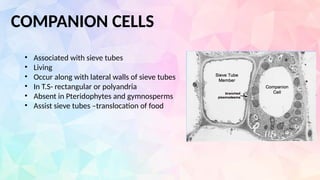
COMPANION CELLS
• Associated with sieve tubes
• Living
• Occur along with lateral walls of sieve tubes
• In T.S- rectangular or polyandria
• Absent in Pteridophytes and gymnosperms
• Assist sieve tubes –translocation of food
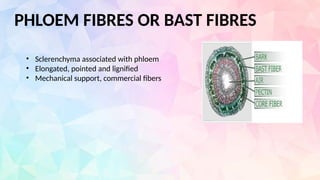
PHLOEM FIBRES OR BAST FIBRES
• Sclerenchyma associated with phloem
• Elongated, pointed and lignified
• Mechanical support, commercial fibers
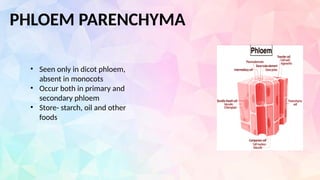
PHLOEM PARENCHYMA
• Seen only in dicot phloem,
absent in monocots
• Occur both in primary and
secondary phloem
• Store- starch, oil and other
foods
Complex tissue.pptx complrx in plant physio

Complex tissue.pptx complrx in plant physio

  • 1.
    MEWAR UNIVERSITY Venue:-Department oflife science Topic:- Complex permanent tissue Presented to- Ms. Khushi Jain Presented by- Deepak Kumar B.Sc(Biotechnology) MUR2401255
  • 3.
    COMPLEX TISSUE -XYLEM Principle- water conducting tissue  Two types- 1.Primary xylem– Protoxylem and Metaxylem 2. Secondary xylem
  • 4.
    ELEMENTS OF XYLEM TRACHEIDS  VESSELS OR TRACHAEA  XYLEM FIBRES OR WOOD FIBRES  XYLEM PARENCHYMA OR WOOD PARENCHYMA
  • 5.
    TRACHEIDS  Elongated cellwith tapering ends  Dead cells at maturity and lack protoplast  Have large cavity or lumen  Walls hard and usually lignified  Thickening- annular, spiral, Scalariform-Primary xylem and Pitted –Secondary xylem  In Angiosperms –associated with vessels but in Pteridophytes and Gymnosperms- main bulk of xylem  Functions- conduction and storage , supporting
  • 6.
    VESSELS  Elongated tube-likestructures-placed end to end with end walls  End walls-perforated –perforation plates  Perforation Plates- two types  Simple perforation: -single perforation  Multiple Perforation: - two or perforations  Devoid of protoplast  Thickenings-starch, oil and pitted  Found in Angiosperms and few gymnosperms  Functions- Water conduction and support
  • 7.
    XYLEM FIBRES ORWOOD FIBRES  Sclerenchyma cells-associated with xylem  Elongated and pointed at both ends  Dead cells  Walls lignified  On the basis of wall thickness-two types-  Libriform fibers- extremely thick  Fiber tracheid's – medium thickness  In some septate fibers are seen  Functions- Mechanical strength,  commercial - Textile, brush, filling fibers etc.
  • 8.
    XYLEM PARENCHYMA ORWOOD PARENCHYMA • Parenchyma –associated with xylem • More or less elongated , placed end to end and may be thick or thin walled • Living element of xylem • Found in both primary and secondary xylem • Functions- storage, conduction
  • 9.
    COMPLEX TISSUE -PHLOEM •Complex permanent tissue • Also called bast or leptome • Transport of food materials • Types- • Primary Phloem-Protophloem and Meta phloem • Secondary Phloem
  • 10.
    ELEMENTS OF PHLOEM 1.SIEVE ELEMENTS 2. COMPANION CELLS 3. PHLOEM FIBRES 4. PHLOEM PARENCHYMA
  • 11.
    SIEVE ELEMENTS The conductiveelements of Phloem –sieve elements Two types sieve tubes and sieve cells
  • 12.
    SIEVE TUBES SIEVECELLS • Long tube like structures- longitudinal rows –end to end • Transverse walls –end – perforated –sieve plates • Sieve plate –simple and compound • Each perforation-surrounded by ring of callose • living • Single cells, do not unite to form tubes • Long, slender with tapering ends • Walls-abundant sieve areas-conduction • Living • Functions-conduct food materials
  • 13.
    COMPANION CELLS • Associatedwith sieve tubes • Living • Occur along with lateral walls of sieve tubes • In T.S- rectangular or polyandria • Absent in Pteridophytes and gymnosperms • Assist sieve tubes –translocation of food
  • 14.
    PHLOEM FIBRES ORBAST FIBRES • Sclerenchyma associated with phloem • Elongated, pointed and lignified • Mechanical support, commercial fibers
  • 15.
    PHLOEM PARENCHYMA • Seenonly in dicot phloem, absent in monocots • Occur both in primary and secondary phloem • Store- starch, oil and other foods