Presented BY:
   Pradeep Jaswani
M.S.c MHG III semester
Jiwaji University Gwalior
          (M.P)
Contents
Introduction
Principles & strategies in identifying disease gene
Position independent strategies for identifying disease gene
 Identifying disease gene though knowing the protein product
 Identifying disease gene though an animal model
 Identification of a diseases gene using position independent
   DNA sequence knowledge
Positional cloning
 Single stand conformation polymorphism analysis
 Hetero duplex analysis
Candidate gene approach
INTRODUCTION
“Identifying genetic determinants of human
  phenotypes”.

The approach described are equally applicable
  to identifying determinants of diseases or of
  normal variations such as red hair or red-
  green color blindness.
PRINCIPLES & STRATEGIES IN IDENTIFYING
               DISEASE GENE

• There are many different ways of arriving at
  the final identification, but all path converge
  on a candidate gene.

• One way or another, a candidate gene is
  identified; the researcher then test the
  hypothesis that these gene is disease gene by
  screening it for mutation
• Candidate genes may be identified without
  reference to their chromosomal location but
  more commonly, first a candidate chromosomal
  region is pinpointed, and then candidate genes
  are identified from within that region.

• Positional information reduces the list of possible
  candidates from all 30000 or so on human genes
  to may be 10-30genes in a candidate region.
• Over and over again, when a disease gene is
  finally identified, it remains a complete mystery
  why mutation should cause that particular
  disease
• For e.g. why should loss of function of the
  FMR1 protein, involved in transporting RNA
  from nucleus to cytoplasm cause, cause mental
  retardation (Fragile-X syndrome)
POSITION INDEPENDENT STRATEGIES FOR
        IDENTIFYING DISEASE GENE
Historically, the first diseases genes were
  identified by position independent methods,
  simply because no relevant mapping
  information existed an no techniques were
  available to generate it.
Under those circumstances the candidate must
  be suggested by the knowledge of the gene
  product: β-globin for sickle cell disease,
  phenylalanine hydroxylase for PKU.
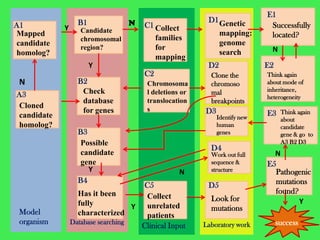
E1
                  B1             N                       D1 Genetic
A1          Y                         C1 Collect                             Successfully
Mapped             Candidate                                  mapping:
                   chromosomal             families                          located?
candidate                                                     genome
                   region?                 for                               N
homolog?                                                      search
                                           mapping
                       Y                                 D2                 E2
                                      C2                  Clone the         Think again
 N                B2                   Chromosoma         chromoso          about mode of
                   Check               l deletions or     mal               inheritance,
A3                                                                          heterogeneity
                   database            translocation      breakpoints
Cloned                                 s
                   for genes                            D3                  E3    Think again
candidate                                                    Identify new
   B3                                                                             about
homolog?                                                     human                candidate
                  B3                                         genes                gene & go to
                  Possible                                                        A3 B2 D3
                                                          D4
                  candidate                               Work out full       N
                  gene                                    sequence &        E5
                     Y                           N        structure           Pathogenic
                  B4                                                          mutations
                                     C5                  D5
                  Has it been                                                 found?
                                      Collect             Look for
                  fully                                                              Y
                                   Y unrelated            mutations
 Model            characterized       patients
 organism       Database searching                      Laboratory work          success
                                     Clinical Input
IDENTIFYING DISEASE GENE THOUGH KNOWING THE
PROTEIN PRODUCT
Modern proteomic technique allow even very
  tiny quantities of protein to be identified or
  partially sequenced by mass
  spectrophotometery.
As only one of the nucleotide in the mixture will
  corresponding to the authentic sequence, it is
  important to keep the number of different
  oligonucleotides low so as to increase the
  chance of identifying correct target.
The number of possible permutations should be
  reduced by ligating the target cDNA to a vector
  and using one vector-specific primer and one
  degenerate protein specific-primer
Host cells containing clones with the desired
  gene should produce the protein or at least
  parts of the protein, and could be indentified
  using colony filters from the library with an
  appropriate antibody.
A more rapid alternative is to use partially
  degenerate oligonucleotides as PCR primers
IDENTIFYING DISEASE GENE THOUGH
        AN ANIMAL MODEL
• Many human diseases genes have been
   identified with the help of animal models-but
   nearly always this has been after checking
   positional information's
A mouse mutant and a phenotypically similar
   human diseases are mapped to chromosomal
   location that are corresponds.
If the mouse gene is cloned its human homolog
   became a natural candidate.
• Alternatively a diseases gene may be identified
  in the mouse and then the human homolog
  isolated; this can be mapped by fluorescence
  in situ Hybridization, and becomes a candidate
  gene for any relevant diseases mapping to that
  location.
• This is how the MIFT gene was identified as a
  cause of type2 waardenburg syndrome (Hughes
  et al 1994).
IDENTIFICATION OF A DISEASES GENE USING POSITION
    INDEPENDENT DNA SEQUENCE KNOWLEDGE
• Positional independent candidates are also
  generated by expression array experiment in
  which mRNA samples from patient and
  controls are compared to produce a list of
  genes whose expression is alter in the disease.
• An interesting application of positional
  independent DNA sequence knowledge is
  attempt to clone genes containing novel
  trinucleotide repeats.
• The repeat expansion detection method of
  schalling et al 1993 permits detection of
  expanded repeats in unfractionated genomic
  DNA of affected patient and method have been
  developed for cloning expanded repeats
  detected (koob et al 1998).
Positional cloning
A diseases is identified knowing nothing except its
  appropriate chromosomal location.
The first successful application was identification of
  the gene for X-linked chronic granulomatous
  disease (Royer- Pokora et al 1985)
The successful conclusion of these work in 1986
  marked the start of triumphant new era for
  human molecular genetics.
One after another, the genes underlying important
  disorder such as cystic fibrosis, Huntington's
  diseases.
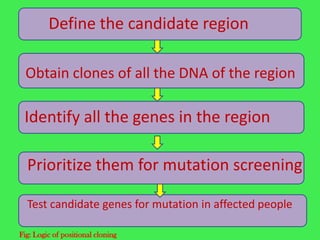
Define the candidate region

  Obtain clones of all the DNA of the region

 Identify all the genes in the region

  Prioritize them for mutation screening

  Test candidate genes for mutation in affected people

Fig: Logic of positional cloning
A NUMBER OF POSITIONAL CLONING METHODS
         ARE USED AS FOLLOWS:-

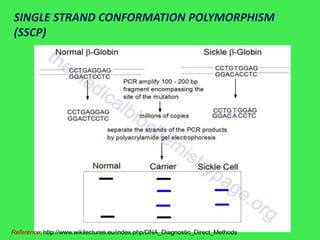
Single strand conformation polymorphism
 (SSCP)
Denaturing gradient gel electrophoresis
 (DGGE)
Heteroduplex analysis
Chemical mismatch cleavage protein
 truncation test (PTT)
SINGLE STRAND CONFORMATION POLYMORPHISM
(SSCP)


Reference: http://www.wikilectures.eu/index.php/DNA_Diagnostic_Direct_Methods
CANDIDATE GENE APPROACH
• A functional/candidate gene cloning project
  starts with either the known protein that is
  responsible for an inherited disorder or a
  protein that is considered a likely candidate
  based on the symptoms and biochemistry of
  the disease.
• The amino acid sequence of the protein is
  used to deduce the possible cloning sequence
  of the corresponding gene.
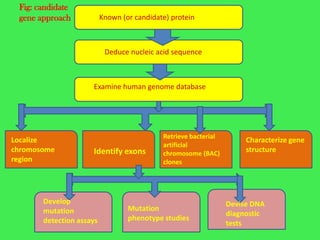
Fig: candidate
 gene approach            Known (or candidate) protein


                           Deduce nucleic acid sequence


                     Examine human genome database


                                            Retrieve bacterial
Localize                                                              Characterize gene
                                            artificial
chromosome           Identify exons         chromosome (BAC)
                                                                      structure
region                                      clones


       Develop                                                   Devise DNA
       mutation                   Mutation
                                                                 diagnostic
       detection assays           phenotype studies
                                                                 tests
REFERENCES
 HUMAN MOLECULAR GENETICS “Tom strachan &
 Read”
 AN INTRODUCTION TO HUMAN MOLECULAR
 GENETICS “Jack J.Pasternek”
http://www.wikilectures.eu/index.php/DNA_Di
 agnostic_Direct_Methods
Pradeep.ii

Pradeep.ii

  • 1.
    Presented BY: Pradeep Jaswani M.S.c MHG III semester Jiwaji University Gwalior (M.P)
  • 2.
    Contents Introduction Principles & strategiesin identifying disease gene Position independent strategies for identifying disease gene  Identifying disease gene though knowing the protein product  Identifying disease gene though an animal model  Identification of a diseases gene using position independent DNA sequence knowledge Positional cloning  Single stand conformation polymorphism analysis  Hetero duplex analysis Candidate gene approach
  • 3.
    INTRODUCTION “Identifying genetic determinantsof human phenotypes”. The approach described are equally applicable to identifying determinants of diseases or of normal variations such as red hair or red- green color blindness.
  • 4.
    PRINCIPLES & STRATEGIESIN IDENTIFYING DISEASE GENE • There are many different ways of arriving at the final identification, but all path converge on a candidate gene. • One way or another, a candidate gene is identified; the researcher then test the hypothesis that these gene is disease gene by screening it for mutation
  • 5.
    • Candidate genesmay be identified without reference to their chromosomal location but more commonly, first a candidate chromosomal region is pinpointed, and then candidate genes are identified from within that region. • Positional information reduces the list of possible candidates from all 30000 or so on human genes to may be 10-30genes in a candidate region.
  • 6.
    • Over andover again, when a disease gene is finally identified, it remains a complete mystery why mutation should cause that particular disease • For e.g. why should loss of function of the FMR1 protein, involved in transporting RNA from nucleus to cytoplasm cause, cause mental retardation (Fragile-X syndrome)
  • 7.
    POSITION INDEPENDENT STRATEGIESFOR IDENTIFYING DISEASE GENE Historically, the first diseases genes were identified by position independent methods, simply because no relevant mapping information existed an no techniques were available to generate it. Under those circumstances the candidate must be suggested by the knowledge of the gene product: β-globin for sickle cell disease, phenylalanine hydroxylase for PKU.
  • 8.
    E1 B1 N D1 Genetic A1 Y C1 Collect Successfully Mapped Candidate mapping: chromosomal families located? candidate genome region? for N homolog? search mapping Y D2 E2 C2 Clone the Think again N B2 Chromosoma chromoso about mode of Check l deletions or mal inheritance, A3 heterogeneity database translocation breakpoints Cloned s for genes D3 E3 Think again candidate Identify new B3 about homolog? human candidate B3 genes gene & go to Possible A3 B2 D3 D4 candidate Work out full N gene sequence & E5 Y N structure Pathogenic B4 mutations C5 D5 Has it been found? Collect Look for fully Y Y unrelated mutations Model characterized patients organism Database searching Laboratory work success Clinical Input
  • 9.
    IDENTIFYING DISEASE GENETHOUGH KNOWING THE PROTEIN PRODUCT Modern proteomic technique allow even very tiny quantities of protein to be identified or partially sequenced by mass spectrophotometery. As only one of the nucleotide in the mixture will corresponding to the authentic sequence, it is important to keep the number of different oligonucleotides low so as to increase the chance of identifying correct target.
  • 10.
    The number ofpossible permutations should be reduced by ligating the target cDNA to a vector and using one vector-specific primer and one degenerate protein specific-primer Host cells containing clones with the desired gene should produce the protein or at least parts of the protein, and could be indentified using colony filters from the library with an appropriate antibody. A more rapid alternative is to use partially degenerate oligonucleotides as PCR primers
  • 11.
    IDENTIFYING DISEASE GENETHOUGH AN ANIMAL MODEL • Many human diseases genes have been identified with the help of animal models-but nearly always this has been after checking positional information's A mouse mutant and a phenotypically similar human diseases are mapped to chromosomal location that are corresponds. If the mouse gene is cloned its human homolog became a natural candidate.
  • 12.
    • Alternatively adiseases gene may be identified in the mouse and then the human homolog isolated; this can be mapped by fluorescence in situ Hybridization, and becomes a candidate gene for any relevant diseases mapping to that location. • This is how the MIFT gene was identified as a cause of type2 waardenburg syndrome (Hughes et al 1994).
  • 13.
    IDENTIFICATION OF ADISEASES GENE USING POSITION INDEPENDENT DNA SEQUENCE KNOWLEDGE • Positional independent candidates are also generated by expression array experiment in which mRNA samples from patient and controls are compared to produce a list of genes whose expression is alter in the disease. • An interesting application of positional independent DNA sequence knowledge is attempt to clone genes containing novel trinucleotide repeats.
  • 14.
    • The repeatexpansion detection method of schalling et al 1993 permits detection of expanded repeats in unfractionated genomic DNA of affected patient and method have been developed for cloning expanded repeats detected (koob et al 1998).
  • 15.
    Positional cloning A diseasesis identified knowing nothing except its appropriate chromosomal location. The first successful application was identification of the gene for X-linked chronic granulomatous disease (Royer- Pokora et al 1985) The successful conclusion of these work in 1986 marked the start of triumphant new era for human molecular genetics. One after another, the genes underlying important disorder such as cystic fibrosis, Huntington's diseases.
  • 16.
    Define the candidateregion Obtain clones of all the DNA of the region Identify all the genes in the region Prioritize them for mutation screening Test candidate genes for mutation in affected people Fig: Logic of positional cloning
  • 17.
    A NUMBER OFPOSITIONAL CLONING METHODS ARE USED AS FOLLOWS:- Single strand conformation polymorphism (SSCP) Denaturing gradient gel electrophoresis (DGGE) Heteroduplex analysis Chemical mismatch cleavage protein truncation test (PTT)
  • 18.
    SINGLE STRAND CONFORMATIONPOLYMORPHISM (SSCP) Reference: http://www.wikilectures.eu/index.php/DNA_Diagnostic_Direct_Methods
  • 19.
    CANDIDATE GENE APPROACH •A functional/candidate gene cloning project starts with either the known protein that is responsible for an inherited disorder or a protein that is considered a likely candidate based on the symptoms and biochemistry of the disease. • The amino acid sequence of the protein is used to deduce the possible cloning sequence of the corresponding gene.
  • 20.
    Fig: candidate geneapproach Known (or candidate) protein Deduce nucleic acid sequence Examine human genome database Retrieve bacterial Localize Characterize gene artificial chromosome Identify exons chromosome (BAC) structure region clones Develop Devise DNA mutation Mutation diagnostic detection assays phenotype studies tests
  • 21.
    REFERENCES  HUMAN MOLECULARGENETICS “Tom strachan & Read”  AN INTRODUCTION TO HUMAN MOLECULAR GENETICS “Jack J.Pasternek” http://www.wikilectures.eu/index.php/DNA_Di agnostic_Direct_Methods