PRINCIPLES OF
INHERITANCE
AND VARIATION
BY: DR. PRITIMA GUPTA
INTRODUCTION
• Branch of biology that deals with the study of genes, genetic
variation and hereditary is known as GENETICS.
• INHERITANCE- the process by which characters are passed
on from parent to progeny.
• VARIATION- It is the degree by which progeny differ from
their parents.
TERMINOLOGIES
• GENETICS – It is the branch of life science that deals with the study of
heredity and variation.
• HEREDITY – It is the transmission of characters from parents to their
offsprings.
• VARIATION – It is the difference among the offsprings and with their
parents.
• HEREDITARY VARIATIONS – It these are genetical and inheritable.
• ENVIRONMENTAL VARIATION – It these are acquired and non
inheritable.
GREGOR JOHANN MENDEL
• HE IS THE FATHER OF GENETICS.
• FATHER OF MODERN GENETICS.
• Gregor Mendel developed the principles
of heredity while studying seven pairs of
inherited characteristics in pea plants.
• He conducted experiments on for 7
years from 1856-1863 & gave laws of
inheritance.
• HIS APPROACH – Used pea plant for
his experiments due to -
1. Pure variety are available.
2. Pea plants are easy to cultivate.
3. Life cycle of plants are only few
months. So that result can be got early.
4. Contrasting trait are observed.
5. Flowers are bisexual and normally self
pollinated.
6. Flowers can be cross pollinated only
manually.
7. Hybrids are fertile.
8. Pure line breeding was possible.
MENDEL’S EXPERIMENT
1. Applied statistical analysis
& mathematical logic for
biology problems.
2. Large sampling size.
3. Confirmation of inference
from experiments on
successive generations of
test plants, proved
general rules of
inheritance.
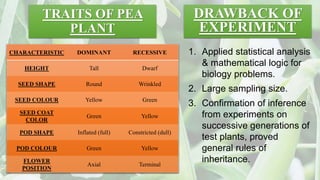
TRAITS OF PEA
PLANT
CHARACTERISTIC DOMINANT RECESSIVE
HEIGHT Tall Dwarf
SEED SHAPE Round Wrinkled
SEED COLOUR Yellow Green
SEED COAT
COLOR
Green Yellow
POD SHAPE Inflated (full) Constricted (dull)
POD COLOUR Green Yellow
FLOWER
POSITION
Axial Terminal
DRAWBACK OF
EXPERIMENT
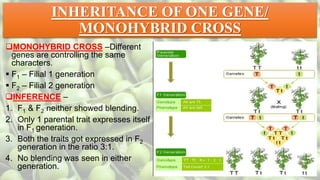
INHERITANCE OF ONE GENE/
MONOHYBRID CROSS
MONOHYBRID CROSS –Different
genes are controlling the same
characters.
 F1 – Filial 1 generation
 F2 – Filial 2 generation
INFERENCE –
1. F1 & F2 neither showed blending.
2. Only 1 parental trait expresses itself
in F1 generation.
3. Both the traits got expressed in F2
generation in the ratio 3:1.
4. No blending was seen in either
generation.
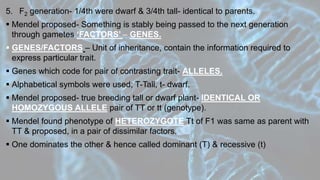
5. F2 generation- 1/4th were dwarf & 3/4th tall- identical to parents.
 Mendel proposed- Something is stably being passed to the next generation
through gametes ‘FACTORS’ – GENES.
 GENES/FACTORS – Unit of inheritance, contain the information required to
express particular trait.
 Genes which code for pair of contrasting trait- ALLELES.
 Alphabetical symbols were used; T-Tall, t- dwarf.
 Mendel proposed- true breeding tall or dwarf plant- IDENTICAL OR
HOMOZYGOUS ALLELE pair of TT or tt (genotype).
 Mendel found phenotype of HETEROZYGOTE Tt of F1 was same as parent with
TT & proposed, in a pair of dissimilar factors.
 One dominates the other & hence called dominant (T) & recessive (t)
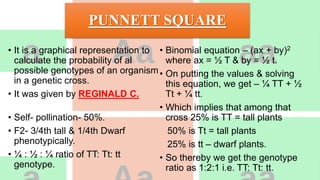
PUNNETT SQUARE
• It is a graphical representation to
calculate the probability of al
possible genotypes of an organism
in a genetic cross.
• It was given by REGINALD C.
PUNNETT.
• Self- pollination- 50%.
• F2- 3/4th tall & 1/4th Dwarf
phenotypically.
• ¼ : ½ : ¼ ratio of TT: Tt: tt
genotype.
• Binomial equation – (ax + by)2
where ax = ½ T & by = ½ t.
• On putting the values & solving
this equation, we get – ¼ TT + ½
Tt + ¼ tt.
• Which implies that among that
cross 25% is TT = tall plants
50% is Tt = tall plants
25% is tt – dwarf plants.
• So thereby we get the genotype
ratio as 1:2:1 i.e. TT: Tt: tt.
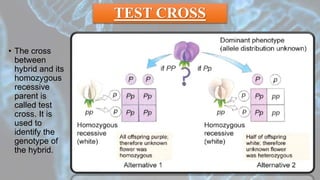
TEST CROSS
• The cross
between
hybrid and its
homozygous
recessive
parent is
called test
cross. It is
used to
identify the
genotype of
the hybrid.
LAWS OF INHERITANCE
• LAW OF DOMINANCE – First law of Inheritance.
• LAW OF SEGREGATION – Second law
LAW OF DOMINANCE –
1. Characters are controlled by factors.
2. Factors occurs in pairs.
3. In a dissimilar pair of factors one member of the pair dominates (dominant) the
other (recessive).
• Used to explain the expression of only one of the parental characters in
monohybrid cross (F1) & expression of both in F2.
• Also explains proportion 3:1 in F2
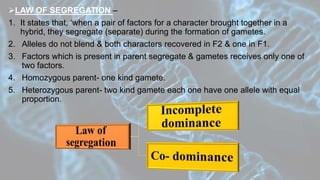
LAW OF SEGREGATION –
1. It states that, ‘when a pair of factors for a character brought together in a
hybrid, they segregate (separate) during the formation of gametes.
2. Alleles do not blend & both characters recovered in F2 & one in F1.
3. Factors which is present in parent segregate & gametes receives only one of
two factors.
4. Homozygous parent- one kind gamete.
5. Heterozygous parent- two kind gamete each one have one allele with equal
proportion.
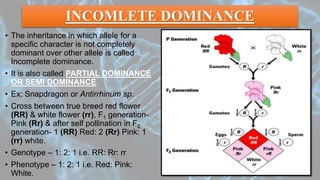
INCOMLETE DOMINANCE
• The inheritance in which allele for a
specific character is not completely
dominant over other allele is called
Incomplete dominance.
• It is also called PARTIAL DOMINANCE
OR SEMI DOMINANCE.
• Ex: Snapdragon or Antirrhinum sp.
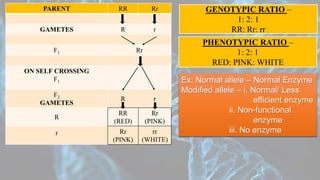
• Cross between true breed red flower
(RR) & white flower (rr), F1 generation-
Pink (Rr) & after self pollination in F2
generation- 1 (RR) Red: 2 (Rr) Pink: 1
(rr) white.
• Genotype – 1: 2: 1 i.e. RR: Rr: rr
• Phenotype – 1: 2: 1 i.e. Red: Pink:
White.
PARENT RR Rr
GAMETES R r
F1 Rr
ON SELF CROSSING
F1
F2
GAMETES
R r
R
RR
(RED)
Rr
(PINK)
r Rr
(PINK)
rr
(WHITE)
GENOTYPIC RATIO –
1: 2: 1
RR: Rr: rr
PHENOTYPIC RATIO –
1: 2: 1
RED: PINK: WHITE
Ex: Normal allele – Normal Enzyme
Modified allele – i. Normal/ Less
efficient enzyme
ii. Non-functional
enzyme
iii. No enzyme
CO - DOMINANCE
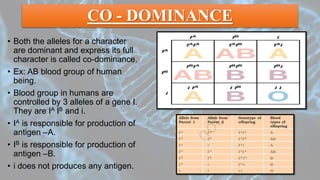
• Both the alleles for a character
are dominant and express its full
character is called co-dominance.
• Ex: AB blood group of human
being.
• Blood group in humans are
controlled by 3 alleles of a gene I.
They are IA IB and i.
• IA is responsible for production of
antigen –A.
• IB is responsible for production of
antigen –B.
• i does not produces any antigen.
MULTIPLE ALLELISM
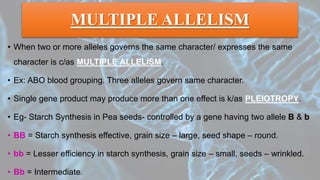
• When two or more alleles governs the same character/ expresses the same
character is c/as MULTIPLE ALLELISM.
• Ex: ABO blood grouping. Three alleles govern same character.
• Single gene product may produce more than one effect is k/as PLEIOTROPY.
• Eg- Starch Synthesis in Pea seeds- controlled by a gene having two allele B & b
• BB = Starch synthesis effective, grain size – large, seed shape – round.
• bb = Lesser efficiency in starch synthesis, grain size – small, seeds – wrinkled.
• Bb = Intermediate.
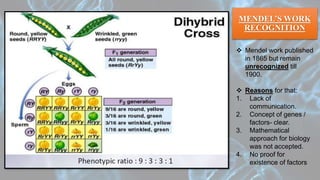
INHERITANCE OF TWO GENES
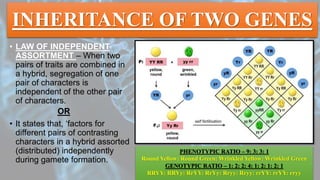
• LAW OF INDEPENDENT
ASSORTMENT – When two
pairs of traits are combined in
a hybrid, segregation of one
pair of characters is
independent of the other pair
of characters.
OR
• It states that, ‘factors for
different pairs of contrasting
characters in a hybrid assorted
(distributed) independently
during gamete formation.
PHENOTYPIC RATIO – 9: 3: 3: 1
Round Yellow: Round Green: Wrinkled Yellow: Wrinkled Green
GENOTYPIC RATIO – 1: 2: 2: 4: 1: 2: 1: 2: 1
RRYY: RRYy: RrYY: RrYy: Rryy: Rryy: rrYY: rrYY: rryy
 Mendel work published
in 1865 but remain
unrecognized till
1900.
 Reasons for that:
1. Lack of
communication.
2. Concept of genes /
factors- clear.
3. Mathematical
approach for biology
was not accepted.
4. No proof for
existence of factors
MENDEL’S WORK
RECOGNITION
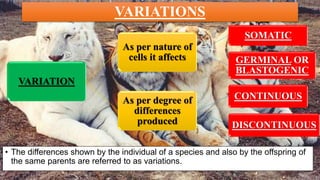
VARIATIONS
VARIATION
As per nature of
cells it affects
SOMATIC
GERMINAL OR
BLASTOGENIC
As per degree of
differences
produced
CONTINUOUS
DISCONTINUOUS
• The differences shown by the individual of a species and also by the offspring of
the same parents are referred to as variations.
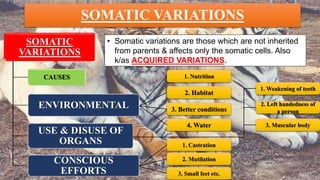
SOMATIC VARIATIONS
SOMATIC
VARIATIONS
CAUSES
ENVIRONMENTAL
USE & DISUSE OF
ORGANS
CONSCIOUS
EFFORTS
• Somatic variations are those which are not inherited
from parents & affects only the somatic cells. Also
k/as ACQUIRED VARIATIONS.
1. Nutrition
2. Habitat
3. Better conditions
4. Water
1. Weakening of teeth
3. Muscular body
2. Left handedness of
a person
1. Castration
2. Mutilation
3. Small feet etc.
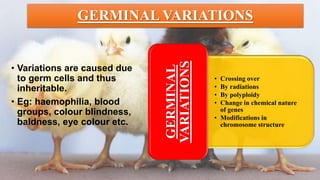
GERMINAL VARIATIONS
• Variations are caused due
to germ cells and thus
inheritable.
• Eg: haemophilia, blood
groups, colour blindness,
baldness, eye colour etc.
• Crossing over
• By radiations
• By polyploidy
• Change in chemical nature
of genes
• Modifications in
chromosome structure
GERMINAL
VARIATIONS
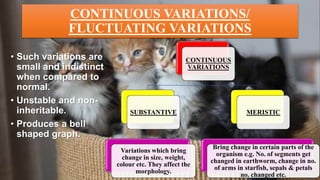
CONTINUOUS VARIATIONS/
FLUCTUATING VARIATIONS
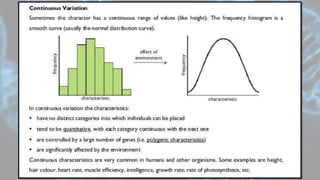
• Such variations are
small and indistinct
when compared to
normal.
• Unstable and non-
inheritable.
• Produces a bell
shaped graph.
CONTINUOUS
VARIATIONS
SUBSTANTIVE
Variations which bring
change in size, weight,
colour etc. They affect the
morphology.
MERISTIC
Bring change in certain parts of the
organism e.g. No. of segments get
changed in earthworm, change in no.
of arms in starfish, sepals & petals
no. changed etc.
DISCONTINUOUS VARIATIONS
• Such variations are
large and represent
the conspicuous
differences of the
progeny from
parents.
• They are referred as
mutations or sports
or saltations.
• Mutations appear
suddenly and are
inheritable and
stable.
DISCONTINUOUS
VARIATIONS
SUBSTANTIVE
Mutations bring variation
in size, weight, shape,
colour etc. Eg:
brachydactyly, syndactyly
etc.
MERISTIC
Bring change in no. of certain parts
of the organism e.g. polydactyly.
SIGNIFICANCE OF VARIATIONS
1. Constitutes the raw material for evolution.
2. Useful variants of animals and plants are produced.
3. Variations form the basis of heredity.
4. Help in adaptations of organisms to changed environment.
5. Make some individuals better suited in the struggle for existence.
6. Variations provide each organism a distinct individuality.
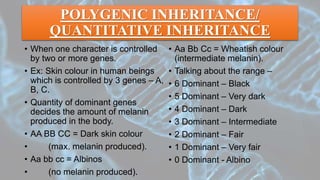
POLYGENIC INHERITANCE/
QUANTITATIVE INHERITANCE
• When one character is controlled
by two or more genes.
• Ex: Skin colour in human beings
which is controlled by 3 genes – A,
B, C.
• Quantity of dominant genes
decides the amount of melanin
produced in the body.
• AA BB CC = Dark skin colour
• (max. melanin produced).
• Aa bb cc = Albinos
• (no melanin produced).
• Aa Bb Cc = Wheatish colour
(intermediate melanin).
• Talking about the range –
• 6 Dominant – Black
• 5 Dominant – Very dark
• 4 Dominant – Dark
• 3 Dominant – Intermediate
• 2 Dominant – Fair
• 1 Dominant – Very fair
• 0 Dominant - Albino
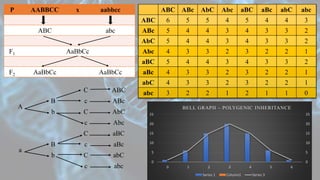
P AABBCC x aabbcc
ABC abc
F1 AaBbCc
F2 AaBbCc AaBbCc
A
C ABC
B c ABc
b C AbC
c Abc
a
C aBC
B c aBc
b C abC
c abc
ABC ABc AbC Abc aBC aBc abC abc
ABC 6 5 5 4 5 4 4 3
ABc 5 4 4 3 4 3 3 2
AbC 5 4 4 3 4 3 3 2
Abc 4 3 3 2 3 2 2 1
aBC 5 4 4 3 4 3 3 2
aBc 4 3 3 2 3 2 2 1
abC 4 3 3 2 3 2 2 1
abc 3 2 2 1 2 1 1 0
0
5
10
15
20
25
0
5
10
15
20
25
0 1 2 3 4 5 6
BELL GRAPH – POLYGENIC INHERITANCE
Series 1 Column1 Series 3
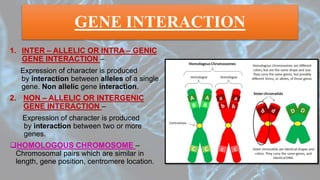
GENE INTERACTION
1. INTER – ALLELIC OR INTRA – GENIC
GENE INTERACTION –
Expression of character is produced
by interaction between alleles of a single
gene. Non allelic gene interaction.
2. NON – ALLELIC OR INTERGENIC
GENE INTERACTION –
Expression of character is produced
by interaction between two or more
genes.
HOMOLOGOUS CHROMOSOME –
Chromosomal pairs which are similar in
length, gene position, centromere location.
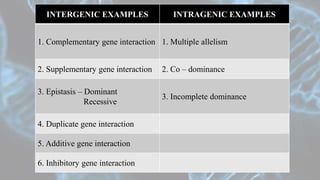
INTERGENIC EXAMPLES INTRAGENIC EXAMPLES
1. Complementary gene interaction 1. Multiple allelism
2. Supplementary gene interaction 2. Co – dominance
3. Epistasis – Dominant
Recessive
3. Incomplete dominance
4. Duplicate gene interaction
5. Additive gene interaction
6. Inhibitory gene interaction
INTERGENIC – 1. COMPLEMENTARY
GENES
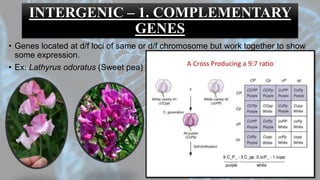
• Genes located at d/f loci of same or d/f chromosome but work together to show
some expression.
• Ex: Lathyrus odoratus (Sweet pea)
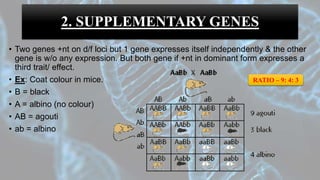
• Two genes +nt on d/f loci but 1 gene expresses itself independently & the other
gene is w/o any expression. But both gene if +nt in dominant form expresses a
third trait/ effect.
• Ex: Coat colour in mice.
• B = black
• A = albino (no colour)
• AB = agouti
• ab = albino
2. SUPPLEMENTARY GENES
RATIO – 9: 4: 3
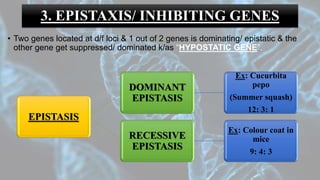
3. EPISTAXIS/ INHIBITING GENES
• Two genes located at d/f loci & 1 out of 2 genes is dominating/ epistatic & the
other gene get suppressed/ dominated k/as “HYPOSTATIC GENE”.
EPISTASIS
DOMINANT
EPISTASIS
Ex: Cucurbita
pepo
(Summer squash)
12: 3: 1
RECESSIVE
EPISTASIS
Ex: Colour coat in
mice
9: 4: 3
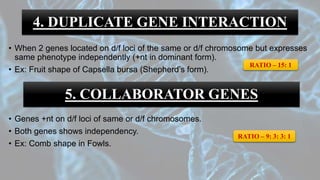
4. DUPLICATE GENE INTERACTION
• When 2 genes located on d/f loci of the same or d/f chromosome but expresses
same phenotype independently (+nt in dominant form).
• Ex: Fruit shape of Capsella bursa (Shepherd’s form).
• Genes +nt on d/f loci of same or d/f chromosomes.
• Both genes shows independency.
• Ex: Comb shape in Fowls.
RATIO – 15: 1
5. COLLABORATOR GENES
RATIO – 9: 3: 3: 1
PLEIOTROPIC GENES
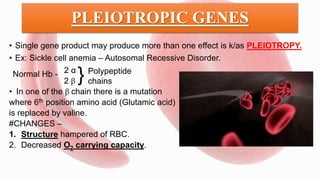
• Single gene product may produce more than one effect is k/as PLEIOTROPY.
• Ex: Sickle cell anemia – Autosomal Recessive Disorder.
2 α
2 β
• In one of the β chain there is a mutation
where 6th position amino acid (Glutamic acid)
is replaced by valine.
#CHANGES –
1. Structure hampered of RBC.
2. Decreased O2 carrying capacity.
} Polypeptide
chains
Normal Hb -
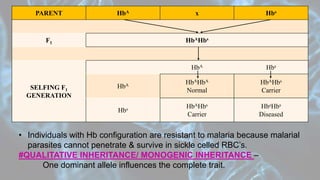
PARENT HbA x Hbs
F1 HbAHbs
SELFING F1
GENERATION
HbA Hbs
HbA HbAHbA
Normal
HbAHbs
Carrier
Hbs HbAHbs
Carrier
HbsHbs
Diseased
• Individuals with Hb configuration are resistant to malaria because malarial
parasites cannot penetrate & survive in sickle celled RBC’s.
#QUALITATIVE INHERITANCE/ MONOGENIC INHERITANCE –
One dominant allele influences the complete trait.
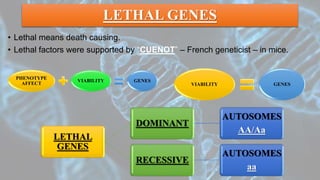
LETHAL GENES
• Lethal means death causing.
• Lethal factors were supported by “CUENOT” – French geneticist – in mice.
PHENOTYPE
AFFECT
VIABILITY GENES
VIABILITY GENES
LETHAL
GENES
DOMINANT
AUTOSOMES
AA/Aa
RECESSIVE
AUTOSOMES
aa
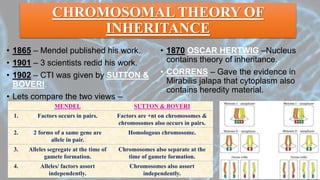
CHROMOSOMAL THEORY OF
INHERITANCE
• 1865 – Mendel published his work.
• 1901 – 3 scientists redid his work.
• 1902 – CTI was given by SUTTON &
BOVERI.
• Lets compare the two views –
• 1870 OSCAR HERTWIG –Nucleus
contains theory of inheritance.
• CORRENS – Gave the evidence in
Mirabilis jalapa that cytoplasm also
contains heredity material.
MENDEL SUTTON & BOVERI
1. Factors occurs in pairs. Factors are +nt on chromosomes &
chromosomes also occurs in pairs.
2. 2 forms of a same gene are
allele in pair.
Homologous chromosome.
3. Alleles segregate at the time of
gamete formation.
Chromosomes also separate at the
time of gamete formation.
4. Alleles/ factors assort
independently.
Chromosomes also assort
independently.
LINKAGE AND RECOMBINATION
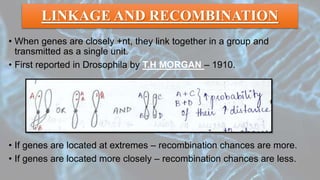
• When genes are closely +nt, they link together in a group and
transmitted as a single unit.
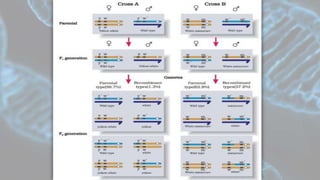
• First reported in Drosophila by T.H MORGAN – 1910.
• If genes are located at extremes – recombination chances are more.
• If genes are located more closely – recombination chances are less.
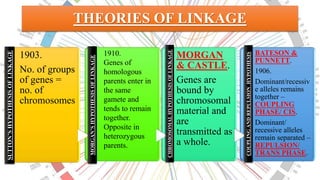
THEORIES OF LINKAGE
1903.
No. of groups
of genes =
no. of
chromosomes
MORGAN
& CASTLE.
Genes are
bound by
chromosomal
material and
are
transmitted as
a whole.
BATESON &
PUNNETT.
1906.
Dominant/recessiv
e alleles remains
together –
COUPLING
PHASE/ CIS.
Dominant/
recessive alleles
remain separated –
REPULSION/
TRANS PHASE.
SUTTON’SHYPOTHESISOFLINKAGE
MORGAN’SHYPOTHESISOFLINKAGE
CHROMOSOMALHYPOTHESISOFLINKAGE
COUPLINGANDREPULSIONHYPOTHESIS
1910.
Genes of
homologous
parents enter in
the same
gamete and
tends to remain
together.
Opposite in
heterozygous
parents.
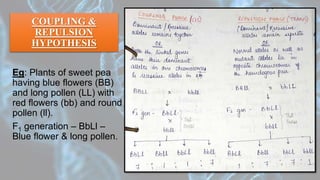
COUPLING &
REPULSION
HYPOTHESIS
Eg: Plants of sweet pea
having blue flowers (BB)
and long pollen (LL) with
red flowers (bb) and round
pollen (ll).
F1 generation – BbLl –
Blue flower & long pollen.
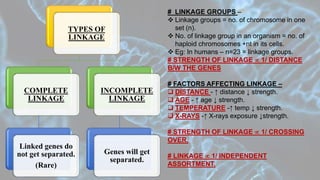
TYPES OF
LINKAGE
COMPLETE
LINKAGE
Linked genes do
not get separated.
(Rare)
INCOMPLETE
LINKAGE
Genes will get
separated.
# LINKAGE GROUPS –
 Linkage groups = no. of chromosome in one
set (n).
 No. of linkage group in an organism = no. of
haploid chromosomes +nt in its cells.
 Eg: In humans – n=23 = linkage groups.
# STRENGTH OF LINKAGE  1/ DISTANCE
B/W THE GENES
# FACTORS AFFECTING LINKAGE –
 DISTANCE - ↑ distance ↓ strength.
 AGE - ↑ age ↓ strength.
 TEMPERATURE -↑ temp ↓ strength.
 X-RAYS -↑ X-rays exposure ↓strength.
# STRENGTH OF LINKAGE  1/ CROSSING
OVER.
# LINKAGE  1/ INDEPENDENT
ASSORTMENT.
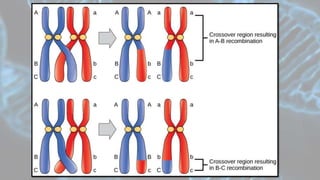
CROSSING OVER
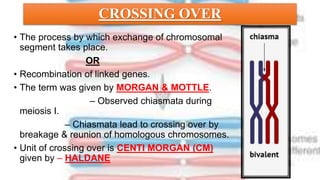
• The process by which exchange of chromosomal
segment takes place.
OR
• Recombination of linked genes.
• The term was given by MORGAN & MOTTLE.
• JANSEN (1909) – Observed chiasmata during
meiosis I.
• MORGAN – Chiasmata lead to crossing over by
breakage & reunion of homologous chromosomes.
• Unit of crossing over is CENTI MORGAN (CM)
given by – HALDANE.
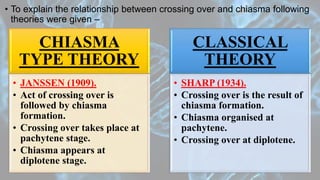
• To explain the relationship between crossing over and chiasma following
theories were given –
CHIASMA
TYPE THEORY
• JANSSEN (1909).
• Act of crossing over is
followed by chiasma
formation.
• Crossing over takes place at
pachytene stage.
• Chiasma appears at
diplotene stage.
CLASSICAL
THEORY
• SHARP (1934).
• Crossing over is the result of
chiasma formation.
• Chiasma organised at
pachytene.
• Crossing over at diplotene.
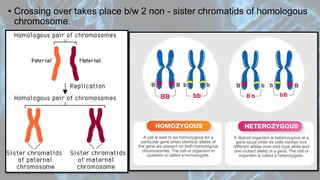
• Crossing over takes place b/w 2 non - sister chromatids of homologous
chromosome.
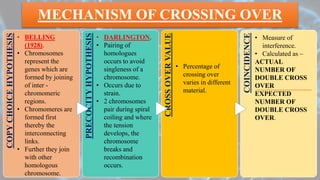
MECHANISM OF CROSSING OVERCOPYCHOICEHYPOTHESIS
PRECOCITYHYPOTHESIS
CROSSOVERVALUE
COINCIDENCE
• DARLINGTON.
• Pairing of
homologues
occurs to avoid
singleness of a
chromosome.
• Occurs due to
strain.
• 2 chromosomes
pair during spiral
coiling and where
the tension
develops, the
chromosome
breaks and
recombination
occurs.
• BELLING
(1928).
• Chromosomes
represent the
genes which are
formed by joining
of inter -
chromomeric
regions.
• Chromomeres are
formed first
thereby the
interconnecting
links.
• Further they join
with other
homologous
chromosome.
• Percentage of
crossing over
varies in different
material.
• Measure of
interference.
• Calculated as –
ACTUAL
NUMBER OF
DOUBLE CROSS
OVER
EXPECTED
NUMBER OF
DOUBLE CROSS
OVER.
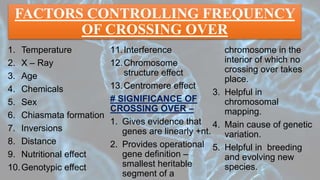
FACTORS CONTROLLING FREQUENCY
OF CROSSING OVER
1. Temperature
2. X – Ray
3. Age
4. Chemicals
5. Sex
6. Chiasmata formation
7. Inversions
8. Distance
9. Nutritional effect
10.Genotypic effect
11.Interference
12.Chromosome
structure effect
13.Centromere effect
# SIGNIFICANCE OF
CROSSING OVER –
1. Gives evidence that
genes are linearly +nt.
2. Provides operational
gene definition –
smallest heritable
segment of a
chromosome in the
interior of which no
crossing over takes
place.
3. Helpful in
chromosomal
mapping.
4. Main cause of genetic
variation.
5. Helpful in breeding
and evolving new
species.
CHROMOSOMAL MAPS/ LINKAGE MAP/
GENE MAP
• A linkage or genetic chromosome map is
a linear graphic representation of the
sequence & relative distances of the
various genes +nt in a chromosome.
# RECOMBINATION FREQUENCY –
• Frequency of crossing over is dependent
upon distance present b/w the two genes.
• If we say that 2 genes A & B are 10 map
units apart.
OR
• We can say that recombination frequency
is 10%.
Eg: We are saying genes A & B are 20
units apart & genes A & C are 10 units
apart. What is are the locations of gene A,
B & C?
#USES OF CHROMOSOMAL MAPS –
1. Find out the gene location.
2. Knowing recombination of various
genes.
3. Result prediction of di & tri hybrid
cross.
CHROMOSOMES
• Also k/as “HEREDITARY MATERIAL”.
• Responsible for genes transmission.
#DISCOVERY OF CHROMOSOMES –
• HOFMEISTER (1848) – first observed chromosomes in microsporocytes of
Tradescantia.
• ROUX (1883) – chromosomes take part in inheritance.
• W. WALDEYER (1888) – coined the term chromosome.
• WALTHER FLEMMING (1879) – splitting of chromosomes during cell division.
• BENDEN & BOVERI (1887) – found fixed number of chromosome in species.
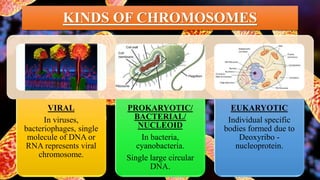
KINDS OF CHROMOSOMES
VIRAL
In viruses,
bacteriophages, single
molecule of DNA or
RNA represents viral
chromosome.
PROKARYOTIC/
BACTERIAL/
NUCLEOID
In bacteria,
cyanobacteria.
Single large circular
DNA.
EUKARYOTIC
Individual specific
bodies formed due to
Deoxyribo -
nucleoprotein.
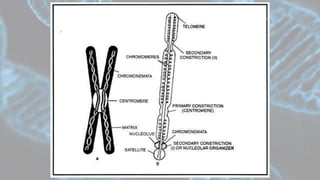
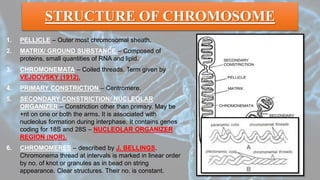
STRUCTURE OF CHROMOSOME
1. PELLICLE – Outer most chromosomal sheath.
2. MATRIX/ GROUND SUBSTANCE – Composed of
proteins, small quantities of RNA and lipid.
3. CHROMONEMATA – Coiled threads. Term given by
VEJDOVSKY (1912).
4. PRIMARY CONSTRICTION – Centromere.
5. SECONDARY CONSTRICTION/ NUCLEOLAR
ORGANIZER – Constriction other than primary. May be
+nt on one or both the arms. It is associated with
nucleolus formation during interphase. It contains genes
coding for 18S and 28S – NUCLEOLAR ORGANIZER
REGION (NOR).
6. CHROMOMERES – described by J. BELLINGS.
Chromonema thread at intervals is marked in linear order
by no. of knot or granules as in bead on string
appearance. Clear structures. Their no. is constant.
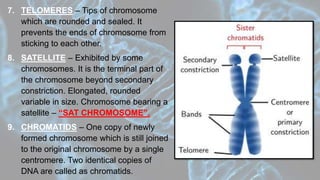
7. TELOMERES – Tips of chromosome
which are rounded and sealed. It
prevents the ends of chromosome from
sticking to each other.
8. SATELLITE – Exhibited by some
chromosomes. It is the terminal part of
the chromosome beyond secondary
constriction. Elongated, rounded
variable in size. Chromosome bearing a
satellite – “SAT CHROMOSOME”.
9. CHROMATIDS – One copy of newly
formed chromosome which is still joined
to the original chromosome by a single
centromere. Two identical copies of
DNA are called as chromatids.
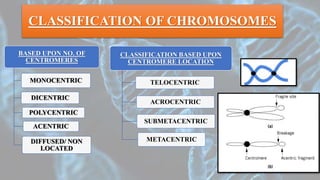
BASED UPON NO. OF
CENTROMERES
MONOCENTRIC
DICENTRIC
POLYCENTRIC
ACENTRIC
DIFFUSED/ NON
LOCATED
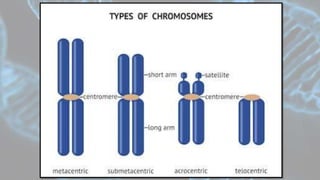
CLASSIFICATION OF CHROMOSOMES
CLASSIFICATION BASED UPON
CENTROMERE LOCATION
TELOCENTRIC
ACROCENTRIC
SUBMETACENTRIC
METACENTRIC
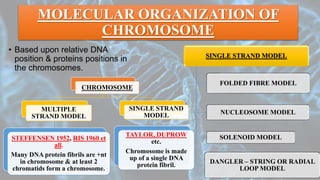
MOLECULAR ORGANIZATION OF
CHROMOSOME
• Based upon relative DNA
position & proteins positions in
the chromosomes.
CHROMOSOME
MULTIPLE
STRAND MODEL
STEFFENSEN 1952, RIS 1960 et
all.
Many DNA protein fibrils are +nt
in chromosome & at least 2
chromatids form a chromosome.
SINGLE STRAND
MODEL
TAYLOR, DUPROW
etc.
Chromosome is made
up of a single DNA
protein fibril.
SINGLE STRAND MODEL
FOLDED FIBRE MODEL
NUCLEOSOME MODEL
SOLENOID MODEL
DANGLER – STRING OR RADIAL
LOOP MODEL
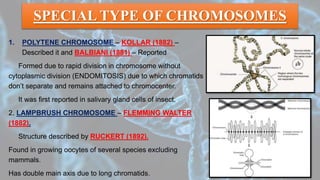
SPECIAL TYPE OF CHROMOSOMES
1. POLYTENE CHROMOSOME – KOLLAR (1882) –
Described it and BALBIANI (1881) – Reported
Formed due to rapid division in chromosome without
cytoplasmic division (ENDOMITOSIS) due to which chromatids
don’t separate and remains attached to chromocenter.
It was first reported in salivary gland cells of insect.
2. LAMPBRUSH CHROMOSOME – FLEMMING WALTER
(1882).
Structure described by RUCKERT (1892).
Found in growing oocytes of several species excluding
mammals.
Has double main axis due to long chromatids.
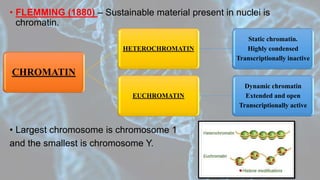
• FLEMMING (1880) – Sustainable material present in nuclei is
chromatin.
• Largest chromosome is chromosome 1
and the smallest is chromosome Y.
CHROMATIN
HETEROCHROMATIN
Static chromatin.
Highly condensed
Transcriptionally inactive
EUCHROMATIN
Dynamic chromatin
Extended and open
Transcriptionally active
GENES
• Term given by JOHANNSEN (1909).
• T.H MORGAN (1910) defined gene as
“Any particle on the chromosome
which can be separated from other
particles by mutation or recombination
is called as a gene”.
• KHORANA awarded Nobel prize fro
the synthesis of artificial gene.
#GENE ACTION –
• Gene act by producing enzymes.
• Each gene synthesizes a particular
protein which acts as an enzyme &
brings about an appropriate change.
#MOLECULAR STRUCTURE –
• CISTRON/ FUNCTIONAL – BENZER
(1995) Cistron is that particular length
of DNA which is capable of producing
a protein molecule or polypeptide
chain or enzyme molecule.
• MUTON/ UNIT OF MUTATION – That
part of DNA which is capable of
undergoing mutation.
• RECON – That length of DNA which
is capable of undergoing
recombination.
SOME SPECIFIC TERMS
• TRANSPOSONS OR JUMPING
GENES – HEDGES & JACOB
(1974) gave the term and reported
this in bacteria. Those DNA
segments which can join with other
DNA segments completely
unrelated & thus forming an
illegitimate pairing.
• RETROPOSONS – ROGERS
(1983). Those DNA segments
which are formed from RNA or
from reverse transcription.
• SPLIT GENES OR INTERRUPTED
GENES – R. ROBERTS & P.
SHARP reported this in
mammalian virus & then in
eukaryotes. These genes break up
into pieces/ segments –
• EXONS = Coding segment.
• INTRONS = Non coding segments.
• SPLIT GENES = EXONS +
INTRONS.
• FALSE GENES/ PSEUDOGENES
– Copy of cistron which is
defective.
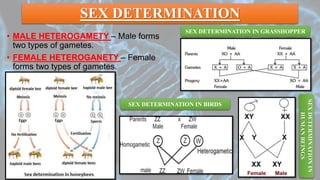
SEX DETERMINATION
• MALE HETEROGAMETY – Male forms
two types of gametes.
• FEMALE HETEROGANETY – Female
forms two types of gametes.
SEX DETERMINATION IN GRASSHOPPER
SEXDETERMINATIONIN
HUMANBEINGS
SEX DETERMINATION IN BIRDS
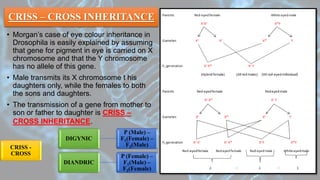
CRISS – CROSS INHERITANCE
• Morgan’s case of eye colour inheritance in
Drosophila is easily explained by assuming
that gene for pigment in eye is carried on X
chromosome and that the Y chromosome
has no allele of this gene.
• Male transmits its X chromosome t his
daughters only, while the females to both
the sons and daughters.
• The transmission of a gene from mother to
son or father to daughter is CRISS –
CROSS INHERITANCE.
CRISS -
CROSS
DIGYNIC
P (Male) –
F1(Female) –
F2(Male)
DIANDRIC
P (Female) –
F1(Male) –
F2(Female)
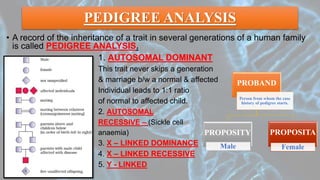
PEDIGREE ANALYSIS
• A record of the inheritance of a trait in several generations of a human family
is called PEDIGREE ANALYSIS.
• 1. AUTOSOMAL DOMINANT
• This trait never skips a generation
• & marriage b/w a normal & affected
• Individual leads to 1:1 ratio
• of normal to affected child.
• 2. AUTOSOMAL
• RECESSIVE – (Sickle cell
• anaemia)
• 3. X – LINKED DOMINANCE
• 4. X – LINKED RECESSIVE
• 5. Y - LINKED
PROBAND
Person from whom the case
history of pedigree starts.
PROPOSITY
Male
PROPOSITA
Female
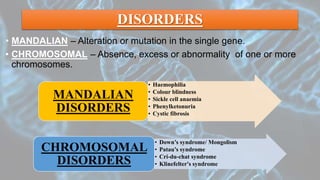
DISORDERS
• MANDALIAN – Alteration or mutation in the single gene.
• CHROMOSOMAL – Absence, excess or abnormality of one or more
chromosomes.
• Haemophilia
• Colour blindness
• Sickle cell anaemia
• Phenylketonuria
• Cystic fibrosis
MANDALIAN
DISORDERS
• Down’s syndrome/ Mongolism
• Patau’s syndrome
• Cri-du-chat syndrome
• Klinefelter's syndrome
CHROMOSOMAL
DISORDERS
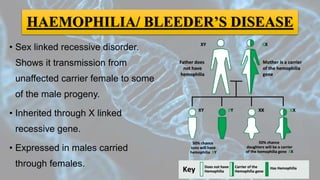
HAEMOPHILIA/ BLEEDER’S DISEASE
• Sex linked recessive disorder.
Shows it transmission from
unaffected carrier female to some
of the male progeny.
• Inherited through X linked
recessive gene.
• Expressed in males carried
through females.
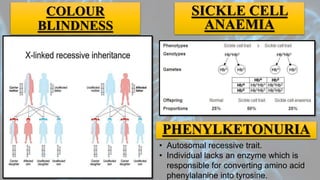
COLOUR
BLINDNESS
SICKLE CELL
ANAEMIA
PHENYLKETONURIA
• Autosomal recessive trait.
• Individual lacks an enzyme which is
responsible for converting amino acid
phenylalanine into tyrosine.
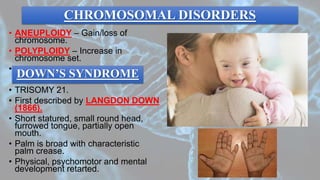
CHROMOSOMAL DISORDERS
• ANEUPLOIDY – Gain/loss of
chromosome.
• POLYPLOIDY – Increase in
chromosome set.
•
• TRISOMY 21.
• First described by LANGDON DOWN
(1866).
• Short statured, small round head,
furrowed tongue, partially open
mouth.
• Palm is broad with characteristic
palm crease.
• Physical, psychomotor and mental
development retarted.
DOWN’S SYNDROME
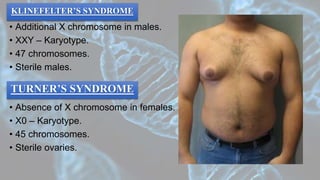
• Additional X chromosome in males.
• XXY – Karyotype.
• 47 chromosomes.
• Sterile males.
• Absence of X chromosome in females.
• X0 – Karyotype.
• 45 chromosomes.
• Sterile ovaries.
KLINEFELTER’S SYNDROME
TURNER’S SYNDROME
Principles of inheritance & and variation

Principles of inheritance & and variation

  • 1.
  • 2.
    INTRODUCTION • Branch ofbiology that deals with the study of genes, genetic variation and hereditary is known as GENETICS. • INHERITANCE- the process by which characters are passed on from parent to progeny. • VARIATION- It is the degree by which progeny differ from their parents.
  • 3.
    TERMINOLOGIES • GENETICS –It is the branch of life science that deals with the study of heredity and variation. • HEREDITY – It is the transmission of characters from parents to their offsprings. • VARIATION – It is the difference among the offsprings and with their parents. • HEREDITARY VARIATIONS – It these are genetical and inheritable. • ENVIRONMENTAL VARIATION – It these are acquired and non inheritable.
  • 4.
    GREGOR JOHANN MENDEL •HE IS THE FATHER OF GENETICS. • FATHER OF MODERN GENETICS. • Gregor Mendel developed the principles of heredity while studying seven pairs of inherited characteristics in pea plants. • He conducted experiments on for 7 years from 1856-1863 & gave laws of inheritance. • HIS APPROACH – Used pea plant for his experiments due to - 1. Pure variety are available. 2. Pea plants are easy to cultivate. 3. Life cycle of plants are only few months. So that result can be got early. 4. Contrasting trait are observed. 5. Flowers are bisexual and normally self pollinated. 6. Flowers can be cross pollinated only manually. 7. Hybrids are fertile. 8. Pure line breeding was possible. MENDEL’S EXPERIMENT
  • 5.
    1. Applied statisticalanalysis & mathematical logic for biology problems. 2. Large sampling size. 3. Confirmation of inference from experiments on successive generations of test plants, proved general rules of inheritance. TRAITS OF PEA PLANT CHARACTERISTIC DOMINANT RECESSIVE HEIGHT Tall Dwarf SEED SHAPE Round Wrinkled SEED COLOUR Yellow Green SEED COAT COLOR Green Yellow POD SHAPE Inflated (full) Constricted (dull) POD COLOUR Green Yellow FLOWER POSITION Axial Terminal DRAWBACK OF EXPERIMENT
  • 6.
    INHERITANCE OF ONEGENE/ MONOHYBRID CROSS MONOHYBRID CROSS –Different genes are controlling the same characters.  F1 – Filial 1 generation  F2 – Filial 2 generation INFERENCE – 1. F1 & F2 neither showed blending. 2. Only 1 parental trait expresses itself in F1 generation. 3. Both the traits got expressed in F2 generation in the ratio 3:1. 4. No blending was seen in either generation.
  • 7.
    5. F2 generation-1/4th were dwarf & 3/4th tall- identical to parents.  Mendel proposed- Something is stably being passed to the next generation through gametes ‘FACTORS’ – GENES.  GENES/FACTORS – Unit of inheritance, contain the information required to express particular trait.  Genes which code for pair of contrasting trait- ALLELES.  Alphabetical symbols were used; T-Tall, t- dwarf.  Mendel proposed- true breeding tall or dwarf plant- IDENTICAL OR HOMOZYGOUS ALLELE pair of TT or tt (genotype).  Mendel found phenotype of HETEROZYGOTE Tt of F1 was same as parent with TT & proposed, in a pair of dissimilar factors.  One dominates the other & hence called dominant (T) & recessive (t)
  • 8.
    PUNNETT SQUARE • Itis a graphical representation to calculate the probability of al possible genotypes of an organism in a genetic cross. • It was given by REGINALD C. PUNNETT. • Self- pollination- 50%. • F2- 3/4th tall & 1/4th Dwarf phenotypically. • ¼ : ½ : ¼ ratio of TT: Tt: tt genotype. • Binomial equation – (ax + by)2 where ax = ½ T & by = ½ t. • On putting the values & solving this equation, we get – ¼ TT + ½ Tt + ¼ tt. • Which implies that among that cross 25% is TT = tall plants 50% is Tt = tall plants 25% is tt – dwarf plants. • So thereby we get the genotype ratio as 1:2:1 i.e. TT: Tt: tt.
  • 9.
    TEST CROSS • Thecross between hybrid and its homozygous recessive parent is called test cross. It is used to identify the genotype of the hybrid.
  • 10.
    LAWS OF INHERITANCE •LAW OF DOMINANCE – First law of Inheritance. • LAW OF SEGREGATION – Second law LAW OF DOMINANCE – 1. Characters are controlled by factors. 2. Factors occurs in pairs. 3. In a dissimilar pair of factors one member of the pair dominates (dominant) the other (recessive). • Used to explain the expression of only one of the parental characters in monohybrid cross (F1) & expression of both in F2. • Also explains proportion 3:1 in F2
  • 11.
    LAW OF SEGREGATION– 1. It states that, ‘when a pair of factors for a character brought together in a hybrid, they segregate (separate) during the formation of gametes. 2. Alleles do not blend & both characters recovered in F2 & one in F1. 3. Factors which is present in parent segregate & gametes receives only one of two factors. 4. Homozygous parent- one kind gamete. 5. Heterozygous parent- two kind gamete each one have one allele with equal proportion.
  • 12.
    INCOMLETE DOMINANCE • Theinheritance in which allele for a specific character is not completely dominant over other allele is called Incomplete dominance. • It is also called PARTIAL DOMINANCE OR SEMI DOMINANCE. • Ex: Snapdragon or Antirrhinum sp. • Cross between true breed red flower (RR) & white flower (rr), F1 generation- Pink (Rr) & after self pollination in F2 generation- 1 (RR) Red: 2 (Rr) Pink: 1 (rr) white. • Genotype – 1: 2: 1 i.e. RR: Rr: rr • Phenotype – 1: 2: 1 i.e. Red: Pink: White.
  • 13.
    PARENT RR Rr GAMETESR r F1 Rr ON SELF CROSSING F1 F2 GAMETES R r R RR (RED) Rr (PINK) r Rr (PINK) rr (WHITE) GENOTYPIC RATIO – 1: 2: 1 RR: Rr: rr PHENOTYPIC RATIO – 1: 2: 1 RED: PINK: WHITE Ex: Normal allele – Normal Enzyme Modified allele – i. Normal/ Less efficient enzyme ii. Non-functional enzyme iii. No enzyme
  • 14.
    CO - DOMINANCE •Both the alleles for a character are dominant and express its full character is called co-dominance. • Ex: AB blood group of human being. • Blood group in humans are controlled by 3 alleles of a gene I. They are IA IB and i. • IA is responsible for production of antigen –A. • IB is responsible for production of antigen –B. • i does not produces any antigen.
  • 15.
    MULTIPLE ALLELISM • Whentwo or more alleles governs the same character/ expresses the same character is c/as MULTIPLE ALLELISM. • Ex: ABO blood grouping. Three alleles govern same character. • Single gene product may produce more than one effect is k/as PLEIOTROPY. • Eg- Starch Synthesis in Pea seeds- controlled by a gene having two allele B & b • BB = Starch synthesis effective, grain size – large, seed shape – round. • bb = Lesser efficiency in starch synthesis, grain size – small, seeds – wrinkled. • Bb = Intermediate.
  • 16.
    INHERITANCE OF TWOGENES • LAW OF INDEPENDENT ASSORTMENT – When two pairs of traits are combined in a hybrid, segregation of one pair of characters is independent of the other pair of characters. OR • It states that, ‘factors for different pairs of contrasting characters in a hybrid assorted (distributed) independently during gamete formation. PHENOTYPIC RATIO – 9: 3: 3: 1 Round Yellow: Round Green: Wrinkled Yellow: Wrinkled Green GENOTYPIC RATIO – 1: 2: 2: 4: 1: 2: 1: 2: 1 RRYY: RRYy: RrYY: RrYy: Rryy: Rryy: rrYY: rrYY: rryy
  • 17.
     Mendel workpublished in 1865 but remain unrecognized till 1900.  Reasons for that: 1. Lack of communication. 2. Concept of genes / factors- clear. 3. Mathematical approach for biology was not accepted. 4. No proof for existence of factors MENDEL’S WORK RECOGNITION
  • 18.
    VARIATIONS VARIATION As per natureof cells it affects SOMATIC GERMINAL OR BLASTOGENIC As per degree of differences produced CONTINUOUS DISCONTINUOUS • The differences shown by the individual of a species and also by the offspring of the same parents are referred to as variations.
  • 19.
    SOMATIC VARIATIONS SOMATIC VARIATIONS CAUSES ENVIRONMENTAL USE &DISUSE OF ORGANS CONSCIOUS EFFORTS • Somatic variations are those which are not inherited from parents & affects only the somatic cells. Also k/as ACQUIRED VARIATIONS. 1. Nutrition 2. Habitat 3. Better conditions 4. Water 1. Weakening of teeth 3. Muscular body 2. Left handedness of a person 1. Castration 2. Mutilation 3. Small feet etc.
  • 20.
    GERMINAL VARIATIONS • Variationsare caused due to germ cells and thus inheritable. • Eg: haemophilia, blood groups, colour blindness, baldness, eye colour etc. • Crossing over • By radiations • By polyploidy • Change in chemical nature of genes • Modifications in chromosome structure GERMINAL VARIATIONS
  • 21.
    CONTINUOUS VARIATIONS/ FLUCTUATING VARIATIONS •Such variations are small and indistinct when compared to normal. • Unstable and non- inheritable. • Produces a bell shaped graph. CONTINUOUS VARIATIONS SUBSTANTIVE Variations which bring change in size, weight, colour etc. They affect the morphology. MERISTIC Bring change in certain parts of the organism e.g. No. of segments get changed in earthworm, change in no. of arms in starfish, sepals & petals no. changed etc.
  • 23.
    DISCONTINUOUS VARIATIONS • Suchvariations are large and represent the conspicuous differences of the progeny from parents. • They are referred as mutations or sports or saltations. • Mutations appear suddenly and are inheritable and stable. DISCONTINUOUS VARIATIONS SUBSTANTIVE Mutations bring variation in size, weight, shape, colour etc. Eg: brachydactyly, syndactyly etc. MERISTIC Bring change in no. of certain parts of the organism e.g. polydactyly.
  • 24.
    SIGNIFICANCE OF VARIATIONS 1.Constitutes the raw material for evolution. 2. Useful variants of animals and plants are produced. 3. Variations form the basis of heredity. 4. Help in adaptations of organisms to changed environment. 5. Make some individuals better suited in the struggle for existence. 6. Variations provide each organism a distinct individuality.
  • 25.
    POLYGENIC INHERITANCE/ QUANTITATIVE INHERITANCE •When one character is controlled by two or more genes. • Ex: Skin colour in human beings which is controlled by 3 genes – A, B, C. • Quantity of dominant genes decides the amount of melanin produced in the body. • AA BB CC = Dark skin colour • (max. melanin produced). • Aa bb cc = Albinos • (no melanin produced). • Aa Bb Cc = Wheatish colour (intermediate melanin). • Talking about the range – • 6 Dominant – Black • 5 Dominant – Very dark • 4 Dominant – Dark • 3 Dominant – Intermediate • 2 Dominant – Fair • 1 Dominant – Very fair • 0 Dominant - Albino
  • 26.
    P AABBCC xaabbcc ABC abc F1 AaBbCc F2 AaBbCc AaBbCc A C ABC B c ABc b C AbC c Abc a C aBC B c aBc b C abC c abc ABC ABc AbC Abc aBC aBc abC abc ABC 6 5 5 4 5 4 4 3 ABc 5 4 4 3 4 3 3 2 AbC 5 4 4 3 4 3 3 2 Abc 4 3 3 2 3 2 2 1 aBC 5 4 4 3 4 3 3 2 aBc 4 3 3 2 3 2 2 1 abC 4 3 3 2 3 2 2 1 abc 3 2 2 1 2 1 1 0 0 5 10 15 20 25 0 5 10 15 20 25 0 1 2 3 4 5 6 BELL GRAPH – POLYGENIC INHERITANCE Series 1 Column1 Series 3
  • 27.
    GENE INTERACTION 1. INTER– ALLELIC OR INTRA – GENIC GENE INTERACTION – Expression of character is produced by interaction between alleles of a single gene. Non allelic gene interaction. 2. NON – ALLELIC OR INTERGENIC GENE INTERACTION – Expression of character is produced by interaction between two or more genes. HOMOLOGOUS CHROMOSOME – Chromosomal pairs which are similar in length, gene position, centromere location.
  • 28.
    INTERGENIC EXAMPLES INTRAGENICEXAMPLES 1. Complementary gene interaction 1. Multiple allelism 2. Supplementary gene interaction 2. Co – dominance 3. Epistasis – Dominant Recessive 3. Incomplete dominance 4. Duplicate gene interaction 5. Additive gene interaction 6. Inhibitory gene interaction
  • 29.
    INTERGENIC – 1.COMPLEMENTARY GENES • Genes located at d/f loci of same or d/f chromosome but work together to show some expression. • Ex: Lathyrus odoratus (Sweet pea)
  • 30.
    • Two genes+nt on d/f loci but 1 gene expresses itself independently & the other gene is w/o any expression. But both gene if +nt in dominant form expresses a third trait/ effect. • Ex: Coat colour in mice. • B = black • A = albino (no colour) • AB = agouti • ab = albino 2. SUPPLEMENTARY GENES RATIO – 9: 4: 3
  • 31.
    3. EPISTAXIS/ INHIBITINGGENES • Two genes located at d/f loci & 1 out of 2 genes is dominating/ epistatic & the other gene get suppressed/ dominated k/as “HYPOSTATIC GENE”. EPISTASIS DOMINANT EPISTASIS Ex: Cucurbita pepo (Summer squash) 12: 3: 1 RECESSIVE EPISTASIS Ex: Colour coat in mice 9: 4: 3
  • 32.
    4. DUPLICATE GENEINTERACTION • When 2 genes located on d/f loci of the same or d/f chromosome but expresses same phenotype independently (+nt in dominant form). • Ex: Fruit shape of Capsella bursa (Shepherd’s form). • Genes +nt on d/f loci of same or d/f chromosomes. • Both genes shows independency. • Ex: Comb shape in Fowls. RATIO – 15: 1 5. COLLABORATOR GENES RATIO – 9: 3: 3: 1
  • 33.
    PLEIOTROPIC GENES • Singlegene product may produce more than one effect is k/as PLEIOTROPY. • Ex: Sickle cell anemia – Autosomal Recessive Disorder. 2 α 2 β • In one of the β chain there is a mutation where 6th position amino acid (Glutamic acid) is replaced by valine. #CHANGES – 1. Structure hampered of RBC. 2. Decreased O2 carrying capacity. } Polypeptide chains Normal Hb -
  • 34.
    PARENT HbA xHbs F1 HbAHbs SELFING F1 GENERATION HbA Hbs HbA HbAHbA Normal HbAHbs Carrier Hbs HbAHbs Carrier HbsHbs Diseased • Individuals with Hb configuration are resistant to malaria because malarial parasites cannot penetrate & survive in sickle celled RBC’s. #QUALITATIVE INHERITANCE/ MONOGENIC INHERITANCE – One dominant allele influences the complete trait.
  • 35.
    LETHAL GENES • Lethalmeans death causing. • Lethal factors were supported by “CUENOT” – French geneticist – in mice. PHENOTYPE AFFECT VIABILITY GENES VIABILITY GENES LETHAL GENES DOMINANT AUTOSOMES AA/Aa RECESSIVE AUTOSOMES aa
  • 36.
    CHROMOSOMAL THEORY OF INHERITANCE •1865 – Mendel published his work. • 1901 – 3 scientists redid his work. • 1902 – CTI was given by SUTTON & BOVERI. • Lets compare the two views – • 1870 OSCAR HERTWIG –Nucleus contains theory of inheritance. • CORRENS – Gave the evidence in Mirabilis jalapa that cytoplasm also contains heredity material. MENDEL SUTTON & BOVERI 1. Factors occurs in pairs. Factors are +nt on chromosomes & chromosomes also occurs in pairs. 2. 2 forms of a same gene are allele in pair. Homologous chromosome. 3. Alleles segregate at the time of gamete formation. Chromosomes also separate at the time of gamete formation. 4. Alleles/ factors assort independently. Chromosomes also assort independently.
  • 37.
    LINKAGE AND RECOMBINATION •When genes are closely +nt, they link together in a group and transmitted as a single unit. • First reported in Drosophila by T.H MORGAN – 1910. • If genes are located at extremes – recombination chances are more. • If genes are located more closely – recombination chances are less.
  • 38.
    THEORIES OF LINKAGE 1903. No.of groups of genes = no. of chromosomes MORGAN & CASTLE. Genes are bound by chromosomal material and are transmitted as a whole. BATESON & PUNNETT. 1906. Dominant/recessiv e alleles remains together – COUPLING PHASE/ CIS. Dominant/ recessive alleles remain separated – REPULSION/ TRANS PHASE. SUTTON’SHYPOTHESISOFLINKAGE MORGAN’SHYPOTHESISOFLINKAGE CHROMOSOMALHYPOTHESISOFLINKAGE COUPLINGANDREPULSIONHYPOTHESIS 1910. Genes of homologous parents enter in the same gamete and tends to remain together. Opposite in heterozygous parents.
  • 39.
    COUPLING & REPULSION HYPOTHESIS Eg: Plantsof sweet pea having blue flowers (BB) and long pollen (LL) with red flowers (bb) and round pollen (ll). F1 generation – BbLl – Blue flower & long pollen.
  • 40.
    TYPES OF LINKAGE COMPLETE LINKAGE Linked genesdo not get separated. (Rare) INCOMPLETE LINKAGE Genes will get separated. # LINKAGE GROUPS –  Linkage groups = no. of chromosome in one set (n).  No. of linkage group in an organism = no. of haploid chromosomes +nt in its cells.  Eg: In humans – n=23 = linkage groups. # STRENGTH OF LINKAGE  1/ DISTANCE B/W THE GENES # FACTORS AFFECTING LINKAGE –  DISTANCE - ↑ distance ↓ strength.  AGE - ↑ age ↓ strength.  TEMPERATURE -↑ temp ↓ strength.  X-RAYS -↑ X-rays exposure ↓strength. # STRENGTH OF LINKAGE  1/ CROSSING OVER. # LINKAGE  1/ INDEPENDENT ASSORTMENT.
  • 42.
    CROSSING OVER • Theprocess by which exchange of chromosomal segment takes place. OR • Recombination of linked genes. • The term was given by MORGAN & MOTTLE. • JANSEN (1909) – Observed chiasmata during meiosis I. • MORGAN – Chiasmata lead to crossing over by breakage & reunion of homologous chromosomes. • Unit of crossing over is CENTI MORGAN (CM) given by – HALDANE.
  • 43.
    • To explainthe relationship between crossing over and chiasma following theories were given – CHIASMA TYPE THEORY • JANSSEN (1909). • Act of crossing over is followed by chiasma formation. • Crossing over takes place at pachytene stage. • Chiasma appears at diplotene stage. CLASSICAL THEORY • SHARP (1934). • Crossing over is the result of chiasma formation. • Chiasma organised at pachytene. • Crossing over at diplotene.
  • 44.
    • Crossing overtakes place b/w 2 non - sister chromatids of homologous chromosome.
  • 46.
    MECHANISM OF CROSSINGOVERCOPYCHOICEHYPOTHESIS PRECOCITYHYPOTHESIS CROSSOVERVALUE COINCIDENCE • DARLINGTON. • Pairing of homologues occurs to avoid singleness of a chromosome. • Occurs due to strain. • 2 chromosomes pair during spiral coiling and where the tension develops, the chromosome breaks and recombination occurs. • BELLING (1928). • Chromosomes represent the genes which are formed by joining of inter - chromomeric regions. • Chromomeres are formed first thereby the interconnecting links. • Further they join with other homologous chromosome. • Percentage of crossing over varies in different material. • Measure of interference. • Calculated as – ACTUAL NUMBER OF DOUBLE CROSS OVER EXPECTED NUMBER OF DOUBLE CROSS OVER.
  • 48.
    FACTORS CONTROLLING FREQUENCY OFCROSSING OVER 1. Temperature 2. X – Ray 3. Age 4. Chemicals 5. Sex 6. Chiasmata formation 7. Inversions 8. Distance 9. Nutritional effect 10.Genotypic effect 11.Interference 12.Chromosome structure effect 13.Centromere effect # SIGNIFICANCE OF CROSSING OVER – 1. Gives evidence that genes are linearly +nt. 2. Provides operational gene definition – smallest heritable segment of a chromosome in the interior of which no crossing over takes place. 3. Helpful in chromosomal mapping. 4. Main cause of genetic variation. 5. Helpful in breeding and evolving new species.
  • 49.
    CHROMOSOMAL MAPS/ LINKAGEMAP/ GENE MAP • A linkage or genetic chromosome map is a linear graphic representation of the sequence & relative distances of the various genes +nt in a chromosome. # RECOMBINATION FREQUENCY – • Frequency of crossing over is dependent upon distance present b/w the two genes. • If we say that 2 genes A & B are 10 map units apart. OR • We can say that recombination frequency is 10%. Eg: We are saying genes A & B are 20 units apart & genes A & C are 10 units apart. What is are the locations of gene A, B & C? #USES OF CHROMOSOMAL MAPS – 1. Find out the gene location. 2. Knowing recombination of various genes. 3. Result prediction of di & tri hybrid cross.
  • 50.
    CHROMOSOMES • Also k/as“HEREDITARY MATERIAL”. • Responsible for genes transmission. #DISCOVERY OF CHROMOSOMES – • HOFMEISTER (1848) – first observed chromosomes in microsporocytes of Tradescantia. • ROUX (1883) – chromosomes take part in inheritance. • W. WALDEYER (1888) – coined the term chromosome. • WALTHER FLEMMING (1879) – splitting of chromosomes during cell division. • BENDEN & BOVERI (1887) – found fixed number of chromosome in species.
  • 51.
    KINDS OF CHROMOSOMES VIRAL Inviruses, bacteriophages, single molecule of DNA or RNA represents viral chromosome. PROKARYOTIC/ BACTERIAL/ NUCLEOID In bacteria, cyanobacteria. Single large circular DNA. EUKARYOTIC Individual specific bodies formed due to Deoxyribo - nucleoprotein.
  • 52.
    STRUCTURE OF CHROMOSOME 1.PELLICLE – Outer most chromosomal sheath. 2. MATRIX/ GROUND SUBSTANCE – Composed of proteins, small quantities of RNA and lipid. 3. CHROMONEMATA – Coiled threads. Term given by VEJDOVSKY (1912). 4. PRIMARY CONSTRICTION – Centromere. 5. SECONDARY CONSTRICTION/ NUCLEOLAR ORGANIZER – Constriction other than primary. May be +nt on one or both the arms. It is associated with nucleolus formation during interphase. It contains genes coding for 18S and 28S – NUCLEOLAR ORGANIZER REGION (NOR). 6. CHROMOMERES – described by J. BELLINGS. Chromonema thread at intervals is marked in linear order by no. of knot or granules as in bead on string appearance. Clear structures. Their no. is constant.
  • 53.
    7. TELOMERES –Tips of chromosome which are rounded and sealed. It prevents the ends of chromosome from sticking to each other. 8. SATELLITE – Exhibited by some chromosomes. It is the terminal part of the chromosome beyond secondary constriction. Elongated, rounded variable in size. Chromosome bearing a satellite – “SAT CHROMOSOME”. 9. CHROMATIDS – One copy of newly formed chromosome which is still joined to the original chromosome by a single centromere. Two identical copies of DNA are called as chromatids.
  • 54.
    BASED UPON NO.OF CENTROMERES MONOCENTRIC DICENTRIC POLYCENTRIC ACENTRIC DIFFUSED/ NON LOCATED CLASSIFICATION OF CHROMOSOMES CLASSIFICATION BASED UPON CENTROMERE LOCATION TELOCENTRIC ACROCENTRIC SUBMETACENTRIC METACENTRIC
  • 56.
    MOLECULAR ORGANIZATION OF CHROMOSOME •Based upon relative DNA position & proteins positions in the chromosomes. CHROMOSOME MULTIPLE STRAND MODEL STEFFENSEN 1952, RIS 1960 et all. Many DNA protein fibrils are +nt in chromosome & at least 2 chromatids form a chromosome. SINGLE STRAND MODEL TAYLOR, DUPROW etc. Chromosome is made up of a single DNA protein fibril. SINGLE STRAND MODEL FOLDED FIBRE MODEL NUCLEOSOME MODEL SOLENOID MODEL DANGLER – STRING OR RADIAL LOOP MODEL
  • 57.
    SPECIAL TYPE OFCHROMOSOMES 1. POLYTENE CHROMOSOME – KOLLAR (1882) – Described it and BALBIANI (1881) – Reported Formed due to rapid division in chromosome without cytoplasmic division (ENDOMITOSIS) due to which chromatids don’t separate and remains attached to chromocenter. It was first reported in salivary gland cells of insect. 2. LAMPBRUSH CHROMOSOME – FLEMMING WALTER (1882). Structure described by RUCKERT (1892). Found in growing oocytes of several species excluding mammals. Has double main axis due to long chromatids.
  • 58.
    • FLEMMING (1880)– Sustainable material present in nuclei is chromatin. • Largest chromosome is chromosome 1 and the smallest is chromosome Y. CHROMATIN HETEROCHROMATIN Static chromatin. Highly condensed Transcriptionally inactive EUCHROMATIN Dynamic chromatin Extended and open Transcriptionally active
  • 59.
    GENES • Term givenby JOHANNSEN (1909). • T.H MORGAN (1910) defined gene as “Any particle on the chromosome which can be separated from other particles by mutation or recombination is called as a gene”. • KHORANA awarded Nobel prize fro the synthesis of artificial gene. #GENE ACTION – • Gene act by producing enzymes. • Each gene synthesizes a particular protein which acts as an enzyme & brings about an appropriate change. #MOLECULAR STRUCTURE – • CISTRON/ FUNCTIONAL – BENZER (1995) Cistron is that particular length of DNA which is capable of producing a protein molecule or polypeptide chain or enzyme molecule. • MUTON/ UNIT OF MUTATION – That part of DNA which is capable of undergoing mutation. • RECON – That length of DNA which is capable of undergoing recombination.
  • 60.
    SOME SPECIFIC TERMS •TRANSPOSONS OR JUMPING GENES – HEDGES & JACOB (1974) gave the term and reported this in bacteria. Those DNA segments which can join with other DNA segments completely unrelated & thus forming an illegitimate pairing. • RETROPOSONS – ROGERS (1983). Those DNA segments which are formed from RNA or from reverse transcription. • SPLIT GENES OR INTERRUPTED GENES – R. ROBERTS & P. SHARP reported this in mammalian virus & then in eukaryotes. These genes break up into pieces/ segments – • EXONS = Coding segment. • INTRONS = Non coding segments. • SPLIT GENES = EXONS + INTRONS. • FALSE GENES/ PSEUDOGENES – Copy of cistron which is defective.
  • 61.
    SEX DETERMINATION • MALEHETEROGAMETY – Male forms two types of gametes. • FEMALE HETEROGANETY – Female forms two types of gametes. SEX DETERMINATION IN GRASSHOPPER SEXDETERMINATIONIN HUMANBEINGS SEX DETERMINATION IN BIRDS
  • 62.
    CRISS – CROSSINHERITANCE • Morgan’s case of eye colour inheritance in Drosophila is easily explained by assuming that gene for pigment in eye is carried on X chromosome and that the Y chromosome has no allele of this gene. • Male transmits its X chromosome t his daughters only, while the females to both the sons and daughters. • The transmission of a gene from mother to son or father to daughter is CRISS – CROSS INHERITANCE. CRISS - CROSS DIGYNIC P (Male) – F1(Female) – F2(Male) DIANDRIC P (Female) – F1(Male) – F2(Female)
  • 63.
    PEDIGREE ANALYSIS • Arecord of the inheritance of a trait in several generations of a human family is called PEDIGREE ANALYSIS. • 1. AUTOSOMAL DOMINANT • This trait never skips a generation • & marriage b/w a normal & affected • Individual leads to 1:1 ratio • of normal to affected child. • 2. AUTOSOMAL • RECESSIVE – (Sickle cell • anaemia) • 3. X – LINKED DOMINANCE • 4. X – LINKED RECESSIVE • 5. Y - LINKED PROBAND Person from whom the case history of pedigree starts. PROPOSITY Male PROPOSITA Female
  • 64.
    DISORDERS • MANDALIAN –Alteration or mutation in the single gene. • CHROMOSOMAL – Absence, excess or abnormality of one or more chromosomes. • Haemophilia • Colour blindness • Sickle cell anaemia • Phenylketonuria • Cystic fibrosis MANDALIAN DISORDERS • Down’s syndrome/ Mongolism • Patau’s syndrome • Cri-du-chat syndrome • Klinefelter's syndrome CHROMOSOMAL DISORDERS
  • 65.
    HAEMOPHILIA/ BLEEDER’S DISEASE •Sex linked recessive disorder. Shows it transmission from unaffected carrier female to some of the male progeny. • Inherited through X linked recessive gene. • Expressed in males carried through females.
  • 66.
    COLOUR BLINDNESS SICKLE CELL ANAEMIA PHENYLKETONURIA • Autosomalrecessive trait. • Individual lacks an enzyme which is responsible for converting amino acid phenylalanine into tyrosine.
  • 67.
    CHROMOSOMAL DISORDERS • ANEUPLOIDY– Gain/loss of chromosome. • POLYPLOIDY – Increase in chromosome set. • • TRISOMY 21. • First described by LANGDON DOWN (1866). • Short statured, small round head, furrowed tongue, partially open mouth. • Palm is broad with characteristic palm crease. • Physical, psychomotor and mental development retarted. DOWN’S SYNDROME
  • 68.
    • Additional Xchromosome in males. • XXY – Karyotype. • 47 chromosomes. • Sterile males. • Absence of X chromosome in females. • X0 – Karyotype. • 45 chromosomes. • Sterile ovaries. KLINEFELTER’S SYNDROME TURNER’S SYNDROME