Communication
Types of Communication
Effective Communication
Presentation by: Braikhna
Subject: Communication Skills
1
What is Communication?
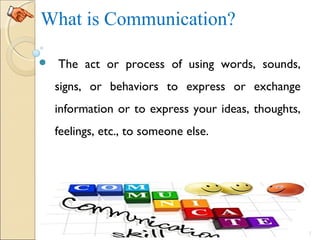
  The act or process of using words, sounds,
signs, or behaviors to express or exchange
information or to express your ideas, thoughts,
feelings, etc., to someone else.
2
What is Communication?
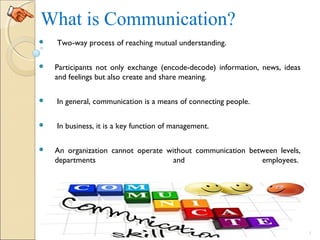
  Two-way process of reaching mutual understanding.
 Participants not only exchange (encode-decode) information, news, ideas
and feelings but also create and share meaning.
 In general, communication is a means of connecting people.
 In business, it is a key function of management.
 An organization cannot operate without communication between levels,
departments and employees. 
3
Types of Communication:
i) Verbal Communication:
a) Written Communication
b) Oral Communication
i) Non-Verbal Communication:
a) Physical nonverbal communication
(body language)
b) Visual Communication
(Silence, Time and Space)
4
1) Verbal Communication:
a) Written Communication:
 Includes traditional pen and paper letters and documents, typed electronic
documents, e-mails, text chats, SMS and anything else conveyed through
written symbols such as language.
 This type of communication is indispensable (necessary) for formal
business communications and issuing legal instructions.
1) Written communication is the most common form of business
communication.
Q: Why is written communication a type of
Verbal Communication?
5
1) Verbal Communication:
b) Oral Communication:
 The other form of verbal communication is the spoken word.
 Either face-to-face or through phone, voice chat, video conferencing or any other
medium.
 Various forms of informal communications such as the gossips or informal rumors,
and formal communications such as lectures, conferences are forms of oral
communication.
 Oral communication is use in discussions, causal and informal conversations.
 The effectiveness of oral conversations depends on the clarity of speech, pitch,
volume, speed, and even non-verbal communications such as body language and
visual clues.
6
7
Forms of Verbal Communication:
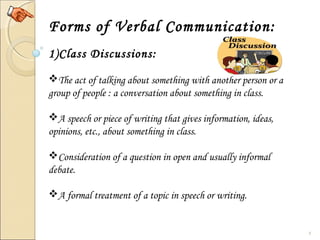
1)Class Discussions
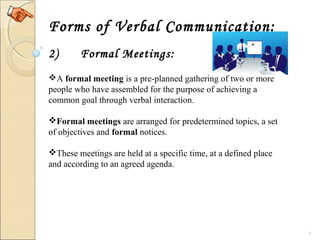
2)Formal Meetings
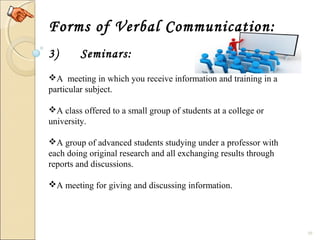
3)Seminars
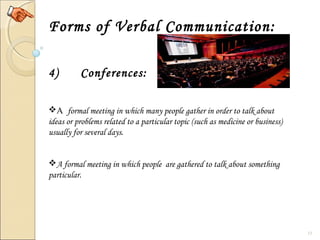
4)Conferences
5)Dealing with clients
6)Debates
7)Conversations
8)Telephonic Calls
8
Forms of Verbal Communication:
1)Class Discussions:
The act of talking about something with another person or a
group of people : a conversation about something in class.
A speech or piece of writing that gives information, ideas,
opinions, etc., about something in class.
Consideration of a question in open and usually informal
debate.
A formal treatment of a topic in speech or writing.
9
Forms of Verbal Communication:
2) Formal Meetings:
A formal meeting is a pre-planned gathering of two or more 
people who have assembled for the purpose of achieving a 
common goal through verbal interaction.
Formal meetings are arranged for predetermined topics, a set 
of objectives and formal notices.
These meetings are held at a specific time, at a defined place 
and according to an agreed agenda. 
10
Forms of Verbal Communication:
3) Seminars:
A  meeting in which you receive information and training in a 
particular subject.
A class offered to a small group of students at a college or 
university.
A group of advanced students studying under a professor with 
each doing original research and all exchanging results through 
reports and discussions.
A meeting for giving and discussing information.
11
Forms of Verbal Communication:
4) Conferences:
A  formal meeting in which many people gather in order to talk about
ideas or problems related to a particular topic (such as medicine or business)
usually for several days.
A formal meeting in which people are gathered to talk about something
particular.
12
Forms of Verbal Communication:
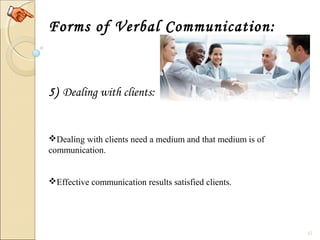
5) Dealing with clients:
Dealing with clients need a medium and that medium is of 
communication.
Effective communication results satisfied clients.
13
Forms of Verbal Communication:
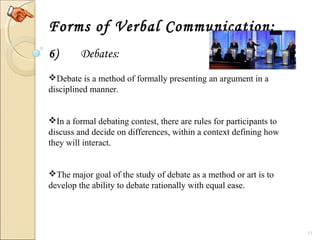
6) Debates:
Debate is a method of formally presenting an argument in a 
disciplined manner.
In a formal debating contest, there are rules for participants to 
discuss and decide on differences, within a context defining how 
they will interact.
The major goal of the study of debate as a method or art is to 
develop the ability to debate rationally with equal ease.
14
Forms of Verbal Communication:
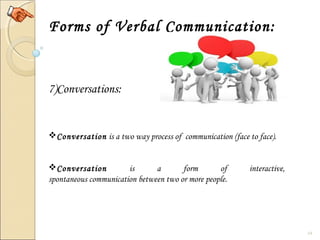
7)Conversations:
Conversation is a two way process of communication (face to face).
Conversation is a form of interactive,
spontaneous communication between two or more people.
15
Forms of Verbal Communication:
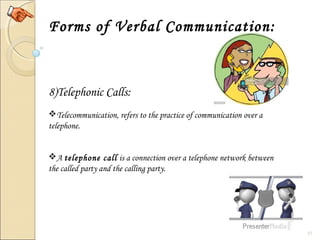
8)Telephonic Calls:
Telecommunication, refers to the practice of communication over a
telephone. 
A telephone call is a connection over a telephone network between
the called party and the calling party.
2) Non-Verbal Communication:
a)Physical nonverbal communication:
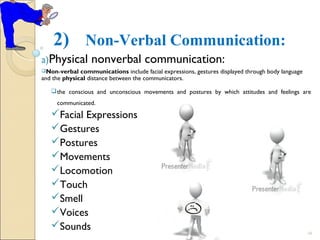
Non-verbal communications include facial expressions, gestures displayed through body language
and the physical distance between the communicators.
the conscious and unconscious movements and postures by which attitudes and feelings are
communicated.
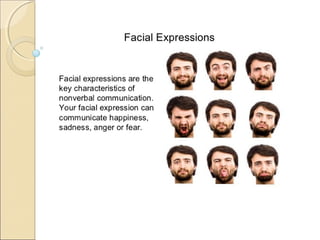
Facial Expressions
Gestures
Postures
Movements
Locomotion
Touch
Smell
Voices
Sounds 16
2) Non-Verbal Communication:
b)Visual non-Verbal Communication:
(Silence, Time and Space)
Visual communication is the communication of ideas through the visual display of information.
 Primarily associated with two dimensional images, it includes: art, signs, photography, typography,
drawing fundamentals, color and electronic resources.
18
Importance of Effective Communication:
 Effective communication is an important life skill that enables us to better understand and
connect with the people around us. 
 It allows us to build respect and trust and resolve differences where problem solving,
caring, affection and creative ideas can be flourished.
 Lack of effective communication unconsciously leads to conflict and frustration in both
professional and personal relationships.
19
Importance of Effective Communication:
“If a wise man is gifted a life of abundance of everything material, so that he has leisure to
contemplate everything with knowing, but still if he could not communicate with any other
human being, he would abandoned life”
(Cicero)
20
Aspects of Communication:
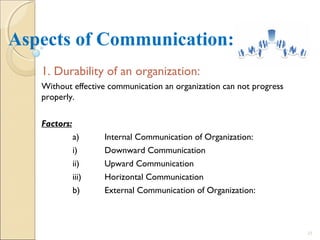
1. Durability of an organization:
Without effective communication an organization can not progress
properly.
Factors:
a) Internal Communication of Organization:
i) Downward Communication
ii) Upward Communication
iii) Horizontal Communication
b) External Communication of Organization:
21
Aspects of Communication:
Factors:
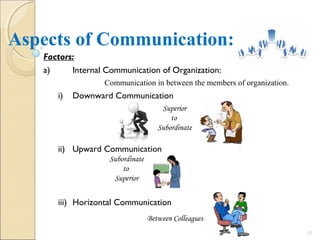
a) Internal Communication of Organization:
Communication in between the members of organization.
i) Downward Communication
ii) Upward Communication
iii) Horizontal Communication
22
Superior
to
Subordinate
Subordinate
to
Superior
Between Colleagues
Aspects of Communication:
Factors:
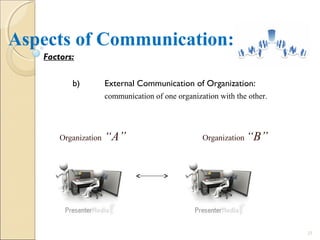
b) External Communication of Organization:
communication of one organization with the other.
Organization “A” Organization “B”
23
Aspects of Communication:
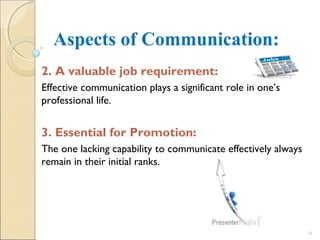
2. A valuable job requirement:
Effective communication plays a significant role in one’s
professional life.
3. Essential for Promotion:
The one lacking capability to communicate effectively always
remain in their initial ranks.
24
Aspects of Communication:
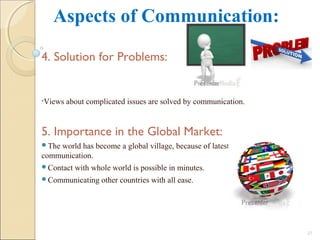
4. Solution for Problems:
•Views about complicated issues are solved by communication.
5. Importance in the Global Market:
The world has become a global village, because of latest means of
communication.
Contact with whole world is possible in minutes.
Communicating other countries with all ease.
25
Conclusion:
26
One should develop the right attitude, prepare
oneself fully and adopt flexibility which will make
one’s communication effective.
Thank You
27

Communication skill

  • 1.
    Communication Types of Communication EffectiveCommunication Presentation by: Braikhna Subject: Communication Skills 1
  • 2.
    What is Communication?  The act or process of using words, sounds, signs, or behaviors to express or exchange information or to express your ideas, thoughts, feelings, etc., to someone else. 2
  • 3.
    What is Communication?  Two-way process of reaching mutual understanding.  Participants not only exchange (encode-decode) information, news, ideas and feelings but also create and share meaning.  In general, communication is a means of connecting people.  In business, it is a key function of management.  An organization cannot operate without communication between levels, departments and employees.  3
  • 4.
    Types of Communication: i)Verbal Communication: a) Written Communication b) Oral Communication i) Non-Verbal Communication: a) Physical nonverbal communication (body language) b) Visual Communication (Silence, Time and Space) 4
  • 5.
    1) Verbal Communication: a)Written Communication:  Includes traditional pen and paper letters and documents, typed electronic documents, e-mails, text chats, SMS and anything else conveyed through written symbols such as language.  This type of communication is indispensable (necessary) for formal business communications and issuing legal instructions. 1) Written communication is the most common form of business communication. Q: Why is written communication a type of Verbal Communication? 5
  • 6.
    1) Verbal Communication: b)Oral Communication:  The other form of verbal communication is the spoken word.  Either face-to-face or through phone, voice chat, video conferencing or any other medium.  Various forms of informal communications such as the gossips or informal rumors, and formal communications such as lectures, conferences are forms of oral communication.  Oral communication is use in discussions, causal and informal conversations.  The effectiveness of oral conversations depends on the clarity of speech, pitch, volume, speed, and even non-verbal communications such as body language and visual clues. 6
  • 7.
    7 Forms of VerbalCommunication: 1)Class Discussions 2)Formal Meetings 3)Seminars 4)Conferences 5)Dealing with clients 6)Debates 7)Conversations 8)Telephonic Calls
  • 8.
    8 Forms of VerbalCommunication: 1)Class Discussions: The act of talking about something with another person or a group of people : a conversation about something in class. A speech or piece of writing that gives information, ideas, opinions, etc., about something in class. Consideration of a question in open and usually informal debate. A formal treatment of a topic in speech or writing.
  • 9.
    9 Forms of VerbalCommunication: 2) Formal Meetings: A formal meeting is a pre-planned gathering of two or more  people who have assembled for the purpose of achieving a  common goal through verbal interaction. Formal meetings are arranged for predetermined topics, a set  of objectives and formal notices. These meetings are held at a specific time, at a defined place  and according to an agreed agenda. 
  • 10.
    10 Forms of VerbalCommunication: 3) Seminars: A  meeting in which you receive information and training in a  particular subject. A class offered to a small group of students at a college or  university. A group of advanced students studying under a professor with  each doing original research and all exchanging results through  reports and discussions. A meeting for giving and discussing information.
  • 11.
    11 Forms of VerbalCommunication: 4) Conferences: A  formal meeting in which many people gather in order to talk about ideas or problems related to a particular topic (such as medicine or business) usually for several days. A formal meeting in which people are gathered to talk about something particular.
  • 12.
    12 Forms of VerbalCommunication: 5) Dealing with clients: Dealing with clients need a medium and that medium is of  communication. Effective communication results satisfied clients.
  • 13.
    13 Forms of VerbalCommunication: 6) Debates: Debate is a method of formally presenting an argument in a  disciplined manner. In a formal debating contest, there are rules for participants to  discuss and decide on differences, within a context defining how  they will interact. The major goal of the study of debate as a method or art is to  develop the ability to debate rationally with equal ease.
  • 14.
    14 Forms of VerbalCommunication: 7)Conversations: Conversation is a two way process of communication (face to face). Conversation is a form of interactive, spontaneous communication between two or more people.
  • 15.
    15 Forms of VerbalCommunication: 8)Telephonic Calls: Telecommunication, refers to the practice of communication over a telephone.  A telephone call is a connection over a telephone network between the called party and the calling party.
  • 16.
    2) Non-Verbal Communication: a)Physicalnonverbal communication: Non-verbal communications include facial expressions, gestures displayed through body language and the physical distance between the communicators. the conscious and unconscious movements and postures by which attitudes and feelings are communicated. Facial Expressions Gestures Postures Movements Locomotion Touch Smell Voices Sounds 16
  • 18.
    2) Non-Verbal Communication: b)Visualnon-Verbal Communication: (Silence, Time and Space) Visual communication is the communication of ideas through the visual display of information.  Primarily associated with two dimensional images, it includes: art, signs, photography, typography, drawing fundamentals, color and electronic resources. 18
  • 19.
    Importance of EffectiveCommunication:  Effective communication is an important life skill that enables us to better understand and connect with the people around us.   It allows us to build respect and trust and resolve differences where problem solving, caring, affection and creative ideas can be flourished.  Lack of effective communication unconsciously leads to conflict and frustration in both professional and personal relationships. 19
  • 20.
    Importance of EffectiveCommunication: “If a wise man is gifted a life of abundance of everything material, so that he has leisure to contemplate everything with knowing, but still if he could not communicate with any other human being, he would abandoned life” (Cicero) 20
  • 21.
    Aspects of Communication: 1.Durability of an organization: Without effective communication an organization can not progress properly. Factors: a) Internal Communication of Organization: i) Downward Communication ii) Upward Communication iii) Horizontal Communication b) External Communication of Organization: 21
  • 22.
    Aspects of Communication: Factors: a)Internal Communication of Organization: Communication in between the members of organization. i) Downward Communication ii) Upward Communication iii) Horizontal Communication 22 Superior to Subordinate Subordinate to Superior Between Colleagues
  • 23.
    Aspects of Communication: Factors: b)External Communication of Organization: communication of one organization with the other. Organization “A” Organization “B” 23
  • 24.
    Aspects of Communication: 2.A valuable job requirement: Effective communication plays a significant role in one’s professional life. 3. Essential for Promotion: The one lacking capability to communicate effectively always remain in their initial ranks. 24
  • 25.
    Aspects of Communication: 4.Solution for Problems: •Views about complicated issues are solved by communication. 5. Importance in the Global Market: The world has become a global village, because of latest means of communication. Contact with whole world is possible in minutes. Communicating other countries with all ease. 25
  • 26.
    Conclusion: 26 One should developthe right attitude, prepare oneself fully and adopt flexibility which will make one’s communication effective.
  • 27.