By : Ahmed jan & Muhammad Bilal Yusu
email # bilalyusuf767@gmail.com
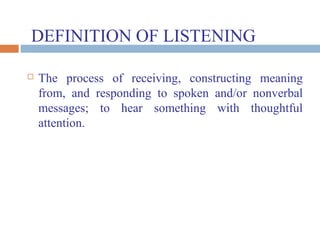
DEFINITION OF LISTENING
 The process of receiving, constructing meaning
from, and responding to spoken and/or nonverbal
messages; to hear something with thoughtful
attention.
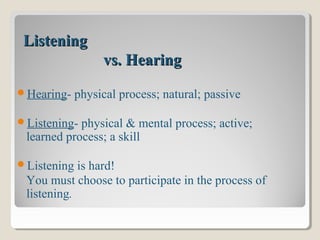
ListeningListening
vs. Hearingvs. Hearing
Hearing- physical process; natural; passive
Listening- physical & mental process; active;
learned process; a skill
Listening is hard!
You must choose to participate in the process of
listening.
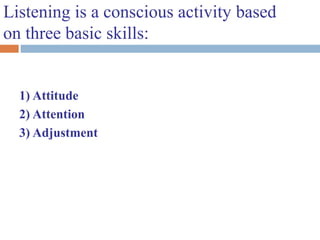
Listening is a conscious activity based
on three basic skills:
1) Attitude
2) Attention
3) Adjustment
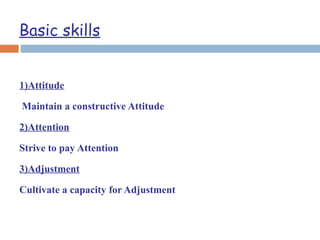
Basic skills
1)Attitude
Maintain a constructive Attitude
2)Attention
Strive to pay Attention
3)Adjustment
Cultivate a capacity for Adjustment
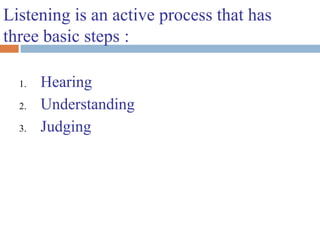
Listening is an active process that has
three basic steps :
1. Hearing
2. Understanding
3. Judging
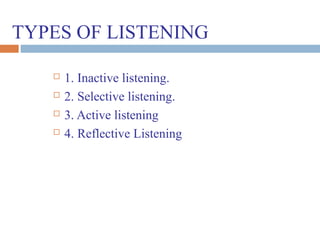
TYPES OF LISTENING
 1. Inactive listening.
 2. Selective listening.
 3. Active listening
 4. Reflective Listening
ACTİVE LİSTENİNG
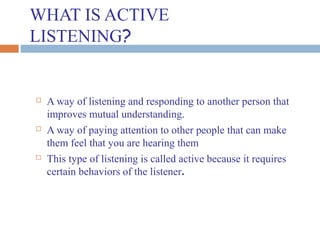
WHAT IS ACTIVE
LISTENING?
 A way of listening and responding to another person that
improves mutual understanding.
 A way of paying attention to other people that can make
them feel that you are hearing them
 This type of listening is called active because it requires
certain behaviors of the listener.
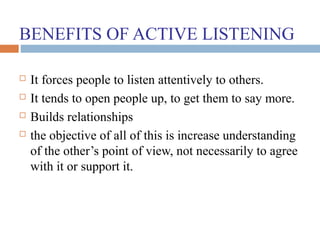
BENEFITS OF ACTIVE LISTENING
 It forces people to listen attentively to others.
 It tends to open people up, to get them to say more.
 Builds relationships
 the objective of all of this is increase understanding
of the other’s point of view, not necessarily to agree
with it or support it.
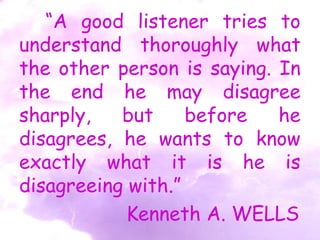
“A good listener tries to
understand thoroughly what
the other person is saying. In
the end he may disagree
sharply, but before he
disagrees, he wants to know
exactly what it is he is
disagreeing with.”
Kenneth A. WELLS
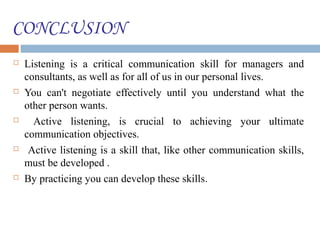
CONCLUSION
 Listening is a critical communication skill for managers and
consultants, as well as for all of us in our personal lives.
 You can't negotiate effectively until you understand what the
other person wants.
 Active listening, is crucial to achieving your ultimate
communication objectives.
 Active listening is a skill that, like other communication skills,
must be developed .
 By practicing you can develop these skills.

Active listening

  • 1.
    By : Ahmedjan & Muhammad Bilal Yusu email # bilalyusuf767@gmail.com
  • 2.
    DEFINITION OF LISTENING The process of receiving, constructing meaning from, and responding to spoken and/or nonverbal messages; to hear something with thoughtful attention.
  • 3.
    ListeningListening vs. Hearingvs. Hearing Hearing-physical process; natural; passive Listening- physical & mental process; active; learned process; a skill Listening is hard! You must choose to participate in the process of listening.
  • 4.
    Listening is aconscious activity based on three basic skills: 1) Attitude 2) Attention 3) Adjustment
  • 5.
    Basic skills 1)Attitude Maintain aconstructive Attitude 2)Attention Strive to pay Attention 3)Adjustment Cultivate a capacity for Adjustment
  • 6.
    Listening is anactive process that has three basic steps : 1. Hearing 2. Understanding 3. Judging
  • 7.
    TYPES OF LISTENING 1. Inactive listening.  2. Selective listening.  3. Active listening  4. Reflective Listening
  • 8.
  • 9.
    WHAT IS ACTIVE LISTENING? A way of listening and responding to another person that improves mutual understanding.  A way of paying attention to other people that can make them feel that you are hearing them  This type of listening is called active because it requires certain behaviors of the listener.
  • 10.
    BENEFITS OF ACTIVELISTENING  It forces people to listen attentively to others.  It tends to open people up, to get them to say more.  Builds relationships  the objective of all of this is increase understanding of the other’s point of view, not necessarily to agree with it or support it.
  • 11.
    “A good listenertries to understand thoroughly what the other person is saying. In the end he may disagree sharply, but before he disagrees, he wants to know exactly what it is he is disagreeing with.” Kenneth A. WELLS
  • 12.
    CONCLUSION  Listening isa critical communication skill for managers and consultants, as well as for all of us in our personal lives.  You can't negotiate effectively until you understand what the other person wants.  Active listening, is crucial to achieving your ultimate communication objectives.  Active listening is a skill that, like other communication skills, must be developed .  By practicing you can develop these skills.