COMMUNICATION
SKILLS
Mohammed Refaat
2
AGENDA
- Introduction​
- Communication Skills Types
- Verbal Communication (Oral / Written)
- Non Verbal Communication (Body Language / Sound / Appearance)
- Informal VS Formal Communication
- How to measure your communication skills
- Lack of Communications
- Tips to Improve your Communication Skills
- Practical Ways to Improve Your Communication Skills
INTRODUCTION
Communication skills allow you to understand and be understood by others.
These can include but are not limited to effectively communicating ideas to
others, as example
- Actively listening in conversations
- Giving and receiving critical feedback
- Public speaking.
Communication Skills 4
WHAT ARE COMMUNICATION SKILLS?
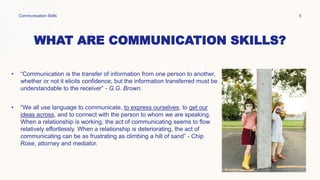
• “Communication is the transfer of information from one person to another,
whether or not it elicits confidence; but the information transferred must be
understandable to the receiver” - G.G. Brown.
• “We all use language to communicate, to express ourselves, to get our
ideas across, and to connect with the person to whom we are speaking.
When a relationship is working, the act of communicating seems to flow
relatively effortlessly. When a relationship is deteriorating, the act of
communicating can be as frustrating as climbing a hill of sand” - Chip
Rose, attorney and mediator.
Communication Skills 5
COMMUNICATION
SKILLS TYPES
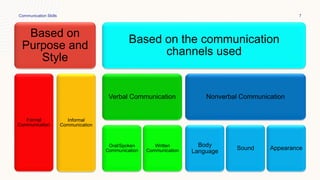
Based on
Purpose and
Style
Formal
Communication
Informal
Communication
Based on the communication
channels used
Verbal Communication
Oral/Spoken
Communication
Written
Communication
Nonverbal Communication
Body
Language
Sound Appearance
Communication Skills 7
VERBAL COMMUNICATION SKILLS
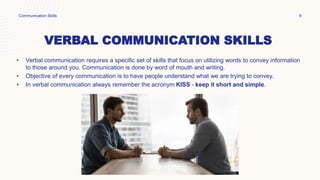
• Verbal communication requires a specific set of skills that focus on utilizing words to convey information
to those around you. Communication is done by word of mouth and writing.
• Objective of every communication is to have people understand what we are trying to convey.
• In verbal communication always remember the acronym KISS - keep it short and simple.
Communication Skills 8
VERBAL COMMUNICATION SKILLS
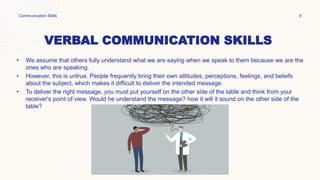
• We assume that others fully understand what we are saying when we speak to them because we are the
ones who are speaking.
• However, this is untrue. People frequently bring their own attitudes, perceptions, feelings, and beliefs
about the subject, which makes it difficult to deliver the intended message.
• To deliver the right message, you must put yourself on the other side of the table and think from your
receiver's point of view. Would he understand the message? how it will it sound on the other side of the
table?
Communication Skills 9
ORAL/SPOKEN COMMUNICATION
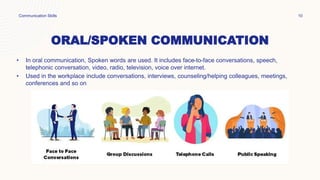
• In oral communication, Spoken words are used. It includes face-to-face conversations, speech,
telephonic conversation, video, radio, television, voice over internet.
• Used in the workplace include conversations, interviews, counseling/helping colleagues, meetings,
conferences and so on
Communication Skills 10
ORAL/SPOKEN COMMUNICATION
Communication Skills 11
Advantage
 Allows for immediate feedback such as the opportunity to ask questions when the meaning is not
entirely clear.
 There is high level of understanding and transparency in oral communication.
 There is flexibility for allowing changes in the decisions.
 Oral communication is an essential for teamwork and group energy
 Oral communication can be best used to transfer private and confidential information/matter.
ORAL/SPOKEN COMMUNICATION
Communication Skills 12
Disadvantage
 Poor presentation of the message can result in misunderstanding and wrong responses.
 Relying only on oral communication may not be sufficient as business communication is formal and
very organized.
 Oral communication is time-saving in case of daily interactions, but in meetings, long speeches
consume lot of time and are unproductive at times.
 Spoken communication is influenced by both verbal and non-verbal communication which may twist
the meaning of your message in the mind of the receiver.
WRITTEN COMMUNICATION
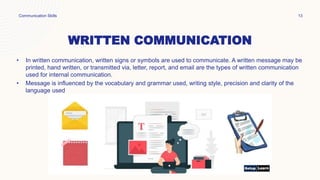
• In written communication, written signs or symbols are used to communicate. A written message may be
printed, hand written, or transmitted via, letter, report, and email are the types of written communication
used for internal communication.
• Message is influenced by the vocabulary and grammar used, writing style, precision and clarity of the
language used
Communication Skills 13
WRITTEN COMMUNICATION
Communication Skills 14
Advantage
 Written Communication is most common form of communication being used in business.
 Effective written communication develops and enhances an organization's image.
 Written communication is more precise and explicit & it’s good for complicated and vital instructions,
which can be given in a precise and uniform manner.
WRITTEN COMMUNICATION
Communication Skills 15
Disadvantage
 People may not always read them.
 It is impersonal or unfriendly.
 Written communication is time-consuming as the feedback is not immediate. The encoding and
sending of message takes time.
 Effective written communication requires great skills and competencies in language and vocabulary
use. Poor writing skills and quality have a negative impact on organization’s reputation.
NON-VERBAL COMMUNICATION
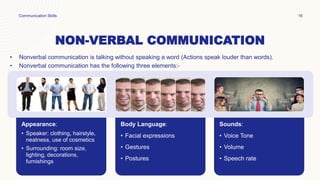
• Nonverbal communication is talking without speaking a word (Actions speak louder than words).
• Nonverbal communication has the following three elements:-
Communication Skills 16
Appearance:
• Speaker: clothing, hairstyle,
neatness, use of cosmetics
• Surrounding: room size,
lighting, decorations,
furnishings
Body Language:
• Facial expressions
• Gestures
• Postures
Sounds:
• Voice Tone
• Volume
• Speech rate
NON-VERBAL COMMUNICATION
Communication Skills 17
Advantage
 You can communicate with someone who cannot hear
 You can communicate in places where you have to avoid talking audibly
 Non-verbal communication makes conversation short and brief.
 Non-verbal communication saves on time and can be used as a tool to communicate with people
who don't understand your language.
NON-VERBAL COMMUNICATION
Communication Skills 18
Disadvantage
 Long conversations using non-verbal communication are usually not possible.
 Non-verbal communication varies from culture to culture.
 Particulars of messages using non-verbal communication cannot be discussed in detail
 It is not useful as a public tool for communication
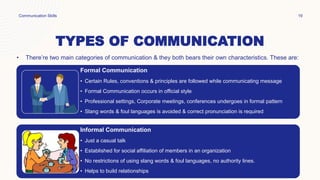
TYPES OF COMMUNICATION
• There’re two main categories of communication & they both bears their own characteristics. These are:
Communication Skills 19
Formal Communication
• Certain Rules, conventions & principles are followed while communicating message
• Formal Communication occurs in official style
• Professional settings, Corporate meetings, conferences undergoes in formal pattern
• Slang words & foul languages is avoided & correct pronunciation is required
Informal Communication
• Just a casual talk
• Established for social affiliation of members in an organization
• No restrictions of using slang words & foul languages, no authority lines.
• Helps to build relationships
20
MEASURE YOUR
COMMUNICATION SKILLS
Communication Skills 21
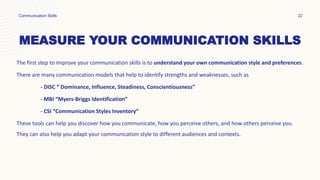
MEASURE YOUR COMMUNICATION SKILLS
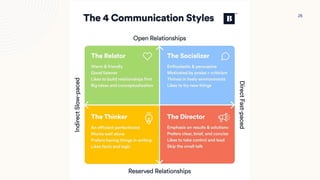
The first step to improve your communication skills is to understand your own communication style and preferences.
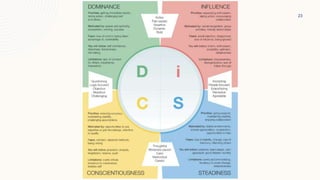
There are many communication models that help to identify strengths and weaknesses, such as
- DISC “ Dominance, Influence, Steadiness, Conscientiousness”
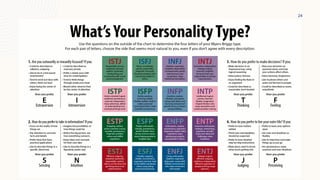
- MBI “Myers-Briggs Identification”
- CSI “Communication Styles Inventory”
These tools can help you discover how you communicate, how you perceive others, and how others perceive you.
They can also help you adapt your communication style to different audiences and contexts.
Communication Skills 22
23
24
TEST YOUR PERSONALTY
Presentation title 25
26
27
28
29
LACK OF
COMMUNICATION
LACK OF COMMUNICATION
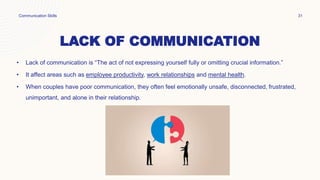
• Lack of communication is “The act of not expressing yourself fully or omitting crucial information.”
• It affect areas such as employee productivity, work relationships and mental health.
• When couples have poor communication, they often feel emotionally unsafe, disconnected, frustrated,
unimportant, and alone in their relationship.
Communication Skills 31
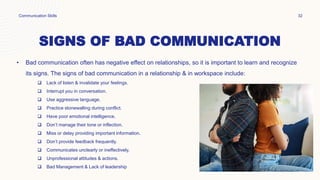
SIGNS OF BAD COMMUNICATION
• Bad communication often has negative effect on relationships, so it is important to learn and recognize
its signs. The signs of bad communication in a relationship & in workspace include:
 Lack of listen & invalidate your feelings.
 Interrupt you in conversation.
 Use aggressive language.
 Practice stonewalling during conflict.
 Have poor emotional intelligence.
 Don’t manage their tone or inflection.
 Miss or delay providing important information.
 Don’t provide feedback frequently.
 Communicates unclearly or ineffectively.
 Unprofessional attitudes & actions.
 Bad Management & Lack of leadership
Communication Skills 32
CASE SCENARIO #1
• Disregarding emails from a team member when you collaborate on a project together, especially
when it’s a high priority or with a tight timeline.
• Try this instead: Coordinate with team members to keep a project flowing.
• If emailing is not the best way for team members to coordinate with you, work together to establish the
best communication methods. Then respond expediently according to priorities.
Communication Skills 33
CASE SCENARIO #2
• A Client needs to move tomorrow’s meeting to today. The timing is tight & stuff members was gathered
quickly in the meeting room. However, the client inquires as to the whereabouts of Anthony - an
important hybrid worker who wasn’t notified about the meeting update. They quickly get a frazzled,
unprepared, and not happy Anthony in on a phone call.
Communication Skills 34
• Try this instead: Team members must have fast, easy access to each
other’s location and schedule at all times.
• Also, workplaces need to develop consistent team communication
strategies for disseminating information to off-site staff.
• Without time to prepare, the stuff member cannot bring his best self to
the meeting, which is not good for business nor for his reputation.
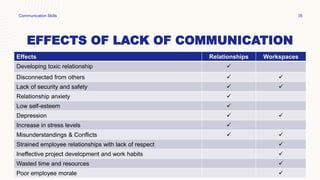
EFFECTS OF LACK OF COMMUNICATION
Communication Skills 35
Effects Relationships Workspaces
Developing toxic relationship 
Disconnected from others  
Lack of security and safety  
Relationship anxiety 
Low self-esteem 
Depression  
Increase in stress levels 
Misunderstandings & Conflicts  
Strained employee relationships with lack of respect 
Ineffective project development and work habits 
Wasted time and resources 
Poor employee morale 
IMPROVE
COMMUNICATION SKILLS
Communication Skills 36
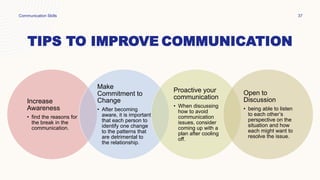
TIPS TO IMPROVE COMMUNICATION
Communication Skills 37
Increase
Awareness
• find the reasons for
the break in the
communication.
Make
Commitment to
Change
• After becoming
aware, it is important
that each person to
identify one change
to the patterns that
are detrimental to
the relationship.
Proactive your
communication
• When discussing
how to avoid
communication
issues, consider
coming up with a
plan after cooling
off.
Open to
Discussion
• being able to listen
to each other’s
perspective on the
situation and how
each might want to
resolve the issue.
PRACTICAL WAYS TO IMPROVE YOUR
COMMUNICATION SKILLS
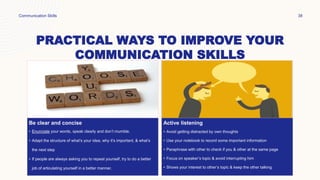
Be clear and concise
• Enunciate your words, speak clearly and don’t mumble.
• Adapt the structure of what’s your idea, why it’s important, & what’s
the next step
• If people are always asking you to repeat yourself, try to do a better
job of articulating yourself in a better manner.
Active listening
• Avoid getting distracted by own thoughts
• Use your notebook to record some important information
• Paraphrase with other to check if you & other at the same page
• Focus on speaker’s topic & avoid interrupting him
• Shows your interest to other’s topic & keep the other talking
Communication Skills 38
PRACTICAL WAYS TO IMPROVE YOUR
COMMUNICATION SKILLS
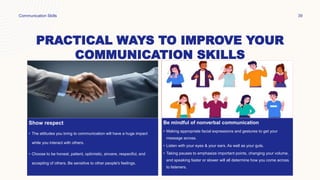
Show respect
• The attitudes you bring to communication will have a huge impact
while you interact with others.
• Choose to be honest, patient, optimistic, sincere, respectful, and
accepting of others. Be sensitive to other people's feelings.
Be mindful of nonverbal communication
• Making appropriate facial expressions and gestures to get your
message across.
• Listen with your eyes & your ears. As well as your guts.
• Taking pauses to emphasize important points, changing your volume,
and speaking faster or slower will all determine how you come across
to listeners.
Communication Skills 39
PRACTICAL WAYS TO IMPROVE YOUR
COMMUNICATION SKILLS
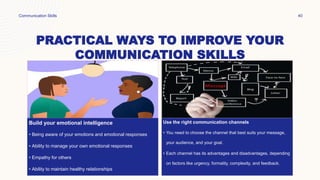
Build your emotional intelligence
• Being aware of your emotions and emotional responses
• Ability to manage your own emotional responses
• Empathy for others
• Ability to maintain healthy relationships
Use the right communication channels
• You need to choose the channel that best suits your message,
your audience, and your goal.
• Each channel has its advantages and disadvantages, depending
on factors like urgency, formality, complexity, and feedback.
Communication Skills 40
Build your emotional intelligence
• Being aware of your emotions and emotional responses
• Ability to manage your own emotional responses
• Empathy for others
• Ability to maintain healthy relationships
Use the right communication channels
• You need to choose the channel that best suits your message,
your audience, and your goal.
• Each channel has its advantages and disadvantages, depending
on factors like urgency, formality, complexity, and feedback.
SUMMARY VIDEO
Presentation title 41
THANK YOU

Communication skills.pptx

  • 1.
  • 2.
  • 3.
    AGENDA - Introduction​ - CommunicationSkills Types - Verbal Communication (Oral / Written) - Non Verbal Communication (Body Language / Sound / Appearance) - Informal VS Formal Communication - How to measure your communication skills - Lack of Communications - Tips to Improve your Communication Skills - Practical Ways to Improve Your Communication Skills
  • 4.
    INTRODUCTION Communication skills allowyou to understand and be understood by others. These can include but are not limited to effectively communicating ideas to others, as example - Actively listening in conversations - Giving and receiving critical feedback - Public speaking. Communication Skills 4
  • 5.
    WHAT ARE COMMUNICATIONSKILLS? • “Communication is the transfer of information from one person to another, whether or not it elicits confidence; but the information transferred must be understandable to the receiver” - G.G. Brown. • “We all use language to communicate, to express ourselves, to get our ideas across, and to connect with the person to whom we are speaking. When a relationship is working, the act of communicating seems to flow relatively effortlessly. When a relationship is deteriorating, the act of communicating can be as frustrating as climbing a hill of sand” - Chip Rose, attorney and mediator. Communication Skills 5
  • 6.
  • 7.
    Based on Purpose and Style Formal Communication Informal Communication Basedon the communication channels used Verbal Communication Oral/Spoken Communication Written Communication Nonverbal Communication Body Language Sound Appearance Communication Skills 7
  • 8.
    VERBAL COMMUNICATION SKILLS •Verbal communication requires a specific set of skills that focus on utilizing words to convey information to those around you. Communication is done by word of mouth and writing. • Objective of every communication is to have people understand what we are trying to convey. • In verbal communication always remember the acronym KISS - keep it short and simple. Communication Skills 8
  • 9.
    VERBAL COMMUNICATION SKILLS •We assume that others fully understand what we are saying when we speak to them because we are the ones who are speaking. • However, this is untrue. People frequently bring their own attitudes, perceptions, feelings, and beliefs about the subject, which makes it difficult to deliver the intended message. • To deliver the right message, you must put yourself on the other side of the table and think from your receiver's point of view. Would he understand the message? how it will it sound on the other side of the table? Communication Skills 9
  • 10.
    ORAL/SPOKEN COMMUNICATION • Inoral communication, Spoken words are used. It includes face-to-face conversations, speech, telephonic conversation, video, radio, television, voice over internet. • Used in the workplace include conversations, interviews, counseling/helping colleagues, meetings, conferences and so on Communication Skills 10
  • 11.
    ORAL/SPOKEN COMMUNICATION Communication Skills11 Advantage  Allows for immediate feedback such as the opportunity to ask questions when the meaning is not entirely clear.  There is high level of understanding and transparency in oral communication.  There is flexibility for allowing changes in the decisions.  Oral communication is an essential for teamwork and group energy  Oral communication can be best used to transfer private and confidential information/matter.
  • 12.
    ORAL/SPOKEN COMMUNICATION Communication Skills12 Disadvantage  Poor presentation of the message can result in misunderstanding and wrong responses.  Relying only on oral communication may not be sufficient as business communication is formal and very organized.  Oral communication is time-saving in case of daily interactions, but in meetings, long speeches consume lot of time and are unproductive at times.  Spoken communication is influenced by both verbal and non-verbal communication which may twist the meaning of your message in the mind of the receiver.
  • 13.
    WRITTEN COMMUNICATION • Inwritten communication, written signs or symbols are used to communicate. A written message may be printed, hand written, or transmitted via, letter, report, and email are the types of written communication used for internal communication. • Message is influenced by the vocabulary and grammar used, writing style, precision and clarity of the language used Communication Skills 13
  • 14.
    WRITTEN COMMUNICATION Communication Skills14 Advantage  Written Communication is most common form of communication being used in business.  Effective written communication develops and enhances an organization's image.  Written communication is more precise and explicit & it’s good for complicated and vital instructions, which can be given in a precise and uniform manner.
  • 15.
    WRITTEN COMMUNICATION Communication Skills15 Disadvantage  People may not always read them.  It is impersonal or unfriendly.  Written communication is time-consuming as the feedback is not immediate. The encoding and sending of message takes time.  Effective written communication requires great skills and competencies in language and vocabulary use. Poor writing skills and quality have a negative impact on organization’s reputation.
  • 16.
    NON-VERBAL COMMUNICATION • Nonverbalcommunication is talking without speaking a word (Actions speak louder than words). • Nonverbal communication has the following three elements:- Communication Skills 16 Appearance: • Speaker: clothing, hairstyle, neatness, use of cosmetics • Surrounding: room size, lighting, decorations, furnishings Body Language: • Facial expressions • Gestures • Postures Sounds: • Voice Tone • Volume • Speech rate
  • 17.
    NON-VERBAL COMMUNICATION Communication Skills17 Advantage  You can communicate with someone who cannot hear  You can communicate in places where you have to avoid talking audibly  Non-verbal communication makes conversation short and brief.  Non-verbal communication saves on time and can be used as a tool to communicate with people who don't understand your language.
  • 18.
    NON-VERBAL COMMUNICATION Communication Skills18 Disadvantage  Long conversations using non-verbal communication are usually not possible.  Non-verbal communication varies from culture to culture.  Particulars of messages using non-verbal communication cannot be discussed in detail  It is not useful as a public tool for communication
  • 19.
    TYPES OF COMMUNICATION •There’re two main categories of communication & they both bears their own characteristics. These are: Communication Skills 19 Formal Communication • Certain Rules, conventions & principles are followed while communicating message • Formal Communication occurs in official style • Professional settings, Corporate meetings, conferences undergoes in formal pattern • Slang words & foul languages is avoided & correct pronunciation is required Informal Communication • Just a casual talk • Established for social affiliation of members in an organization • No restrictions of using slang words & foul languages, no authority lines. • Helps to build relationships
  • 20.
  • 21.
  • 22.
    MEASURE YOUR COMMUNICATIONSKILLS The first step to improve your communication skills is to understand your own communication style and preferences. There are many communication models that help to identify strengths and weaknesses, such as - DISC “ Dominance, Influence, Steadiness, Conscientiousness” - MBI “Myers-Briggs Identification” - CSI “Communication Styles Inventory” These tools can help you discover how you communicate, how you perceive others, and how others perceive you. They can also help you adapt your communication style to different audiences and contexts. Communication Skills 22
  • 23.
  • 24.
  • 25.
  • 26.
  • 27.
  • 28.
  • 29.
  • 30.
  • 31.
    LACK OF COMMUNICATION •Lack of communication is “The act of not expressing yourself fully or omitting crucial information.” • It affect areas such as employee productivity, work relationships and mental health. • When couples have poor communication, they often feel emotionally unsafe, disconnected, frustrated, unimportant, and alone in their relationship. Communication Skills 31
  • 32.
    SIGNS OF BADCOMMUNICATION • Bad communication often has negative effect on relationships, so it is important to learn and recognize its signs. The signs of bad communication in a relationship & in workspace include:  Lack of listen & invalidate your feelings.  Interrupt you in conversation.  Use aggressive language.  Practice stonewalling during conflict.  Have poor emotional intelligence.  Don’t manage their tone or inflection.  Miss or delay providing important information.  Don’t provide feedback frequently.  Communicates unclearly or ineffectively.  Unprofessional attitudes & actions.  Bad Management & Lack of leadership Communication Skills 32
  • 33.
    CASE SCENARIO #1 •Disregarding emails from a team member when you collaborate on a project together, especially when it’s a high priority or with a tight timeline. • Try this instead: Coordinate with team members to keep a project flowing. • If emailing is not the best way for team members to coordinate with you, work together to establish the best communication methods. Then respond expediently according to priorities. Communication Skills 33
  • 34.
    CASE SCENARIO #2 •A Client needs to move tomorrow’s meeting to today. The timing is tight & stuff members was gathered quickly in the meeting room. However, the client inquires as to the whereabouts of Anthony - an important hybrid worker who wasn’t notified about the meeting update. They quickly get a frazzled, unprepared, and not happy Anthony in on a phone call. Communication Skills 34 • Try this instead: Team members must have fast, easy access to each other’s location and schedule at all times. • Also, workplaces need to develop consistent team communication strategies for disseminating information to off-site staff. • Without time to prepare, the stuff member cannot bring his best self to the meeting, which is not good for business nor for his reputation.
  • 35.
    EFFECTS OF LACKOF COMMUNICATION Communication Skills 35 Effects Relationships Workspaces Developing toxic relationship  Disconnected from others   Lack of security and safety   Relationship anxiety  Low self-esteem  Depression   Increase in stress levels  Misunderstandings & Conflicts   Strained employee relationships with lack of respect  Ineffective project development and work habits  Wasted time and resources  Poor employee morale 
  • 36.
  • 37.
    TIPS TO IMPROVECOMMUNICATION Communication Skills 37 Increase Awareness • find the reasons for the break in the communication. Make Commitment to Change • After becoming aware, it is important that each person to identify one change to the patterns that are detrimental to the relationship. Proactive your communication • When discussing how to avoid communication issues, consider coming up with a plan after cooling off. Open to Discussion • being able to listen to each other’s perspective on the situation and how each might want to resolve the issue.
  • 38.
    PRACTICAL WAYS TOIMPROVE YOUR COMMUNICATION SKILLS Be clear and concise • Enunciate your words, speak clearly and don’t mumble. • Adapt the structure of what’s your idea, why it’s important, & what’s the next step • If people are always asking you to repeat yourself, try to do a better job of articulating yourself in a better manner. Active listening • Avoid getting distracted by own thoughts • Use your notebook to record some important information • Paraphrase with other to check if you & other at the same page • Focus on speaker’s topic & avoid interrupting him • Shows your interest to other’s topic & keep the other talking Communication Skills 38
  • 39.
    PRACTICAL WAYS TOIMPROVE YOUR COMMUNICATION SKILLS Show respect • The attitudes you bring to communication will have a huge impact while you interact with others. • Choose to be honest, patient, optimistic, sincere, respectful, and accepting of others. Be sensitive to other people's feelings. Be mindful of nonverbal communication • Making appropriate facial expressions and gestures to get your message across. • Listen with your eyes & your ears. As well as your guts. • Taking pauses to emphasize important points, changing your volume, and speaking faster or slower will all determine how you come across to listeners. Communication Skills 39
  • 40.
    PRACTICAL WAYS TOIMPROVE YOUR COMMUNICATION SKILLS Build your emotional intelligence • Being aware of your emotions and emotional responses • Ability to manage your own emotional responses • Empathy for others • Ability to maintain healthy relationships Use the right communication channels • You need to choose the channel that best suits your message, your audience, and your goal. • Each channel has its advantages and disadvantages, depending on factors like urgency, formality, complexity, and feedback. Communication Skills 40 Build your emotional intelligence • Being aware of your emotions and emotional responses • Ability to manage your own emotional responses • Empathy for others • Ability to maintain healthy relationships Use the right communication channels • You need to choose the channel that best suits your message, your audience, and your goal. • Each channel has its advantages and disadvantages, depending on factors like urgency, formality, complexity, and feedback.
  • 41.
  • 42.