By- Sweety Gupta
The message must be complete. It should
convey all the facts required by the audience.
The sender of the message must take into
consideration the receiver and should
communicate all the facts and figures related
to the message.
 Conciseness means communicating what
you want to convey in least possible words.
Conciseness is a necessity for effective
communication. Concise communication
has following features:
◦ It is both time-saving as well as cost-saving.
◦ It underlines and highlights the main message.
◦ Concise communication provides short and
essential message in limited words to the
audience.
◦ Concise message is more appealing and
comprehensible to the audience.
Consideration
Consideration implies “stepping into the
shoes of others”. Effective communication
must take the audience into
consideration, i.e, the audience’s view
points, background, mind-set, education
level, etc. Make an attempt to envisage your
audience, their requirements, emotions as
well as problems. Ensure that the self-
respect of the audience is maintained and
their emotions are not at harm.
 Clarity implies emphasizing on a specific
message or goal at a time, rather than
trying to achieve too much at once. Clarity
in communication has following features:
◦ It makes understanding easier.
◦ Complete clarity of thoughts and ideas
enhances the meaning of message.
 Clear message makes use of
exact, appropriate and concrete words
 Concrete communication implies being
particular and clear rather than fuzzy and
general. Concreteness strengthens the
confidence. Concrete message has
following features:
◦ It is supported with specific facts and
figures.
◦ It makes use of words that are clear and
that build the reputation.
 Concrete messages are not misinterpreted
 Courtesy in message implies the message
should show the sender’s expression as well as
should respect the receiver. The sender of the
message should be sincerely
polite, judicious, reflective and enthusiastic.
Courteous message has following features:
◦ Courtesy implies taking into consideration both
viewpoints as well as feelings of the receiver of the
message.
◦ Courteous message is positive and focused at the
audience.
◦ It makes use of terms showing respect for the receiver
of message.
 It is not at all biased
 Correctness in communication implies that there
are no grammatical errors in communication.
Correct communication has following features:
◦ The message is exact, correct and well-timed.
◦ If the communication is correct, it boosts up
the confidence level.
◦ Correct message has greater impact on the
audience/ readers.
◦ It checks for the precision and accurateness
of facts and figures used in the message.
◦ It makes use of appropriate and correct
language in the message.
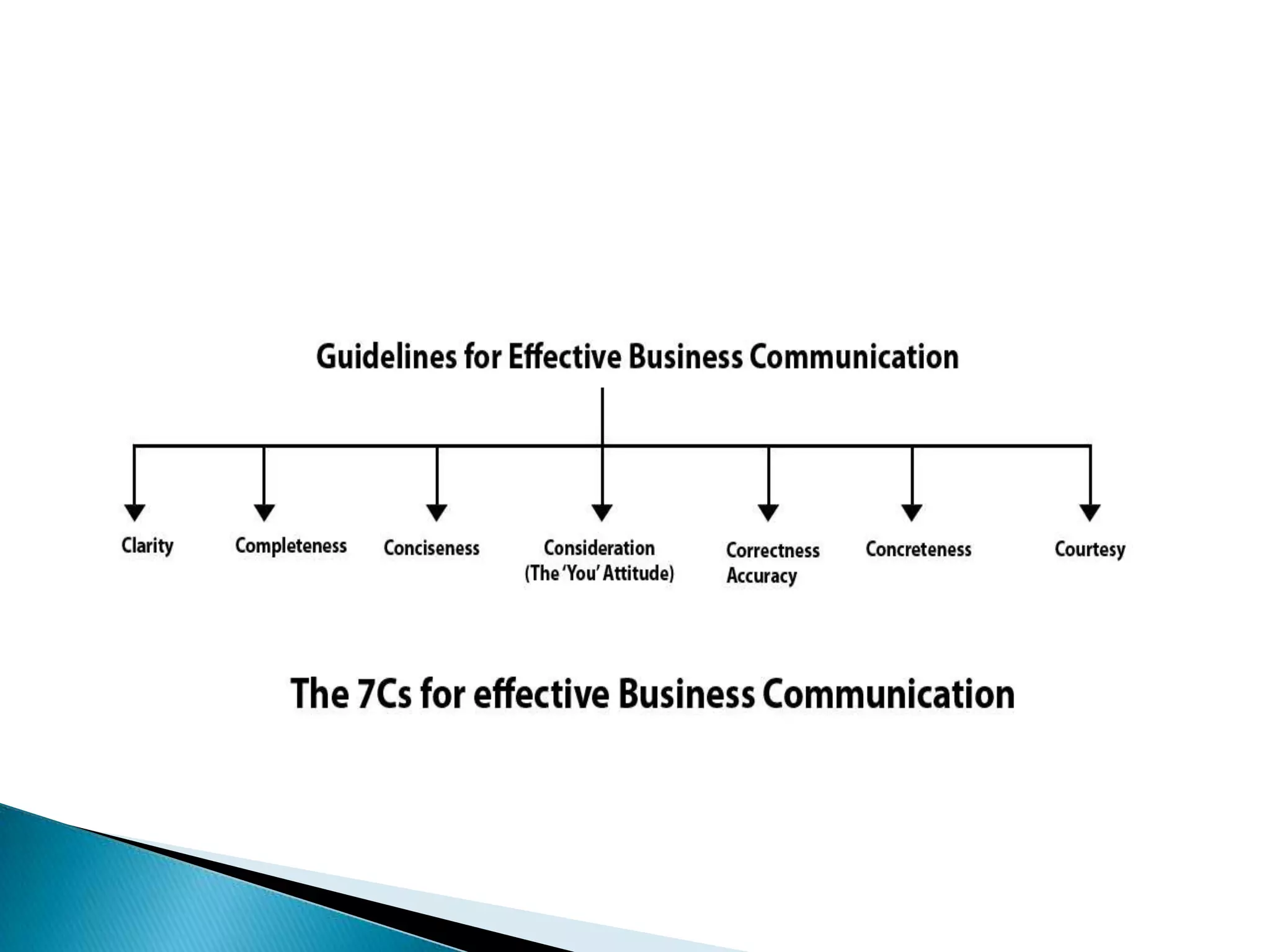
7 C's of effective communication

7 C's of effective communication

  • 1.
  • 3.
    The message mustbe complete. It should convey all the facts required by the audience. The sender of the message must take into consideration the receiver and should communicate all the facts and figures related to the message.
  • 4.
     Conciseness meanscommunicating what you want to convey in least possible words. Conciseness is a necessity for effective communication. Concise communication has following features: ◦ It is both time-saving as well as cost-saving. ◦ It underlines and highlights the main message. ◦ Concise communication provides short and essential message in limited words to the audience. ◦ Concise message is more appealing and comprehensible to the audience.
  • 5.
    Consideration Consideration implies “steppinginto the shoes of others”. Effective communication must take the audience into consideration, i.e, the audience’s view points, background, mind-set, education level, etc. Make an attempt to envisage your audience, their requirements, emotions as well as problems. Ensure that the self- respect of the audience is maintained and their emotions are not at harm.
  • 6.
     Clarity impliesemphasizing on a specific message or goal at a time, rather than trying to achieve too much at once. Clarity in communication has following features: ◦ It makes understanding easier. ◦ Complete clarity of thoughts and ideas enhances the meaning of message.  Clear message makes use of exact, appropriate and concrete words
  • 7.
     Concrete communicationimplies being particular and clear rather than fuzzy and general. Concreteness strengthens the confidence. Concrete message has following features: ◦ It is supported with specific facts and figures. ◦ It makes use of words that are clear and that build the reputation.  Concrete messages are not misinterpreted
  • 8.
     Courtesy inmessage implies the message should show the sender’s expression as well as should respect the receiver. The sender of the message should be sincerely polite, judicious, reflective and enthusiastic. Courteous message has following features: ◦ Courtesy implies taking into consideration both viewpoints as well as feelings of the receiver of the message. ◦ Courteous message is positive and focused at the audience. ◦ It makes use of terms showing respect for the receiver of message.  It is not at all biased
  • 9.
     Correctness incommunication implies that there are no grammatical errors in communication. Correct communication has following features: ◦ The message is exact, correct and well-timed. ◦ If the communication is correct, it boosts up the confidence level. ◦ Correct message has greater impact on the audience/ readers. ◦ It checks for the precision and accurateness of facts and figures used in the message. ◦ It makes use of appropriate and correct language in the message.