bilalAmjad
ceo@attrayantdesigns.com


  Organizational Culture


                           1
Organizational Culture
 Organizational Culture represents shared values,
 principles, traditions and ways of doing things that
 influence the way organizational members act.

 Perceptive
 Descriptive
 Shared


                COMSATS, Lahore Campus                  2
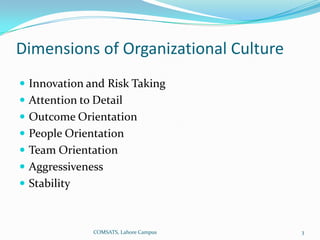
Dimensions of Organizational Culture
 Innovation and Risk Taking
 Attention to Detail
 Outcome Orientation
 People Orientation
 Team Orientation
 Aggressiveness
 Stability


               COMSATS, Lahore Campus   3
Strong Culture Vs Week Culture
Strong Culture                                  Week Culture
Values widely shared                            Values limited to a few people-usually
                                                top management

Culture conveys consistent messages             Culture sends contradictory messages
about what’s important                          about what’s important

Most employees can tell stories about           Employees have little knowledge of
company history/heroes                          company history or heroes

Employees strongly identify with                Employees have little identification
culture                                         with culture

Strong connection between shared                Little connection between shared values
values and behavior                             and behavior


                       COMSATS, Lahore Campus                                             4
Source of Culture
 Company founders….vision for company….installing culture
 Small size companies can easily implement founder’s vision
 Management practices reinforce organizational culture i.e. selection
  criteria
    Top management actions…
    Risk-taking
    Hospitality
    Team work
 Socialization Process


                   COMSATS, Lahore Campus                                5
How Employees Learn Culture
 Stories
 Rituals
 Material Symbols
 Language


             COMSATS, Lahore Campus   6
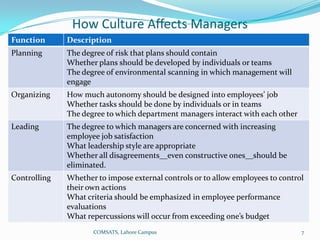
How Culture Affects Managers
Function      Description
Planning      The degree of risk that plans should contain
              Whether plans should be developed by individuals or teams
              The degree of environmental scanning in which management will
              engage
Organizing    How much autonomy should be designed into employees’ job
              Whether tasks should be done by individuals or in teams
              The degree to which department managers interact with each other
Leading       The degree to which managers are concerned with increasing
              employee job satisfaction
              What leadership style are appropriate
              Whether all disagreements__even constructive ones__should be
              eliminated.
Controlling   Whether to impose external controls or to allow employees to control
              their own actions
              What criteria should be emphasized in employee performance
              evaluations
              What repercussions will occur from exceeding one’s budget
                     COMSATS, Lahore Campus                                      7
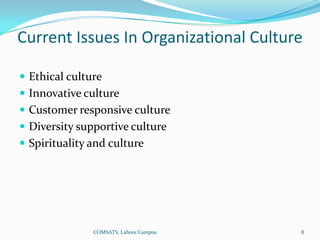
Current Issues In Organizational Culture

 Ethical culture
 Innovative culture
 Customer responsive culture
 Diversity supportive culture
 Spirituality and culture


               COMSATS, Lahore Campus   8
External Environment
 The combination of factors and forces that effect business
  processes for an organization determine external environment.
 Specific environment
      Customers
      Suppliers
      Competitors
      Pressure groups
 General environment
    Economic conditions
    Political conditions
    Legal conditions
    Sociocultural conditions
    Demographic conditions
    Technological conditions
    Global conditions


                   COMSATS, Lahore Campus                         9
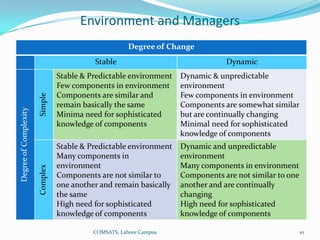
Environment and Managers
                                                       Degree of Change
                                           Stable                               Dynamic
                                 Stable & Predictable environment   Dynamic & unpredictable
                                 Few components in environment      environment
                                 Components are similar and         Few components in environment
                       Simple


                                 remain basically the same          Components are somewhat similar
Degree of Complexity


                                 Minima need for sophisticated      but are continually changing
                                 knowledge of components            Minimal need for sophisticated
                                                                    knowledge of components
                                 Stable & Predictable environment   Dynamic and unpredictable
                                 Many components in                 environment
                                 environment                        Many components in environment
                       Complex


                                 Components are not similar to      Components are not similar to one
                                 one another and remain basically   another and are continually
                                 the same                           changing
                                 High need for sophisticated        High need for sophisticated
                                 knowledge of components            knowledge of components

                                           COMSATS, Lahore Campus                                       10
Managing Stakeholder Relationships

                   Communities               Employees

                                                            Customers
       Unions


Trade & Industry                                            Social & Political
  Associations                                               Action Groups
                                 Organization

    Suppliers                                               Shareholders


         Media                 Governments               Competitors


                    COMSATS, Lahore Campus                                       11

Organizational structure

  • 1.
  • 2.
    Organizational Culture  OrganizationalCulture represents shared values, principles, traditions and ways of doing things that influence the way organizational members act.  Perceptive  Descriptive  Shared COMSATS, Lahore Campus 2
  • 3.
    Dimensions of OrganizationalCulture  Innovation and Risk Taking  Attention to Detail  Outcome Orientation  People Orientation  Team Orientation  Aggressiveness  Stability COMSATS, Lahore Campus 3
  • 4.
    Strong Culture VsWeek Culture Strong Culture Week Culture Values widely shared Values limited to a few people-usually top management Culture conveys consistent messages Culture sends contradictory messages about what’s important about what’s important Most employees can tell stories about Employees have little knowledge of company history/heroes company history or heroes Employees strongly identify with Employees have little identification culture with culture Strong connection between shared Little connection between shared values values and behavior and behavior COMSATS, Lahore Campus 4
  • 5.
    Source of Culture Company founders….vision for company….installing culture  Small size companies can easily implement founder’s vision  Management practices reinforce organizational culture i.e. selection criteria  Top management actions…  Risk-taking  Hospitality  Team work  Socialization Process COMSATS, Lahore Campus 5
  • 6.
    How Employees LearnCulture  Stories  Rituals  Material Symbols  Language COMSATS, Lahore Campus 6
  • 7.
    How Culture AffectsManagers Function Description Planning The degree of risk that plans should contain Whether plans should be developed by individuals or teams The degree of environmental scanning in which management will engage Organizing How much autonomy should be designed into employees’ job Whether tasks should be done by individuals or in teams The degree to which department managers interact with each other Leading The degree to which managers are concerned with increasing employee job satisfaction What leadership style are appropriate Whether all disagreements__even constructive ones__should be eliminated. Controlling Whether to impose external controls or to allow employees to control their own actions What criteria should be emphasized in employee performance evaluations What repercussions will occur from exceeding one’s budget COMSATS, Lahore Campus 7
  • 8.
    Current Issues InOrganizational Culture  Ethical culture  Innovative culture  Customer responsive culture  Diversity supportive culture  Spirituality and culture COMSATS, Lahore Campus 8
  • 9.
    External Environment  Thecombination of factors and forces that effect business processes for an organization determine external environment.  Specific environment  Customers  Suppliers  Competitors  Pressure groups  General environment  Economic conditions  Political conditions  Legal conditions  Sociocultural conditions  Demographic conditions  Technological conditions  Global conditions COMSATS, Lahore Campus 9
  • 10.
    Environment and Managers Degree of Change Stable Dynamic Stable & Predictable environment Dynamic & unpredictable Few components in environment environment Components are similar and Few components in environment Simple remain basically the same Components are somewhat similar Degree of Complexity Minima need for sophisticated but are continually changing knowledge of components Minimal need for sophisticated knowledge of components Stable & Predictable environment Dynamic and unpredictable Many components in environment environment Many components in environment Complex Components are not similar to Components are not similar to one one another and remain basically another and are continually the same changing High need for sophisticated High need for sophisticated knowledge of components knowledge of components COMSATS, Lahore Campus 10
  • 11.
    Managing Stakeholder Relationships Communities Employees Customers Unions Trade & Industry Social & Political Associations Action Groups Organization Suppliers Shareholders Media Governments Competitors COMSATS, Lahore Campus 11