Information Technology(402)
Employability Skills
(10 Marks)
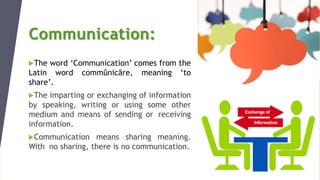
Communication:
The word ‘Communication’ comes from the
Latin word commūnicāre, meaning ‘to
share’.
The imparting or exchanging of information
by speaking, writing or using some other
medium and means of sending or receiving
information.
Communication means sharing meaning.
With no sharing, there is no communication.
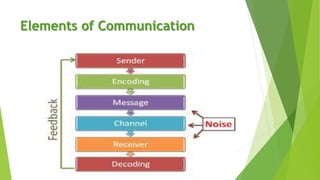
Elements of Communication
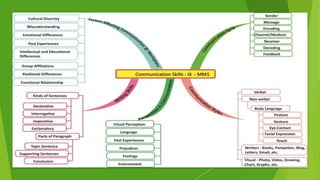
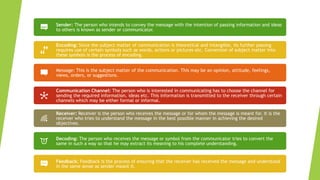
Sender: The person who intends to convey the message with the intention of passing information and ideas
to others is known as sender or communicator.
Encoding: Since the subject matter of communication is theoretical and intangible, its further passing
requires use of certain symbols such as words, actions or pictures etc. Conversion of subject matter into
these symbols is the process of encoding.
Message: This is the subject matter of the communication. This may be an opinion, attitude, feelings,
views, orders, or suggestions.
Communication Channel: The person who is interested in communicating has to choose the channel for
sending the required information, ideas etc. This information is transmitted to the receiver through certain
channels which may be either formal or informal.
Receiver: Receiver is the person who receives the message or for whom the message is meant for. It is the
receiver who tries to understand the message in the best possible manner in achieving the desired
objectives.
Decoding: The person who receives the message or symbol from the communicator tries to convert the
same in such a way so that he may extract its meaning to his complete understanding.
Feedback: Feedback is the process of ensuring that the receiver has received the message and understood
in the same sense as sender meant it.
Meaning and importance of Feedback in
a communication
 Feedback is the final component and one of the important factors in the
process of communication.
 It is defined as the response given by the receiver to the sender. The sender
needs response of the receiver in order to decide effectiveness of
communication.
 Feedback can be negative or positive.
 Feedback plays an important part in communication because it tells both the
source and the receiver, how their messages are being interpreted.
Different types of
communication?
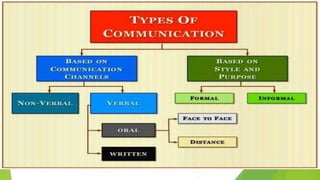
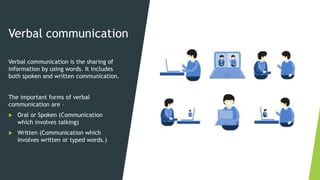
Verbal communication
Verbal communication is the sharing of
information by using words. It includes
both spoken and written communication.
The important forms of verbal
communication are –
 Oral or Spoken (Communication
which involves talking)
 Written (Communication which
involves written or typed words.)
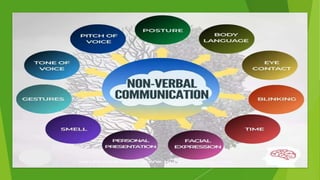
Non-verbal communication
Non-verbal communication is the message we send to others without
using any words.
We send signals and messages to others, through expressions,
gestures and body postures.
Note : - In our day-to-day communication, it is observed that most
of the communication is done using body movements (face, arms,
movements, etc.) and voice control (voice, tone, pauses, etc.).
Effective communication
 Effective communication can happen
if we follow the basic principles of
professional communication skills.
 These can be abbreviated as 7 Cs,
i.e., Clear, Concise, Concrete,
Correct, Coherent, Complete and
Courteous.
7 Cs of Communication
The 7Cs of Communication provide
a checklist for making sure that your
meetings, emails, conference calls,
reports, and presentations are well
constructed and clear – so your
audience gets your message.
1. Be Clear
Begin every message by asking the question,
“What is the purpose of this
communication?” This will enable you to
make the objective of your communication
clear to the recipient.
Clarity is also about avoiding the use of
complex words, sentences, and fuzzy
language. It is important that you clearly
communicate the intended information to
the recipient.
2. Be Concise
Make your message brief and to the
point. To make your communications
more concise, avoid going over the
same point several times, and avoid
the use of filler words, sentences,
and over wordy expressions.
3. Be Concrete
Concrete communication is about
being specific and clear rather than
vague, obscure, and general. To be
more concrete use sentences that
cannot be misinterpreted. Include
supporting facts and figures to
underscore your message.
4. Be Correct
Incorrect information doesn’t help anyone and it does your credibility no good.
Ensure that your facts and figures are correct and you are using the right level of
language.
Being correct you save your time and boost your credibility. A correct message
will also have a greater impact on the recipient than an incorrect one.
5. Be Coherent
Does your message make sense? Does it
flow logically from one sentence to the
next? To ensure that your communication
is coherent: Check that each sentence
flows logically from one to the next.
6. Be Complete
Your message must contain all the
necessary information to achieve the
desired response. To ensure that your
message is complete think about questions
the receiver might think of as they receive
your message. Address these questions.
Ensure you have included a call to action
so that your audience knows exactly what
you expect them to do next.
7. Be Courteous
Be polite. You are more likely to get what
you want from your communication if you
are courteous, as courtesy builds goodwill.
Check that your message is polite, shows
respect for the feelings of the receiver,
and is tactful. Make your message brief
and to the point.
Communication
Barrier?
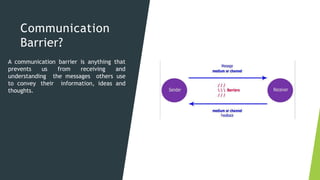
A communication barrier is anything that
prevents us from receiving and
understanding the messages others use
to convey their information, ideas and
thoughts.
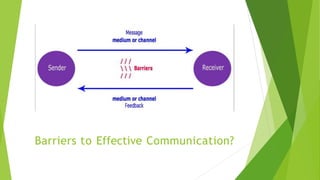
Barriers to Effective Communication?
Physical Barriers
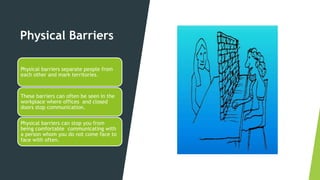
Physical barriers separate people from
each other and mark territories.
These barriers can often be seen in the
workplace where offices and closed
doors stop communication.
Physical barriers can stop you from
being comfortable communicating with
a person whom you do not come face to
face with often.
Language Barriers
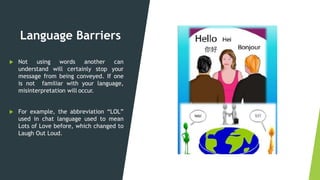
 Not using words another can
understand will certainly stop your
message from being conveyed. If one
is not familiar with your language,
misinterpretation will occur.
 For example, the abbreviation “LOL”
used in chat language used to mean
Lots of Love before, which changed to
Laugh Out Loud.
Gender Barriers
Variation exists among masculine and
feminine styles of communication.
While women often emphasize politeness,
empathy, and rapport building, male
communication is often more direct.
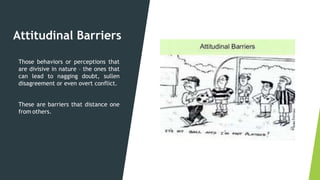
Attitudinal Barriers
Those behaviors or perceptions that
are divisive in nature – the ones that
can lead to nagging doubt, sullen
disagreement or even overt conflict.
These are barriers that distance one
from others.
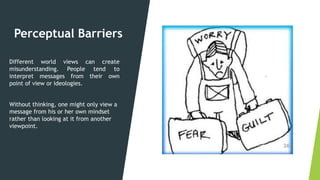
Perceptual Barriers
Different world views can create
misunderstanding. People tend to
interpret messages from their own
point of view or ideologies.
Without thinking, one might only view a
message from his or her own mindset
rather than looking at it from another
viewpoint.
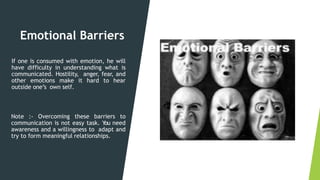
Emotional Barriers
If one is consumed with emotion, he will
have difficulty in understanding what is
communicated. Hostility, anger, fear, and
other emotions make it hard to hear
outside one’s own self.
Note :- Overcoming these barriers to
communication is not easy task. You need
awareness and a willingness to adapt and
try to form meaningful relationships.
Cultural Barriers
Ethnic, religious, and social differences can
often create misunderstandings when
trying to communicate.
These differences can also affect one’s
perception and create confusion in getting
a message.
Activity to be practiced at Home:
Blindfold Game
• In this game break off everyone into teams of two.
• One member is blindfolded and navigates an object (Chair, Person
etc.) The other member shouts directions to the other member.
Blindfold Game works because it builds trust, listening, and instructional skills.
Trust among team-members is crucial for effective communication.
It encourages cooperation and successful teamwork.
Thank You

Communication Skills - IX.pptx

  • 1.
  • 4.
    Communication: The word ‘Communication’comes from the Latin word commūnicāre, meaning ‘to share’. The imparting or exchanging of information by speaking, writing or using some other medium and means of sending or receiving information. Communication means sharing meaning. With no sharing, there is no communication.
  • 5.
  • 6.
    Sender: The personwho intends to convey the message with the intention of passing information and ideas to others is known as sender or communicator. Encoding: Since the subject matter of communication is theoretical and intangible, its further passing requires use of certain symbols such as words, actions or pictures etc. Conversion of subject matter into these symbols is the process of encoding. Message: This is the subject matter of the communication. This may be an opinion, attitude, feelings, views, orders, or suggestions. Communication Channel: The person who is interested in communicating has to choose the channel for sending the required information, ideas etc. This information is transmitted to the receiver through certain channels which may be either formal or informal. Receiver: Receiver is the person who receives the message or for whom the message is meant for. It is the receiver who tries to understand the message in the best possible manner in achieving the desired objectives. Decoding: The person who receives the message or symbol from the communicator tries to convert the same in such a way so that he may extract its meaning to his complete understanding. Feedback: Feedback is the process of ensuring that the receiver has received the message and understood in the same sense as sender meant it.
  • 7.
    Meaning and importanceof Feedback in a communication  Feedback is the final component and one of the important factors in the process of communication.  It is defined as the response given by the receiver to the sender. The sender needs response of the receiver in order to decide effectiveness of communication.  Feedback can be negative or positive.  Feedback plays an important part in communication because it tells both the source and the receiver, how their messages are being interpreted.
  • 8.
  • 10.
    Verbal communication Verbal communicationis the sharing of information by using words. It includes both spoken and written communication. The important forms of verbal communication are –  Oral or Spoken (Communication which involves talking)  Written (Communication which involves written or typed words.)
  • 11.
    Non-verbal communication Non-verbal communicationis the message we send to others without using any words. We send signals and messages to others, through expressions, gestures and body postures. Note : - In our day-to-day communication, it is observed that most of the communication is done using body movements (face, arms, movements, etc.) and voice control (voice, tone, pauses, etc.).
  • 13.
    Effective communication  Effectivecommunication can happen if we follow the basic principles of professional communication skills.  These can be abbreviated as 7 Cs, i.e., Clear, Concise, Concrete, Correct, Coherent, Complete and Courteous.
  • 14.
    7 Cs ofCommunication The 7Cs of Communication provide a checklist for making sure that your meetings, emails, conference calls, reports, and presentations are well constructed and clear – so your audience gets your message.
  • 15.
    1. Be Clear Beginevery message by asking the question, “What is the purpose of this communication?” This will enable you to make the objective of your communication clear to the recipient. Clarity is also about avoiding the use of complex words, sentences, and fuzzy language. It is important that you clearly communicate the intended information to the recipient.
  • 16.
    2. Be Concise Makeyour message brief and to the point. To make your communications more concise, avoid going over the same point several times, and avoid the use of filler words, sentences, and over wordy expressions.
  • 17.
    3. Be Concrete Concretecommunication is about being specific and clear rather than vague, obscure, and general. To be more concrete use sentences that cannot be misinterpreted. Include supporting facts and figures to underscore your message.
  • 18.
    4. Be Correct Incorrectinformation doesn’t help anyone and it does your credibility no good. Ensure that your facts and figures are correct and you are using the right level of language. Being correct you save your time and boost your credibility. A correct message will also have a greater impact on the recipient than an incorrect one.
  • 19.
    5. Be Coherent Doesyour message make sense? Does it flow logically from one sentence to the next? To ensure that your communication is coherent: Check that each sentence flows logically from one to the next.
  • 20.
    6. Be Complete Yourmessage must contain all the necessary information to achieve the desired response. To ensure that your message is complete think about questions the receiver might think of as they receive your message. Address these questions. Ensure you have included a call to action so that your audience knows exactly what you expect them to do next.
  • 21.
    7. Be Courteous Bepolite. You are more likely to get what you want from your communication if you are courteous, as courtesy builds goodwill. Check that your message is polite, shows respect for the feelings of the receiver, and is tactful. Make your message brief and to the point.
  • 22.
    Communication Barrier? A communication barrieris anything that prevents us from receiving and understanding the messages others use to convey their information, ideas and thoughts.
  • 23.
    Barriers to EffectiveCommunication?
  • 24.
    Physical Barriers Physical barriersseparate people from each other and mark territories. These barriers can often be seen in the workplace where offices and closed doors stop communication. Physical barriers can stop you from being comfortable communicating with a person whom you do not come face to face with often.
  • 25.
    Language Barriers  Notusing words another can understand will certainly stop your message from being conveyed. If one is not familiar with your language, misinterpretation will occur.  For example, the abbreviation “LOL” used in chat language used to mean Lots of Love before, which changed to Laugh Out Loud.
  • 26.
    Gender Barriers Variation existsamong masculine and feminine styles of communication. While women often emphasize politeness, empathy, and rapport building, male communication is often more direct.
  • 27.
    Attitudinal Barriers Those behaviorsor perceptions that are divisive in nature – the ones that can lead to nagging doubt, sullen disagreement or even overt conflict. These are barriers that distance one from others.
  • 28.
    Perceptual Barriers Different worldviews can create misunderstanding. People tend to interpret messages from their own point of view or ideologies. Without thinking, one might only view a message from his or her own mindset rather than looking at it from another viewpoint.
  • 29.
    Emotional Barriers If oneis consumed with emotion, he will have difficulty in understanding what is communicated. Hostility, anger, fear, and other emotions make it hard to hear outside one’s own self. Note :- Overcoming these barriers to communication is not easy task. You need awareness and a willingness to adapt and try to form meaningful relationships.
  • 30.
    Cultural Barriers Ethnic, religious,and social differences can often create misunderstandings when trying to communicate. These differences can also affect one’s perception and create confusion in getting a message.
  • 31.
    Activity to bepracticed at Home: Blindfold Game • In this game break off everyone into teams of two. • One member is blindfolded and navigates an object (Chair, Person etc.) The other member shouts directions to the other member. Blindfold Game works because it builds trust, listening, and instructional skills. Trust among team-members is crucial for effective communication. It encourages cooperation and successful teamwork.
  • 32.