Common Surgical ProceduresBy:  S. Delfin, RN
PRETEST NAMAN…
IDENTIFICATION (no retracing,no erasure)_________ 1. Surgery to correct an abnormal bulging of internal organs, often the intestines through a weakness in a muscular wall._________ 2. Surgical removal of a limb or Body part._________ 3. Is the resection of the prostate by means of a cystoscope passed through the urethra._________ 4. surgical resection of all or more commonly part of the stomach. _________ 5. surgical opening into the Thoracic cavity.
_________ 6. Is the excision of the faucial tonsils._________ 7. Endoscopic visualization of the anal canal, rectum, and sigmoidcolon._________ 8. Formation of a permanent or temporary opening into the colon brought out onto the abdominal wall as a stoma._________ 9. The removal of the entire uterus, fallopian tubes and the corresponding ovaries through an abdominal incision._________ 10. Removal of the Lung.
SURGICAL TERMINOLOGY
EsophagoscopyDefinition:Endoscopic Visualization of the esophagus.Indication:Esophagoscopyis performed to diagnose malignancies, esophagitis,(noting reflux), hiatal hernia, strictures, and varicies; to remove tissues or secretions for study; for direct therapeutic manipulations such as removal of a foreign body, injection or coagulation of varices.
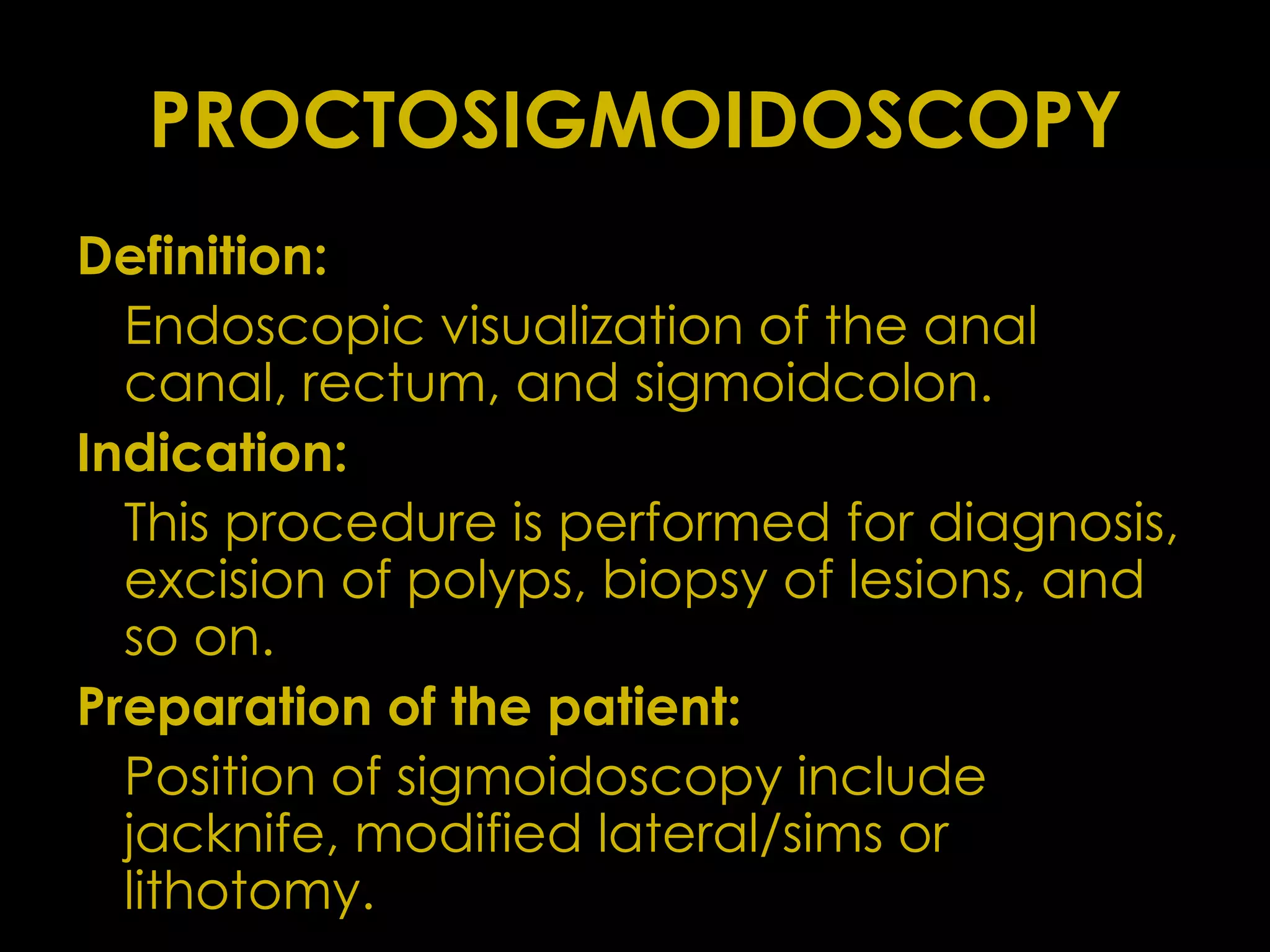
PROCTOSIGMOIDOSCOPYDefinition:	Endoscopic visualization of the anal canal, rectum, and sigmoidcolon.Indication:	This procedure is performed for diagnosis, excision of polyps, biopsy of lesions, and so on.Preparation of the patient:	Position of sigmoidoscopy include jacknife, modified lateral/sims or lithotomy.
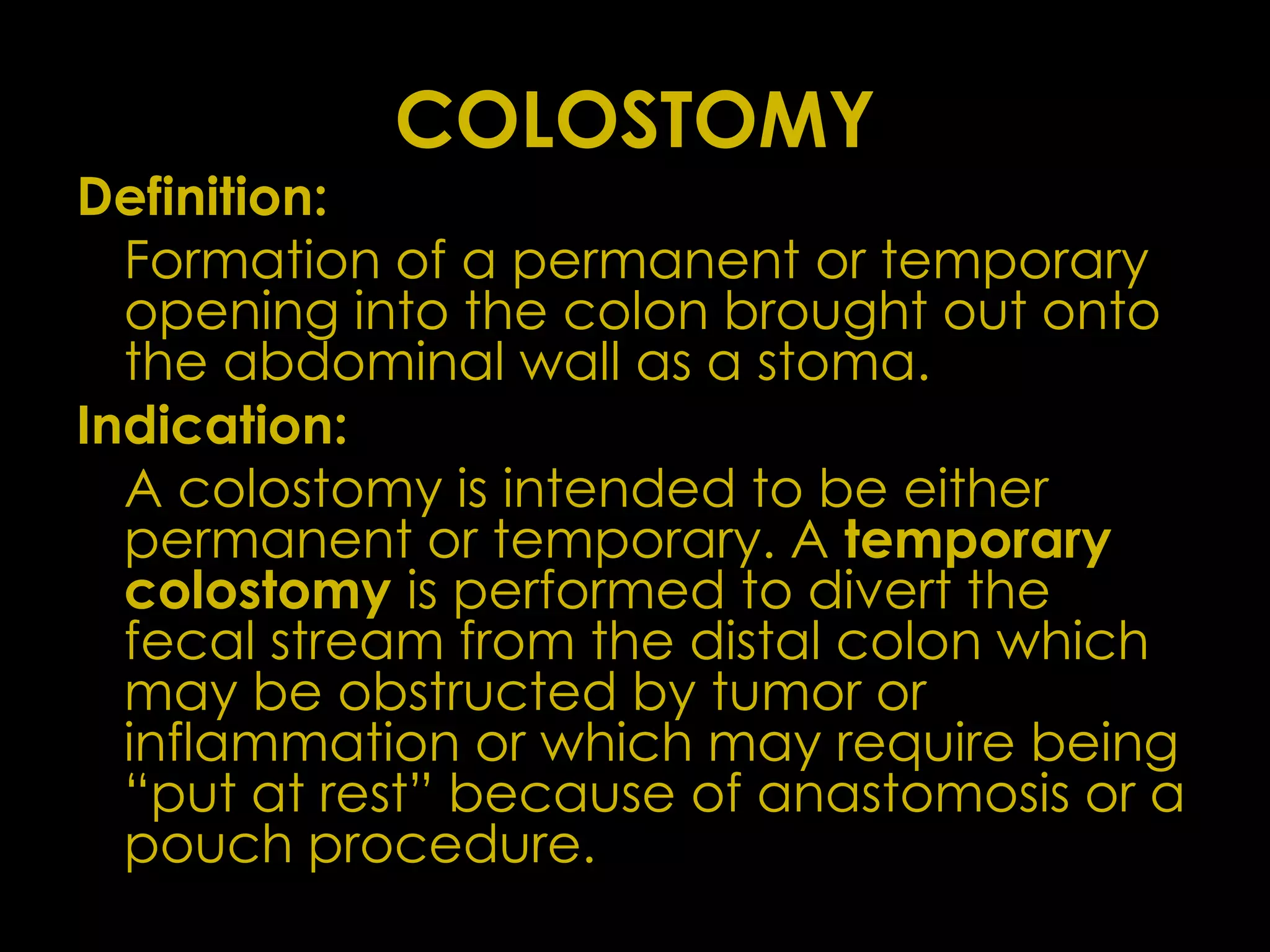
COLOSTOMYDefinition:	Formation of a permanent or temporary opening into the colon brought out onto the abdominal wall as a stoma.Indication:	A colostomy is intended to be either permanent or temporary. A temporary colostomy is performed to divert the fecal stream from the distal colon which may be obstructed by tumor or inflammation or which may require being “put at rest” because of anastomosis or a pouch procedure.
	A permanent colostomy is performed to treat malignancies of the colon; other indications include irrevocable rectal stricture, irrevocable anal incontinence, and inflammatory bowel disease.
HEMORRHOIDECTOMYDefinition:     Excision of the veins of the anus and associated overlying skin and anoderm (externally) and mucous membrane (internally).Indication:Hemorrhoidectomy refers to the removal of the hemorrhoidal tissues including the enlarged veins within. Anesthesia may be regional, local, or general ( or as combination). Following the induction of anesthesia, proctosigmoidoscopy is performed.
DILATATION OF THE CERVIX AND CURETTAGE OF THE UTERUS(D&C)Definition:	The gradual enlargement of the cervical canal and removal (by scraping) of endocervical or endometrial tissue for histologic study.Indication:	The procedure is usually performed to diagnose cervical or uterine malignancy, control dysfunctional uterine bleeding, and complete incomplete abortion.
HERNIORRHAPHY Definition 	Surgery to correct an abnormal bulging of internal organs, often the intestines through a weakness in a muscular wall.Indication:	Hernias are either reducible or irreducible, that is incarcerated. The contents of an incarcerated hernia may become strangulated, compromising the viability of the trapped tissue.Types:Inguinal Hernia- multifascial defect is in the groin.Umbilical hernia- within the umbilicusEpigastric– defect in the abdominal wall between the xiphoid process and umbilicus through which fats protrudes.
AMPUTATIONDefinition and PreparationSurgical removal of a limb or Body partPre-op assess medication historydiscuss possibility of phantom limbs sensationensure adequate hydrationIntra-opmonitor blood pressure, temperature, heart ratemaintain sterilityanesthesia administeredPost-op monitor vita signsmove the stump often to encourage circulationwhen dressing the stump, wrap it looselymaintain joint movementobserve dressings for excessive bleeding
TURP- TRANSURETHRAL RESECTION OF PROSTATE Definition	Is the resection of the prostate by means of a cystoscope passed through the urethra.Indication:	This procedure is particularly desirable when the patient is a poor surgical risk, thereby eliminating the need for prostatectomy.
GASTRECTOMYDefinition 	surgical resection of all or more commonly part of the stomach. Indication:	It is performed to remove a chronic peptic ulcer or to remove a malignancy and reestablishment of the continuity of the gastrointestinal tract.
THORACOSTOMYDefinition surgical opening into the Thoracic cavityIndication:To remove air and fluid from the pleural cavity and re-expansion of the lung.
CRANIOTOMYDefinition:Opening of the skull.Indication:	The most basic form of craniotomy is the burr hole, a limited opening through which blood or fluid may be evacuated or instruments inserted, to divide neural tracts.Numerous neurosurgical are treated with craniotomy:
Intracranial Aneurysm
Occluded and malformed Intracranial vessel
Subdural or epidural hematoma
Neurological disorders
Hydrocephalus
Congenital abnormalities
TONSILLECTOMY	Definition:Is the excision of the faucial tonsils. Indication:	The faucial tonsils and nasopharyngeal tonsils are aggregates of lymphoid tissue in the posterior nasopharynx that hypertrophy secondary to infection.
CHOLECYSTECTOMYDefinition and Preparationsurgical removal of the gallbladderIndication:	To treat chronic or acute cholecystitis, with or without cholelithiasis, to remove malignancy or to remove polyps.
MASTECTOMYDefinition and Preparationthe surgical removal of one or both breasts. This is most commonly performed to remove a malignant tumor
evaluate health and ensure that patient is fit for the surgery
patient must submit to laboratory tests; routine blood workshop, urinalysis, ECG
if patient is taking medication, the surgeon and anesthesiologist should be informed
patient should be NPO after midnight on the night prior to surgery
Showering with an anti-bacterial soap the night before surgery may be required of the patient
consent form should be signed by the patientAPPENDECTOMY	Definition 	surgical removal of the venifom appendix. Indication:	This is performed in acute appendicitis to remove an inflamed appendix before in ruptures.
THYROIDECTOMYDefinition	Removal of all or a portion of the thyroid gland.Indication	Thyroid lobectomy is done to treat some thyroid nodules and carcinomas. Total thyroidectomy is indicated for certain carcinomas and to relieve tracheal or esophageal compression 
TOTAL ABDOMINAL HYSTERECTOMY AND BILATERAL SALPINGO OOPHERECTOMY (TAHBSO)Definition:	The removal of the entire uterus, fallopian tubes and the corresponding ovaries through an abdominal incision.Indication:	Some indications for TAHBSO are endometriosis, postmenopausal bleeding, dysfunctional uterine bleeding, cysts, hemorrhage ( tubal pregnancy) and benign and malignant tumors.
HYDROCELECTOMYDefinition:	Excision of portion of tunica vaginalis testis with evacuation of fluid contained therein.Indication:	A hydrocele is an accumulation of serous fluid around the testis within the tunica vaginalis resulting from trauma or infection or occuring spontaneously.
CYSTOSCOPYDefinition:    Endoscopic examination of the interior of the urethra, the bladder, and urethral orifices.Indication:Cystoscopy is indicated for diagnosis of urinary tract symptoms (e.g. hematuria, pyuria), to catheterize the ureters, to obtain biopsy specimen, to treat lesions, and for follow up examination of an operative or endoscopic procedure.
NEPHRECTOMYDefinition:	Removal of a kidneyIndication:	This procedure is performed for numerous conditions including hydronephrosis, pyelonephritis, renal atrophy, renal artery stenosis, trauma, and tumors of the kidney and ureter.
PULMONARY LOBECTOMYDefinition:Excision of one or more lobe of the lung.Indication:	The diseased lobe is identified. Usually performed when the lesion is limited to the lobe.
PNEUMONECTOMYDefinition:Removal of the Lung.Indication:	The chief indication for pneumonectomy is bronchogenic carcinoma; among other indications are extensive unilateral tuberculosis, some benign tumors, bronchiectasis, and multiple lung abscesses.
CARDIAC PROCEDURESDefinition:	Involves the correction of congenital anomalies, acquired diseases of the heart, pericardium, and great vessels   ( including repair and replacement of diseased valves, resection of aneurysm, pericardiectomy, pulmonary embolectomy and replacement of the great vessels)
Aortic valve replacement: Involves the excision and replacement of the diseased aortic valve.Mitral valve replacement: Involves the excision and replacement of the diseased mitral valve.Coronary artery bypass: Refers to the grafting of the internal mammary artery or segments of autologoussaphenous vein to bypass coronary artery obstruction.Cardiopulmonary Bypass: Is a technique by which the patient’s blood is diverted, oxygenated, and reperfused. Intra-aortic balloon catheter: The purpose of this is to increase coronary artery blood flow and to assist peripheral perfusion.
INTRA AORTIC BALLON
CARDIOPULMONARY BYPASS
TOTAL HIP REPLACEMENTDefinition:	Substitution of the femoral head with prosthesis and the reconstruction of the acetabulum with the placement of an acetabular cup or metal.Indication:	 Disorders  of the hip joint for which this procedure may be indicated are rheumatoid arthritis, degenerative disease and hip fracture.
HEMICOLECTOMYDefinition:	Resection of the colon( a portion of the transverse colon, ascending colon, and cecum)Indication:	Tumors, bleeding, inflammation, or trauma and obstruction.
DERMABRASIONDefinition:Sanding of the skin to smooth scars and surface irregularities.Indication:This procedure removes or minimizes scars (e.g. from acne vulgaris and chicken pox). Dermabrasion may also employed to remove tatoos. Fine wrinkling around the mouth can be temporarily improved with dermabrasion.
AUGMENTATION MAMMOPLASTYDefinition:	Implantation of breast prostheses for the purpose of enlarging the breast.Indication:	This procedure is performed for micromastia, postpartum involution of the breast, and post surgical deformity. The silicon rubber prostheses can be filled with gel, inflatable, or filled with gel or saline.

Common Surgical Procedures

  • 1.
  • 2.
  • 3.
    IDENTIFICATION (no retracing,noerasure)_________ 1. Surgery to correct an abnormal bulging of internal organs, often the intestines through a weakness in a muscular wall._________ 2. Surgical removal of a limb or Body part._________ 3. Is the resection of the prostate by means of a cystoscope passed through the urethra._________ 4. surgical resection of all or more commonly part of the stomach. _________ 5. surgical opening into the Thoracic cavity.
  • 4.
    _________ 6. Isthe excision of the faucial tonsils._________ 7. Endoscopic visualization of the anal canal, rectum, and sigmoidcolon._________ 8. Formation of a permanent or temporary opening into the colon brought out onto the abdominal wall as a stoma._________ 9. The removal of the entire uterus, fallopian tubes and the corresponding ovaries through an abdominal incision._________ 10. Removal of the Lung.
  • 5.
  • 9.
    EsophagoscopyDefinition:Endoscopic Visualization ofthe esophagus.Indication:Esophagoscopyis performed to diagnose malignancies, esophagitis,(noting reflux), hiatal hernia, strictures, and varicies; to remove tissues or secretions for study; for direct therapeutic manipulations such as removal of a foreign body, injection or coagulation of varices.
  • 10.
    PROCTOSIGMOIDOSCOPYDefinition: Endoscopic visualization ofthe anal canal, rectum, and sigmoidcolon.Indication: This procedure is performed for diagnosis, excision of polyps, biopsy of lesions, and so on.Preparation of the patient: Position of sigmoidoscopy include jacknife, modified lateral/sims or lithotomy.
  • 13.
    COLOSTOMYDefinition: Formation of apermanent or temporary opening into the colon brought out onto the abdominal wall as a stoma.Indication: A colostomy is intended to be either permanent or temporary. A temporary colostomy is performed to divert the fecal stream from the distal colon which may be obstructed by tumor or inflammation or which may require being “put at rest” because of anastomosis or a pouch procedure.
  • 14.
    A permanent colostomyis performed to treat malignancies of the colon; other indications include irrevocable rectal stricture, irrevocable anal incontinence, and inflammatory bowel disease.
  • 17.
    HEMORRHOIDECTOMYDefinition: Excision of the veins of the anus and associated overlying skin and anoderm (externally) and mucous membrane (internally).Indication:Hemorrhoidectomy refers to the removal of the hemorrhoidal tissues including the enlarged veins within. Anesthesia may be regional, local, or general ( or as combination). Following the induction of anesthesia, proctosigmoidoscopy is performed.
  • 19.
    DILATATION OF THECERVIX AND CURETTAGE OF THE UTERUS(D&C)Definition: The gradual enlargement of the cervical canal and removal (by scraping) of endocervical or endometrial tissue for histologic study.Indication: The procedure is usually performed to diagnose cervical or uterine malignancy, control dysfunctional uterine bleeding, and complete incomplete abortion.
  • 20.
    HERNIORRHAPHY Definition Surgery tocorrect an abnormal bulging of internal organs, often the intestines through a weakness in a muscular wall.Indication: Hernias are either reducible or irreducible, that is incarcerated. The contents of an incarcerated hernia may become strangulated, compromising the viability of the trapped tissue.Types:Inguinal Hernia- multifascial defect is in the groin.Umbilical hernia- within the umbilicusEpigastric– defect in the abdominal wall between the xiphoid process and umbilicus through which fats protrudes.
  • 22.
    AMPUTATIONDefinition and PreparationSurgicalremoval of a limb or Body partPre-op assess medication historydiscuss possibility of phantom limbs sensationensure adequate hydrationIntra-opmonitor blood pressure, temperature, heart ratemaintain sterilityanesthesia administeredPost-op monitor vita signsmove the stump often to encourage circulationwhen dressing the stump, wrap it looselymaintain joint movementobserve dressings for excessive bleeding
  • 23.
    TURP- TRANSURETHRAL RESECTIONOF PROSTATE Definition Is the resection of the prostate by means of a cystoscope passed through the urethra.Indication: This procedure is particularly desirable when the patient is a poor surgical risk, thereby eliminating the need for prostatectomy.
  • 26.
    GASTRECTOMYDefinition surgical resectionof all or more commonly part of the stomach. Indication: It is performed to remove a chronic peptic ulcer or to remove a malignancy and reestablishment of the continuity of the gastrointestinal tract.
  • 27.
    THORACOSTOMYDefinition surgical openinginto the Thoracic cavityIndication:To remove air and fluid from the pleural cavity and re-expansion of the lung.
  • 28.
    CRANIOTOMYDefinition:Opening of theskull.Indication: The most basic form of craniotomy is the burr hole, a limited opening through which blood or fluid may be evacuated or instruments inserted, to divide neural tracts.Numerous neurosurgical are treated with craniotomy:
  • 29.
  • 30.
    Occluded and malformedIntracranial vessel
  • 31.
  • 32.
  • 33.
  • 34.
  • 35.
    TONSILLECTOMY Definition:Is the excisionof the faucial tonsils. Indication: The faucial tonsils and nasopharyngeal tonsils are aggregates of lymphoid tissue in the posterior nasopharynx that hypertrophy secondary to infection.
  • 37.
    CHOLECYSTECTOMYDefinition and Preparationsurgicalremoval of the gallbladderIndication: To treat chronic or acute cholecystitis, with or without cholelithiasis, to remove malignancy or to remove polyps.
  • 38.
    MASTECTOMYDefinition and Preparationthesurgical removal of one or both breasts. This is most commonly performed to remove a malignant tumor
  • 39.
    evaluate health andensure that patient is fit for the surgery
  • 40.
    patient must submitto laboratory tests; routine blood workshop, urinalysis, ECG
  • 41.
    if patient istaking medication, the surgeon and anesthesiologist should be informed
  • 42.
    patient should beNPO after midnight on the night prior to surgery
  • 43.
    Showering with ananti-bacterial soap the night before surgery may be required of the patient
  • 44.
    consent form shouldbe signed by the patientAPPENDECTOMY Definition surgical removal of the venifom appendix. Indication: This is performed in acute appendicitis to remove an inflamed appendix before in ruptures.
  • 46.
    THYROIDECTOMYDefinition Removal of allor a portion of the thyroid gland.Indication Thyroid lobectomy is done to treat some thyroid nodules and carcinomas. Total thyroidectomy is indicated for certain carcinomas and to relieve tracheal or esophageal compression 
  • 47.
    TOTAL ABDOMINAL HYSTERECTOMYAND BILATERAL SALPINGO OOPHERECTOMY (TAHBSO)Definition: The removal of the entire uterus, fallopian tubes and the corresponding ovaries through an abdominal incision.Indication: Some indications for TAHBSO are endometriosis, postmenopausal bleeding, dysfunctional uterine bleeding, cysts, hemorrhage ( tubal pregnancy) and benign and malignant tumors.
  • 48.
    HYDROCELECTOMYDefinition: Excision of portionof tunica vaginalis testis with evacuation of fluid contained therein.Indication: A hydrocele is an accumulation of serous fluid around the testis within the tunica vaginalis resulting from trauma or infection or occuring spontaneously.
  • 50.
    CYSTOSCOPYDefinition: Endoscopic examination of the interior of the urethra, the bladder, and urethral orifices.Indication:Cystoscopy is indicated for diagnosis of urinary tract symptoms (e.g. hematuria, pyuria), to catheterize the ureters, to obtain biopsy specimen, to treat lesions, and for follow up examination of an operative or endoscopic procedure.
  • 52.
    NEPHRECTOMYDefinition: Removal of akidneyIndication: This procedure is performed for numerous conditions including hydronephrosis, pyelonephritis, renal atrophy, renal artery stenosis, trauma, and tumors of the kidney and ureter.
  • 54.
    PULMONARY LOBECTOMYDefinition:Excision ofone or more lobe of the lung.Indication: The diseased lobe is identified. Usually performed when the lesion is limited to the lobe.
  • 55.
    PNEUMONECTOMYDefinition:Removal of theLung.Indication: The chief indication for pneumonectomy is bronchogenic carcinoma; among other indications are extensive unilateral tuberculosis, some benign tumors, bronchiectasis, and multiple lung abscesses.
  • 56.
    CARDIAC PROCEDURESDefinition: Involves thecorrection of congenital anomalies, acquired diseases of the heart, pericardium, and great vessels ( including repair and replacement of diseased valves, resection of aneurysm, pericardiectomy, pulmonary embolectomy and replacement of the great vessels)
  • 58.
    Aortic valve replacement:Involves the excision and replacement of the diseased aortic valve.Mitral valve replacement: Involves the excision and replacement of the diseased mitral valve.Coronary artery bypass: Refers to the grafting of the internal mammary artery or segments of autologoussaphenous vein to bypass coronary artery obstruction.Cardiopulmonary Bypass: Is a technique by which the patient’s blood is diverted, oxygenated, and reperfused. Intra-aortic balloon catheter: The purpose of this is to increase coronary artery blood flow and to assist peripheral perfusion.
  • 59.
  • 60.
  • 61.
    TOTAL HIP REPLACEMENTDefinition: Substitutionof the femoral head with prosthesis and the reconstruction of the acetabulum with the placement of an acetabular cup or metal.Indication: Disorders of the hip joint for which this procedure may be indicated are rheumatoid arthritis, degenerative disease and hip fracture.
  • 63.
    HEMICOLECTOMYDefinition: Resection of thecolon( a portion of the transverse colon, ascending colon, and cecum)Indication: Tumors, bleeding, inflammation, or trauma and obstruction.
  • 64.
    DERMABRASIONDefinition:Sanding of theskin to smooth scars and surface irregularities.Indication:This procedure removes or minimizes scars (e.g. from acne vulgaris and chicken pox). Dermabrasion may also employed to remove tatoos. Fine wrinkling around the mouth can be temporarily improved with dermabrasion.
  • 65.
    AUGMENTATION MAMMOPLASTYDefinition: Implantation ofbreast prostheses for the purpose of enlarging the breast.Indication: This procedure is performed for micromastia, postpartum involution of the breast, and post surgical deformity. The silicon rubber prostheses can be filled with gel, inflatable, or filled with gel or saline.
  • 66.
    MYRINGOTOMYDefinition: Incision of thetympanic membrane to remove fluid accumulation.Indication: Indicated in acute and chronic otitis media. Myringotomy tubes are often implanted to facilitate drainage of the middle ear.
  • 67.
    CATARACT EXTRACTION WITHPCIOL Definition:Removal of opaque occular lens.Indication: The occular lens become opacified for a number of reasons including trauma and congenital, but it is primarily due to aging. PCIOL- Posterior Chamber IntraOccular Lens replacement of opaque occular lens.
  • 69.
    THANK YOU FORLISTENING AND THANK YOU FOR SLEEPING…POST TEST IN A WHILE…quiz namanya? Huo eh.. Tulog ka dabi!
  • 70.
    IDENTIFICATION: Root wordand suffixesPertains to a tumor.To force fluids.To puncture and remove fluids.Formation of a fistula or opening.Molding or plastic repair.To remove by excision.To repair.Pertains to a rectum.Related to vagina. It means to crushed into pieces.
  • 71.
    11. Pertains toa joint.12. A breast.13. Pertains to a stone.14. Pertains to a gallbladder.15. A vein.16. An Intestine.17. It means an eye.18. An ovary.19. It means a stomach.20. A gland.
  • 72.
    NO CLASS THISAFTERNOONYOU WILL HAVE MUCH TIME TO STUDY FOR YOUR EXAMGOOD LUCK ON YOUR PRELIMINARY EXAM SEE YOU ON THE DAY OF EXAMLECTURE NOTEBOOK MUST BE SUBMITTED AFTER YOUR EXAMINATION
  • 73.
  • 74.
  • 75.
  • 76.
  • 77.
  • 78.
  • 79.
  • 80.
  • 81.
  • 82.
  • 83.
  • 84.
  • 85.
  • 86.
    Roles of theOR team members
  • 87.
    Common surgical proceduresHintsin taking the examLook for key wordsRule out or eliminate similar choices Does the questions have a positive or negative focus?Determine priority nursing action, nursing implications and the nursing process/diagnosis
  • 88.