Esophagectomy
---SoushritaPurkait
3rd proff part 1 , NRSMCH
Introduction
 Esophagectomy is a surgical procedure to remove
esophagus completely or partially and then reconstruct
it using part of another organ, usually the stomach.
 Esophagectomy is a common treatment for advanced
esophageal cancer and is used occasionally for Barrett’s
esophagus if aggressive precancerous cells are present.
 It may also be recommended for noncancerous
conditions when prior attempts to save the esophagus
have failed, such as with end-stage achalasia or
strictures, or after ingestion of material that damages
the lining of the esophagus.
Indication
 Advanced esophageal cancer
 Barrett’s esophagus if aggressive precancerous cells
are present
 End-stage achalasia or strictures,
 After ingestion of material that damages the lining of
the esophagus.
Procedure
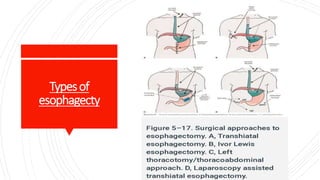
There are many ways to perform an esophagectomy,
including:
• Transhiatal (through the diaphragm): Incisions (cuts)
are made in the belly and the neck. This allows the
surgeon to reach the esophagus.
• Transthoracic (through the thoracic cavity): Incisions
(cuts) are made in the belly and one side of the chest.
This allows the surgeon to reach the esophagus.
• Thoracoabdominal (through the abdominal cavity): One
large incision (cut) is made from the chest to the belly.
This allows the surgeon to reach the esophagus.
• Minimally invasive laparoscopic esophagectomy: Many
small incisions (cuts) are made, allowing for the insertion
of surgical tools and a lighted camera, which are used
during the procedure.
Typesof
esophagecty
Contd.
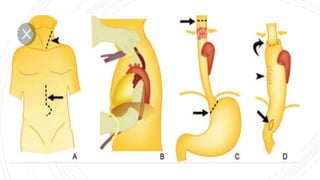
 The extent of the esophagectomy and how much of the
esophagus is removed depends on many factors, such
as disease size and location.
 At times, the stomach or the intestine is connected to a
piece of the esophagus that is left in place at the time
of surgery.
Stepsof
transhiatal
esophagectomy
Transhiatal esophagectomy is performed in five phases,
as follows [15] :
1. Abdominal phase
2. Cervical phase
3. Mediastinal dissection
4. Creation and positioning of the gastric conduit, and
abdominal closure
5. Construction of the cervical esophagogastric
anastomosis (CEGA)
During esophagectomy, lymph nodes may also be
removed to check for possible spread of cancer.
Complications
 Bleeding.
 Blood clots.
 Injury to the spleen and/or trachea.
 Infection.
 Pneumonia.
 Voice changes.
 Leaking at the site of internal stitches
 Leaking of a type of lymphatic fluid, called chyle.
 Trouble with swallowing because of narrowing of the
esophagus.
 Delayed gastric emptying .
 Heartburn.
 Dumping syndrome
Contraindication
Relative contraindication:
 Advanced age
 Comorbid illness
Esophagectomy

Esophagectomy

  • 1.
  • 2.
    Introduction  Esophagectomy isa surgical procedure to remove esophagus completely or partially and then reconstruct it using part of another organ, usually the stomach.  Esophagectomy is a common treatment for advanced esophageal cancer and is used occasionally for Barrett’s esophagus if aggressive precancerous cells are present.  It may also be recommended for noncancerous conditions when prior attempts to save the esophagus have failed, such as with end-stage achalasia or strictures, or after ingestion of material that damages the lining of the esophagus.
  • 3.
    Indication  Advanced esophagealcancer  Barrett’s esophagus if aggressive precancerous cells are present  End-stage achalasia or strictures,  After ingestion of material that damages the lining of the esophagus.
  • 4.
    Procedure There are manyways to perform an esophagectomy, including: • Transhiatal (through the diaphragm): Incisions (cuts) are made in the belly and the neck. This allows the surgeon to reach the esophagus. • Transthoracic (through the thoracic cavity): Incisions (cuts) are made in the belly and one side of the chest. This allows the surgeon to reach the esophagus. • Thoracoabdominal (through the abdominal cavity): One large incision (cut) is made from the chest to the belly. This allows the surgeon to reach the esophagus. • Minimally invasive laparoscopic esophagectomy: Many small incisions (cuts) are made, allowing for the insertion of surgical tools and a lighted camera, which are used during the procedure.
  • 5.
  • 6.
    Contd.  The extentof the esophagectomy and how much of the esophagus is removed depends on many factors, such as disease size and location.  At times, the stomach or the intestine is connected to a piece of the esophagus that is left in place at the time of surgery.
  • 7.
    Stepsof transhiatal esophagectomy Transhiatal esophagectomy isperformed in five phases, as follows [15] : 1. Abdominal phase 2. Cervical phase 3. Mediastinal dissection 4. Creation and positioning of the gastric conduit, and abdominal closure 5. Construction of the cervical esophagogastric anastomosis (CEGA) During esophagectomy, lymph nodes may also be removed to check for possible spread of cancer.
  • 9.
    Complications  Bleeding.  Bloodclots.  Injury to the spleen and/or trachea.  Infection.  Pneumonia.  Voice changes.  Leaking at the site of internal stitches  Leaking of a type of lymphatic fluid, called chyle.  Trouble with swallowing because of narrowing of the esophagus.  Delayed gastric emptying .  Heartburn.  Dumping syndrome
  • 10.