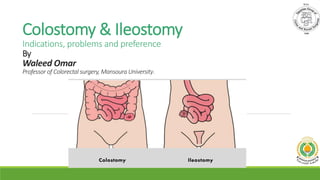
Colostomy & Ileostomy
Indications, problems and preference
By
Waleed Omar
Professor of Colorectal surgery, Mansoura University.
Disclosure
I have no disclosures.
Presentation outline
•Stoma: Definition and classifications.
•Rationale and indications.
•Stoma Problems.
•What should we do?
•Colostomy Vs Ileostomy.
•Is there another solution?
Stoma
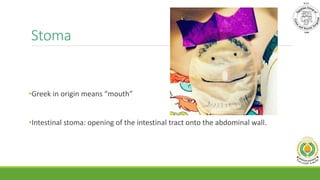
•Greek in origin means “mouth”
•Intestinal stoma: opening of the intestinal tract onto the abdominal wall.
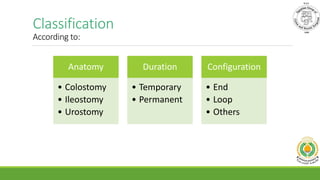
Classification
According to:
Anatomy
• Colostomy
• Ileostomy
• Urostomy
Duration
• Temporary
• Permanent
Configuration
• End
• Loop
• Others
Rationale
Reduce mortality
Prevent or reduce complications
Defunction to allow healing
of distal anastomosis or
reconstruction
Decompression for distal
obstruction
Indications (general)
•Protecting anastomosis
• Anastomosis at risk due to general condition (immunosuppression, shock, peritonitis..etc)
• Oftnely after certain procedures: Low anterior resection (TME for cancer).
Restorative proctocolectomy (UC, FAP).
•Protecting repair
• Anal sphincter repair
• Complex fistula
• Colorectal Trauma
•Infection
• Fournier gangrene
• Pelvic sepsis
• Bowel perforation
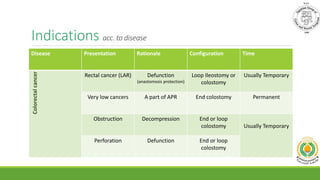
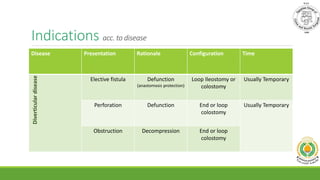
Indications acc. to disease
Disease Presentation Rationale Configuration Time
Colorectal
cancer
Rectal cancer (LAR) Defunction
(anastomosis protection)
Loop Ileostomy or
colostomy
Usually Temporary
Very low cancers A part of APR End colostomy Permanent
Obstruction Decompression End or loop
colostomy Usually Temporary
Perforation Defunction End or loop
colostomy
Indications acc. to disease
Disease Presentation Rationale Configuration Time
Diverticular
disease
Elective fistula Defunction
(anastomosis protection)
Loop Ileostomy or
colostomy
Usually Temporary
Perforation Defunction End or loop
colostomy
Usually Temporary
Obstruction Decompression End or loop
colostomy
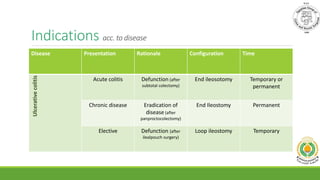
Indications acc. to disease
Disease Presentation Rationale Configuration Time
Ulcerative
colitis
Acute colitis Defunction (after
subtotal colectomy)
End ileosotomy Temporary or
permanent
Chronic disease Eradication of
disease (after
panproctocolectomy)
End Ileostomy Permanent
Elective Defunction (after
ilealpouch surgery)
Loop ileostomy Temporary
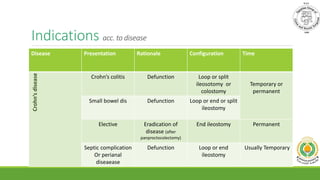
Indications acc. to disease
Disease Presentation Rationale Configuration Time
Crohn’s
disease
Crohn’s colitis Defunction Loop or split
ileosotomy or
colostomy
Temporary or
permanent
Small bowel dis Defunction Loop or end or split
ileostomy
Elective Eradication of
disease (after
panproctocolectomy)
End ileostomy Permanent
Septic complication
Or perianal
diseaease
Defunction Loop or end
ileostomy
Usually Temporary
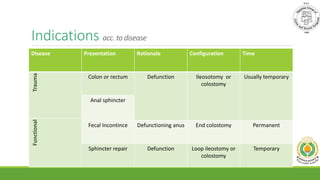
Indications acc. to disease
Disease Presentation Rationale Configuration Time
Trauma
Colon or rectum Defunction Ileosotomy or
colostomy
Usually temporary
Anal sphincter
Functional
Fecal Incontince Defunctioning anus End colostomy Permanent
Sphincter repair Defunction Loop ileostomy or
colostomy
Temporary
Stoma problems
◦ Arumugam et al, Colorectal dis 2003.
◦ Shabbir et al, Colorectal dis 2010.
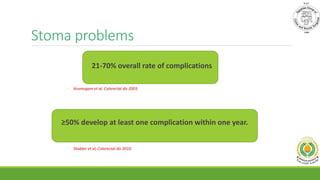
21-70% overall rate of complications
≥50% develop at least one complication within one year.
Risk for stoma problems
According to:
Cottam et al, Colorectal dis 2007
Shabbir et al, Colorectal dis 2010
•Emergency procedures.
•Obesity.
•Female gender.
•Age.
•Type of stoma ??!!
•Eversion(sprout) >10mm.
•Diabetes.
•Others…
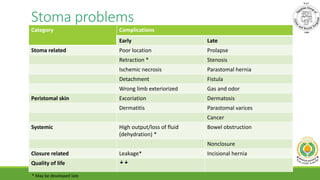
Stoma problems
Category Complications
Early Late
Stoma related Poor location Prolapse
Retraction * Stenosis
Ischemic necrosis Parastomal hernia
Detachment Fistula
Wrong limb exteriorized Gas and odor
Peristomal skin Excoriation Dermatosis
Dermatitis Parastomal varices
Cancer
Systemic High output/loss of fluid
(dehydration) *
Bowel obstruction
Nonclosure
Closure related Leakage* Incisional hernia
Quality of life
ꜜꜜ
* May be developed late
What should we do?
 Patient selection (risk assessment).
 Prevention is always better than treatment.
• Adequate surgical technique:
• Positioning
• Bowel perfusion
• Length
• Tension
• Fascial opening
• Sprouting
• Suturing
What should we do?
Follow the guidelines (at least the strong recommendations level 1)
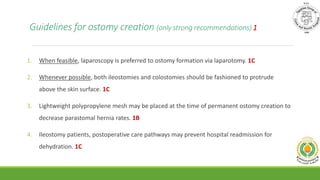
Guidelines for ostomy creation (only strong recommendations) 1
1. When feasible, laparoscopy is preferred to ostomy formation via laparotomy. 1C
2. Whenever possible, both ileostomies and colostomies should be fashioned to protrude
above the skin surface. 1C
3. Lightweight polypropylene mesh may be placed at the time of permanent ostomy creation to
decrease parastomal hernia rates. 1B
4. Ileostomy patients, postoperative care pathways may prevent hospital readmission for
dehydration. 1C
Guidelines for ostomy closure (only strong recommendations) 1
1. Stapled and hand-sutured techniques are both acceptable for loop ileostomy closure. 1B
2. Ostomy-site skin reapproximation should be performed when feasible, and pursestring skin
closure may have advantages compared with other techniques. 1B
3. Laparoscopic Hartmann reversal is a safe alternative to open reversal in experienced hands. 1C
Guidelines for ostomy complications (only strong recommendations) 1
1. Parastomal hernia repair should typically be performed by using mesh reinforcement or by
relocating the stoma. 1C
2. Prosthetic mesh may be used during parastomal hernia repair with low short-term risk of
intestinal erosion or mesh infection. 1C
3. Laparoscopic parastomal hernia repair with mesh may be a safe alternative to open mesh
repair. 1C
So, Colostomy or Ileostomy?
Colostomy Vs Ileostomy
•5 RCT included.
•20 outcomes measures:
◦ A - General outcomes: mortality, wound infection, time interval between formation and closure of the stoma, length of hospital
stay, reoperation and colorectal anastomotic dehiscence.
◦ B- Stoma construction: time of formation, stoma prolapse, stoma retraction, stoma necrosis, parastomal hernia, parastomal fistula
and stoma stenosis.
◦ C- Stoma closure: bowel leakage, time of stoma closure, incisional hernia and postoperative bowel obstruction.
◦ D - Functioning stoma: patient adaptation, skin irritation and postoperative ileus.
•Only stoma prolapse was significantly less with ileostomy.
•No other significant difference.
•Conclusion: From the current data included in this review, it is not possible to
express a preference for use of either loop ileostomy or loop colostomy for
fecal diversion from a colorectal anastomosis.
Colostomy Vs Ileostomy
• 12 comparative studies; 5 RCTs, 7 comparative non randomized (3 prospective & 4 retrospective).
• Outcomes measured:.
◦ A—General: wound infection and dehydratation.
◦ B—Stoma Construstion: necrosis, prolapse, retraction, parastomal hernia, stenosis, sepsis, and hemorrhage.
◦ C—Stoma closure: occlusion, wound infection, anastomotic leak or fistula, and hernia.
◦ D—Stoma function: skin irritation and occlusion.
• Hernia and prolapse are less with Ileostomy.
• Dehydration is less with colostomy.
• No other significant differences.
• The conclusion reached from this meta-analysis is that the superiority of one
treatment over another cannot be definitively declared; however, the authors
here endorse LI over LC.
Colostomy Vs Ileostomy
Conclusion
Loop ileostomy is preferred over transverse loop colostomy for temporary fecal
diversion in most cases. Weak recommendation based on moderate-quality evidence, 2B.
Is there another solution?
Another solutions?
Ghost ileostomy
Another solutions? Ghost ileostomy
•168 LAR with TME for rectal cancer.
•20/168 had leaks
• 13/20 Ileostomy by local anesthesia.
• 5/20 successful conservative measures.
• 2/20 peritonitis required colostomy.
• 91% without Stomas
High risk patients were excluded
Another solutions?
Ghost ileostomy
Another solutions? Ghost ileostomy
• No patients with leak needed laparotomy
(n=3)
• High risk patients were excluded
Another solutions?
Tube ileostomy
Another solutions? Tube ileostomy
• No difference in anastomotic leakage.
• Less morbidty (Mostly peristomal cellulitis)
• But only retrospective comparative studies, no RCT
Another solutions?
Transanal decompression tube
Another solutions? Transanal decompression tube
• 7 studies only 2 RCT
• Conclusion: TDT might reduce
the rate of Anastomotic
Leakage.
• But there was no difference in
the RCTs
Conclusion
•Stoma has several indications.
•Morbidity rates are high.
•Prevention of morbidities is always better than treatment:
• Patient selection.
• Adequate surgical technique.
•According to available evidence there is no difference between colostomy and ileostomy
• Ileostomy might have a very slight edge over colostomy
•Ghost ileostomy, tube ileostomy and transrectal tube decompression may become options.
Thank you..

Colostomy & Ileostomy

  • 1.
    Colostomy & Ileostomy Indications,problems and preference By Waleed Omar Professor of Colorectal surgery, Mansoura University.
  • 2.
  • 3.
    Presentation outline •Stoma: Definitionand classifications. •Rationale and indications. •Stoma Problems. •What should we do? •Colostomy Vs Ileostomy. •Is there another solution?
  • 4.
    Stoma •Greek in originmeans “mouth” •Intestinal stoma: opening of the intestinal tract onto the abdominal wall.
  • 5.
    Classification According to: Anatomy • Colostomy •Ileostomy • Urostomy Duration • Temporary • Permanent Configuration • End • Loop • Others
  • 6.
    Rationale Reduce mortality Prevent orreduce complications Defunction to allow healing of distal anastomosis or reconstruction Decompression for distal obstruction
  • 7.
    Indications (general) •Protecting anastomosis •Anastomosis at risk due to general condition (immunosuppression, shock, peritonitis..etc) • Oftnely after certain procedures: Low anterior resection (TME for cancer). Restorative proctocolectomy (UC, FAP). •Protecting repair • Anal sphincter repair • Complex fistula • Colorectal Trauma •Infection • Fournier gangrene • Pelvic sepsis • Bowel perforation
  • 8.
    Indications acc. todisease Disease Presentation Rationale Configuration Time Colorectal cancer Rectal cancer (LAR) Defunction (anastomosis protection) Loop Ileostomy or colostomy Usually Temporary Very low cancers A part of APR End colostomy Permanent Obstruction Decompression End or loop colostomy Usually Temporary Perforation Defunction End or loop colostomy
  • 9.
    Indications acc. todisease Disease Presentation Rationale Configuration Time Diverticular disease Elective fistula Defunction (anastomosis protection) Loop Ileostomy or colostomy Usually Temporary Perforation Defunction End or loop colostomy Usually Temporary Obstruction Decompression End or loop colostomy
  • 10.
    Indications acc. todisease Disease Presentation Rationale Configuration Time Ulcerative colitis Acute colitis Defunction (after subtotal colectomy) End ileosotomy Temporary or permanent Chronic disease Eradication of disease (after panproctocolectomy) End Ileostomy Permanent Elective Defunction (after ilealpouch surgery) Loop ileostomy Temporary
  • 11.
    Indications acc. todisease Disease Presentation Rationale Configuration Time Crohn’s disease Crohn’s colitis Defunction Loop or split ileosotomy or colostomy Temporary or permanent Small bowel dis Defunction Loop or end or split ileostomy Elective Eradication of disease (after panproctocolectomy) End ileostomy Permanent Septic complication Or perianal diseaease Defunction Loop or end ileostomy Usually Temporary
  • 12.
    Indications acc. todisease Disease Presentation Rationale Configuration Time Trauma Colon or rectum Defunction Ileosotomy or colostomy Usually temporary Anal sphincter Functional Fecal Incontince Defunctioning anus End colostomy Permanent Sphincter repair Defunction Loop ileostomy or colostomy Temporary
  • 13.
    Stoma problems ◦ Arumugamet al, Colorectal dis 2003. ◦ Shabbir et al, Colorectal dis 2010. 21-70% overall rate of complications ≥50% develop at least one complication within one year.
  • 14.
    Risk for stomaproblems According to: Cottam et al, Colorectal dis 2007 Shabbir et al, Colorectal dis 2010 •Emergency procedures. •Obesity. •Female gender. •Age. •Type of stoma ??!! •Eversion(sprout) >10mm. •Diabetes. •Others…
  • 15.
    Stoma problems Category Complications EarlyLate Stoma related Poor location Prolapse Retraction * Stenosis Ischemic necrosis Parastomal hernia Detachment Fistula Wrong limb exteriorized Gas and odor Peristomal skin Excoriation Dermatosis Dermatitis Parastomal varices Cancer Systemic High output/loss of fluid (dehydration) * Bowel obstruction Nonclosure Closure related Leakage* Incisional hernia Quality of life ꜜꜜ * May be developed late
  • 16.
    What should wedo?  Patient selection (risk assessment).  Prevention is always better than treatment. • Adequate surgical technique: • Positioning • Bowel perfusion • Length • Tension • Fascial opening • Sprouting • Suturing
  • 17.
    What should wedo? Follow the guidelines (at least the strong recommendations level 1)
  • 18.
    Guidelines for ostomycreation (only strong recommendations) 1 1. When feasible, laparoscopy is preferred to ostomy formation via laparotomy. 1C 2. Whenever possible, both ileostomies and colostomies should be fashioned to protrude above the skin surface. 1C 3. Lightweight polypropylene mesh may be placed at the time of permanent ostomy creation to decrease parastomal hernia rates. 1B 4. Ileostomy patients, postoperative care pathways may prevent hospital readmission for dehydration. 1C
  • 19.
    Guidelines for ostomyclosure (only strong recommendations) 1 1. Stapled and hand-sutured techniques are both acceptable for loop ileostomy closure. 1B 2. Ostomy-site skin reapproximation should be performed when feasible, and pursestring skin closure may have advantages compared with other techniques. 1B 3. Laparoscopic Hartmann reversal is a safe alternative to open reversal in experienced hands. 1C
  • 20.
    Guidelines for ostomycomplications (only strong recommendations) 1 1. Parastomal hernia repair should typically be performed by using mesh reinforcement or by relocating the stoma. 1C 2. Prosthetic mesh may be used during parastomal hernia repair with low short-term risk of intestinal erosion or mesh infection. 1C 3. Laparoscopic parastomal hernia repair with mesh may be a safe alternative to open mesh repair. 1C
  • 21.
    So, Colostomy orIleostomy?
  • 22.
  • 23.
    •5 RCT included. •20outcomes measures: ◦ A - General outcomes: mortality, wound infection, time interval between formation and closure of the stoma, length of hospital stay, reoperation and colorectal anastomotic dehiscence. ◦ B- Stoma construction: time of formation, stoma prolapse, stoma retraction, stoma necrosis, parastomal hernia, parastomal fistula and stoma stenosis. ◦ C- Stoma closure: bowel leakage, time of stoma closure, incisional hernia and postoperative bowel obstruction. ◦ D - Functioning stoma: patient adaptation, skin irritation and postoperative ileus. •Only stoma prolapse was significantly less with ileostomy. •No other significant difference. •Conclusion: From the current data included in this review, it is not possible to express a preference for use of either loop ileostomy or loop colostomy for fecal diversion from a colorectal anastomosis.
  • 24.
  • 25.
    • 12 comparativestudies; 5 RCTs, 7 comparative non randomized (3 prospective & 4 retrospective). • Outcomes measured:. ◦ A—General: wound infection and dehydratation. ◦ B—Stoma Construstion: necrosis, prolapse, retraction, parastomal hernia, stenosis, sepsis, and hemorrhage. ◦ C—Stoma closure: occlusion, wound infection, anastomotic leak or fistula, and hernia. ◦ D—Stoma function: skin irritation and occlusion. • Hernia and prolapse are less with Ileostomy. • Dehydration is less with colostomy. • No other significant differences. • The conclusion reached from this meta-analysis is that the superiority of one treatment over another cannot be definitively declared; however, the authors here endorse LI over LC.
  • 26.
    Colostomy Vs Ileostomy Conclusion Loopileostomy is preferred over transverse loop colostomy for temporary fecal diversion in most cases. Weak recommendation based on moderate-quality evidence, 2B.
  • 27.
  • 28.
  • 29.
    Another solutions? Ghostileostomy •168 LAR with TME for rectal cancer. •20/168 had leaks • 13/20 Ileostomy by local anesthesia. • 5/20 successful conservative measures. • 2/20 peritonitis required colostomy. • 91% without Stomas High risk patients were excluded
  • 30.
  • 31.
    Another solutions? Ghostileostomy • No patients with leak needed laparotomy (n=3) • High risk patients were excluded
  • 32.
  • 33.
    Another solutions? Tubeileostomy • No difference in anastomotic leakage. • Less morbidty (Mostly peristomal cellulitis) • But only retrospective comparative studies, no RCT
  • 34.
  • 35.
    Another solutions? Transanaldecompression tube • 7 studies only 2 RCT • Conclusion: TDT might reduce the rate of Anastomotic Leakage. • But there was no difference in the RCTs
  • 36.
    Conclusion •Stoma has severalindications. •Morbidity rates are high. •Prevention of morbidities is always better than treatment: • Patient selection. • Adequate surgical technique. •According to available evidence there is no difference between colostomy and ileostomy • Ileostomy might have a very slight edge over colostomy •Ghost ileostomy, tube ileostomy and transrectal tube decompression may become options.
  • 37.