Integrated Management of Childhood Illness
•Child Health: Global Profile
•IMCI Rationale, objectives,
components
•Principles of integrated care
•IMCI Case Management Process
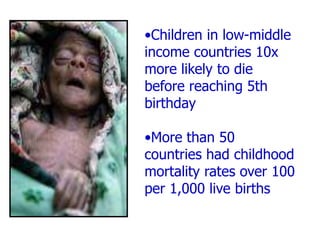
•Children in low-middle
income countries 10x
more likely to die
before reaching 5th
birthday
•More than 50
countries had childhood
mortality rates over 100
per 1,000 live births
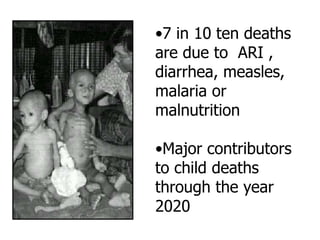
•7 in 10 ten deaths
are due to ARI ,
diarrhea, measles,
malaria or
malnutrition
•Major contributors
to child deaths
through the year
2020
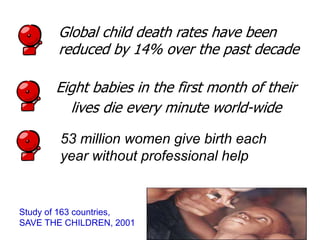
Study of 163 countries,
SAVE THE CHILDREN, 2001
53 million women give birth each
year without professional help
Global child death rates have been
reduced by 14% over the past decade
Eight babies in the first month of their
lives die every minute world-wide
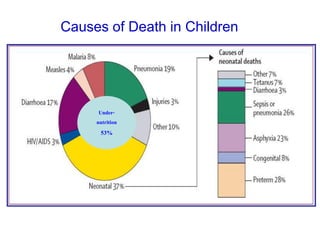
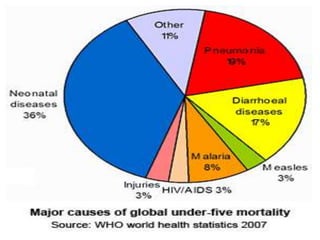
Causes of Death in Children
Under-
nutrition
53%
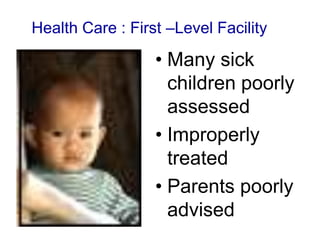
• Many sick
children poorly
assessed
• Improperly
treated
• Parents poorly
advised
Health Care : First –Level Facility

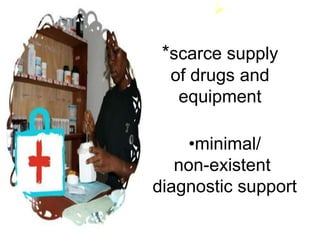
*scarce supply
of drugs and
equipment
•minimal/
non-existent
diagnostic support
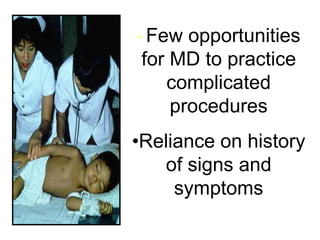
• Few opportunities
for MD to practice
complicated
procedures
•Reliance on history
of signs and
symptoms
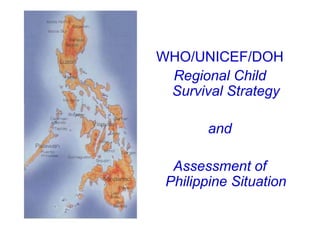
WHO/UNICEF/DOH
Regional Child
Survival Strategy
and
Assessment of
Philippine Situation
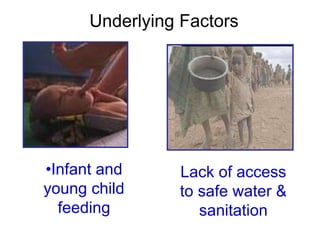
•Infant and
young child
feeding
Lack of access
to safe water &
sanitation
Underlying Factors
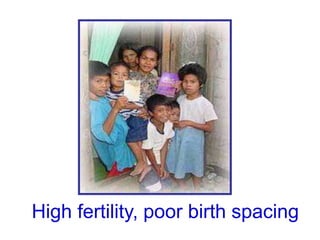
High fertility, poor birth spacing
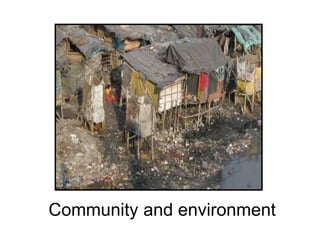
Community and environment
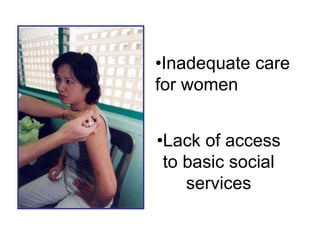
•Lack of access
to basic social
services
•Inadequate care
for women
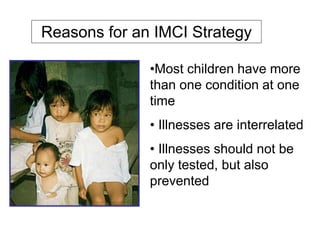
Reasons for an IMCI Strategy
•Most children have more
than one condition at one
time
• Illnesses are interrelated
• Illnesses should not be
only tested, but also
prevented
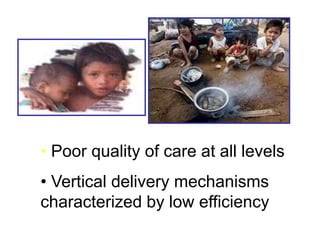
• Poor quality of care at all levels
• Vertical delivery mechanisms
characterized by low efficiency
Objectives
•Reduce illness,
disability and
death from
common
childhood
illnesses
To promote improved growth and
development among
under-5 children
An evidence- based syndromic approach can
be used to determine the:
Health
problem/s
Severity of
the condition
Actions
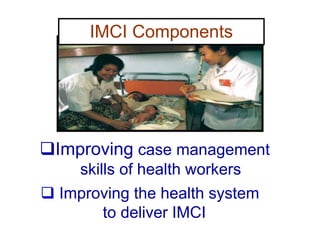
 Improving the health system
to deliver IMCI
IMCI Components
Improving case management
skills of health workers
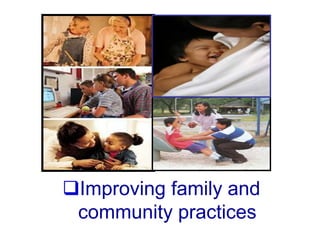
Improving family and
community practices
Principles of Integrated Care
IMCI guidelines
address most, but
not all, of the
major reasons a
sick child is
brought to a
clinic.
A combination of
individual signs
leads to a child’s
classification/s
rather than a
diagnosis
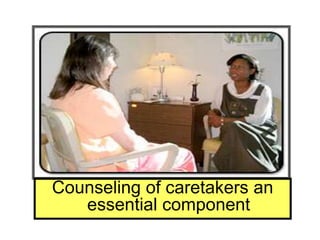
Counseling of caretakers an
essential component
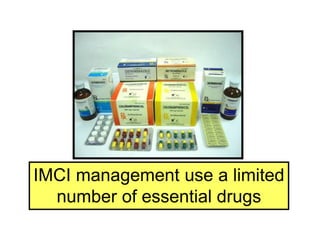
IMCI management use a limited
number of essential drugs
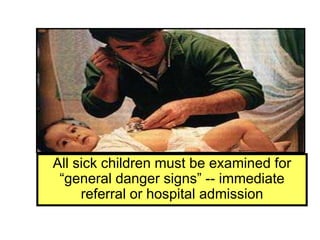
All sick children must be examined for
“general danger signs” -- immediate
referral or hospital admission
All sick children must be
routinely assessed for:
2 mos.-5 yrs. Old:
(cough/difficult breathing,
diarrhea, fever, ear problem)
1 week-2 mos:
(bacterial infection and
diarrhea)
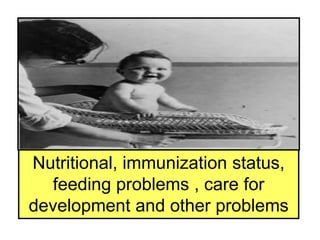
Nutritional, immunization status,
feeding problems , care for
development and other problems
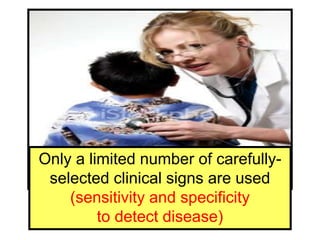
Only a limited number of carefully-
selected clinical signs are used
(sensitivity and specificity
to detect disease)
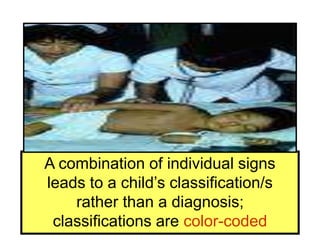
A combination of individual signs
leads to a child’s classification/s
rather than a diagnosis;
classifications are color-coded
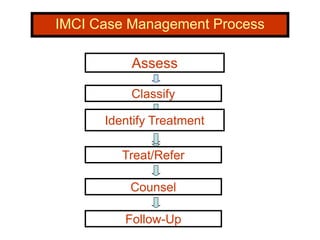
IMCI Case Management Process
Classify
Assess
Identify Treatment
Treat/Refer
Counsel
Follow-Up
Classify
Identify Treatment
Treat/Refer
Counsel
Assess
Follow-Up
Assess
Identify Treatment
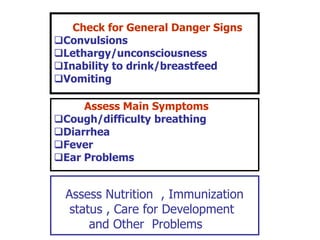
Check for General Danger Signs
Convulsions
Lethargy/unconsciousness
Inability to drink/breastfeed
Vomiting
Assess Main Symptoms
Cough/difficulty breathing
Diarrhea
Fever
Ear Problems
Assess Nutrition , Immunization
status , Care for Development
and Other Problems
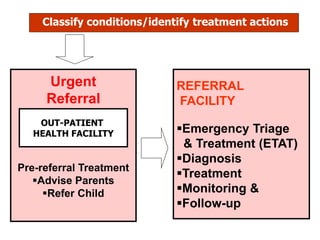
Classify conditions/identify treatment actions
Pre-referral Treatment
Advise Parents
Refer Child
Urgent
Referral
OUT-PATIENT
HEALTH FACILITY
REFERRAL
FACILITY
Emergency Triage
& Treatment (ETAT)
Diagnosis
Treatment
Monitoring &
Follow-up
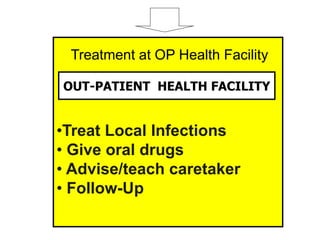
OUT-PATIENT
HEALTH FACILITY
Treatment at OP Health Facility
•Treat Local Infections
• Give oral drugs
• Advise/teach caretaker
• Follow-Up
OUT-PATIENT HEALTH FACILITY
Treatment at OP Health Facility
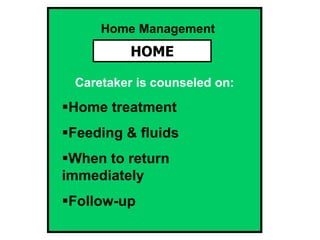
HOME
Caretaker is counseled on:
Home treatment
Feeding & fluids
When to return
immediately
Follow-up
Home Management
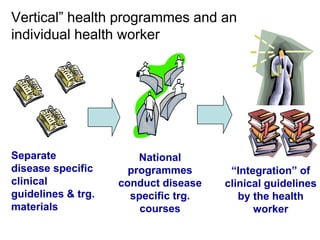
Vertical” health programmes and an
individual health worker
Separate
disease specific
clinical
guidelines & trg.
materials
National
programmes
conduct disease
specific trg.
courses
“Integration” of
clinical guidelines
by the health
worker
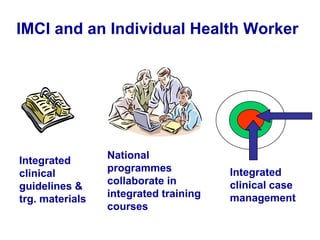
IMCI and an Individual Health Worker
Integrated
clinical
guidelines &
trg. materials
National
programmes
collaborate in
integrated training
courses
Integrated
clinical case
management
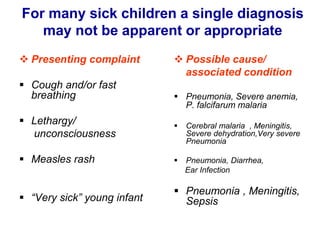
For many sick children a single diagnosis
may not be apparent or appropriate
 Presenting complaint
 Cough and/or fast
breathing
 Lethargy/
unconsciousness
 Measles rash
 “Very sick” young infant
 Possible cause/
associated condition
 Pneumonia, Severe anemia,
P. falcifarum malaria
 Cerebral malaria , Meningitis,
Severe dehydration,Very severe
Pneumonia
 Pneumonia, Diarrhea,
Ear Infection
 Pneumonia , Meningitis,
Sepsis
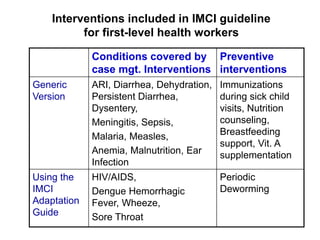
Interventions included in IMCI guideline
for first-level health workers
Conditions covered by
case mgt. Interventions
Preventive
interventions
Generic
Version
ARI, Diarrhea, Dehydration,
Persistent Diarrhea,
Dysentery,
Meningitis, Sepsis,
Malaria, Measles,
Anemia, Malnutrition, Ear
Infection
Immunizations
during sick child
visits, Nutrition
counseling,
Breastfeeding
support, Vit. A
supplementation
Using the
IMCI
Adaptation
Guide
HIV/AIDS,
Dengue Hemorrhagic
Fever, Wheeze,
Sore Throat
Periodic
Deworming
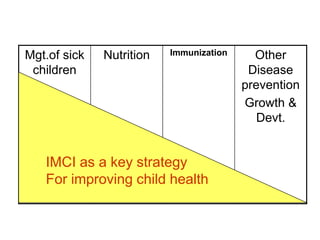
Mgt.of sick
children
Nutrition Immunization Other
Disease
prevention
Growth &
Devt.
IMCI as a key strategy
For improving child health
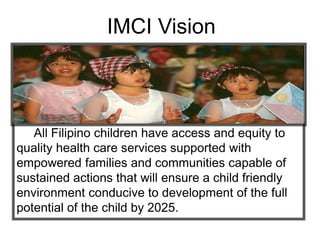
IMCI Vision
All Filipino children have access and equity to
quality health care services supported with
empowered families and communities capable of
sustained actions that will ensure a child friendly
environment conducive to development of the full
potential of the child by 2025.
“ Lo, children are an
heritage of the
LORD..” Psalm 127: 3a
“..And the King shall
answer and say unto
them, Verily I say
unto you, Inasmuch
as ye have done it
unto one of the least
of these my
brethren, ye have
done it unto me.”
Matthew 25:40
Resources
• WHO. Department of Child and Adolescent Health and
Development. Model Chapter for Textbooks –IMCI , 2001
•news.bbc.co.uk/olmedia/1535000/images/_153685.
September, 2001
•DOH Report presented during IMCI National Program
Implementation Review, December 2006
•http://www.who.int/child_adolescent_health/
•topics/prevention_care/child/imci/en/index.html
•http://www.google.images.com
•http://greenhealthinformation.com/wp-content/pic/healthy_children.jpg
•http://web.ivenue.com/standrewlutheranchurch/images/children.jpg
•http://www.ibiblio.org/obl/docs/yearbooks/images/Photo-RC010.gif
•http://hamilton.co.nz/images/1151.jpg

Imci pwede ky doc zen

  • 3.
    Integrated Management ofChildhood Illness •Child Health: Global Profile •IMCI Rationale, objectives, components •Principles of integrated care •IMCI Case Management Process
  • 4.
    •Children in low-middle incomecountries 10x more likely to die before reaching 5th birthday •More than 50 countries had childhood mortality rates over 100 per 1,000 live births
  • 5.
    •7 in 10ten deaths are due to ARI , diarrhea, measles, malaria or malnutrition •Major contributors to child deaths through the year 2020
  • 6.
    Study of 163countries, SAVE THE CHILDREN, 2001 53 million women give birth each year without professional help Global child death rates have been reduced by 14% over the past decade Eight babies in the first month of their lives die every minute world-wide
  • 7.
    Causes of Deathin Children Under- nutrition 53%
  • 9.
    • Many sick childrenpoorly assessed • Improperly treated • Parents poorly advised Health Care : First –Level Facility
  • 10.
     *scarce supply of drugsand equipment •minimal/ non-existent diagnostic support
  • 11.
    • Few opportunities forMD to practice complicated procedures •Reliance on history of signs and symptoms
  • 12.
  • 13.
    •Infant and young child feeding Lackof access to safe water & sanitation Underlying Factors
  • 14.
    High fertility, poorbirth spacing
  • 15.
  • 16.
    •Lack of access tobasic social services •Inadequate care for women
  • 18.
    Reasons for anIMCI Strategy •Most children have more than one condition at one time • Illnesses are interrelated • Illnesses should not be only tested, but also prevented
  • 19.
    • Poor qualityof care at all levels • Vertical delivery mechanisms characterized by low efficiency
  • 21.
  • 22.
    To promote improvedgrowth and development among under-5 children
  • 23.
    An evidence- basedsyndromic approach can be used to determine the: Health problem/s Severity of the condition Actions
  • 24.
     Improving thehealth system to deliver IMCI IMCI Components Improving case management skills of health workers
  • 25.
  • 26.
    Principles of IntegratedCare IMCI guidelines address most, but not all, of the major reasons a sick child is brought to a clinic.
  • 27.
    A combination of individualsigns leads to a child’s classification/s rather than a diagnosis
  • 28.
    Counseling of caretakersan essential component
  • 29.
    IMCI management usea limited number of essential drugs
  • 30.
    All sick childrenmust be examined for “general danger signs” -- immediate referral or hospital admission
  • 31.
    All sick childrenmust be routinely assessed for: 2 mos.-5 yrs. Old: (cough/difficult breathing, diarrhea, fever, ear problem) 1 week-2 mos: (bacterial infection and diarrhea)
  • 32.
    Nutritional, immunization status, feedingproblems , care for development and other problems
  • 33.
    Only a limitednumber of carefully- selected clinical signs are used (sensitivity and specificity to detect disease)
  • 34.
    A combination ofindividual signs leads to a child’s classification/s rather than a diagnosis; classifications are color-coded
  • 35.
    IMCI Case ManagementProcess Classify Assess Identify Treatment Treat/Refer Counsel Follow-Up Classify Identify Treatment Treat/Refer Counsel Assess Follow-Up Assess Identify Treatment
  • 36.
    Check for GeneralDanger Signs Convulsions Lethargy/unconsciousness Inability to drink/breastfeed Vomiting Assess Main Symptoms Cough/difficulty breathing Diarrhea Fever Ear Problems Assess Nutrition , Immunization status , Care for Development and Other Problems
  • 37.
    Classify conditions/identify treatmentactions Pre-referral Treatment Advise Parents Refer Child Urgent Referral OUT-PATIENT HEALTH FACILITY REFERRAL FACILITY Emergency Triage & Treatment (ETAT) Diagnosis Treatment Monitoring & Follow-up
  • 38.
    OUT-PATIENT HEALTH FACILITY Treatment atOP Health Facility •Treat Local Infections • Give oral drugs • Advise/teach caretaker • Follow-Up OUT-PATIENT HEALTH FACILITY Treatment at OP Health Facility
  • 39.
    HOME Caretaker is counseledon: Home treatment Feeding & fluids When to return immediately Follow-up Home Management
  • 40.
    Vertical” health programmesand an individual health worker Separate disease specific clinical guidelines & trg. materials National programmes conduct disease specific trg. courses “Integration” of clinical guidelines by the health worker
  • 41.
    IMCI and anIndividual Health Worker Integrated clinical guidelines & trg. materials National programmes collaborate in integrated training courses Integrated clinical case management
  • 42.
    For many sickchildren a single diagnosis may not be apparent or appropriate  Presenting complaint  Cough and/or fast breathing  Lethargy/ unconsciousness  Measles rash  “Very sick” young infant  Possible cause/ associated condition  Pneumonia, Severe anemia, P. falcifarum malaria  Cerebral malaria , Meningitis, Severe dehydration,Very severe Pneumonia  Pneumonia, Diarrhea, Ear Infection  Pneumonia , Meningitis, Sepsis
  • 43.
    Interventions included inIMCI guideline for first-level health workers Conditions covered by case mgt. Interventions Preventive interventions Generic Version ARI, Diarrhea, Dehydration, Persistent Diarrhea, Dysentery, Meningitis, Sepsis, Malaria, Measles, Anemia, Malnutrition, Ear Infection Immunizations during sick child visits, Nutrition counseling, Breastfeeding support, Vit. A supplementation Using the IMCI Adaptation Guide HIV/AIDS, Dengue Hemorrhagic Fever, Wheeze, Sore Throat Periodic Deworming
  • 44.
    Mgt.of sick children Nutrition ImmunizationOther Disease prevention Growth & Devt. IMCI as a key strategy For improving child health
  • 45.
    IMCI Vision All Filipinochildren have access and equity to quality health care services supported with empowered families and communities capable of sustained actions that will ensure a child friendly environment conducive to development of the full potential of the child by 2025.
  • 46.
    “ Lo, childrenare an heritage of the LORD..” Psalm 127: 3a “..And the King shall answer and say unto them, Verily I say unto you, Inasmuch as ye have done it unto one of the least of these my brethren, ye have done it unto me.” Matthew 25:40
  • 48.
    Resources • WHO. Departmentof Child and Adolescent Health and Development. Model Chapter for Textbooks –IMCI , 2001 •news.bbc.co.uk/olmedia/1535000/images/_153685. September, 2001 •DOH Report presented during IMCI National Program Implementation Review, December 2006 •http://www.who.int/child_adolescent_health/ •topics/prevention_care/child/imci/en/index.html •http://www.google.images.com •http://greenhealthinformation.com/wp-content/pic/healthy_children.jpg •http://web.ivenue.com/standrewlutheranchurch/images/children.jpg •http://www.ibiblio.org/obl/docs/yearbooks/images/Photo-RC010.gif •http://hamilton.co.nz/images/1151.jpg