Basics of Laparoscopic surgery
DR NAVDEEP SINGH KAMBOJ
JUNIOR RESIDENT SRI GURU RAMDAS UNIVERSITY OF MEDICAL
SCIENCE AND RESEARCH , AMRITSAR
History
 First laparoscopic cholecystectomy was done by Muhe of Germany
in 1985 .
 First laparoscopic appendicectomy was done by Semm as
prophylaxis.
 First laparoscopic appendicectomy for acute appendicitis was done
by Schreiber in 1987.
 Professor TE Udwadia, Mumbai did first laparoscopic
cholecystectomy in India.
Advantages of Laparoscopic Surgery
 Relatively less painful compared to open surgery.
 Trauma of access is very less.
 Shorter hospital stay and early return to work.
 Faster postoperative recovery.
 Better Visualisation of the anatomy, i.e. better approach for dissection and Visualisation of other parts of
abdomen for any other pathology.
 Instrumental access to different abdominal locations is many times better compared to open method.
 Minimal scar on the abdomen.
 Reduction in wound infection, dehiscence, bleeding,herniation and nerve entrapment
Surgical principles
 The core principles of minimal access surgery (independent of procedure
or device) can be summarized by the acronym I-VITROS:
 Insufflate /create space – to allow surgery to take place in the minimal access setting
 Visualise – the tissues, anatomical landmarks and the environment for the surgery to take place
 Identify – the specific structures for surgery
 Triangulate – surgical tools (such as port placement) to optimise the efficiency of their action, and
ergonomics by minimising overlap and clashing of instruments
 Retract – and manipulate local tissues to improve access and gain entry into the correct tissue planes
 Operate – incise, suture, anastomose, fuse
 Seal/haemostasis.
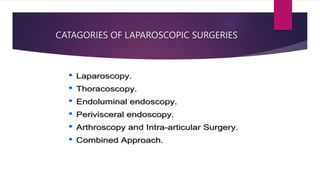
CATAGORIES OF LAPAROSCOPIC SURGERIES
Thoracoscopy
 A rigid endoscope is introduced through an incision in the
chest to gain access to the thoracic contents. Usually
there is no requirement for gas insufflation, as the
operating space is held open by the rigidity of the thoracic
cavity. In specific cases, such as mediastinal tumour
resection and diaphragmatic surgery, gas insufflation at
low pressure (5–8 mmHg) may be applied.
Endoluminal endoscopy
Flexible or rigid endoscopes are introduced
into hollow organs or systems, such as the
urinary tract, upper or lower gastrointestinal
Tract, and respiratory and vascular systems.
Perivisceral endoscopy
Body planes can be accessed even in the absence of a natural
cavity. Examples are mediastinoscopy, retroperitoneoscopy
and retroperitoneal approaches to the kidney, aorta
and lumbar sympathetic chain.
Arthroscopy and intra-articular joint
surgery
Orthopaedic surgeons have applied arthroscopic
access to the knee for some time and are
applying this modality to other joints, including the
shoulder, wrist, elbow and hip.
INDICATIONS OF LAPAROSCOPIC SURGRIES
 DIAGNOSTIC LAPAROSCOPY Indications
 Acute pelvic conditions.
 Tubal pregnancy.
 Ovarian diseases.
 Infertility.
 Staging of the malignancy.
 Biopsy from the tumours.
 In chronic pain abdomen where ultrasound, endoscopies, barium studies are negative, then
diagnostic laparoscopy is useful.
INDICATIONS OF LAPAROSCOPIC SURGERY
 Procedures
 Laparoscopic hernia repair.
 Laparoscopic splenectomy.
 Laparoscopic fundoplication.
 Laparoscopic vagotomy and gastrojejunostomy.
 Laparoscopic Nissen’s fundoplication.
 Laparoscopic colectomy.
 Laparoscopic hysterectomy. It is becoming very popular.
 Laparoscopic urologic surgeries.
 Laparoscopic paediatric surgeries.etc…..
Preparation for laparoscopic
surgery
 Overall fitness: Patients must be fit for general anaesthesia and open operation if
necessary.
 As adhesions may cause problems, previous abdominal operations or peritonitis
should be documented.
 Severe chronic obstructive airways disease and ischaemic heart disease may be
contraindications to the laparoscopic approach. longer operating times and the
establishment of the pneumoperitoneum may provoke cardiac
arrhythmias
 Moderate obesity does not increase operative difficulty significantly,but massive
obesity may make pneumoperitoneum difficult.and standard instrumentation may
be too short.
 Normal coagulation,Thromboprophylaxis ,Informed consent are must.
Preparation for laparoscopic
surgery
Access may prove difficult in very thin patients, especially those
with
severe kyphosis.
Prophylaxis against thromboembolism .. Venous stasis induced
by the reverse Trendelenburg position during laparoscopic
surgery may be a particular risk factorfor deep vein thrombosis,
as is a lengthy operation and the obesity of many patients.
Subcutaneous low molecular weight heparin and
antithromboembolic stockings should be used routinely, in
addition to pneumatic leggings during the operation.
In the early days of laparoscopic surgery, routine
bladder catheterization and nasogastric intubation were
advised. Most surgeons now omit these, but it remains
essential to check that the patient is fasted and has
recently emptied their bladder, particularly before the
blind insertion of a Verres needle.
Instruments Used
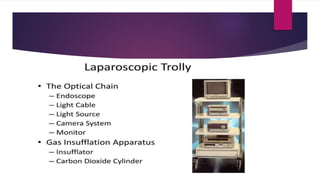
 Cold light source either halogen lamp or xenon lamp is used.
 Halogen lamp is used commonly and is cheaper. Xenon lamp gives high visualisation.
 Camera: 3 chip camera is commonly used with high resolution.
 Video-monitor to display images.
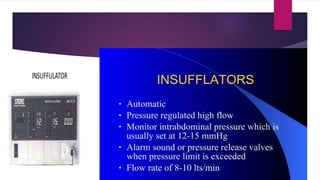
 CO2 insufflator.
 Hooks and spatulas are used along with cautery for dissection.
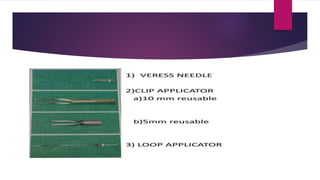
 Clip applicators.
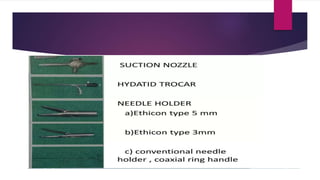
 Needle holders.
Instruments Used
 Endostaplers.
 Veress needle.
 Suction-irrigation apparatus.
 Trocars of different sizes—10 mm, 5 mm.
Instruments Used
 Zero degree and 30°
laparoscope is
commonly used. Side
viewing scopes [30°]
have better
visualisation .
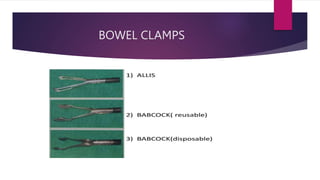
BOWEL CLAMPS
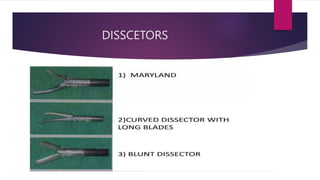
DISSCETORS
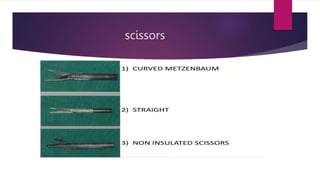
scissors
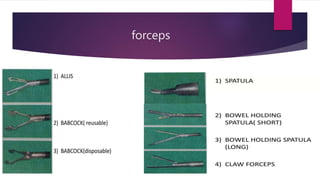
forceps
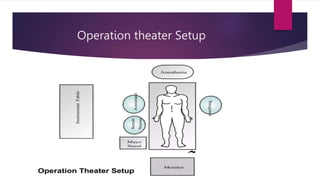
Operation theater Setup
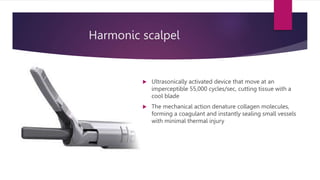
Harmonic scalpel
 Ultrasonically activated device that move at an
imperceptible 55,000 cycles/sec, cutting tissue with a
cool blade
 The mechanical action denature collagen molecules,
forming a coagulant and instantly sealing small vessels
with minimal thermal injury
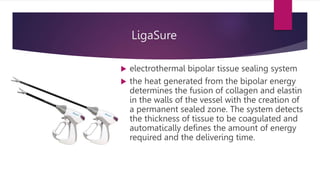
LigaSure
 electrothermal bipolar tissue sealing system
 the heat generated from the bipolar energy
determines the fusion of collagen and elastin
in the walls of the vessel with the creation of
a permanent sealed zone. The system detects
the thickness of tissue to be coagulated and
automatically defines the amount of energy
required and the delivering time.
ligasure
 The LigaSure Vessel Sealing System allows hemostasis by vessel compression and obliteration through
the emission of bipolar energy. It includes
 1. An electrosurgical generator able to detect the characteristics of the tissue closed between the
instrument jaws; it delivers the exact amount of energy needed to seal it permanently.
 2. Several types of instruments that seal and, in some cases, divide the tissue. Those used in thoracic
surgery are the following:
 LigaSure Atlas is a surgical endoscopic device (diameter: 10 mm, length: 37 cm) that seals and divides
vessels up to 7 mm in diameter;
 LigaSure V is a single-use endoscopic instrument (diameter: 5 mm, length: 37 cm) able to seal and
divide;
 LigaSure Lap is a single-use endoscopic instrument (diameter: 5 mm, length: 32 cm);
 LigaSure Precise is a single-use instrument (length: 16.5 cm) for open procedures specifically designed
to provide permanent vessel occlusion to structures that require fine grasping;
 LigaSure Std is a reusable instrument;
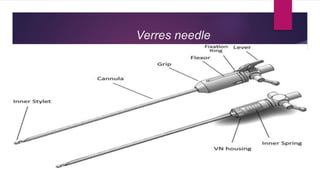
Verres needle
Creating a pneumoperitoneum
 There are two methods for creation of a
pneumoperitoneum:open and closed.
 1 The closed method involves blind puncture using a
Verres needle. Although this method is fast and relatively
safe, there is a small but significant potential for intestinal
or vascular injury on introduction of the needle or first
trocar.
Creating a pneumoperitoneum
2 The routine use of the open technique for creating a
pneumoperitoneum avoids the morbidity related to a blind
puncture.
To achieve this , a 1 cm vertical or transverse incision is made
at the level of the umbilicus. The umbilicus carries importance
as it is a reliable anatomical landmark deriving from the
embryological coalescence of the rectus sheath and
peritoneum and is devoid of other myofascial planes that
could complicate subsequent entry into the peritoneum.
Creating a pneumoperitoneum
Two small retractors are used to dissect bluntly the
subcutaneous
fat and expose the midline fascia. Two sutures are inserted
each side of the midline incision (into the rectus sheath
confluence), followed by the creation of a 1 cm opening in the
fascia . Free penetration into the abdominal cavity is
confirmed
by the gentle introduction of a finger.
Creation of pneumoperitonem
 CO2 is commonly used to create pneumoperitoneum
As it is..
 It is readily available
 is cheaper
 suppresses the combustion
 is easily absorbed by tissues
 has a high diffusion coefficient
 is quickly released via respiration
Physiologic Changes due to
Pneumoperitoneum
 CO2 causes hypercarbia, acidosis and hypoxia.
 Pneumoperitoneum exerts pressure on the IVC, decreases the
venous return and so the cardiac output.
 It increases the arterial pressure also.
 It compromises the respiratory function by compressing over the
diaphragm impairing the pulmonary compliance.
Complications
 CO2 narcosis and hypoxia.
 Sepsis—subphrenic abscess, pelvic abscess, septicaemia.
 IVC compression.
 Leak from the site, e.g. bleeding , bile leak.
 Organ injury during insertion of ports, e.g. major vessels, bowel,mesentery,
liver.
 Subcutaneous emphysema and pneumomediastinum.
Complications
 Gas emboli, though is rare but fatal.
 Postoperative shoulder pain due to irritation of diaphragm.
 Cardiac dysfunction due to decreased venous return.
 Injury to the abdominal wall vessels and nerves.
 Cautery burn to abdominal structures.
 Abdominal wall hernias.
 Wound infection.
Basic Laparoscopic
Surgeries
 Laparoscopic cholecystectomy.
 Laparoscopic appendicectomy.
 Laparoscopic hernia repair.
Laparoscopic cholecystectomy.
 Now days treatment of choice for cholelithiasis
 Indications
 ™
™
Gallstones—symptomatic
 ™
™
Cholecystitis
 ™
™
Biliary colic
Laparoscopic cholecystectomy
 Relative Contraindications…
 End stage cirrhosis, ascites or portal hypertension.
 Cholangitis: Cholecystectomy should be done after the controlof
cholangitis.
 CBD stones: Here, initially ERCP and stone extraction is done from
CBD, then laparoscopic cholecystectomy is done.
Cont..
After pneumoperitoneum, patient is placed in head up and slight left tilt position so as to make
bowels to fall below and towards the left side.
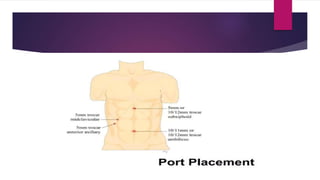
One 10 mm trocar is placed at umbilicus and through this umbilical port, laparoscope is passed. One
10 mm port in the epigastric regionand two 5 mm ports in the right subcostal line are placed for
grasping the gallbladder and for dissection. Initially, through the working channel gallbladder is held
and Calot’s triangle is dissected. Cystic duct and cystic artery are clipped.
An intraoperative cholangiogram is done with C-arm. Through the epigastric port, clips or ligatures
are applied to the cystic duct and cystic artery, close to the gallbladder. Care should be taken to avoid
bleeding and not to injure or clip the CBD or hepatic ducts. Gallbladder is separated from its bed
using cautery and spatula and removed through the epigastric port. Abdomen may be drained.
Patient is discharged after 48–72 hours.
Complications
 Common bile duct (CBD) injury
 ™
™
Bile leak
 ™
™
Haemorrhage
 ™
™
Postoperative jaundice
 ™
™
Subphrenic and other intra-abdominal abscess
 ™
™
Septicaemia.
 Conversion rate to open cholecystectomy is 2–10%.
 It is indicated when there is uncontrolled bleeding, dense adhesions,suspected CBD injury,
when anatomy is indistinct.
Laparoscopic appendicectomy
 Indications
 Acute appendicitis. Here main advantage is confirmationof the diagnosis.Other
parts of the abdomen are also visualised.
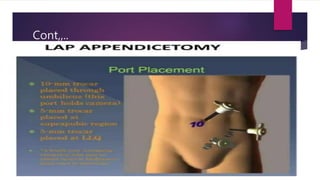
 Technique: Laparoscope is passed through the umbilical port. Two additional ports are
placed, one in lower midline (5 mm), another at right lumbar region. Mesoappendix is
clipped or cauterized, using bipolar cautery. Appendix base is clipped or ligated using
Roeder knot and ligature.
Cont,,..
 Complications
 Appendicular stump leak.
 Pelvic abscess.
 Bleeding.
 Injury to caecum, ileum
Laparoscopic Inguinal Hernia Repair
 It is becoming popular method, lately. It is a skilled laparoscopic
surgery.
 1. Transabdominal preperitoneal repair (TAPP repair): Through abdomen, using laparoscope
Hesselbach’s triangle is exposed and mesh is placed in the preperitoneal space. Peritoneum is
sutured back or stapled.
Cont..
2. Totally extraperitoneal repair (TEP repair):
Through sub-umbilical incision, preperitoneal space is created with the help of a
balloon.Laparoscope is passed to this space. Inguinal canal is dissected and mesh is
placed.
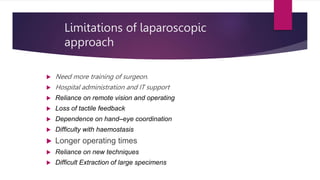
Limitations of laparoscopic
approach
 Need more training of surgeon.
 Hospital administration and IT support
 Reliance on remote vision and operating
 Loss of tactile feedback
 Dependence on hand–eye coordination
 Difficulty with haemostasis
 Longer operating times
 Reliance on new techniques
 Difficult Extraction of large specimens
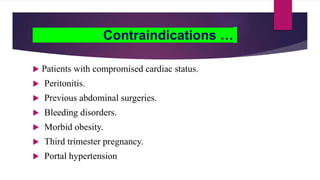
Contraindications …
 Patients with compromised cardiac status.
 Peritonitis.
 Previous abdominal surgeries.
 Bleeding disorders.
 Morbid obesity.
 Third trimester pregnancy.
 Portal hypertension
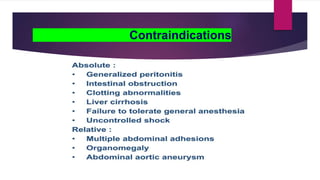
Contraindications
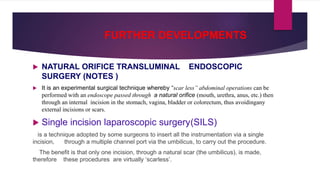
FURTHER DEVELOPMENTS
 NATURAL ORIFICE TRANSLUMINAL ENDOSCOPIC
SURGERY (NOTES )
 It is an experimental surgical technique whereby “scar less” abdominal operations can be
performed with an endoscope passed through a natural orifice (mouth, urethra, anus, etc.) then
through an internal incision in the stomach, vagina, bladder or colorectum, thus avoidingany
external incisions or scars.
 Single incision laparoscopic surgery(SILS)
is a technique adopted by some surgeons to insert all the instrumentation via a single
incision, through a multiple channel port via the umbilicus, to carry out the procedure.
The benefit is that only one incision, through a natural scar (the umbilicus), is made,
therefore these procedures are virtually ‘scarless’.
THANKS

Basics of laparoscopic surgery.pptx

  • 1.
    Basics of Laparoscopicsurgery DR NAVDEEP SINGH KAMBOJ JUNIOR RESIDENT SRI GURU RAMDAS UNIVERSITY OF MEDICAL SCIENCE AND RESEARCH , AMRITSAR
  • 2.
    History  First laparoscopiccholecystectomy was done by Muhe of Germany in 1985 .  First laparoscopic appendicectomy was done by Semm as prophylaxis.  First laparoscopic appendicectomy for acute appendicitis was done by Schreiber in 1987.  Professor TE Udwadia, Mumbai did first laparoscopic cholecystectomy in India.
  • 3.
    Advantages of LaparoscopicSurgery  Relatively less painful compared to open surgery.  Trauma of access is very less.  Shorter hospital stay and early return to work.  Faster postoperative recovery.  Better Visualisation of the anatomy, i.e. better approach for dissection and Visualisation of other parts of abdomen for any other pathology.  Instrumental access to different abdominal locations is many times better compared to open method.  Minimal scar on the abdomen.  Reduction in wound infection, dehiscence, bleeding,herniation and nerve entrapment
  • 4.
    Surgical principles  Thecore principles of minimal access surgery (independent of procedure or device) can be summarized by the acronym I-VITROS:  Insufflate /create space – to allow surgery to take place in the minimal access setting  Visualise – the tissues, anatomical landmarks and the environment for the surgery to take place  Identify – the specific structures for surgery  Triangulate – surgical tools (such as port placement) to optimise the efficiency of their action, and ergonomics by minimising overlap and clashing of instruments  Retract – and manipulate local tissues to improve access and gain entry into the correct tissue planes  Operate – incise, suture, anastomose, fuse  Seal/haemostasis.
  • 5.
  • 6.
    Thoracoscopy  A rigidendoscope is introduced through an incision in the chest to gain access to the thoracic contents. Usually there is no requirement for gas insufflation, as the operating space is held open by the rigidity of the thoracic cavity. In specific cases, such as mediastinal tumour resection and diaphragmatic surgery, gas insufflation at low pressure (5–8 mmHg) may be applied.
  • 7.
    Endoluminal endoscopy Flexible orrigid endoscopes are introduced into hollow organs or systems, such as the urinary tract, upper or lower gastrointestinal Tract, and respiratory and vascular systems.
  • 8.
    Perivisceral endoscopy Body planescan be accessed even in the absence of a natural cavity. Examples are mediastinoscopy, retroperitoneoscopy and retroperitoneal approaches to the kidney, aorta and lumbar sympathetic chain.
  • 9.
    Arthroscopy and intra-articularjoint surgery Orthopaedic surgeons have applied arthroscopic access to the knee for some time and are applying this modality to other joints, including the shoulder, wrist, elbow and hip.
  • 10.
    INDICATIONS OF LAPAROSCOPICSURGRIES  DIAGNOSTIC LAPAROSCOPY Indications  Acute pelvic conditions.  Tubal pregnancy.  Ovarian diseases.  Infertility.  Staging of the malignancy.  Biopsy from the tumours.  In chronic pain abdomen where ultrasound, endoscopies, barium studies are negative, then diagnostic laparoscopy is useful.
  • 11.
    INDICATIONS OF LAPAROSCOPICSURGERY  Procedures  Laparoscopic hernia repair.  Laparoscopic splenectomy.  Laparoscopic fundoplication.  Laparoscopic vagotomy and gastrojejunostomy.  Laparoscopic Nissen’s fundoplication.  Laparoscopic colectomy.  Laparoscopic hysterectomy. It is becoming very popular.  Laparoscopic urologic surgeries.  Laparoscopic paediatric surgeries.etc…..
  • 12.
    Preparation for laparoscopic surgery Overall fitness: Patients must be fit for general anaesthesia and open operation if necessary.  As adhesions may cause problems, previous abdominal operations or peritonitis should be documented.  Severe chronic obstructive airways disease and ischaemic heart disease may be contraindications to the laparoscopic approach. longer operating times and the establishment of the pneumoperitoneum may provoke cardiac arrhythmias  Moderate obesity does not increase operative difficulty significantly,but massive obesity may make pneumoperitoneum difficult.and standard instrumentation may be too short.  Normal coagulation,Thromboprophylaxis ,Informed consent are must.
  • 13.
    Preparation for laparoscopic surgery Accessmay prove difficult in very thin patients, especially those with severe kyphosis. Prophylaxis against thromboembolism .. Venous stasis induced by the reverse Trendelenburg position during laparoscopic surgery may be a particular risk factorfor deep vein thrombosis, as is a lengthy operation and the obesity of many patients. Subcutaneous low molecular weight heparin and antithromboembolic stockings should be used routinely, in addition to pneumatic leggings during the operation.
  • 14.
    In the earlydays of laparoscopic surgery, routine bladder catheterization and nasogastric intubation were advised. Most surgeons now omit these, but it remains essential to check that the patient is fasted and has recently emptied their bladder, particularly before the blind insertion of a Verres needle.
  • 15.
    Instruments Used  Coldlight source either halogen lamp or xenon lamp is used.  Halogen lamp is used commonly and is cheaper. Xenon lamp gives high visualisation.  Camera: 3 chip camera is commonly used with high resolution.  Video-monitor to display images.  CO2 insufflator.  Hooks and spatulas are used along with cautery for dissection.  Clip applicators.  Needle holders.
  • 16.
    Instruments Used  Endostaplers. Veress needle.  Suction-irrigation apparatus.  Trocars of different sizes—10 mm, 5 mm.
  • 18.
    Instruments Used  Zerodegree and 30° laparoscope is commonly used. Side viewing scopes [30°] have better visualisation .
  • 19.
  • 20.
  • 21.
  • 22.
  • 25.
  • 27.
    Harmonic scalpel  Ultrasonicallyactivated device that move at an imperceptible 55,000 cycles/sec, cutting tissue with a cool blade  The mechanical action denature collagen molecules, forming a coagulant and instantly sealing small vessels with minimal thermal injury
  • 28.
    LigaSure  electrothermal bipolartissue sealing system  the heat generated from the bipolar energy determines the fusion of collagen and elastin in the walls of the vessel with the creation of a permanent sealed zone. The system detects the thickness of tissue to be coagulated and automatically defines the amount of energy required and the delivering time.
  • 29.
    ligasure  The LigaSureVessel Sealing System allows hemostasis by vessel compression and obliteration through the emission of bipolar energy. It includes  1. An electrosurgical generator able to detect the characteristics of the tissue closed between the instrument jaws; it delivers the exact amount of energy needed to seal it permanently.  2. Several types of instruments that seal and, in some cases, divide the tissue. Those used in thoracic surgery are the following:  LigaSure Atlas is a surgical endoscopic device (diameter: 10 mm, length: 37 cm) that seals and divides vessels up to 7 mm in diameter;  LigaSure V is a single-use endoscopic instrument (diameter: 5 mm, length: 37 cm) able to seal and divide;  LigaSure Lap is a single-use endoscopic instrument (diameter: 5 mm, length: 32 cm);  LigaSure Precise is a single-use instrument (length: 16.5 cm) for open procedures specifically designed to provide permanent vessel occlusion to structures that require fine grasping;  LigaSure Std is a reusable instrument;
  • 30.
  • 31.
    Creating a pneumoperitoneum There are two methods for creation of a pneumoperitoneum:open and closed.  1 The closed method involves blind puncture using a Verres needle. Although this method is fast and relatively safe, there is a small but significant potential for intestinal or vascular injury on introduction of the needle or first trocar.
  • 32.
    Creating a pneumoperitoneum 2The routine use of the open technique for creating a pneumoperitoneum avoids the morbidity related to a blind puncture. To achieve this , a 1 cm vertical or transverse incision is made at the level of the umbilicus. The umbilicus carries importance as it is a reliable anatomical landmark deriving from the embryological coalescence of the rectus sheath and peritoneum and is devoid of other myofascial planes that could complicate subsequent entry into the peritoneum.
  • 33.
    Creating a pneumoperitoneum Twosmall retractors are used to dissect bluntly the subcutaneous fat and expose the midline fascia. Two sutures are inserted each side of the midline incision (into the rectus sheath confluence), followed by the creation of a 1 cm opening in the fascia . Free penetration into the abdominal cavity is confirmed by the gentle introduction of a finger.
  • 34.
    Creation of pneumoperitonem CO2 is commonly used to create pneumoperitoneum As it is..  It is readily available  is cheaper  suppresses the combustion  is easily absorbed by tissues  has a high diffusion coefficient  is quickly released via respiration
  • 35.
    Physiologic Changes dueto Pneumoperitoneum  CO2 causes hypercarbia, acidosis and hypoxia.  Pneumoperitoneum exerts pressure on the IVC, decreases the venous return and so the cardiac output.  It increases the arterial pressure also.  It compromises the respiratory function by compressing over the diaphragm impairing the pulmonary compliance.
  • 36.
    Complications  CO2 narcosisand hypoxia.  Sepsis—subphrenic abscess, pelvic abscess, septicaemia.  IVC compression.  Leak from the site, e.g. bleeding , bile leak.  Organ injury during insertion of ports, e.g. major vessels, bowel,mesentery, liver.  Subcutaneous emphysema and pneumomediastinum.
  • 37.
    Complications  Gas emboli,though is rare but fatal.  Postoperative shoulder pain due to irritation of diaphragm.  Cardiac dysfunction due to decreased venous return.  Injury to the abdominal wall vessels and nerves.  Cautery burn to abdominal structures.  Abdominal wall hernias.  Wound infection.
  • 38.
    Basic Laparoscopic Surgeries  Laparoscopiccholecystectomy.  Laparoscopic appendicectomy.  Laparoscopic hernia repair.
  • 39.
    Laparoscopic cholecystectomy.  Nowdays treatment of choice for cholelithiasis  Indications  ™ ™ Gallstones—symptomatic  ™ ™ Cholecystitis  ™ ™ Biliary colic
  • 40.
    Laparoscopic cholecystectomy  RelativeContraindications…  End stage cirrhosis, ascites or portal hypertension.  Cholangitis: Cholecystectomy should be done after the controlof cholangitis.  CBD stones: Here, initially ERCP and stone extraction is done from CBD, then laparoscopic cholecystectomy is done.
  • 42.
    Cont.. After pneumoperitoneum, patientis placed in head up and slight left tilt position so as to make bowels to fall below and towards the left side. One 10 mm trocar is placed at umbilicus and through this umbilical port, laparoscope is passed. One 10 mm port in the epigastric regionand two 5 mm ports in the right subcostal line are placed for grasping the gallbladder and for dissection. Initially, through the working channel gallbladder is held and Calot’s triangle is dissected. Cystic duct and cystic artery are clipped. An intraoperative cholangiogram is done with C-arm. Through the epigastric port, clips or ligatures are applied to the cystic duct and cystic artery, close to the gallbladder. Care should be taken to avoid bleeding and not to injure or clip the CBD or hepatic ducts. Gallbladder is separated from its bed using cautery and spatula and removed through the epigastric port. Abdomen may be drained. Patient is discharged after 48–72 hours.
  • 43.
    Complications  Common bileduct (CBD) injury  ™ ™ Bile leak  ™ ™ Haemorrhage  ™ ™ Postoperative jaundice  ™ ™ Subphrenic and other intra-abdominal abscess  ™ ™ Septicaemia.  Conversion rate to open cholecystectomy is 2–10%.  It is indicated when there is uncontrolled bleeding, dense adhesions,suspected CBD injury, when anatomy is indistinct.
  • 44.
    Laparoscopic appendicectomy  Indications Acute appendicitis. Here main advantage is confirmationof the diagnosis.Other parts of the abdomen are also visualised.  Technique: Laparoscope is passed through the umbilical port. Two additional ports are placed, one in lower midline (5 mm), another at right lumbar region. Mesoappendix is clipped or cauterized, using bipolar cautery. Appendix base is clipped or ligated using Roeder knot and ligature.
  • 45.
  • 46.
     Complications  Appendicularstump leak.  Pelvic abscess.  Bleeding.  Injury to caecum, ileum
  • 47.
    Laparoscopic Inguinal HerniaRepair  It is becoming popular method, lately. It is a skilled laparoscopic surgery.  1. Transabdominal preperitoneal repair (TAPP repair): Through abdomen, using laparoscope Hesselbach’s triangle is exposed and mesh is placed in the preperitoneal space. Peritoneum is sutured back or stapled.
  • 48.
    Cont.. 2. Totally extraperitonealrepair (TEP repair): Through sub-umbilical incision, preperitoneal space is created with the help of a balloon.Laparoscope is passed to this space. Inguinal canal is dissected and mesh is placed.
  • 49.
    Limitations of laparoscopic approach Need more training of surgeon.  Hospital administration and IT support  Reliance on remote vision and operating  Loss of tactile feedback  Dependence on hand–eye coordination  Difficulty with haemostasis  Longer operating times  Reliance on new techniques  Difficult Extraction of large specimens
  • 50.
    Contraindications …  Patientswith compromised cardiac status.  Peritonitis.  Previous abdominal surgeries.  Bleeding disorders.  Morbid obesity.  Third trimester pregnancy.  Portal hypertension
  • 51.
  • 52.
    FURTHER DEVELOPMENTS  NATURALORIFICE TRANSLUMINAL ENDOSCOPIC SURGERY (NOTES )  It is an experimental surgical technique whereby “scar less” abdominal operations can be performed with an endoscope passed through a natural orifice (mouth, urethra, anus, etc.) then through an internal incision in the stomach, vagina, bladder or colorectum, thus avoidingany external incisions or scars.  Single incision laparoscopic surgery(SILS) is a technique adopted by some surgeons to insert all the instrumentation via a single incision, through a multiple channel port via the umbilicus, to carry out the procedure. The benefit is that only one incision, through a natural scar (the umbilicus), is made, therefore these procedures are virtually ‘scarless’.
  • 53.