REPRODUCTIVE
TRACT INFECTION
Sexually Transmitted
Diseases
 Sexually transmitted (venereal) diseases
are infections that are often, if not always,
passed from person to person through
sexual contact. It is sometimes grouped by
the signs and symptoms they cause.
 Syphilis, genital herpes, and chancroid all
cause ulcers (sores) on the skin or
membranes lining the vagina or mouth.
 Gonorrhea and chlamydial infections cause
urethritis (inflammation and discharge of
the urethra) in men; cervicitis
(inflammation and discharge of the cervix)
in women; pelvic infections in women and
eye infections in newborns.
Transmission
Intimate contact
○Vaginal
○Oral
○Anal
Intercourse
Etiology
Bacteria
Chlamydia
Viruses
Fungi
Protozoa
Parasites
Prevalence
Occur in over 50% of people
at some point
Women/infants
disproportionately affected
Highest in ages 15-24
 Risk Factors
 Decreased use of condoms
 Characteristics
 Most can be prevented by use of
latex condoms
 Heterosexual/homosexual activities
○ Includes non-penetrating intimate
exposure
 Sexual partners must be treated
 Two or more STIs frequently
Complications
Pelvic inflammatory disease
Ectopic pregnancy
Infertility
Chronic pelvic pain
Neonatal illness and death
Genital cancer
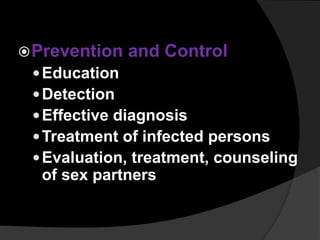
Prevention and Control
Education
Detection
Effective diagnosis
Treatment of infected persons
Evaluation, treatment, counseling
of sex partners
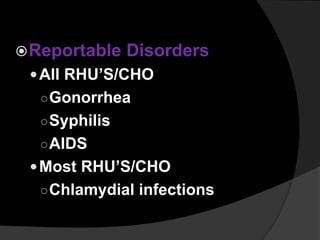
Reportable Disorders
All RHU’S/CHO
○Gonorrhea
○Syphilis
○AIDS
Most RHU’S/CHO
○Chlamydial infections
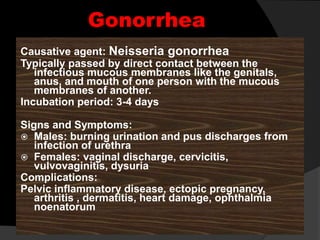
Gonorrhea
Causative agent: Neisseria gonorrhea
Typically passed by direct contact between the
infectious mucous membranes like the genitals,
anus, and mouth of one person with the mucous
membranes of another.
Incubation period: 3-4 days
Signs and Symptoms:
 Males: burning urination and pus discharges from
infection of urethra
 Females: vaginal discharge, cervicitis,
vulvovaginitis, dysuria
Complications:
Pelvic inflammatory disease, ectopic pregnancy,
arthritis , dermatitis, heart damage, ophthalmia
noenatorum
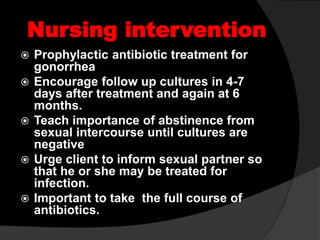
Nursing intervention
 Prophylactic antibiotic treatment for
gonorrhea
 Encourage follow up cultures in 4-7
days after treatment and again at 6
months.
 Teach importance of abstinence from
sexual intercourse until cultures are
negative
 Urge client to inform sexual partner so
that he or she may be treated for
infection.
 Important to take the full course of
antibiotics.
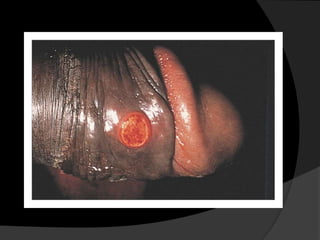
Syphilis
 Causative agent: Treponema
pallidum
 Incubation period: 10-90 days;
average is 20-30 days.
 Pathophysiology
 Enters body through break in
skin/mucous membrane
 Spreads through blood and lymph
 Congenital syphilis transfers through
placental circulation
 Transmission: direct contact
with primary chancre lesion,
body secretions (saliva, blood,
vaginal discharge, semen)
 Complications: development of
late syphilis and the resultant
systemic involvement of
cardiovascular and central
nervous system
NURSING INTERVENTION
 Administration of parenteral
penicillin is treatment of choice.
 If pregnant mother is treated before
the 18th week of gestation, the fetus
will usually be born unafected.
 Preventive education regarding
sexual exposure, adequate case
finding and treatment of contacts.
 All cases are reported to local public
health authorities
Chlamydia
Causative agent: Chlamydia Trachomatis
Passed during sexual intercourse; infants can become
infected during vaginal delivery. Highly contagious.
Incubation period: 2-35 days
Signs and Symptoms
 Males: discharges from penis, burning and itching
of urethral opening, burning sensation during
urination
 Females: slight vaginal discharges, itching of
vagina, painful intercourse, abdominal pain, fever in
later stages
Treatment: antibiotics as prescribed ( Doxycycline and
azithromycin)
Complications
Infant pneumonia, eye infections in infants which can
lead to blindness, stillbirths and pre-maturity
NURSING
INTERVENTION
 Urge client to have sexual
partner treated.
 Emphasize the importance
of long term drug therapy
because of the pathogens
unique life cycle, which
make it difficult to
eliminate.
 Antibiotic treatment
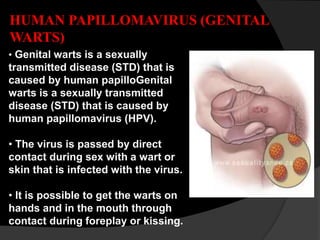
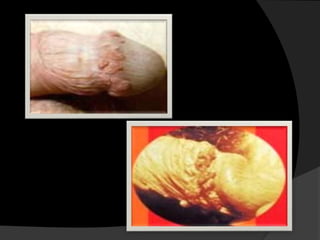
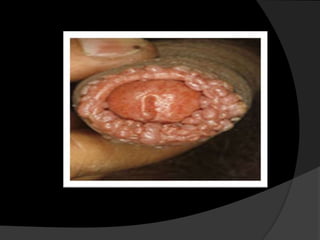
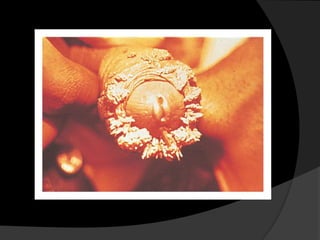
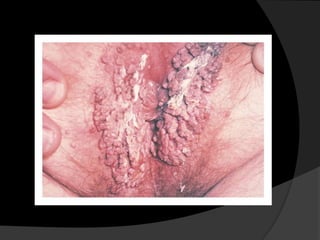
HUMAN PAPILLOMAVIRUS (GENITAL
WARTS)
• Genital warts is a sexually
transmitted disease (STD) that is
caused by human papilloGenital
warts is a sexually transmitted
disease (STD) that is caused by
human papillomavirus (HPV).
• The virus is passed by direct
contact during sex with a wart or
skin that is infected with the virus.
• It is possible to get the warts on
hands and in the mouth through
contact during foreplay or kissing.
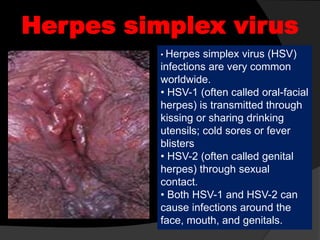
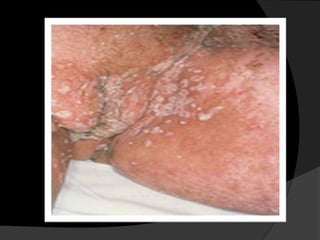
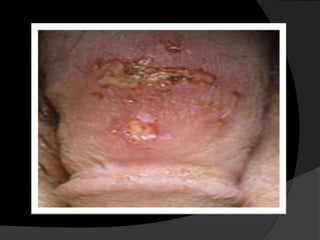
Herpes simplex virus
• Herpes simplex virus (HSV)
infections are very common
worldwide.
• HSV-1 (often called oral-facial
herpes) is transmitted through
kissing or sharing drinking
utensils; cold sores or fever
blisters
• HSV-2 (often called genital
herpes) through sexual
contact.
• Both HSV-1 and HSV-2 can
cause infections around the
face, mouth, and genitals.
NURSING INTERVENTION
 Teach importance of genital
hygiene and avoidance of
unprotected sexual contact
 Teach good hygiene practices. If
the lesions break open, the fluids
contains the virus. The virus can
be spread by contact and can
cause a lesion in any area of the
body.
VAGINAL
INFLAMMATORY
CONDITIONS
Common predisposing
factors
 Excessive douching
 Oral contraceptives, steroids
 Antibiotics that usually wipe out
normal vaginal flora.
 Improper cleaning after voiding and
defecating.
BACTERIAL
VAGINOSIS
 Causative organisms: E. coli,
haemophillus vaginalis and
gardnerella vaginalis.
 Profuse yellowish discharge, “fishy
smell”
 Itching, redness, burning, edema,
which are exacerbated by voiding and
defecation.
 Treatment: antibacterial/ antiprotozoal
medication.
 Complication: Bacterial vaginosis may
increase susceptibility to STD’s and HIV
infection if woman is exposed to either
 Sexually transmitted
CANDIDIASIS
 Characteristics:
1. Organisms: CANDIDA ALBICANS (fungus)
2. Internal itching, beefy red irritations,
inflammation of vaginal epithelium
3. White cheese-like, odorless discharge that
clings to the vaginal mucosa
4. Occurs frequently and is difficult to cure
5. Increased risk in women with diabetes and
women taking birth control pills, during
pregnancy and after treatment of antibiotics
 Treatment: antifungal vaginal medication.
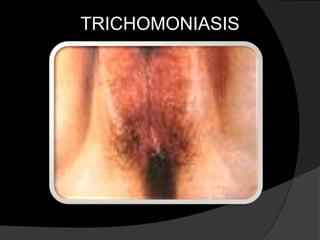
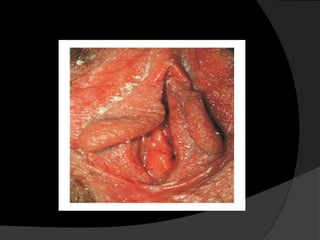
Trichomoniasis
Causative Agent: Trichomonas vaginalis (protozoan)
Usually passed by direct sexual contact. Can be
transmitted through contact with wet objects, such as
towels and wash clothes.
 Signs and Symptoms
Females: white or greenish-yellowish odorous
discharges, vaginal itching and soreness, painful
urination
Males: Slight itching of penis, painful urination, clear
discharge from penis
 Treatment: curable with an oral medication (
antibacterial/antiprotozoan medication
 Prevention: avoid extended time in nylon or tight
fitting undergarments.
TRICHOMONIASIS
GOAL
 TO TEACH CLIENT TO PREVENT
INFECTION BY PERFORMING
APPROPRIATE PERSONAL
HYGIENE, TO DECREASE
INFLAMMATION, AND TO PROMOTE
COMFORT
NURSING INTERVENTION
 Appropriate cleansing from front of vulva to
back of perineal area.
 Frequently, infection is worse around
menstrual period. Teach clients to change
tampons at least 3 -4 times a day or use
external pads.
 Client should not douche;
 Discourage use of feminine hygiene sprays
because they can cause irritation.
 Avoid constricting clothing and non-cotton
underwear.

Sexually transmitted diseases 202

  • 1.
  • 2.
    Sexually Transmitted Diseases  Sexuallytransmitted (venereal) diseases are infections that are often, if not always, passed from person to person through sexual contact. It is sometimes grouped by the signs and symptoms they cause.  Syphilis, genital herpes, and chancroid all cause ulcers (sores) on the skin or membranes lining the vagina or mouth.  Gonorrhea and chlamydial infections cause urethritis (inflammation and discharge of the urethra) in men; cervicitis (inflammation and discharge of the cervix) in women; pelvic infections in women and eye infections in newborns.
  • 3.
  • 4.
  • 5.
    Prevalence Occur in over50% of people at some point Women/infants disproportionately affected Highest in ages 15-24
  • 6.
     Risk Factors Decreased use of condoms  Characteristics  Most can be prevented by use of latex condoms  Heterosexual/homosexual activities ○ Includes non-penetrating intimate exposure  Sexual partners must be treated  Two or more STIs frequently
  • 7.
    Complications Pelvic inflammatory disease Ectopicpregnancy Infertility Chronic pelvic pain Neonatal illness and death Genital cancer
  • 8.
    Prevention and Control Education Detection Effectivediagnosis Treatment of infected persons Evaluation, treatment, counseling of sex partners
  • 9.
  • 10.
    Gonorrhea Causative agent: Neisseriagonorrhea Typically passed by direct contact between the infectious mucous membranes like the genitals, anus, and mouth of one person with the mucous membranes of another. Incubation period: 3-4 days Signs and Symptoms:  Males: burning urination and pus discharges from infection of urethra  Females: vaginal discharge, cervicitis, vulvovaginitis, dysuria Complications: Pelvic inflammatory disease, ectopic pregnancy, arthritis , dermatitis, heart damage, ophthalmia noenatorum
  • 11.
    Nursing intervention  Prophylacticantibiotic treatment for gonorrhea  Encourage follow up cultures in 4-7 days after treatment and again at 6 months.  Teach importance of abstinence from sexual intercourse until cultures are negative  Urge client to inform sexual partner so that he or she may be treated for infection.  Important to take the full course of antibiotics.
  • 13.
    Syphilis  Causative agent:Treponema pallidum  Incubation period: 10-90 days; average is 20-30 days.  Pathophysiology  Enters body through break in skin/mucous membrane  Spreads through blood and lymph  Congenital syphilis transfers through placental circulation
  • 14.
     Transmission: directcontact with primary chancre lesion, body secretions (saliva, blood, vaginal discharge, semen)  Complications: development of late syphilis and the resultant systemic involvement of cardiovascular and central nervous system
  • 15.
    NURSING INTERVENTION  Administrationof parenteral penicillin is treatment of choice.  If pregnant mother is treated before the 18th week of gestation, the fetus will usually be born unafected.  Preventive education regarding sexual exposure, adequate case finding and treatment of contacts.  All cases are reported to local public health authorities
  • 17.
    Chlamydia Causative agent: ChlamydiaTrachomatis Passed during sexual intercourse; infants can become infected during vaginal delivery. Highly contagious. Incubation period: 2-35 days Signs and Symptoms  Males: discharges from penis, burning and itching of urethral opening, burning sensation during urination  Females: slight vaginal discharges, itching of vagina, painful intercourse, abdominal pain, fever in later stages Treatment: antibiotics as prescribed ( Doxycycline and azithromycin) Complications Infant pneumonia, eye infections in infants which can lead to blindness, stillbirths and pre-maturity
  • 18.
    NURSING INTERVENTION  Urge clientto have sexual partner treated.  Emphasize the importance of long term drug therapy because of the pathogens unique life cycle, which make it difficult to eliminate.  Antibiotic treatment
  • 19.
    HUMAN PAPILLOMAVIRUS (GENITAL WARTS) •Genital warts is a sexually transmitted disease (STD) that is caused by human papilloGenital warts is a sexually transmitted disease (STD) that is caused by human papillomavirus (HPV). • The virus is passed by direct contact during sex with a wart or skin that is infected with the virus. • It is possible to get the warts on hands and in the mouth through contact during foreplay or kissing.
  • 24.
    Herpes simplex virus •Herpes simplex virus (HSV) infections are very common worldwide. • HSV-1 (often called oral-facial herpes) is transmitted through kissing or sharing drinking utensils; cold sores or fever blisters • HSV-2 (often called genital herpes) through sexual contact. • Both HSV-1 and HSV-2 can cause infections around the face, mouth, and genitals.
  • 27.
    NURSING INTERVENTION  Teachimportance of genital hygiene and avoidance of unprotected sexual contact  Teach good hygiene practices. If the lesions break open, the fluids contains the virus. The virus can be spread by contact and can cause a lesion in any area of the body.
  • 28.
  • 29.
    Common predisposing factors  Excessivedouching  Oral contraceptives, steroids  Antibiotics that usually wipe out normal vaginal flora.  Improper cleaning after voiding and defecating.
  • 30.
    BACTERIAL VAGINOSIS  Causative organisms:E. coli, haemophillus vaginalis and gardnerella vaginalis.  Profuse yellowish discharge, “fishy smell”  Itching, redness, burning, edema, which are exacerbated by voiding and defecation.
  • 31.
     Treatment: antibacterial/antiprotozoal medication.  Complication: Bacterial vaginosis may increase susceptibility to STD’s and HIV infection if woman is exposed to either  Sexually transmitted
  • 32.
    CANDIDIASIS  Characteristics: 1. Organisms:CANDIDA ALBICANS (fungus) 2. Internal itching, beefy red irritations, inflammation of vaginal epithelium 3. White cheese-like, odorless discharge that clings to the vaginal mucosa 4. Occurs frequently and is difficult to cure 5. Increased risk in women with diabetes and women taking birth control pills, during pregnancy and after treatment of antibiotics  Treatment: antifungal vaginal medication.
  • 34.
    Trichomoniasis Causative Agent: Trichomonasvaginalis (protozoan) Usually passed by direct sexual contact. Can be transmitted through contact with wet objects, such as towels and wash clothes.  Signs and Symptoms Females: white or greenish-yellowish odorous discharges, vaginal itching and soreness, painful urination Males: Slight itching of penis, painful urination, clear discharge from penis  Treatment: curable with an oral medication ( antibacterial/antiprotozoan medication  Prevention: avoid extended time in nylon or tight fitting undergarments.
  • 35.
  • 36.
    GOAL  TO TEACHCLIENT TO PREVENT INFECTION BY PERFORMING APPROPRIATE PERSONAL HYGIENE, TO DECREASE INFLAMMATION, AND TO PROMOTE COMFORT
  • 37.
    NURSING INTERVENTION  Appropriatecleansing from front of vulva to back of perineal area.  Frequently, infection is worse around menstrual period. Teach clients to change tampons at least 3 -4 times a day or use external pads.  Client should not douche;  Discourage use of feminine hygiene sprays because they can cause irritation.  Avoid constricting clothing and non-cotton underwear.