2
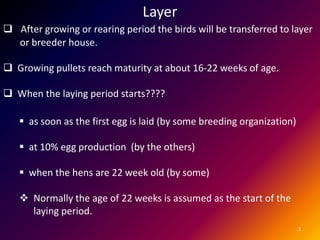
Comb
Wattle
Ear lobe
Pullet about to maturity
Layer
 After growing or rearing period the birds will be transferred to layer
or breeder house.
 Growing pullets reach maturity at about 16-22 weeks of age.
 When the laying period starts????
 as soon as the first egg is laid (by some breeding organization)
 at 10% egg production (by the others)
 when the hens are 22 week old (by some)
 Normally the age of 22 weeks is assumed as the start of the
laying period.
3
Factors Affecting The Performance
BREED
(Genetic, Chick Quality)
ENVIRONMENT
(Setup, Adjust)
FEED & WATER
( Quality, Quantity )
MANAGEMENT
( B, EN, F, W, D )
DISEASE CONTROL
( ISO, Hyg, Sani. Vac. Med )
 Some important points to look at before
buying pullets from a rearing farm
 Age of the birds
 Is the flock uniform
 Average body weight
 Whether the birds are properly vaccinated or properly
debeaked
 Lighting programme is practiced properly or not
5
6
Age at first egg depend on:
 Breed and strain - Light breed (White Leghorn) lay eggs earlier than
heavy breed (Rhode Island Red). Modern strain
has a tendency to reach production at an early age.
 Type of feed used as grower ration
 Type of housing – Birds kept in intensive system lay eggs earlier than
birds kept in Range System.
 The presence or absence of stress factors. E.g. disease, high ambient
temperature.
7
 Too early maturity is not favoured as a result of a greater
number of small eggs.
 Small eggs get less price. Small hatching eggs (<50 g) is
not good quality hatching eggs. It will affect the size of
the day old chick.
 Late maturity is also not good.
 Birds, which are not in production by the time they are 24
weeks old should be checked for diseases and poor
management.
Principles of layer management
 Cleaning and sanitation of the layer house
 Provide enough floor space, feeding space and drinking space per bird
 Change from grower ration to layer ration
 Normal feed consumption per bird
 Provision of nests and prevention of floor eggs
 Lighting programme
 Control the broodiness
 Culling and grading of the bird
 Problems during the laying period
 Production and health control
8
9
 Cleaning and sanitation of the layer house
 Clean and disinfect the layer house two weeks before the birds are
transferred to layer house.
• remove old litter and all loose debris.
• thoroughly wash the interior of the house, use the most powerful
concentration of disinfectant according to label (recommended).
• allow the house to dry.
• clean the equipment and feed bin.
• treat the dirt floor.
 less stress as much as possible during the shipment of the birds from grower
house to layer house.
10
Floor space requirement for layers1
Mini Leghorn Standard Leghorn Medium size
Type of floor ft2 m2 Birds
/m2
ft2 m2 Birds
/m2
ft2 m2 Birds
/m2
All-litter1 1.25 0.11 8.6 1.50 0.14 7.2 1.75 0.16 6.2
Slat-and-litter2 1.00 0.09 10.8 1.25 0.12 9.0 1.50 0.14 7.2
Wire-and-litter3 1.00 0.09 10.8 1.25 0.12 9.0 1.50 0.14 7.2
All-slat 0.75 0.07 14.4 1.00 0.09 10.8 1.25 0.12 9.0
All-wire 0.75 0.07 14.4 1.00 0.09 10.8 1.25 0.12 9.0
1 For maximum egg production, prevention of wet litter and poor house ventilation
2 Approximately 40% litter, 60% slat
3 Approximately 40% litter, 60% wire
All Litter
11
Slatted floor system
Slat-litter floor system (1/2 slat-1/2 litter)
14
Mini leghorn Standard Leghorn Medium-size
Item in cm in cm in cm
Trough
space 1
3.0 7.5 3.5 8.75 4.0 10.5
Number of pullets per pen or Tube Feeder
Pans 2
16 14 12
Tube feeder 3
21 18 15
Feeding space requirements for layer
1 Space on one side of trough only
2 Approximately 12 in. (0.3 m) in diameter. Usually found on certain automatic feeder.
3 A pan with a circumference of 50 in.( 1.27 m) or a diameter of 16 in. (40.6 cm).
15
Mini leghorn Standard Leghorn Medium-size
Item in cm in cm in cm
Trough
space 1
1.0 2.5 1.0 2.5 1.25 3.1
Number of pullets per pen, cup or Drip valve
Pans 2 25 25 20
Automatic cups 8 8 6
Drip valve 8 8 6
Waterer space requirements for layer
1 Space on one side of trough only
2 A pan approximately 10 in. (25.4 cm) in diameter.
16
Tube feeder
3/29/2023 prepared by Dr. Nwe Nwe Htin 17
Pan Feeder
18
 Recommended nutrient level
 Layer ration (19 weeks)
• ME (metabolizable energy) kcal/kg = 2700-2800
• Crude protein = 16-17%
• Energy: Protein (ME/CP) = 170-175
• Crude fat = 3-5%
• Crude fibre = 5-6%
• Calcium = 2.5-3.5%
• Total phosphorus = 0.8%
• Lysine = 0.7%
• Methionine = 0.3%
• Salt (NaCL) = 0.25%
 Form of the feed: mash or pellet
19
 Feed consumption:
 For body maintenance --- 70 g/b/d
 The management system
• battery housing system (cage system) --- reduced feed intake (-5g/b/d)
 Health of the birds and activity
• healthy and active > sick and not active
 Type (body weight) and age of the birds
• broiler > layer (higher body weight > lower body weight)
• broiler breeder (broiler parent stock) > broiler grower > broiler starter
• provide feed ± 1.2g/b/d for 50g body weight difference from 2000g body weight
 ME content of the ration
• higher ME < lower ME
• provide feed ± 1g/b/d for 50 kcal ME difference from ME 2750 kcal/kg
 Production level
• higher egg production ---- increased feed consumption
• provide additional feed 7 g/b/d for each 10% egg production
 Environment and climate
• Lower house temperature > higher house temperature
• ± 1.4 g feed for each °C environmental temperature higher than 20°C
20
 Calculate feed consumption per layer per day (g/b/d) for a given
flock:
average body weight = 2100 g; ME = 2850 kcal/kg;
egg production 80%; house temperature 25°C; rear in battery
system
Amount of feed (g/b/d) given
• For body maintenance + 70.0
• For body weight difference (2100 -2000) = 100 x1.2/50 = + 2.4
• For 80% egg production (80/10 x 7) = + 56.0
• For environmental temperature (25 °C-20° C) = 5 x 1.4 = 7.0
• For ME content of the ration (2850-2750) =100 x1/50 = 2.0
• For battery housing system = - 5.0
________
114.4 g/b/d
That layer flock should be provided 114.4 gram per bird per day. For
1000 layers it will be (114.4x1000)g= 114400 g=114.4kg
21
In general,
 15-21 °C (70°F) is the optimal range of temperature for a
layer known as thermo-neutral zone.
 25-30 °C and higher
 decreased feed consumption
 Increased water consumption
22
 Provision of nests
 Laying nests are indispensable part of the house
equipment for layers. Why ???
• To prevent floor eggs.
• The floor eggs have more chance to be cracked.
• Cracked eggs can lead to egg eating habit,
proceed to cannibalism.
• Floor eggs are not easy to collect.
 Important to provide the nest before the first egg is laid.
 Laying nests are not housed in battery housing system.
23
Provision of laying nests
24
 Laying nests are not housed in battery housing system.
 Individual nest without litter or
roll away nest .
 the slope of the angle is very
important to prevent the eggs
from cracked (14-17%).
[(X/Y)x100] = 14-17%.
Roll away nest
X
Y
25
 Types of nest
 Individual nest
 Community nest
Individual nest
Individual nest
• width – 25 - 30 cm
• depth – 35 - 45 cm
• height - 35- 40 cm
• with litter material ± 15 cm
• capacity
7 layers/nest
4-5 Broiler Parent Stock/nest
• removable bottom of the nest is
preferred for easier cleaning
Litter material
26
Individual laying nests
27
Community nest
Community nest
 height – 35-40 cm
 length - 2 meters
 depth - 0.7 meter
 capacity - 50-60 layers/m2
 15-20 cm of litter material
 ventilation inside the nest is
very important
28
 Placement of the nest in the house
 Not to place the nest in the” long side”
direction of the house.
 This will disturb the ventilation
 Direct sunlight enters the nest and it
prevent enough darkness, which is
required for the nest.
29
E
W
N
S
 Poultry house should be east-west orientation.
 The nest arrangements should not prevent ventilation.
 The nests should be away from direct sunlight
30
 Measures to limit the numbers of floor eggs
 Install the laying nests in time.
 The laying nest should be easy accessible.
 Enough laying nests must be available.
 Do not collect all the eggs from the nest in the beginning of the
laying period.
 Collect the floor eggs as often as possible.
 Avoid direct sunshine enters the nests
 Give the birds some grain (oats, rice) twice a day in the litter.
 Manage to get enough ventilation inside the laying nests
 Supply the nests with enough good litters.
 Place the nest about 50 cm above the litter, if too low, birds may
lay under the nests.
31
 Egg Collection
 collect the eggs at least twice a day.
 eggs should be kept in cool condition
 frequent egg collection will ensure good quality
eggs and reduces the number of cracked, broken
and dirty eggs.
 use the suitable egg collecting container to
reduce the cracked and broken eggs.
 While collecting eggs birds on nest should be
carefully handle.
 record the number of collected eggs.
32
 Lighting Programme
 to stimulate egg production
 to obtain sufficient peak production
Vision of
light to
the eye
+
Pituitary
gland +
Increased the production of
FSH (follicular stimulating
hormone) and LH (leutenizing
hormone).
+
Responsible for the growth
of follicles and ovulation
33
Continued:
 During the rearing period (growing) 8-10 hours/day till 18-20 weeks
of age.
 Above 7 feet from the floor; 40 watt globe/200 square feet floor
area.
 After 20 weeks of age; provide 14 hours light per day. If day time is
12 hours, provide extra 2 hours light.
 Detrimental results occur if lighting is stopped at any stage.
 Keep constant or increasing light, never decrease the light hours.
34
 Broodiness
 Broodiness is an inherited characteristics.
 Heavy breed > Light breed.
 Brooding hen cease laying for one month or more; occupy the
nesting space; so it should be removed as soon as noticed to
special broody coop.
 Broody coop allow maximum ventilation.
 After 4-5 days, the birds will no longer be broody and can be
return to the pen.
 Food and water must be provided to birds kept in broody coop.
35
Broody hen
36
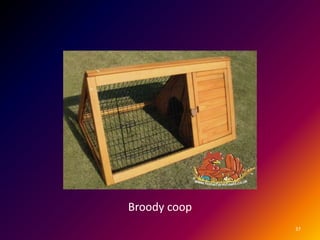
Broody coop
37
Broody coop
38
Broody coop
39
Broody coop
40
 Practice culling and grading
 Culling is removing of inferior birds.
 Practice culling continuously during the rearing and
laying period to reduce the production cost.
Illness
Deformities
Poor
growth
rate
Poor egg
production
Early
moulting
layers
Broody
hens
Inferior birds
3/29/2023 prepared by Dr. Nwe Nwe Htin 41
Characters Productive layer Non-productive layer
Comb and wattle Red, strong, big depend on breed Pale, small,wrinkled or shrunken
Eyes Bright and alert Sunken eyes, blindness
Eye ring Pale Yellow
Beak Short, pale Too long, cross beak, yellow
Crop Preferably filled Too hard, hanging crop
Breast Breast bone is straight and well
covered with muscle
Wrong shaped, sharp and poor
muscle
Abdomen Feels elastic, full, wide. Distance
between pelvic bones and keel bone
is about 4 fingers
Stiff, too hard, tumours, egg-
concrement, water belly
Pelvic bones Distance between the bones, 2-3
fingers, bones easy to move
Between pelvic bones, only one
fingers
Cloaca Large, moist, oval, pink Small, dry, round, yellow
Legs (shank0 Straight, strong, pale, shiny shanks
with well closed scales
Yellow, criple
Feathers Young birds- thick and bright;
Old birds– dim and some damage
appear
Early moulting is a sign of poor
production
42
43
 Mortality
 Light breed (White leghorn) 0.7- 0.8 % per 4
week period; i.e. 9-10% per year
 Medium heavy breed 0.5-0.6% per 4 week
period; i.e. 6.5-9.0% per year
 Problems during the laying period
 The start of the laying period is delayed
 No high top production
 High mortality
 High feed consumption
 Many second grade eggs
44
 The start of the laying period is delayed
• rearing is poorly managed
• disease
• number of hours of light is decreasing
• hens are not well developed
45
 No high top production
• no uniform flock
• start of lay is very slow
• disease
• poor quality of feed
46
 High mortality
• poor debeaking
• high stocking density per m2
• disease
47
 High feed consumption
• poor quality of feed
• too much feed wastage
• the balance is not weighing properly
48
 Many second grade eggs
• poor construction of laying nests
• not frequently enough collected the eggs per day
• no supply of oystershells
• age of the birds
• high temperature
49
 The production control during the laying period is
important to become a highly productive laying flock.
 Important points for production control
 Mortality
 Average body weight
 Feed consumption
 Egg production (laying%)
 Egg weight
 % of 2nd class egg
 Feed conversion ratio
 Compare the results of the flock on a ready made graph
provided by breeding organization with printed
standard performance of their breed
50
51

Lecture 7 (Layer Management).pptx

  • 2.
  • 3.
    Layer  After growingor rearing period the birds will be transferred to layer or breeder house.  Growing pullets reach maturity at about 16-22 weeks of age.  When the laying period starts????  as soon as the first egg is laid (by some breeding organization)  at 10% egg production (by the others)  when the hens are 22 week old (by some)  Normally the age of 22 weeks is assumed as the start of the laying period. 3
  • 4.
    Factors Affecting ThePerformance BREED (Genetic, Chick Quality) ENVIRONMENT (Setup, Adjust) FEED & WATER ( Quality, Quantity ) MANAGEMENT ( B, EN, F, W, D ) DISEASE CONTROL ( ISO, Hyg, Sani. Vac. Med )
  • 5.
     Some importantpoints to look at before buying pullets from a rearing farm  Age of the birds  Is the flock uniform  Average body weight  Whether the birds are properly vaccinated or properly debeaked  Lighting programme is practiced properly or not 5
  • 6.
    6 Age at firstegg depend on:  Breed and strain - Light breed (White Leghorn) lay eggs earlier than heavy breed (Rhode Island Red). Modern strain has a tendency to reach production at an early age.  Type of feed used as grower ration  Type of housing – Birds kept in intensive system lay eggs earlier than birds kept in Range System.  The presence or absence of stress factors. E.g. disease, high ambient temperature.
  • 7.
    7  Too earlymaturity is not favoured as a result of a greater number of small eggs.  Small eggs get less price. Small hatching eggs (<50 g) is not good quality hatching eggs. It will affect the size of the day old chick.  Late maturity is also not good.  Birds, which are not in production by the time they are 24 weeks old should be checked for diseases and poor management.
  • 8.
    Principles of layermanagement  Cleaning and sanitation of the layer house  Provide enough floor space, feeding space and drinking space per bird  Change from grower ration to layer ration  Normal feed consumption per bird  Provision of nests and prevention of floor eggs  Lighting programme  Control the broodiness  Culling and grading of the bird  Problems during the laying period  Production and health control 8
  • 9.
    9  Cleaning andsanitation of the layer house  Clean and disinfect the layer house two weeks before the birds are transferred to layer house. • remove old litter and all loose debris. • thoroughly wash the interior of the house, use the most powerful concentration of disinfectant according to label (recommended). • allow the house to dry. • clean the equipment and feed bin. • treat the dirt floor.  less stress as much as possible during the shipment of the birds from grower house to layer house.
  • 10.
    10 Floor space requirementfor layers1 Mini Leghorn Standard Leghorn Medium size Type of floor ft2 m2 Birds /m2 ft2 m2 Birds /m2 ft2 m2 Birds /m2 All-litter1 1.25 0.11 8.6 1.50 0.14 7.2 1.75 0.16 6.2 Slat-and-litter2 1.00 0.09 10.8 1.25 0.12 9.0 1.50 0.14 7.2 Wire-and-litter3 1.00 0.09 10.8 1.25 0.12 9.0 1.50 0.14 7.2 All-slat 0.75 0.07 14.4 1.00 0.09 10.8 1.25 0.12 9.0 All-wire 0.75 0.07 14.4 1.00 0.09 10.8 1.25 0.12 9.0 1 For maximum egg production, prevention of wet litter and poor house ventilation 2 Approximately 40% litter, 60% slat 3 Approximately 40% litter, 60% wire
  • 11.
  • 12.
  • 13.
    Slat-litter floor system(1/2 slat-1/2 litter)
  • 14.
    14 Mini leghorn StandardLeghorn Medium-size Item in cm in cm in cm Trough space 1 3.0 7.5 3.5 8.75 4.0 10.5 Number of pullets per pen or Tube Feeder Pans 2 16 14 12 Tube feeder 3 21 18 15 Feeding space requirements for layer 1 Space on one side of trough only 2 Approximately 12 in. (0.3 m) in diameter. Usually found on certain automatic feeder. 3 A pan with a circumference of 50 in.( 1.27 m) or a diameter of 16 in. (40.6 cm).
  • 15.
    15 Mini leghorn StandardLeghorn Medium-size Item in cm in cm in cm Trough space 1 1.0 2.5 1.0 2.5 1.25 3.1 Number of pullets per pen, cup or Drip valve Pans 2 25 25 20 Automatic cups 8 8 6 Drip valve 8 8 6 Waterer space requirements for layer 1 Space on one side of trough only 2 A pan approximately 10 in. (25.4 cm) in diameter.
  • 16.
  • 17.
    3/29/2023 prepared byDr. Nwe Nwe Htin 17 Pan Feeder
  • 18.
    18  Recommended nutrientlevel  Layer ration (19 weeks) • ME (metabolizable energy) kcal/kg = 2700-2800 • Crude protein = 16-17% • Energy: Protein (ME/CP) = 170-175 • Crude fat = 3-5% • Crude fibre = 5-6% • Calcium = 2.5-3.5% • Total phosphorus = 0.8% • Lysine = 0.7% • Methionine = 0.3% • Salt (NaCL) = 0.25%  Form of the feed: mash or pellet
  • 19.
    19  Feed consumption: For body maintenance --- 70 g/b/d  The management system • battery housing system (cage system) --- reduced feed intake (-5g/b/d)  Health of the birds and activity • healthy and active > sick and not active  Type (body weight) and age of the birds • broiler > layer (higher body weight > lower body weight) • broiler breeder (broiler parent stock) > broiler grower > broiler starter • provide feed ± 1.2g/b/d for 50g body weight difference from 2000g body weight  ME content of the ration • higher ME < lower ME • provide feed ± 1g/b/d for 50 kcal ME difference from ME 2750 kcal/kg  Production level • higher egg production ---- increased feed consumption • provide additional feed 7 g/b/d for each 10% egg production  Environment and climate • Lower house temperature > higher house temperature • ± 1.4 g feed for each °C environmental temperature higher than 20°C
  • 20.
    20  Calculate feedconsumption per layer per day (g/b/d) for a given flock: average body weight = 2100 g; ME = 2850 kcal/kg; egg production 80%; house temperature 25°C; rear in battery system Amount of feed (g/b/d) given • For body maintenance + 70.0 • For body weight difference (2100 -2000) = 100 x1.2/50 = + 2.4 • For 80% egg production (80/10 x 7) = + 56.0 • For environmental temperature (25 °C-20° C) = 5 x 1.4 = 7.0 • For ME content of the ration (2850-2750) =100 x1/50 = 2.0 • For battery housing system = - 5.0 ________ 114.4 g/b/d That layer flock should be provided 114.4 gram per bird per day. For 1000 layers it will be (114.4x1000)g= 114400 g=114.4kg
  • 21.
    21 In general,  15-21°C (70°F) is the optimal range of temperature for a layer known as thermo-neutral zone.  25-30 °C and higher  decreased feed consumption  Increased water consumption
  • 22.
    22  Provision ofnests  Laying nests are indispensable part of the house equipment for layers. Why ??? • To prevent floor eggs. • The floor eggs have more chance to be cracked. • Cracked eggs can lead to egg eating habit, proceed to cannibalism. • Floor eggs are not easy to collect.  Important to provide the nest before the first egg is laid.  Laying nests are not housed in battery housing system.
  • 23.
  • 24.
    24  Laying nestsare not housed in battery housing system.  Individual nest without litter or roll away nest .  the slope of the angle is very important to prevent the eggs from cracked (14-17%). [(X/Y)x100] = 14-17%. Roll away nest X Y
  • 25.
    25  Types ofnest  Individual nest  Community nest Individual nest Individual nest • width – 25 - 30 cm • depth – 35 - 45 cm • height - 35- 40 cm • with litter material ± 15 cm • capacity 7 layers/nest 4-5 Broiler Parent Stock/nest • removable bottom of the nest is preferred for easier cleaning Litter material
  • 26.
  • 27.
    27 Community nest Community nest height – 35-40 cm  length - 2 meters  depth - 0.7 meter  capacity - 50-60 layers/m2  15-20 cm of litter material  ventilation inside the nest is very important
  • 28.
    28  Placement ofthe nest in the house  Not to place the nest in the” long side” direction of the house.  This will disturb the ventilation  Direct sunlight enters the nest and it prevent enough darkness, which is required for the nest.
  • 29.
    29 E W N S  Poultry houseshould be east-west orientation.  The nest arrangements should not prevent ventilation.  The nests should be away from direct sunlight
  • 30.
    30  Measures tolimit the numbers of floor eggs  Install the laying nests in time.  The laying nest should be easy accessible.  Enough laying nests must be available.  Do not collect all the eggs from the nest in the beginning of the laying period.  Collect the floor eggs as often as possible.  Avoid direct sunshine enters the nests  Give the birds some grain (oats, rice) twice a day in the litter.  Manage to get enough ventilation inside the laying nests  Supply the nests with enough good litters.  Place the nest about 50 cm above the litter, if too low, birds may lay under the nests.
  • 31.
    31  Egg Collection collect the eggs at least twice a day.  eggs should be kept in cool condition  frequent egg collection will ensure good quality eggs and reduces the number of cracked, broken and dirty eggs.  use the suitable egg collecting container to reduce the cracked and broken eggs.  While collecting eggs birds on nest should be carefully handle.  record the number of collected eggs.
  • 32.
    32  Lighting Programme to stimulate egg production  to obtain sufficient peak production Vision of light to the eye + Pituitary gland + Increased the production of FSH (follicular stimulating hormone) and LH (leutenizing hormone). + Responsible for the growth of follicles and ovulation
  • 33.
    33 Continued:  During therearing period (growing) 8-10 hours/day till 18-20 weeks of age.  Above 7 feet from the floor; 40 watt globe/200 square feet floor area.  After 20 weeks of age; provide 14 hours light per day. If day time is 12 hours, provide extra 2 hours light.  Detrimental results occur if lighting is stopped at any stage.  Keep constant or increasing light, never decrease the light hours.
  • 34.
    34  Broodiness  Broodinessis an inherited characteristics.  Heavy breed > Light breed.  Brooding hen cease laying for one month or more; occupy the nesting space; so it should be removed as soon as noticed to special broody coop.  Broody coop allow maximum ventilation.  After 4-5 days, the birds will no longer be broody and can be return to the pen.  Food and water must be provided to birds kept in broody coop.
  • 35.
  • 36.
  • 37.
  • 38.
  • 39.
  • 40.
    40  Practice cullingand grading  Culling is removing of inferior birds.  Practice culling continuously during the rearing and laying period to reduce the production cost. Illness Deformities Poor growth rate Poor egg production Early moulting layers Broody hens Inferior birds
  • 41.
    3/29/2023 prepared byDr. Nwe Nwe Htin 41 Characters Productive layer Non-productive layer Comb and wattle Red, strong, big depend on breed Pale, small,wrinkled or shrunken Eyes Bright and alert Sunken eyes, blindness Eye ring Pale Yellow Beak Short, pale Too long, cross beak, yellow Crop Preferably filled Too hard, hanging crop Breast Breast bone is straight and well covered with muscle Wrong shaped, sharp and poor muscle Abdomen Feels elastic, full, wide. Distance between pelvic bones and keel bone is about 4 fingers Stiff, too hard, tumours, egg- concrement, water belly Pelvic bones Distance between the bones, 2-3 fingers, bones easy to move Between pelvic bones, only one fingers Cloaca Large, moist, oval, pink Small, dry, round, yellow Legs (shank0 Straight, strong, pale, shiny shanks with well closed scales Yellow, criple Feathers Young birds- thick and bright; Old birds– dim and some damage appear Early moulting is a sign of poor production
  • 42.
  • 43.
    43  Mortality  Lightbreed (White leghorn) 0.7- 0.8 % per 4 week period; i.e. 9-10% per year  Medium heavy breed 0.5-0.6% per 4 week period; i.e. 6.5-9.0% per year
  • 44.
     Problems duringthe laying period  The start of the laying period is delayed  No high top production  High mortality  High feed consumption  Many second grade eggs 44
  • 45.
     The startof the laying period is delayed • rearing is poorly managed • disease • number of hours of light is decreasing • hens are not well developed 45
  • 46.
     No hightop production • no uniform flock • start of lay is very slow • disease • poor quality of feed 46
  • 47.
     High mortality •poor debeaking • high stocking density per m2 • disease 47
  • 48.
     High feedconsumption • poor quality of feed • too much feed wastage • the balance is not weighing properly 48
  • 49.
     Many secondgrade eggs • poor construction of laying nests • not frequently enough collected the eggs per day • no supply of oystershells • age of the birds • high temperature 49
  • 50.
     The productioncontrol during the laying period is important to become a highly productive laying flock.  Important points for production control  Mortality  Average body weight  Feed consumption  Egg production (laying%)  Egg weight  % of 2nd class egg  Feed conversion ratio  Compare the results of the flock on a ready made graph provided by breeding organization with printed standard performance of their breed 50
  • 51.

Editor's Notes

  • #3 What is pullet? Young layers, before laying eggs
  • #4 Different method used by the industry
  • #9 CAN OMIT