COMBUSTION OF SOLID BIOFUEL

Solid Bio-fuels - Characteristics - Properties - Preparation

of biomass as feedstock for combustion reactorCombustion Process and equipment - Combined Cycle
Operation
2
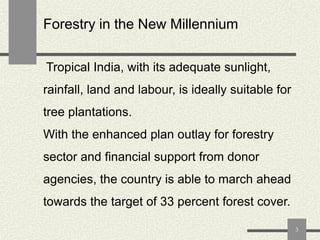
Forestry in the New Millennium
Tropical India, with its adequate sunlight,
rainfall, land and labour, is ideally suitable for

tree plantations.
With the enhanced plan outlay for forestry

sector and financial support from donor
agencies, the country is able to march ahead

towards the target of 33 percent forest cover.
3
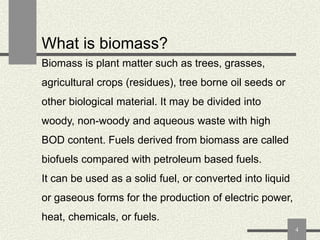
What is biomass?
Biomass is plant matter such as trees, grasses,
agricultural crops (residues), tree borne oil seeds or
other biological material. It may be divided into
woody, non-woody and aqueous waste with high
BOD content. Fuels derived from biomass are called

biofuels compared with petroleum based fuels.
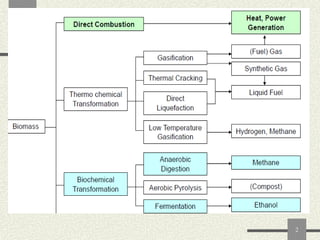
It can be used as a solid fuel, or converted into liquid

or gaseous forms for the production of electric power,
heat, chemicals, or fuels.
4
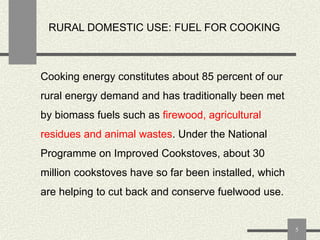
RURAL DOMESTIC USE: FUEL FOR COOKING

Cooking energy constitutes about 85 percent of our
rural energy demand and has traditionally been met

by biomass fuels such as firewood, agricultural
residues and animal wastes. Under the National

Programme on Improved Cookstoves, about 30
million cookstoves have so far been installed, which
are helping to cut back and conserve fuelwood use.

5
Can solid biofuels be used in Power

Plants?
Power generation plants fired solely by biomass are

small compared with conventional coal, gas, oil or nuclear
stations. This size depends on biomass growing capacity and
delivery. Transport of biomass, a material with a low bulk
energy density is expensive when conveyed over the long
distances to larger plants. The traffic involved may also be a
major local concern. Specific capital cost, efficiency and
specific operational cost advantages of larger power plants

are balanced against fuel transport issues.
6
What inputs are needed to develop biofuels?
 Biofuel as energy source of rural poor people






requires social and technical inputs to make
it a modern sustainable system.
Wasteland
Forest wastes _ forest tree twigs, shrubs
Marginal Croplands
Overcome disadvantage of low bulk energy
density of particulate biomass by preparatory
process like briquetting.
7
Give examples of solid bio-fuels
WOOD [Forestry / agro-forestry based]
BAGASSE [Agro - industry residue]
RICE HUSK [Crop residue]

NEEM ETC.- [Multi-purpose trees]
PROSOPIS ETC.- [Energy crops]
8
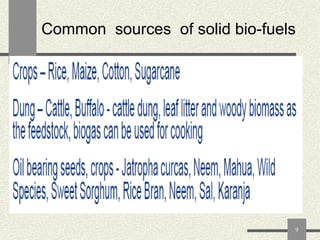
Common sources of solid bio-fuels

9
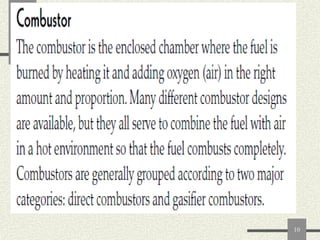
10
APPLCATIONS OF
BIOMASS COMBUSTION
• RURAL DOMESTIC: COOKING
• HEAT & STEAM FOR SMALL SCALE

PROCESS
• COGENERATION / COMBINED CYCLE FOR

ELECTRIC POWER GENERATION

11
What is the advantage of solid bio-fuel
over coal as fuel for combustion?

•

For decentralized and small / medium scale

operation where coal mines are remote but forest

resource / woodlands are near.
• Restricts the emission of green house gases and
air pollutants (like SO2).
•Lessens our dependence on imported
hydrocarbon fuels, creates rural employment.
12
As fuel for combustion, what are the
disadvantages of solid bio-fuel over coal?
• Availability is location specific and limited
• Lower calorific value; variable particle

size
• Preparation like drying, briquetting etc.
needed for wood /agro-residue
• Price depends on production system like
energy plantation, social forestry, saw
mills, paddy processing etc.
• India‟s Forest resource is highly stressed
13
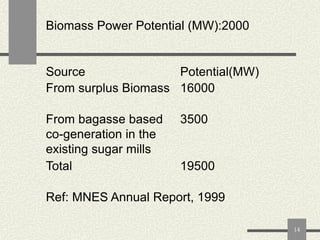
Biomass Power Potential (MW):2000

Source
Potential(MW)
From surplus Biomass 16000
From bagasse based
co-generation in the
existing sugar mills
Total

3500

19500

Ref: MNES Annual Report, 1999
14
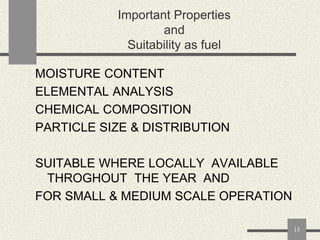
Important Properties
and
Suitability as fuel
MOISTURE CONTENT
ELEMENTAL ANALYSIS
CHEMICAL COMPOSITION
PARTICLE SIZE & DISTRIBUTION
SUITABLE WHERE LOCALLY AVAILABLE
THROGHOUT THE YEAR AND
FOR SMALL & MEDIUM SCALE OPERATION
15
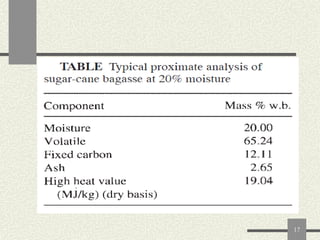
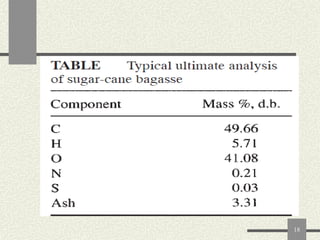
Proximate and Ultimate Analysis,
and HHV
Proximate Analysis: (1) Moisture,
(2) Volatile,
(3) Fixed carbon and
(4) Ash. [Wt %]
Ultimate Analysis : C, H, O, N, S. [Wt %]
Higher Heating Value, MJ/Kg
16
17
18
Providing the Draft
P required to make the air flow through the
fuel bed and to the flue gas discharge height
is called draft of air in a furnace and is
expressed in millimeters of water.
Natural: by means of a chimney
Artificial: The fan is used to suck the gases
away from the furnace [induced draft], or to
force the air required [forced draft] through
the grate.

19
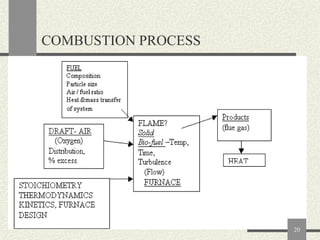
COMBUSTION PROCESS

20
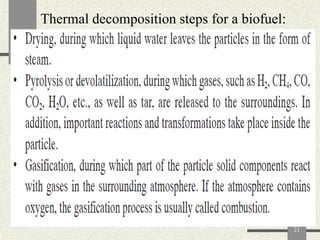
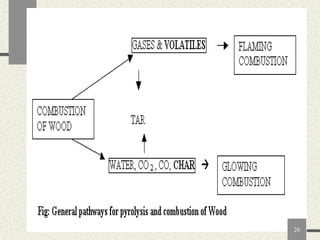
Thermal decomposition steps for a biofuel:

21
COMBUSTION REACTIONS
C6n[H2O]5n = 6nC + 5nH2O
Biomass

C + O2 + 3.79N2 = 3.79N2 +CO2
EXOTHERMIC, 395400 KJ / KG ATOM
OF CARBON

22
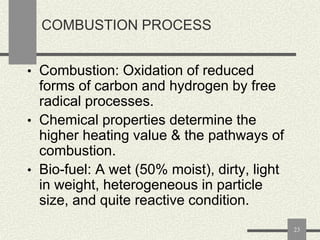
COMBUSTION PROCESS
• Combustion: Oxidation of reduced

forms of carbon and hydrogen by free
radical processes.
• Chemical properties determine the
higher heating value & the pathways of
combustion.
• Bio-fuel: A wet (50% moist), dirty, light
in weight, heterogeneous in particle
size, and quite reactive condition.
23
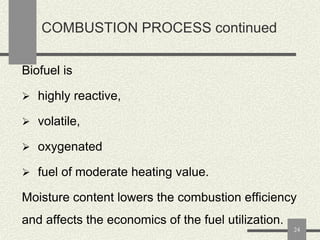
COMBUSTION PROCESS continued
Biofuel is
 highly reactive,

 volatile,
 oxygenated
 fuel of moderate heating value.

Moisture content lowers the combustion efficiency
and affects the economics of the fuel utilization.
24
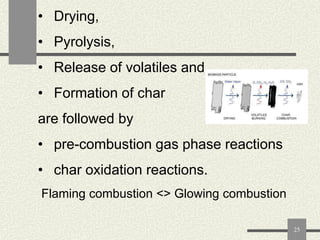
• Drying,
• Pyrolysis,

• Release of volatiles and
• Formation of char
are followed by

• pre-combustion gas phase reactions
• char oxidation reactions.
Flaming combustion <> Glowing combustion
25
26
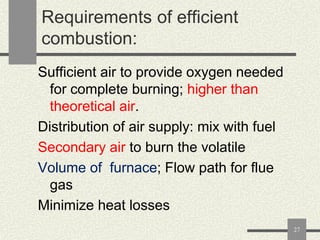
Requirements of efficient
combustion:
Sufficient air to provide oxygen needed
for complete burning; higher than
theoretical air.
Distribution of air supply: mix with fuel
Secondary air to burn the volatile
Volume of furnace; Flow path for flue
gas
Minimize heat losses
27
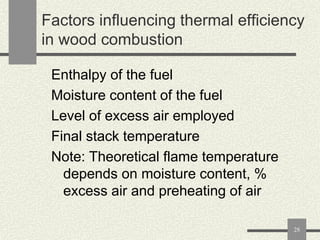
Factors influencing thermal efficiency
in wood combustion
Enthalpy of the fuel
Moisture content of the fuel
Level of excess air employed
Final stack temperature
Note: Theoretical flame temperature
depends on moisture content, %
excess air and preheating of air
28
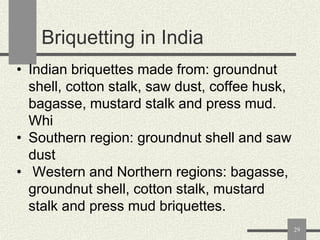
Briquetting in India
• Indian briquettes made from: groundnut
shell, cotton stalk, saw dust, coffee husk,
bagasse, mustard stalk and press mud.
Whi
• Southern region: groundnut shell and saw
dust
• Western and Northern regions: bagasse,
groundnut shell, cotton stalk, mustard
stalk and press mud briquettes.
29
Briquetting continued
A recent addition: Municipal solid waste
densified for use as fuel in process
industries (tea, tobacco, textile,

chemical, paper, starch, tyre retreading, tiles, etc.) for thermal

applications.
30
Screw and Ram Press
• Both the machines give briquettes with a
density of 1-1.2 gm /cc, suitable as industrial
solid fuels.
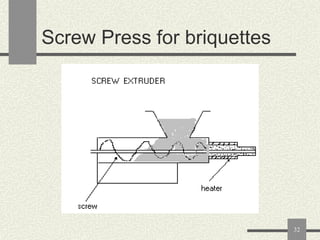
• The screw type machines: briquettes with a
concentric hole-- better combustibility- a
preferred fuel.
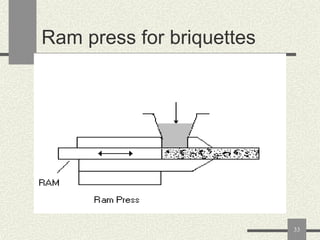
• These briquettes can also be more
conveniently deployed in small furnaces and
even cook-stoves than solid briquettes
generated by a ram press.
31
Screw Press for briquettes

32
Ram press for briquettes

33
34
35
36
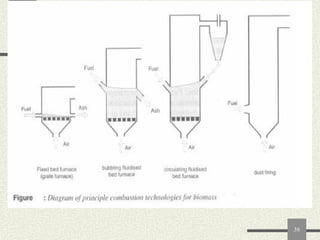
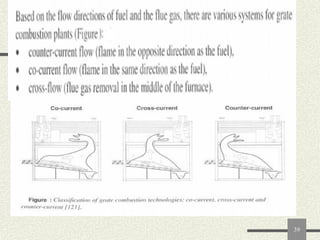
FURNACE FOR BIOFUEL
COMBUSTION
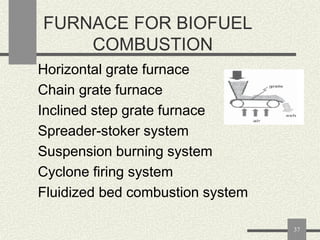
Horizontal grate furnace
Chain grate furnace
Inclined step grate furnace
Spreader-stoker system
Suspension burning system
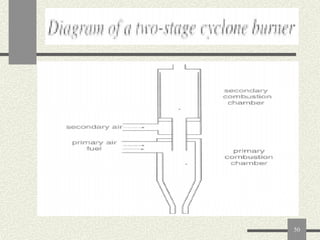
Cyclone firing system
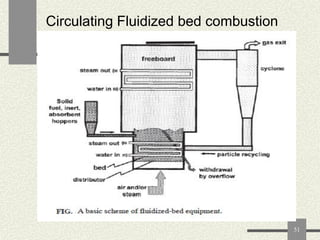
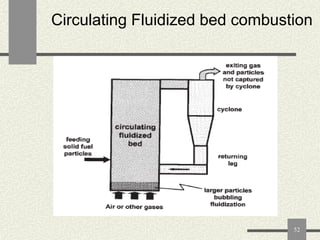
Fluidized bed combustion system
37
38
39
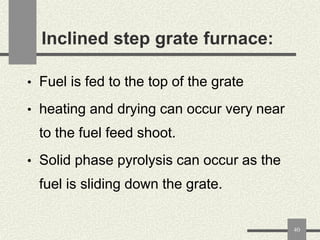
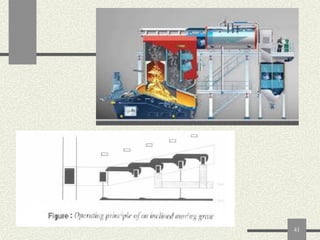
Inclined step grate furnace:
• Fuel is fed to the top of the grate
• heating and drying can occur very near

to the fuel feed shoot.
• Solid phase pyrolysis can occur as the

fuel is sliding down the grate.

40
41
Inclined step grate furnace:
….continued
• Char oxidation can occur at the base of

the grate and on the dumping grate.
• Gas phase reactions can be controlled

by over-fire air distribution and
separated completely from solid phase

reactions
42
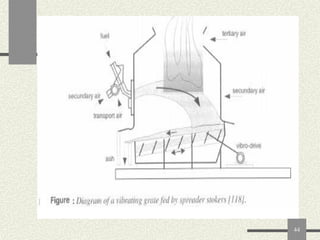
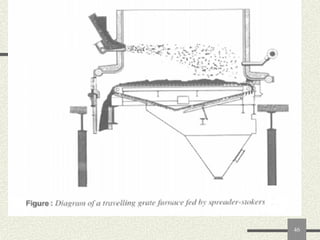
Spreader stoker
• Fuel particles are fed into the firebox

and flung, mechanically or
pneumatically across the grate
• Some heating and drying and possibly
some pyrolysis occurs while the particle
is in suspension
• Solid phase pyrolysis and char oxidation
occur on the grate.
43
44
Spreader stoker …continued
• Pre-combustion gas phase reactions

occur between the grate and the zone
where secondary air is introduced.
• Gas phase oxidation occurs either
throughout the firebox or in the vicinity
of the zone where secondary air is
introduced if the under-grate air is
limited to sub-stoichiometric quantities.
45
46
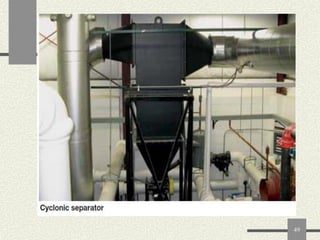
Suspension burning system:
horizontal cyclone furnace
• A horizontal or slightly inclined cylinder lined

with firebricks into which air is ejected
tangentially at a velocity of 6000- 7000 m/min.
• The flame in the furnace revolves at a rpm of

1200 to 1800
• The fuel introduced at the cyclone tip is

entrained by the revolving mass and is thrown
against the cyclone walls where it burns.
47
Horizontal cyclone furnace
• The flue gases that escape at high

velocities through the aperture at the

other end of the cyclone are substantially
free from fly ash.
• The heat release rate of (2-5 )X 106

kcal/m2-hr can be achieved for
pulverized coal in a cyclone furnace
48
49
50
Circulating Fluidized bed combustion

51
Circulating Fluidized bed combustion

52
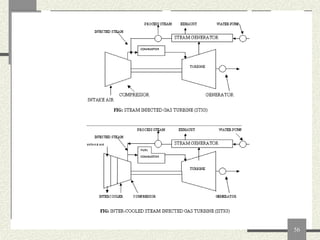
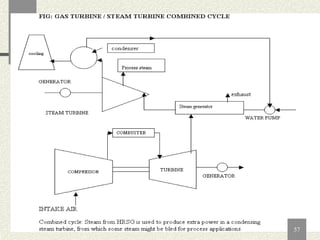
COMBINED HEAT & POWER
• STEAM INJECTED GAS TURBINE
• INTERCOOLED STEAM INJECTED GAS

TURBINE
• COMBINED CYCLE
53
biofuel use in
cogeneration cycle
• SUITABLE FOR SMALL SCALE (<10 MW)

GENERATION
• PRODUCES LESS AIR POLLUTANTS AND

SOLID WASTES
• AUGMENTS POWER SUPPLY TO

INDUSTRY
54
BIOMASS INTEGRATED GASIFIER /GAS
TURBINE (BIG/ GT) TECHNOLOGY
 

HIGH THERMODYNAMIC CYCLE
EFFICIENCY
 
GAS TURBINES TECHNOLOGY IS
MADE AVAILABLE NOW AT REASONABLE
COSTS
 
LOW UNIT CAPITAL COST AT
MODEST SCALES FEASIBLE
 
IT IS EXPECTED THAT THIS
TECHNOLOGY WILL BE COMMERCIALLY
SUCCESSFUL IN THE NEXT FIVE YEARS.
55
56
57
Reference Books
•

•

•

A. Chakraverthy, “Biotechnology and
Alternative Technologies for Utilisation of
Biomass / Agricultural Wastes”, Oxford &
IBH publishing Co., N. Delhi, 1989.
Samir Sarkar, Fuels and Combustion, 2nd
Edition, Orient Longman, 1990
Chapters on Combustion process
Stoichiometry and Thermodynamics,
Combustion Kinetics and Combustion
Appliances. pages 217 to 326
58
Reference Books / journals
Journal—„Biomass and Bio-energy‟,
a) 1996, 11(4): 271-281 „Biomass Combustion
for power generation‟
b) 1998, 14(1): 33-56 „De-centralized biomass
combustion: state of the art and future
development‟
4. Wood Combustion, Tillman, Ch.
5 „Heat
production & release from wood combustion‟,
5. Progress in biomass Conversion, vol 3, Edited
by K V Sarkanen, D A Tillman and. E C Jahn,
Academic Press, 1982
59
Reference Books / journals
6. Solid Fuels Combustion and Gasification,
Marcio L.de Souza-Santos, MARCEL
DEKKER, 2005
7. Wood Energy News, October 1999, Vol. 14,
No 9, The Regional Wood Energy
Development Programme in Asia (RWEDP), Email: rwedp@fao.org, „Wood energy in India‟

60

Combustion of solid biofuel

  • 1.
    COMBUSTION OF SOLIDBIOFUEL Solid Bio-fuels - Characteristics - Properties - Preparation of biomass as feedstock for combustion reactorCombustion Process and equipment - Combined Cycle Operation
  • 2.
  • 3.
    Forestry in theNew Millennium Tropical India, with its adequate sunlight, rainfall, land and labour, is ideally suitable for tree plantations. With the enhanced plan outlay for forestry sector and financial support from donor agencies, the country is able to march ahead towards the target of 33 percent forest cover. 3
  • 4.
    What is biomass? Biomassis plant matter such as trees, grasses, agricultural crops (residues), tree borne oil seeds or other biological material. It may be divided into woody, non-woody and aqueous waste with high BOD content. Fuels derived from biomass are called biofuels compared with petroleum based fuels. It can be used as a solid fuel, or converted into liquid or gaseous forms for the production of electric power, heat, chemicals, or fuels. 4
  • 5.
    RURAL DOMESTIC USE:FUEL FOR COOKING Cooking energy constitutes about 85 percent of our rural energy demand and has traditionally been met by biomass fuels such as firewood, agricultural residues and animal wastes. Under the National Programme on Improved Cookstoves, about 30 million cookstoves have so far been installed, which are helping to cut back and conserve fuelwood use. 5
  • 6.
    Can solid biofuelsbe used in Power Plants? Power generation plants fired solely by biomass are small compared with conventional coal, gas, oil or nuclear stations. This size depends on biomass growing capacity and delivery. Transport of biomass, a material with a low bulk energy density is expensive when conveyed over the long distances to larger plants. The traffic involved may also be a major local concern. Specific capital cost, efficiency and specific operational cost advantages of larger power plants are balanced against fuel transport issues. 6
  • 7.
    What inputs areneeded to develop biofuels?  Biofuel as energy source of rural poor people     requires social and technical inputs to make it a modern sustainable system. Wasteland Forest wastes _ forest tree twigs, shrubs Marginal Croplands Overcome disadvantage of low bulk energy density of particulate biomass by preparatory process like briquetting. 7
  • 8.
    Give examples ofsolid bio-fuels WOOD [Forestry / agro-forestry based] BAGASSE [Agro - industry residue] RICE HUSK [Crop residue] NEEM ETC.- [Multi-purpose trees] PROSOPIS ETC.- [Energy crops] 8
  • 9.
    Common sources ofsolid bio-fuels 9
  • 10.
  • 11.
    APPLCATIONS OF BIOMASS COMBUSTION •RURAL DOMESTIC: COOKING • HEAT & STEAM FOR SMALL SCALE PROCESS • COGENERATION / COMBINED CYCLE FOR ELECTRIC POWER GENERATION 11
  • 12.
    What is theadvantage of solid bio-fuel over coal as fuel for combustion? • For decentralized and small / medium scale operation where coal mines are remote but forest resource / woodlands are near. • Restricts the emission of green house gases and air pollutants (like SO2). •Lessens our dependence on imported hydrocarbon fuels, creates rural employment. 12
  • 13.
    As fuel forcombustion, what are the disadvantages of solid bio-fuel over coal? • Availability is location specific and limited • Lower calorific value; variable particle size • Preparation like drying, briquetting etc. needed for wood /agro-residue • Price depends on production system like energy plantation, social forestry, saw mills, paddy processing etc. • India‟s Forest resource is highly stressed 13
  • 14.
    Biomass Power Potential(MW):2000 Source Potential(MW) From surplus Biomass 16000 From bagasse based co-generation in the existing sugar mills Total 3500 19500 Ref: MNES Annual Report, 1999 14
  • 15.
    Important Properties and Suitability asfuel MOISTURE CONTENT ELEMENTAL ANALYSIS CHEMICAL COMPOSITION PARTICLE SIZE & DISTRIBUTION SUITABLE WHERE LOCALLY AVAILABLE THROGHOUT THE YEAR AND FOR SMALL & MEDIUM SCALE OPERATION 15
  • 16.
    Proximate and UltimateAnalysis, and HHV Proximate Analysis: (1) Moisture, (2) Volatile, (3) Fixed carbon and (4) Ash. [Wt %] Ultimate Analysis : C, H, O, N, S. [Wt %] Higher Heating Value, MJ/Kg 16
  • 17.
  • 18.
  • 19.
    Providing the Draft Prequired to make the air flow through the fuel bed and to the flue gas discharge height is called draft of air in a furnace and is expressed in millimeters of water. Natural: by means of a chimney Artificial: The fan is used to suck the gases away from the furnace [induced draft], or to force the air required [forced draft] through the grate. 19
  • 20.
  • 21.
    Thermal decomposition stepsfor a biofuel: 21
  • 22.
    COMBUSTION REACTIONS C6n[H2O]5n =6nC + 5nH2O Biomass C + O2 + 3.79N2 = 3.79N2 +CO2 EXOTHERMIC, 395400 KJ / KG ATOM OF CARBON 22
  • 23.
    COMBUSTION PROCESS • Combustion:Oxidation of reduced forms of carbon and hydrogen by free radical processes. • Chemical properties determine the higher heating value & the pathways of combustion. • Bio-fuel: A wet (50% moist), dirty, light in weight, heterogeneous in particle size, and quite reactive condition. 23
  • 24.
    COMBUSTION PROCESS continued Biofuelis  highly reactive,  volatile,  oxygenated  fuel of moderate heating value. Moisture content lowers the combustion efficiency and affects the economics of the fuel utilization. 24
  • 25.
    • Drying, • Pyrolysis, •Release of volatiles and • Formation of char are followed by • pre-combustion gas phase reactions • char oxidation reactions. Flaming combustion <> Glowing combustion 25
  • 26.
  • 27.
    Requirements of efficient combustion: Sufficientair to provide oxygen needed for complete burning; higher than theoretical air. Distribution of air supply: mix with fuel Secondary air to burn the volatile Volume of furnace; Flow path for flue gas Minimize heat losses 27
  • 28.
    Factors influencing thermalefficiency in wood combustion Enthalpy of the fuel Moisture content of the fuel Level of excess air employed Final stack temperature Note: Theoretical flame temperature depends on moisture content, % excess air and preheating of air 28
  • 29.
    Briquetting in India •Indian briquettes made from: groundnut shell, cotton stalk, saw dust, coffee husk, bagasse, mustard stalk and press mud. Whi • Southern region: groundnut shell and saw dust • Western and Northern regions: bagasse, groundnut shell, cotton stalk, mustard stalk and press mud briquettes. 29
  • 30.
    Briquetting continued A recentaddition: Municipal solid waste densified for use as fuel in process industries (tea, tobacco, textile, chemical, paper, starch, tyre retreading, tiles, etc.) for thermal applications. 30
  • 31.
    Screw and RamPress • Both the machines give briquettes with a density of 1-1.2 gm /cc, suitable as industrial solid fuels. • The screw type machines: briquettes with a concentric hole-- better combustibility- a preferred fuel. • These briquettes can also be more conveniently deployed in small furnaces and even cook-stoves than solid briquettes generated by a ram press. 31
  • 32.
    Screw Press forbriquettes 32
  • 33.
    Ram press forbriquettes 33
  • 34.
  • 35.
  • 36.
  • 37.
    FURNACE FOR BIOFUEL COMBUSTION Horizontalgrate furnace Chain grate furnace Inclined step grate furnace Spreader-stoker system Suspension burning system Cyclone firing system Fluidized bed combustion system 37
  • 38.
  • 39.
  • 40.
    Inclined step gratefurnace: • Fuel is fed to the top of the grate • heating and drying can occur very near to the fuel feed shoot. • Solid phase pyrolysis can occur as the fuel is sliding down the grate. 40
  • 41.
  • 42.
    Inclined step gratefurnace: ….continued • Char oxidation can occur at the base of the grate and on the dumping grate. • Gas phase reactions can be controlled by over-fire air distribution and separated completely from solid phase reactions 42
  • 43.
    Spreader stoker • Fuelparticles are fed into the firebox and flung, mechanically or pneumatically across the grate • Some heating and drying and possibly some pyrolysis occurs while the particle is in suspension • Solid phase pyrolysis and char oxidation occur on the grate. 43
  • 44.
  • 45.
    Spreader stoker …continued •Pre-combustion gas phase reactions occur between the grate and the zone where secondary air is introduced. • Gas phase oxidation occurs either throughout the firebox or in the vicinity of the zone where secondary air is introduced if the under-grate air is limited to sub-stoichiometric quantities. 45
  • 46.
  • 47.
    Suspension burning system: horizontalcyclone furnace • A horizontal or slightly inclined cylinder lined with firebricks into which air is ejected tangentially at a velocity of 6000- 7000 m/min. • The flame in the furnace revolves at a rpm of 1200 to 1800 • The fuel introduced at the cyclone tip is entrained by the revolving mass and is thrown against the cyclone walls where it burns. 47
  • 48.
    Horizontal cyclone furnace •The flue gases that escape at high velocities through the aperture at the other end of the cyclone are substantially free from fly ash. • The heat release rate of (2-5 )X 106 kcal/m2-hr can be achieved for pulverized coal in a cyclone furnace 48
  • 49.
  • 50.
  • 51.
  • 52.
  • 53.
    COMBINED HEAT &POWER • STEAM INJECTED GAS TURBINE • INTERCOOLED STEAM INJECTED GAS TURBINE • COMBINED CYCLE 53
  • 54.
    biofuel use in cogenerationcycle • SUITABLE FOR SMALL SCALE (<10 MW) GENERATION • PRODUCES LESS AIR POLLUTANTS AND SOLID WASTES • AUGMENTS POWER SUPPLY TO INDUSTRY 54
  • 55.
    BIOMASS INTEGRATED GASIFIER/GAS TURBINE (BIG/ GT) TECHNOLOGY   HIGH THERMODYNAMIC CYCLE EFFICIENCY   GAS TURBINES TECHNOLOGY IS MADE AVAILABLE NOW AT REASONABLE COSTS   LOW UNIT CAPITAL COST AT MODEST SCALES FEASIBLE   IT IS EXPECTED THAT THIS TECHNOLOGY WILL BE COMMERCIALLY SUCCESSFUL IN THE NEXT FIVE YEARS. 55
  • 56.
  • 57.
  • 58.
    Reference Books • • • A. Chakraverthy,“Biotechnology and Alternative Technologies for Utilisation of Biomass / Agricultural Wastes”, Oxford & IBH publishing Co., N. Delhi, 1989. Samir Sarkar, Fuels and Combustion, 2nd Edition, Orient Longman, 1990 Chapters on Combustion process Stoichiometry and Thermodynamics, Combustion Kinetics and Combustion Appliances. pages 217 to 326 58
  • 59.
    Reference Books /journals Journal—„Biomass and Bio-energy‟, a) 1996, 11(4): 271-281 „Biomass Combustion for power generation‟ b) 1998, 14(1): 33-56 „De-centralized biomass combustion: state of the art and future development‟ 4. Wood Combustion, Tillman, Ch. 5 „Heat production & release from wood combustion‟, 5. Progress in biomass Conversion, vol 3, Edited by K V Sarkanen, D A Tillman and. E C Jahn, Academic Press, 1982 59
  • 60.
    Reference Books /journals 6. Solid Fuels Combustion and Gasification, Marcio L.de Souza-Santos, MARCEL DEKKER, 2005 7. Wood Energy News, October 1999, Vol. 14, No 9, The Regional Wood Energy Development Programme in Asia (RWEDP), Email: rwedp@fao.org, „Wood energy in India‟ 60