INTRODUCTION
TO
ENERGY FROM BIOMASS PROCESSING
FOR INDIA

BIOMASS CONVERSION METHODS
BRIQUETTING
COMBUSTION OF SOLID BIOMASS
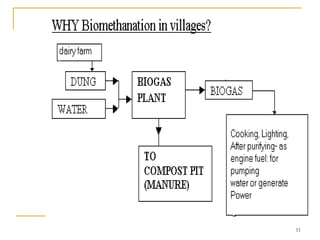
BIOMETHANATION [Biogas]
Many different biomass feedstocks can be used to
produce solid, liquid and gas fuels. They include
crops specifically grown for bioenergy, and various
agricultural residues, wood residues and waste
streams. Their costs and availability vary widely.
Collection and transportation costs are often
critical.
Biomass Feedstocks
• Agricultural crops
• Bioenergy crops
• Agricultural residues
• Wood residues
• Waste streams
2
Agricultural crops:
• Sugarcane, sugarbeet, corn, and sweet sorghum
(agricultural crops presently grown commercially for both
carbohydrate production and animal feeds.)
• Sugarcane, Corn and sweet sorghum are efficient at trapping
solar energy because they are all "C4" plants. They use special
biochemical pathways to recycle and trap carbon dioxide that is
lost through photorespiration.
• Sugarbeets are efficient because they store their carbohydrate
in the ground. Sugarcane was the basis for the World's first
renewable biofuel program in Brazil. Corn is the basis for the
present renewable ethanol fuel industry in the United States.
3
Conventional use of biomass as
low cost fuel for the poor
Before 1990s, nearly 75% of the rural Indians depended
on bio-fuels (firewood, agricultural residues, and cow
dung-cake) for 80% of their energy needs.

Similarly 25 – 30% of the urban poor, the slum dwellers
depended heavily on bio-fuels.
Why was biomass used? People’s purchasing power
was low, and commercial fuels like kerosene and LPG were
not available adequately/ not affordable.
4
Objectives of Bio-energy Program:
To make bio-energy a sustainable energy
source & elevate its present status from the
‘poor man’s oil’ into a modern energy source,

• Use advanced techniques to
produce biomass renewably and
• Convert it efficiently into electricity,
gaseous, liquid and processed solid
fuels.

5
6
INPUTS & TASKS FOR BIOMASS
UTILIZATION

7
Biomass-Production-Biomass-residue-Conversion to biofuel








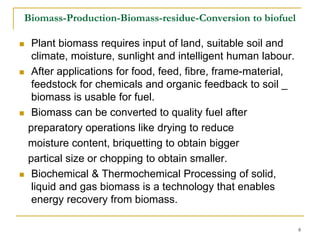
Plant biomass requires input of land, suitable soil and
climate, moisture, sunlight and intelligent human labour.
After applications for food, feed, fibre, frame-material,
feedstock for chemicals and organic feedback to soil _
biomass is usable for fuel.
Biomass can be converted to quality fuel after
preparatory operations like drying to reduce
moisture content, briquetting to obtain bigger
partical size or chopping to obtain smaller.
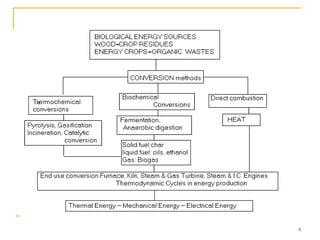
Biochemical & Thermochemical Processing of solid,
liquid and gas biomass is a technology that enables
energy recovery from biomass.
8
9
EFFICIENTLY CONVERT BIOMASS ENERGY
TO A CONVENIENT END USE FORM

10
11
RURAL BIOMASS COMBUSTION


RURAL DOMESTIC: COOKING



HEAT & STEAM: SMALL SCALE Processes



ELECTRICITY: Boiler-Steam turbine-

Generator


COGENERATION / COMBINED CYCLE
FOR PRODUCING PROCESS HEAT &
ELECTRICITY
12
BIOMASS COMBUSTION-USES

13
COMBUSTION PROCESS

14
15
Briquetting in India
In India, briquettes are mostly made from
groundnut shell, cotton stalk, saw dust,
coffee husk, bagasse, mustard stalk and
press mud. While the Southern region of
India produces briquettes mostly from
groundnut shell and saw dust, Western and
Northern regions produce bagasse,
groundnut shell, cotton stalk, mustard stalk
and press mud briquettes.
16
Briquetting continued
As a recent addition municipal solid waste is
also densified for use as fuel in process
industries (tea, tobacco, textile, chemical,
paper, starch, tyre re-treading, tiles, etc) for
thermal applications.

17
Screw and Ram Press
Both the machines give briquettes with a density
of 1-1.2 gm/cc and are suitable as industrial solid
fuels.
The screw type machines provide briquettes with a
concentric hole that gives better combustibility and
is a preferred fuel.
These briquettes can also be more conveniently
deployed in small furnaces and even cook-stoves
than solid briquettes generated by a ram press.
18
19
Ram press for briquetting

20
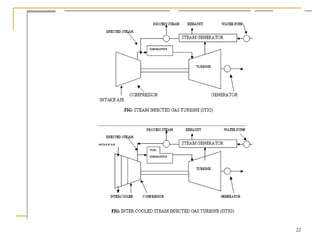
COMBINED HEAT & POWER


STEAM INJECTED GAS TURBINE



INTERCOOLED STEAM INJECTED GAS
TURBINE



COMBINED CYCLE

21
22
23
24
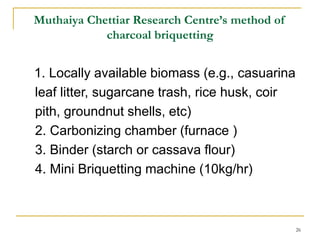
Murugappa Chettiar Research Centre,
Chennai
(Kindly approach them for permission to
Use this knowhow)

charcoal briquetting

25
Muthaiya Chettiar Research Centre’s method of
charcoal briquetting

1. Locally available biomass (e.g., casuarina
leaf litter, sugarcane trash, rice husk, coir
pith, groundnut shells, etc)
2. Carbonizing chamber (furnace )
3. Binder (starch or cassava flour)
4. Mini Briquetting machine (10kg/hr)

26
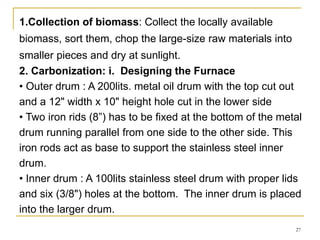
1.Collection of biomass: Collect the locally available
biomass, sort them, chop the large-size raw materials into
smaller pieces and dry at sunlight.
2. Carbonization: i. Designing the Furnace
• Outer drum : A 200lits. metal oil drum with the top cut out
and a 12" width x 10" height hole cut in the lower side
• Two iron rids (8”) has to be fixed at the bottom of the metal
drum running parallel from one side to the other side. This
iron rods act as base to support the stainless steel inner
drum.
• Inner drum : A 100lits stainless steel drum with proper lids
and six (3/8") holes at the bottom. The inner drum is placed
into the larger drum.
27
MCRC’s method of charcoal briquetting [continued]

ii. Carbonizing the biomass
• The biomass is tightly packed into the
inner drum and fired for 45minutes to 1hr
(Depending upon the biomass) using
biomass.
• After firing, the carbonized biomass in the
inner drum has to collected and weighed. In
this method 30 % of carbonized char can be
obtained.
28
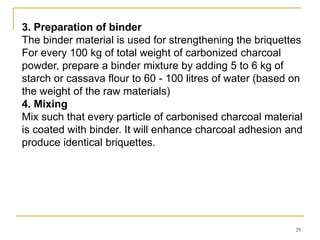
3. Preparation of binder
The binder material is used for strengthening the briquettes
For every 100 kg of total weight of carbonized charcoal
powder, prepare a binder mixture by adding 5 to 6 kg of
starch or cassava flour to 60 - 100 litres of water (based on
the weight of the raw materials)
4. Mixing
Mix such that every particle of carbonised charcoal material
is coated with binder. It will enhance charcoal adhesion and
produce identical briquettes.

29


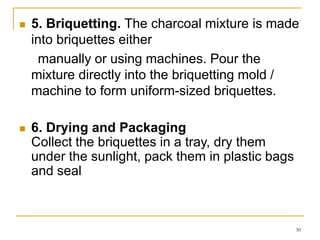
5. Briquetting. The charcoal mixture is made
into briquettes either
manually or using machines. Pour the
mixture directly into the briquetting mold /
machine to form uniform-sized briquettes.



6. Drying and Packaging
Collect the briquettes in a tray, dry them
under the sunlight, pack them in plastic bags
and seal

30
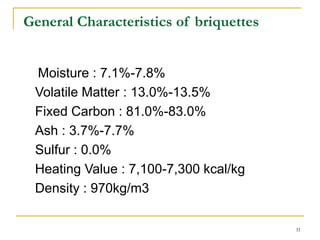
General Characteristics of briquettes
Moisture : 7.1%-7.8%
Volatile Matter : 13.0%-13.5%
Fixed Carbon : 81.0%-83.0%
Ash : 3.7%-7.7%
Sulfur : 0.0%
Heating Value : 7,100-7,300 kcal/kg
Density : 970kg/m3
31
32

Biomass energy in India

  • 1.
    INTRODUCTION TO ENERGY FROM BIOMASSPROCESSING FOR INDIA BIOMASS CONVERSION METHODS BRIQUETTING COMBUSTION OF SOLID BIOMASS BIOMETHANATION [Biogas]
  • 2.
    Many different biomassfeedstocks can be used to produce solid, liquid and gas fuels. They include crops specifically grown for bioenergy, and various agricultural residues, wood residues and waste streams. Their costs and availability vary widely. Collection and transportation costs are often critical. Biomass Feedstocks • Agricultural crops • Bioenergy crops • Agricultural residues • Wood residues • Waste streams 2
  • 3.
    Agricultural crops: • Sugarcane,sugarbeet, corn, and sweet sorghum (agricultural crops presently grown commercially for both carbohydrate production and animal feeds.) • Sugarcane, Corn and sweet sorghum are efficient at trapping solar energy because they are all "C4" plants. They use special biochemical pathways to recycle and trap carbon dioxide that is lost through photorespiration. • Sugarbeets are efficient because they store their carbohydrate in the ground. Sugarcane was the basis for the World's first renewable biofuel program in Brazil. Corn is the basis for the present renewable ethanol fuel industry in the United States. 3
  • 4.
    Conventional use ofbiomass as low cost fuel for the poor Before 1990s, nearly 75% of the rural Indians depended on bio-fuels (firewood, agricultural residues, and cow dung-cake) for 80% of their energy needs. Similarly 25 – 30% of the urban poor, the slum dwellers depended heavily on bio-fuels. Why was biomass used? People’s purchasing power was low, and commercial fuels like kerosene and LPG were not available adequately/ not affordable. 4
  • 5.
    Objectives of Bio-energyProgram: To make bio-energy a sustainable energy source & elevate its present status from the ‘poor man’s oil’ into a modern energy source, • Use advanced techniques to produce biomass renewably and • Convert it efficiently into electricity, gaseous, liquid and processed solid fuels. 5
  • 6.
  • 7.
    INPUTS & TASKSFOR BIOMASS UTILIZATION 7
  • 8.
    Biomass-Production-Biomass-residue-Conversion to biofuel     Plantbiomass requires input of land, suitable soil and climate, moisture, sunlight and intelligent human labour. After applications for food, feed, fibre, frame-material, feedstock for chemicals and organic feedback to soil _ biomass is usable for fuel. Biomass can be converted to quality fuel after preparatory operations like drying to reduce moisture content, briquetting to obtain bigger partical size or chopping to obtain smaller. Biochemical & Thermochemical Processing of solid, liquid and gas biomass is a technology that enables energy recovery from biomass. 8
  • 9.
  • 10.
    EFFICIENTLY CONVERT BIOMASSENERGY TO A CONVENIENT END USE FORM 10
  • 11.
  • 12.
    RURAL BIOMASS COMBUSTION  RURALDOMESTIC: COOKING  HEAT & STEAM: SMALL SCALE Processes  ELECTRICITY: Boiler-Steam turbine- Generator  COGENERATION / COMBINED CYCLE FOR PRODUCING PROCESS HEAT & ELECTRICITY 12
  • 13.
  • 14.
  • 15.
  • 16.
    Briquetting in India InIndia, briquettes are mostly made from groundnut shell, cotton stalk, saw dust, coffee husk, bagasse, mustard stalk and press mud. While the Southern region of India produces briquettes mostly from groundnut shell and saw dust, Western and Northern regions produce bagasse, groundnut shell, cotton stalk, mustard stalk and press mud briquettes. 16
  • 17.
    Briquetting continued As arecent addition municipal solid waste is also densified for use as fuel in process industries (tea, tobacco, textile, chemical, paper, starch, tyre re-treading, tiles, etc) for thermal applications. 17
  • 18.
    Screw and RamPress Both the machines give briquettes with a density of 1-1.2 gm/cc and are suitable as industrial solid fuels. The screw type machines provide briquettes with a concentric hole that gives better combustibility and is a preferred fuel. These briquettes can also be more conveniently deployed in small furnaces and even cook-stoves than solid briquettes generated by a ram press. 18
  • 19.
  • 20.
    Ram press forbriquetting 20
  • 21.
    COMBINED HEAT &POWER  STEAM INJECTED GAS TURBINE  INTERCOOLED STEAM INJECTED GAS TURBINE  COMBINED CYCLE 21
  • 22.
  • 23.
  • 24.
  • 25.
    Murugappa Chettiar ResearchCentre, Chennai (Kindly approach them for permission to Use this knowhow) charcoal briquetting 25
  • 26.
    Muthaiya Chettiar ResearchCentre’s method of charcoal briquetting 1. Locally available biomass (e.g., casuarina leaf litter, sugarcane trash, rice husk, coir pith, groundnut shells, etc) 2. Carbonizing chamber (furnace ) 3. Binder (starch or cassava flour) 4. Mini Briquetting machine (10kg/hr) 26
  • 27.
    1.Collection of biomass:Collect the locally available biomass, sort them, chop the large-size raw materials into smaller pieces and dry at sunlight. 2. Carbonization: i. Designing the Furnace • Outer drum : A 200lits. metal oil drum with the top cut out and a 12" width x 10" height hole cut in the lower side • Two iron rids (8”) has to be fixed at the bottom of the metal drum running parallel from one side to the other side. This iron rods act as base to support the stainless steel inner drum. • Inner drum : A 100lits stainless steel drum with proper lids and six (3/8") holes at the bottom. The inner drum is placed into the larger drum. 27
  • 28.
    MCRC’s method ofcharcoal briquetting [continued] ii. Carbonizing the biomass • The biomass is tightly packed into the inner drum and fired for 45minutes to 1hr (Depending upon the biomass) using biomass. • After firing, the carbonized biomass in the inner drum has to collected and weighed. In this method 30 % of carbonized char can be obtained. 28
  • 29.
    3. Preparation ofbinder The binder material is used for strengthening the briquettes For every 100 kg of total weight of carbonized charcoal powder, prepare a binder mixture by adding 5 to 6 kg of starch or cassava flour to 60 - 100 litres of water (based on the weight of the raw materials) 4. Mixing Mix such that every particle of carbonised charcoal material is coated with binder. It will enhance charcoal adhesion and produce identical briquettes. 29
  • 30.
     5. Briquetting. Thecharcoal mixture is made into briquettes either manually or using machines. Pour the mixture directly into the briquetting mold / machine to form uniform-sized briquettes.  6. Drying and Packaging Collect the briquettes in a tray, dry them under the sunlight, pack them in plastic bags and seal 30
  • 31.
    General Characteristics ofbriquettes Moisture : 7.1%-7.8% Volatile Matter : 13.0%-13.5% Fixed Carbon : 81.0%-83.0% Ash : 3.7%-7.7% Sulfur : 0.0% Heating Value : 7,100-7,300 kcal/kg Density : 970kg/m3 31
  • 32.