BIOMASS CONVERSION
FOR
ENERGY UTILIZATION
BIOFUELS
GENERATION FROM BIOMASS
Biomass Conversion
Contents
•
•
•
•
•
•

Energy Crisis: Inefficient use of biofuels
Objectives of Bio-energy Program
Biomass to Energy Conversion Methods
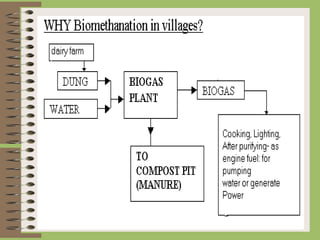
Biomethanation: Rural applications
Biogas Technology: Topics
Biofuel: Combustion of solid fuels
Energy Crisis:
Inefficient use of biofuels
o Nearly 75% of the rural Indians depend on biofuels (firewood, agricultural residues, and cow dung-

cake) for 80% of their energy needs.
o Similarly 25 – 30% of the urban poor, the slum
dwellers depend heavily on bio-fuels.
o Biomass is used as: People’s purchasing power is
low, & commercial fuels: kerosene and LPG are not
available adequately.
Objectives of Bio-energy Program:
To make bio-energy a major energy
source & elevate its present status as
the ‘poor man’s oil’ into a modern energy
source, use advanced techniques to

produce biomass renewably and to
convert it efficiently into electricity,
gaseous, liquid and processed solid
fuels.
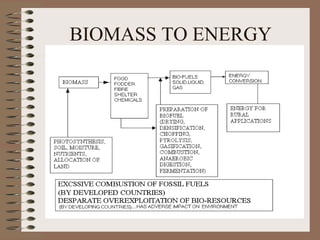
BIOMASS TO ENERGY
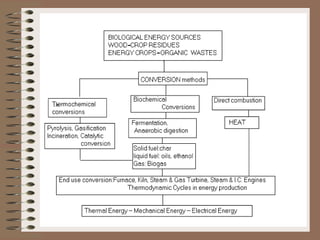
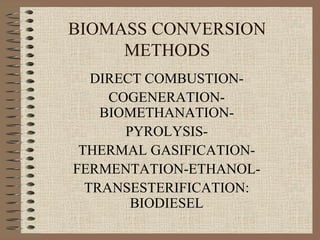
BIOMASS CONVERSION
METHODS
DIRECT COMBUSTIONCOGENERATIONBIOMETHANATIONPYROLYSISTHERMAL GASIFICATIONFERMENTATION-ETHANOLTRANSESTERIFICATION:
BIODIESEL
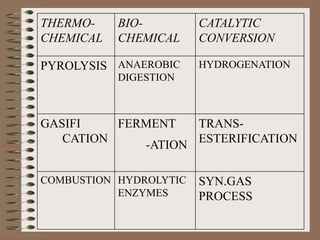
THERMOCHEMICAL

BIOCHEMICAL

PYROLYSIS ANAEROBIC

CATALYTIC
CONVERSION
HYDROGENATION

DIGESTION

GASIFI
FERMENT
TRANSCATION
ESTERIFICATION
-ATION
COMBUSTION HYDROLYTIC
ENZYMES

SYN.GAS
PROCESS
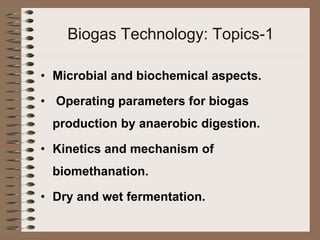
Biogas Technology: Topics-1
• Microbial and biochemical aspects.
• Operating parameters for biogas
production by anaerobic digestion.
• Kinetics and mechanism of
biomethanation.
• Dry and wet fermentation.
Biogas Technology: Topics-2
• Digesters for rural application.
• MNES Recognized biogas-plant models.
• High rate digesters for industrial waste
water treatment.
• Biogas as a fuel for stationary dual fuel

engines.
BIOMASS COMBUSTION

• RURAL DOMESTIC: COOKING
• HEAT & STEAM: SMALL SCALE
• ELECTRIC POWER GENERATION:

• COGENERATION / COMBINED
CYCLE
Burning Wood Better
• Inefficient burning of wood causes an air
pollution problem as well as less efficient
use of wood fuel.
• The operator of a wood burning device
needs to maintain a hot fire with an
adequate supply of air to burn the volatile
gases as they are released from the wood.
• Control heat output primarily by fuel load
size rather than by air control only.
• Burn only dry and properly seasoned wood
in a stove. Never burn trash, coal, railroad
ties, plastics or wrapping paper.
Conditions for efficient Combustion-1
• Sufficient air to provide oxygen needed for
complete burning; higher than stoichiometric
amount of air is supplied.
• Free and intimate contact between fuel and oxygen
by distribution of air supply.

• Secondary air to burn the volatile mass leaving the
fuel bed completely before it leaves the combustion

zone.
Continued…
Conditions for efficient Combustion-2
• Volatile matter leaving the fuel bed should not cool
below combustion temperature by dilution with the
flue gas. Flow path should assure this.
• Volume of the furnace should be arranged so as to
provide for expansion of gases at high temperature
and complete burning of volatile matter before
flowing away.
DRAFT: The pressure difference required to make
the air flow through the fuel bed and to the flue gas

discharge height is called draft of air in a furnace and
is expressed in millimeters of water.
The draft is produced either naturally by
means of a chimney or mechanically by a fan.
Mechanical draft can be either induced draft or a
forced draft depending on whether the fan is used to
suck the gases away from the furnace or to force the

air required for combustion through the grate
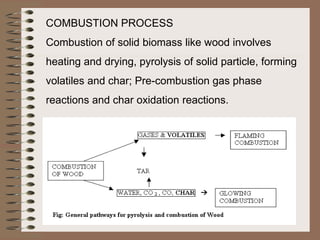
COMBUSTION PROCESS
Combustion of solid biomass like wood involves
heating and drying, pyrolysis of solid particle, forming
volatiles and char; Pre-combustion gas phase
reactions and char oxidation reactions.
To determine the quantity of air required for
complete combustion
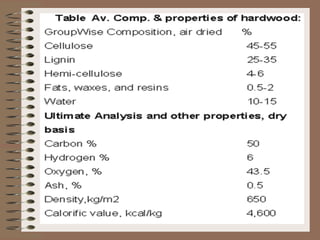
• To determine the air, the ultimate analysis is useful.
• C + O2 = CO2 +97644 cal /mole [[15 o C]
• H2 +O2 = H2O + 69000 cal / mole [15 o C]

• Excess air % = (40*MCg)/(1- MCg) where MCg is
moisture content on total wt basis (green). For typical
biomass fuels at 50 % moisture content, for grate firing
system about 40% excess air may be required.
• For suspension fired and fluidized bed combustion, air
required may be 100 % excess
• Distribution of air and whether it is pre-heated is also
important
Combustion equipment for solid biomass

•
•

•
•

For wood:
Inclined step grate furnace
Spreader Stoker
For solid biomass particulates- (agroresidues):
Cyclonic, Suspension Fired Combustion
System
Fluidised Bed Combustion System
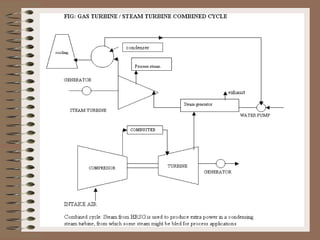
BIOMASS INTEGRATED GASIFIER /GAS
TURBINE (BIG/ GT) TECHNOLOGY
• HIGH THERMODYNAMIC CYCLE
EFFICIENCY

GAS TURBINES TECHNOLOGY IS
MADE AVAILABLE NOW AT REASONABLE
COSTS

LOW UNIT CAPITAL COST AT MODEST
SCALES FEASIBLE

IT IS EXPECTED THAT THIS
TECHNOLOGY WILL BE COMMERCIALLY
SUCCESSFUL IN THE NEXT TEN YEARS.
Biomass conversion  for energy

Biomass conversion for energy

  • 1.
  • 2.
    Biomass Conversion Contents • • • • • • Energy Crisis:Inefficient use of biofuels Objectives of Bio-energy Program Biomass to Energy Conversion Methods Biomethanation: Rural applications Biogas Technology: Topics Biofuel: Combustion of solid fuels
  • 3.
    Energy Crisis: Inefficient useof biofuels o Nearly 75% of the rural Indians depend on biofuels (firewood, agricultural residues, and cow dung- cake) for 80% of their energy needs. o Similarly 25 – 30% of the urban poor, the slum dwellers depend heavily on bio-fuels. o Biomass is used as: People’s purchasing power is low, & commercial fuels: kerosene and LPG are not available adequately.
  • 4.
    Objectives of Bio-energyProgram: To make bio-energy a major energy source & elevate its present status as the ‘poor man’s oil’ into a modern energy source, use advanced techniques to produce biomass renewably and to convert it efficiently into electricity, gaseous, liquid and processed solid fuels.
  • 5.
  • 7.
    BIOMASS CONVERSION METHODS DIRECT COMBUSTIONCOGENERATIONBIOMETHANATIONPYROLYSISTHERMALGASIFICATIONFERMENTATION-ETHANOLTRANSESTERIFICATION: BIODIESEL
  • 8.
  • 10.
    Biogas Technology: Topics-1 •Microbial and biochemical aspects. • Operating parameters for biogas production by anaerobic digestion. • Kinetics and mechanism of biomethanation. • Dry and wet fermentation.
  • 11.
    Biogas Technology: Topics-2 •Digesters for rural application. • MNES Recognized biogas-plant models. • High rate digesters for industrial waste water treatment. • Biogas as a fuel for stationary dual fuel engines.
  • 12.
    BIOMASS COMBUSTION • RURALDOMESTIC: COOKING • HEAT & STEAM: SMALL SCALE • ELECTRIC POWER GENERATION: • COGENERATION / COMBINED CYCLE
  • 13.
    Burning Wood Better •Inefficient burning of wood causes an air pollution problem as well as less efficient use of wood fuel. • The operator of a wood burning device needs to maintain a hot fire with an adequate supply of air to burn the volatile gases as they are released from the wood. • Control heat output primarily by fuel load size rather than by air control only. • Burn only dry and properly seasoned wood in a stove. Never burn trash, coal, railroad ties, plastics or wrapping paper.
  • 17.
    Conditions for efficientCombustion-1 • Sufficient air to provide oxygen needed for complete burning; higher than stoichiometric amount of air is supplied. • Free and intimate contact between fuel and oxygen by distribution of air supply. • Secondary air to burn the volatile mass leaving the fuel bed completely before it leaves the combustion zone. Continued…
  • 18.
    Conditions for efficientCombustion-2 • Volatile matter leaving the fuel bed should not cool below combustion temperature by dilution with the flue gas. Flow path should assure this. • Volume of the furnace should be arranged so as to provide for expansion of gases at high temperature and complete burning of volatile matter before flowing away.
  • 19.
    DRAFT: The pressuredifference required to make the air flow through the fuel bed and to the flue gas discharge height is called draft of air in a furnace and is expressed in millimeters of water. The draft is produced either naturally by means of a chimney or mechanically by a fan. Mechanical draft can be either induced draft or a forced draft depending on whether the fan is used to suck the gases away from the furnace or to force the air required for combustion through the grate
  • 20.
    COMBUSTION PROCESS Combustion ofsolid biomass like wood involves heating and drying, pyrolysis of solid particle, forming volatiles and char; Pre-combustion gas phase reactions and char oxidation reactions.
  • 21.
    To determine thequantity of air required for complete combustion • To determine the air, the ultimate analysis is useful. • C + O2 = CO2 +97644 cal /mole [[15 o C] • H2 +O2 = H2O + 69000 cal / mole [15 o C] • Excess air % = (40*MCg)/(1- MCg) where MCg is moisture content on total wt basis (green). For typical biomass fuels at 50 % moisture content, for grate firing system about 40% excess air may be required. • For suspension fired and fluidized bed combustion, air required may be 100 % excess • Distribution of air and whether it is pre-heated is also important
  • 22.
    Combustion equipment forsolid biomass • • • • For wood: Inclined step grate furnace Spreader Stoker For solid biomass particulates- (agroresidues): Cyclonic, Suspension Fired Combustion System Fluidised Bed Combustion System
  • 23.
    BIOMASS INTEGRATED GASIFIER/GAS TURBINE (BIG/ GT) TECHNOLOGY • HIGH THERMODYNAMIC CYCLE EFFICIENCY  GAS TURBINES TECHNOLOGY IS MADE AVAILABLE NOW AT REASONABLE COSTS  LOW UNIT CAPITAL COST AT MODEST SCALES FEASIBLE  IT IS EXPECTED THAT THIS TECHNOLOGY WILL BE COMMERCIALLY SUCCESSFUL IN THE NEXT TEN YEARS.