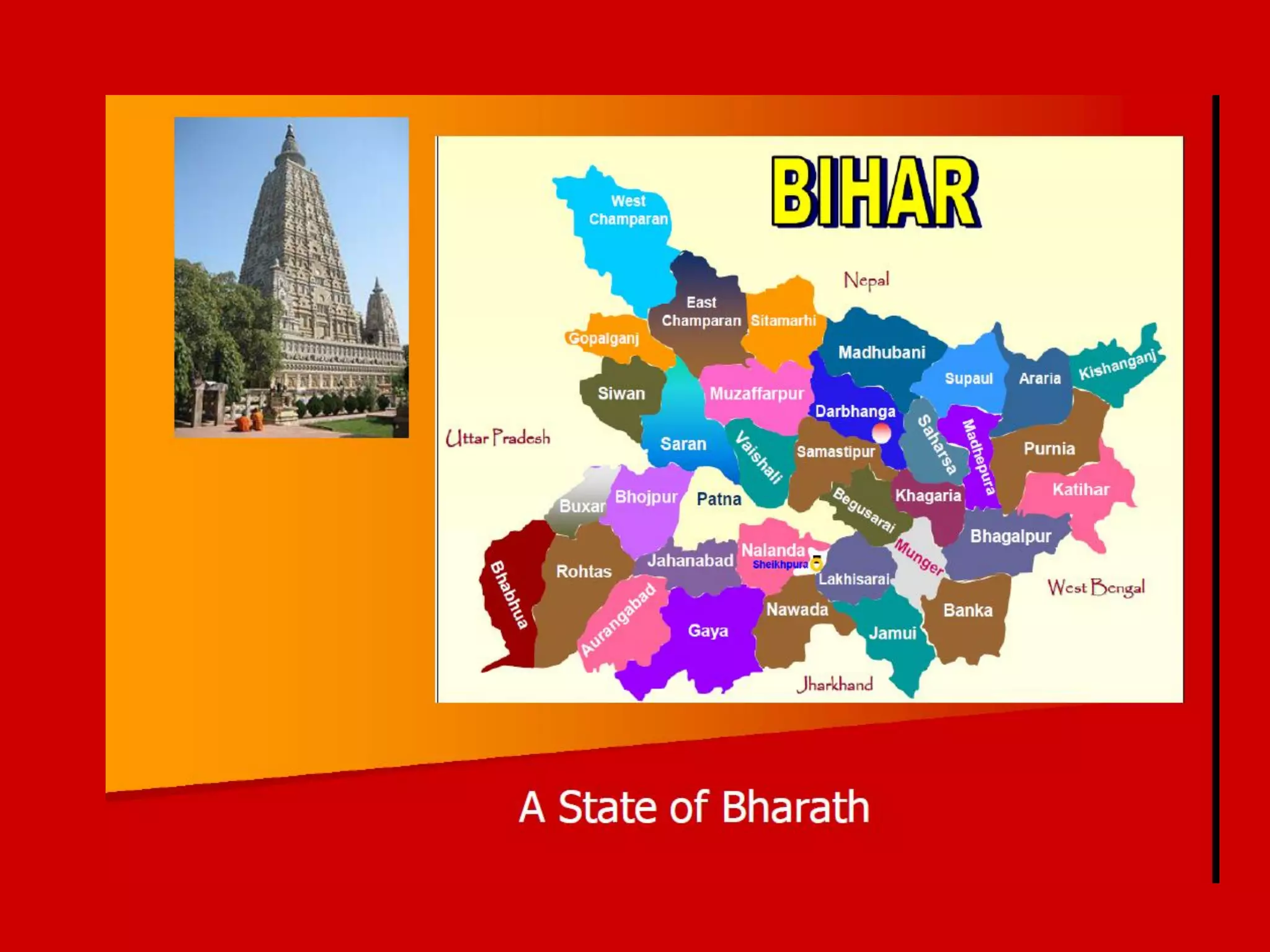
Nepal
Uttar frade,h
West !)engal
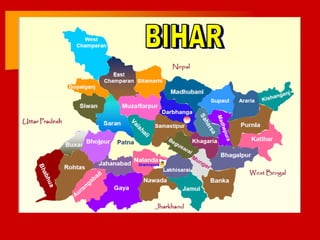
A State of Bharath
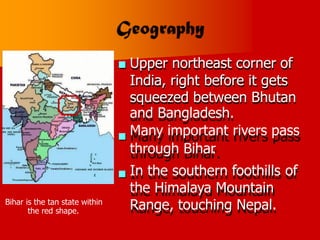
Upper northeast corner of
India, right before it gets
squeezed between Bhutan
and Bangladesh.
Many important rivers pass
through Bihar
.
In the southern foothills of
the Himalaya Mountain
Range, touching Nepal.



Bihar is the tan state within
the red shape.
-·--
,.�-
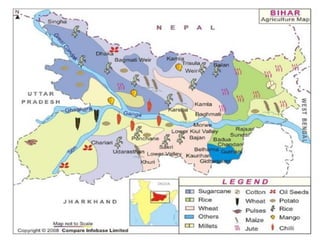
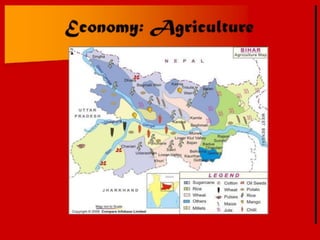
BIHAR
Agriculture Map
'•
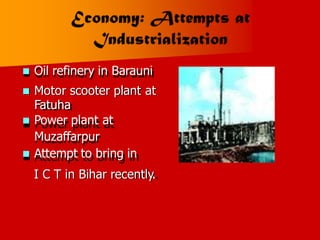
'
N
Singha -·
q.
�
- p
E
N A L
. ' - •
.I',
--.-
.
_
..
-,
-
,, -:»: / -c
�·  ..,.c.,'! -.
-
"
.r » '-
.. J 
Ba11"18ti Weir
..
la ..
.....,
,
�
Tnsula ,,.��er
',) ,)'t.t/.
Q n
Weir
I .-.
I (
•
•
• ·
.,
�
II I
PRADESH
OJ
m
,
.
'-
,
,
�
)
-J
'r
J
-Potato
Rice
Mango
Chilli
JHARKHAND
f
� Wheat
-Others
CD Millets
.._.

'
Pulses
Maize
Jute
Q
•
Map not to�
Copyright C 2008 Compare lnfoba•• Limit.ct
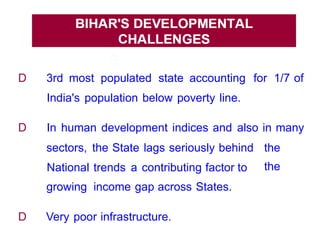
BIHAR'
S
DEVELOPMENTA
L
CHALLENGE
S
D 3rd most populated state accounting for 1/7 of
India's population below poverty line.
D In human development indices and also in many
sectors,
National
growing
the State lags seriously behind
trends a contributing factor to
income gap across States.
the
the
D Very poor infrastructure.
Bihar has a population of 104 million.

 It is
 The
 This
a majority male population(52.6%)
total area of land is 94,163 sq. km
is divided into two main regions: the
North Ganga Plain and the South Ganga
Plain
 Further divided there are 38 districts
Capital city is Patna

 Per capita income was Rs. 28317
 Density: 880 people per sq. mile
 Birth rate: 30.9 per 1000
in 2012-13
Death rate: 7.9 per 1000

 Population grew 28.4% from
 Rural development has three
1991-2001
actors i.e.
officials, elected representatives and
villagers.
Bihar has alluvial soil, replenished by flood

waters, suitable for agriculture.
 Often a governing elite that controlled
the political and the economic aspects
life.
both
of
 Trade (and migration) is increasingly
important.
The Ganges divides Bihar into two unequal
halves and flows through the middle from
west to east. Other Ganges tributaries are
the Son, Budhi Gandak, Chandan, Orhani
and Phalgu.
Though the Himalayas begin at the foothills,
a short distance inside Nepal and to the
north of Bihar
, the mountains influence
Bihar's landforms, climate, hydrology and
culture.
Central parts of Bihar have some small
hills, for example the Rajgir hills.
T
o the south is the Chota Nagpur plateau,
which was part of Bihar until 2000 but
now is part of a separate state called
Jharkhand.
 Gross state domestic product of Bihar for the year
2013/2014 has been around 3683.37 billion INR.
 By sectors, its composition is:
– Agriculture = 22%
– Industry = 5%
– Services = 73%.
 The economy of Bihar is largely service-oriented,
has a significant agricultural base. The state also
but
has
it
a
small industrial sector
. More recently, Bihar's state GDP
recorded a very high growth (in the excess of 10%),
making Bihar the fastest growing major state of India.
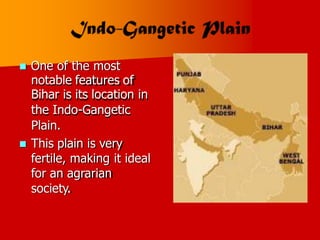
 One of the most
notable features of
Bihar is its location in
the Indo-Gangetic
Plain.
 This plain is very
fertile, making it ideal
for an agrarian
society.
Located in the northeast of the country, on the

border with Nepal, Bihar was India’s third
populous state.
Historically, it was the base of an agrarian
movement that championed the rights of
most

peasant farmers. Most of its residents were
scattered across 45,000 villages, where many
cultivated the plain that surrounded the Ganges
River
.
Bihar was the country’s poorest state, and more
than half the population subsisted on less than
the equivalent of one US dollar a day.

 Historically Bihar had been a major
of learning
 Originated from the time of Buddha or
even earlier
 Home of one of the earliest universities,
center
Nalanda, which dates back to the
century
5th
 Vikramshia, which is another university is
located there as well
During medieval period, education
was lost.
Believed that marauding armies of
the invaders destroyed the
centers of learning.
Has an overall literacy of 63.82%
Male literacy rate of 73.39%
Female literacy rate of 53.57%
Only 21% of all primary school teachers
completed the matriculation



 have
Because of the law of affirmative action that
reserves jobs and education for people of
backward classes, students from Bihar are
performing well in respect to better economically
well off states in India

 During 1970s and 1980s government
took control over private schools
 Because government was ill-equipped
the standards of the schools began to fall
 However
, government did not take over
schools ran by Christian missionaries,
and these schools still provided quality
education
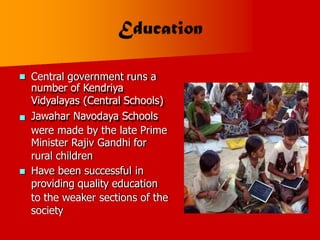
Central government runs a
number of Kendriya
Vidyalayas (Central Schools)
Jawahar Navodaya Schools
were made by the late Prime
Minister Rajiv Gandhi for
rural children
Have been successful in
providing quality education
to the weaker sections of the
society



Literacy rate from 1951 to 2011[99]
Year T
otal
1961 21.95
1971 23.17
1981 32.32
1991 37
.49
2001 47
.53
2011 63.82
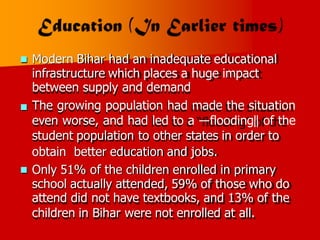
Modern Bihar had an inadequate educational
infrastructure which places a huge impact
between supply and demand
The growing population had made the situation
even worse, and had led to a ―flooding‖ of the
student population to other states in order to


obtain better education and jobs.
Only 51% of the children enrolled in primary
school actually attended, 59% of those who do
attend did not have textbooks, and 13% of the
children in Bihar were not enrolled at all.

Bihar lagged behind in the overall progress of
India.
 Per capita GDP: Rs. 4000 per month in Bihar
national average of Rs.12000 per month.
 Nearly 10% more people living below the
poverty line than the average for India
Reasons for slow development
 Inadequate investment in infrastructure,
irrigation, and technology.
vs.
 CM Nitish Kumar tried to change this from 2005.
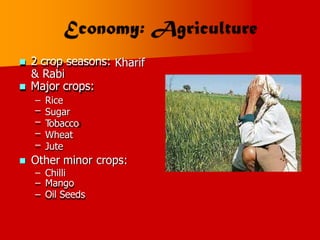
 2 crop seasons:
& Rabi
 Major crops:
Kharif
–
–
–
–
–
Rice
Sugar
T
obacco
Wheat
Jute
 Other minor crops:
–
–
–
Chilli
Mango
Oil Seeds
.
,
t •00
1
..
..
_,..
.J
,(."
. -
-
.
.
r,
'
_,
N
.
'
.I
,-
I
, N E P A L
,,,
·,
I
)
L .....
'1Bettiah
·,.- ..
,.
...........
.)
.f
I
-
I
, ©
,..
�.,:,
, .- ' Gopalg•nJ
®
UTTAR
PRADESH
®
Shivhar
Mu
•zaffarpur
r.
·, •
.,Chl,>pra
,.... 1_f°", ,,.,
Samastipur
- ®
Pum1a
HaJipur
''
Ara 0
Buxa
r
I
{'
.......,
Khagarla
®
®Mung@r
PATN
A
I
_, KaLihar
...
,.,
Begusaral®
,,-
I
.••
l v,esr
• ., """ "'
BENGAL
Jahanablld ® Bihar1'1
Sharif-
I Bhabhua @Luck@esara
l
Bh�•lpur '�.: � '
J
LEGEND
Bawute
Cemenl Mortar
Dolomile
Glass Sand
M.ca
all
Others
,.I
I <i)
Shokhupura •
•
Na,v3da
'
•
®
G:lya
•
@Sasaram
® ©Jamul
'' •
•
•
Banka ,."
'
I
®
Aurangabad
,._,
t 1 ,.,,:.,•
I
",ol.l
I
t>
I I
/>:J ':.,. I...... J
't
..- r. ..,..- ...
'1,(1."'/�
•
.·
,.,.J
_....,
�/'
�
I
',
J
"
/
'-
,_J......
..'
'-
· -....
,,...,
b
-
pncttoSca S
'., JHAR.KHAND
1
t
tcp,Jright C 2006 Comps,r Wob1111 Umlt11d
'1
•
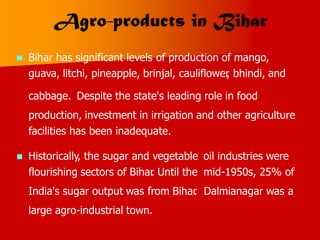
 Bihar has significant levels of production of mango,
guava, litchi, pineapple, brinjal, cauliflower
, bhindi, and
cabbage. Despite the state's leading role in food
production, investment in irrigation and other agriculture
facilities has been inadequate.
 Historically, the sugar and vegetable
flourishing sectors of Bihar
. Until the
India's sugar output was from Bihar
.
large agro-industrial town.
oil industries were
mid-1950s, 25% of
Dalmianagar was a
There were attempts to industrialise the state between
1950 and 1980: an oil refinery in Barauni, a motor scooter
plant at Fatuha, and a power plant at Muzaffarpur
.
However
, these were forced to shut down due to certain
central government policies (like the Freight Settlement
Policy) which neutralised the strategic advantages of
Bihar
. Barauni is still one of the few old industrialised
towns in the state. Hajipur
, near Patna, remains a major
industrial town in the Bihar
, linked to the capital city
through the Ganges bridge and good road infrastructure
N E P A L
/
,,.,.
,,/
I
I
'l
�
�
,
rJ
'f
)
I
LEGEND
Sugarcane
(J!J
Rice
�t Oil
Seeds
Cotton
Wheat
Pulses
Maize
Jute
- '
C]J •
I
Q
•
Potato
Rice
Mango
Chilli
JHARKHANO
..
..

11
CJ Wheat
Others
Map not to Seate
Copyright Cl 2008 Compare lnfobase Limited
OJ Millets
 Very little due to the division of southern
Bihar into the separate state of Jharkhand
 Most mineral production takes
Jharkhand
place in
Some Minerals Produced

–
–
–
Coal
Bauxite
Dolomite
 Oil refinery in Barauni
 Motor scooter plant
Fatuha
 Power plant at
Muzaffarpur
 Attempt to bring in
at
I C T in Bihar recently.
 Bicameral Legislature
– Upper-house Legislative Council
– Lower-house Legislative Assembly
 Governor appointed by president of India
– Head of state
 Real executive power rests with Chief Minister
7 administrative divisions and 39 divisions
Each division has a divisional commissioner
District magistrate and collector in each
division
Sub divisional officer in each of the 76
subdivisions




 High court at Patna
– Chief justice and several other justices
– District courts and sub divisional courts,
councils
and village
 Currently 2 main political formations
– NDA
 Janata Dal and Bharatiya Janata Party
Rashtriya Janata Dal
 Indian National Congress
–
 1995 – Lalu Prasad Yadav became chief minister
– Corruption charges forced his resignation
anointed his wife CM through proxy
– Led to deterioration of administration
but
 2005 and 2010
– In 2005, the RJD [Lalu] was voted out of power and
replaced by a coalition headed by his former ally,
Nitish Kumar
. In 2010 also his group won 206 out of
243.Bihar e-Governance Services & Technologies
(BeST) and the Government of Bihar have initiated a
unique program to establish a center of excellence
called Bihar Knowledge Center
, a finishing school.
By 2012, Bihar had earned acclaim for its technology-
related gains, and the government of India recognized the
turnaround through e-governance awards. Kumar’s efforts
earned him the nickname Sushasan Babu, or Mr
. Good
Governance.
Still, significant limitations remained: lack of integration
among information and communications systems prevented
proper coordination across departments. Lack of electricity
and Internet connectivity in many areas prevented citizens
from taking full advantage of the services.
T
rained as an engineer
, Nitish Kumar believed in
the power of technology to improve governance.
As India’s minister of railways from 2001 to 2004,
he had initiated an online ticketing process for the
100 million people who traveled by train each
year
. His emphasis on ICT as a tool for
administrative reform built on broader technology
shifts taking place in India.
Bihar is pioneer in the field of yoga with its internationally
renowned institute Bihar School of Yoga in Munger
. Bihar
e-Governance Services & T
echnologies (BeST) and the
Government of Bihar have initiated a unique program to
establish a center of excellence called Bihar Knowledge
Center
, a finishing school to equip students with the latest
skills and customised short-term training programs at an
affordable cost. The center aims to attract the youth of
the state to improve their technical, professional, and soft
skills, to meet the current requirements of the industrial
job market
Bihar, had female literacy at 53.3%. The
government has established educational
institutions to improve this.
Bihar has a National Institute of T
echnology (NIT)
in Patna and an Indian Institute of T
echnology
(IIT) in Patna.Arecent survey by Pratham rated
the absorption of their teaching by the Bihar
children better than those in other states.
The best talent pool of engineers is in Delhi,
Bihar and Jharkhand says the National
Employability Report of Engg Graduates, 2014
byAspiring Minds, which makes Bihar one of the
top three states producing best Engg Graduates
in terms of Quality and Employability
.
 Chhath
– Worship
God
 T
eej
– Worship
Parvati
of the Sun
of Goddess
Bihar has contributed to Indian (Hindustani) classical
music. Bharat Ratna Ustad Bismillah Khan was from Bihar
,
who, however
, left Bihar at an early age. Dhrupad singers
like the Malliks (of the Darbhanga Gharana), and the
Mishras (of the Bettiah Gharana), who were patronised by
the Zamindars of Darbhanga and Bettiah respectively
, have
produced masters like Ram Chatur Mallik, Abhay Narayan
Mallik, and Indra Kishore Mishra. While perhaps not as well-
known as those of the Dagar school of Dhrupad, these
masters have kept the Dhrupad tradition in perhaps the
purest
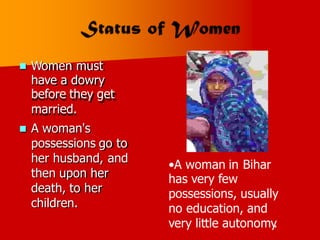
Women must
have a dowry
before they get
married.
A woman's
possessions go to
her husband, and
then upon her
death, to her
children.


•A woman in Bihar
has very few
possessions, usually
no education, and
very little autonomy
.
 Religion also played a much more
important role (long ago) e.g., Buddha,
Mahavira
 Construction of major architectural works
is more common—specifically temples and
shrines
 Advancement of leisure and arts
 Further stratification of the social classes
 Hinduism
 Buddhism
 Jainism
 The third largest religion in the
diverse sects.
 Five Basic Tenets:
world with
–
–
–
–
–
Dharma (ethics or duties)
Samsara (the continuing cycle
Karma (action and reaction)
of rebirth)
Moksha (liberation from samsara)
Yogas (paths or practices)
 Governed by the teachings of
Gautama known as Buddha
Siddhartha
–
–
–
Rebirth
Karma
The Four Noble Truths
 There
 There
 There
 There
is suffering
is
is
is
a cause of suffering
the cessation of suffering
a way leading to the cessation of suffering
 Often described as a way of life instead of
religion.
a
 Founded in the
Bihar
.
6th century B.C. in ancient
Three main tenets:
– Ahimsa (non- violence): Towards both humans and
animals. Leads to the propagation of vegetarianism

Aparigraha (non- attachment): Freeing the soul
through the disregard of material objects.
– Anekantwad (relativity): No absolute truth. Everything
is possible.
–
Ahirs
 Endogamous/ exogamous clans
 Marriages arranged
 Marriage of first cousins prohibited
 Wed at time of marriage
 Bride moves into household of husband’s
 Extended family
family
 Divorce allowed but requires approval of the
caste’s council
 Endogamous/Exogamous
 Don’t marry before the boy can build a
plow and the girl can weave and spin
 Marriages negotiated and depend on
consent of involved parties
 Bride-price paid in both cash and goods
 T
ake up residence in husband’s fathers
house
 Nuclear family preferred
Village and clan exogamy

 Patrilineal extended
 5-7 members
 Arranged marriages
family
most common
Bride price paid

 Divorce rare as marriage is seen as
lifelong undertaking
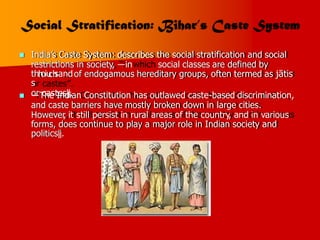
 India’s Caste System: describes the social stratification and social
restrictions in society, ―in social classes are defined by
of endogamous hereditary groups, often termed as jātis
thh
oiu
ch
sand
s
or castes‖.
 ―The Indian Constitution has outlawed caste-based discrimination,
and caste barriers have mostly broken down in large cities.
However
, it still persist in rural areas of the country, and in various
forms, does continue to play a major role in Indian society and
politics‖.
 Different Castes: Brahman, Bhumihar
, Rajput,
Banias and Kayastha are the dominant castes
 Kayasthas and Banias are the two important
caste groups in the cities and towns.
 The Brahmans and Kshatriyas belong to the
same racial stock, but the Kshatriyas ―are
more
mixed because of their marriage with various
stocks of people‖.
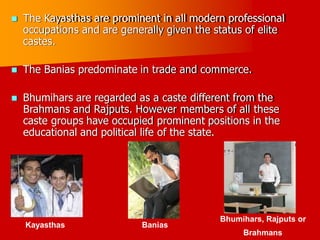
 The Kayasthas are prominent in all modern professional
occupations and are generally given the status of elite
castes.
 The Banias predominate in trade and commerce.
 Bhumihars are regarded as a caste different from the
Brahmans and Rajputs. However members of all these
in the
caste groups have occupied prominent positions
educational and political life of the state.
Bhumihars, Rajputs
Brahmans
or
Kayasthas Banias
 The lower castes consist of the Koiri,
Kurmi, Kahar
, and the Ahir
 There are many Caste rivalries and
prejudices because of narrow-mindedness;
however
, modern day education systems
and efforts the enlightened youth, ―are
gradually doing away with the prejudices‖.
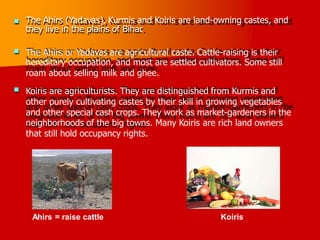
The Ahirs (Yadavas), Kurmis and Koiris are land-owning castes, and
they live in the plains of Bihar
.

The Ahirs or Yadavas are agricultural caste. Cattle-raising is their
hereditary occupation, and most are settled cultivators. Some still
roam about selling milk and ghee.
Koiris are agriculturists. They are distinguished from Kurmis and
other purely cultivating castes by their skill in growing vegetables
and other special cash crops. They work as market-gardeners in the


neighborhoods of the big towns. Many Koiris are rich land owners
that still hold occupancy rights.
Ahirs = raise cattle Koiris
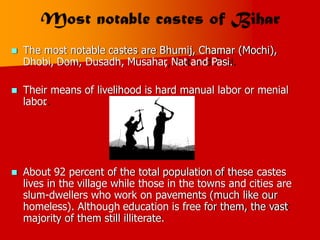
 The most notable castes are Bhumij, Chamar (Mochi),
Dhobi, Dom, Dusadh, Musahar
, Nat and Pasi.
 Their means
labor
.
of livelihood is hard manual labor or menial
 About 92 percent of the total population of these castes
lives in the village while those in the towns and cities are
slum-dwellers who work on pavements (much like our
homeless). Although education is free for them, the vast
majority of them still illiterate.
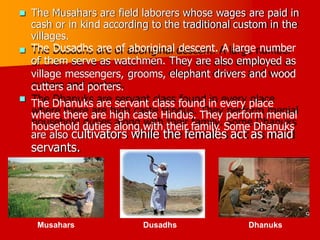
The Musahars are field laborers whose wages are paid in
cash or in kind according to the traditional custom in the
villages.
The Dusadhs are of aboriginal descent. A large number
of them serve as watchmen. They are also employed as
village messengers, grooms, elephant drivers and wood
cutters and porters.
The Dhanuks are servant class found in every place
where there are high caste Hindus. They perform menial
household duties along with their family. Some Dhanuks



are also cultivators while the females act as maid
servants.
Musahars Dusadhs Dhanuks
Prejudice against the lower castes is gradually
disappearing in Bihar
.
In the country districts, the influence of Zamindar (land
lords) families is still considerable, but their influence is
based more on their position as landlords than as
persons of title.
The middle class is made up of professionals that for the
most part have done away with caste prejudices.
Marriage is somewhat different: though inter-caste
marriages are now relatively common in India, many
Indians still consider caste a major criterion for
matrimonial choices.
Biharis still prefer to go in for arranged marriages in their
own community and caste.





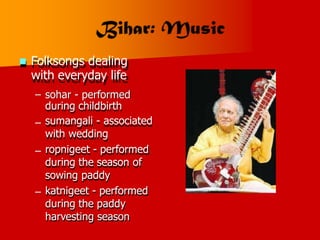
 Folksongs dealing
with everyday life
– sohar - performed
during childbirth
sumangali - associated
with wedding
ropnigeet - performed
during the season of
sowing paddy
katnigeet - performed
during the paddy
harvesting season
–
–
–
Nepal
Uttar Fradesh
West
E:,engal
Jharkhand
How did Bihaar change? The return of safety, fast
expansion of the road network and rapid spread of cell
phones all created new economic opportunities, so
economic growth galloped upward. Agriculture boomed
too and rural wages shot up in response to higher
productivity plus a new employment guarantee scheme
from New Delhi. The old labour surplus that led to much
outmigration from the state was replaced by a labour
shortage, not just in richer states but even in Bihar. Wages
in many places rose above the legal minimum wage.

Bihar Jano

  • 1.
  • 2.
    Upper northeast cornerof India, right before it gets squeezed between Bhutan and Bangladesh. Many important rivers pass through Bihar . In the southern foothills of the Himalaya Mountain Range, touching Nepal.    Bihar is the tan state within the red shape.
  • 3.
    -·-- ,.�- BIHAR Agriculture Map '• ' N Singha -· q. � -p E N A L . ' - • .I', --.- . _ .. -, - ,, -:»: / -c �· ..,.c.,'! -. - " .r » '- .. J Ba11"18ti Weir .. la .. ....., , � Tnsula ,,.��er ',) ,)'t.t/. Q n Weir I .-. I ( • • • · ., � II I PRADESH OJ m , . '- , , � ) -J 'r J -Potato Rice Mango Chilli JHARKHAND f � Wheat -Others CD Millets .._. ' Pulses Maize Jute Q • Map not to� Copyright C 2008 Compare lnfoba•• Limit.ct
  • 4.
    BIHAR' S DEVELOPMENTA L CHALLENGE S D 3rd mostpopulated state accounting for 1/7 of India's population below poverty line. D In human development indices and also in many sectors, National growing the State lags seriously behind trends a contributing factor to income gap across States. the the D Very poor infrastructure.
  • 5.
    Bihar has apopulation of 104 million.   It is  The  This a majority male population(52.6%) total area of land is 94,163 sq. km is divided into two main regions: the North Ganga Plain and the South Ganga Plain  Further divided there are 38 districts Capital city is Patna 
  • 6.
     Per capitaincome was Rs. 28317  Density: 880 people per sq. mile  Birth rate: 30.9 per 1000 in 2012-13 Death rate: 7.9 per 1000   Population grew 28.4% from  Rural development has three 1991-2001 actors i.e. officials, elected representatives and villagers.
  • 7.
    Bihar has alluvialsoil, replenished by flood  waters, suitable for agriculture.  Often a governing elite that controlled the political and the economic aspects life. both of  Trade (and migration) is increasingly important.
  • 8.
    The Ganges dividesBihar into two unequal halves and flows through the middle from west to east. Other Ganges tributaries are the Son, Budhi Gandak, Chandan, Orhani and Phalgu. Though the Himalayas begin at the foothills, a short distance inside Nepal and to the north of Bihar , the mountains influence Bihar's landforms, climate, hydrology and culture.
  • 9.
    Central parts ofBihar have some small hills, for example the Rajgir hills. T o the south is the Chota Nagpur plateau, which was part of Bihar until 2000 but now is part of a separate state called Jharkhand.
  • 10.
     Gross statedomestic product of Bihar for the year 2013/2014 has been around 3683.37 billion INR.  By sectors, its composition is: – Agriculture = 22% – Industry = 5% – Services = 73%.  The economy of Bihar is largely service-oriented, has a significant agricultural base. The state also but has it a small industrial sector . More recently, Bihar's state GDP recorded a very high growth (in the excess of 10%), making Bihar the fastest growing major state of India.
  • 11.
     One ofthe most notable features of Bihar is its location in the Indo-Gangetic Plain.  This plain is very fertile, making it ideal for an agrarian society.
  • 12.
    Located in thenortheast of the country, on the  border with Nepal, Bihar was India’s third populous state. Historically, it was the base of an agrarian movement that championed the rights of most  peasant farmers. Most of its residents were scattered across 45,000 villages, where many cultivated the plain that surrounded the Ganges River . Bihar was the country’s poorest state, and more than half the population subsisted on less than the equivalent of one US dollar a day. 
  • 13.
     Historically Biharhad been a major of learning  Originated from the time of Buddha or even earlier  Home of one of the earliest universities, center Nalanda, which dates back to the century 5th  Vikramshia, which is another university is located there as well
  • 14.
    During medieval period,education was lost. Believed that marauding armies of the invaders destroyed the centers of learning.
  • 15.
    Has an overallliteracy of 63.82% Male literacy rate of 73.39% Female literacy rate of 53.57% Only 21% of all primary school teachers completed the matriculation     have Because of the law of affirmative action that reserves jobs and education for people of backward classes, students from Bihar are performing well in respect to better economically well off states in India 
  • 16.
     During 1970sand 1980s government took control over private schools  Because government was ill-equipped the standards of the schools began to fall  However , government did not take over schools ran by Christian missionaries, and these schools still provided quality education
  • 17.
    Central government runsa number of Kendriya Vidyalayas (Central Schools) Jawahar Navodaya Schools were made by the late Prime Minister Rajiv Gandhi for rural children Have been successful in providing quality education to the weaker sections of the society   
  • 18.
    Literacy rate from1951 to 2011[99] Year T otal 1961 21.95 1971 23.17 1981 32.32 1991 37 .49 2001 47 .53 2011 63.82
  • 19.
    Modern Bihar hadan inadequate educational infrastructure which places a huge impact between supply and demand The growing population had made the situation even worse, and had led to a ―flooding‖ of the student population to other states in order to   obtain better education and jobs. Only 51% of the children enrolled in primary school actually attended, 59% of those who do attend did not have textbooks, and 13% of the children in Bihar were not enrolled at all. 
  • 20.
    Bihar lagged behindin the overall progress of India.  Per capita GDP: Rs. 4000 per month in Bihar national average of Rs.12000 per month.  Nearly 10% more people living below the poverty line than the average for India Reasons for slow development  Inadequate investment in infrastructure, irrigation, and technology. vs.  CM Nitish Kumar tried to change this from 2005.
  • 21.
     2 cropseasons: & Rabi  Major crops: Kharif – – – – – Rice Sugar T obacco Wheat Jute  Other minor crops: – – – Chilli Mango Oil Seeds
  • 22.
    . , t •00 1 .. .. _,.. .J ,(." . - - . . r, ' _, N . ' .I ,- I ,N E P A L ,,, ·, I ) L ..... '1Bettiah ·,.- .. ,. ........... .) .f I - I , © ,.. �.,:, , .- ' Gopalg•nJ ® UTTAR PRADESH ® Shivhar Mu •zaffarpur r. ·, • .,Chl,>pra ,.... 1_f°", ,,., Samastipur - ® Pum1a HaJipur '' Ara 0 Buxa r I {' ......., Khagarla ® ®Mung@r PATN A I _, KaLihar ... ,., Begusaral® ,,- I .•• l v,esr • ., """ "' BENGAL Jahanablld ® Bihar1'1 Sharif- I Bhabhua @Luck@esara l Bh�•lpur '�.: � ' J LEGEND Bawute Cemenl Mortar Dolomile Glass Sand M.ca all Others ,.I I <i) Shokhupura • • Na,v3da ' • ® G:lya • @Sasaram ® ©Jamul '' • • • Banka ,." ' I ® Aurangabad ,._, t 1 ,.,,:.,• I ",ol.l I t> I I />:J ':.,. I...... J 't ..- r. ..,..- ... '1,(1."'/� • .· ,.,.J _...., �/' � I ', J " / '- ,_J...... ..' '- · -.... ,,..., b - pncttoSca S '., JHAR.KHAND 1 t tcp,Jright C 2006 Comps,r Wob1111 Umlt11d '1 •
  • 23.
     Bihar hassignificant levels of production of mango, guava, litchi, pineapple, brinjal, cauliflower , bhindi, and cabbage. Despite the state's leading role in food production, investment in irrigation and other agriculture facilities has been inadequate.  Historically, the sugar and vegetable flourishing sectors of Bihar . Until the India's sugar output was from Bihar . large agro-industrial town. oil industries were mid-1950s, 25% of Dalmianagar was a
  • 24.
    There were attemptsto industrialise the state between 1950 and 1980: an oil refinery in Barauni, a motor scooter plant at Fatuha, and a power plant at Muzaffarpur . However , these were forced to shut down due to certain central government policies (like the Freight Settlement Policy) which neutralised the strategic advantages of Bihar . Barauni is still one of the few old industrialised towns in the state. Hajipur , near Patna, remains a major industrial town in the Bihar , linked to the capital city through the Ganges bridge and good road infrastructure
  • 25.
    N E PA L / ,,.,. ,,/ I I 'l � � , rJ 'f ) I LEGEND Sugarcane (J!J Rice �t Oil Seeds Cotton Wheat Pulses Maize Jute - ' C]J • I Q • Potato Rice Mango Chilli JHARKHANO .. .. 11 CJ Wheat Others Map not to Seate Copyright Cl 2008 Compare lnfobase Limited OJ Millets
  • 26.
     Very littledue to the division of southern Bihar into the separate state of Jharkhand  Most mineral production takes Jharkhand place in Some Minerals Produced  – – – Coal Bauxite Dolomite
  • 27.
     Oil refineryin Barauni  Motor scooter plant Fatuha  Power plant at Muzaffarpur  Attempt to bring in at I C T in Bihar recently.
  • 28.
     Bicameral Legislature –Upper-house Legislative Council – Lower-house Legislative Assembly  Governor appointed by president of India – Head of state  Real executive power rests with Chief Minister 7 administrative divisions and 39 divisions Each division has a divisional commissioner District magistrate and collector in each division Sub divisional officer in each of the 76 subdivisions    
  • 29.
     High courtat Patna – Chief justice and several other justices – District courts and sub divisional courts, councils and village  Currently 2 main political formations – NDA  Janata Dal and Bharatiya Janata Party Rashtriya Janata Dal  Indian National Congress –
  • 30.
     1995 –Lalu Prasad Yadav became chief minister – Corruption charges forced his resignation anointed his wife CM through proxy – Led to deterioration of administration but  2005 and 2010 – In 2005, the RJD [Lalu] was voted out of power and replaced by a coalition headed by his former ally, Nitish Kumar . In 2010 also his group won 206 out of 243.Bihar e-Governance Services & Technologies (BeST) and the Government of Bihar have initiated a unique program to establish a center of excellence called Bihar Knowledge Center , a finishing school.
  • 31.
    By 2012, Biharhad earned acclaim for its technology- related gains, and the government of India recognized the turnaround through e-governance awards. Kumar’s efforts earned him the nickname Sushasan Babu, or Mr . Good Governance. Still, significant limitations remained: lack of integration among information and communications systems prevented proper coordination across departments. Lack of electricity and Internet connectivity in many areas prevented citizens from taking full advantage of the services.
  • 32.
    T rained as anengineer , Nitish Kumar believed in the power of technology to improve governance. As India’s minister of railways from 2001 to 2004, he had initiated an online ticketing process for the 100 million people who traveled by train each year . His emphasis on ICT as a tool for administrative reform built on broader technology shifts taking place in India.
  • 33.
    Bihar is pioneerin the field of yoga with its internationally renowned institute Bihar School of Yoga in Munger . Bihar e-Governance Services & T echnologies (BeST) and the Government of Bihar have initiated a unique program to establish a center of excellence called Bihar Knowledge Center , a finishing school to equip students with the latest skills and customised short-term training programs at an affordable cost. The center aims to attract the youth of the state to improve their technical, professional, and soft skills, to meet the current requirements of the industrial job market
  • 34.
    Bihar, had femaleliteracy at 53.3%. The government has established educational institutions to improve this. Bihar has a National Institute of T echnology (NIT) in Patna and an Indian Institute of T echnology (IIT) in Patna.Arecent survey by Pratham rated the absorption of their teaching by the Bihar children better than those in other states.
  • 35.
    The best talentpool of engineers is in Delhi, Bihar and Jharkhand says the National Employability Report of Engg Graduates, 2014 byAspiring Minds, which makes Bihar one of the top three states producing best Engg Graduates in terms of Quality and Employability .
  • 36.
     Chhath – Worship God T eej – Worship Parvati of the Sun of Goddess
  • 37.
    Bihar has contributedto Indian (Hindustani) classical music. Bharat Ratna Ustad Bismillah Khan was from Bihar , who, however , left Bihar at an early age. Dhrupad singers like the Malliks (of the Darbhanga Gharana), and the Mishras (of the Bettiah Gharana), who were patronised by the Zamindars of Darbhanga and Bettiah respectively , have produced masters like Ram Chatur Mallik, Abhay Narayan Mallik, and Indra Kishore Mishra. While perhaps not as well- known as those of the Dagar school of Dhrupad, these masters have kept the Dhrupad tradition in perhaps the purest
  • 38.
    Women must have adowry before they get married. A woman's possessions go to her husband, and then upon her death, to her children.   •A woman in Bihar has very few possessions, usually no education, and very little autonomy .
  • 39.
     Religion alsoplayed a much more important role (long ago) e.g., Buddha, Mahavira  Construction of major architectural works is more common—specifically temples and shrines  Advancement of leisure and arts  Further stratification of the social classes
  • 40.
  • 41.
     The thirdlargest religion in the diverse sects.  Five Basic Tenets: world with – – – – – Dharma (ethics or duties) Samsara (the continuing cycle Karma (action and reaction) of rebirth) Moksha (liberation from samsara) Yogas (paths or practices)
  • 42.
     Governed bythe teachings of Gautama known as Buddha Siddhartha – – – Rebirth Karma The Four Noble Truths  There  There  There  There is suffering is is is a cause of suffering the cessation of suffering a way leading to the cessation of suffering  Often described as a way of life instead of religion. a
  • 43.
     Founded inthe Bihar . 6th century B.C. in ancient Three main tenets: – Ahimsa (non- violence): Towards both humans and animals. Leads to the propagation of vegetarianism  Aparigraha (non- attachment): Freeing the soul through the disregard of material objects. – Anekantwad (relativity): No absolute truth. Everything is possible. –
  • 44.
    Ahirs  Endogamous/ exogamousclans  Marriages arranged  Marriage of first cousins prohibited  Wed at time of marriage  Bride moves into household of husband’s  Extended family family  Divorce allowed but requires approval of the caste’s council
  • 45.
     Endogamous/Exogamous  Don’tmarry before the boy can build a plow and the girl can weave and spin  Marriages negotiated and depend on consent of involved parties  Bride-price paid in both cash and goods  T ake up residence in husband’s fathers house  Nuclear family preferred
  • 46.
    Village and clanexogamy   Patrilineal extended  5-7 members  Arranged marriages family most common Bride price paid   Divorce rare as marriage is seen as lifelong undertaking
  • 47.
     India’s CasteSystem: describes the social stratification and social restrictions in society, ―in social classes are defined by of endogamous hereditary groups, often termed as jātis thh oiu ch sand s or castes‖.  ―The Indian Constitution has outlawed caste-based discrimination, and caste barriers have mostly broken down in large cities. However , it still persist in rural areas of the country, and in various forms, does continue to play a major role in Indian society and politics‖.
  • 48.
     Different Castes:Brahman, Bhumihar , Rajput, Banias and Kayastha are the dominant castes  Kayasthas and Banias are the two important caste groups in the cities and towns.  The Brahmans and Kshatriyas belong to the same racial stock, but the Kshatriyas ―are more mixed because of their marriage with various stocks of people‖.
  • 49.
     The Kayasthasare prominent in all modern professional occupations and are generally given the status of elite castes.  The Banias predominate in trade and commerce.  Bhumihars are regarded as a caste different from the Brahmans and Rajputs. However members of all these in the caste groups have occupied prominent positions educational and political life of the state. Bhumihars, Rajputs Brahmans or Kayasthas Banias
  • 50.
     The lowercastes consist of the Koiri, Kurmi, Kahar , and the Ahir  There are many Caste rivalries and prejudices because of narrow-mindedness; however , modern day education systems and efforts the enlightened youth, ―are gradually doing away with the prejudices‖.
  • 51.
    The Ahirs (Yadavas),Kurmis and Koiris are land-owning castes, and they live in the plains of Bihar .  The Ahirs or Yadavas are agricultural caste. Cattle-raising is their hereditary occupation, and most are settled cultivators. Some still roam about selling milk and ghee. Koiris are agriculturists. They are distinguished from Kurmis and other purely cultivating castes by their skill in growing vegetables and other special cash crops. They work as market-gardeners in the   neighborhoods of the big towns. Many Koiris are rich land owners that still hold occupancy rights. Ahirs = raise cattle Koiris
  • 52.
     The mostnotable castes are Bhumij, Chamar (Mochi), Dhobi, Dom, Dusadh, Musahar , Nat and Pasi.  Their means labor . of livelihood is hard manual labor or menial  About 92 percent of the total population of these castes lives in the village while those in the towns and cities are slum-dwellers who work on pavements (much like our homeless). Although education is free for them, the vast majority of them still illiterate.
  • 53.
    The Musahars arefield laborers whose wages are paid in cash or in kind according to the traditional custom in the villages. The Dusadhs are of aboriginal descent. A large number of them serve as watchmen. They are also employed as village messengers, grooms, elephant drivers and wood cutters and porters. The Dhanuks are servant class found in every place where there are high caste Hindus. They perform menial household duties along with their family. Some Dhanuks    are also cultivators while the females act as maid servants. Musahars Dusadhs Dhanuks
  • 54.
    Prejudice against thelower castes is gradually disappearing in Bihar . In the country districts, the influence of Zamindar (land lords) families is still considerable, but their influence is based more on their position as landlords than as persons of title. The middle class is made up of professionals that for the most part have done away with caste prejudices. Marriage is somewhat different: though inter-caste marriages are now relatively common in India, many Indians still consider caste a major criterion for matrimonial choices. Biharis still prefer to go in for arranged marriages in their own community and caste.     
  • 55.
     Folksongs dealing witheveryday life – sohar - performed during childbirth sumangali - associated with wedding ropnigeet - performed during the season of sowing paddy katnigeet - performed during the paddy harvesting season – – –
  • 56.
  • 57.
    How did Bihaarchange? The return of safety, fast expansion of the road network and rapid spread of cell phones all created new economic opportunities, so economic growth galloped upward. Agriculture boomed too and rural wages shot up in response to higher productivity plus a new employment guarantee scheme from New Delhi. The old labour surplus that led to much outmigration from the state was replaced by a labour shortage, not just in richer states but even in Bihar. Wages in many places rose above the legal minimum wage.