RENEWABLE ENERGY
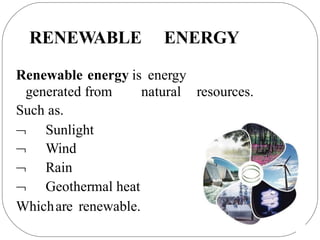
Renewable energy is energy
generated from
Such as.
natural resources.




Sunlight
Wind
Rain
Geothermal heat
Whichare renewable.
RENEWABLE ENERGY
The goal ( = objective to be achieved) for all energy
systems is sustainable development. The goal for
rural energy systems is that they must be instruments
of sustainable rural development. These must
advance rural economic growth that is economically
efficient, need-oriented and equitable, self-reliant and
empowering, and environmentally sound.
About 18% of global final energy
consumption
renewables,
came from
13% coming from traditional biomass,
wood-burning.
Hydroelectricitywas the next largest renewable
source, providing3% (15%
suchas
of global
electricity generation),followed by solar hot
water/heating, whichcontributed 1.3%.
Modern technologies,such as geothermal energy, wind
power, solar power, and ocean energy together provided
some ,0.8% of final energy consumption.
RENEWABLE ENERGY
TECHNOLOGIES:
1.
2.
3.
4.
5.
6.
WIND POWER
WATER POWER
SOLAR ENERGY
BIOFUEL
WAVE POWER
HYDRO POWER
SOME FACTS:
Wind power is growingat 30% annually with
capacity of 100gw.
The majority of renewable energy technologies are
poweredby the sun.
The world's largest geothermal power installation is The
Geysers in California, with a rated capacityof 750 MW
.
Brazil has one of the largest renewable energy programs in
the world, involving production of ethanol fuel from sugar
cane, ethanol provides 18 percent of the country's
automotive fuel.
SOLAR ENERGY
Solar Power a clean renewable resource with zero emission,
has got tremendous potential of energy which can be
harnessed using a variety of devices.
With recent developments, solar energy systems are easily
available for industrial and domestic use with the added
advantage of minimum maintenance.
Solar energy could be made financially viable with
government tax incentives and rebates.
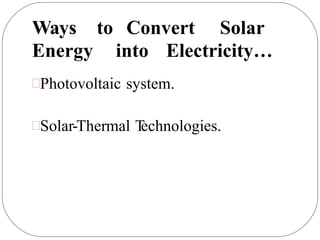
Ways to Convert Solar
Energy into Electricity…
Photovoltaic system.
Solar-Thermal T
echnologies.
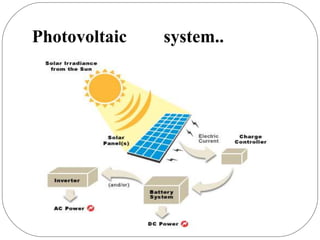
Photovoltaic system..
Advantages of
Photovoltaic systems…
PV arrays can be installed quickly

and in any size required or
allowed.
The environmental impact is minimal,
requiring no water for system coolingand
generating no by-products.

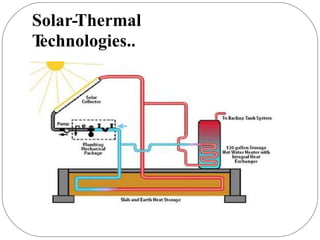
Solar-Thermal
T
echnologies..
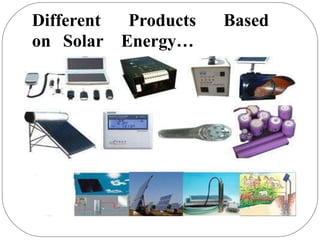
Different Products Based
on Solar Energy…
WIND POWER
What is it?
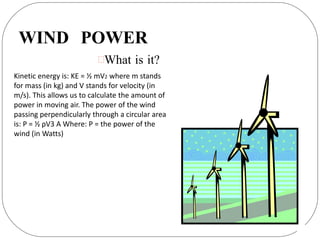
Kinetic energy is: KE = ½ mV2 where m stands
for mass (in kg) and V stands for velocity (in
m/s). This allows us to calculate the amount of
power in moving air. The power of the wind
passing perpendicularly through a circular area
is: P = ½ ρV3 A Where: P = the power of the
wind (in Watts)
WIND POWER - What is it?
All renewable energy (except tidal and
geothermal power), ultimately comes from the sun
Wind power is the conversionof wind energy
into a useful form, such as electricity, using wind
turbines
About one
converted
100 times
or 2 percent of this energy is
to wind energy (whichis about 50-
more than the energy converted to
biomass by all plants on earth
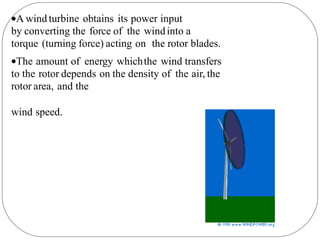
A wind turbine obtains its power input
by converting the force of the windinto a
torque (turning force) acting on the rotor blades.
The amount of energy whichthe wind transfers
to the rotor depends on the density of the air, the
rotor area, and the
wind speed.
How it is Generated
Windpower is generarated by using wind mill.
A Windmill captures windenergy and then uses a
generator to convert it to electrical energy
Advantages of Wind Power
The wind blows day and night, which allows
windmillsto produce electricity throughout the day
. (Faster
duringthe day)
Energy output from a windturbine will vary as the
wind varies, although the most rapid variations will to some
extent be compensated for by the inertia of the windturbine
rotor.
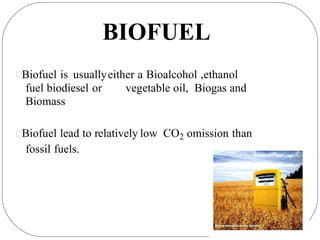
BIOFUEL
Biofuel is usuallyeither a Bioalcohol ,ethanol
fuel biodiesel or
Biomass
vegetable oil, Biogas and
Biofuel lead to relatively low CO2 omission than
fossil fuels.
BIODIESEL
Biodiesel is made by chemically-reacting lipids, typically
vegetable oil or animal and alcohol.
Biodiesel can be used in modern diesel vehicles
with little or no modificationto the engine.
ETHANOL
Ethanol are
produced from
corn, cornstalks,
sugarbeets, sugar
cane, and
switchgrasses to
produce ethanol.
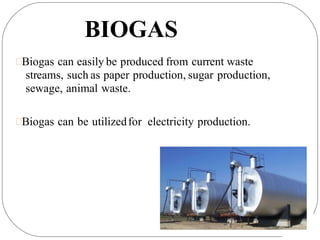
BIOGAS
Biogas can easily be produced from current waste
streams, such as paper production, sugar production,
sewage, animal waste.
Biogas can be utilizedfor electricity production.
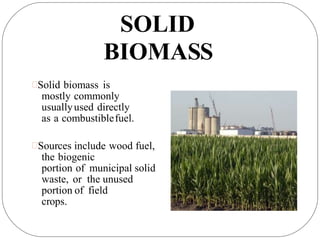
SOLID
BIOMASS
Solid biomass is
mostly commonly
usuallyused directly
as a combustiblefuel.
Sources include wood fuel,
the biogenic
portion of municipal solid
waste, or the unused
portion of field
crops.
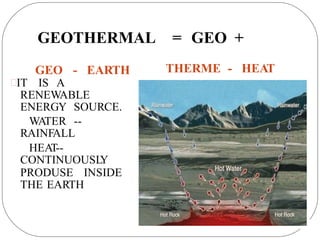
GEOTHERMAL
GEOTHERMAL = GEO +
THERME - HEAT
GEO - EARTH
IT IS A
RENEWABLE
ENERGY SOURCE.
WATER --
RAINFALL
HEAT--
CONTINUOUSL
Y
PRODUSE INSIDE
THE EARTH
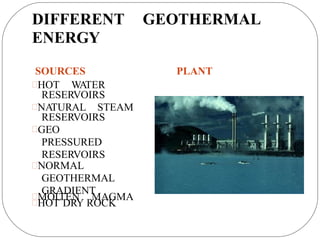
DIFFERENT
ENERGY
GEOTHERMAL
SOURCES PLANT
HOT WATER
RESERVOIRS
NATURAL STEAM
RESERVOIRS
GEO
PRESSURED
RESERVOIRS
NORMAL
GEOTHERMAL
GRADIENT
HOT DRY ROCK
MOL
TEN MAGMA
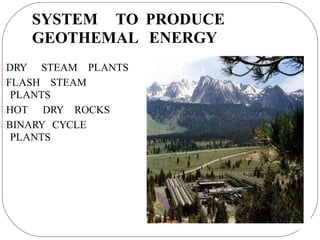
SYSTEM TO PRODUCE
ENERGY
GEOTHEMAL
DRY STEAM PLANTS
FLASH STEAM
PLANTS
HOT DRY ROCKS
BINARY CYCLE
PLANTS
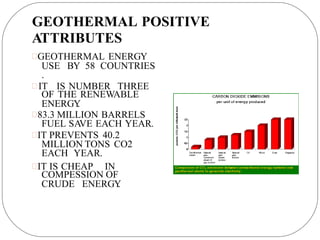
GEOTHERMAL POSITIVE
ATTRIBUTES
GEOTHERMAL ENERGY
USE BY 58 COUNTRIES
.
 IT IS NUMBER THREE
OF THE RENEWABLE
ENERGY
.
83.3 MILLION BARRELS
FUEL SAVE EACH YEAR.
IT PREVENTS 40.2
MILLION TONS CO2
EACH YEAR.
IT IS CHEAP IN
COMPESSION OF
CRUDE ENERGY
.

Renewable Energy

  • 1.
    RENEWABLE ENERGY Renewable energyis energy generated from Such as. natural resources.     Sunlight Wind Rain Geothermal heat Whichare renewable.
  • 2.
    RENEWABLE ENERGY The goal( = objective to be achieved) for all energy systems is sustainable development. The goal for rural energy systems is that they must be instruments of sustainable rural development. These must advance rural economic growth that is economically efficient, need-oriented and equitable, self-reliant and empowering, and environmentally sound.
  • 3.
    About 18% ofglobal final energy consumption renewables, came from 13% coming from traditional biomass, wood-burning. Hydroelectricitywas the next largest renewable source, providing3% (15% suchas of global electricity generation),followed by solar hot water/heating, whichcontributed 1.3%. Modern technologies,such as geothermal energy, wind power, solar power, and ocean energy together provided some ,0.8% of final energy consumption.
  • 4.
    RENEWABLE ENERGY TECHNOLOGIES: 1. 2. 3. 4. 5. 6. WIND POWER WATERPOWER SOLAR ENERGY BIOFUEL WAVE POWER HYDRO POWER
  • 6.
    SOME FACTS: Wind poweris growingat 30% annually with capacity of 100gw. The majority of renewable energy technologies are poweredby the sun. The world's largest geothermal power installation is The Geysers in California, with a rated capacityof 750 MW . Brazil has one of the largest renewable energy programs in the world, involving production of ethanol fuel from sugar cane, ethanol provides 18 percent of the country's automotive fuel.
  • 7.
    SOLAR ENERGY Solar Powera clean renewable resource with zero emission, has got tremendous potential of energy which can be harnessed using a variety of devices. With recent developments, solar energy systems are easily available for industrial and domestic use with the added advantage of minimum maintenance. Solar energy could be made financially viable with government tax incentives and rebates.
  • 8.
    Ways to ConvertSolar Energy into Electricity… Photovoltaic system. Solar-Thermal T echnologies.
  • 9.
  • 10.
    Advantages of Photovoltaic systems… PVarrays can be installed quickly  and in any size required or allowed. The environmental impact is minimal, requiring no water for system coolingand generating no by-products. 
  • 11.
  • 12.
  • 13.
    WIND POWER What isit? Kinetic energy is: KE = ½ mV2 where m stands for mass (in kg) and V stands for velocity (in m/s). This allows us to calculate the amount of power in moving air. The power of the wind passing perpendicularly through a circular area is: P = ½ ρV3 A Where: P = the power of the wind (in Watts)
  • 14.
    WIND POWER -What is it? All renewable energy (except tidal and geothermal power), ultimately comes from the sun Wind power is the conversionof wind energy into a useful form, such as electricity, using wind turbines About one converted 100 times or 2 percent of this energy is to wind energy (whichis about 50- more than the energy converted to biomass by all plants on earth
  • 15.
    A wind turbineobtains its power input by converting the force of the windinto a torque (turning force) acting on the rotor blades. The amount of energy whichthe wind transfers to the rotor depends on the density of the air, the rotor area, and the wind speed.
  • 16.
    How it isGenerated Windpower is generarated by using wind mill. A Windmill captures windenergy and then uses a generator to convert it to electrical energy
  • 17.
    Advantages of WindPower The wind blows day and night, which allows windmillsto produce electricity throughout the day . (Faster duringthe day) Energy output from a windturbine will vary as the wind varies, although the most rapid variations will to some extent be compensated for by the inertia of the windturbine rotor.
  • 18.
    BIOFUEL Biofuel is usuallyeithera Bioalcohol ,ethanol fuel biodiesel or Biomass vegetable oil, Biogas and Biofuel lead to relatively low CO2 omission than fossil fuels.
  • 19.
    BIODIESEL Biodiesel is madeby chemically-reacting lipids, typically vegetable oil or animal and alcohol. Biodiesel can be used in modern diesel vehicles with little or no modificationto the engine.
  • 20.
    ETHANOL Ethanol are produced from corn,cornstalks, sugarbeets, sugar cane, and switchgrasses to produce ethanol.
  • 21.
    BIOGAS Biogas can easilybe produced from current waste streams, such as paper production, sugar production, sewage, animal waste. Biogas can be utilizedfor electricity production.
  • 22.
    SOLID BIOMASS Solid biomass is mostlycommonly usuallyused directly as a combustiblefuel. Sources include wood fuel, the biogenic portion of municipal solid waste, or the unused portion of field crops.
  • 23.
  • 24.
    GEOTHERMAL = GEO+ THERME - HEAT GEO - EARTH IT IS A RENEWABLE ENERGY SOURCE. WATER -- RAINFALL HEAT-- CONTINUOUSL Y PRODUSE INSIDE THE EARTH
  • 25.
    DIFFERENT ENERGY GEOTHERMAL SOURCES PLANT HOT WATER RESERVOIRS NATURALSTEAM RESERVOIRS GEO PRESSURED RESERVOIRS NORMAL GEOTHERMAL GRADIENT HOT DRY ROCK MOL TEN MAGMA
  • 26.
    SYSTEM TO PRODUCE ENERGY GEOTHEMAL DRYSTEAM PLANTS FLASH STEAM PLANTS HOT DRY ROCKS BINARY CYCLE PLANTS
  • 27.
    GEOTHERMAL POSITIVE ATTRIBUTES GEOTHERMAL ENERGY USEBY 58 COUNTRIES .  IT IS NUMBER THREE OF THE RENEWABLE ENERGY . 83.3 MILLION BARRELS FUEL SAVE EACH YEAR. IT PREVENTS 40.2 MILLION TONS CO2 EACH YEAR. IT IS CHEAP IN COMPESSION OF CRUDE ENERGY .