FLUIDIZED BED COMBUSTION
Prof. Siraskar G.D.
Mechanical engineering department
PCCOE&R
LEARNING OUTCOME
 Learning Outcome When you complete this module
you will be able to: Discuss the basic theory and
design of a fluidized bed steam generator and
describe the special operational and control
aspects of fluidized bed combustion
LEARNING OBJECTIVES
 Here is what you will be able to do when you complete
each objective:
 1. Define "fluidized bed combustion". State its benefits
and sketch a simple fluidized bed arrangement.
 2. Explain the operation of atmospheric fluidized bed
combustion.
 3. Explain the operation and advantages of pressurized
fluidized bed combustion and sketch a combined cycle
arrangement.
 4. State the advantages and disadvantages of fluidized
bed combustion.
 5. State two start-up strategies and explain bed
expansion.
INTRODUCTION
 This module will serve as a brief introduction to the
process known as “fluidized bed combustion” or
FBC. This is a relatively new technology in the
steam industry, having been very thoroughly
researched over the past few decades. Several
large systems are now using FBC, and it shows
every sign of becoming a conventional technology
for a number of furnace and combustion processes
in the power and petrochemical industries.
FBC
HISTORY OF FBC
 Fluidized bed combustion technology has evolved
from the fluidized bed process used for years in
classifying, chemical reactor, and drying
applications. Some of the patents date from the
mid-1920s.
 In 1921, first FBC was successfully used in
Germany
BENEFITS OF FBC
 FBC has the potential for significantly increasing power generation
efficiency, while at the same time meeting the stringent sulphur oxide
(SO2) and nitrogen oxide (NOx) emission regulations that apply in an
increasing number of countries.
 In the past, coal had always meant pollution. The sulphur and nitrogen
emissions of coal-burning power and heating plants, such as SO2 and
NO2, dissolved in the water vapour of the atmosphere and came back
down as toxic particles and corrosive acid rain.
 Conventional coal-fired power stations with NOx reduction, dust
separation, and desulphurization equipment are complex and expensive.
 One study estimated that this cost would increase to 47% of the total
capital outlay.
 The vast majority of power stations in the world are equipped with
electrostatic precipitators or fabric filters for effective removal of fine dust.
 Flue gas desulphurization (FGD) plants deal with sulphur products in the
flue gas, but they are also expensive to build, troublesome to operate
and maintain, and can entail problems with disposal of wastewater and
sludge products.
TYPES OF FBC
 The two main types are
 1)atmospheric fluidized bed combustion (AFBC)
and
 a) atmospheric b) Circulating
 2)pressurized fluidized bed combustion (PFBC).
1)ATMOSPHERIC FLUIDIZED BED COMBUSTION (
a) atmospheric b) Circulating
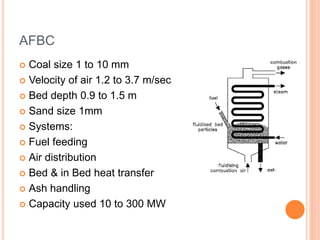
AFBC
 Coal size 1 to 10 mm
 Velocity of air 1.2 to 3.7 m/sec
 Bed depth 0.9 to 1.5 m
 Sand size 1mm
 Systems:
 Fuel feeding
 Air distribution
 Bed & in Bed heat transfer
 Ash handling
 Capacity used 10 to 300 MW
CIRCULATING FBC
 Coal size 6 to 12 mm
 Air velocity 3.7 to 9 m/s
 Combustion efficiency 99.5 %
 Temp 840 to 900 °C
 Steam capacity 75 to 100 T/hr
 More efficient , Sulphur retentions, lime stone
utilization more
 Low Nox and Sox emission
 Capacity used 400 to 500 MW
 Less feeding parts , lateral mixing done at high
velocity
CIRCULATING FBC
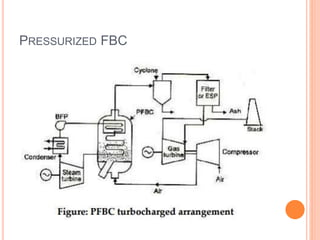
PRESSURIZED FBC
PRESSURIZED FBC
PRESSURIZED FBC
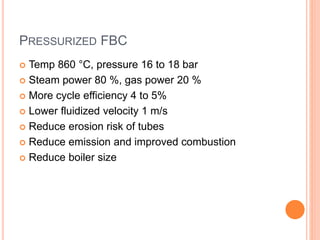
 Temp 860 °C, pressure 16 to 18 bar
 Steam power 80 %, gas power 20 %
 More cycle efficiency 4 to 5%
 Lower fluidized velocity 1 m/s
 Reduce erosion risk of tubes
 Reduce emission and improved combustion
 Reduce boiler size
COMBINED CYCLE
COMBINED CYCLE
 In the combined cycle arrangement 815°C to 871°C
combustion gas from the PFBC boiler is used to
drive the gas turbine.
 About 20% of the net plant electrical output is
provided by the gas turbine.
 With this arrangement, thermal efficiency 2 to 3
percentage points higher than with the
turbocharged cycle are feasible.
ADVANTAGES OF FBC OVER COMMERCIAL
BOILER
 High efficiency, combustion 95 % , overall 84%
 Fuel flexibility
 Ability to burn low grade fuel
 Pollution control
 Low Nox and Sox formation
 Simple operation, quick startup
 No slagging in furnace, no soot blowing
 Provision of automatic ignition sytem
 High reliability and low maintenance cost

Fbc fluidized bed combustion

  • 1.
    FLUIDIZED BED COMBUSTION Prof.Siraskar G.D. Mechanical engineering department PCCOE&R
  • 2.
    LEARNING OUTCOME  LearningOutcome When you complete this module you will be able to: Discuss the basic theory and design of a fluidized bed steam generator and describe the special operational and control aspects of fluidized bed combustion
  • 3.
    LEARNING OBJECTIVES  Hereis what you will be able to do when you complete each objective:  1. Define "fluidized bed combustion". State its benefits and sketch a simple fluidized bed arrangement.  2. Explain the operation of atmospheric fluidized bed combustion.  3. Explain the operation and advantages of pressurized fluidized bed combustion and sketch a combined cycle arrangement.  4. State the advantages and disadvantages of fluidized bed combustion.  5. State two start-up strategies and explain bed expansion.
  • 4.
    INTRODUCTION  This modulewill serve as a brief introduction to the process known as “fluidized bed combustion” or FBC. This is a relatively new technology in the steam industry, having been very thoroughly researched over the past few decades. Several large systems are now using FBC, and it shows every sign of becoming a conventional technology for a number of furnace and combustion processes in the power and petrochemical industries.
  • 5.
  • 6.
    HISTORY OF FBC Fluidized bed combustion technology has evolved from the fluidized bed process used for years in classifying, chemical reactor, and drying applications. Some of the patents date from the mid-1920s.  In 1921, first FBC was successfully used in Germany
  • 7.
    BENEFITS OF FBC FBC has the potential for significantly increasing power generation efficiency, while at the same time meeting the stringent sulphur oxide (SO2) and nitrogen oxide (NOx) emission regulations that apply in an increasing number of countries.  In the past, coal had always meant pollution. The sulphur and nitrogen emissions of coal-burning power and heating plants, such as SO2 and NO2, dissolved in the water vapour of the atmosphere and came back down as toxic particles and corrosive acid rain.  Conventional coal-fired power stations with NOx reduction, dust separation, and desulphurization equipment are complex and expensive.  One study estimated that this cost would increase to 47% of the total capital outlay.  The vast majority of power stations in the world are equipped with electrostatic precipitators or fabric filters for effective removal of fine dust.  Flue gas desulphurization (FGD) plants deal with sulphur products in the flue gas, but they are also expensive to build, troublesome to operate and maintain, and can entail problems with disposal of wastewater and sludge products.
  • 8.
    TYPES OF FBC The two main types are  1)atmospheric fluidized bed combustion (AFBC) and  a) atmospheric b) Circulating  2)pressurized fluidized bed combustion (PFBC).
  • 9.
    1)ATMOSPHERIC FLUIDIZED BEDCOMBUSTION ( a) atmospheric b) Circulating
  • 10.
    AFBC  Coal size1 to 10 mm  Velocity of air 1.2 to 3.7 m/sec  Bed depth 0.9 to 1.5 m  Sand size 1mm  Systems:  Fuel feeding  Air distribution  Bed & in Bed heat transfer  Ash handling  Capacity used 10 to 300 MW
  • 11.
    CIRCULATING FBC  Coalsize 6 to 12 mm  Air velocity 3.7 to 9 m/s  Combustion efficiency 99.5 %  Temp 840 to 900 °C  Steam capacity 75 to 100 T/hr  More efficient , Sulphur retentions, lime stone utilization more  Low Nox and Sox emission  Capacity used 400 to 500 MW  Less feeding parts , lateral mixing done at high velocity
  • 12.
  • 13.
  • 14.
  • 15.
    PRESSURIZED FBC  Temp860 °C, pressure 16 to 18 bar  Steam power 80 %, gas power 20 %  More cycle efficiency 4 to 5%  Lower fluidized velocity 1 m/s  Reduce erosion risk of tubes  Reduce emission and improved combustion  Reduce boiler size
  • 16.
  • 17.
    COMBINED CYCLE  Inthe combined cycle arrangement 815°C to 871°C combustion gas from the PFBC boiler is used to drive the gas turbine.  About 20% of the net plant electrical output is provided by the gas turbine.  With this arrangement, thermal efficiency 2 to 3 percentage points higher than with the turbocharged cycle are feasible.
  • 18.
    ADVANTAGES OF FBCOVER COMMERCIAL BOILER  High efficiency, combustion 95 % , overall 84%  Fuel flexibility  Ability to burn low grade fuel  Pollution control  Low Nox and Sox formation  Simple operation, quick startup  No slagging in furnace, no soot blowing  Provision of automatic ignition sytem  High reliability and low maintenance cost