SHRI MATA VAISHNO DEVI UNIVERSITY , KAKRYAL
, KATRA
BIOENERGY POTENTIAL OF INDIA
BIOGAS DIGESTERS
TYPES OF BIOFUELS
ASSIGNMENT OF NON – CONVENTIONAL ENERGY SOURCES
TEACHER CONCERNED:
DR. V.V. TYAGI
PREPARED BY:
ANAM MUKTHAR
( 16-MRE-010)
TOPICS OF DISCUSSION
•BIOENERGY POTENTIAL
•BIOGAS DIGESTERS
•TYPES OF BIOFUELS
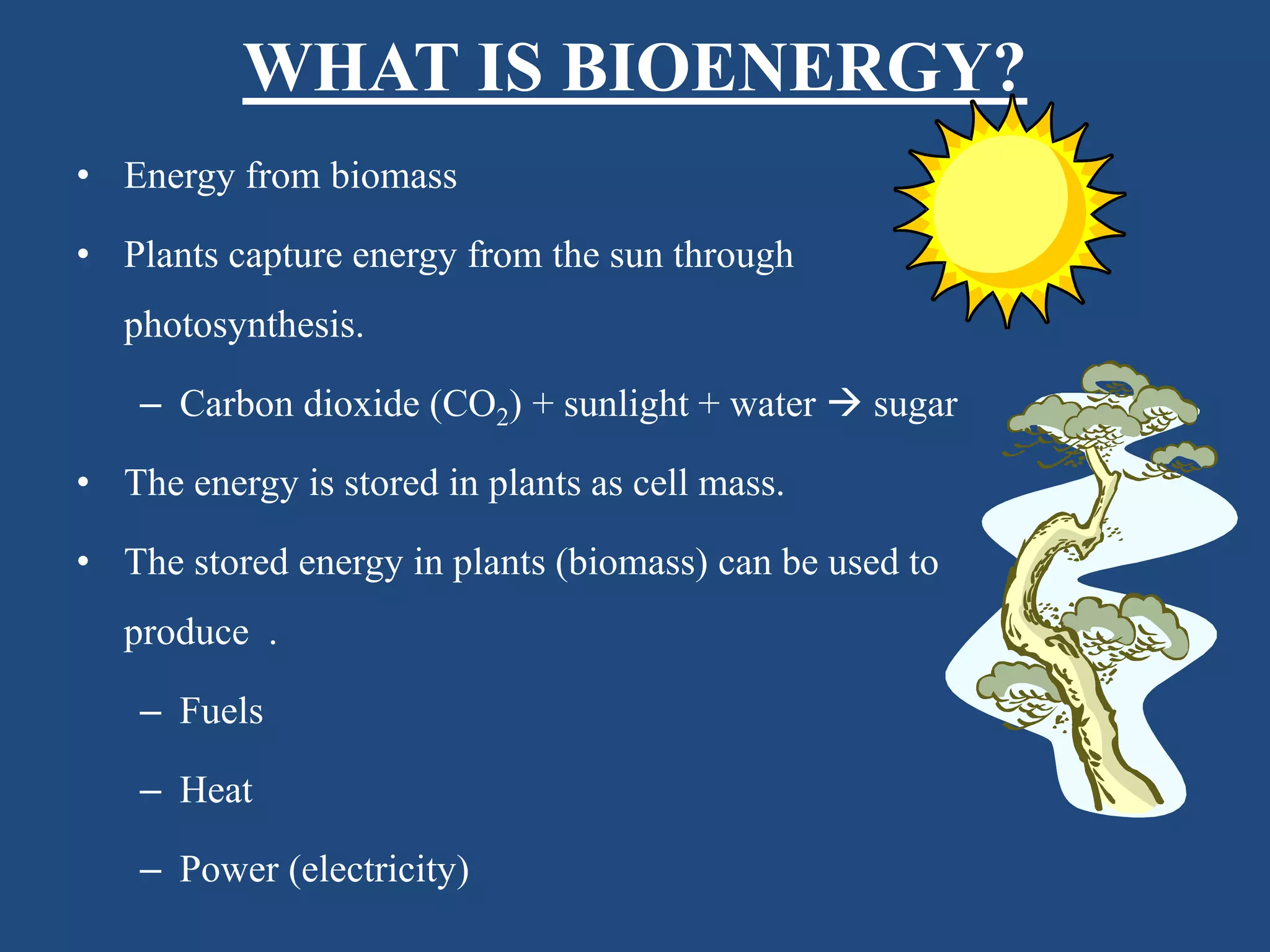
WHAT IS BIOENERGY?
• Energy from biomass
• Plants capture energy from the sun through
photosynthesis.
– Carbon dioxide (CO2) + sunlight + water  sugar
• The energy is stored in plants as cell mass.
• The stored energy in plants (biomass) can be used to
produce .
– Fuels
– Heat
– Power (electricity)
WHY USE BIOMASS AS AN
ENERGY SOURCE?
▫ Oil is a scarce resource.
▫ Countries are becomming more and more dependent on oil
i.e. oil import from other countries are increasing.
▫ Greenhouse effects –Kyoto protocol calls for reduction of
CO2 emissions.
▫ The biobased economy must be established in the 21’st
century.
▫ Biomass can provide a substantial part of our energy supply.
THE BIOENERGY CYCLE
http://www.renewcology.nu 6
BIOMASS ENERGY CONVERSION
PROCESSES
S.NO. PROCESS INPUT
FEEDSTOCK
CONVERS
ION
TEMPERA
TURE
CONVE
RSION
PRESSU
RE (0
C)
CHARACTER
ISTICS OF
PROCESS
PRODUCT
FORM
PROCESS YIELD ( % OF
ORIGINAL MASS)
1. Anaerobic
fermentation
Aqueous slurry
(30%-20% solids)
20 -50 Atmosphe
ric
Fermentation of
wastes or algae
grown on waste of
energy crops
50% -70%
methane ,
remainder co2
20 - 26%
2. Biophotolysis Aqueous slurry
for algae, bacteria
and protein –
enzyme
complexes
20 -50 Atmosphe
ric
Sunlight produces
`intracellular
enzymatic
reduction of H2O
Hydrogen
3. Acid
Hydrolysis
5% acidified
slurry (H2SO4
with cellulose)
20 -50 Atmosphe
ric
Glucose
fermented to ethyl
alcohol. Cellulose
hydrolized to
glucose.
Ethyl Alcohol
4. Enzyme
Hydrolysis
Aqueous slurry
(cellulose rich)
20 -50 Atmosphe
ric
Extracellular
enzymatic
conversion of
cellulose to sugar
to alcohol.
Ethyl Alcohol 90%
5. Combustion Dried feedstock
(10-25% H2O)
1200-1300 Atmosphe
ric
Augments(5-
20%) boiler fuel
Heat , steam
converted to
electricity.
6. Pyrolysis Dried feedstock 500-1300 Atmosphe
ric
1/3 of char is
produced .o2 free
Oil
Char gas
40%
20%
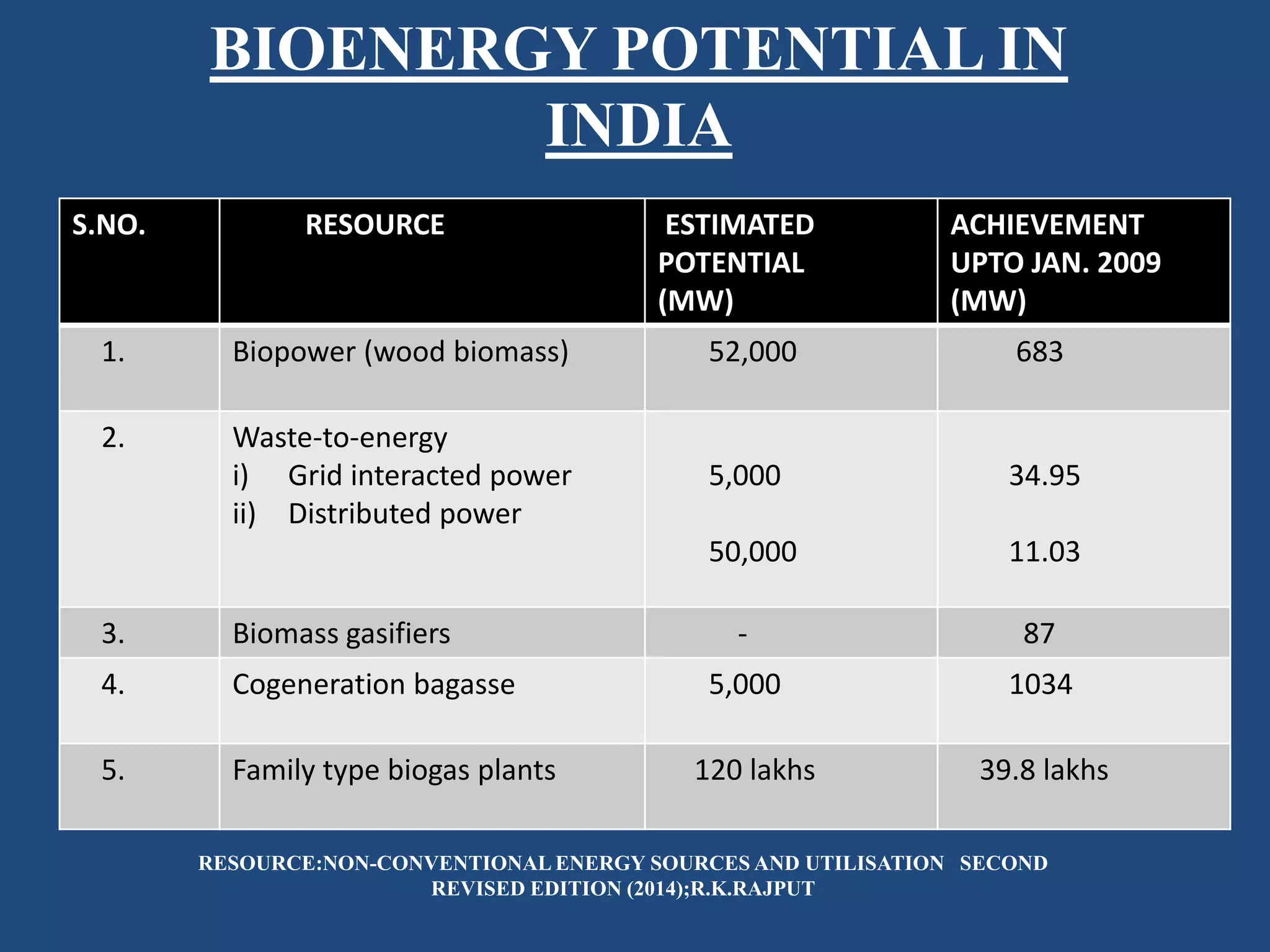
BIOENERGY POTENTIAL IN
INDIA
RESOURCE:NON-CONVENTIONAL ENERGY SOURCES AND UTILISATION SECOND
REVISED EDITION (2014);R.K.RAJPUT
S.NO. RESOURCE ESTIMATED
POTENTIAL
(MW)
ACHIEVEMENT
UPTO JAN. 2009
(MW)
1. Biopower (wood biomass) 52,000 683
2. Waste-to-energy
i) Grid interacted power
ii) Distributed power
5,000
50,000
34.95
11.03
3. Biomass gasifiers - 87
4. Cogeneration bagasse 5,000 1034
5. Family type biogas plants 120 lakhs 39.8 lakhs
BIOMASS POTENTIAL IN INDIA
S.NO. RESOURCES POTENTIAL
1. Surplus biomass 17000 MW
2. Cows manure and poultry droppings 1500 MW
3. a) Urban Wastes
b) Industrial Wastes
2600 MW
1300 MW
INDIA AND THE BIOENERGY
ADVANTAGES OF BIOENERGY
• Bio fuels are friendlier to the nature than fossil fuels.
• The fossil fuel reserves will decline  biofuels’
importance rises.
• Diversifying energy sources.
• Employment.
• Energy supply for developing countries.
11
BIO FUEL
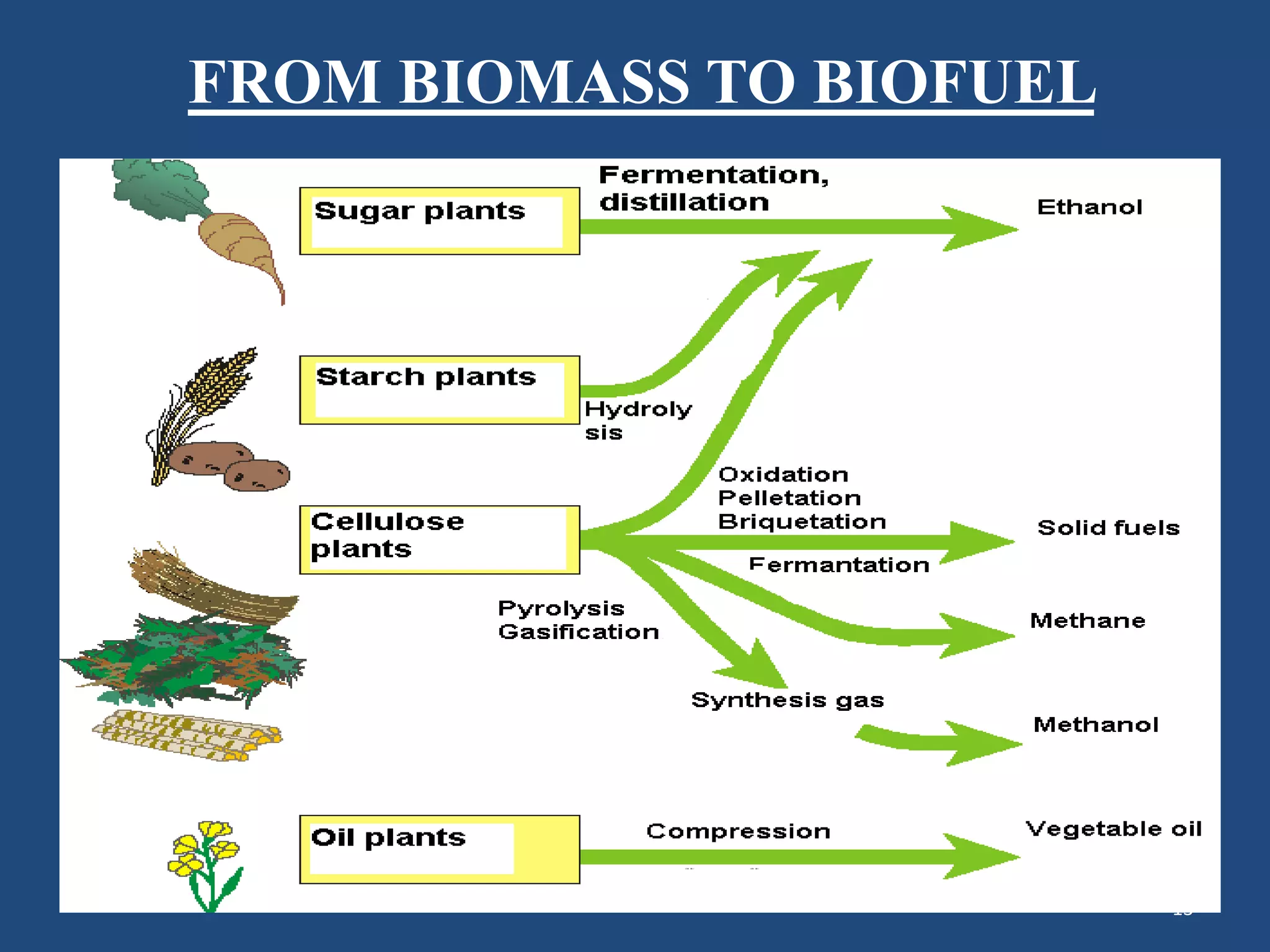
FROM BIOMASS TO BIOFUEL
13
BIOFUELS
• Most biomasses are also bio fuels as such.
• Biomass can be refined into fuels that are easier to
store, transport, and use.
• Processed biofuels are:
– Solids: Processed solids
– Liquid: Liquid biofuels
– Gas: Biogas
12
HISTORY
• An important fuel for most of
mankind's history is the Invention
of gasoline-burning, internal
combustion engine (late 19th
century)  change toward coal
and petroleum-based fuels.
• Use of biofuels began to rise
during the 1970’s .
16
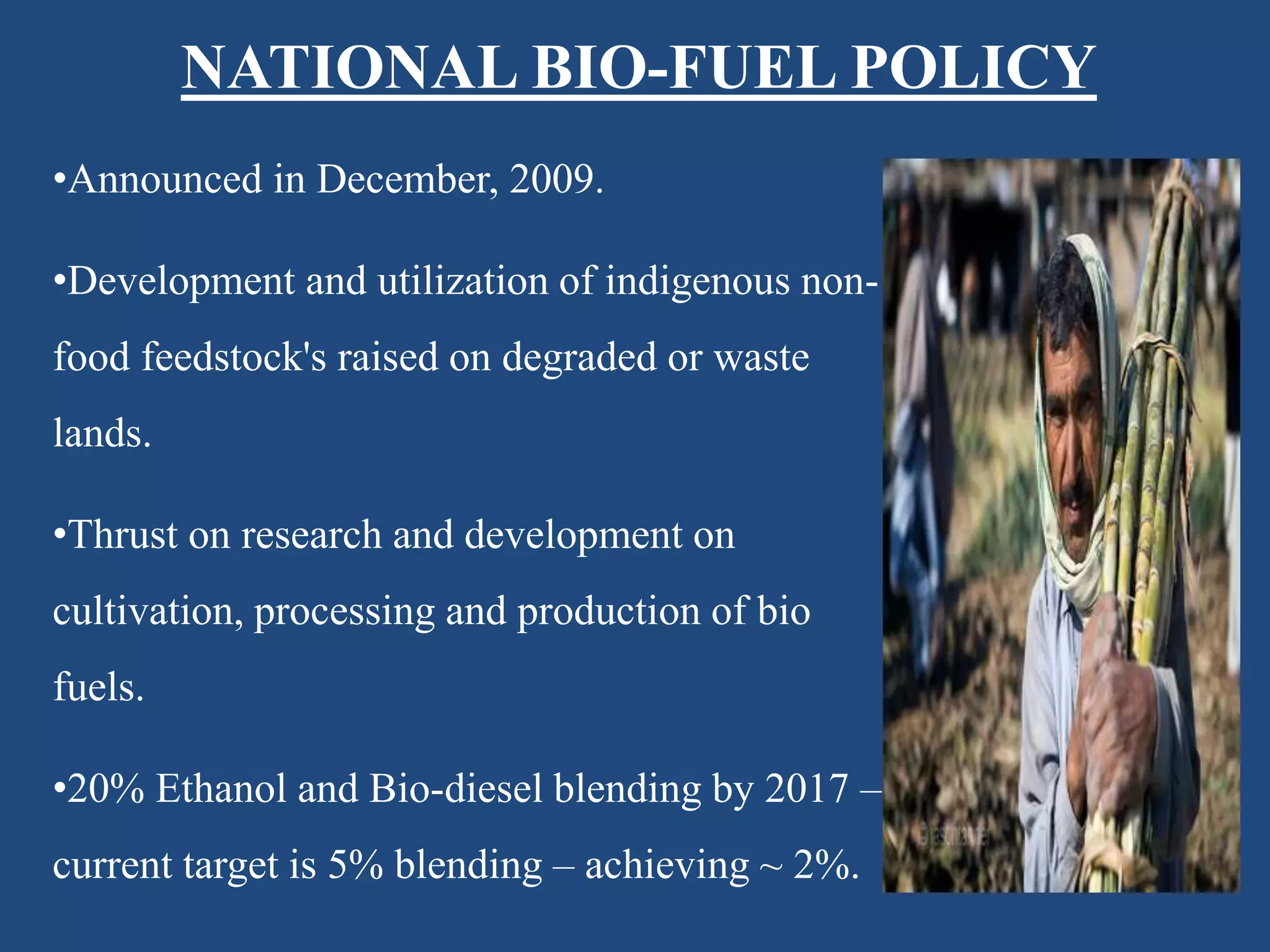
NATIONAL BIO-FUEL POLICY
•Announced in December, 2009.
•Development and utilization of indigenous non-
food feedstock's raised on degraded or waste
lands.
•Thrust on research and development on
cultivation, processing and production of bio
fuels.
•20% Ethanol and Bio-diesel blending by 2017 –
current target is 5% blending – achieving ~ 2%.
TYPES OF BIOFUELS
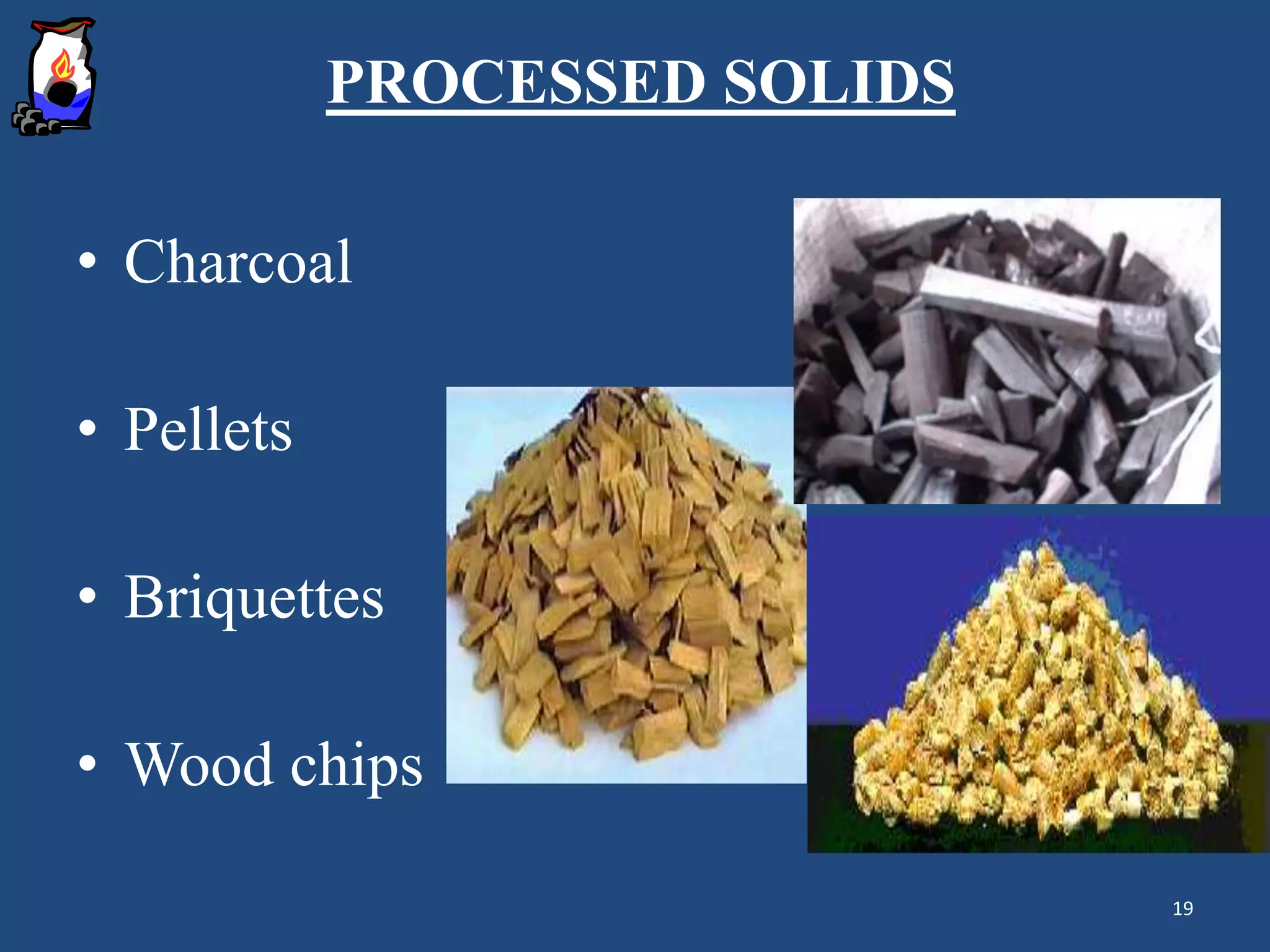
PROCESSED SOLIDS
• Charcoal
• Pellets
• Briquettes
• Wood chips
19
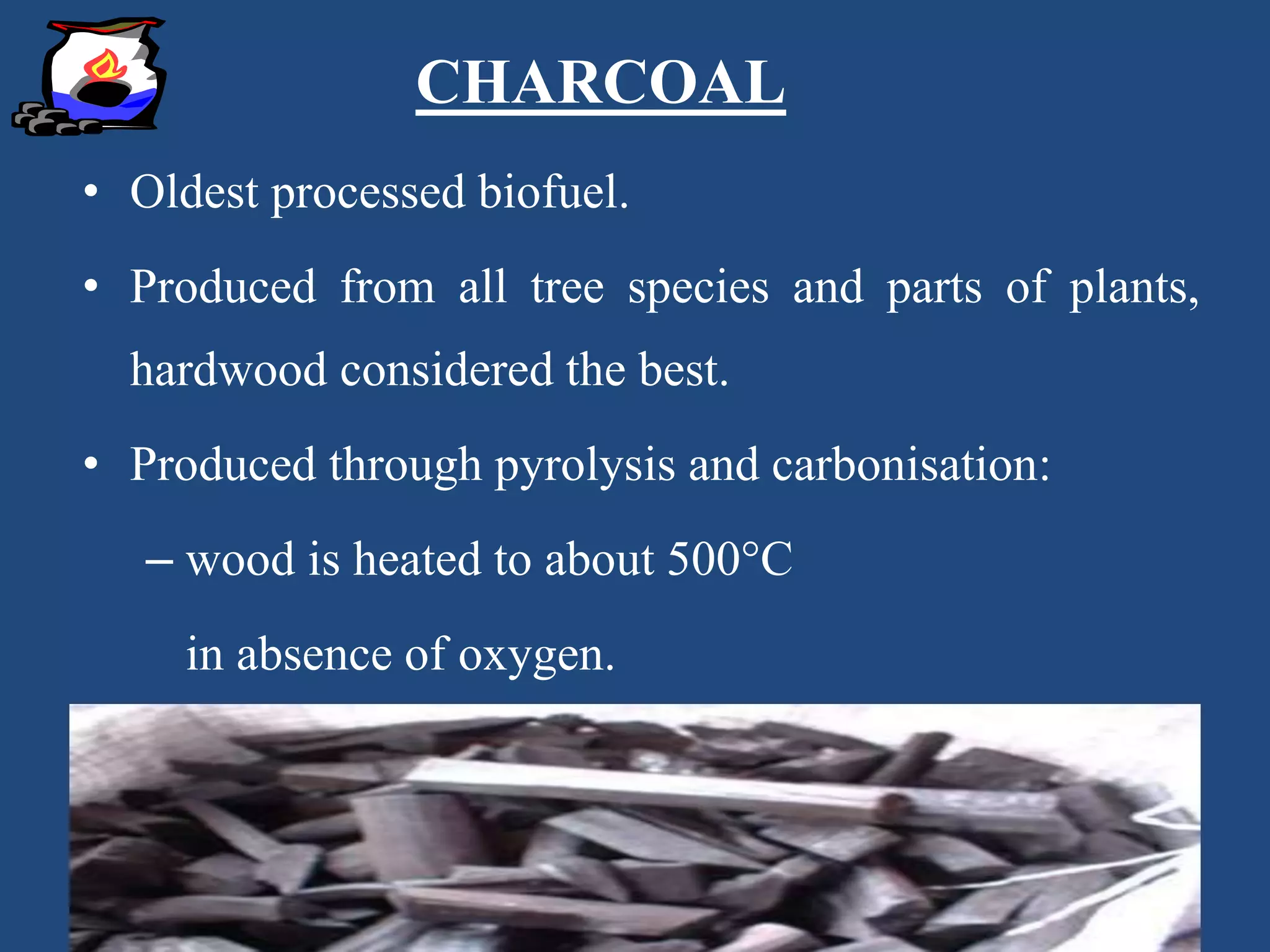
CHARCOAL
• Oldest processed biofuel.
• Produced from all tree species and parts of plants,
hardwood considered the best.
• Produced through pyrolysis and carbonisation:
– wood is heated to about 500°C
in absence of oxygen.
http://www.renewcology.nu 20
THE PRODUCTION OF CHARCOAL
1. Preparation of wood.
2. Drying – reduction of moisture content.
3. Pre-carbonization – reduction of volatiles content.
4. Carbonization – further reduction of volatiles
content.
5. End of carbonization – increasing the carbon content.
6. Cooling and stabilization of charcoal.
21
PELLETS
• Made out of woody residues.
• Cylindrical or cubic granules.
• Production: drying and possibly grinding and then
compressing biomass.
22
BRIQUETTES
• Produced by compressing dry sawdust, grinding dust or
cutter chips.
• Cylindrical.
• Diameter between 50 and 80 mm.
• Net calorific value is 17mj/kg.
23
WOOD CHIPS
• Waste product of forestry operations.
• Made in mechanical chippers.
24
LIQUID BIOFUELS
25
• Generated by gasification, fermentation, and pyrolysis
technologies.
• Ethanol
• Methanol
• Vegetable oils
• Biodiesel
• Pyrolysis bio-oil
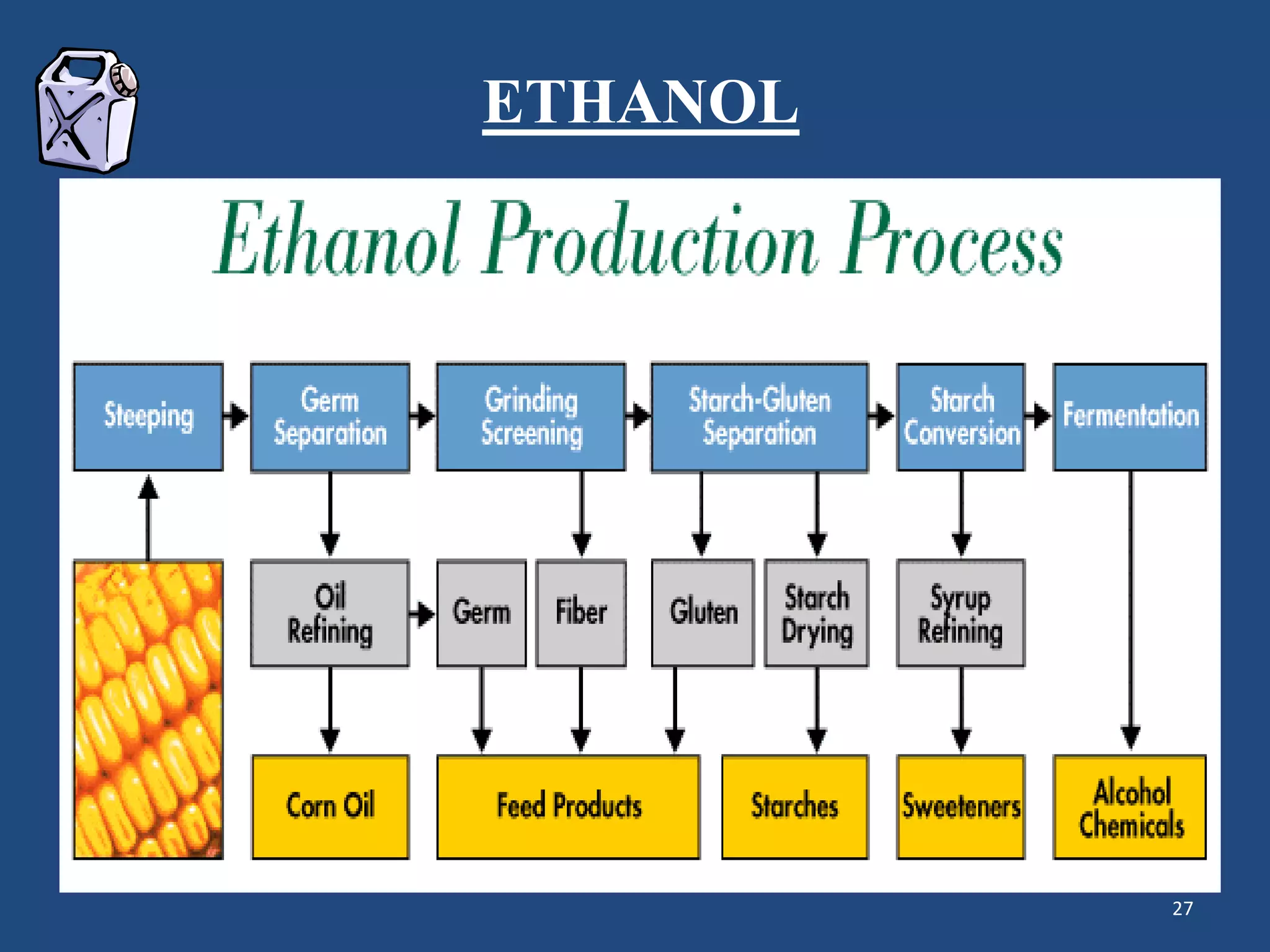
ETHANOL
• Sugars are fermented into ethanol:
– C6H12O6  2C2H5OH + 2CO2
• Ethanol can be used as
– a fuel
– reacted with isobutylene to form ethyl tertiary butyl ether (ETBE) for
blending with gasoline.
• Environmental benefits
– CO2 emission is reduced.
– current world production of ethanol fuel is about 20 to 21 billion litres
annually 26
ETHANOL
27
METHANOL
• Produced by gasification
– Synthesis gas (mainly H2 and CO) at high temperatures (>1000K):
CO + 2H2  CH3OH +heat
– Excess hydrogen (with catalyst):
3H2 + CO2  CH3OH + H2O
• Methanol is used as
– a fuel as such
– reacted with isobutylene  methyl tertiary butyl ether (MTBE) for
blending with gasoline. 28
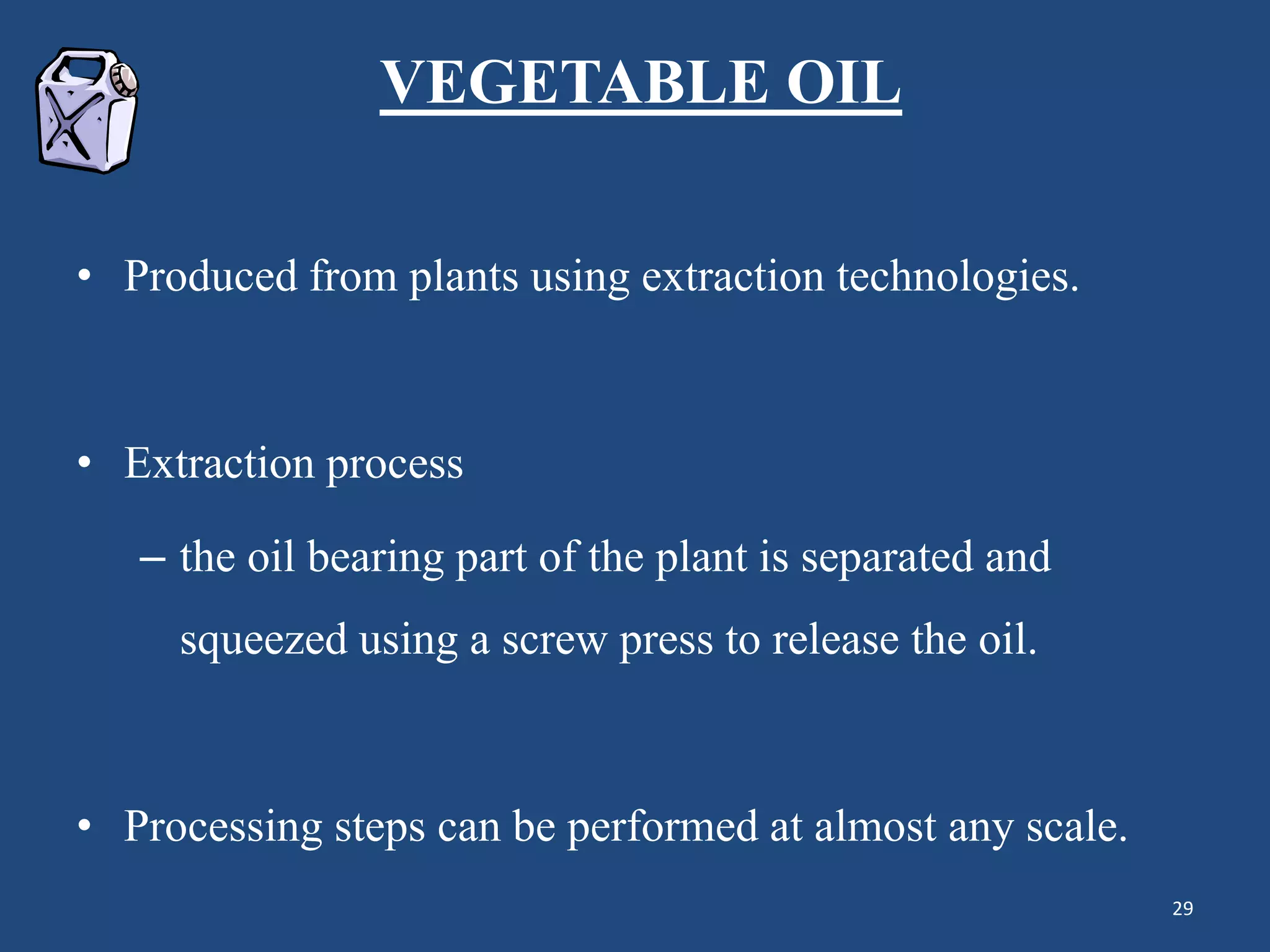
VEGETABLE OIL
• Produced from plants using extraction technologies.
• Extraction process
– the oil bearing part of the plant is separated and
squeezed using a screw press to release the oil.
• Processing steps can be performed at almost any scale.
29
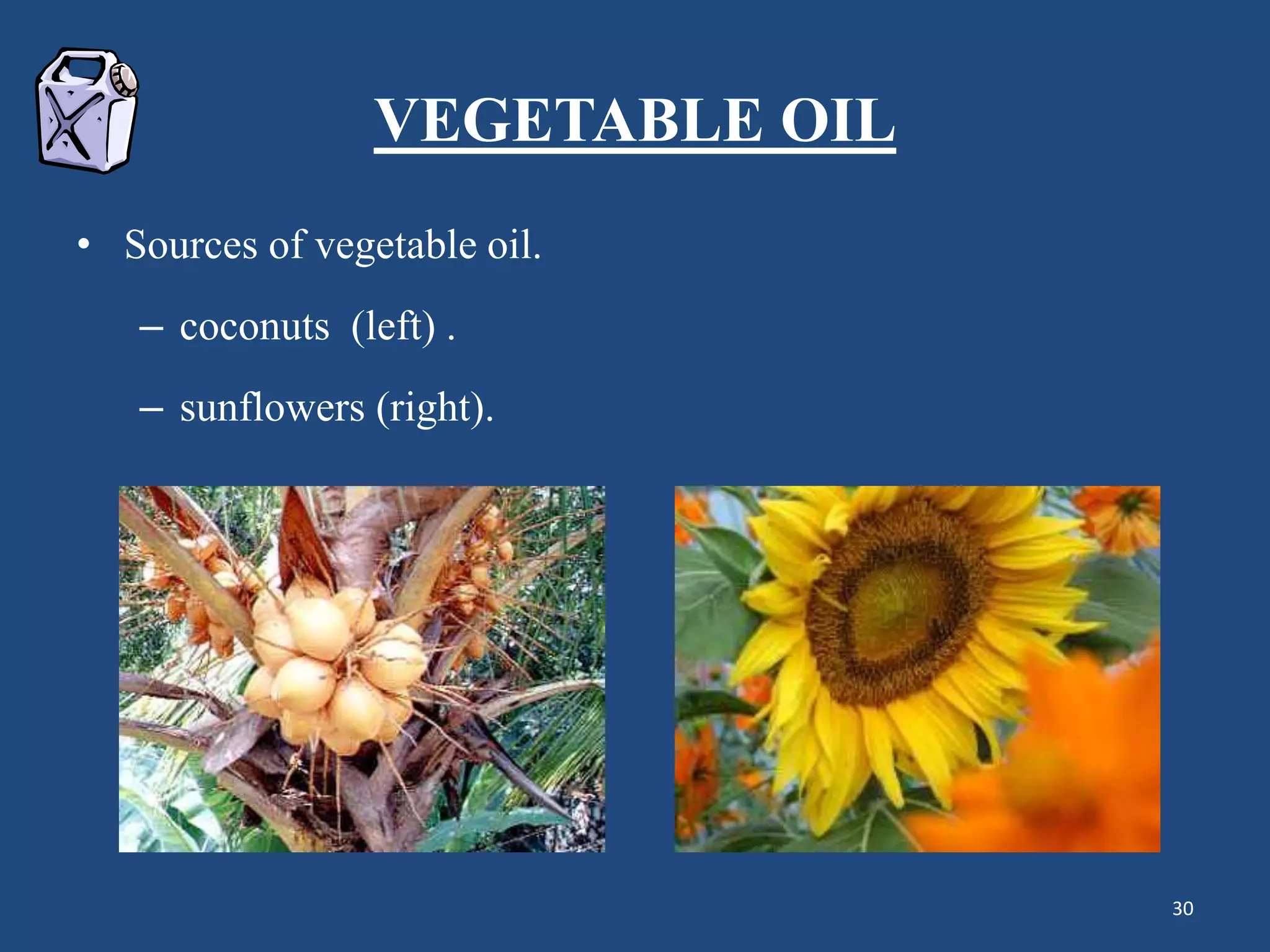
VEGETABLE OIL
• Sources of vegetable oil.
– coconuts (left) .
– sunflowers (right).
30
BIODIESEL
• Diesel fuel based on
vegetable oil.
• Chemical process:
transesterification.
• Glycerine is separated with
alcohol from the vegetable
oil.
• Can be blended with
petroleum diesel.
31
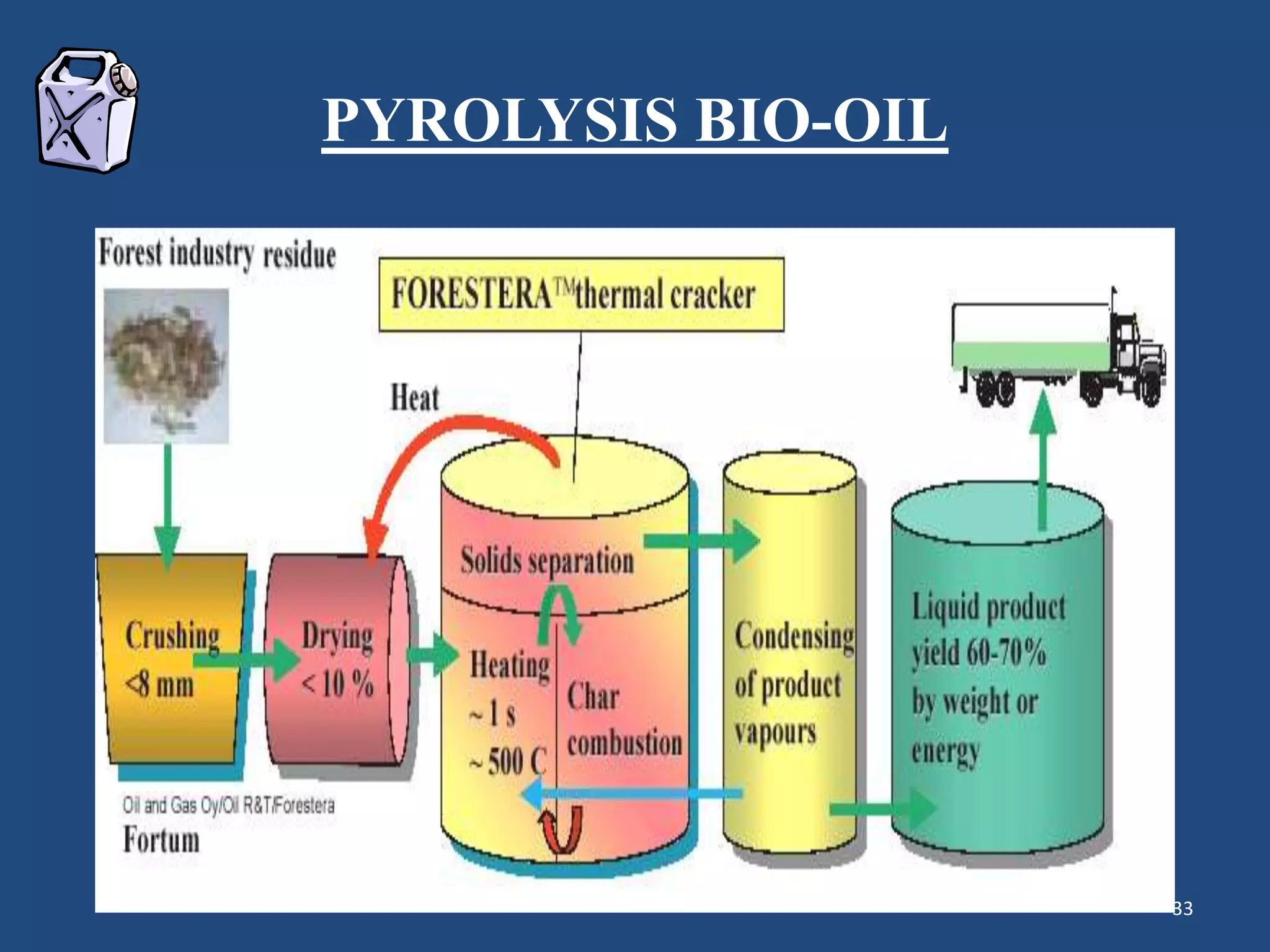
PYROLYSIS BIO-OIL
• From residue chips and sawdust.
• Fast pyrolysis
– organic materials are rapidly heated to 450 - 600 oC in
absence of air  organic vapours  condensed to bio-oil.
• Chemically complex.
• Heating value 14-18 MJ/kg .
32
PYROLYSIS BIO-OIL
33
GREEN BUS
NAGPUR’S ETHANOL GREEN SCANIA BUS SHOWCASED IN PUNE
DRAWBACKS
• Expensive
• Transportation
• Low heating values
• Decaying
• Quality variations
• Some negative environmental impacts
36
ADVANTAGES OF BIOENERGY
• Bio fuels are friendlier to the nature than fossil fuels.
• The fossil fuel reserves will decline  biofuels’
importance rises
• Diversifying energy sources
• Employment
• Energy supply for developing countries
37
AWARDS
Bio energy awards for cutting edge research (B-ACER).
IUSSTF –held by Indo-US Science and Technology
Forum.
EECAAwards 2016 – Innovation and outstanding
achievement in energy efficiency.
Stanford Borough Council Green Awards 2015.
IChemE –Bio processing Award 2013.
Bio energy Man of the year.
EUBCE
(European Biomass Conference and
Exhibition)
• EUBCE is a world class annual event which, since 1980,
is held at different venues throughout Europe .
• The EUBCE covers the entire value chain of biomass to
conduct business network and to present and discuss the
latest developments and innovations , the vision is to
educate the biomass community and to accelerate growth.
• In June 2015 , EUBCE was held in Stockholm, Sweden.
BIOGAS DIGESTERS
INTRODUCTION
• Biogas is clean environment friendly fuel (gas ) that can be obtained
by anaerobic digestion of animal residues and domestic and farm
wastes, abundantly available in the countryside.
• Biogas generally comprise of 55-65 % methane, 35-45 % carbon
dioxide, 0.5-1.0 % hydrogen sulfide and traces of water vapor.
• Average calorific value of biogas is 20 MJ/m3 (4713 kcal/m3).
BIOGAS
Acetate CH4 + CO2
CH4H2 + CO2
Methanol CH4 + H2O
Hydrolysis
Complex carbohydrates  Simple sugars
Complex lipids Fatty acids
Complex proteinsAmino acids
Acidogenesis
Simple sugars + fatty acids + amino acids  Organic acids, including acetate + alcohols
Acetogenesis (acetate production)
Organic acids + alcohols --------Acetate
Methanogenesis
Acetoclastic methanogeesis
Hydogenotrophic methanogenesis
Methyltrophic methanogenesis
BIOGAS PRODUCTION
MECHANISM
Biogas production process is a multiple-stage process in which some main stages are:
DIGESTER
• It is the underground cylindrical wall portion made of
bricks, sand and cement.
• It is this place where fermentation of dung takes
place.
• It is also some times called fermentation tank.
• Two rectangular openings facing each other are
provided for inflow and outflow at almost middle of
its height.
ANAEROBIC DIGESTERS
• It is an air tight, oxygen free container that is fed an
organic material such as animal manure or food
scraps.
• A biological process occurs to this mixture to produce
methane gas, commonly known as biogas along with
an odour reduced effluent.
• Microbes breakdown into biogas and nutrient-rich
effluent.
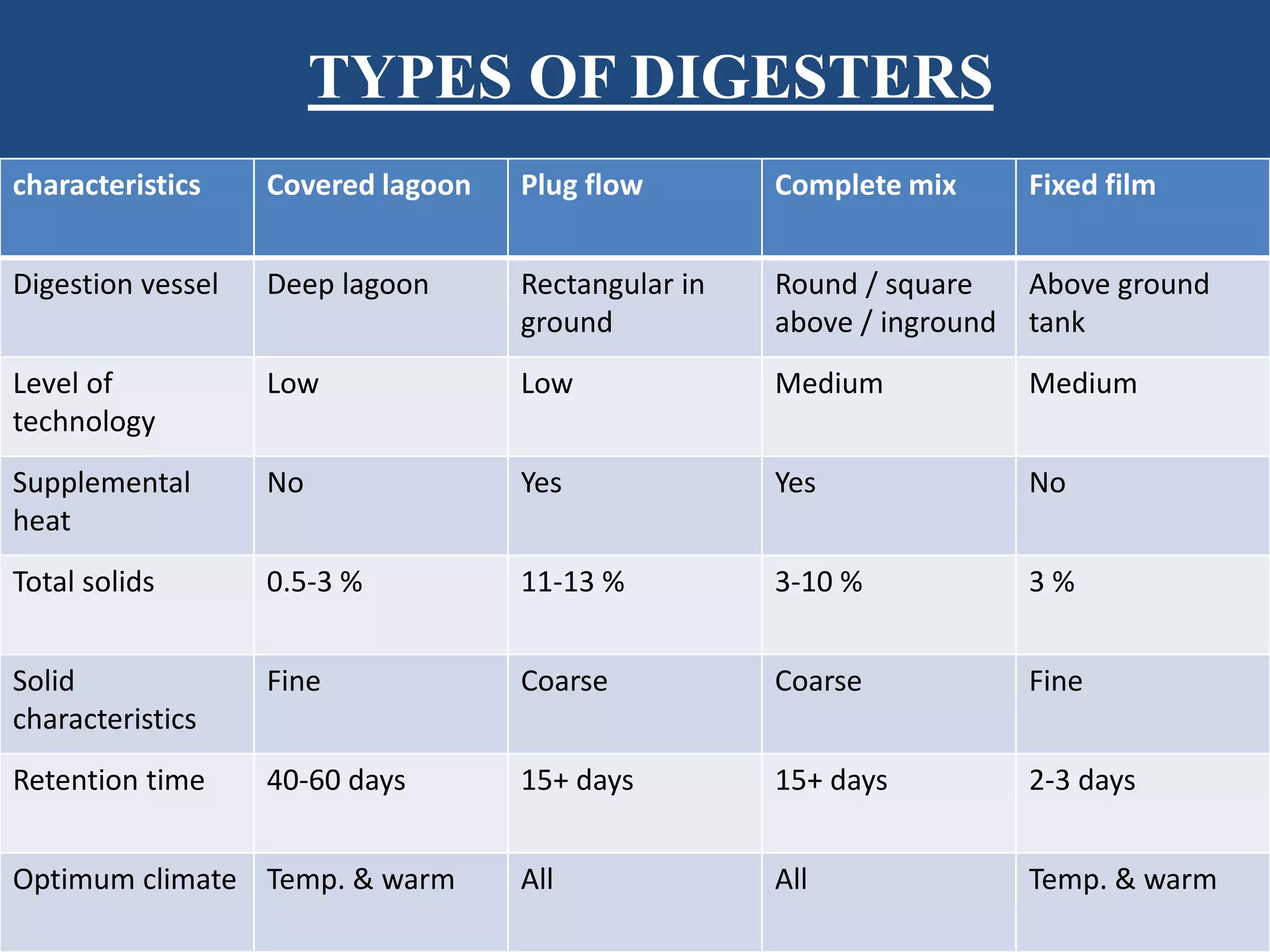
TYPES OF DIGESTERS
characteristics Covered lagoon Plug flow Complete mix Fixed film
Digestion vessel Deep lagoon Rectangular in
ground
Round / square
above / inground
Above ground
tank
Level of
technology
Low Low Medium Medium
Supplemental
heat
No Yes Yes No
Total solids 0.5-3 % 11-13 % 3-10 % 3 %
Solid
characteristics
Fine Coarse Coarse Fine
Retention time 40-60 days 15+ days 15+ days 2-3 days
Optimum climate Temp. & warm All All Temp. & warm
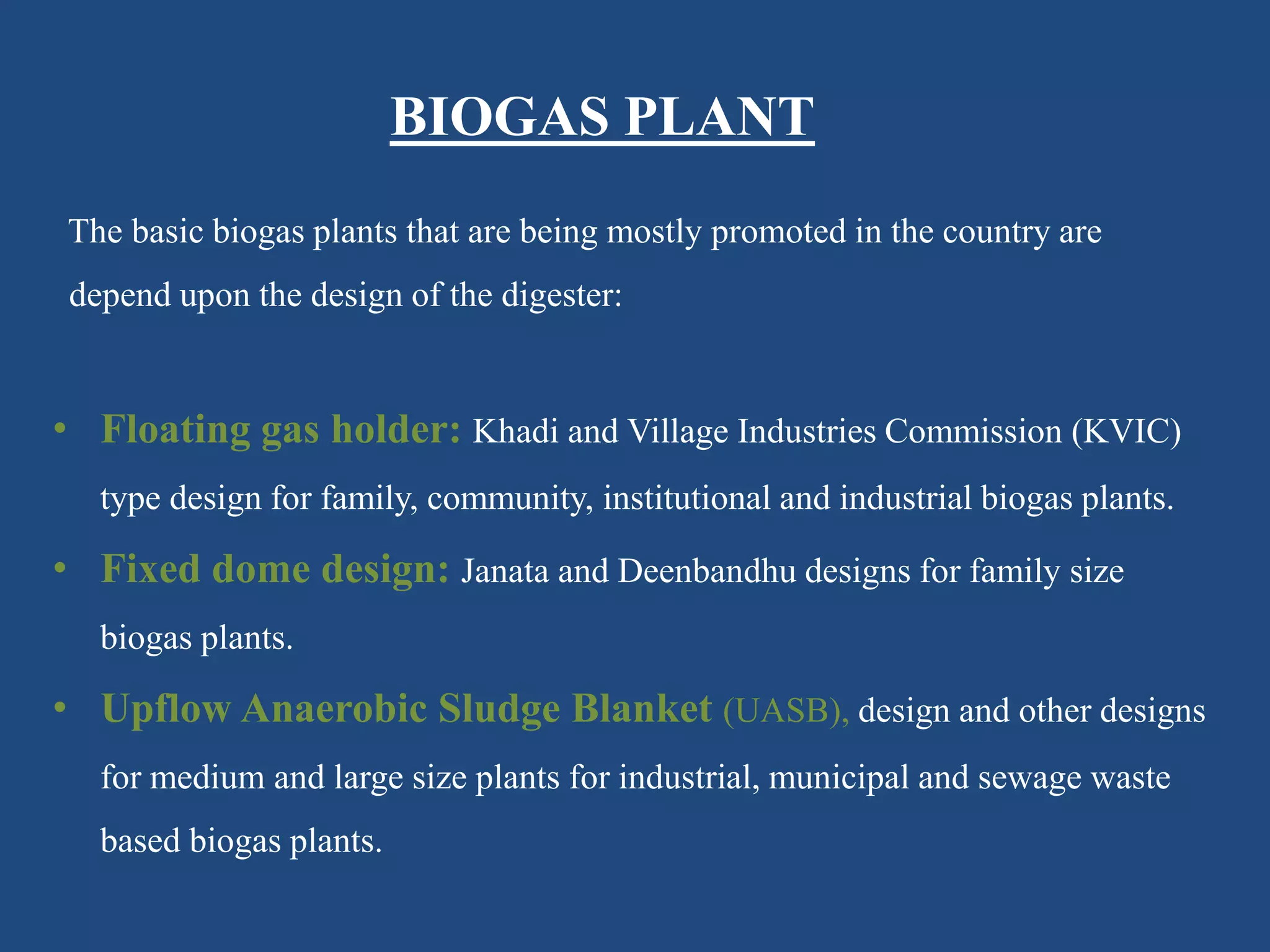
BIOGAS PLANT
The basic biogas plants that are being mostly promoted in the country are
depend upon the design of the digester:
• Floating gas holder: Khadi and Village Industries Commission (KVIC)
type design for family, community, institutional and industrial biogas plants.
• Fixed dome design: Janata and Deenbandhu designs for family size
biogas plants.
• Upflow Anaerobic Sludge Blanket (UASB), design and other designs
for medium and large size plants for industrial, municipal and sewage waste
based biogas plants.
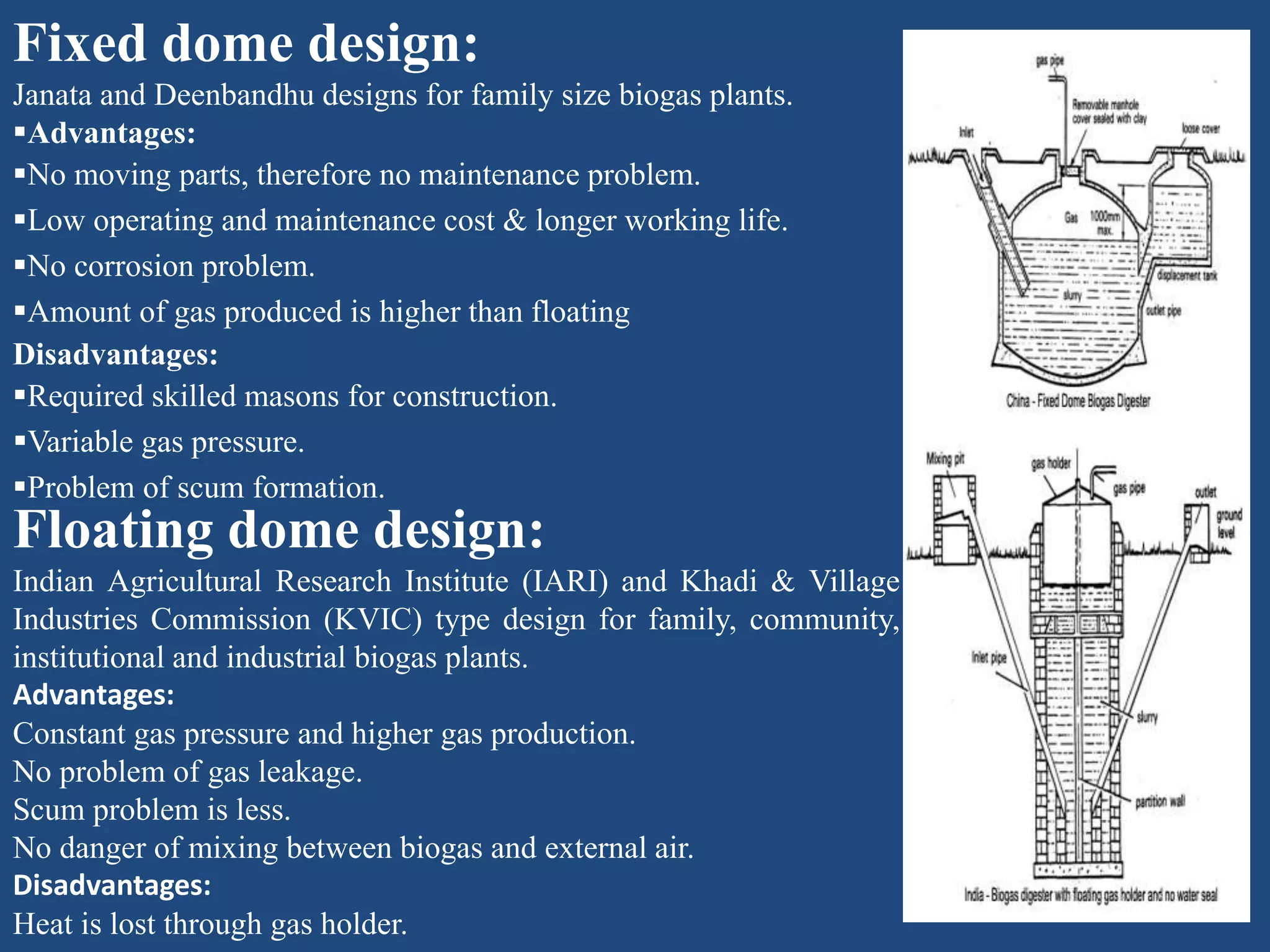
Fixed dome design:
Janata and Deenbandhu designs for family size biogas plants.
Advantages:
No moving parts, therefore no maintenance problem.
Low operating and maintenance cost & longer working life.
No corrosion problem.
Amount of gas produced is higher than floating
Disadvantages:
Required skilled masons for construction.
Variable gas pressure.
Problem of scum formation.
Floating dome design:
Indian Agricultural Research Institute (IARI) and Khadi & Village
Industries Commission (KVIC) type design for family, community,
institutional and industrial biogas plants.
Advantages:
Constant gas pressure and higher gas production.
No problem of gas leakage.
Scum problem is less.
No danger of mixing between biogas and external air.
Disadvantages:
Heat is lost through gas holder.
•Fig. Showing different types of common biogas reactors in India (a)Laboratory batch reactor, (b) Fixed dome
Reactor, (c) Floating dome Reactor, (d) Continues stirrer tank reactor (CSTR), e) Plug Flow and, (f) Up flow
anaerobic sludge blanket (UASB).
UP FLOW ANAEROBIC SLUDGE BLANKET (UASB):
UASB design is used for medium and large size plants for industrial, municipal and
sewage waste based biogas plants.
UASB reactors are typically suited to dilute waste water streams (3% TSS with particle
size >0.75mm
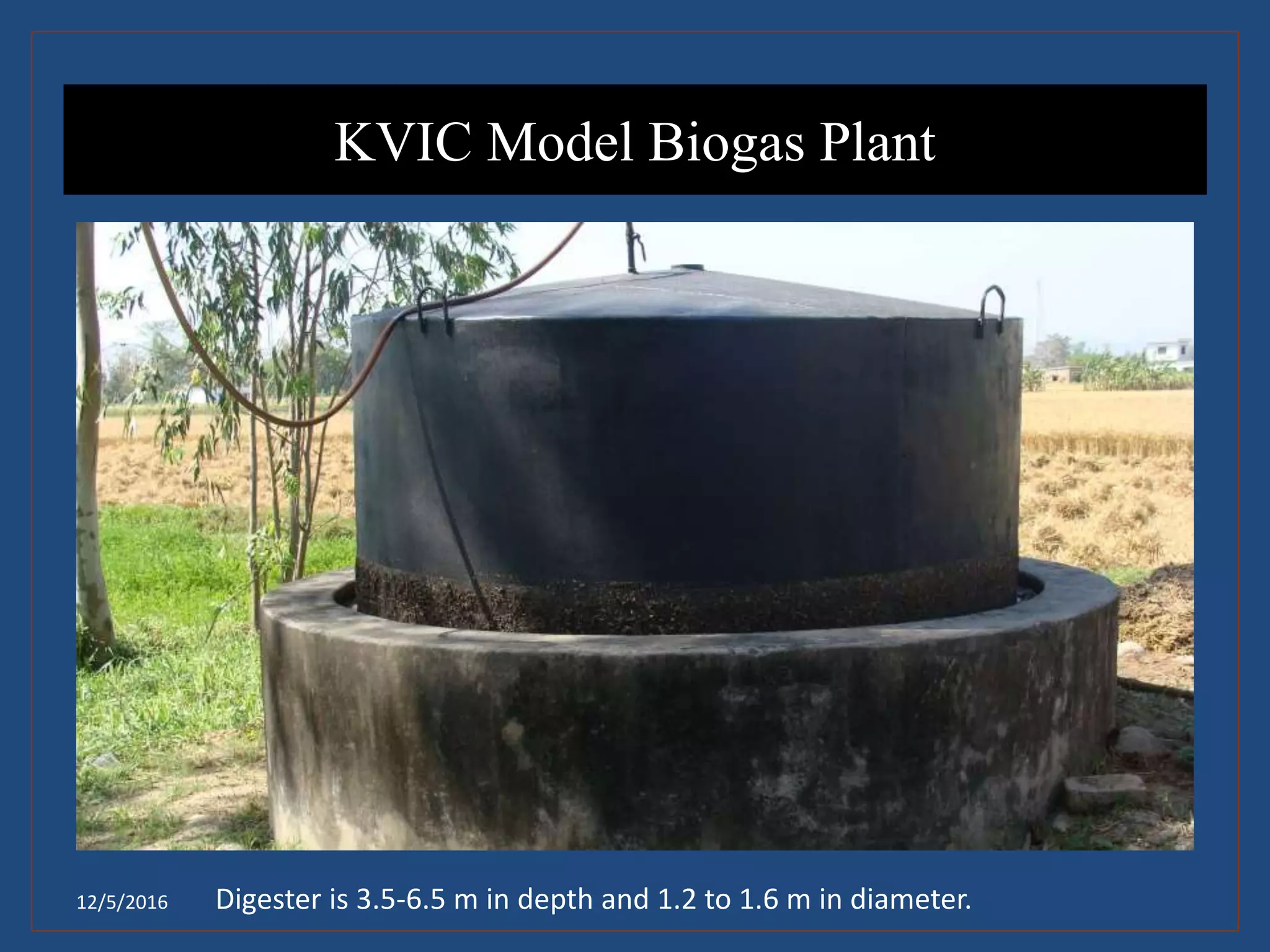
KVIC Model Biogas Plant
12/5/2016 Digester is 3.5-6.5 m in depth and 1.2 to 1.6 m in diameter.
12/5/2016 Development Alternative
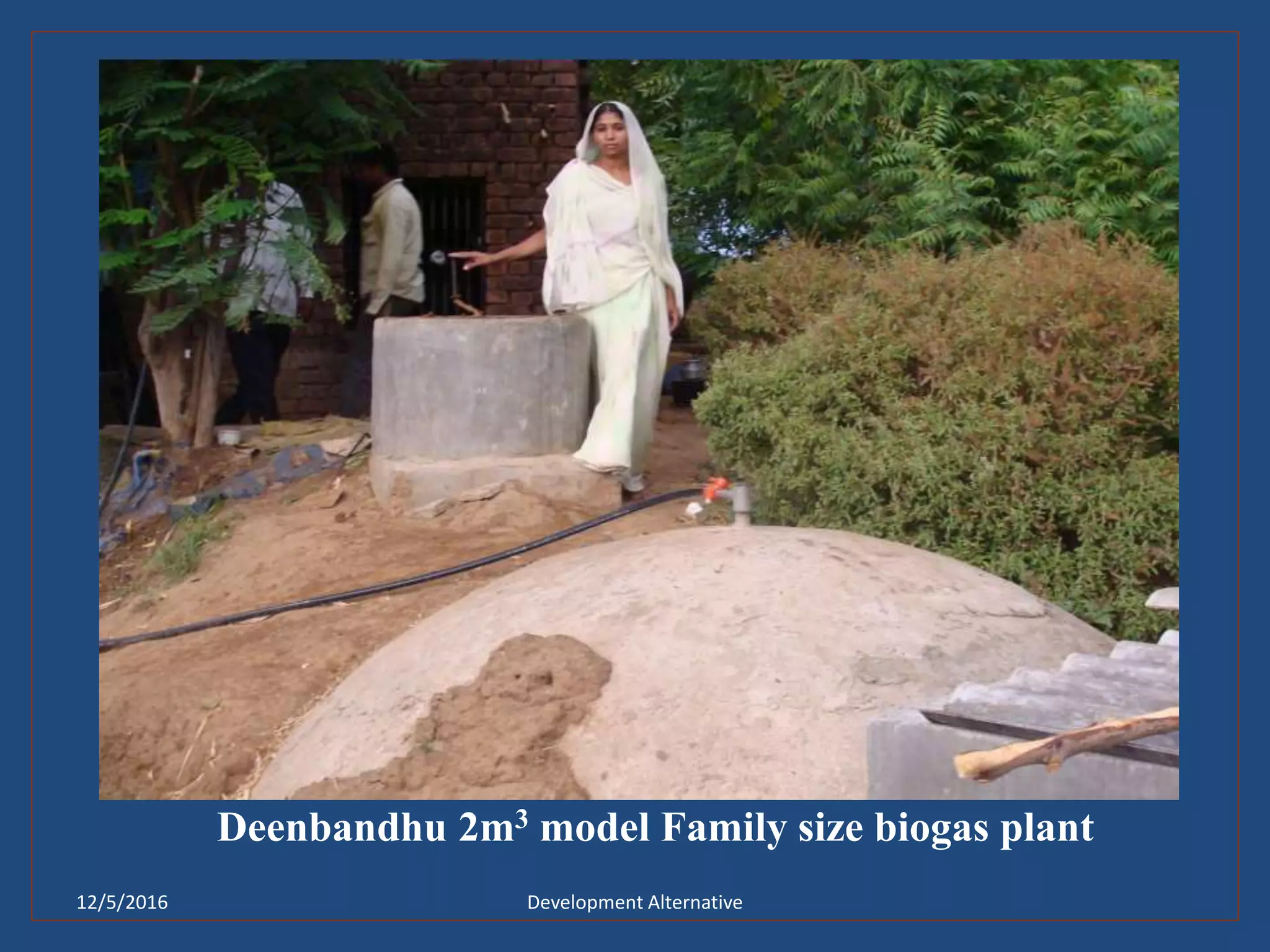
Deenbandhu 2m3 model Family size biogas plant
12/5/2016 Development Alternative
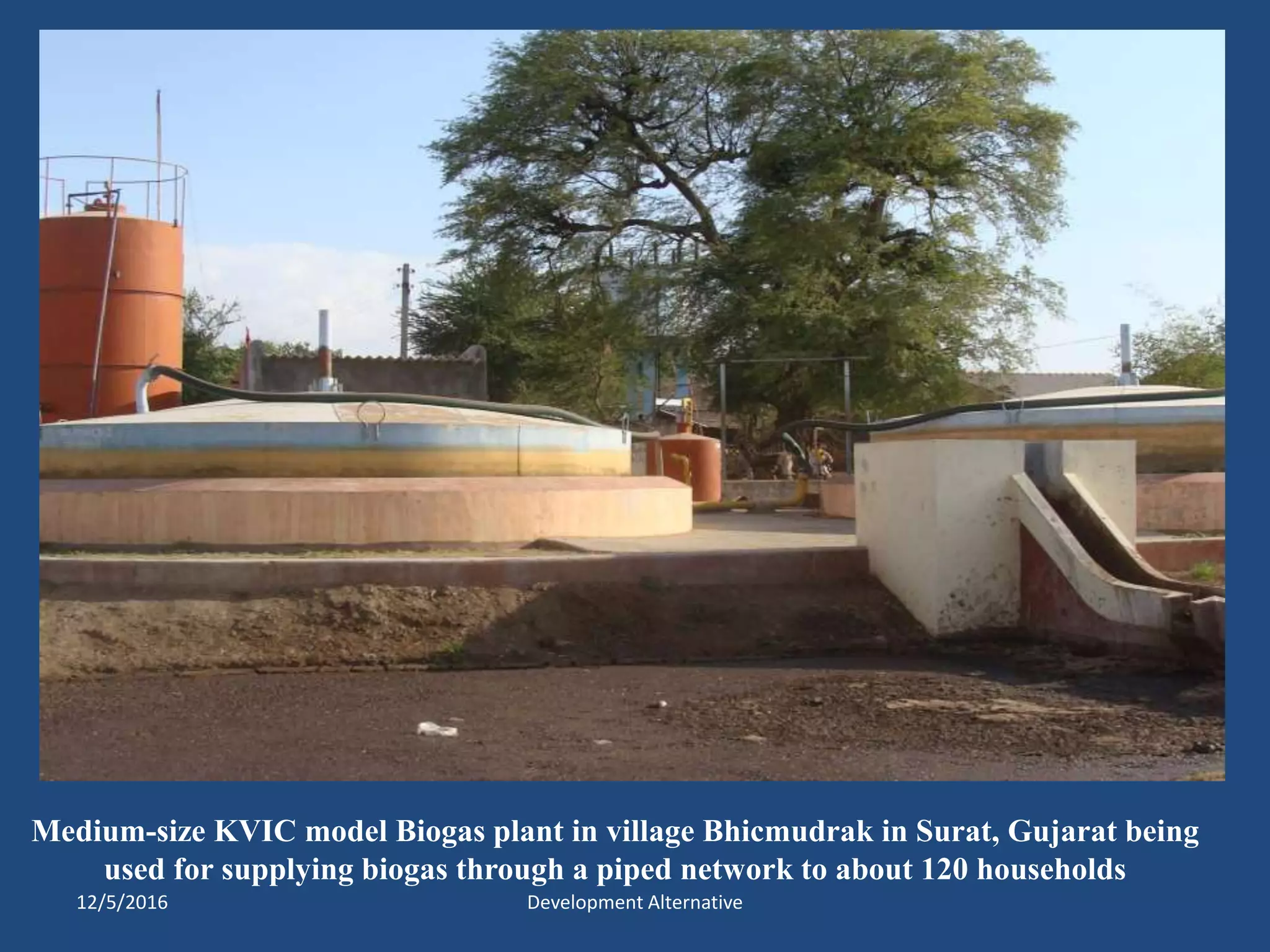
Medium-size KVIC model Biogas plant in village Bhicmudrak in Surat, Gujarat being
used for supplying biogas through a piped network to about 120 households
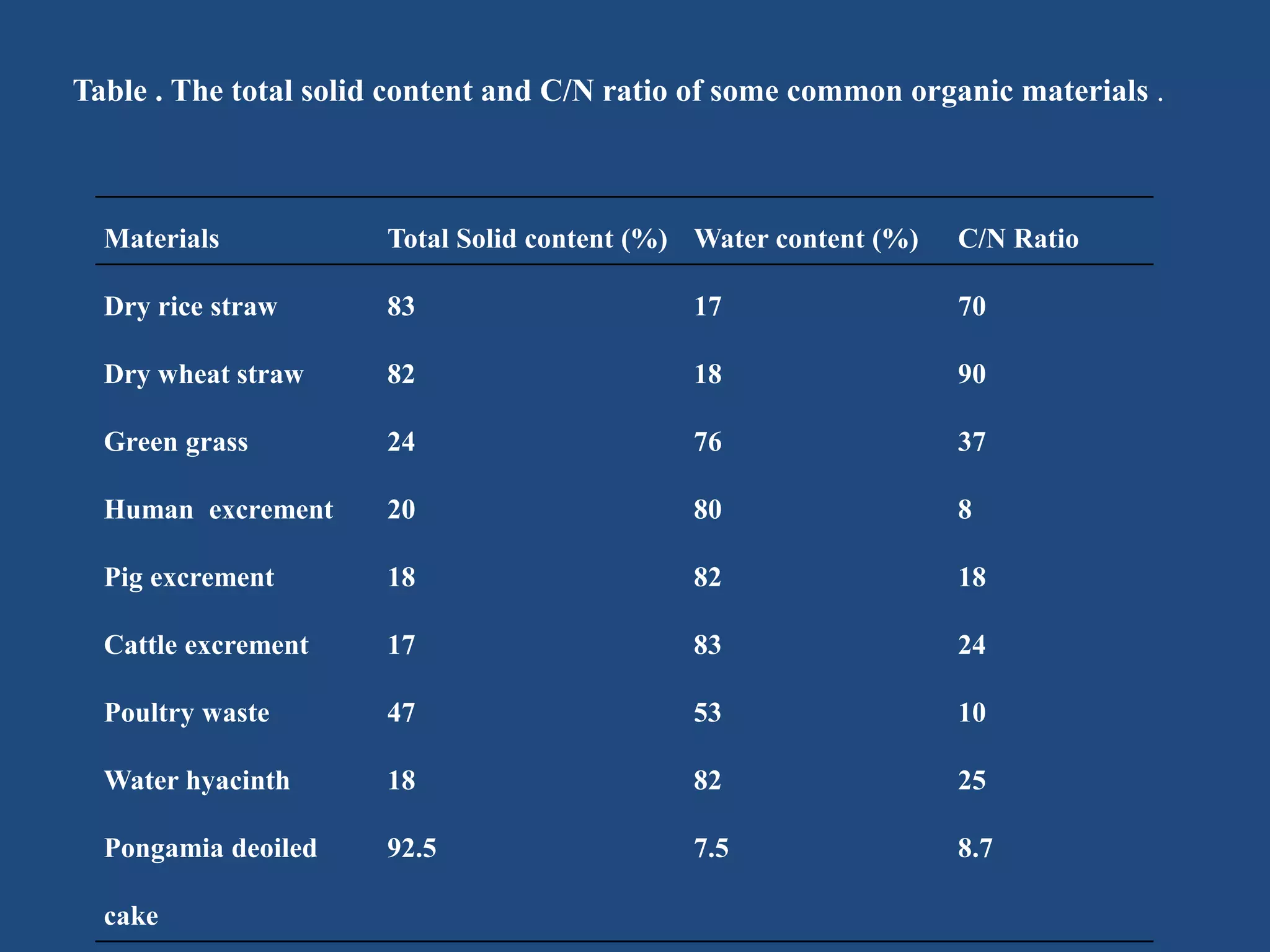
Materials Total Solid content (%) Water content (%) C/N Ratio
Dry rice straw 83 17 70
Dry wheat straw 82 18 90
Green grass 24 76 37
Human excrement 20 80 8
Pig excrement 18 82 18
Cattle excrement 17 83 24
Poultry waste 47 53 10
Water hyacinth 18 82 25
Pongamia deoiled
cake
92.5 7.5 8.7
Table . The total solid content and C/N ratio of some common organic materials .
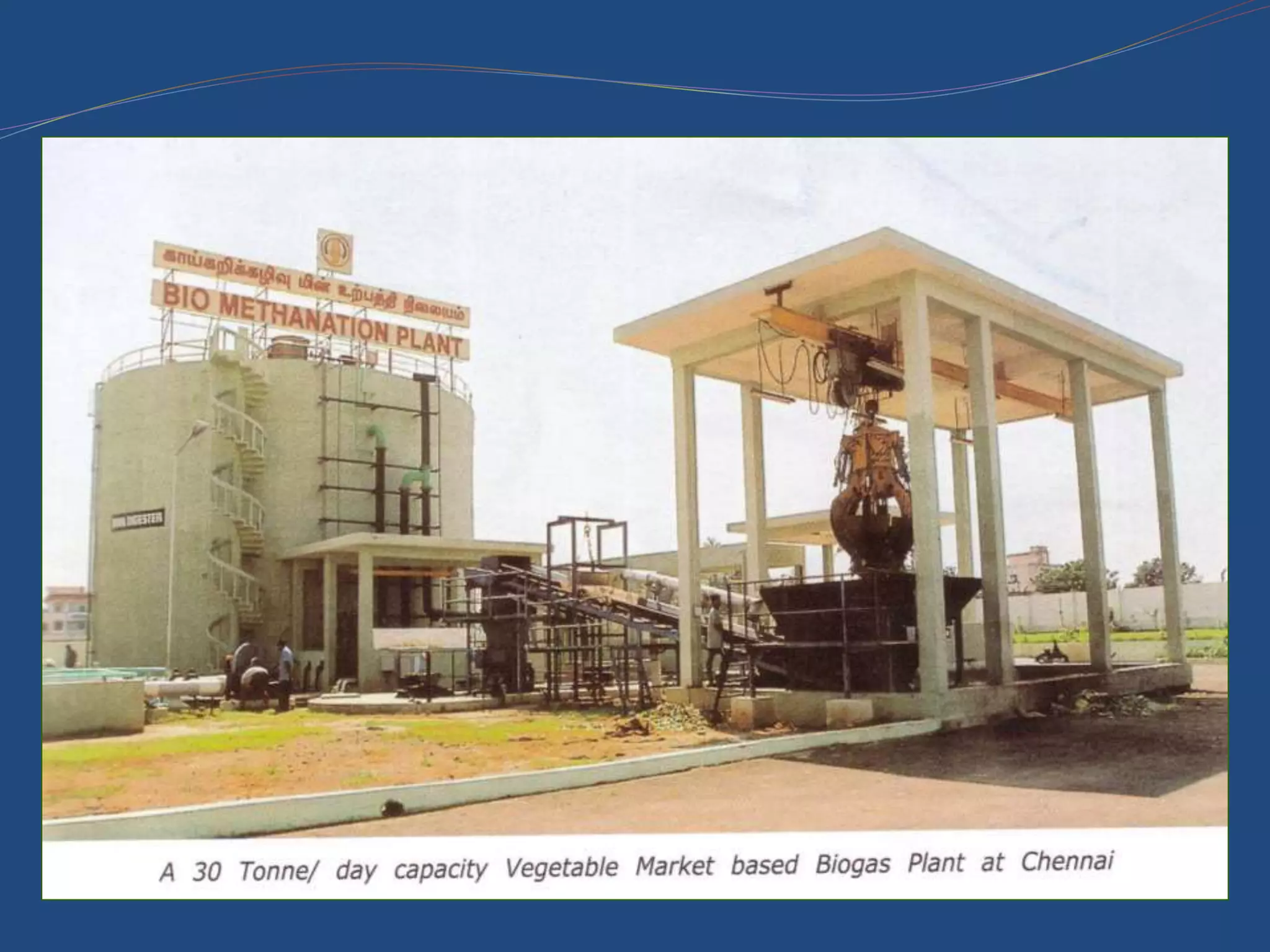
Some Mega Projects based on
Biogas Technology in India:
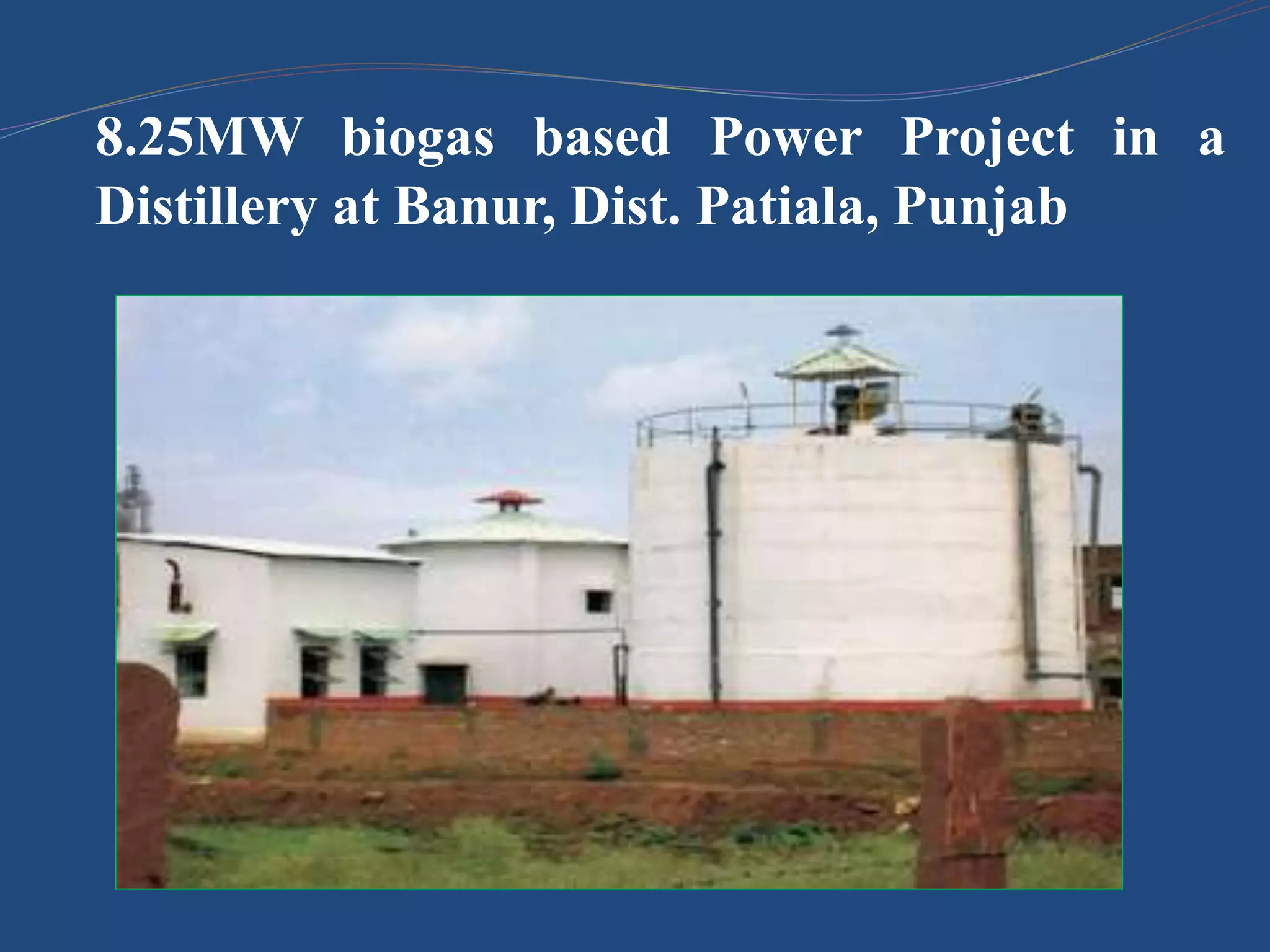
8.25MW biogas based Power Project in a
Distillery at Banur, Dist. Patiala, Punjab
12,000 m3 Biogas per day Biomethanation Project from
Starch Industry Liquid Waste in Salem, Tamilnadu
CONCLUSION
•A robust analysis of the resources and potential of biomass has been
presented.
•Huge potential exist for exploration of available biomass in India to
convert it to energy.
•Agencies and industries are practicing the conversion of different waste
biomass to energy in India and reported benefits from these.
•MNRE showed the huge potential data of installed capacity and surplus
biomass.
CONTD.
• Selection of conversion technologies for biomass depends upon the
form in which the energy is required like combustion produce heat,
mechanical, electricity energy; pyrolysis, fermentation and
mechanical extraction produce liquid fuels suitable for use as
transportation fuels etc.
• The states are also generating power by baggase cogeneration which
uses the waste of sugar mills.
• The prime motto of Govt. to provide the subsidy or providing
financial assistance is to encourage the use of non conventional
sources of energy, which helps in sustainable development of nation.
“THE BEAUTY YOU SEE IN ME IS THE
REFLECTION OF YOU”
RUMI
Bioenergy resources in india 22

Bioenergy resources in india 22

  • 1.
    SHRI MATA VAISHNODEVI UNIVERSITY , KAKRYAL , KATRA BIOENERGY POTENTIAL OF INDIA BIOGAS DIGESTERS TYPES OF BIOFUELS ASSIGNMENT OF NON – CONVENTIONAL ENERGY SOURCES TEACHER CONCERNED: DR. V.V. TYAGI PREPARED BY: ANAM MUKTHAR ( 16-MRE-010)
  • 2.
    TOPICS OF DISCUSSION •BIOENERGYPOTENTIAL •BIOGAS DIGESTERS •TYPES OF BIOFUELS
  • 4.
    WHAT IS BIOENERGY? •Energy from biomass • Plants capture energy from the sun through photosynthesis. – Carbon dioxide (CO2) + sunlight + water  sugar • The energy is stored in plants as cell mass. • The stored energy in plants (biomass) can be used to produce . – Fuels – Heat – Power (electricity)
  • 5.
    WHY USE BIOMASSAS AN ENERGY SOURCE? ▫ Oil is a scarce resource. ▫ Countries are becomming more and more dependent on oil i.e. oil import from other countries are increasing. ▫ Greenhouse effects –Kyoto protocol calls for reduction of CO2 emissions. ▫ The biobased economy must be established in the 21’st century. ▫ Biomass can provide a substantial part of our energy supply.
  • 6.
  • 7.
    BIOMASS ENERGY CONVERSION PROCESSES S.NO.PROCESS INPUT FEEDSTOCK CONVERS ION TEMPERA TURE CONVE RSION PRESSU RE (0 C) CHARACTER ISTICS OF PROCESS PRODUCT FORM PROCESS YIELD ( % OF ORIGINAL MASS) 1. Anaerobic fermentation Aqueous slurry (30%-20% solids) 20 -50 Atmosphe ric Fermentation of wastes or algae grown on waste of energy crops 50% -70% methane , remainder co2 20 - 26% 2. Biophotolysis Aqueous slurry for algae, bacteria and protein – enzyme complexes 20 -50 Atmosphe ric Sunlight produces `intracellular enzymatic reduction of H2O Hydrogen 3. Acid Hydrolysis 5% acidified slurry (H2SO4 with cellulose) 20 -50 Atmosphe ric Glucose fermented to ethyl alcohol. Cellulose hydrolized to glucose. Ethyl Alcohol 4. Enzyme Hydrolysis Aqueous slurry (cellulose rich) 20 -50 Atmosphe ric Extracellular enzymatic conversion of cellulose to sugar to alcohol. Ethyl Alcohol 90% 5. Combustion Dried feedstock (10-25% H2O) 1200-1300 Atmosphe ric Augments(5- 20%) boiler fuel Heat , steam converted to electricity. 6. Pyrolysis Dried feedstock 500-1300 Atmosphe ric 1/3 of char is produced .o2 free Oil Char gas 40% 20%
  • 8.
    BIOENERGY POTENTIAL IN INDIA RESOURCE:NON-CONVENTIONALENERGY SOURCES AND UTILISATION SECOND REVISED EDITION (2014);R.K.RAJPUT S.NO. RESOURCE ESTIMATED POTENTIAL (MW) ACHIEVEMENT UPTO JAN. 2009 (MW) 1. Biopower (wood biomass) 52,000 683 2. Waste-to-energy i) Grid interacted power ii) Distributed power 5,000 50,000 34.95 11.03 3. Biomass gasifiers - 87 4. Cogeneration bagasse 5,000 1034 5. Family type biogas plants 120 lakhs 39.8 lakhs
  • 9.
    BIOMASS POTENTIAL ININDIA S.NO. RESOURCES POTENTIAL 1. Surplus biomass 17000 MW 2. Cows manure and poultry droppings 1500 MW 3. a) Urban Wastes b) Industrial Wastes 2600 MW 1300 MW
  • 10.
    INDIA AND THEBIOENERGY
  • 11.
    ADVANTAGES OF BIOENERGY •Bio fuels are friendlier to the nature than fossil fuels. • The fossil fuel reserves will decline  biofuels’ importance rises. • Diversifying energy sources. • Employment. • Energy supply for developing countries. 11
  • 12.
  • 13.
    FROM BIOMASS TOBIOFUEL 13
  • 15.
    BIOFUELS • Most biomassesare also bio fuels as such. • Biomass can be refined into fuels that are easier to store, transport, and use. • Processed biofuels are: – Solids: Processed solids – Liquid: Liquid biofuels – Gas: Biogas 12
  • 16.
    HISTORY • An importantfuel for most of mankind's history is the Invention of gasoline-burning, internal combustion engine (late 19th century)  change toward coal and petroleum-based fuels. • Use of biofuels began to rise during the 1970’s . 16
  • 17.
    NATIONAL BIO-FUEL POLICY •Announcedin December, 2009. •Development and utilization of indigenous non- food feedstock's raised on degraded or waste lands. •Thrust on research and development on cultivation, processing and production of bio fuels. •20% Ethanol and Bio-diesel blending by 2017 – current target is 5% blending – achieving ~ 2%.
  • 18.
  • 19.
    PROCESSED SOLIDS • Charcoal •Pellets • Briquettes • Wood chips 19
  • 20.
    CHARCOAL • Oldest processedbiofuel. • Produced from all tree species and parts of plants, hardwood considered the best. • Produced through pyrolysis and carbonisation: – wood is heated to about 500°C in absence of oxygen. http://www.renewcology.nu 20
  • 21.
    THE PRODUCTION OFCHARCOAL 1. Preparation of wood. 2. Drying – reduction of moisture content. 3. Pre-carbonization – reduction of volatiles content. 4. Carbonization – further reduction of volatiles content. 5. End of carbonization – increasing the carbon content. 6. Cooling and stabilization of charcoal. 21
  • 22.
    PELLETS • Made outof woody residues. • Cylindrical or cubic granules. • Production: drying and possibly grinding and then compressing biomass. 22
  • 23.
    BRIQUETTES • Produced bycompressing dry sawdust, grinding dust or cutter chips. • Cylindrical. • Diameter between 50 and 80 mm. • Net calorific value is 17mj/kg. 23
  • 24.
    WOOD CHIPS • Wasteproduct of forestry operations. • Made in mechanical chippers. 24
  • 25.
    LIQUID BIOFUELS 25 • Generatedby gasification, fermentation, and pyrolysis technologies. • Ethanol • Methanol • Vegetable oils • Biodiesel • Pyrolysis bio-oil
  • 26.
    ETHANOL • Sugars arefermented into ethanol: – C6H12O6  2C2H5OH + 2CO2 • Ethanol can be used as – a fuel – reacted with isobutylene to form ethyl tertiary butyl ether (ETBE) for blending with gasoline. • Environmental benefits – CO2 emission is reduced. – current world production of ethanol fuel is about 20 to 21 billion litres annually 26
  • 27.
  • 28.
    METHANOL • Produced bygasification – Synthesis gas (mainly H2 and CO) at high temperatures (>1000K): CO + 2H2  CH3OH +heat – Excess hydrogen (with catalyst): 3H2 + CO2  CH3OH + H2O • Methanol is used as – a fuel as such – reacted with isobutylene  methyl tertiary butyl ether (MTBE) for blending with gasoline. 28
  • 29.
    VEGETABLE OIL • Producedfrom plants using extraction technologies. • Extraction process – the oil bearing part of the plant is separated and squeezed using a screw press to release the oil. • Processing steps can be performed at almost any scale. 29
  • 30.
    VEGETABLE OIL • Sourcesof vegetable oil. – coconuts (left) . – sunflowers (right). 30
  • 31.
    BIODIESEL • Diesel fuelbased on vegetable oil. • Chemical process: transesterification. • Glycerine is separated with alcohol from the vegetable oil. • Can be blended with petroleum diesel. 31
  • 32.
    PYROLYSIS BIO-OIL • Fromresidue chips and sawdust. • Fast pyrolysis – organic materials are rapidly heated to 450 - 600 oC in absence of air  organic vapours  condensed to bio-oil. • Chemically complex. • Heating value 14-18 MJ/kg . 32
  • 33.
  • 35.
    GREEN BUS NAGPUR’S ETHANOLGREEN SCANIA BUS SHOWCASED IN PUNE
  • 36.
    DRAWBACKS • Expensive • Transportation •Low heating values • Decaying • Quality variations • Some negative environmental impacts 36
  • 37.
    ADVANTAGES OF BIOENERGY •Bio fuels are friendlier to the nature than fossil fuels. • The fossil fuel reserves will decline  biofuels’ importance rises • Diversifying energy sources • Employment • Energy supply for developing countries 37
  • 38.
    AWARDS Bio energy awardsfor cutting edge research (B-ACER). IUSSTF –held by Indo-US Science and Technology Forum. EECAAwards 2016 – Innovation and outstanding achievement in energy efficiency. Stanford Borough Council Green Awards 2015. IChemE –Bio processing Award 2013. Bio energy Man of the year.
  • 39.
    EUBCE (European Biomass Conferenceand Exhibition) • EUBCE is a world class annual event which, since 1980, is held at different venues throughout Europe . • The EUBCE covers the entire value chain of biomass to conduct business network and to present and discuss the latest developments and innovations , the vision is to educate the biomass community and to accelerate growth. • In June 2015 , EUBCE was held in Stockholm, Sweden.
  • 40.
  • 41.
    INTRODUCTION • Biogas isclean environment friendly fuel (gas ) that can be obtained by anaerobic digestion of animal residues and domestic and farm wastes, abundantly available in the countryside. • Biogas generally comprise of 55-65 % methane, 35-45 % carbon dioxide, 0.5-1.0 % hydrogen sulfide and traces of water vapor. • Average calorific value of biogas is 20 MJ/m3 (4713 kcal/m3). BIOGAS
  • 42.
    Acetate CH4 +CO2 CH4H2 + CO2 Methanol CH4 + H2O Hydrolysis Complex carbohydrates  Simple sugars Complex lipids Fatty acids Complex proteinsAmino acids Acidogenesis Simple sugars + fatty acids + amino acids  Organic acids, including acetate + alcohols Acetogenesis (acetate production) Organic acids + alcohols --------Acetate Methanogenesis Acetoclastic methanogeesis Hydogenotrophic methanogenesis Methyltrophic methanogenesis BIOGAS PRODUCTION MECHANISM Biogas production process is a multiple-stage process in which some main stages are:
  • 43.
    DIGESTER • It isthe underground cylindrical wall portion made of bricks, sand and cement. • It is this place where fermentation of dung takes place. • It is also some times called fermentation tank. • Two rectangular openings facing each other are provided for inflow and outflow at almost middle of its height.
  • 44.
    ANAEROBIC DIGESTERS • Itis an air tight, oxygen free container that is fed an organic material such as animal manure or food scraps. • A biological process occurs to this mixture to produce methane gas, commonly known as biogas along with an odour reduced effluent. • Microbes breakdown into biogas and nutrient-rich effluent.
  • 45.
    TYPES OF DIGESTERS characteristicsCovered lagoon Plug flow Complete mix Fixed film Digestion vessel Deep lagoon Rectangular in ground Round / square above / inground Above ground tank Level of technology Low Low Medium Medium Supplemental heat No Yes Yes No Total solids 0.5-3 % 11-13 % 3-10 % 3 % Solid characteristics Fine Coarse Coarse Fine Retention time 40-60 days 15+ days 15+ days 2-3 days Optimum climate Temp. & warm All All Temp. & warm
  • 46.
    BIOGAS PLANT The basicbiogas plants that are being mostly promoted in the country are depend upon the design of the digester: • Floating gas holder: Khadi and Village Industries Commission (KVIC) type design for family, community, institutional and industrial biogas plants. • Fixed dome design: Janata and Deenbandhu designs for family size biogas plants. • Upflow Anaerobic Sludge Blanket (UASB), design and other designs for medium and large size plants for industrial, municipal and sewage waste based biogas plants.
  • 47.
    Fixed dome design: Janataand Deenbandhu designs for family size biogas plants. Advantages: No moving parts, therefore no maintenance problem. Low operating and maintenance cost & longer working life. No corrosion problem. Amount of gas produced is higher than floating Disadvantages: Required skilled masons for construction. Variable gas pressure. Problem of scum formation. Floating dome design: Indian Agricultural Research Institute (IARI) and Khadi & Village Industries Commission (KVIC) type design for family, community, institutional and industrial biogas plants. Advantages: Constant gas pressure and higher gas production. No problem of gas leakage. Scum problem is less. No danger of mixing between biogas and external air. Disadvantages: Heat is lost through gas holder.
  • 48.
    •Fig. Showing differenttypes of common biogas reactors in India (a)Laboratory batch reactor, (b) Fixed dome Reactor, (c) Floating dome Reactor, (d) Continues stirrer tank reactor (CSTR), e) Plug Flow and, (f) Up flow anaerobic sludge blanket (UASB). UP FLOW ANAEROBIC SLUDGE BLANKET (UASB): UASB design is used for medium and large size plants for industrial, municipal and sewage waste based biogas plants. UASB reactors are typically suited to dilute waste water streams (3% TSS with particle size >0.75mm
  • 49.
    KVIC Model BiogasPlant 12/5/2016 Digester is 3.5-6.5 m in depth and 1.2 to 1.6 m in diameter.
  • 50.
    12/5/2016 Development Alternative Deenbandhu2m3 model Family size biogas plant
  • 51.
    12/5/2016 Development Alternative Medium-sizeKVIC model Biogas plant in village Bhicmudrak in Surat, Gujarat being used for supplying biogas through a piped network to about 120 households
  • 52.
    Materials Total Solidcontent (%) Water content (%) C/N Ratio Dry rice straw 83 17 70 Dry wheat straw 82 18 90 Green grass 24 76 37 Human excrement 20 80 8 Pig excrement 18 82 18 Cattle excrement 17 83 24 Poultry waste 47 53 10 Water hyacinth 18 82 25 Pongamia deoiled cake 92.5 7.5 8.7 Table . The total solid content and C/N ratio of some common organic materials .
  • 53.
    Some Mega Projectsbased on Biogas Technology in India:
  • 54.
    8.25MW biogas basedPower Project in a Distillery at Banur, Dist. Patiala, Punjab
  • 56.
    12,000 m3 Biogasper day Biomethanation Project from Starch Industry Liquid Waste in Salem, Tamilnadu
  • 58.
    CONCLUSION •A robust analysisof the resources and potential of biomass has been presented. •Huge potential exist for exploration of available biomass in India to convert it to energy. •Agencies and industries are practicing the conversion of different waste biomass to energy in India and reported benefits from these. •MNRE showed the huge potential data of installed capacity and surplus biomass.
  • 59.
    CONTD. • Selection ofconversion technologies for biomass depends upon the form in which the energy is required like combustion produce heat, mechanical, electricity energy; pyrolysis, fermentation and mechanical extraction produce liquid fuels suitable for use as transportation fuels etc. • The states are also generating power by baggase cogeneration which uses the waste of sugar mills. • The prime motto of Govt. to provide the subsidy or providing financial assistance is to encourage the use of non conventional sources of energy, which helps in sustainable development of nation.
  • 60.
    “THE BEAUTY YOUSEE IN ME IS THE REFLECTION OF YOU” RUMI