BIOMASS ENERGY
Biomass energy includes energy from all plant matter (tree, shrub, and crop) and
animal dung. Biomass, unlike other renewables, is a versatile source of energy, which can be
converted to modern forms such as liquid and gaseous fuels, electricity, and process heat. One
of the major advantages of biomass energy is that it can be used in different forms. For e.g., Gas
generated from the biomass can be directly used for cooking or it can be used for running an
internal combustion engine for developing stationary shaft power or otherwise coupled to
generator for generating electric power. The availability of biomass such as wood, cow-dung,
leaf litter in rural areas is more. Hence a choice of biomass energy especially in rural areas is
more reasonable but at the same time the technology is being developed to meet the large-
scale requirements using biomass.
- Small-scale (5-100 KW)
- Medium-scale (1-10 MW)
- Large scale (about 50 MW)
Biomass Resources
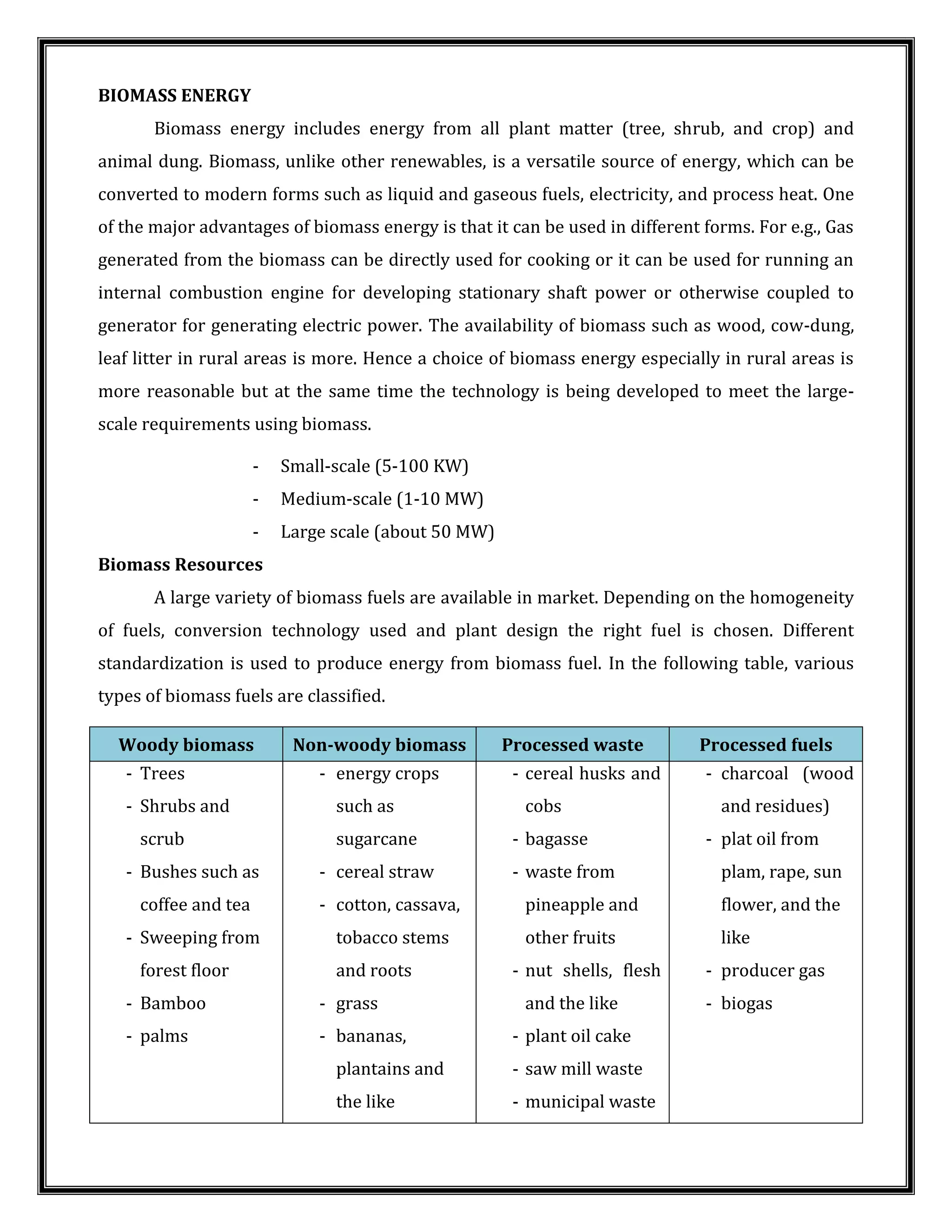
A large variety of biomass fuels are available in market. Depending on the homogeneity
of fuels, conversion technology used and plant design the right fuel is chosen. Different
standardization is used to produce energy from biomass fuel. In the following table, various
types of biomass fuels are classified.
Woody biomass Non-woody biomass Processed waste Processed fuels
- Trees
- Shrubs and
scrub
- Bushes such as
coffee and tea
- Sweeping from
forest floor
- Bamboo
- palms
- energy crops
such as
sugarcane
- cereal straw
- cotton, cassava,
tobacco stems
and roots
- grass
- bananas,
plantains and
the like
- cereal husks and
cobs
- bagasse
- waste from
pineapple and
other fruits
- nut shells, flesh
and the like
- plant oil cake
- saw mill waste
- municipal waste
- charcoal (wood
and residues)
- plat oil from
plam, rape, sun
flower, and the
like
- producer gas
- biogas
Energy Production varies depending on type of biomass fuel used. When energy crops are used
for energy production, it depends mainly on the following factors:
- Availability & Productivity of the land
- Regional distribution
- Environmental implications
- Performance of conversion technologies
When waste & residues are used, energy production from them depends mainly on:
- By-products of agro-industry and forestry
- 30% of it is recoverable
- Production is limited by impracticality of recovering
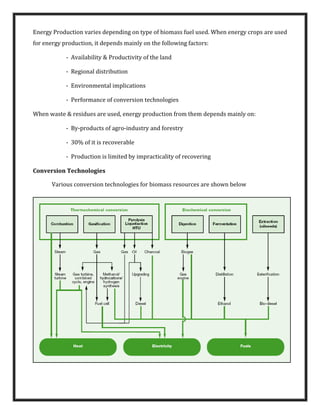
Conversion Technologies
Various conversion technologies for biomass resources are shown below
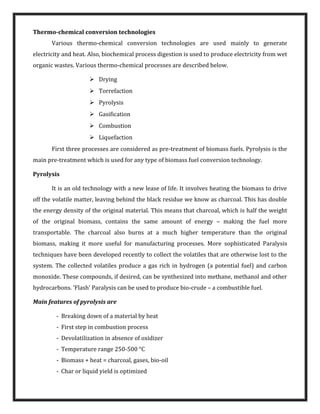
Thermo-chemical conversion technologies
Various thermo-chemical conversion technologies are used mainly to generate
electricity and heat. Also, biochemical process digestion is used to produce electricity from wet
organic wastes. Various thermo-chemical processes are described below.
 Drying
 Torrefaction
 Pyrolysis
 Gasification
 Combustion
 Liquefaction
First three processes are considered as pre-treatment of biomass fuels. Pyrolysis is the
main pre-treatment which is used for any type of biomass fuel conversion technology.
Pyrolysis
It is an old technology with a new lease of life. It involves heating the biomass to drive
off the volatile matter, leaving behind the black residue we know as charcoal. This has double
the energy density of the original material. This means that charcoal, which is half the weight
of the original biomass, contains the same amount of energy – making the fuel more
transportable. The charcoal also burns at a much higher temperature than the original
biomass, making it more useful for manufacturing processes. More sophisticated Paralysis
techniques have been developed recently to collect the volatiles that are otherwise lost to the
system. The collected volatiles produce a gas rich in hydrogen (a potential fuel) and carbon
monoxide. These compounds, if desired, can be synthesized into methane, methanol and other
hydrocarbons. 'Flash' Paralysis can be used to produce bio-crude – a combustible fuel.
Main features of pyrolysis are
- Breaking down of a material by heat
- First step in combustion process
- Devolatilization in absence of oxidizer
- Temperature range 250-500 °C
- Biomass + heat = charcoal, gases, bio-oil
- Char or liquid yield is optimized
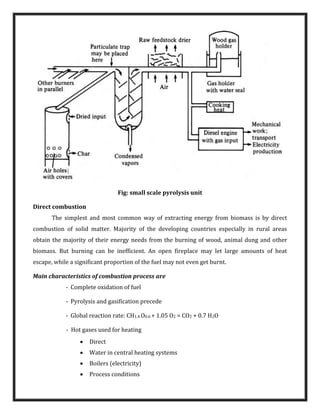
Fig: small scale pyrolysis unit
Direct combustion
The simplest and most common way of extracting energy from biomass is by direct
combustion of solid matter. Majority of the developing countries especially in rural areas
obtain the majority of their energy needs from the burning of wood, animal dung and other
biomass. But burning can be inefficient. An open fireplace may let large amounts of heat
escape, while a significant proportion of the fuel may not even get burnt.
Main characteristics of combustion process are
- Complete oxidation of fuel
- Pyrolysis and gasification precede
- Global reaction rate: CH1.4 O0.6 + 1.05 O2 = CO2 + 0.7 H2O
- Hot gases used for heating
 Direct
 Water in central heating systems
 Boilers (electricity)
 Process conditions
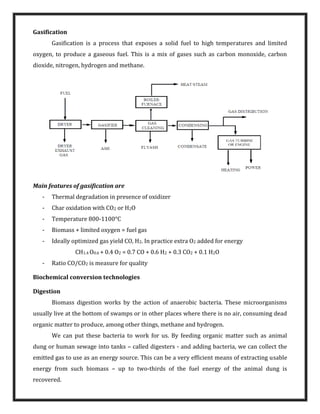
Gasification
Gasification is a process that exposes a solid fuel to high temperatures and limited
oxygen, to produce a gaseous fuel. This is a mix of gases such as carbon monoxide, carbon
dioxide, nitrogen, hydrogen and methane.
Main features of gasification are
- Thermal degradation in presence of oxidizer
- Char oxidation with CO2 or H2O
- Temperature 800-1100°C
- Biomass + limited oxygen = fuel gas
- Ideally optimized gas yield CO, H2. In practice extra O2 added for energy
CH1.4 O0.6 + 0.4 O2 = 0.7 CO + 0.6 H2 + 0.3 CO2 + 0.1 H2O
- Ratio CO/CO2 is measure for quality
Biochemical conversion technologies
Digestion
Biomass digestion works by the action of anaerobic bacteria. These microorganisms
usually live at the bottom of swamps or in other places where there is no air, consuming dead
organic matter to produce, among other things, methane and hydrogen.
We can put these bacteria to work for us. By feeding organic matter such as animal
dung or human sewage into tanks – called digesters - and adding bacteria, we can collect the
emitted gas to use as an energy source. This can be a very efficient means of extracting usable
energy from such biomass – up to two-thirds of the fuel energy of the animal dung is
recovered.
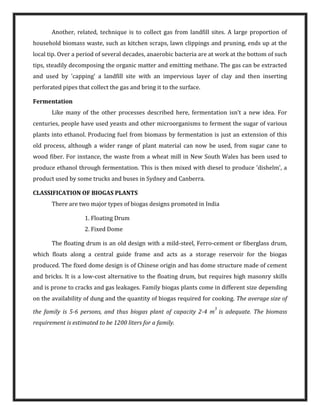
Another, related, technique is to collect gas from landfill sites. A large proportion of
household biomass waste, such as kitchen scraps, lawn clippings and pruning, ends up at the
local tip. Over a period of several decades, anaerobic bacteria are at work at the bottom of such
tips, steadily decomposing the organic matter and emitting methane. The gas can be extracted
and used by 'capping' a landfill site with an impervious layer of clay and then inserting
perforated pipes that collect the gas and bring it to the surface.
Fermentation
Like many of the other processes described here, fermentation isn't a new idea. For
centuries, people have used yeasts and other microorganisms to ferment the sugar of various
plants into ethanol. Producing fuel from biomass by fermentation is just an extension of this
old process, although a wider range of plant material can now be used, from sugar cane to
wood fiber. For instance, the waste from a wheat mill in New South Wales has been used to
produce ethanol through fermentation. This is then mixed with diesel to produce 'dishelm', a
product used by some trucks and buses in Sydney and Canberra.
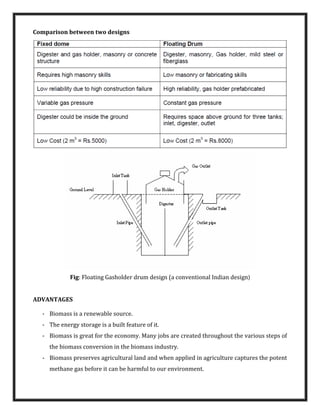
CLASSIFICATION OF BIOGAS PLANTS
There are two major types of biogas designs promoted in India
1. Floating Drum
2. Fixed Dome
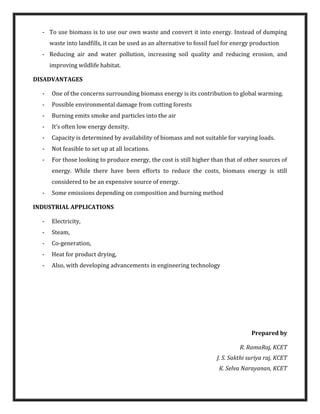
The floating drum is an old design with a mild-steel, Ferro-cement or fiberglass drum,
which floats along a central guide frame and acts as a storage reservoir for the biogas
produced. The fixed dome design is of Chinese origin and has dome structure made of cement
and bricks. It is a low-cost alternative to the floating drum, but requires high masonry skills
and is prone to cracks and gas leakages. Family biogas plants come in different size depending
on the availability of dung and the quantity of biogas required for cooking. The average size of
the family is 5-6 persons, and thus biogas plant of capacity 2-4 m
3
is adequate. The biomass
requirement is estimated to be 1200 liters for a family.
Comparison between two designs
Fig: Floating Gasholder drum design (a conventional Indian design)
ADVANTAGES
- Biomass is a renewable source.
- The energy storage is a built feature of it.
- Biomass is great for the economy. Many jobs are created throughout the various steps of
the biomass conversion in the biomass industry.
- Biomass preserves agricultural land and when applied in agriculture captures the potent
methane gas before it can be harmful to our environment.
- To use biomass is to use our own waste and convert it into energy. Instead of dumping
waste into landfills, it can be used as an alternative to fossil fuel for energy production
- Reducing air and water pollution, increasing soil quality and reducing erosion, and
improving wildlife habitat.
DISADVANTAGES
- One of the concerns surrounding biomass energy is its contribution to global warming.
- Possible environmental damage from cutting forests
- Burning emits smoke and particles into the air
- It’s often low energy density.
- Capacity is determined by availability of biomass and not suitable for varying loads.
- Not feasible to set up at all locations.
- For those looking to produce energy, the cost is still higher than that of other sources of
energy. While there have been efforts to reduce the costs, biomass energy is still
considered to be an expensive source of energy.
- Some emissions depending on composition and burning method
INDUSTRIAL APPLICATIONS
- Electricity,
- Steam,
- Co-generation,
- Heat for product drying,
- Also, with developing advancements in engineering technology
Prepared by
R. RamaRaj, KCET
J. S. Sakthi suriya raj, KCET
K. Selva Narayanan, KCET

Biomass energy

  • 1.
    BIOMASS ENERGY Biomass energyincludes energy from all plant matter (tree, shrub, and crop) and animal dung. Biomass, unlike other renewables, is a versatile source of energy, which can be converted to modern forms such as liquid and gaseous fuels, electricity, and process heat. One of the major advantages of biomass energy is that it can be used in different forms. For e.g., Gas generated from the biomass can be directly used for cooking or it can be used for running an internal combustion engine for developing stationary shaft power or otherwise coupled to generator for generating electric power. The availability of biomass such as wood, cow-dung, leaf litter in rural areas is more. Hence a choice of biomass energy especially in rural areas is more reasonable but at the same time the technology is being developed to meet the large- scale requirements using biomass. - Small-scale (5-100 KW) - Medium-scale (1-10 MW) - Large scale (about 50 MW) Biomass Resources A large variety of biomass fuels are available in market. Depending on the homogeneity of fuels, conversion technology used and plant design the right fuel is chosen. Different standardization is used to produce energy from biomass fuel. In the following table, various types of biomass fuels are classified. Woody biomass Non-woody biomass Processed waste Processed fuels - Trees - Shrubs and scrub - Bushes such as coffee and tea - Sweeping from forest floor - Bamboo - palms - energy crops such as sugarcane - cereal straw - cotton, cassava, tobacco stems and roots - grass - bananas, plantains and the like - cereal husks and cobs - bagasse - waste from pineapple and other fruits - nut shells, flesh and the like - plant oil cake - saw mill waste - municipal waste - charcoal (wood and residues) - plat oil from plam, rape, sun flower, and the like - producer gas - biogas
  • 2.
    Energy Production variesdepending on type of biomass fuel used. When energy crops are used for energy production, it depends mainly on the following factors: - Availability & Productivity of the land - Regional distribution - Environmental implications - Performance of conversion technologies When waste & residues are used, energy production from them depends mainly on: - By-products of agro-industry and forestry - 30% of it is recoverable - Production is limited by impracticality of recovering Conversion Technologies Various conversion technologies for biomass resources are shown below
  • 3.
    Thermo-chemical conversion technologies Variousthermo-chemical conversion technologies are used mainly to generate electricity and heat. Also, biochemical process digestion is used to produce electricity from wet organic wastes. Various thermo-chemical processes are described below.  Drying  Torrefaction  Pyrolysis  Gasification  Combustion  Liquefaction First three processes are considered as pre-treatment of biomass fuels. Pyrolysis is the main pre-treatment which is used for any type of biomass fuel conversion technology. Pyrolysis It is an old technology with a new lease of life. It involves heating the biomass to drive off the volatile matter, leaving behind the black residue we know as charcoal. This has double the energy density of the original material. This means that charcoal, which is half the weight of the original biomass, contains the same amount of energy – making the fuel more transportable. The charcoal also burns at a much higher temperature than the original biomass, making it more useful for manufacturing processes. More sophisticated Paralysis techniques have been developed recently to collect the volatiles that are otherwise lost to the system. The collected volatiles produce a gas rich in hydrogen (a potential fuel) and carbon monoxide. These compounds, if desired, can be synthesized into methane, methanol and other hydrocarbons. 'Flash' Paralysis can be used to produce bio-crude – a combustible fuel. Main features of pyrolysis are - Breaking down of a material by heat - First step in combustion process - Devolatilization in absence of oxidizer - Temperature range 250-500 °C - Biomass + heat = charcoal, gases, bio-oil - Char or liquid yield is optimized
  • 4.
    Fig: small scalepyrolysis unit Direct combustion The simplest and most common way of extracting energy from biomass is by direct combustion of solid matter. Majority of the developing countries especially in rural areas obtain the majority of their energy needs from the burning of wood, animal dung and other biomass. But burning can be inefficient. An open fireplace may let large amounts of heat escape, while a significant proportion of the fuel may not even get burnt. Main characteristics of combustion process are - Complete oxidation of fuel - Pyrolysis and gasification precede - Global reaction rate: CH1.4 O0.6 + 1.05 O2 = CO2 + 0.7 H2O - Hot gases used for heating  Direct  Water in central heating systems  Boilers (electricity)  Process conditions
  • 5.
    Gasification Gasification is aprocess that exposes a solid fuel to high temperatures and limited oxygen, to produce a gaseous fuel. This is a mix of gases such as carbon monoxide, carbon dioxide, nitrogen, hydrogen and methane. Main features of gasification are - Thermal degradation in presence of oxidizer - Char oxidation with CO2 or H2O - Temperature 800-1100°C - Biomass + limited oxygen = fuel gas - Ideally optimized gas yield CO, H2. In practice extra O2 added for energy CH1.4 O0.6 + 0.4 O2 = 0.7 CO + 0.6 H2 + 0.3 CO2 + 0.1 H2O - Ratio CO/CO2 is measure for quality Biochemical conversion technologies Digestion Biomass digestion works by the action of anaerobic bacteria. These microorganisms usually live at the bottom of swamps or in other places where there is no air, consuming dead organic matter to produce, among other things, methane and hydrogen. We can put these bacteria to work for us. By feeding organic matter such as animal dung or human sewage into tanks – called digesters - and adding bacteria, we can collect the emitted gas to use as an energy source. This can be a very efficient means of extracting usable energy from such biomass – up to two-thirds of the fuel energy of the animal dung is recovered.
  • 6.
    Another, related, techniqueis to collect gas from landfill sites. A large proportion of household biomass waste, such as kitchen scraps, lawn clippings and pruning, ends up at the local tip. Over a period of several decades, anaerobic bacteria are at work at the bottom of such tips, steadily decomposing the organic matter and emitting methane. The gas can be extracted and used by 'capping' a landfill site with an impervious layer of clay and then inserting perforated pipes that collect the gas and bring it to the surface. Fermentation Like many of the other processes described here, fermentation isn't a new idea. For centuries, people have used yeasts and other microorganisms to ferment the sugar of various plants into ethanol. Producing fuel from biomass by fermentation is just an extension of this old process, although a wider range of plant material can now be used, from sugar cane to wood fiber. For instance, the waste from a wheat mill in New South Wales has been used to produce ethanol through fermentation. This is then mixed with diesel to produce 'dishelm', a product used by some trucks and buses in Sydney and Canberra. CLASSIFICATION OF BIOGAS PLANTS There are two major types of biogas designs promoted in India 1. Floating Drum 2. Fixed Dome The floating drum is an old design with a mild-steel, Ferro-cement or fiberglass drum, which floats along a central guide frame and acts as a storage reservoir for the biogas produced. The fixed dome design is of Chinese origin and has dome structure made of cement and bricks. It is a low-cost alternative to the floating drum, but requires high masonry skills and is prone to cracks and gas leakages. Family biogas plants come in different size depending on the availability of dung and the quantity of biogas required for cooking. The average size of the family is 5-6 persons, and thus biogas plant of capacity 2-4 m 3 is adequate. The biomass requirement is estimated to be 1200 liters for a family.
  • 7.
    Comparison between twodesigns Fig: Floating Gasholder drum design (a conventional Indian design) ADVANTAGES - Biomass is a renewable source. - The energy storage is a built feature of it. - Biomass is great for the economy. Many jobs are created throughout the various steps of the biomass conversion in the biomass industry. - Biomass preserves agricultural land and when applied in agriculture captures the potent methane gas before it can be harmful to our environment.
  • 8.
    - To usebiomass is to use our own waste and convert it into energy. Instead of dumping waste into landfills, it can be used as an alternative to fossil fuel for energy production - Reducing air and water pollution, increasing soil quality and reducing erosion, and improving wildlife habitat. DISADVANTAGES - One of the concerns surrounding biomass energy is its contribution to global warming. - Possible environmental damage from cutting forests - Burning emits smoke and particles into the air - It’s often low energy density. - Capacity is determined by availability of biomass and not suitable for varying loads. - Not feasible to set up at all locations. - For those looking to produce energy, the cost is still higher than that of other sources of energy. While there have been efforts to reduce the costs, biomass energy is still considered to be an expensive source of energy. - Some emissions depending on composition and burning method INDUSTRIAL APPLICATIONS - Electricity, - Steam, - Co-generation, - Heat for product drying, - Also, with developing advancements in engineering technology Prepared by R. RamaRaj, KCET J. S. Sakthi suriya raj, KCET K. Selva Narayanan, KCET