Biomass and
Biomass Cook Stoves
Dr. Akepati S. Reddy
School of Energy and Environment
Thapar University, Patiala
INDIA
Bio-energy Resources
• Feedstock of biological origin
• Most important among the renewable energy resources
• Indirect solar energy resource (by plants through
photosynthesis) – accumulated biomass
– Photosynthesis: Process used by plants, algae and bacteria
to harness sunlight into chemical energy
CO2 + 2H2A + Light Energy → [CH2O] + 2A + H2O
6CO2 + 12H2O + Light Energy → C6H12O6 + 6O2 + 6H2O
• Starting trophic level of food chains - consumed by
animals (including man)
• Natural ecosystems (terrestrial and aquatic systems),
agricultural and aqua-cultural systems are sources
• Plant biomass, animal wastes, agricultural residues/waste,
agricultural produce, and agro- and forest based industry
wastes are bio-energy resources
Bio-energy Resources
• Feedstock of biological origin used to produce heat, power,
and liquid and gaseous biofuels
• Wood from forests
• Forest residues and wood wastes
• biomass not harvested or not removed from logging sites
• biomass resulting from forest management operations
• agro-forestry and timber plantation
• Agricultural crop residues
• Stalks, leaves and other materials not harvested or not
removed from fields
• Straw, sugar cane tops and leaves, ---
• Industrial crop residues (crops grown to produce specific
industrial chemicals or materials)
• Weeds (including aquatic weeds and see weeds) and grasses
• Animal wastes/manure and other organic wastes
• Cattle dung, Municipal solid wastes, residual foods, ---
Bio-energy Resources
• Industrial wastes (agro and forest based industries)
– Plywood and timber industry (25% of the wood input)
– Bagasse from sugar mills
– Spent wash from distilleries
– Black liquor, wood dust, bark etc. from pulp and paper industry
– Rice husk from rice shellers
– ----
• Dedicated energy crops
• herbaceous crops– perennial crops (2-3 year rotation)
• tree/plantation crops (fast growing trees with 5 to 8 yr
rotation)
• Algae
• -----
• Agricultural produce
• Sugars, starch, cereals, vegetable oils, ---
Biomass
Potential
• Annual biomass production: 4,000 EJ/Year (1 EJ = 1x10¹⁸ J)
• Photosynthetic efficiency of solar radiation: 0.27%
• Standing biomass of the earth: 36,000 EJ
• Technical potential estimated: 1500 EJ/year
• Potential pegged by sustainability constraints: 200-500 EJ/year
Usage
• Largest among the renewable energy resources
• Contribution to the world energy consumption: 50 EJ (of the
total 500 EJ in 2008)
• May increase to 59-145 EJ by 2025 and to 94-280EJ by 2050
• 10 to 15% contribution (less for industrialized countries and
more for developing countries)
• 80% for Nigeria, 25% for India, 10% for China and 4% for USA
• 20% for Sweden, Findland and Austria
The problem is not of resource availability – it is of sustainable
management and proper delivery of the resource
BillionkWh
2025 2050 2100
Shell (1996) 85 200-220 ----
IPCC (1996) 72 280 320
Green peace (1993) 114 181 ----
WEC (1993) 59 94-157 132-215
Johansson et al. (1993) 145 206 ----
Dessus et al. (1992) 135 ---- ----
Lashof and tirpak (1991) 130 215 ----
Global biomass energy (in EJ/year) contributions
Biomass
• Very versatile fuel - can be stored and transported, and can be
converted into higher quality/energy density fuels and electricity
• Carbon neutral fuel - if used sustainably, releases no net CO2
• Available as a produce, a residue and as a waste
• Plant origin or animal origin or other life forms origin
• Solid form or slurry form or liquid form
• Has alternative non-energy uses as
• Food and fodder
• Fiber (Paper, paperboard and textiles)
• Furniture and building materials (timber, plyboard, plywood)
• Many chemicals and other substances
• Has ecological, environmental and sustainability importance
• Destructive to natural ecosystems and to biodiversity (1st trophic level
of food chains)
• Contribute to sustainability and ecology of agricultural systems
• Soil organic matter, nutrients and soil properties contributor
• Energy crops deprive land from other competitive uses
• Use is associated with environmental pollution problems
Biomass and Bio-energy
• Produce, residues and wastes are used
• Used for heat, electricity and bio-fuels
• Sustainability and distribution and supply of energy services
• Residential use
– Cooking, water and/or space heating and lighting
– Firewood, solid biomass and biogas
• Industrial use
– Process heating, and electricity generation and use
– Solid fuels, slurries and wastewaters
– Combined heat and power generation (CHP/cogeneration),
Biogas, gasification, ---
• Transportation use
– Biofuels (ethanol, biodiesel, hydrogen, biogas!)
– Sugars (sugarcane molasses, ….) grain (corn, ….), starch (cassava,
sweet potato, …) and ligno-cellulose (wide range of biomass)
– Edible oils (soya, palm, rapeseed, …), non-edible oils (Jatropa,
…), algal oil, waste/used oils and animal fats
Biomass and Bio-energy
• Of the global 56 EJ biomass use (in 2013?)
– 62% is in buildings for cooking and heating
– 15% in industry for process heating (and power generation - CHP)
• In buildings it is mostly for cooking and heating through direct
combustion
– A small fraction could be through pyrolysis and gasification and
still smaller fraction could be biogas
– Cooking and heating specially at the household level is using
traditional inefficient stoves
• In the industry biomass is mostly used as boiler fuel
– Biomass ‘as it is’ or after compacting/concentration is used
• Burning over the grate or using fluidized bed technology
– Occasionally biogas is used as fuel (when produced internally)
– Burning of black liquor solids in the pulp and paper mills
– Pyrolysis or gasification of biomass and use of the resultant
producer gas could also be possible (specially in furnaces)
Primary biomass demand would double to
108 EJ/year by 2030 (amount to 20% of
global primary energy supply and 60% of
total final renewable energy use)
Increased use of liquid biofuels and CHP,
and reduced use of traditional biomass
will be the major contributors for reduced
building and industrial consumptions
Current (2010 or 2013 or 2014?) global
biomass use reached 56 EJ per year.
62% of this was consumed in buildings,
15% in industry, 9% in transport, and 8%
in the power and district heating sectors
AOSN
HC
194.747.4893.59779.34
942.120184.76615.47kcal/kg...


Biomass Composition and Properties
Proximate analysis: Ash, Volatile Matter, Fixed Carbon, and Moisture
Ultimate analysis: Carbon, Hydrogen, Nitrogen, Sulfur, Oxygen(by
difference), Chlorine, and Ash
Elemental Ash Analysis: Si, Fe, Al, Na, K, Ca, Mg, P, As (ppm)
Calorific value: HHV (product water as liquid) and LHV (product water
as gas)
– HHV from ultimate analysis– elements expressed as %)
Moisture, Bulk density and Energy density
– Energy density: Energy per unit volume/mass (MJ/m3 or MJ/kg)
– Low density enormously increases fuel volume to be handled
Green house gas emissions and climate change problems –
petroleum fuels and chemicals
Densification, combustion, thermo-chemical conversions, bio-
chemical conversions, and biorefineries for chemical products
Bio-energy Technologies
Global primary energy demand will be 600 EJ/year by 2030 –
contribution by biomass fuels will be 108 EJ/year – sustainable
biomass energy potential is about 104 EJ/year – only 40% of the
potential biomass is woody
Biomass, as the key energy source and as a substitute to the rapidly
dwindling fossil fuels, should become a source for heat, power (bio-
power), fuels (bio-fuels for transportation) and chemicals
Biomass is oxygenated fuel and available in many varied forms (varied
in bulk density, energy density and moisture content)
Woody biomass, agriculture and forest residues, grasses and straw,
agricultural, industrial and municipal wastes (MSW, effluents, etc.)
Direct consumption approach is not sufficient for biomass fuel usage
can provide only heat and at the maximum some biopower (but no
biofuels and chemicals)
moisture, low bulk density, low energy density, and emissions can limit
the fuels that can be combusted mainly to woody biomass
Energy efficiency can also be limiting
Thermochemical and biochemical conversions/processes in addition to
combustion is a solution for biomass fuels use to available potential
Biomass Conversion Processes
• Biomass densification
– Pre-treatment for densification
– Pyrolysis densification
– Mechanical densification
• Combustion (direct or after densification and/or drying)
– Burning as fuel in boilers and furnaces for heat or power or CHP
– Co-firing and composite fuel of coal and biomass (CCB)
– Biomass cook-stoves: 3 stone, traditional and improved (ICS) stoves
• Thermo-chemical processes
– Gasification
– Pyrolysis and carbonization
– Hydrothermal gasification and Hydrothermal liquefaction
– Biodiesel (trans-esterification and hydrogenation)
• Biochemical conversion processes
– Anaerobic digestion or biomethanation
– Fermentation of starches and sugars
– Cellulosic fermentation
• Bio-hydrogen
Combustion of solid and gaseous biofuels: Charcoal cookstoves, Biogas
cookstoves, TLUD (microgasifiers) stoves
Hydrothermal liquefaction and hydrothermal gasification
Biohydrogen
High value bio-products (chemicals and materials)
Biomass Densification
• Having lower (energy and bulk) density poses a challenge in the
handling, transportation, storage and combustion of biomass fuels
• Densification (process of producing liquid/solid fuel with denser and
more uniform properties) can address the problems
– simplifies storage, mechanical handling and feeding
– ensures uniform combustion in boilers
– reduces the spontaneous combustion risk in storage
– reduces transportation cost
– reduces dust production
• Densification is associated with cost
Densification: Pre-treatment
• Prior to densification, pre-treatment (including the following
operations) may be required
– Chopping to length/grinding, drying to required moisture level,
application of binding agent, steaming, and torrefaction
• Chop to length/Grinding: required to reduce energy use in the
densification process, to obtain denser products and to decrease
breakage of the densification product
• Drying to optimum moisture for densification (8%–20% : wet basis)
– Compaction requires a small amount of moisture – moisture above the
optimum can decrease strength and durability of densified biomass.
• Addition of Binding Agents, like, vegetable oil, clay, starch, cooking
oil, wax, etc. to increase binding properties
– Density and durability of densified biomass are influenced by natural
binding agents of the material (protein and starch content)
• Steaming to aid in the release and activation of natural binders
• Torrefaction: A type of pyrolysis involving heating of biomass to
280-320°C in the absence of oxygen/air
– Goal is to dry, embrittle and waterproof the biomass
Mechanical Densification
• Densification is mechanical (involving
application of pressure) and pyrolysis types
• Bales
– commonly used with harvested crop
residue
– A baler (a farm machinery) compresses the
chop into square, rectangular or round
(depends on type of baler used) bales
– Round bales are less expensive to produce
– Large square bales are denser and easier to
handle and transport
• Pellets
– Very high in density and formed by an
extrusion process
– Finely ground biomass is forced through
round or square cross-sectional dies, using
a piston press, and cut to desired length
– Biomass pellets are usually 38 mm long and
7 mm diameter
Mechanical Densification
• Cubes
– Larger pellets (13-38 mm size and length 25-102 mm),
but, less denser
– Chopped biomass is compressed with a heavy press
wheel and forced through dies
• Briquettes
– Similar to pellets but differ in size (25 mm or greater
diameter)
– Biomass is punched, using a piston press, into a die
under high pressure
– Alternatively, biomass is extruded by a screw through a
heated die
– Biomass densified through screw extrusion has higher
storability and energy density properties
• Pucks
– Similar in appearance to a hockey puck (75 mm
diameter) and have density similar to pellets
– Produced by a briquetter but have lower production costs
• Wood Chips
– Made with wood chipper and have 5-50 mm length
Pyrolysis Densification
• Heating biomass in the absence of oxygen
• Torrefaction
– Heating biomass in inert atmosphere at temperatures of 280°C–320°C
for a few minutes
– Volatile gases liberated are combusted to supply the heat required
(80% of the required heat is obtained)
– Torrefied biomass is densified into pellets or briquettes
– Torrefied biomass has hydrophobic properties (facilitating storage)
and it shows improved grindability properties.
• Slow Pyrolysis
• Heating to lower temp. (350-500C) for extended period (0.5-2 hrs.)
– Principal product is a solid (charcoal) that retains 60%–70% of the
original energy from the raw biomass
• Fast Pyrolysis
• Heating to 450-500°C temp. for 1-2 seconds
• Yields upto 75% bio-oil (higher energy density fuel) and 10-15%
charcoalfavour liquid or bio-oil production
• Bio-oils are very acidic, have a pungent odour and are prone to
separation/settling
Through various densification technologies, raw biomass is compressed
to densities in the order of 7–10 times to original bulk density
Torrefaction Slow Pyrolysis Fast Pyrolysis
Biomass Cook Stoves
Biomass cook stoves
• Urban households biomass use - reduced to <30% by 2004/5
– Fuel wood was the primary source until early 1970s, and use of
kerosene/LPG, electricity and solar energy for cooking and
heating was started and reached to ~70% by 2004/5
– By early 1980s 10% of the households were using LPG and it rose
to 57% by 2004-05 (< 30% of the population was using 75% of
the residential demand for LPG (IEA 2007)
• In rural India, biomass is the main energy source for >80% of
the households (2008) for cooking and heating
– Population relying on traditional biomass for cooking and heating
was 580 million in 1992 and 668 million in 2005
– Only 13.9% are using LPG for cooking
– 50% rural population has access to electricity, but its use for
cooking is limited (mostly use for lighting-ventilation)
• According to WHO in 2011, globally 3 billion people were using
biomass for cooking and heating (one billion stoves!)
Coke/coal Firewood LPG
Dung
cake Kerosene
No
cooking
Other
materials
Coke/coal Firewood LPG
Dung
cake Kerosene
No
cooking
Other
materials
Percent households
Per capita month fuel consumption
(2009-10)
Rural Urban
Rural Urban
Population
(2011)
83.3
Crore
37.7
Crore
Biomass 211.582
Mil. tons
23.374
Mil. tons
234.956 million tons/year biomass
(3.5 EJ/year)
(15MJ/kg energy density assumed)
Biomass stove design
Desired features of biomass stoves
• Fuel compatibility and fuel efficiency
• Clean burning (no harmful emissions – no indoor air pollution
problems)
• Easier, safer and faster cooking
– Easier and quicker fire start-ups
– Easier and simple stove power control
– Not too hot stove body to cause harm and physical burns
– Stability of the stove and of the pot on stove
• Aesthetics of the stove (should beautify the kitchen)
• Suitability to the owner/cook’s needs and tastes
• Valuable addition to the household’s quality of life
Design focus
• Complete (and clean) combustion of fuel generating heat
• Efficient transfer of the generated heat to cook pot/pan
Biomass stove design
Requirements for complete and clean biomass fuel combustion
• Making available of sufficient air for combustion processes
– Supply of air in excess of the stoicheometric air requirement
• Ensuring better air contact with the burning biomass fuel (and char)
and with the combusting volatile matter and gases
– Supply combustion air from under the burning fuel (either from sides
or from the front below the grate or from the opening for fuel feeding)
• Making available of enough heat for fuel volatilization/gasification,
and sufficient temperature for combustion organic vapours & gases
– Combustion chamber made up of heat soaking heavy materials
– Ensuring 3Ts (time, turbulence and temperature) in the combustion
chamber (enough space for combustion over the burning fuel)
Requirements for efficient heat transfer to cook pot/pan
• Restricting combustion processes and combustion heat release to
the combustion chamber
– Make combustion air available sufficiently inside combustion chamber
– Place biomass stick horizontal and meter them inside to burn at tips
Biomass stove design
Requirements for efficient heat transfer to cook pot/pan
• Insulating the combustion chamber and the hot flue gas passages
– Minimizing heat soaking by combustion chamber and by the hot flue
gas passages
Use light weight insulative refractory materials (insulative ceramics)
in the construction of combustion chamber and flue gas passages
• Maximizing diversion of combustion heat to cook pot/pan
– Provide insulative skirts to the pots and ensure sufficient channel gap
(neither too much nor too little gap)
– Do not allow thick air boundary layers on heat transfer surfaces
(ensure hot flue gases scraping of the pot surface at sufficient velocity)
• Having better and sufficient heat transfer surfaces with the cook
pots/pans
– Make the pots out of high heat conductance materials (metals) – and
have a heat soaking material layer on the heat transfer surfaces
– Maximize the hot flue gases scraping surface area of the cook pots
• Minimizing heat loss in discharged flue gases through maximizing
heat recovery from hot flue gases
– Recover heat as much as possible from flue gases prior to discharge
Biomass stove design
Other requirements
• Supply of pre-heated air for combustion processes from under the
burning fuel sticks
– Use heat soaking grate
– Cause combustion air draft through the grate
• Make fire start-up easy, simple and less time consuming
• Avoid indoor air pollution from flue gas emissions
– Maintain slight negative pressure in combustion chamber
– Add external chimney to the stove
– Operate stove in properly ventilated space (have a hood or a vent in
the kitchen roof or open windows (for the kitchen)
• Minimize emission of green house gases
– Bio-char production
• Incorporate flexibility in fuel use
• Provide for both high power cooking and low power simmering
Biomass stove design
Other requirements
• Avoid intolerable stove surface temperatures during operation
– Insulate the exteriors of combustion chamber and flue gas passages
• Satisfy the ergonomic requirements of cook (and fire mender)
– Ergonomic design of the stove
• Stove stability and cooking pot/pan stability on the stove
– Bottom heavy stoves
– Pot rests
• Aesthetics (should beautify the kitchen) and suitability of the stove
to the owner/cook’s needs and tastes
– Architectural design of the stove
• Make the stove cheap and affordable
– Simple, compact and lighter design
– Use of cheap local materials and local skills in the stove
construction/manufacture
Design of the stove should take advantage of the local
knowledge (experience, expertise) and local inventiveness
Improved Cook Stoves (ICS)
• Traditional cooking
– causing 4.3 million/year deaths from indoor air pollution
– Families of developing countries spend upto 30% of their
income on fuel for cooking and heating
– Inefficient cooking and heating produces 1 billion tons/year C02
• ICS: Replacing traditional cooking with cleaner stoves
– Increased combustion efficiency, reduced heat loss, decreased
indoor air pollution, and reduced fuel consumption
– Durable and affordable stoves, reduced fuel costs, reduced
cooking and cleaning time, minimized fuel collection burden,
and reduced pressure on forests and/or energy resources
• Key features of ICS are
– Use of an insulating materials (to conserve heat and make stove
efficient)
– Compatibility to locally available fuels (stickwood, biomass
residues, charcoal, dung cakes, and densified biomass)
– Appearance, ease of use, etc. Factors
Improved Cook Stoves (ICS)
Type of fuel used:
– Biomass sticks/firewood
– Charcoal
– Fuel brickets/ pellets/ pucks, and Dung cakes
Portable stoves and fixed stoves
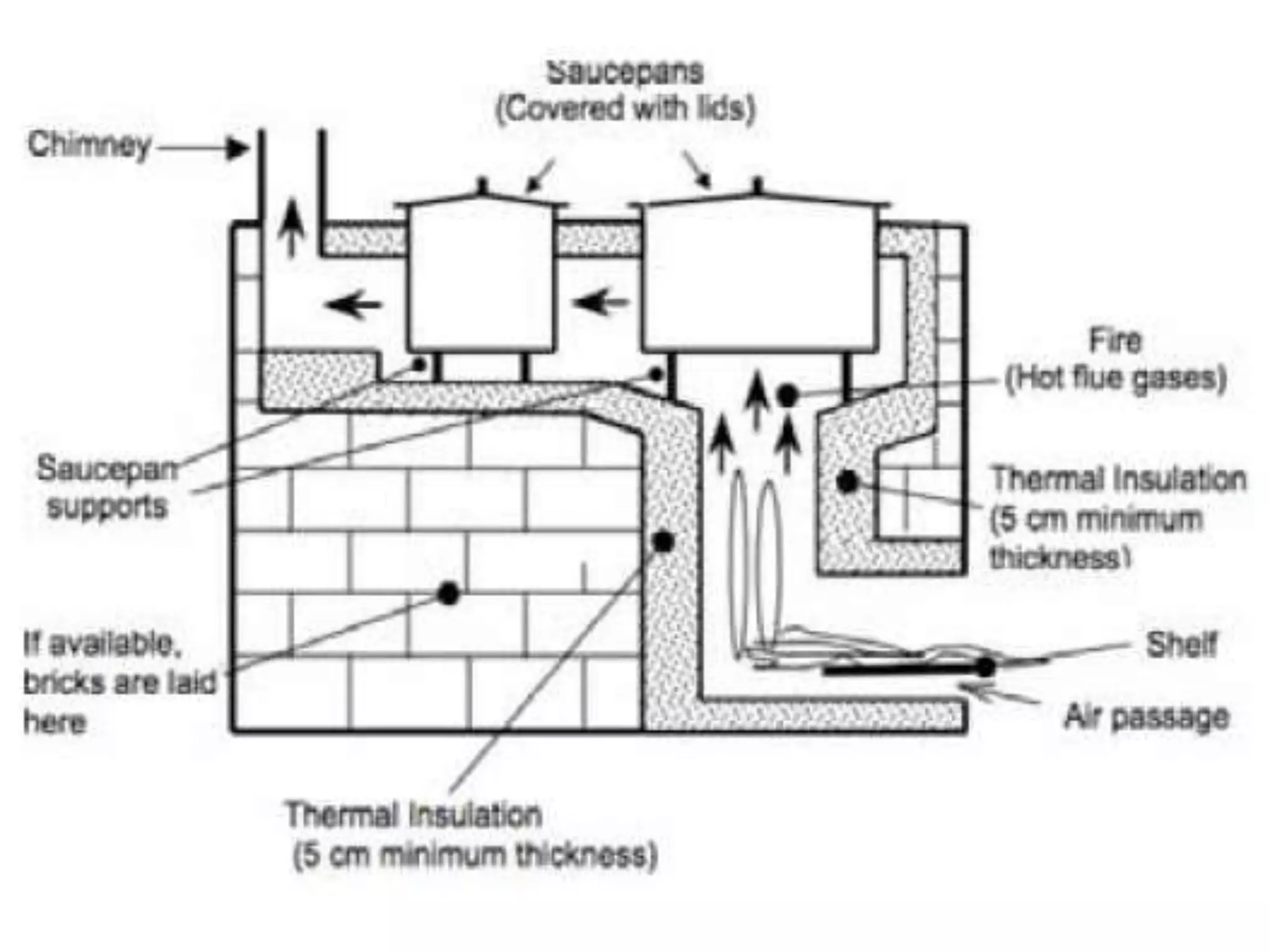
• Fixed stoves are built in situ with local materials (mud or
insulative ceramics)
– These have a) Fire box and air inlet; b) Hot flue gas passage; and
c) Chimney (directing the smoke away)
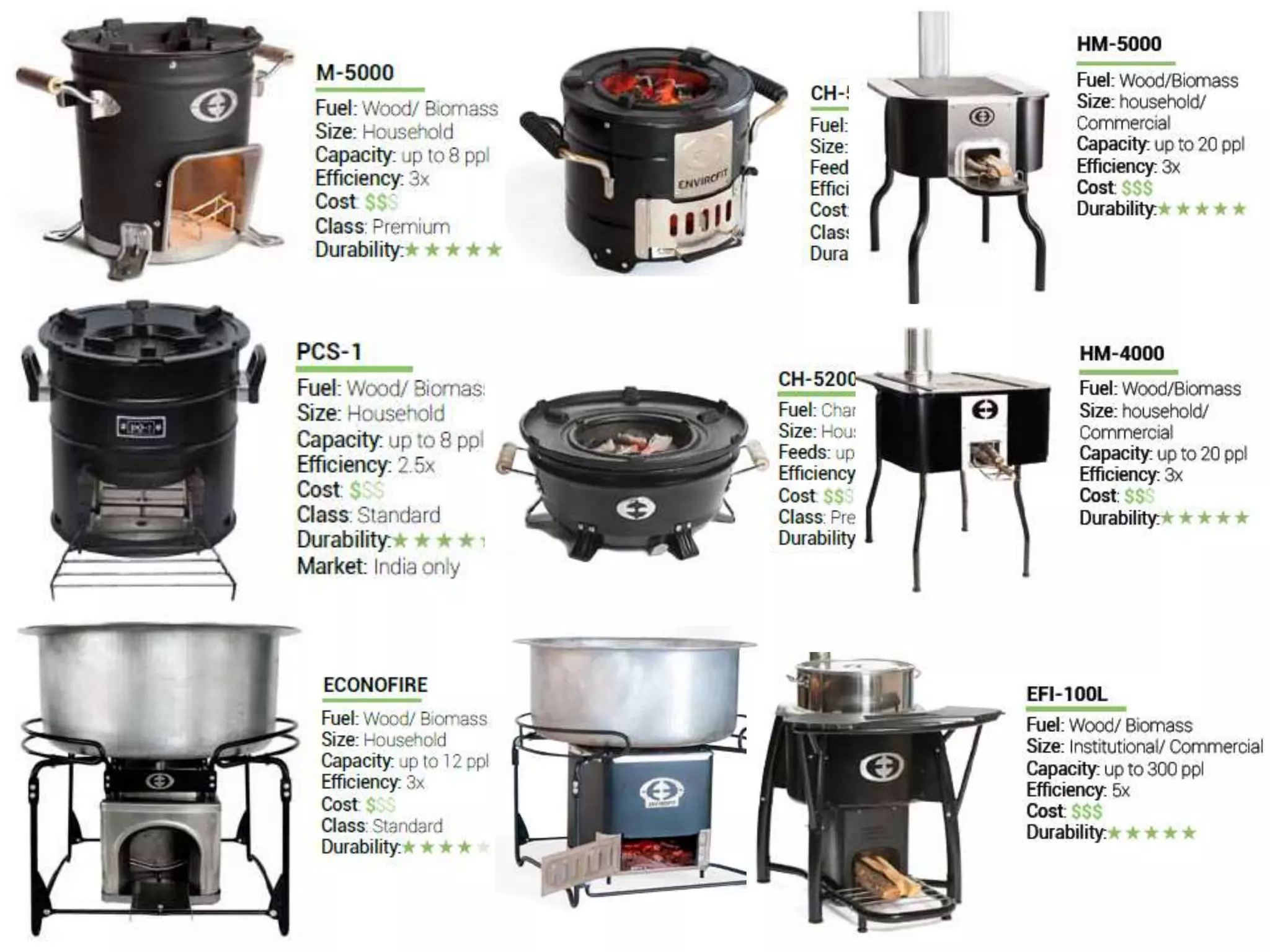
• Portable biomass stoves
– Portability makes the stoves suitable for retailing as a take-
home product, and for mass manufacturing
– Key features include
• Ceramic liner with passage at the base for air and open top with
pot rests and channel gaps and pot skirts
• Steel cladding with doors to regulate air flow, handle for
portability, and pot supports
Classification of cook stoves
1. Three-stone fire
2. Early ICS (Improved Cook Stoves) to 1990s (clay/ceramic/buckets)
3. Fuel-controlled stoves (mainly Rocket stoves)
– Simple (portable)
– Stationary (with chimney)
– Forced-air (FA)
4. Semi-gasifiers (mainly China and Vesto) with some air control
5. Gasifiers (micro for cooking), some with FA (Fan Assistance)
– Top-lit updraft (TLUDs) with migrating pyrolytic zone (batch)
– Updrafts &downdrafts with stationary gasification zones (continuous)
– Other drafts, including cross and opposite/opposing drafts
6. “Fan-jet” with very strong air currents into the fuel
– Philips-FA
– Lucia-FAc.
– Turbococina
7. Non-biomass (not using raw dry biomass fuels) stoves (using
Charcoal; alcohol; refined fossils; coal; biogas; electric; solar.

biomass fuels and cook stoves

  • 1.
    Biomass and Biomass CookStoves Dr. Akepati S. Reddy School of Energy and Environment Thapar University, Patiala INDIA
  • 2.
    Bio-energy Resources • Feedstockof biological origin • Most important among the renewable energy resources • Indirect solar energy resource (by plants through photosynthesis) – accumulated biomass – Photosynthesis: Process used by plants, algae and bacteria to harness sunlight into chemical energy CO2 + 2H2A + Light Energy → [CH2O] + 2A + H2O 6CO2 + 12H2O + Light Energy → C6H12O6 + 6O2 + 6H2O • Starting trophic level of food chains - consumed by animals (including man) • Natural ecosystems (terrestrial and aquatic systems), agricultural and aqua-cultural systems are sources • Plant biomass, animal wastes, agricultural residues/waste, agricultural produce, and agro- and forest based industry wastes are bio-energy resources
  • 3.
    Bio-energy Resources • Feedstockof biological origin used to produce heat, power, and liquid and gaseous biofuels • Wood from forests • Forest residues and wood wastes • biomass not harvested or not removed from logging sites • biomass resulting from forest management operations • agro-forestry and timber plantation • Agricultural crop residues • Stalks, leaves and other materials not harvested or not removed from fields • Straw, sugar cane tops and leaves, --- • Industrial crop residues (crops grown to produce specific industrial chemicals or materials) • Weeds (including aquatic weeds and see weeds) and grasses • Animal wastes/manure and other organic wastes • Cattle dung, Municipal solid wastes, residual foods, ---
  • 4.
    Bio-energy Resources • Industrialwastes (agro and forest based industries) – Plywood and timber industry (25% of the wood input) – Bagasse from sugar mills – Spent wash from distilleries – Black liquor, wood dust, bark etc. from pulp and paper industry – Rice husk from rice shellers – ---- • Dedicated energy crops • herbaceous crops– perennial crops (2-3 year rotation) • tree/plantation crops (fast growing trees with 5 to 8 yr rotation) • Algae • ----- • Agricultural produce • Sugars, starch, cereals, vegetable oils, ---
  • 5.
    Biomass Potential • Annual biomassproduction: 4,000 EJ/Year (1 EJ = 1x10¹⁸ J) • Photosynthetic efficiency of solar radiation: 0.27% • Standing biomass of the earth: 36,000 EJ • Technical potential estimated: 1500 EJ/year • Potential pegged by sustainability constraints: 200-500 EJ/year Usage • Largest among the renewable energy resources • Contribution to the world energy consumption: 50 EJ (of the total 500 EJ in 2008) • May increase to 59-145 EJ by 2025 and to 94-280EJ by 2050 • 10 to 15% contribution (less for industrialized countries and more for developing countries) • 80% for Nigeria, 25% for India, 10% for China and 4% for USA • 20% for Sweden, Findland and Austria The problem is not of resource availability – it is of sustainable management and proper delivery of the resource
  • 6.
    BillionkWh 2025 2050 2100 Shell(1996) 85 200-220 ---- IPCC (1996) 72 280 320 Green peace (1993) 114 181 ---- WEC (1993) 59 94-157 132-215 Johansson et al. (1993) 145 206 ---- Dessus et al. (1992) 135 ---- ---- Lashof and tirpak (1991) 130 215 ---- Global biomass energy (in EJ/year) contributions
  • 7.
    Biomass • Very versatilefuel - can be stored and transported, and can be converted into higher quality/energy density fuels and electricity • Carbon neutral fuel - if used sustainably, releases no net CO2 • Available as a produce, a residue and as a waste • Plant origin or animal origin or other life forms origin • Solid form or slurry form or liquid form • Has alternative non-energy uses as • Food and fodder • Fiber (Paper, paperboard and textiles) • Furniture and building materials (timber, plyboard, plywood) • Many chemicals and other substances • Has ecological, environmental and sustainability importance • Destructive to natural ecosystems and to biodiversity (1st trophic level of food chains) • Contribute to sustainability and ecology of agricultural systems • Soil organic matter, nutrients and soil properties contributor • Energy crops deprive land from other competitive uses • Use is associated with environmental pollution problems
  • 8.
    Biomass and Bio-energy •Produce, residues and wastes are used • Used for heat, electricity and bio-fuels • Sustainability and distribution and supply of energy services • Residential use – Cooking, water and/or space heating and lighting – Firewood, solid biomass and biogas • Industrial use – Process heating, and electricity generation and use – Solid fuels, slurries and wastewaters – Combined heat and power generation (CHP/cogeneration), Biogas, gasification, --- • Transportation use – Biofuels (ethanol, biodiesel, hydrogen, biogas!) – Sugars (sugarcane molasses, ….) grain (corn, ….), starch (cassava, sweet potato, …) and ligno-cellulose (wide range of biomass) – Edible oils (soya, palm, rapeseed, …), non-edible oils (Jatropa, …), algal oil, waste/used oils and animal fats
  • 9.
    Biomass and Bio-energy •Of the global 56 EJ biomass use (in 2013?) – 62% is in buildings for cooking and heating – 15% in industry for process heating (and power generation - CHP) • In buildings it is mostly for cooking and heating through direct combustion – A small fraction could be through pyrolysis and gasification and still smaller fraction could be biogas – Cooking and heating specially at the household level is using traditional inefficient stoves • In the industry biomass is mostly used as boiler fuel – Biomass ‘as it is’ or after compacting/concentration is used • Burning over the grate or using fluidized bed technology – Occasionally biogas is used as fuel (when produced internally) – Burning of black liquor solids in the pulp and paper mills – Pyrolysis or gasification of biomass and use of the resultant producer gas could also be possible (specially in furnaces)
  • 10.
    Primary biomass demandwould double to 108 EJ/year by 2030 (amount to 20% of global primary energy supply and 60% of total final renewable energy use) Increased use of liquid biofuels and CHP, and reduced use of traditional biomass will be the major contributors for reduced building and industrial consumptions Current (2010 or 2013 or 2014?) global biomass use reached 56 EJ per year. 62% of this was consumed in buildings, 15% in industry, 9% in transport, and 8% in the power and district heating sectors
  • 11.
    AOSN HC 194.747.4893.59779.34 942.120184.76615.47kcal/kg...   Biomass Composition andProperties Proximate analysis: Ash, Volatile Matter, Fixed Carbon, and Moisture Ultimate analysis: Carbon, Hydrogen, Nitrogen, Sulfur, Oxygen(by difference), Chlorine, and Ash Elemental Ash Analysis: Si, Fe, Al, Na, K, Ca, Mg, P, As (ppm) Calorific value: HHV (product water as liquid) and LHV (product water as gas) – HHV from ultimate analysis– elements expressed as %) Moisture, Bulk density and Energy density – Energy density: Energy per unit volume/mass (MJ/m3 or MJ/kg) – Low density enormously increases fuel volume to be handled Green house gas emissions and climate change problems – petroleum fuels and chemicals Densification, combustion, thermo-chemical conversions, bio- chemical conversions, and biorefineries for chemical products
  • 12.
  • 13.
    Bio-energy Technologies Global primaryenergy demand will be 600 EJ/year by 2030 – contribution by biomass fuels will be 108 EJ/year – sustainable biomass energy potential is about 104 EJ/year – only 40% of the potential biomass is woody Biomass, as the key energy source and as a substitute to the rapidly dwindling fossil fuels, should become a source for heat, power (bio- power), fuels (bio-fuels for transportation) and chemicals Biomass is oxygenated fuel and available in many varied forms (varied in bulk density, energy density and moisture content) Woody biomass, agriculture and forest residues, grasses and straw, agricultural, industrial and municipal wastes (MSW, effluents, etc.) Direct consumption approach is not sufficient for biomass fuel usage can provide only heat and at the maximum some biopower (but no biofuels and chemicals) moisture, low bulk density, low energy density, and emissions can limit the fuels that can be combusted mainly to woody biomass Energy efficiency can also be limiting Thermochemical and biochemical conversions/processes in addition to combustion is a solution for biomass fuels use to available potential
  • 14.
    Biomass Conversion Processes •Biomass densification – Pre-treatment for densification – Pyrolysis densification – Mechanical densification • Combustion (direct or after densification and/or drying) – Burning as fuel in boilers and furnaces for heat or power or CHP – Co-firing and composite fuel of coal and biomass (CCB) – Biomass cook-stoves: 3 stone, traditional and improved (ICS) stoves • Thermo-chemical processes – Gasification – Pyrolysis and carbonization – Hydrothermal gasification and Hydrothermal liquefaction – Biodiesel (trans-esterification and hydrogenation) • Biochemical conversion processes – Anaerobic digestion or biomethanation – Fermentation of starches and sugars – Cellulosic fermentation • Bio-hydrogen
  • 15.
    Combustion of solidand gaseous biofuels: Charcoal cookstoves, Biogas cookstoves, TLUD (microgasifiers) stoves Hydrothermal liquefaction and hydrothermal gasification Biohydrogen High value bio-products (chemicals and materials)
  • 17.
  • 18.
    Biomass Densification • Havinglower (energy and bulk) density poses a challenge in the handling, transportation, storage and combustion of biomass fuels • Densification (process of producing liquid/solid fuel with denser and more uniform properties) can address the problems – simplifies storage, mechanical handling and feeding – ensures uniform combustion in boilers – reduces the spontaneous combustion risk in storage – reduces transportation cost – reduces dust production • Densification is associated with cost
  • 19.
    Densification: Pre-treatment • Priorto densification, pre-treatment (including the following operations) may be required – Chopping to length/grinding, drying to required moisture level, application of binding agent, steaming, and torrefaction • Chop to length/Grinding: required to reduce energy use in the densification process, to obtain denser products and to decrease breakage of the densification product • Drying to optimum moisture for densification (8%–20% : wet basis) – Compaction requires a small amount of moisture – moisture above the optimum can decrease strength and durability of densified biomass. • Addition of Binding Agents, like, vegetable oil, clay, starch, cooking oil, wax, etc. to increase binding properties – Density and durability of densified biomass are influenced by natural binding agents of the material (protein and starch content) • Steaming to aid in the release and activation of natural binders • Torrefaction: A type of pyrolysis involving heating of biomass to 280-320°C in the absence of oxygen/air – Goal is to dry, embrittle and waterproof the biomass
  • 20.
    Mechanical Densification • Densificationis mechanical (involving application of pressure) and pyrolysis types • Bales – commonly used with harvested crop residue – A baler (a farm machinery) compresses the chop into square, rectangular or round (depends on type of baler used) bales – Round bales are less expensive to produce – Large square bales are denser and easier to handle and transport • Pellets – Very high in density and formed by an extrusion process – Finely ground biomass is forced through round or square cross-sectional dies, using a piston press, and cut to desired length – Biomass pellets are usually 38 mm long and 7 mm diameter
  • 22.
    Mechanical Densification • Cubes –Larger pellets (13-38 mm size and length 25-102 mm), but, less denser – Chopped biomass is compressed with a heavy press wheel and forced through dies • Briquettes – Similar to pellets but differ in size (25 mm or greater diameter) – Biomass is punched, using a piston press, into a die under high pressure – Alternatively, biomass is extruded by a screw through a heated die – Biomass densified through screw extrusion has higher storability and energy density properties • Pucks – Similar in appearance to a hockey puck (75 mm diameter) and have density similar to pellets – Produced by a briquetter but have lower production costs • Wood Chips – Made with wood chipper and have 5-50 mm length
  • 24.
    Pyrolysis Densification • Heatingbiomass in the absence of oxygen • Torrefaction – Heating biomass in inert atmosphere at temperatures of 280°C–320°C for a few minutes – Volatile gases liberated are combusted to supply the heat required (80% of the required heat is obtained) – Torrefied biomass is densified into pellets or briquettes – Torrefied biomass has hydrophobic properties (facilitating storage) and it shows improved grindability properties. • Slow Pyrolysis • Heating to lower temp. (350-500C) for extended period (0.5-2 hrs.) – Principal product is a solid (charcoal) that retains 60%–70% of the original energy from the raw biomass • Fast Pyrolysis • Heating to 450-500°C temp. for 1-2 seconds • Yields upto 75% bio-oil (higher energy density fuel) and 10-15% charcoalfavour liquid or bio-oil production • Bio-oils are very acidic, have a pungent odour and are prone to separation/settling
  • 25.
    Through various densificationtechnologies, raw biomass is compressed to densities in the order of 7–10 times to original bulk density Torrefaction Slow Pyrolysis Fast Pyrolysis
  • 26.
  • 27.
    Biomass cook stoves •Urban households biomass use - reduced to <30% by 2004/5 – Fuel wood was the primary source until early 1970s, and use of kerosene/LPG, electricity and solar energy for cooking and heating was started and reached to ~70% by 2004/5 – By early 1980s 10% of the households were using LPG and it rose to 57% by 2004-05 (< 30% of the population was using 75% of the residential demand for LPG (IEA 2007) • In rural India, biomass is the main energy source for >80% of the households (2008) for cooking and heating – Population relying on traditional biomass for cooking and heating was 580 million in 1992 and 668 million in 2005 – Only 13.9% are using LPG for cooking – 50% rural population has access to electricity, but its use for cooking is limited (mostly use for lighting-ventilation) • According to WHO in 2011, globally 3 billion people were using biomass for cooking and heating (one billion stoves!)
  • 28.
    Coke/coal Firewood LPG Dung cakeKerosene No cooking Other materials Coke/coal Firewood LPG Dung cake Kerosene No cooking Other materials Percent households
  • 29.
    Per capita monthfuel consumption (2009-10) Rural Urban Rural Urban Population (2011) 83.3 Crore 37.7 Crore Biomass 211.582 Mil. tons 23.374 Mil. tons 234.956 million tons/year biomass (3.5 EJ/year) (15MJ/kg energy density assumed)
  • 31.
    Biomass stove design Desiredfeatures of biomass stoves • Fuel compatibility and fuel efficiency • Clean burning (no harmful emissions – no indoor air pollution problems) • Easier, safer and faster cooking – Easier and quicker fire start-ups – Easier and simple stove power control – Not too hot stove body to cause harm and physical burns – Stability of the stove and of the pot on stove • Aesthetics of the stove (should beautify the kitchen) • Suitability to the owner/cook’s needs and tastes • Valuable addition to the household’s quality of life Design focus • Complete (and clean) combustion of fuel generating heat • Efficient transfer of the generated heat to cook pot/pan
  • 32.
    Biomass stove design Requirementsfor complete and clean biomass fuel combustion • Making available of sufficient air for combustion processes – Supply of air in excess of the stoicheometric air requirement • Ensuring better air contact with the burning biomass fuel (and char) and with the combusting volatile matter and gases – Supply combustion air from under the burning fuel (either from sides or from the front below the grate or from the opening for fuel feeding) • Making available of enough heat for fuel volatilization/gasification, and sufficient temperature for combustion organic vapours & gases – Combustion chamber made up of heat soaking heavy materials – Ensuring 3Ts (time, turbulence and temperature) in the combustion chamber (enough space for combustion over the burning fuel) Requirements for efficient heat transfer to cook pot/pan • Restricting combustion processes and combustion heat release to the combustion chamber – Make combustion air available sufficiently inside combustion chamber – Place biomass stick horizontal and meter them inside to burn at tips
  • 33.
    Biomass stove design Requirementsfor efficient heat transfer to cook pot/pan • Insulating the combustion chamber and the hot flue gas passages – Minimizing heat soaking by combustion chamber and by the hot flue gas passages Use light weight insulative refractory materials (insulative ceramics) in the construction of combustion chamber and flue gas passages • Maximizing diversion of combustion heat to cook pot/pan – Provide insulative skirts to the pots and ensure sufficient channel gap (neither too much nor too little gap) – Do not allow thick air boundary layers on heat transfer surfaces (ensure hot flue gases scraping of the pot surface at sufficient velocity) • Having better and sufficient heat transfer surfaces with the cook pots/pans – Make the pots out of high heat conductance materials (metals) – and have a heat soaking material layer on the heat transfer surfaces – Maximize the hot flue gases scraping surface area of the cook pots • Minimizing heat loss in discharged flue gases through maximizing heat recovery from hot flue gases – Recover heat as much as possible from flue gases prior to discharge
  • 34.
    Biomass stove design Otherrequirements • Supply of pre-heated air for combustion processes from under the burning fuel sticks – Use heat soaking grate – Cause combustion air draft through the grate • Make fire start-up easy, simple and less time consuming • Avoid indoor air pollution from flue gas emissions – Maintain slight negative pressure in combustion chamber – Add external chimney to the stove – Operate stove in properly ventilated space (have a hood or a vent in the kitchen roof or open windows (for the kitchen) • Minimize emission of green house gases – Bio-char production • Incorporate flexibility in fuel use • Provide for both high power cooking and low power simmering
  • 35.
    Biomass stove design Otherrequirements • Avoid intolerable stove surface temperatures during operation – Insulate the exteriors of combustion chamber and flue gas passages • Satisfy the ergonomic requirements of cook (and fire mender) – Ergonomic design of the stove • Stove stability and cooking pot/pan stability on the stove – Bottom heavy stoves – Pot rests • Aesthetics (should beautify the kitchen) and suitability of the stove to the owner/cook’s needs and tastes – Architectural design of the stove • Make the stove cheap and affordable – Simple, compact and lighter design – Use of cheap local materials and local skills in the stove construction/manufacture Design of the stove should take advantage of the local knowledge (experience, expertise) and local inventiveness
  • 36.
    Improved Cook Stoves(ICS) • Traditional cooking – causing 4.3 million/year deaths from indoor air pollution – Families of developing countries spend upto 30% of their income on fuel for cooking and heating – Inefficient cooking and heating produces 1 billion tons/year C02 • ICS: Replacing traditional cooking with cleaner stoves – Increased combustion efficiency, reduced heat loss, decreased indoor air pollution, and reduced fuel consumption – Durable and affordable stoves, reduced fuel costs, reduced cooking and cleaning time, minimized fuel collection burden, and reduced pressure on forests and/or energy resources • Key features of ICS are – Use of an insulating materials (to conserve heat and make stove efficient) – Compatibility to locally available fuels (stickwood, biomass residues, charcoal, dung cakes, and densified biomass) – Appearance, ease of use, etc. Factors
  • 37.
    Improved Cook Stoves(ICS) Type of fuel used: – Biomass sticks/firewood – Charcoal – Fuel brickets/ pellets/ pucks, and Dung cakes Portable stoves and fixed stoves • Fixed stoves are built in situ with local materials (mud or insulative ceramics) – These have a) Fire box and air inlet; b) Hot flue gas passage; and c) Chimney (directing the smoke away) • Portable biomass stoves – Portability makes the stoves suitable for retailing as a take- home product, and for mass manufacturing – Key features include • Ceramic liner with passage at the base for air and open top with pot rests and channel gaps and pot skirts • Steel cladding with doors to regulate air flow, handle for portability, and pot supports
  • 43.
    Classification of cookstoves 1. Three-stone fire 2. Early ICS (Improved Cook Stoves) to 1990s (clay/ceramic/buckets) 3. Fuel-controlled stoves (mainly Rocket stoves) – Simple (portable) – Stationary (with chimney) – Forced-air (FA) 4. Semi-gasifiers (mainly China and Vesto) with some air control 5. Gasifiers (micro for cooking), some with FA (Fan Assistance) – Top-lit updraft (TLUDs) with migrating pyrolytic zone (batch) – Updrafts &downdrafts with stationary gasification zones (continuous) – Other drafts, including cross and opposite/opposing drafts 6. “Fan-jet” with very strong air currents into the fuel – Philips-FA – Lucia-FAc. – Turbococina 7. Non-biomass (not using raw dry biomass fuels) stoves (using Charcoal; alcohol; refined fossils; coal; biogas; electric; solar.

Editor's Notes

  • #31 Open fires, three stone stoves and traditional or conventional stoves Improved stoves and micro-gasifier stoves Household stoves and community stoves
  • #32 Biomass fuels: energy density and bulk density, moisture level, and shape and size Cooking: High power cooking and low power simmering; and Frying, roasting, baking, etc. (in pots, pans, griddles, etc.)
  • #33 3 Ts for combustion: time, turbulence and temperature. Enough space for combustion – volume of the combustion chamber
  • #34 3 Ts for combustion: time, turbulence and temperature. Enough space for combustion – volume of the combustion chamber