Colour Theory

Cinematography and Visual Language
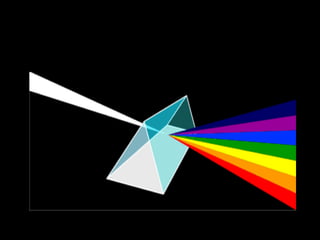
• Sir Isaac Newton was one of the first
  scientists to investigate colourtheory. Around
  1671-72 he discovered the origin of
  colourwhen he shone a beam of light through
  an angular prism and split it into the
  spectrum - the various colors of the rainbow.
• This simple experiment demonstrates that
  colourcomes from light - in fact, that colouris
  light.
• Scientists investigate the properties of
  colourtheory whereas artists explore its
  visual effects. Colourin art can be used in
  many different ways.
• Some artists are fascinated by the effects of
  light; some are interested in the symbolic
  meaning of color; and some use color to
  express their emotions.
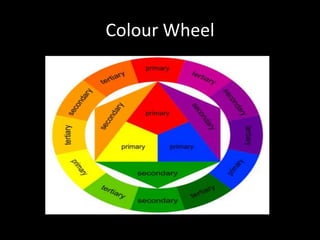
Colour Wheel
• The colour wheel is a useful device to help us
  explain the relationships between Primary,
  Secondary and Tertiary colours.
Colour Wheel
PRIMARY COLOURS


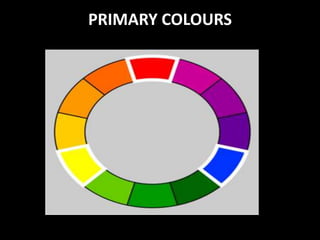
Red, Yellow and Blue are the primary colours.
These are the three basic coloursthat are
used to mix all hues.
PRIMARY COLOURS
SECONDARY COLOURS


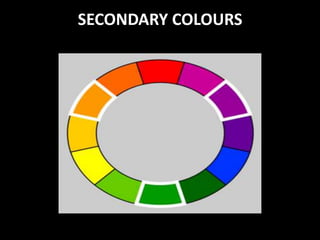
• Orange, Green and Purple are the secondary
  colours. They are achieved by mixing two
  primary colourstogether.
SECONDARY COLOURS
TERTIARY COLOURS


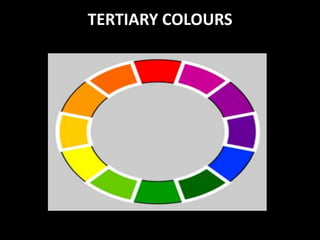
• Tertiary coloursare more subtle hues which
  are achieved by mixing a primary and a
  secondary colourthat are adjacent on the
  color wheel.
TERTIARY COLOURS
COMPLEMENTARY COLOURS

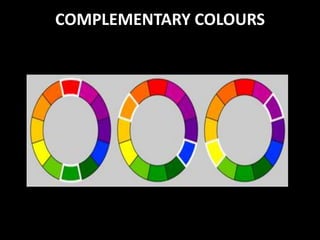
• Opposite coloursare diagonally opposite one
  another on the colourwheel. Opposite
  colourscreate the maximum contrast with
  one another. You can work out the opposite
  color to any primary colourby taking the
  other two primaries and mixing them
  together. The result will be its opposite or
  ‘complementary’ colour.
COMPLEMENTARY COLOURS
ANALOGOUS COLOURS


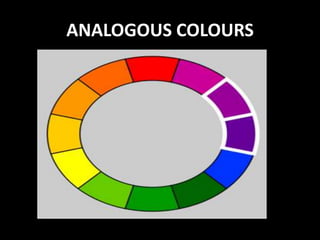
• Analogous colours sit next to one another on
  the colour wheel. These colours are in
  harmony with one another.
ANALOGOUS COLOURS
ADDITIVE and SUBTRACTIVE COLOUR

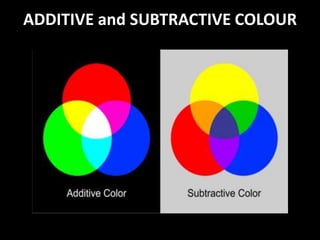
• Additive Colourinvolves the mixing of colored
  light. The colourson a television screen are a
  good example of this. Additive primary colors
  are red, green and blue.
• Subtractive Colourinvolves the mixing of
  colouredpaints, pigments, inks and dyes. The
  traditional subtractive primary coloursare
  red, yellow and blue.
ADDITIVE and SUBTRACTIVE COLOUR
THE SPECTRUM


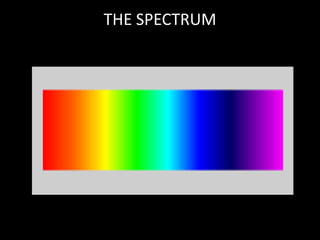
• The spectrum is the colours of the rainbow
  arranged in their natural order: Red - Orange
  - Yellow - Green - Blue - Indigo - Violet. The
  mnemonic for this is ROY G BIV.
THE SPECTRUM
HUES

• Hue refers to the pure spectral colours of the
  rainbow. Hue is the term that encompasses all
  the names we give to specific colours such as
  red, blue, yellow, and so on. Hue is the name
  of a distinct colour of the spectrum ( ROY –G –
  BIV)
Value

• The range of colours from light to dark in an
  image.
•
Contrast

• The distribution of dark, medium, and light
  tones in an image.
Contrast Ratio

• An image’s contrast ratio is the difference
  between the darkest and the lightest tonal
  values within that image.
Chroma
• The C component of the LCH
  (luminance/chroma/hue) colour model.
  Chroma is similar to saturate, and sometimes
  is referred to as colourfulness. It describes the
  purity of a specific hue at a specific lightness.
• No chroma would be grey, low-chroma pastel,
  high chroma, a vivid pure hue.
Saturation

• The purity of a colour, independent of its hue
  and brightness and a lack of grey pollution.
  The more gray a colour contains, the lower its
  saturation is. Colours of the highest saturation
  have no contamination from other hues.
Kelvin

• A unit of absolute temperature. An object at
  zero Kelvin has no energy.
•
Colour Temperature

• The measurement of the colour of light
  radiated by an object known as a black body
  while it is being heated. Colour temperature is
  measured and expressed in a unit called
  Kelvin. As this black body increases in Kelvin,
  its colour goes from warm (red) to cool (blue)
Colour Temperature
• Natural day light is not the white light our
  eyes perceive it to be.
• Our eyes automatically white-balance
  everything we see.
• Film reads light much differently than the eye,
  it interprets the colour of daylight as a bluish
  hue.
Colour Temperature
•   1700k – the light from a match
•   1850k – candle flame
•   2800-3300k – incandescent light bulb
•   3400k studio lamps
•   5000-5400k – Direct sunlight at noon
•   6000-7500k – overcast daylight
•   7000-8000k – 0utside in the shade on a sunny
    day
Colour Correction Filters
• Cinematographers enhance and manipulate
  film stocks using various filters and coloured
  gels.
• CTO – Colour Temperature Orange
• (Converts Daylight into Tungsten)
• CTB – Colour Temperature Blue
• (Converts Tungsten light into Daylight)
• CTB comes in Quarter, Half, and Full Blue
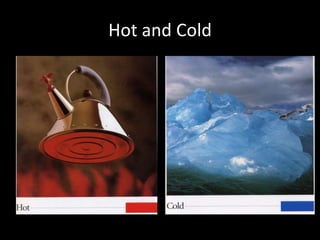
Hot and Cold
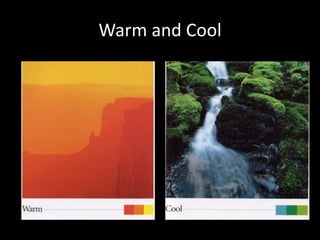
Warm and Cool
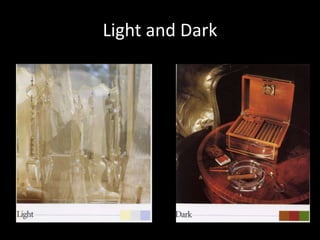
Light and Dark

Colour Theory

  • 1.
  • 2.
    • Sir IsaacNewton was one of the first scientists to investigate colourtheory. Around 1671-72 he discovered the origin of colourwhen he shone a beam of light through an angular prism and split it into the spectrum - the various colors of the rainbow. • This simple experiment demonstrates that colourcomes from light - in fact, that colouris light.
  • 4.
    • Scientists investigatethe properties of colourtheory whereas artists explore its visual effects. Colourin art can be used in many different ways. • Some artists are fascinated by the effects of light; some are interested in the symbolic meaning of color; and some use color to express their emotions.
  • 5.
    Colour Wheel • Thecolour wheel is a useful device to help us explain the relationships between Primary, Secondary and Tertiary colours.
  • 6.
  • 7.
    PRIMARY COLOURS Red, Yellowand Blue are the primary colours. These are the three basic coloursthat are used to mix all hues.
  • 8.
  • 9.
    SECONDARY COLOURS • Orange,Green and Purple are the secondary colours. They are achieved by mixing two primary colourstogether.
  • 10.
  • 11.
    TERTIARY COLOURS • Tertiarycoloursare more subtle hues which are achieved by mixing a primary and a secondary colourthat are adjacent on the color wheel.
  • 12.
  • 13.
    COMPLEMENTARY COLOURS • Oppositecoloursare diagonally opposite one another on the colourwheel. Opposite colourscreate the maximum contrast with one another. You can work out the opposite color to any primary colourby taking the other two primaries and mixing them together. The result will be its opposite or ‘complementary’ colour.
  • 14.
  • 15.
    ANALOGOUS COLOURS • Analogouscolours sit next to one another on the colour wheel. These colours are in harmony with one another.
  • 16.
  • 17.
    ADDITIVE and SUBTRACTIVECOLOUR • Additive Colourinvolves the mixing of colored light. The colourson a television screen are a good example of this. Additive primary colors are red, green and blue. • Subtractive Colourinvolves the mixing of colouredpaints, pigments, inks and dyes. The traditional subtractive primary coloursare red, yellow and blue.
  • 18.
  • 19.
    THE SPECTRUM • Thespectrum is the colours of the rainbow arranged in their natural order: Red - Orange - Yellow - Green - Blue - Indigo - Violet. The mnemonic for this is ROY G BIV.
  • 20.
  • 21.
    HUES • Hue refersto the pure spectral colours of the rainbow. Hue is the term that encompasses all the names we give to specific colours such as red, blue, yellow, and so on. Hue is the name of a distinct colour of the spectrum ( ROY –G – BIV)
  • 22.
    Value • The rangeof colours from light to dark in an image. •
  • 23.
    Contrast • The distributionof dark, medium, and light tones in an image.
  • 24.
    Contrast Ratio • Animage’s contrast ratio is the difference between the darkest and the lightest tonal values within that image.
  • 25.
    Chroma • The Ccomponent of the LCH (luminance/chroma/hue) colour model. Chroma is similar to saturate, and sometimes is referred to as colourfulness. It describes the purity of a specific hue at a specific lightness. • No chroma would be grey, low-chroma pastel, high chroma, a vivid pure hue.
  • 26.
    Saturation • The purityof a colour, independent of its hue and brightness and a lack of grey pollution. The more gray a colour contains, the lower its saturation is. Colours of the highest saturation have no contamination from other hues.
  • 27.
    Kelvin • A unitof absolute temperature. An object at zero Kelvin has no energy. •
  • 28.
    Colour Temperature • Themeasurement of the colour of light radiated by an object known as a black body while it is being heated. Colour temperature is measured and expressed in a unit called Kelvin. As this black body increases in Kelvin, its colour goes from warm (red) to cool (blue)
  • 29.
    Colour Temperature • Naturalday light is not the white light our eyes perceive it to be. • Our eyes automatically white-balance everything we see. • Film reads light much differently than the eye, it interprets the colour of daylight as a bluish hue.
  • 30.
    Colour Temperature • 1700k – the light from a match • 1850k – candle flame • 2800-3300k – incandescent light bulb • 3400k studio lamps • 5000-5400k – Direct sunlight at noon • 6000-7500k – overcast daylight • 7000-8000k – 0utside in the shade on a sunny day
  • 31.
    Colour Correction Filters •Cinematographers enhance and manipulate film stocks using various filters and coloured gels. • CTO – Colour Temperature Orange • (Converts Daylight into Tungsten) • CTB – Colour Temperature Blue • (Converts Tungsten light into Daylight) • CTB comes in Quarter, Half, and Full Blue
  • 32.
  • 33.
  • 34.