COLOUR THEORY
Mel Fee
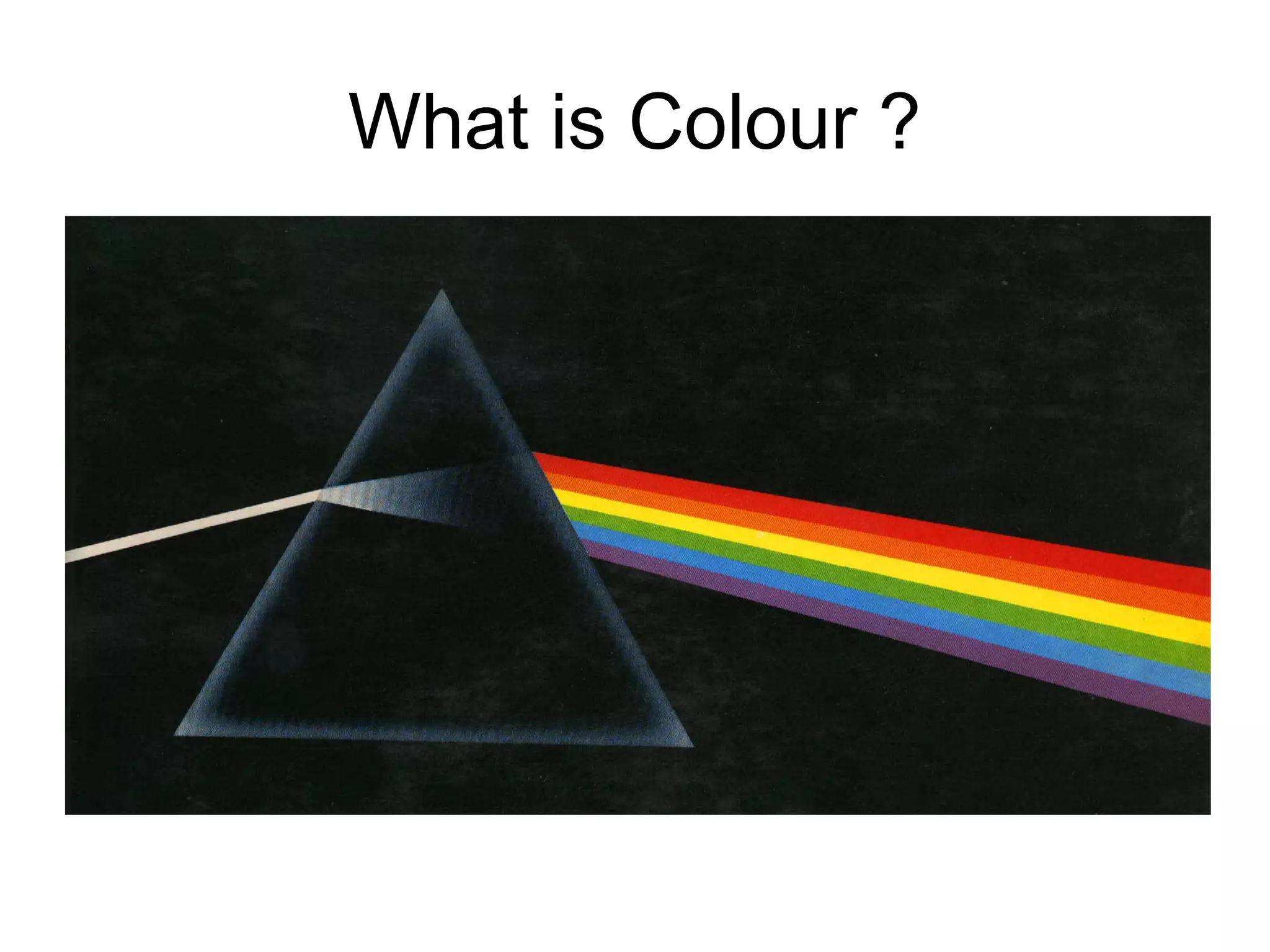
What is Colour?
(Noun)
• the property possessed by an object of
producing different sensations on the eye as a
result of the way it reflects or emits light.
• synonyms: hue, shade, tint, tone, tinge, cast,
tincture
"the lights flickered and changed colour"
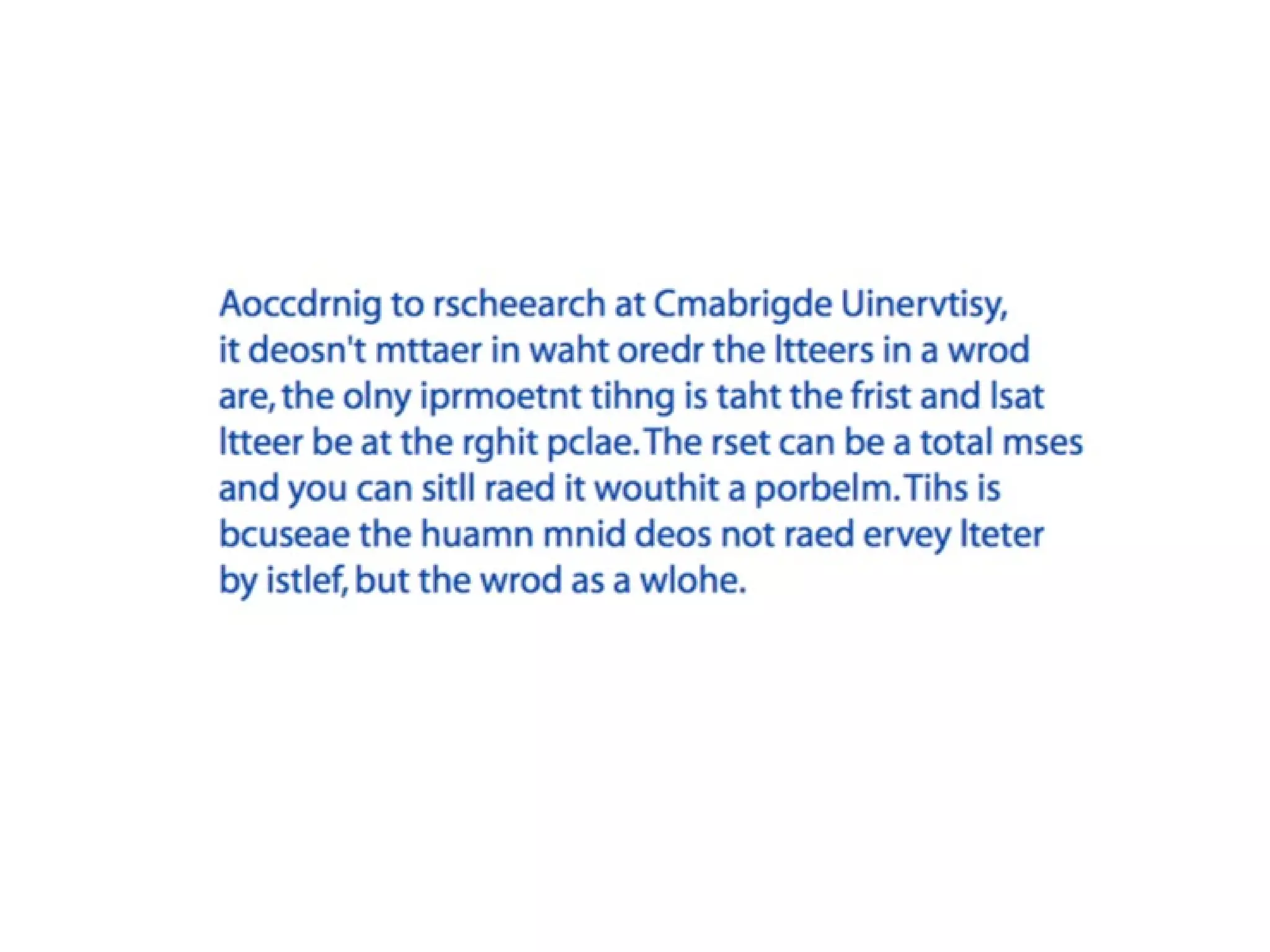
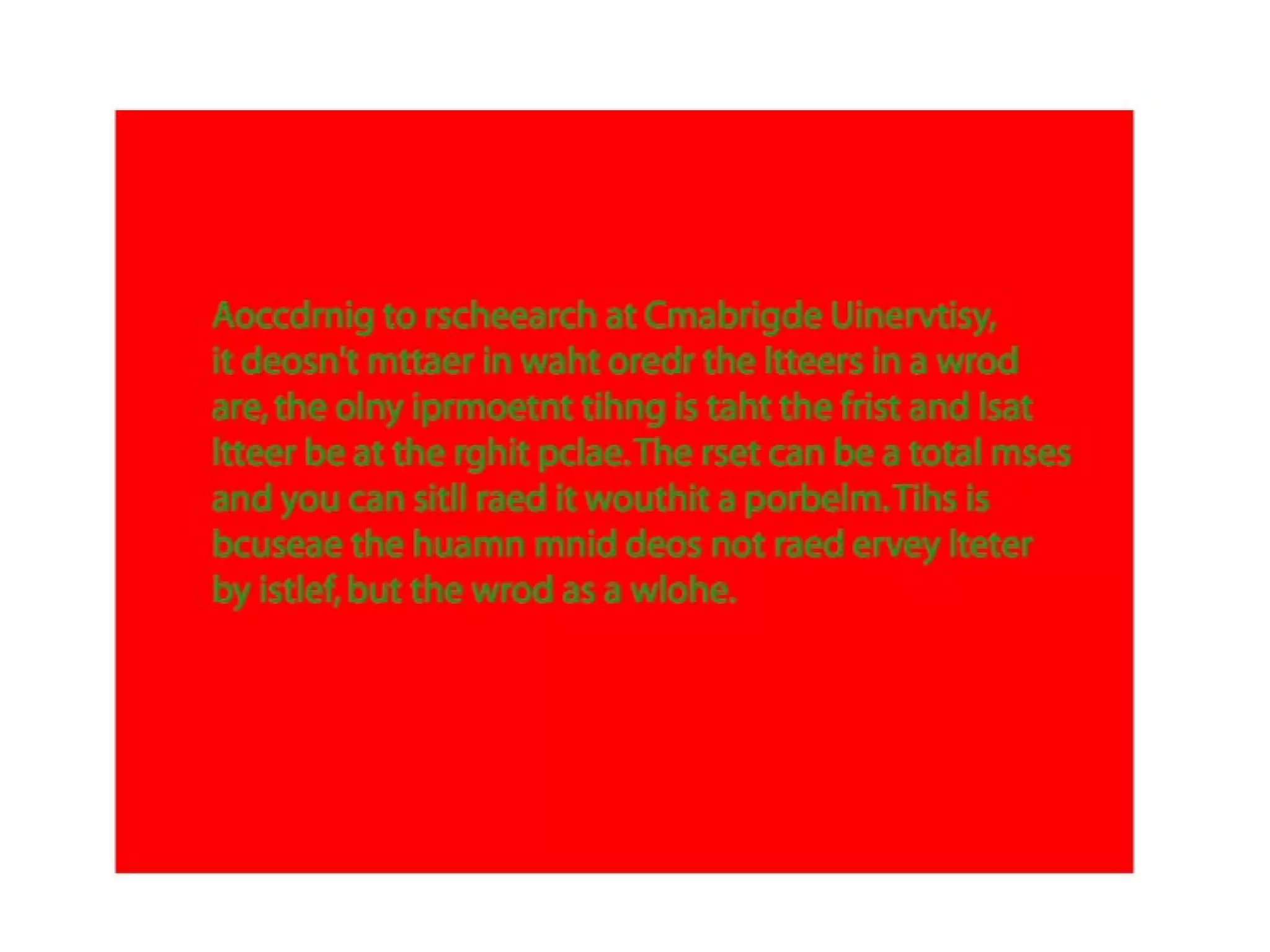
• Introducing colour to the words changes
the way that you read things, some even
becomes painful. Illegible and hurts, it
moves it wobbles it shifts. If you use
colour use it responsibly, this is why its so
important, if you get the colour wrong it
ruins the design
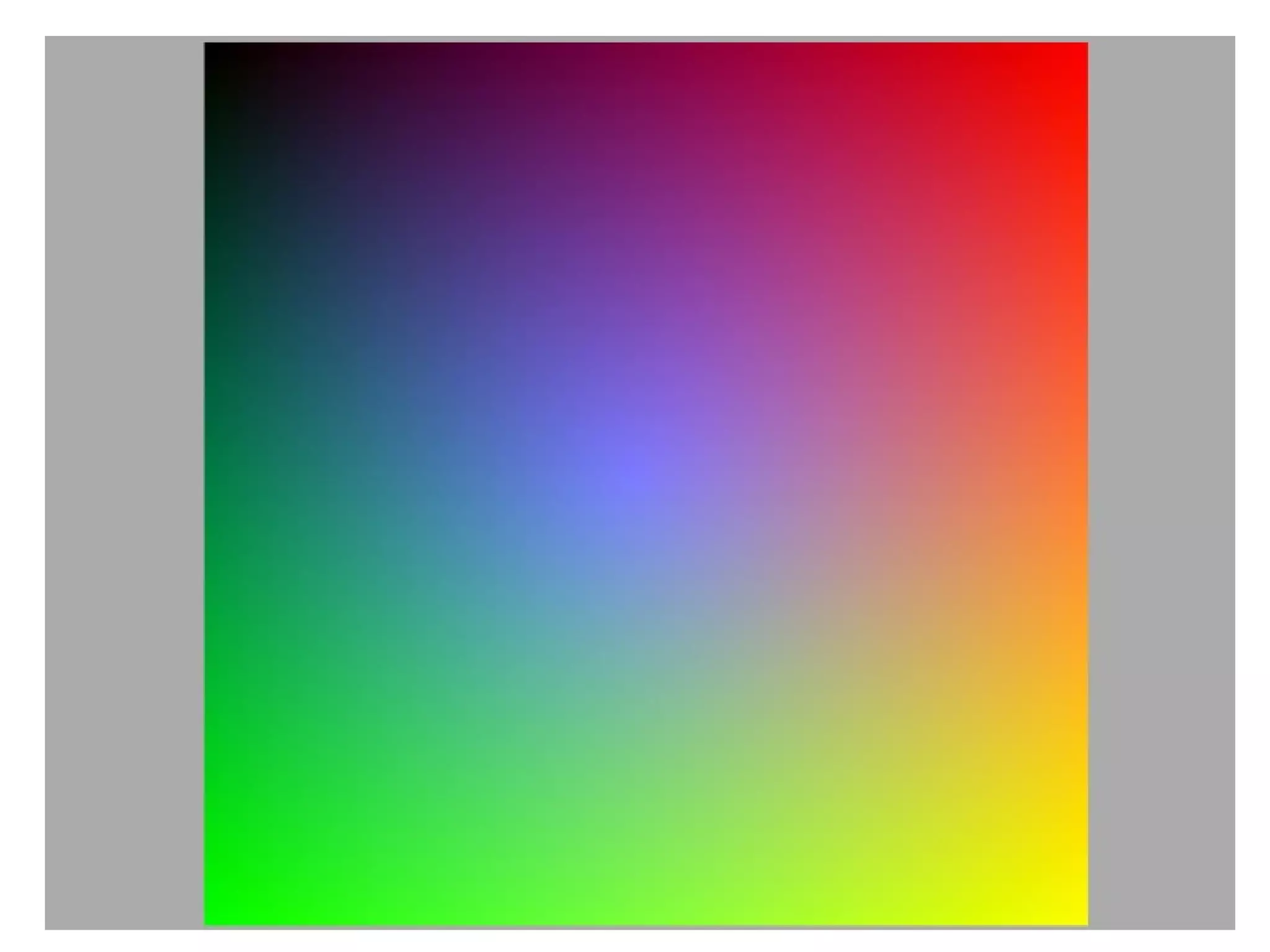
• It covers such as spectrum, billions of
variation of colour, we don't all see colour
the same.
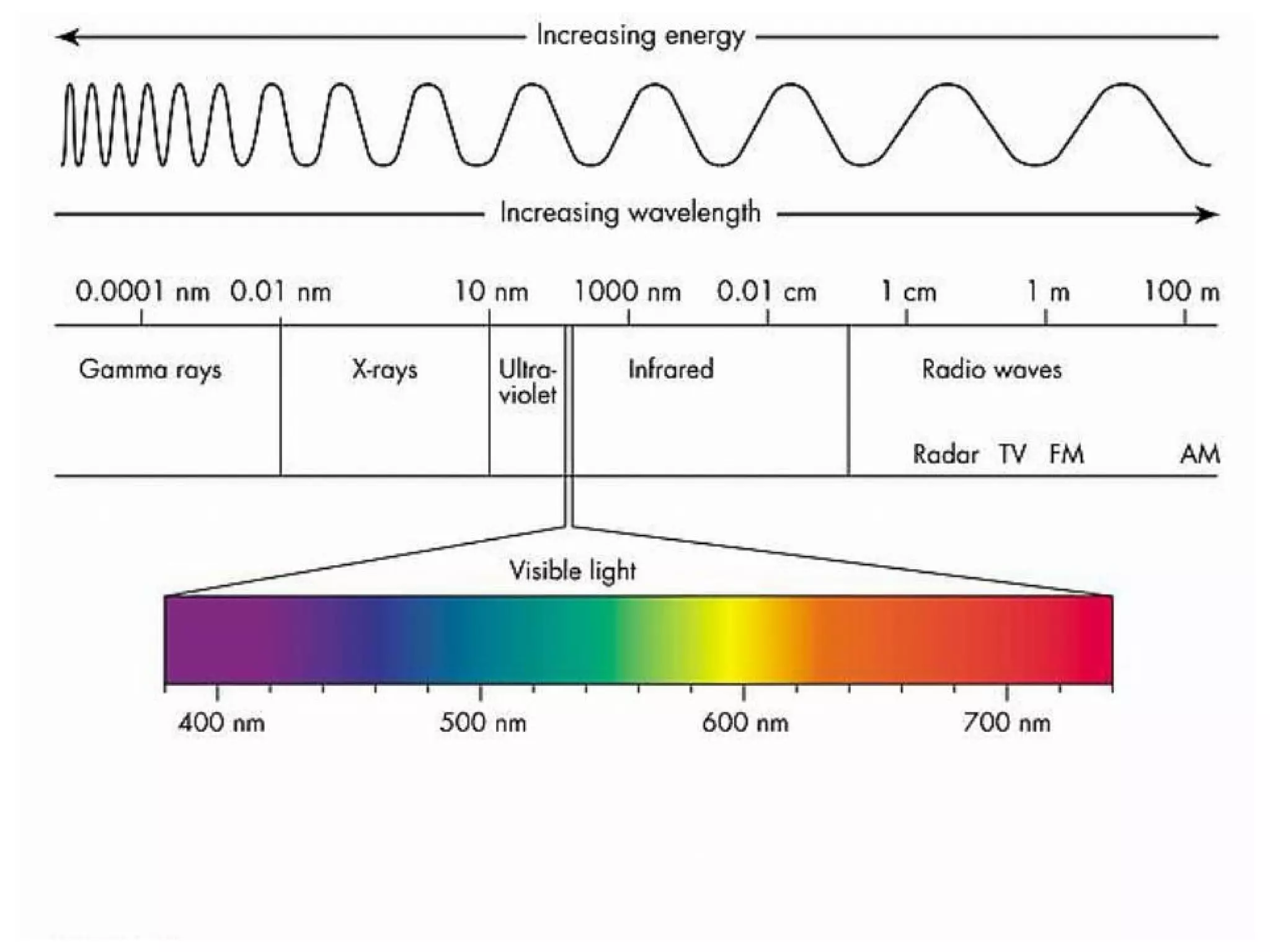
• The ability to perceive colour, is from the
principle that different colours have
different length and strength wave lengths.
As light travels in waves, the different
frequency of each wave shows different
colours.
What effects can colour have?
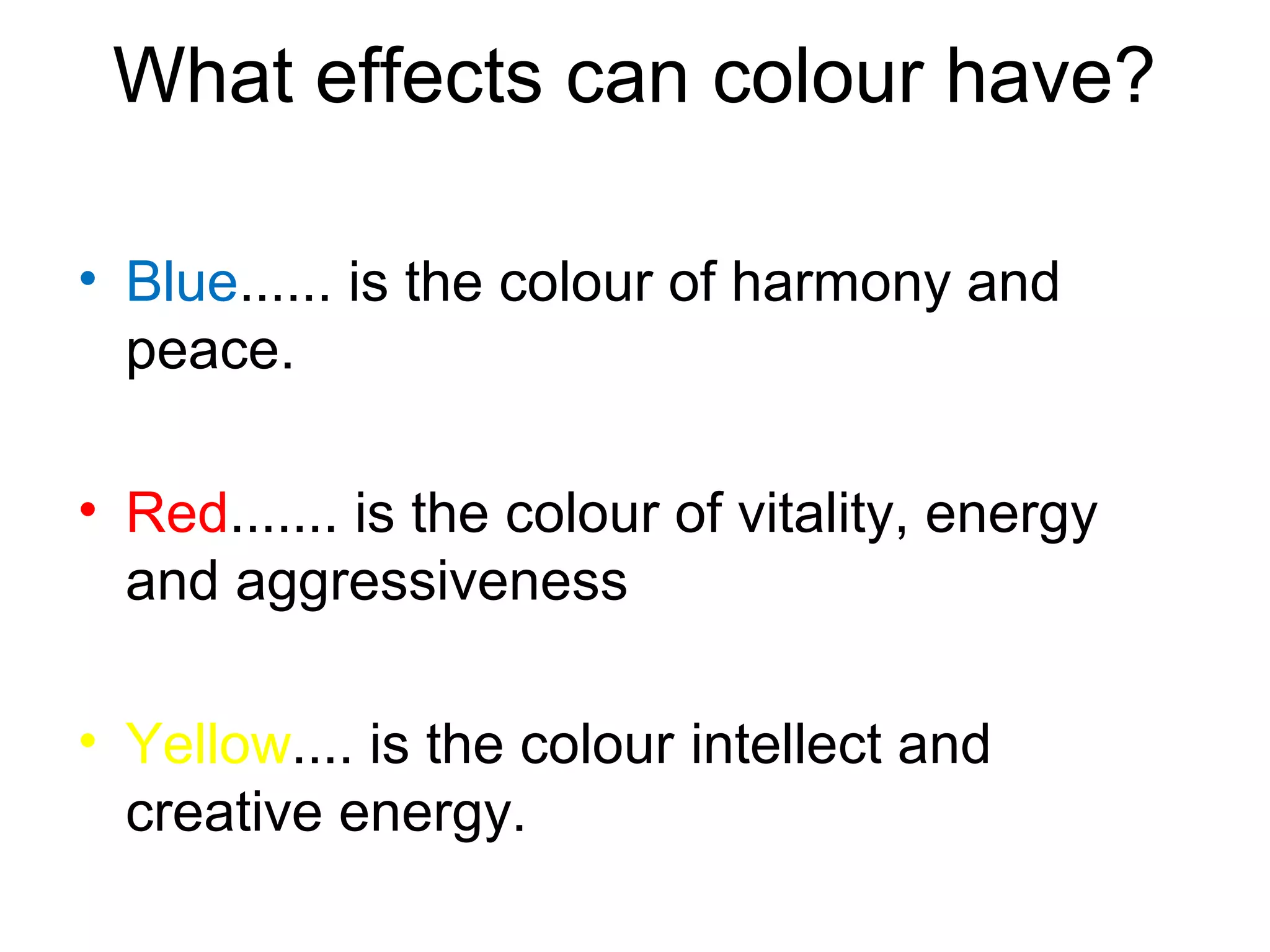
• Blue...... is the colour of harmony and
peace.
• Red....... is the colour of vitality, energy
and aggressiveness
• Yellow.... is the colour intellect and
creative energy.
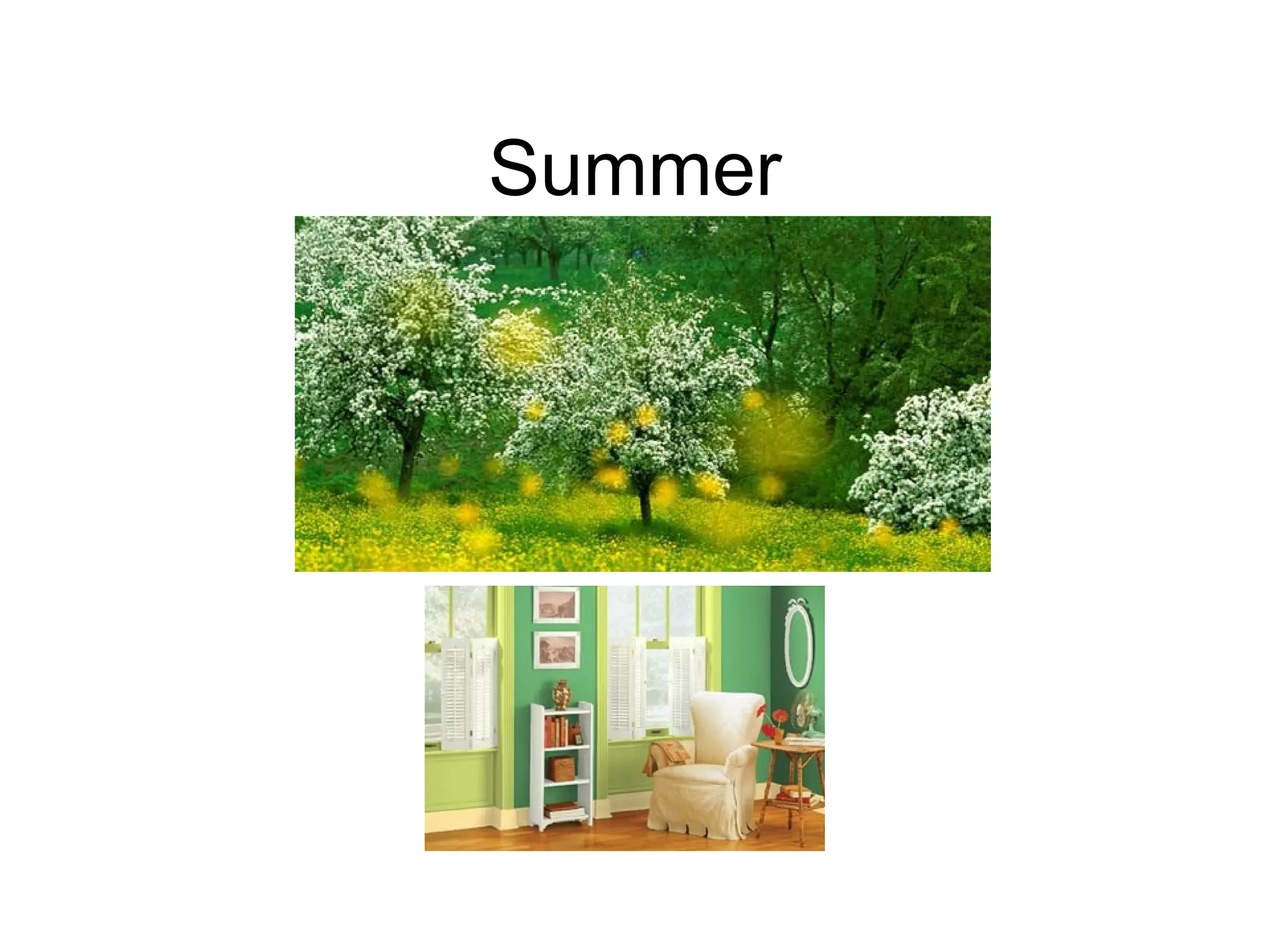
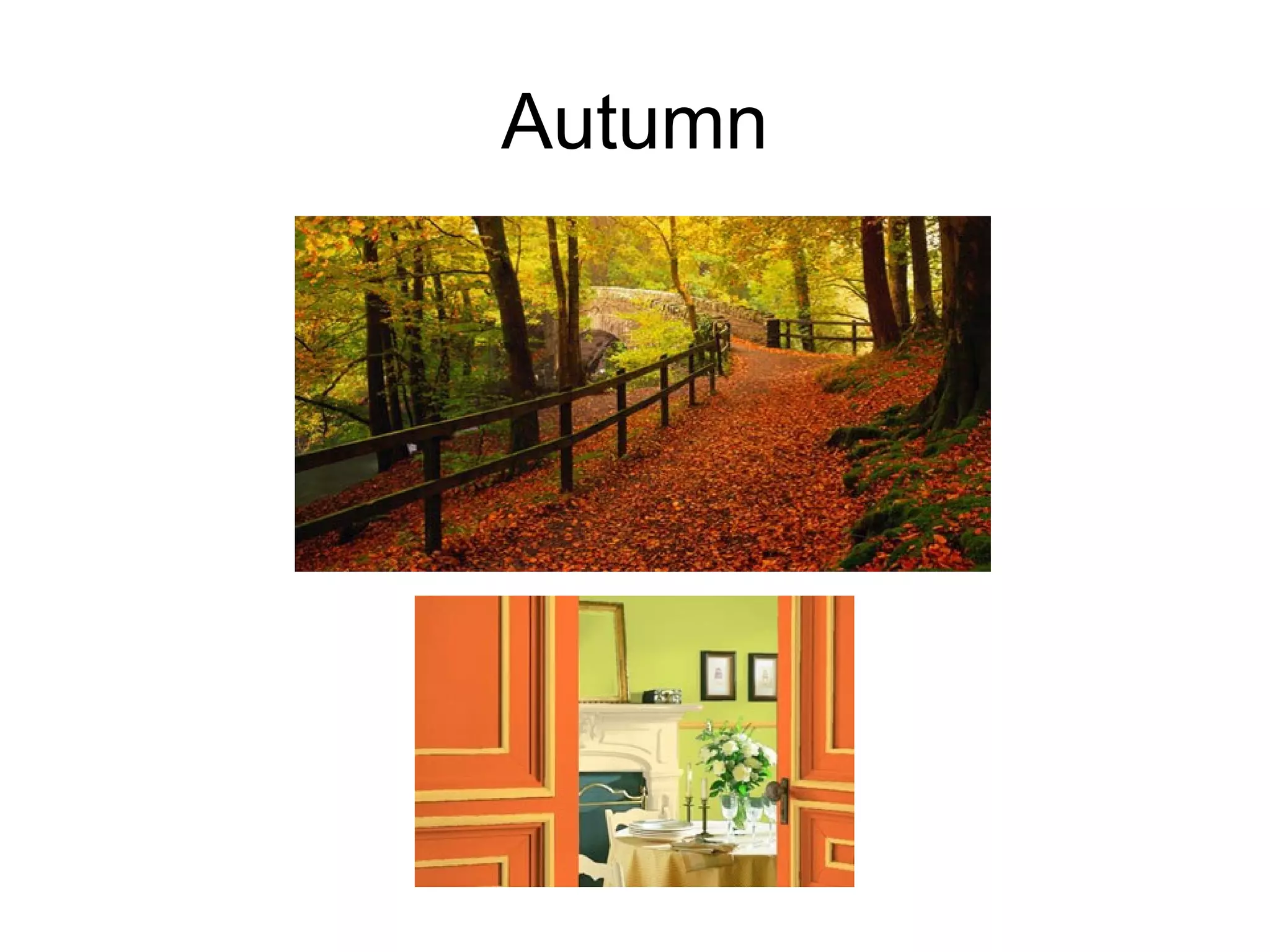
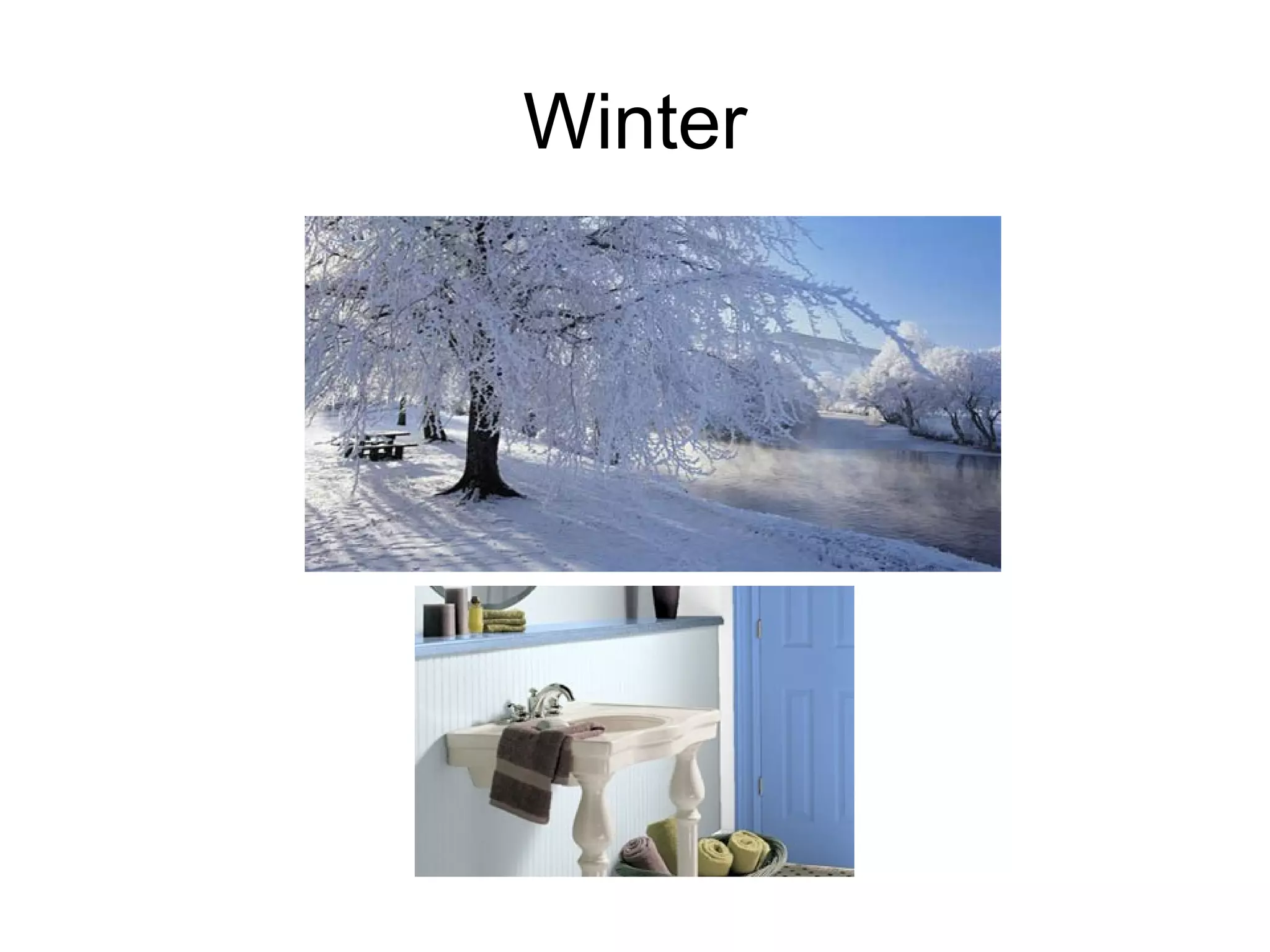
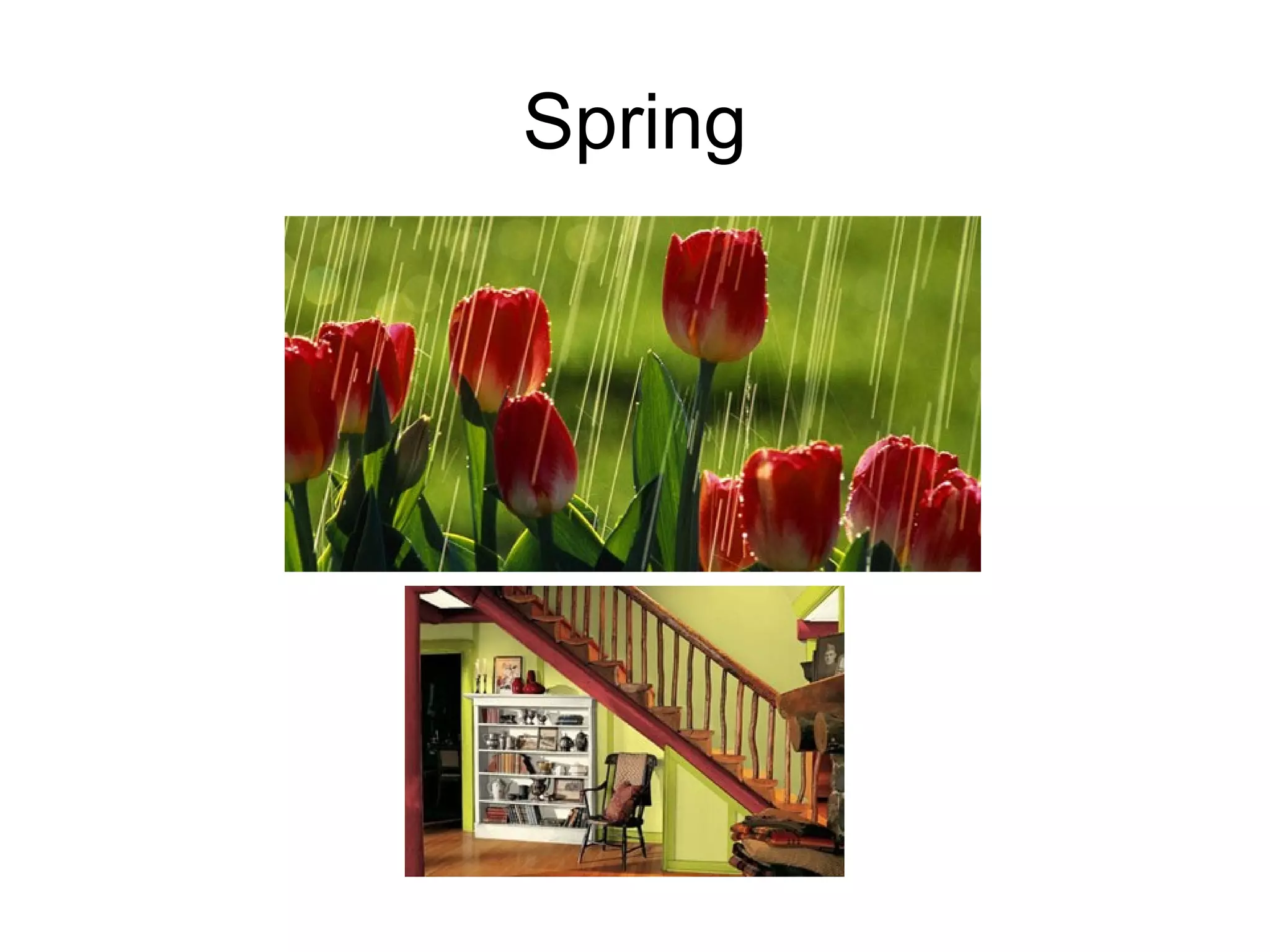
Colours as seen in Nature
• And their application
Summer
QuickTime™ and a
TIFF (Uncompressed) decompressor
are needed to see this picture.
QuickTime™ and a
TIFF (Uncompressed) decompressor
are needed to see this picture.
Autumn
QuickTime™ and a
TIFF (Uncompressed) decompressor
are needed to see this picture.
QuickTime™ and a
TIFF (Uncompressed) decompressor
are needed to see this picture.
Winter
QuickTime™ and a
TIFF (Uncompressed) decompressor
are needed to see this picture.
QuickTime™ and a
TIFF (Uncompressed) decompressor
are needed to see this picture.
Spring
QuickTime™ and a
TIFF (Uncompressed) decompressor
are needed to see this picture.
QuickTime™ and a
TIFF (Uncompressed) decompressor
are needed to see this picture.
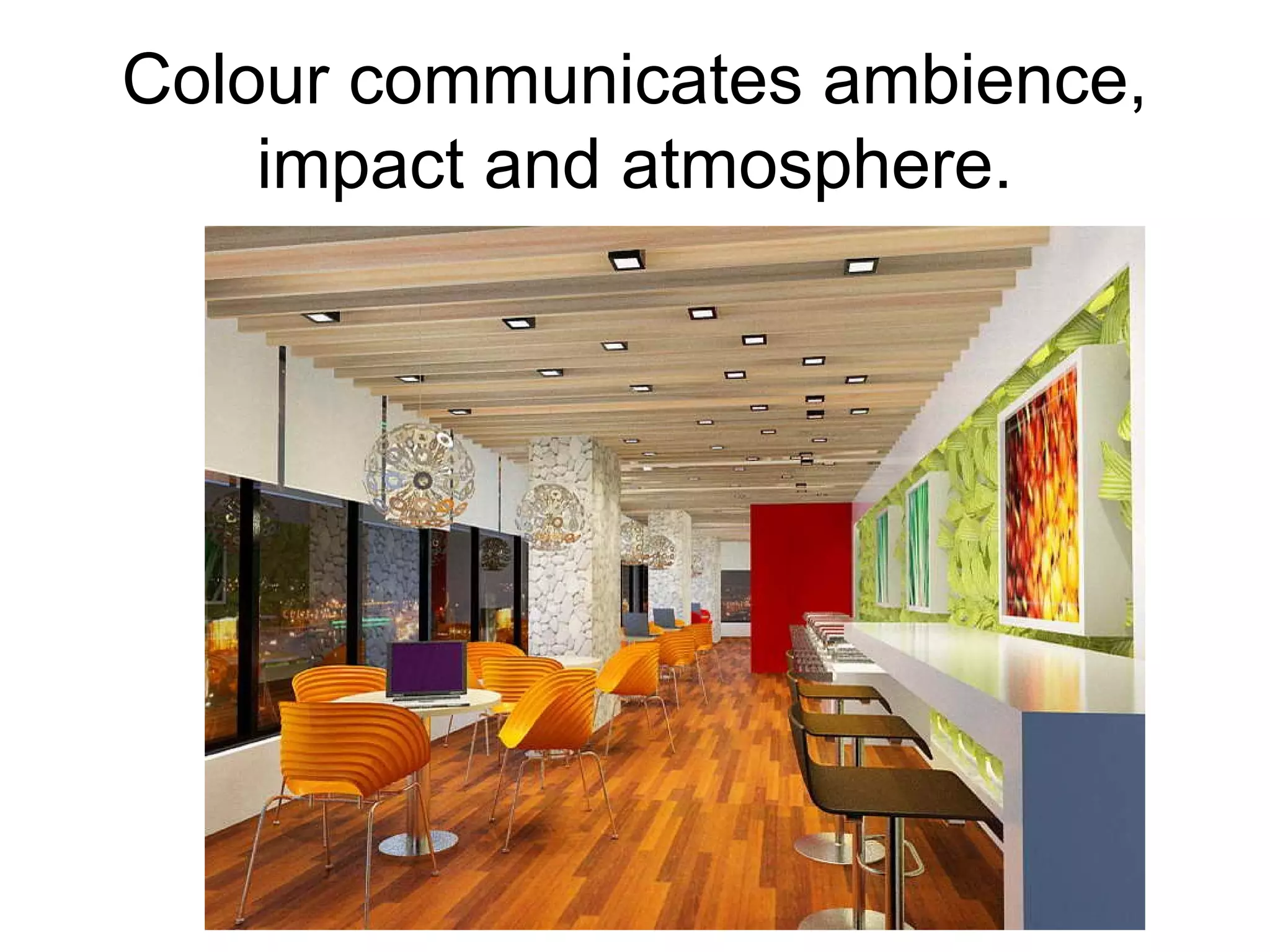
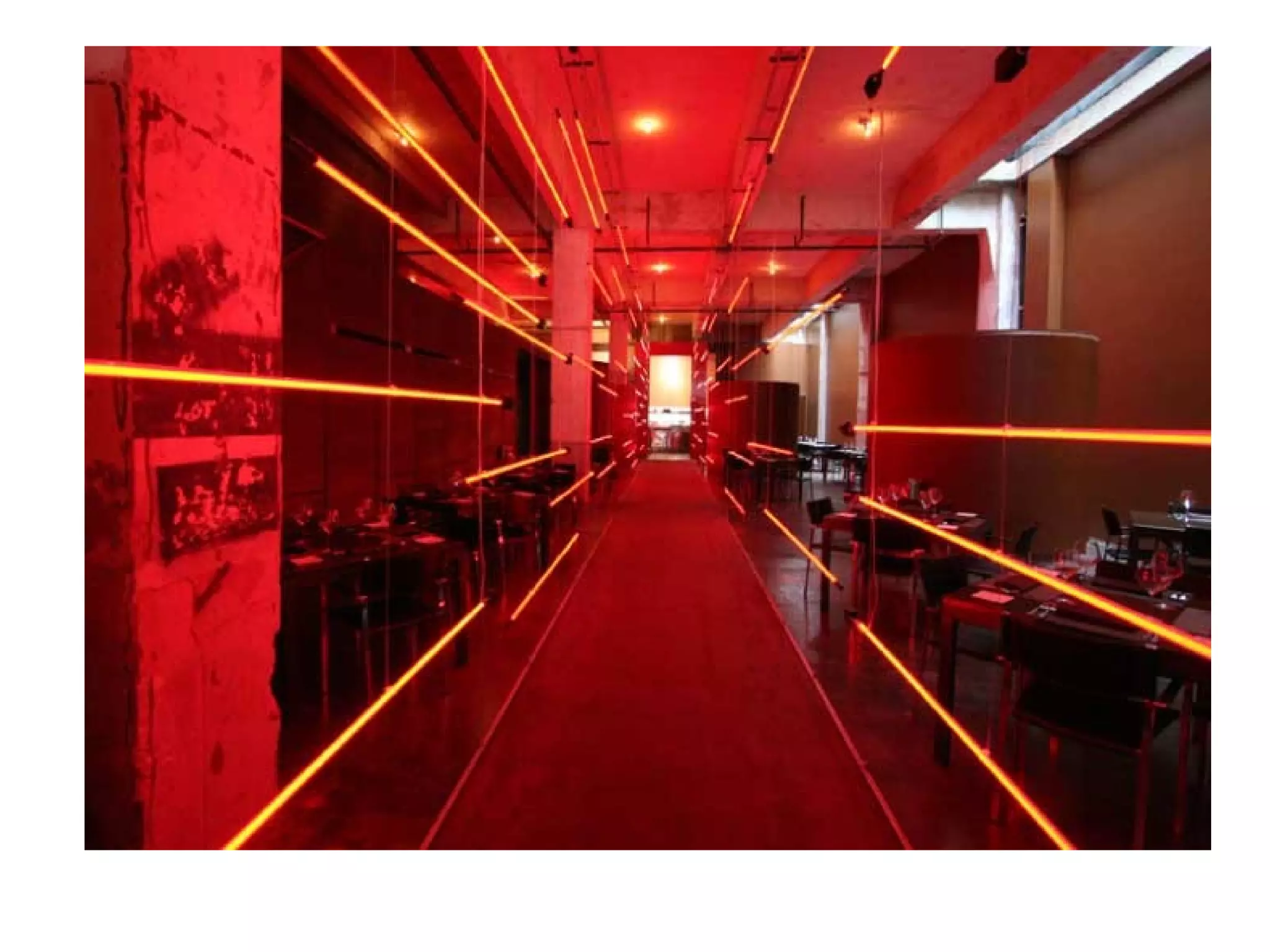
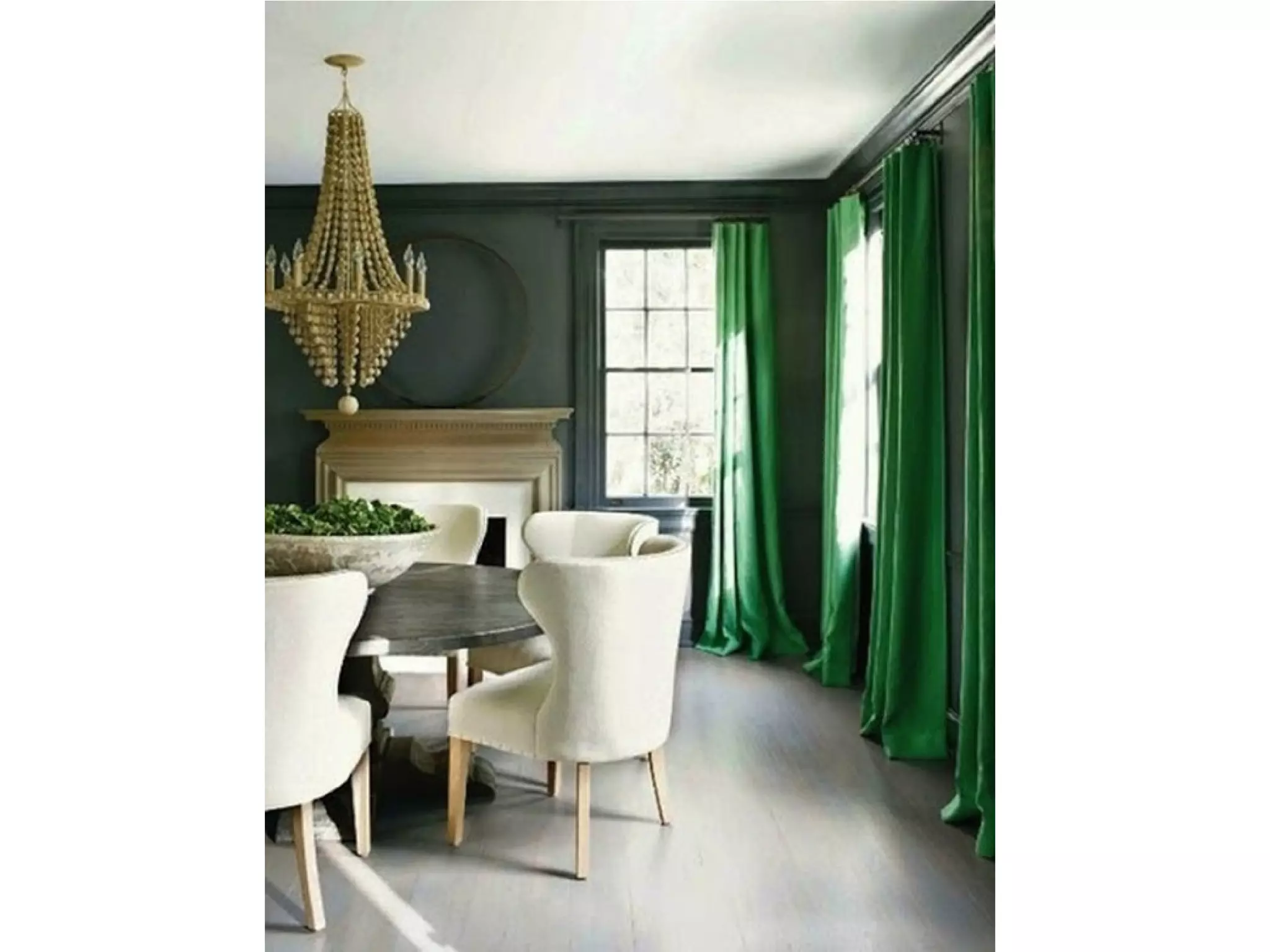
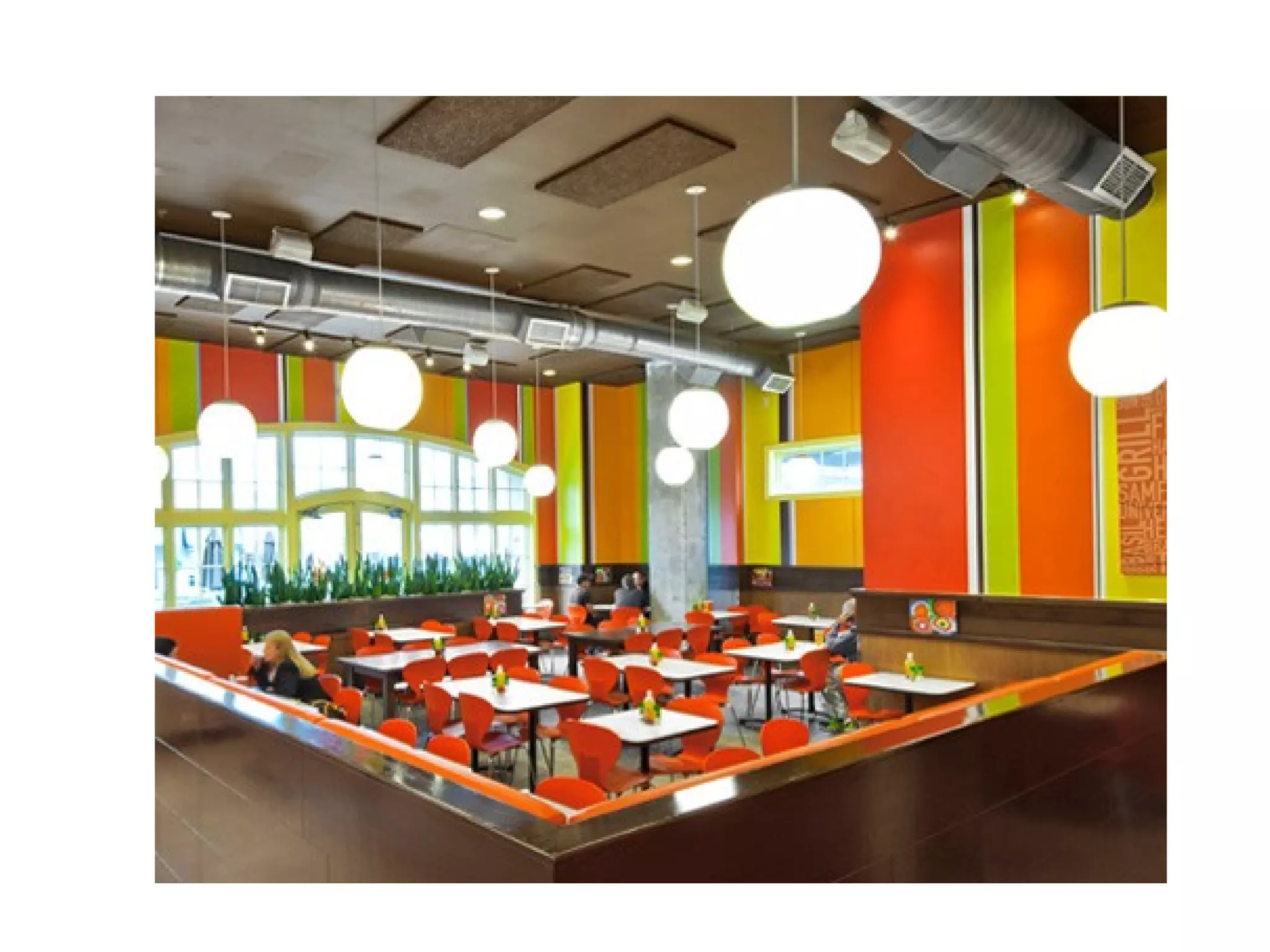
Colour communicates ambience,
impact and atmosphere.
What is Colour ?
The Effects of Colour.
• Colour is one of the most powerful tools available to the designer.
• It can affect our emotions, our responses and the way others react
to us. Colour is everywhere – in nature and in the man made world
around us.
• It is used to communicate information such as danger zones or
identify eye conditions such as colour blindness.
• The physiological effect of colour in interior design is
important to the Designer. The Interior Designer uses colour to
create environments that have a certain ambience or impact,
appropriate to the needs of the client.
• Colour is always planned, regardless of how “casually”
finishes appear to have been thrown together.
• The ability to perceive colour is different
colours have different length and strength
wave lengths.
• As light travels in waves, the different
frequency of each wave shows different
colours.
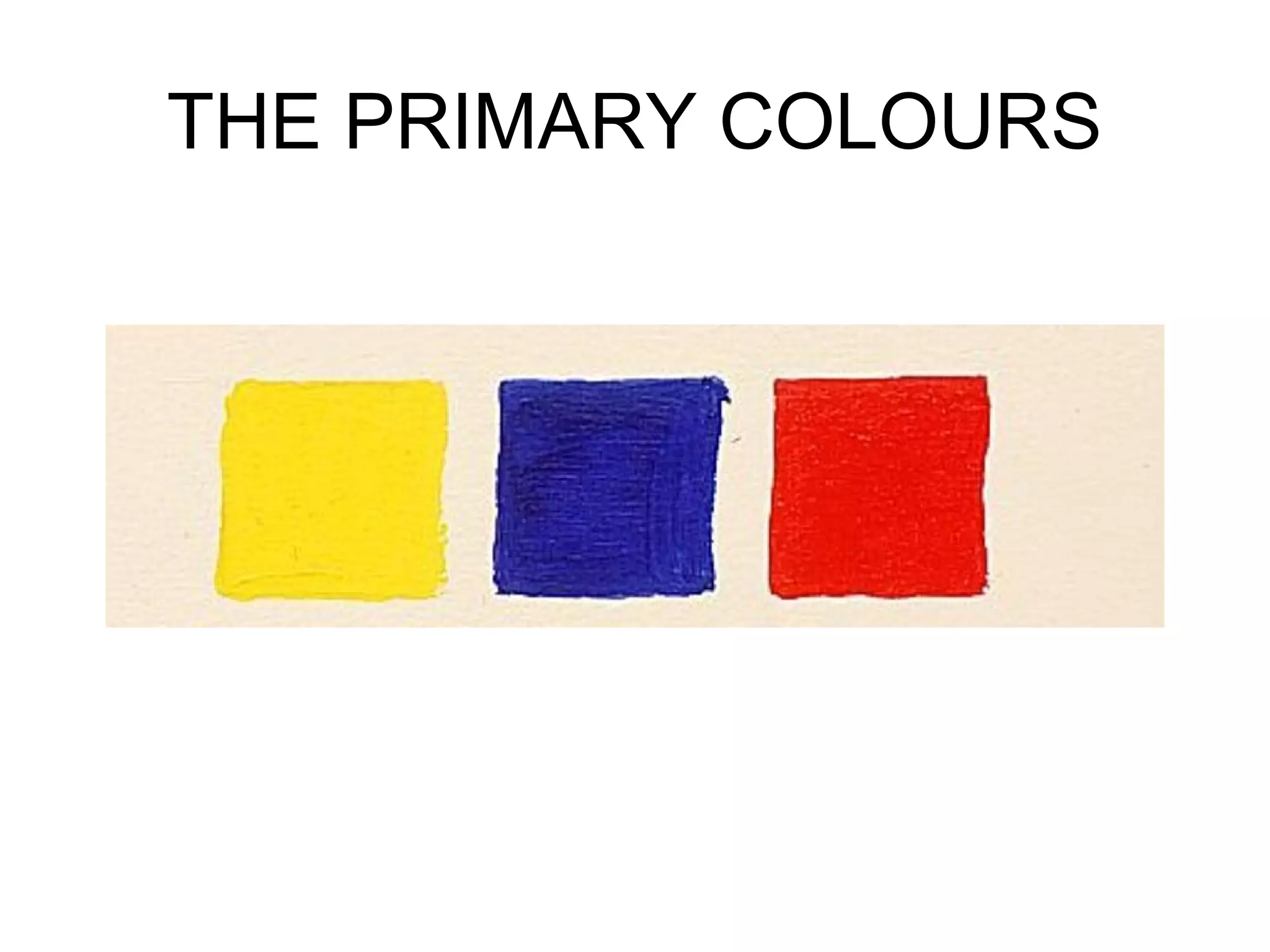
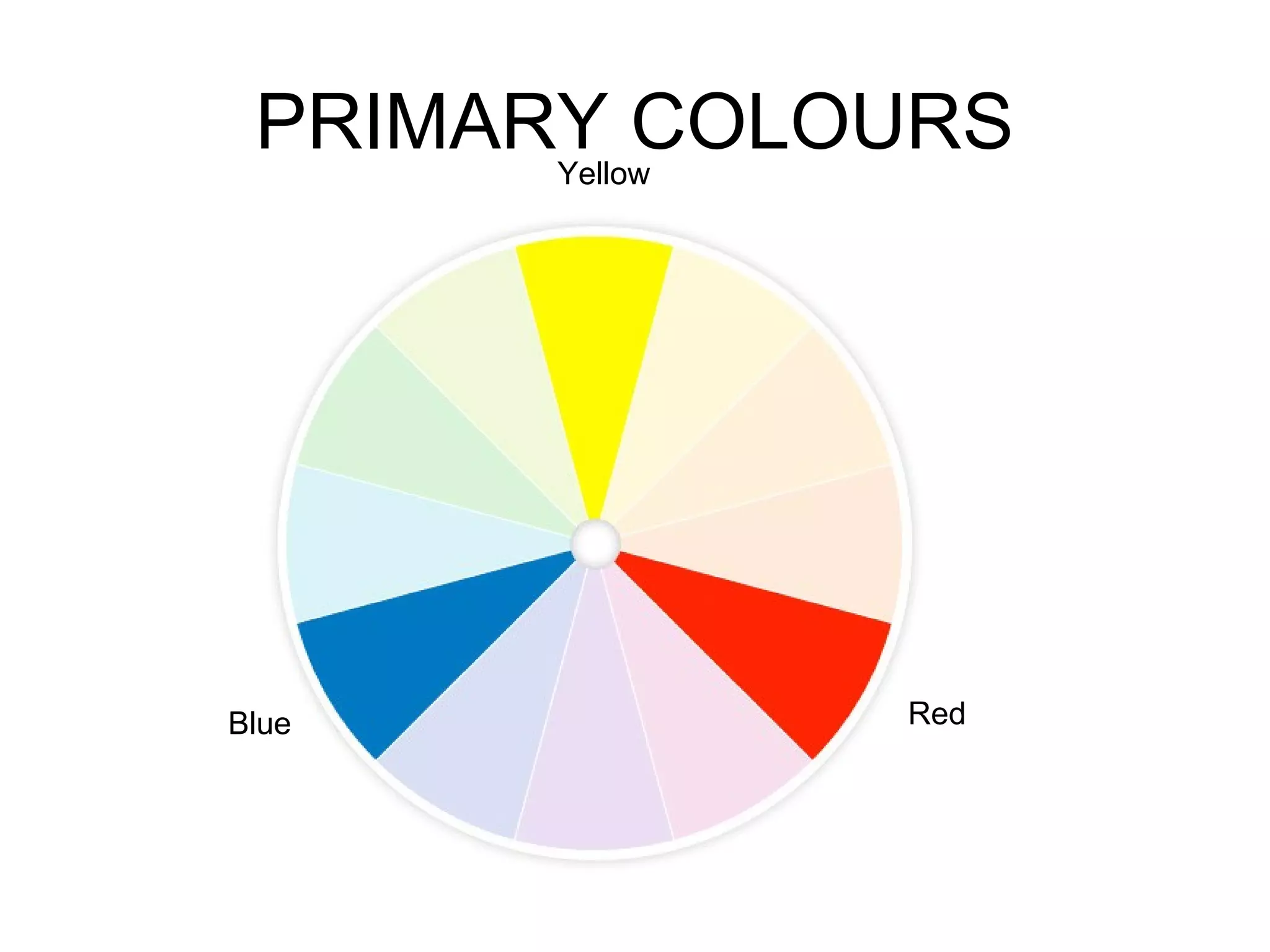
THE PRIMARY COLOURS
PRIMARY COLOURS
RedBlue
Yellow
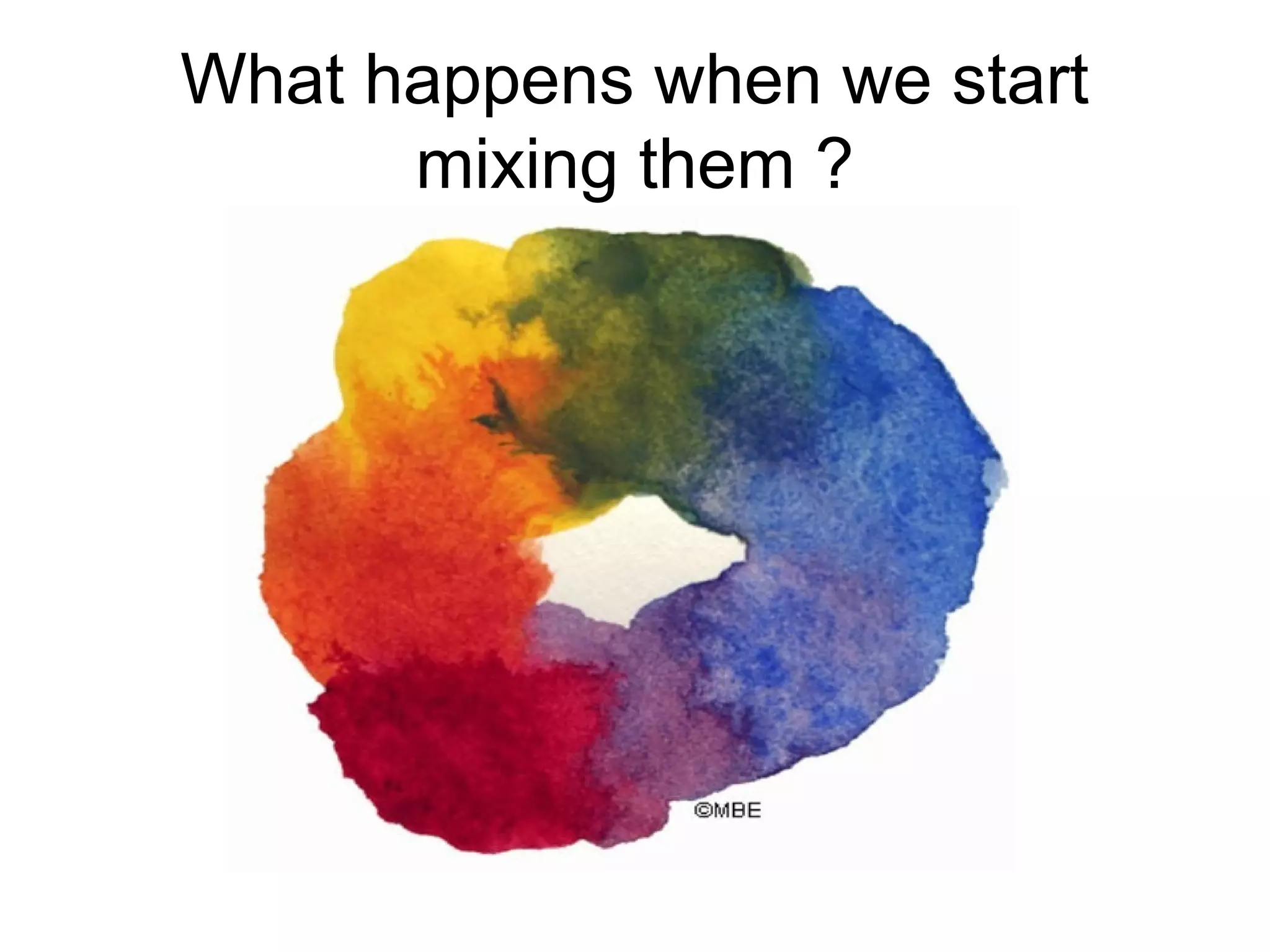
What happens when we start
mixing them ?
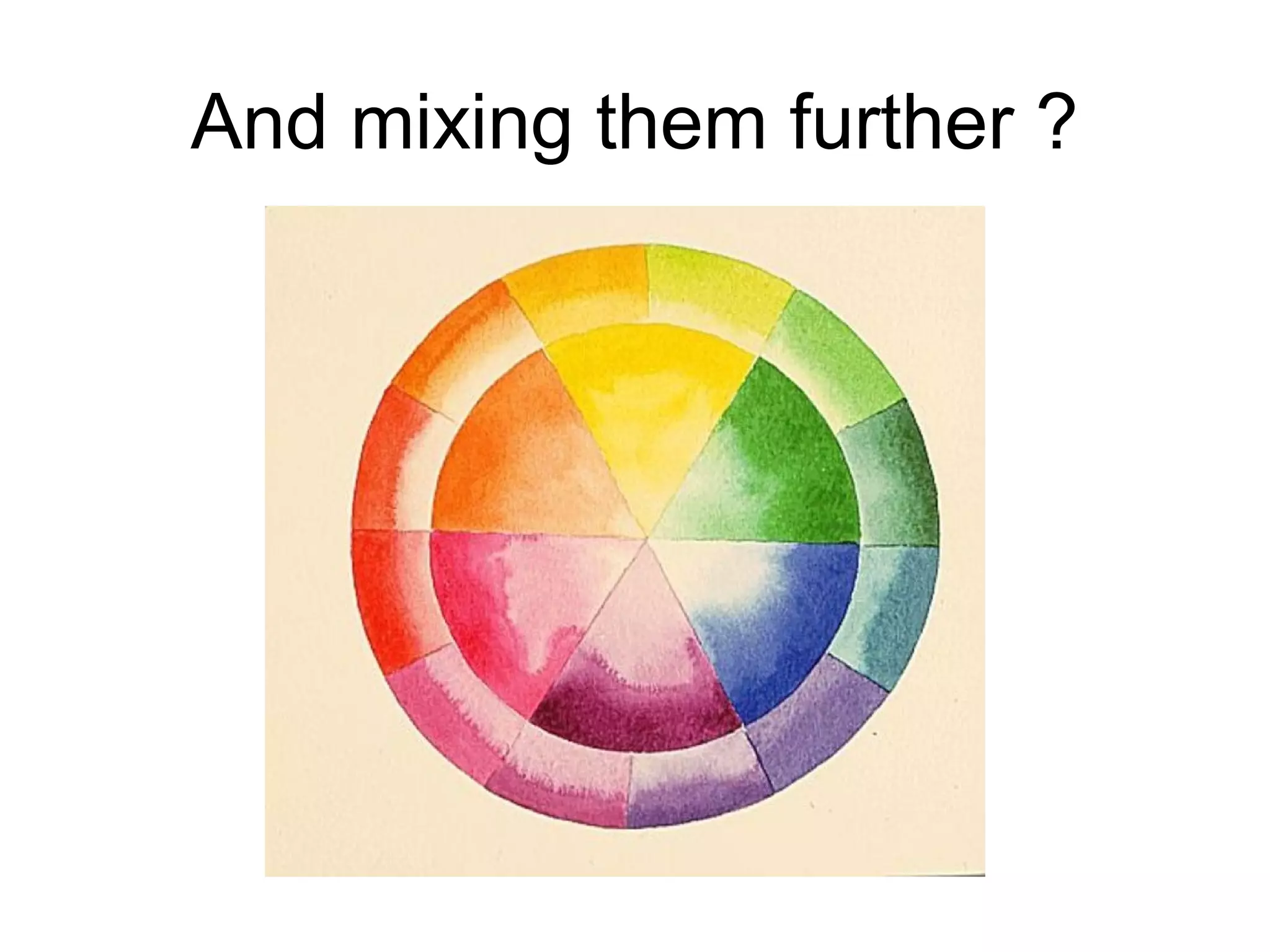
SECONDARY COLOURS
Green Orange
Purple
RedBlue
Yellow
And mixing them further ?
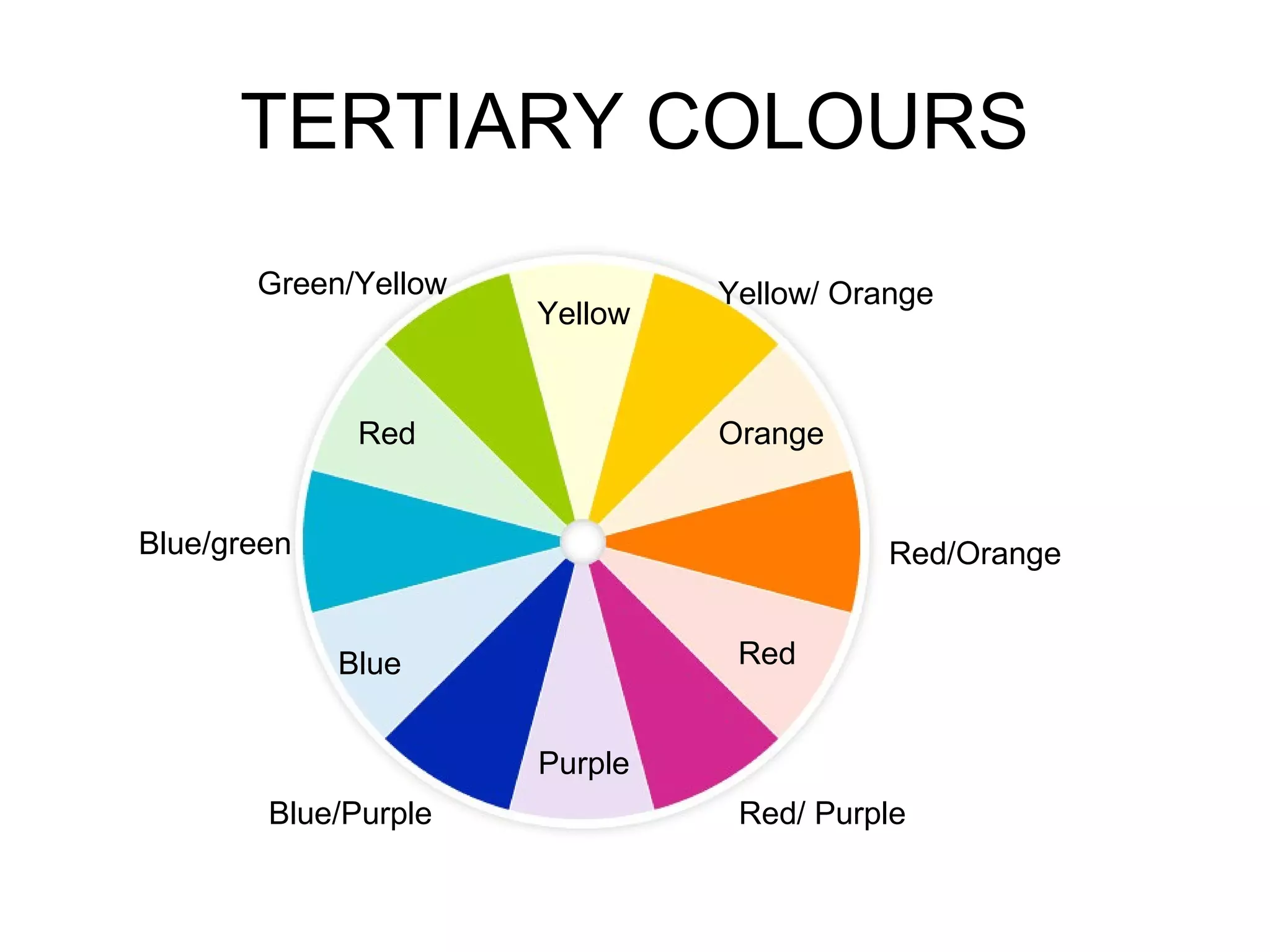
TERTIARY COLOURS
Red
Red/Orange
Green/Yellow
Blue/green
Blue
Yellow
Blue/Purple Red/ Purple
Yellow/ Orange
Red
Purple
Orange
The Colour Wheel
THE COLOUR WHEEL
A VALUABLE TOOL FOR THE
INTERIOR DESIGNER
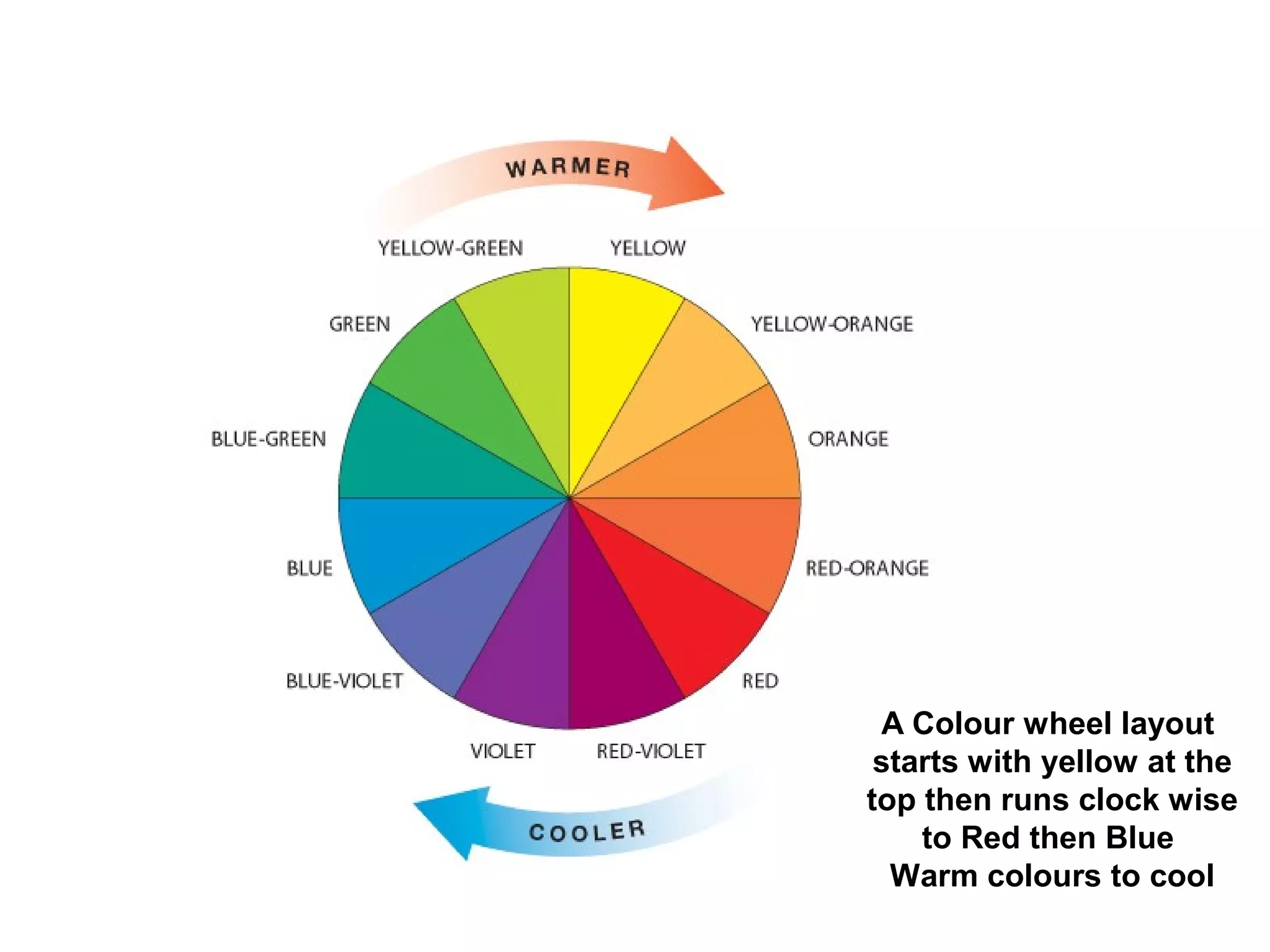
WARM AND COOL COLOURS
A Colour wheel layout
starts with yellow at the
top then runs clock wise
to Red then Blue
Warm colours to cool
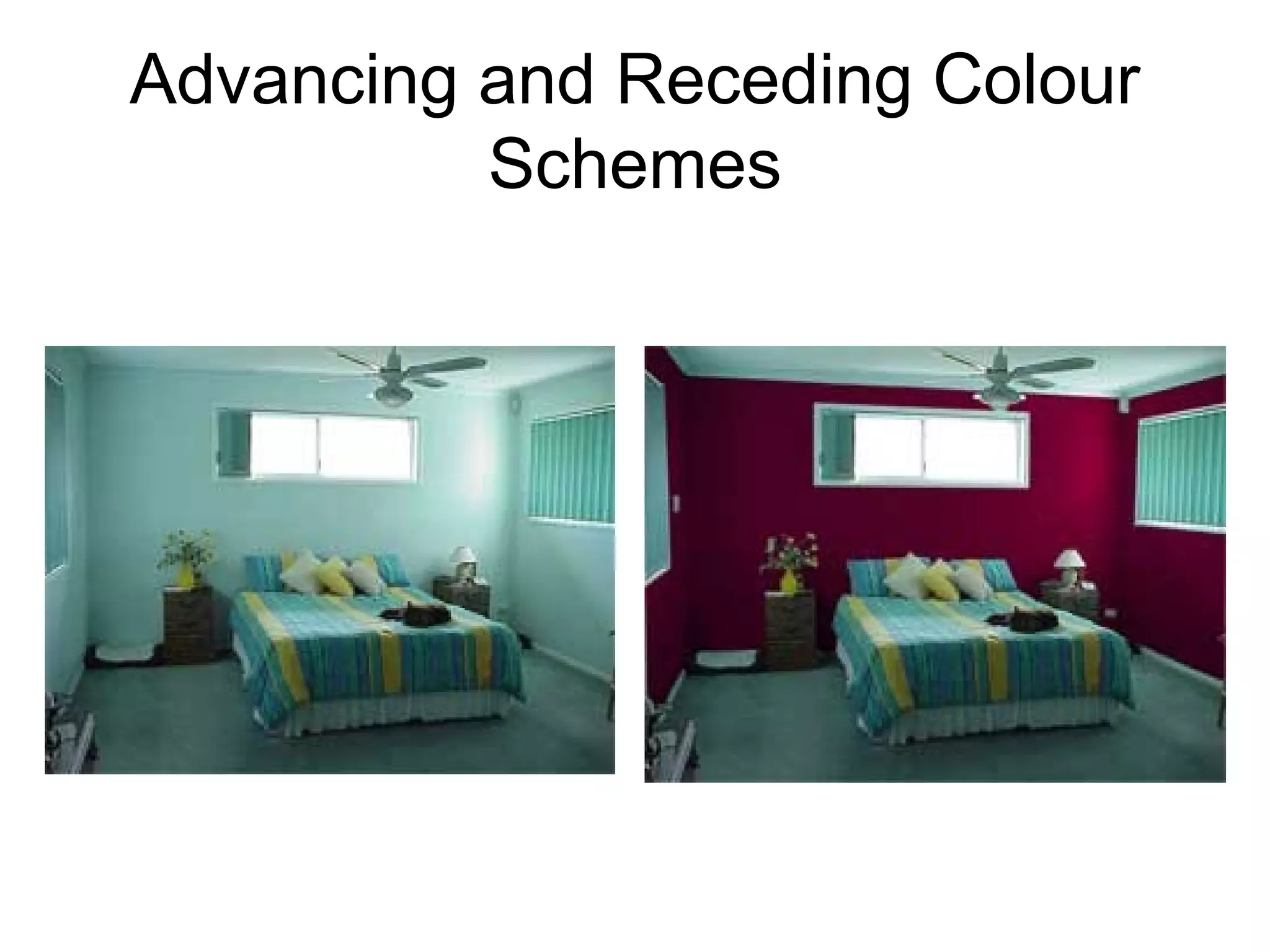
Advancing and Receding Colour
Schemes
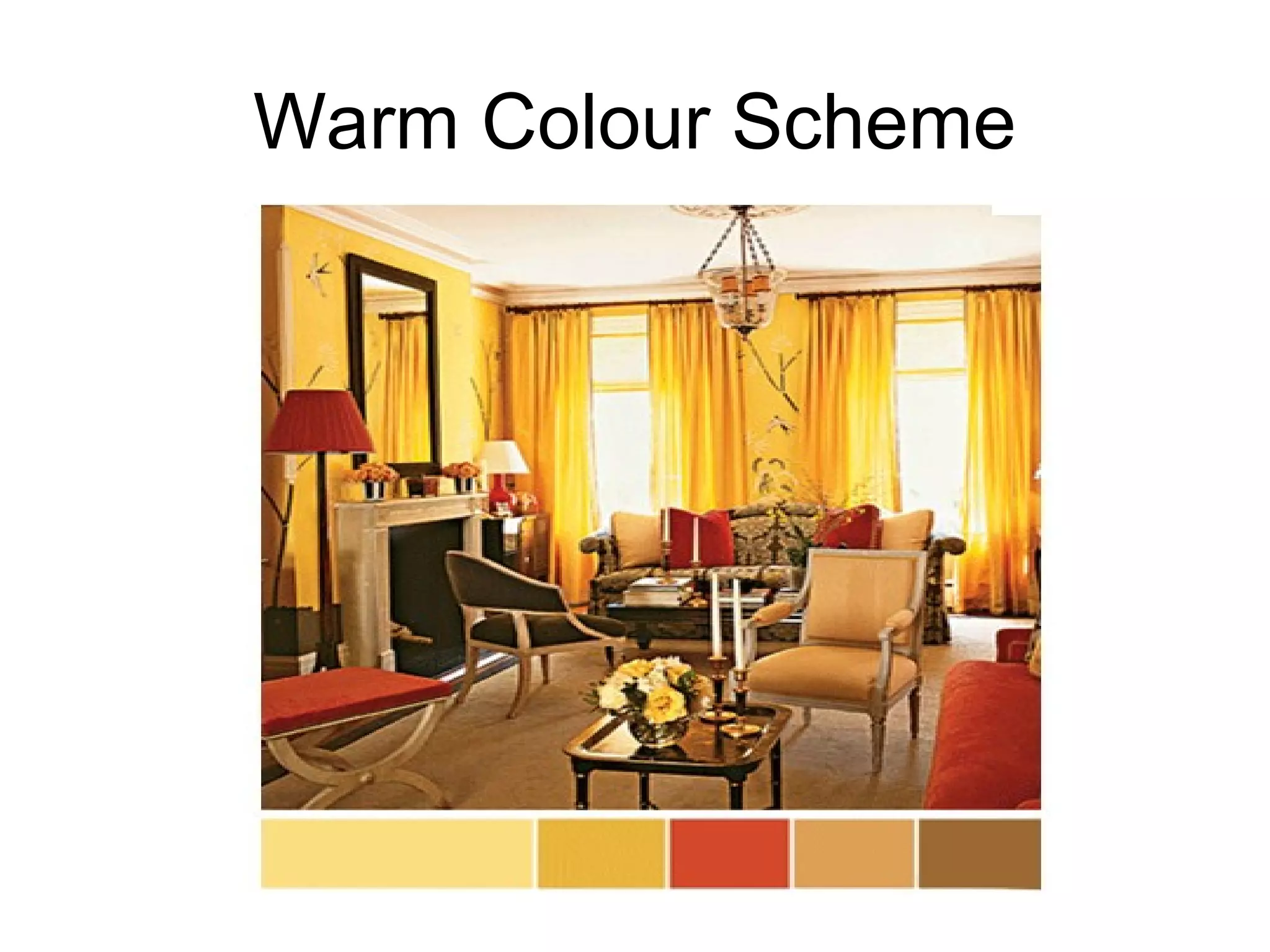
Warm Colour Scheme
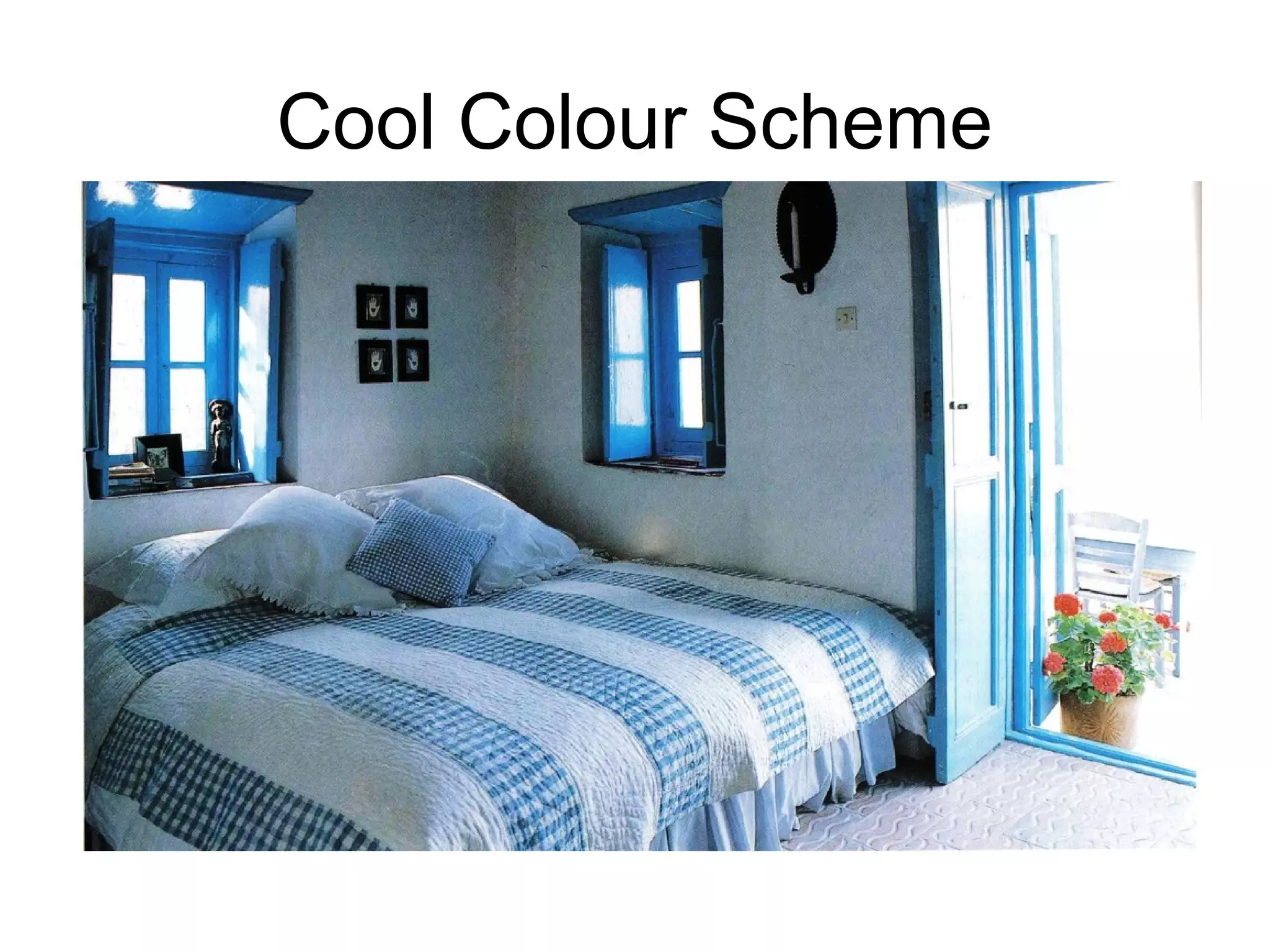
Cool Colour Scheme
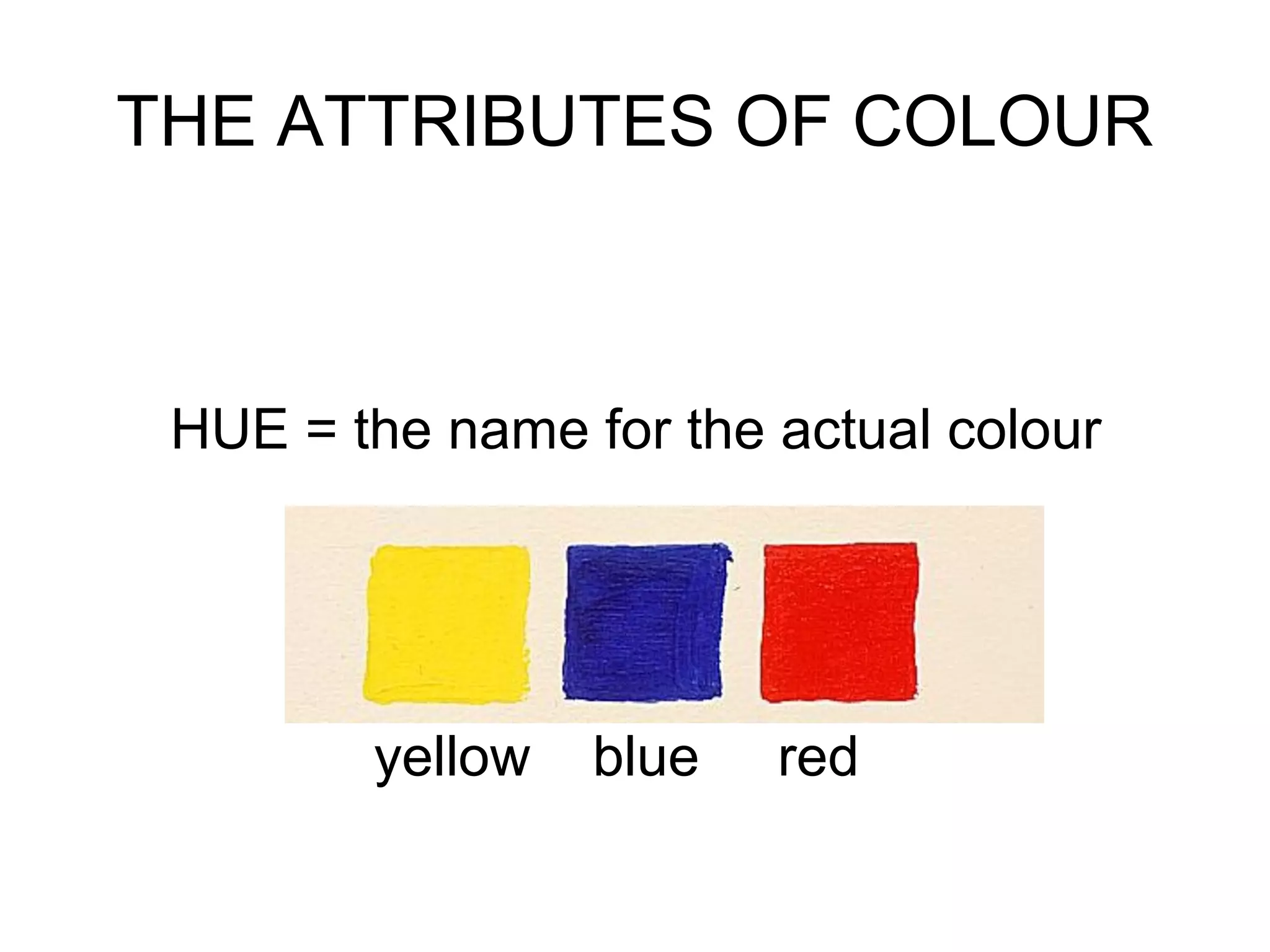
THE ATTRIBUTES OF COLOUR
HUE = the name for the actual colour
yellow blue red
THE ATTRIBUTES OF COLOUR
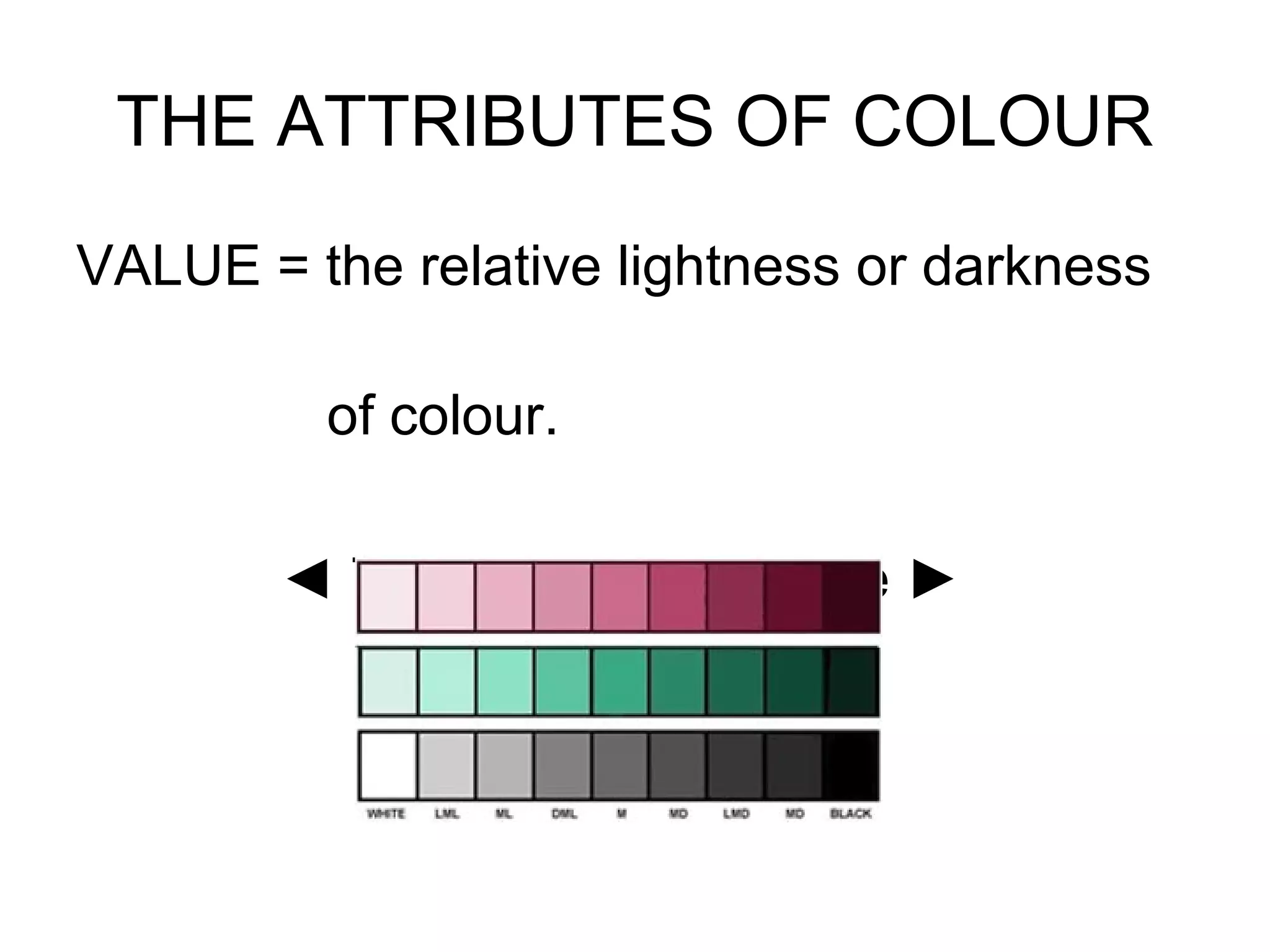
VALUE = the relative lightness or darkness
of colour.
◄ Tint Shade ►
THE ATTRIBUTES OF COLOUR
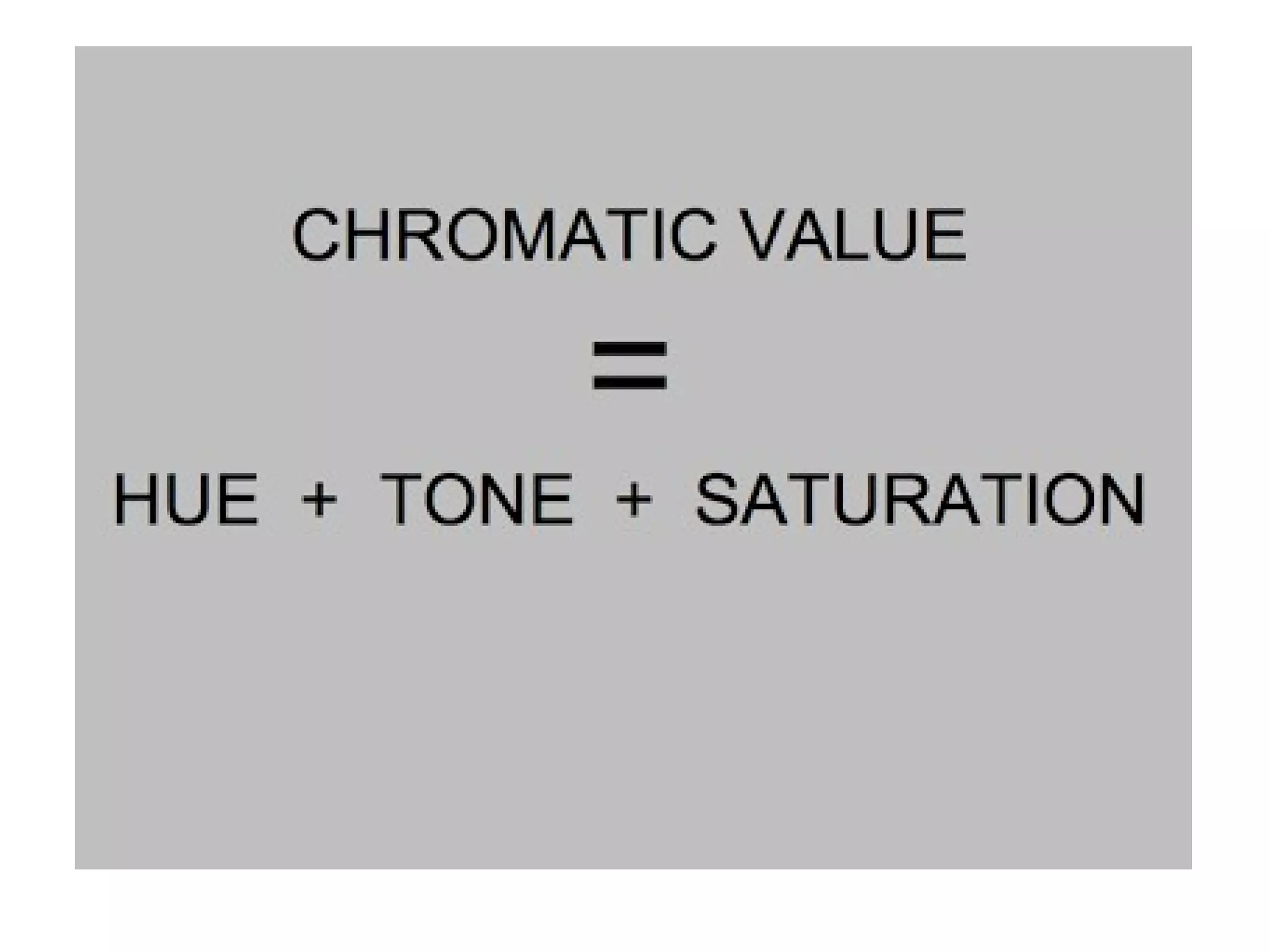
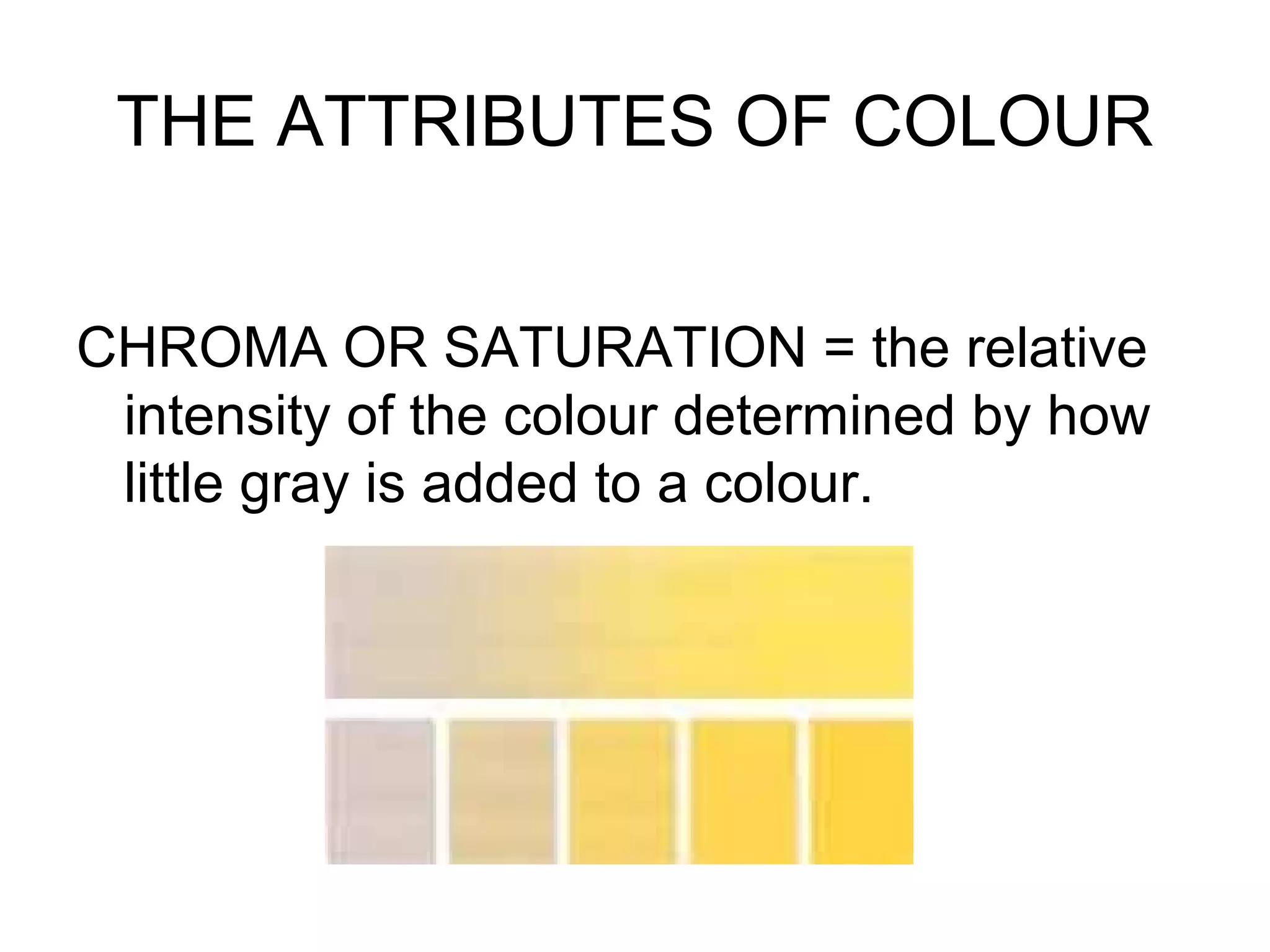
CHROMA OR SATURATION = the relative
intensity of the colour determined by how
little gray is added to a colour.
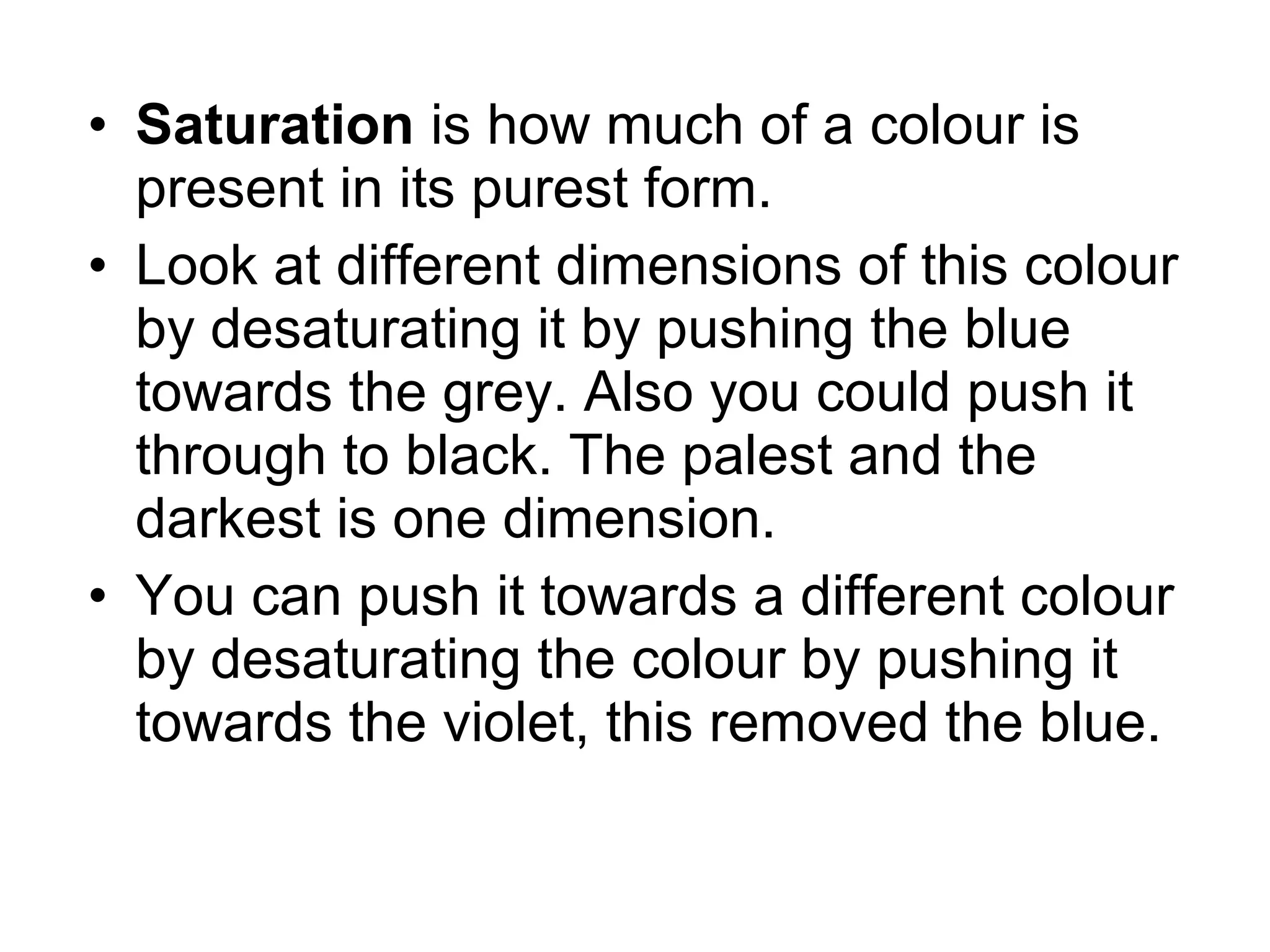
• Saturation is how much of a colour is
present in its purest form.
• Look at different dimensions of this colour
by desaturating it by pushing the blue
towards the grey. Also you could push it
through to black. The palest and the
darkest is one dimension.
• You can push it towards a different colour
by desaturating the colour by pushing it
towards the violet, this removed the blue.
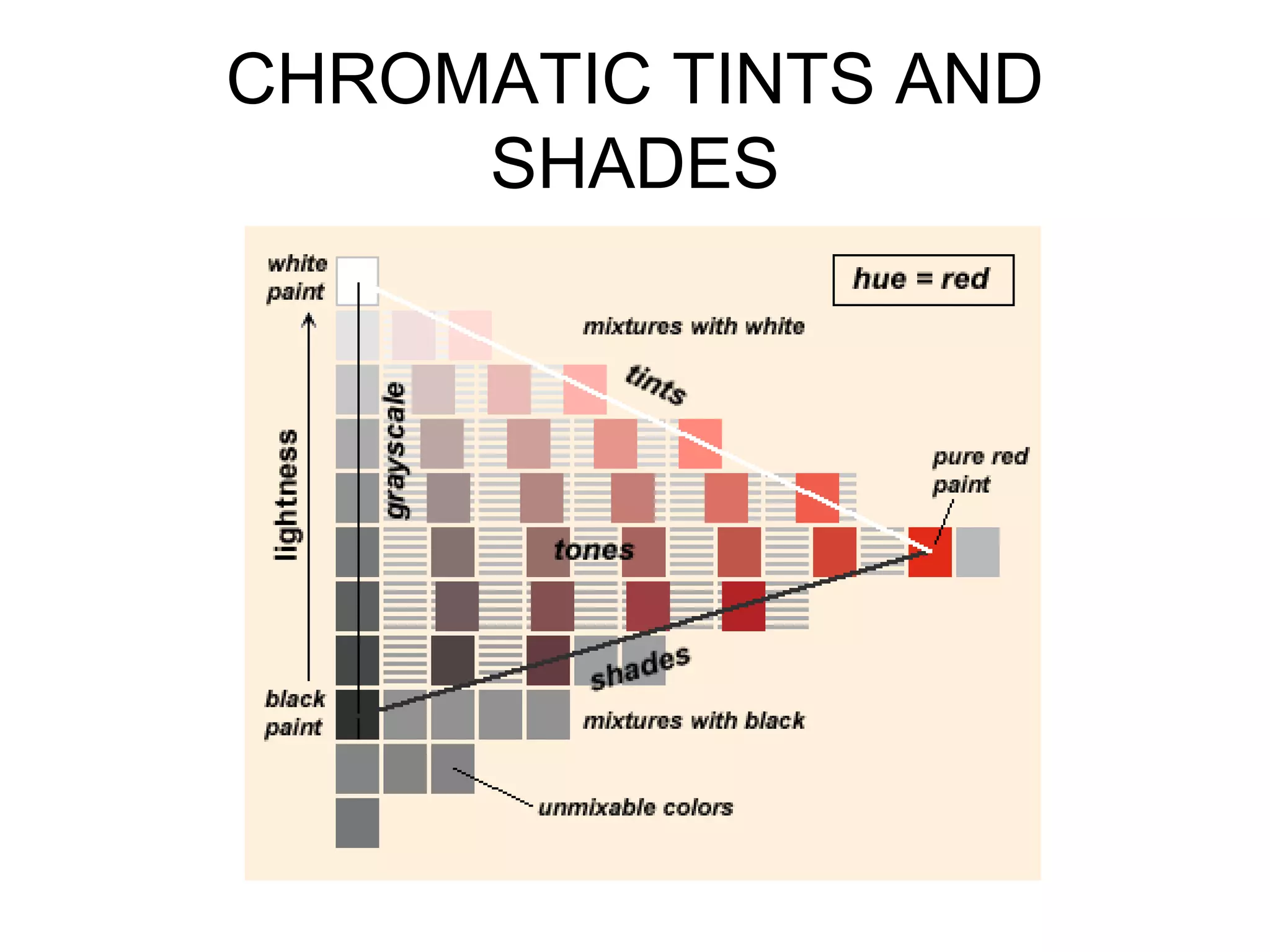
CHROMATIC TINTS AND
SHADES
TONAL VALUES OF COLOUR
• The estimated lightness of a surface colour.
• A series of greys is imagined to run along a vertical axis
with a perfect black (value 0) at the bottom and a perfect
white (value 10) at the top. The greys lighten – or
increase in value - in steps that are subjectively equal.
Colours of the same lightness as a given grey are
assigned the same value and arranged in the same
horizontal level.
• Synonyms: greyness, reflectance, tonal value, weight.
THE MUNSELL SYSTEM
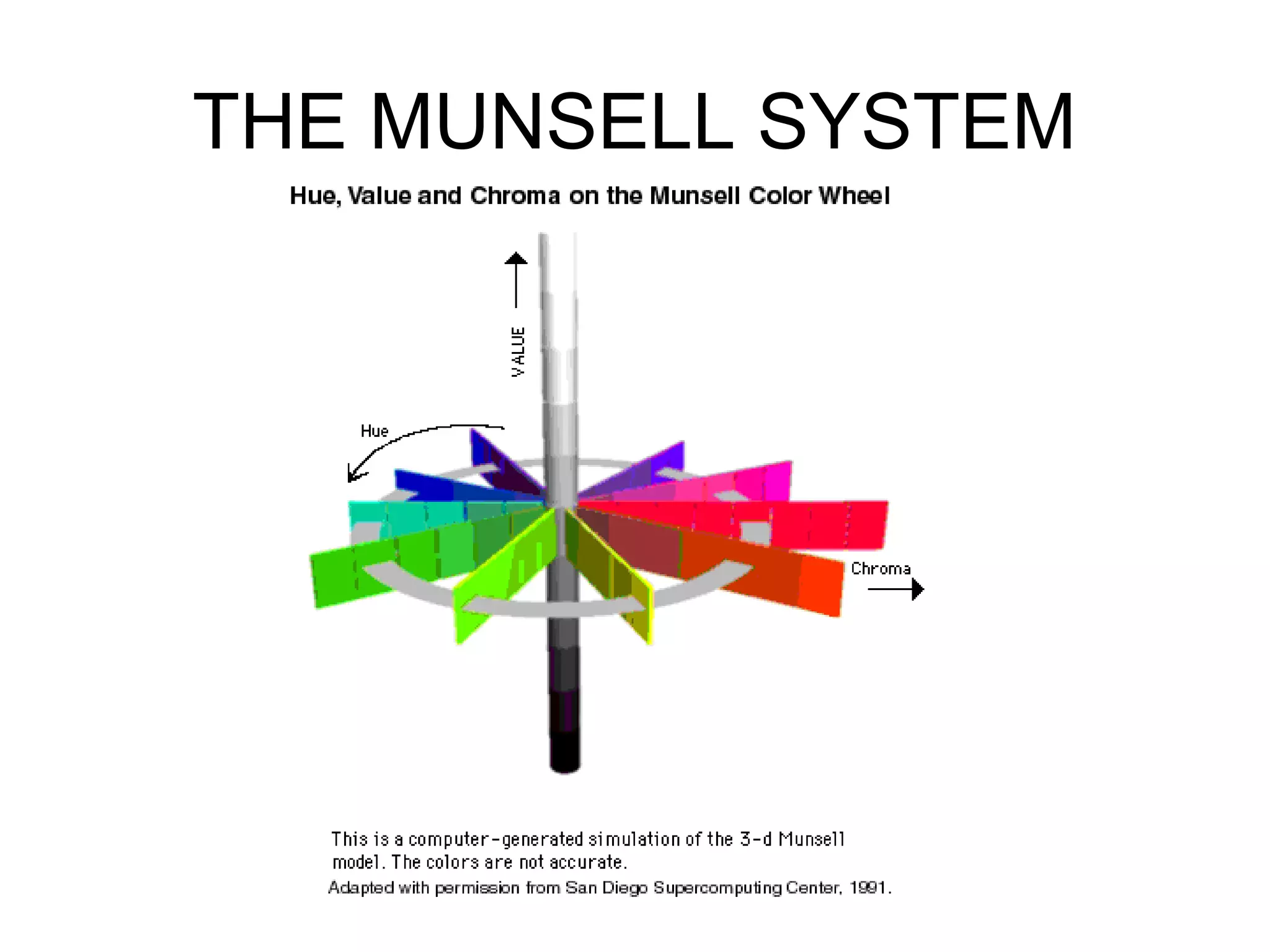
Munsell System
• The Munsell System as developed by Albert Munsell, is
a method of colour notation which allows one to
accurately specify a colour and have it reproduced
exactly. For example,if a group of students were asked
to mix a rose-pink, they may all have a similar
understanding of what rose-pink looks like, but would all
mix a different pink.
• Using the Munsell system of colour notation, an identical
rose pink can be mixed every time, simply based on hue,
value and Chroma.
Colour Planning Considerations
1. Preferences
2. Fixed Colours
3. Juxtaposition Effects
4. Lighting Effects
5. Tonal Value
6. Optical Effects
7. Room Orientation
8. A Balance of Cool and Warm colours
9. Architectural Features
10.The Function of the Space
11.The Balance of colour in an area of
space
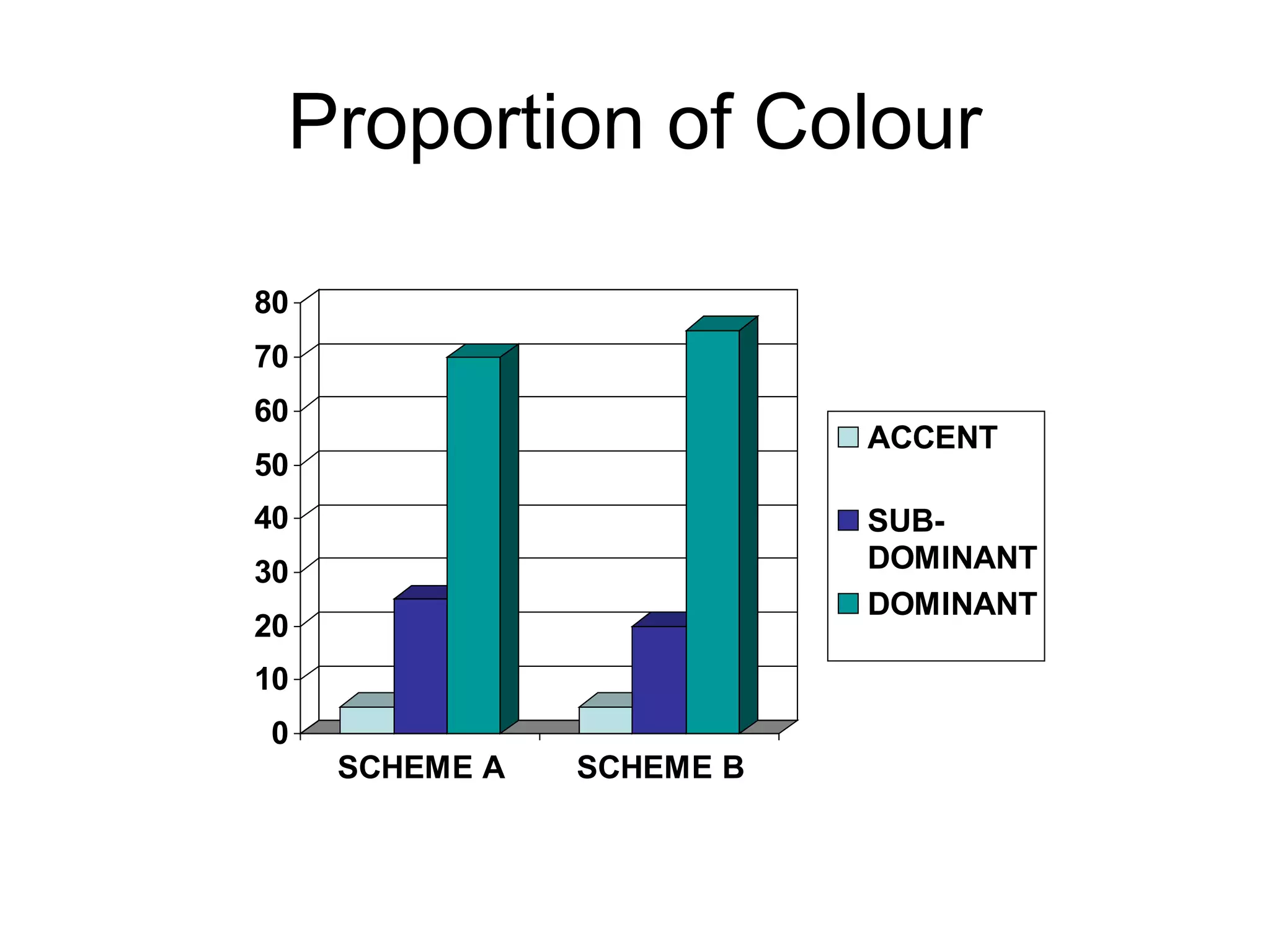
Proportion of Colour
0
10
20
30
40
50
60
70
80
SCHEME A SCHEME B
ACCENT
SUB-
DOMINANT
DOMINANT
Colour Schemes from
the Wheel
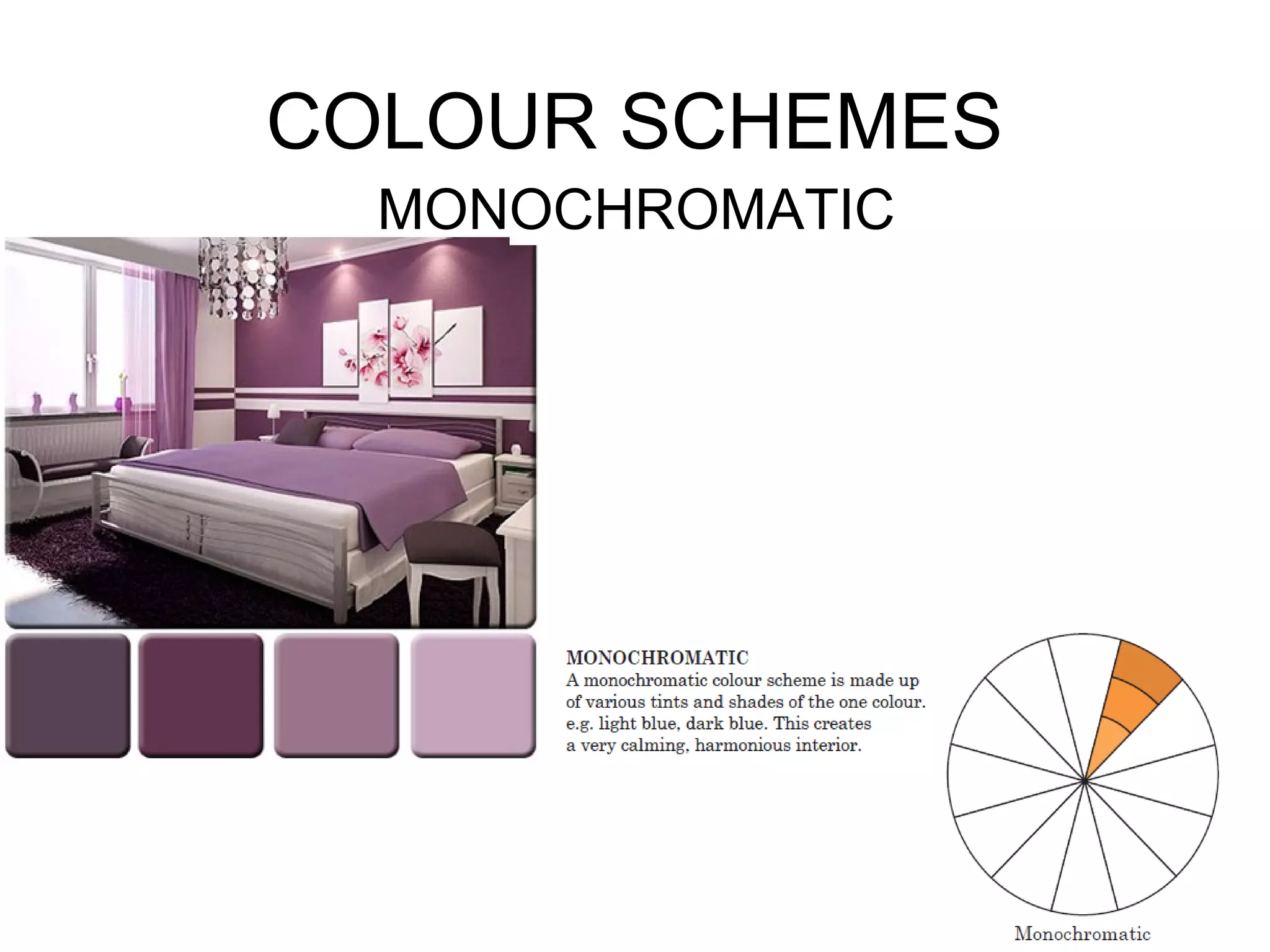
COLOUR SCHEMES
MONOCHROMATIC
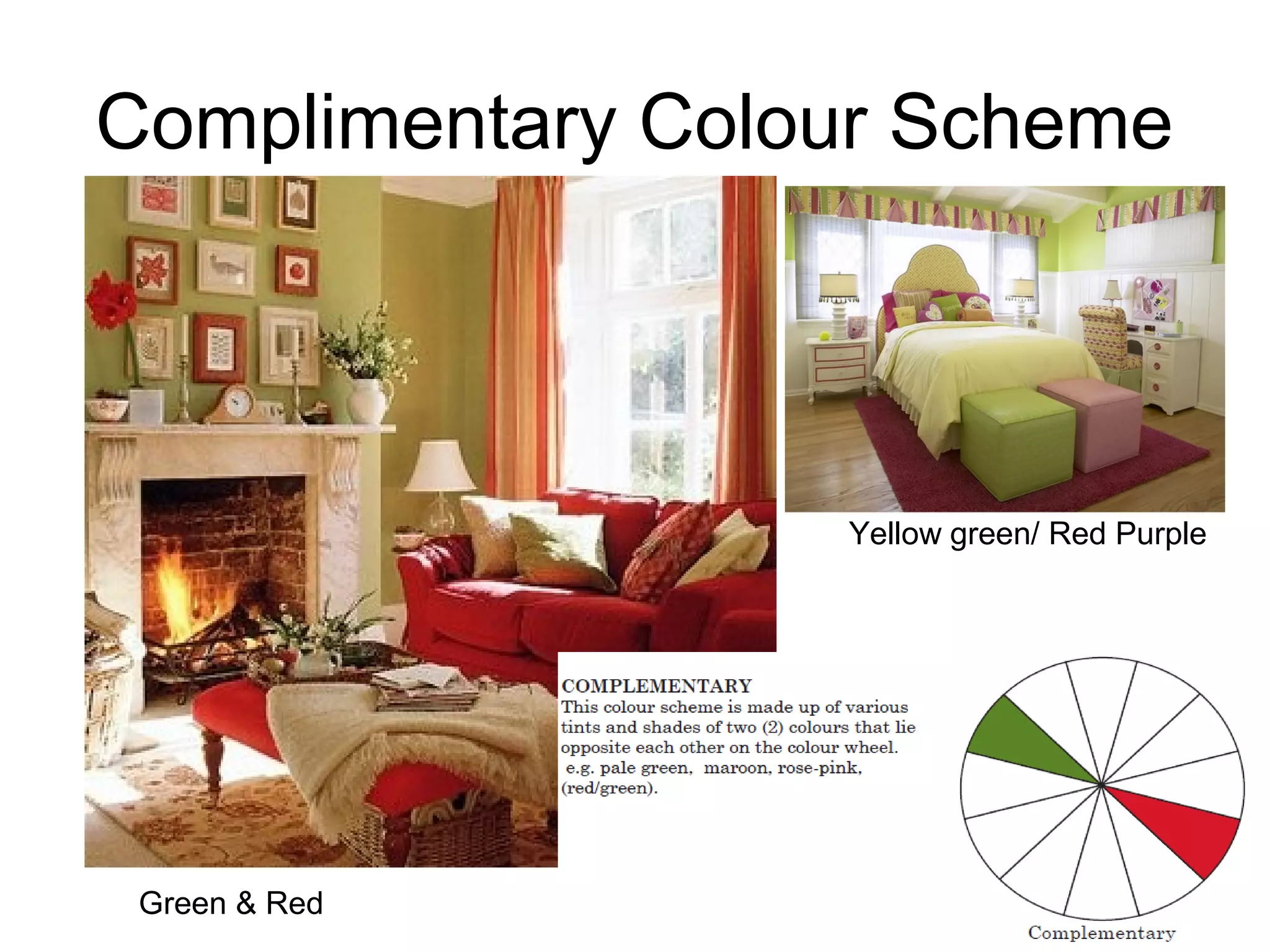
Complimentary Colour Scheme
Yellow green/ Red Purple
Green & Red
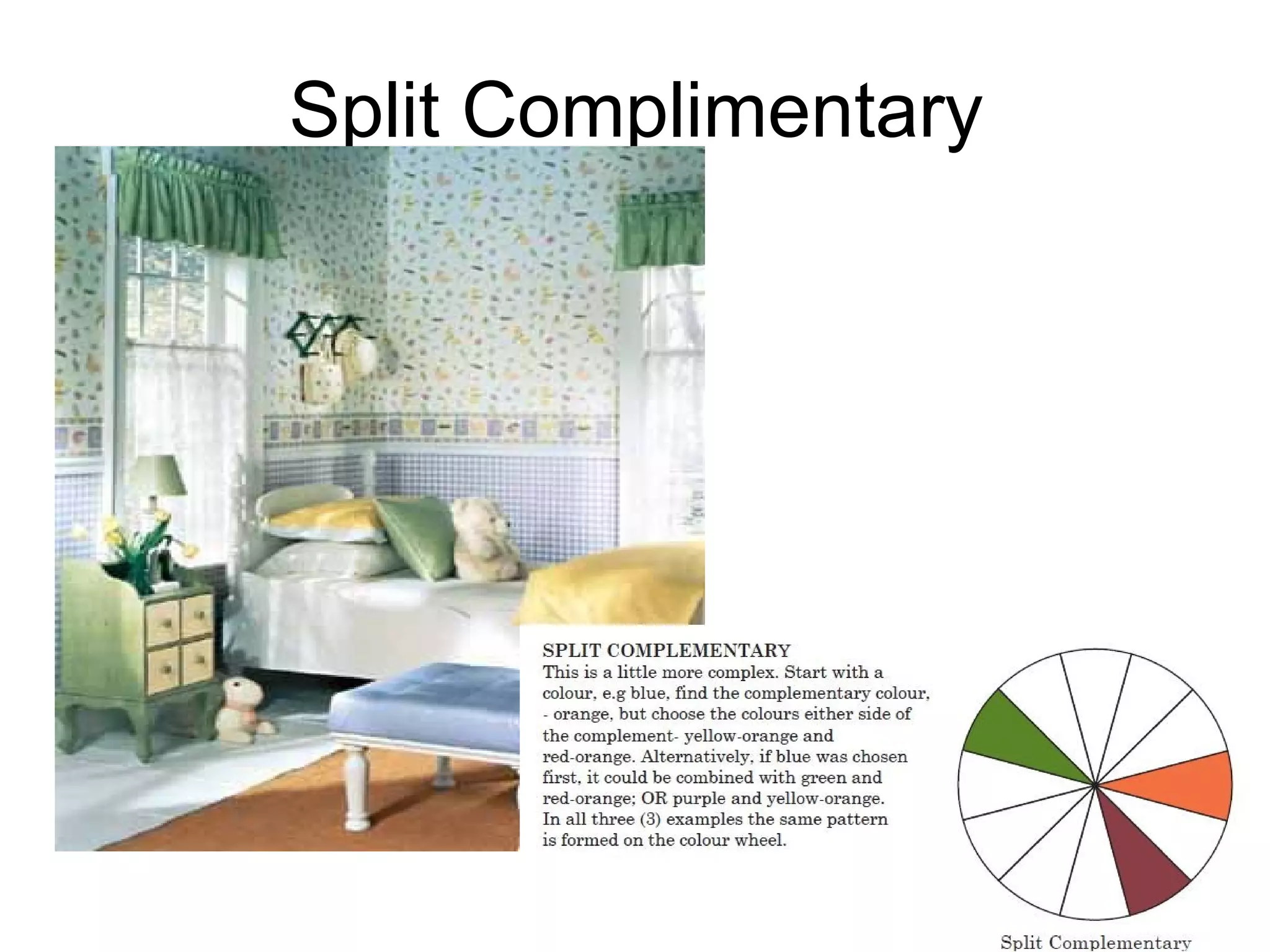
Split Complimentary
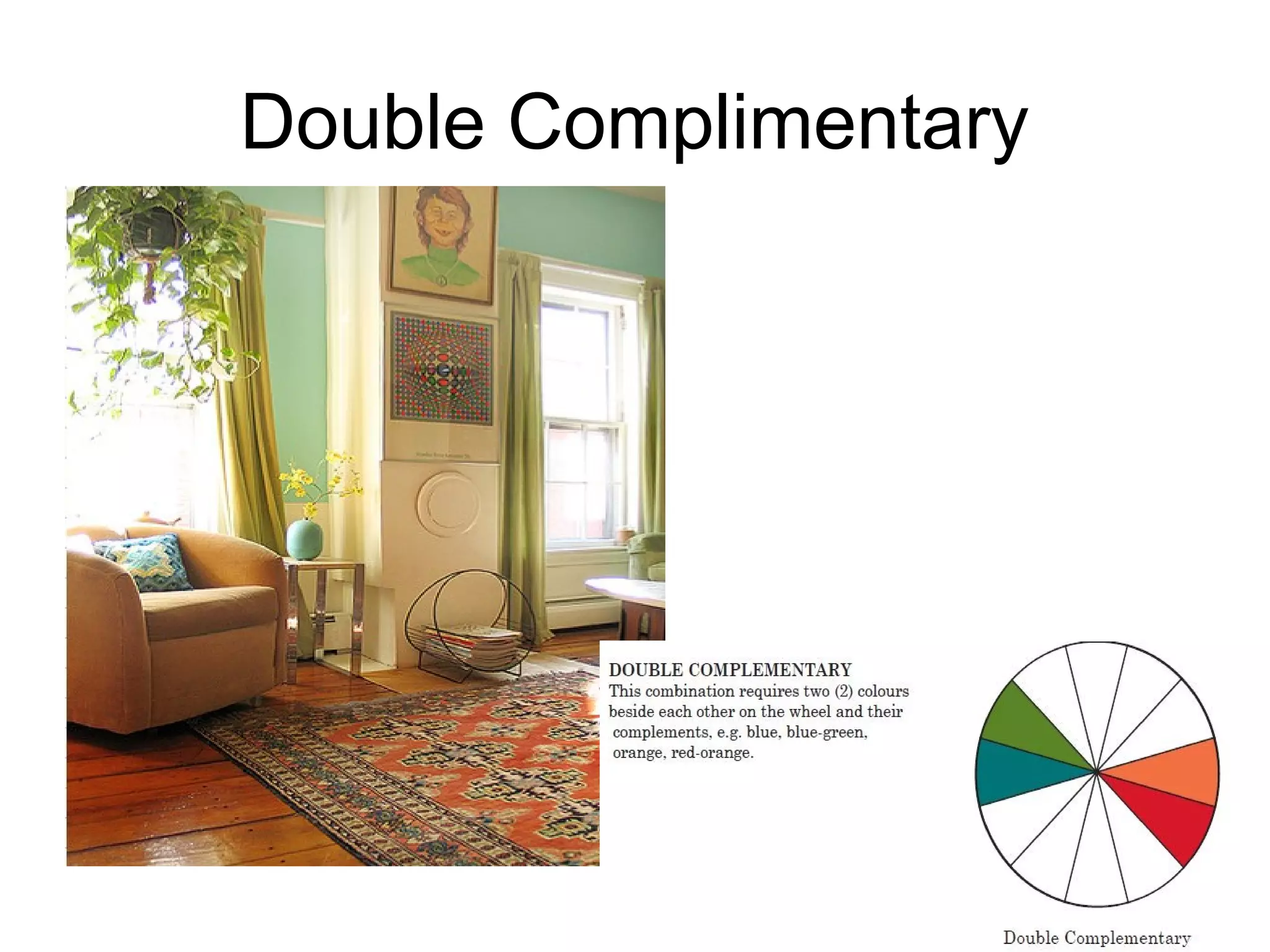
Double Complimentary
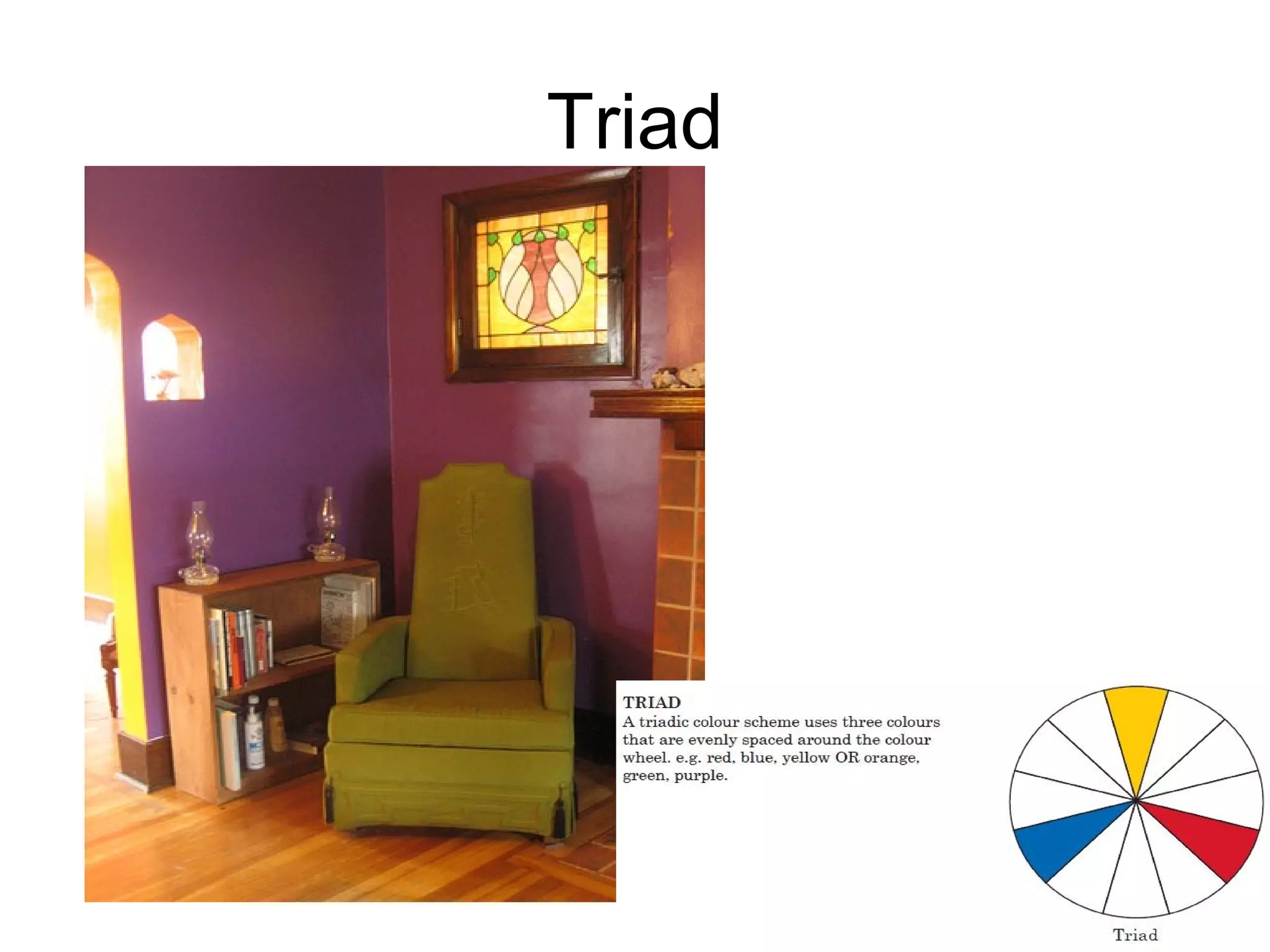
Triad
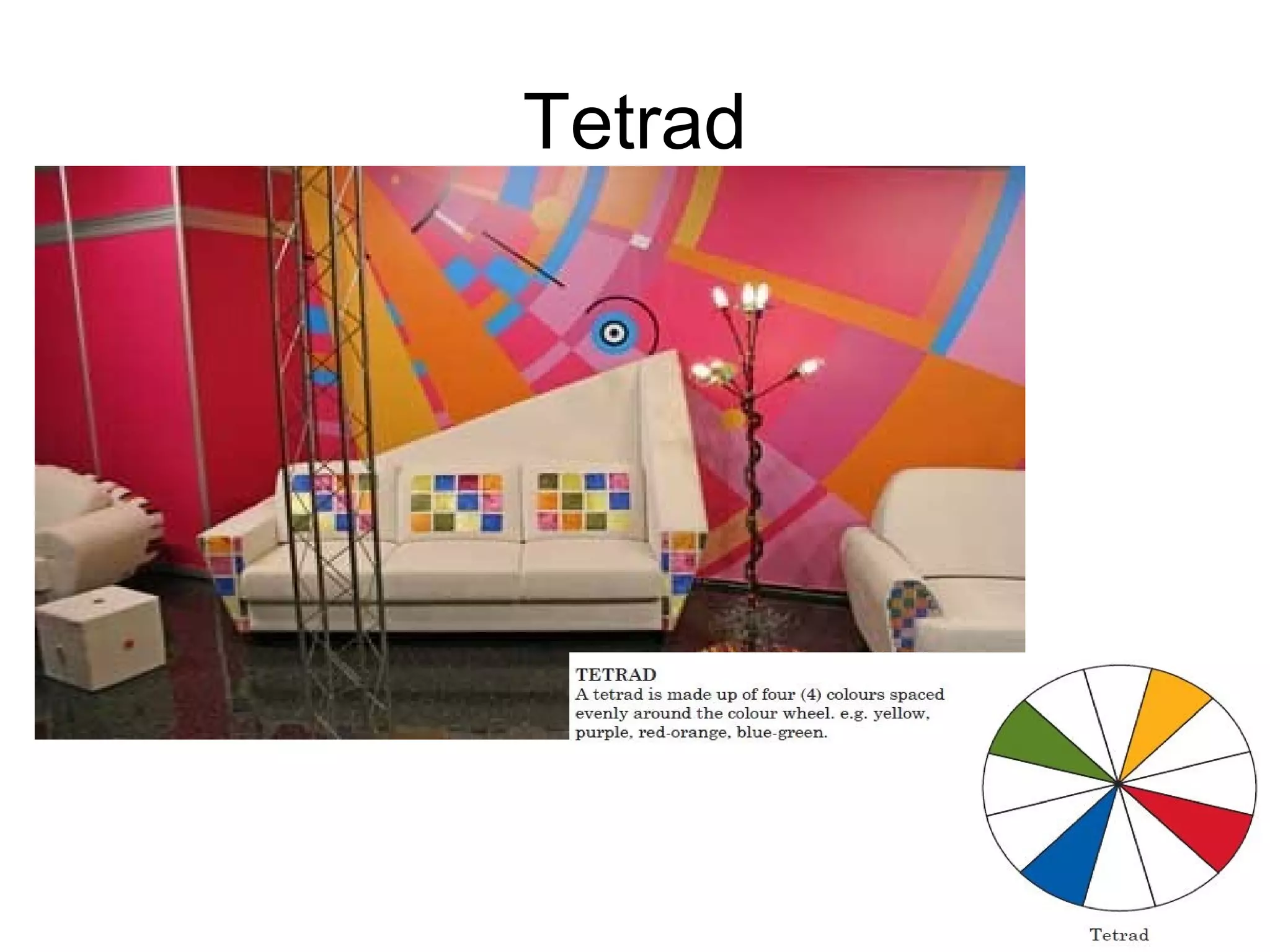
Tetrad
Monochromatic with Accent
Double Split Complimentary
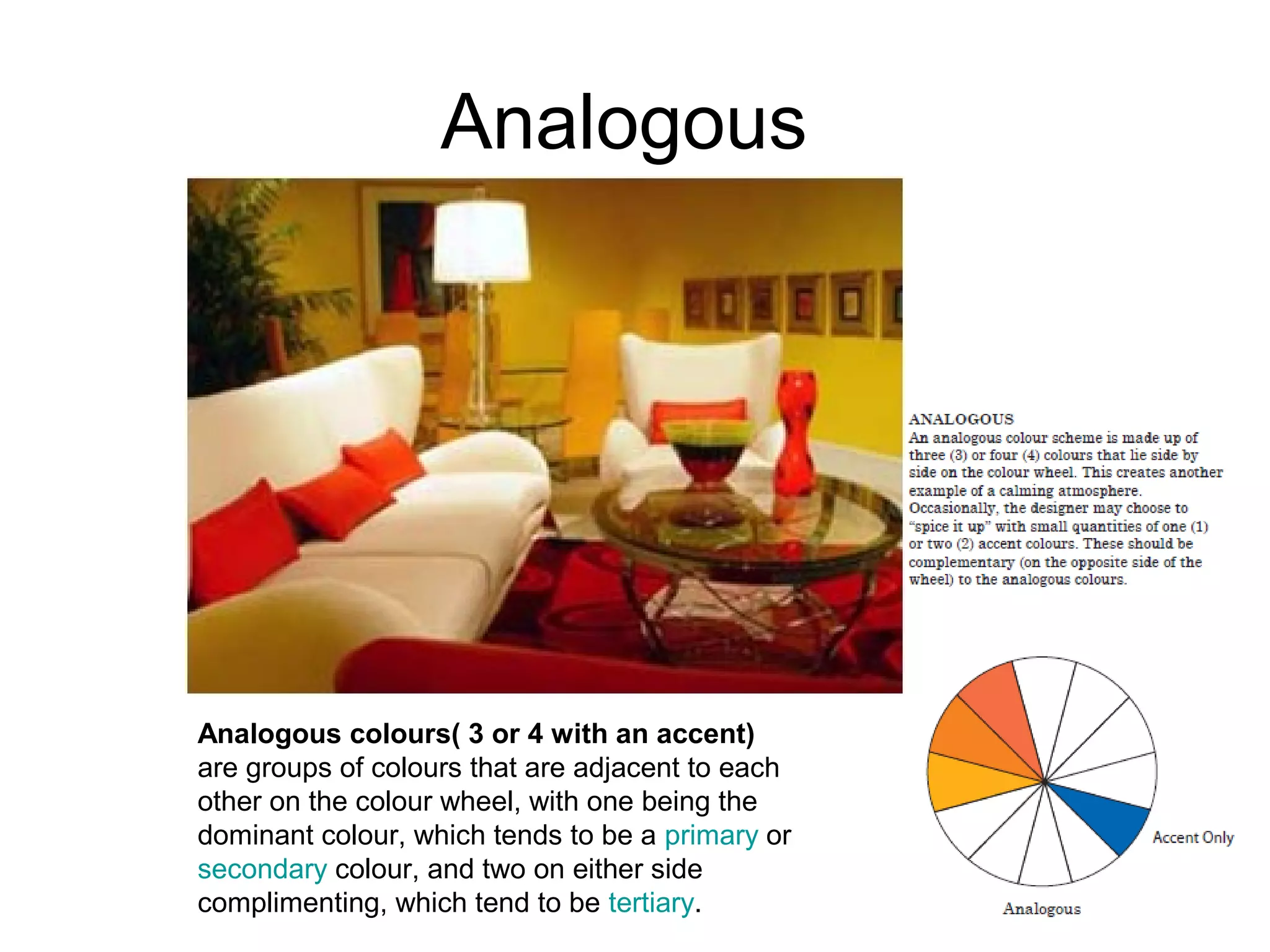
Analogous
Analogous colours( 3 or 4 with an accent)
are groups of colours that are adjacent to each
other on the colour wheel, with one being the
dominant colour, which tends to be a primary or
secondary colour, and two on either side
complimenting, which tend to be tertiary.
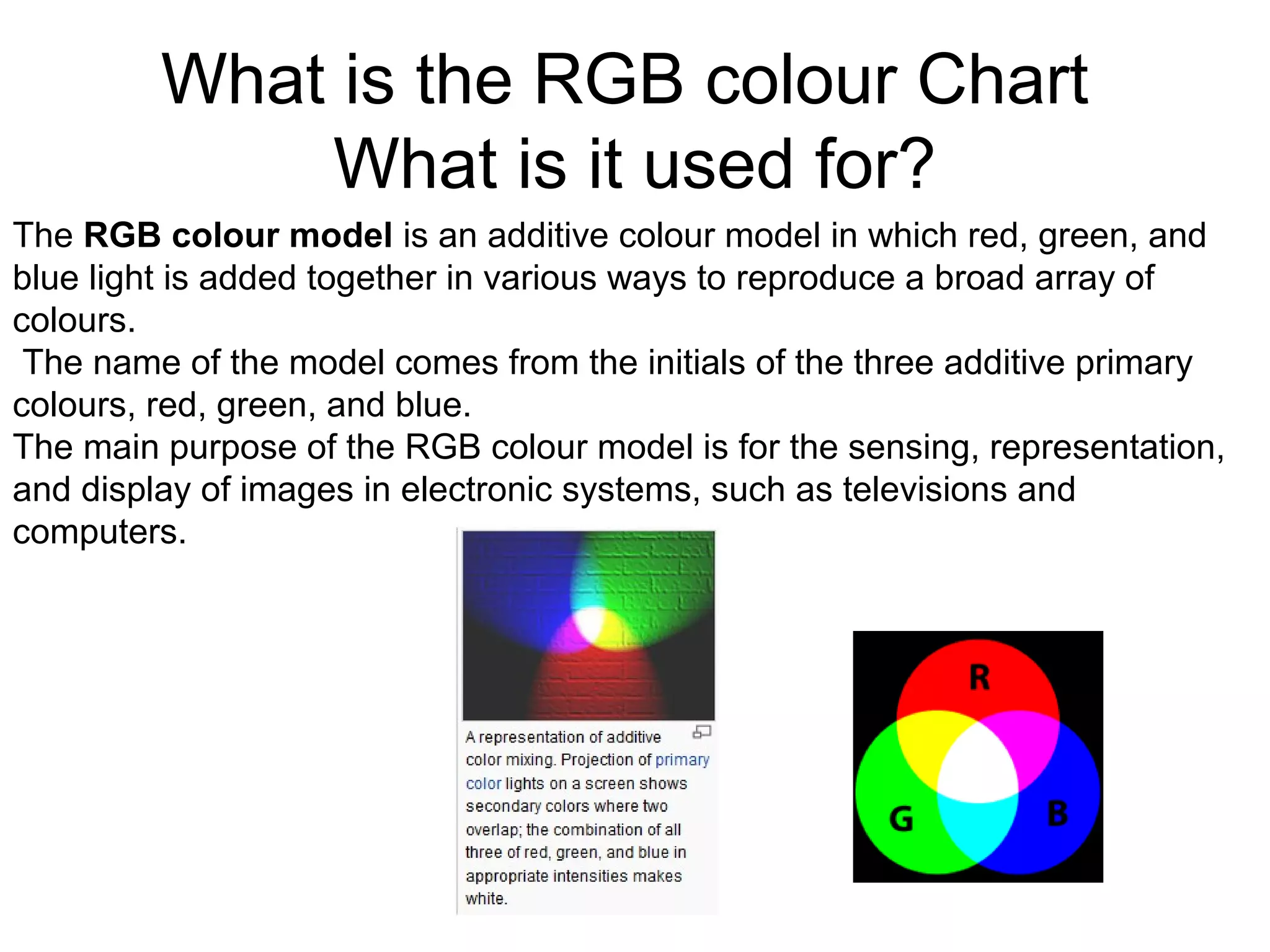
What is the RGB colour Chart
What is it used for?
The RGB colour model is an additive colour model in which red, green, and
blue light is added together in various ways to reproduce a broad array of
colours.
The name of the model comes from the initials of the three additive primary
colours, red, green, and blue.
The main purpose of the RGB colour model is for the sensing, representation,
and display of images in electronic systems, such as televisions and
computers.
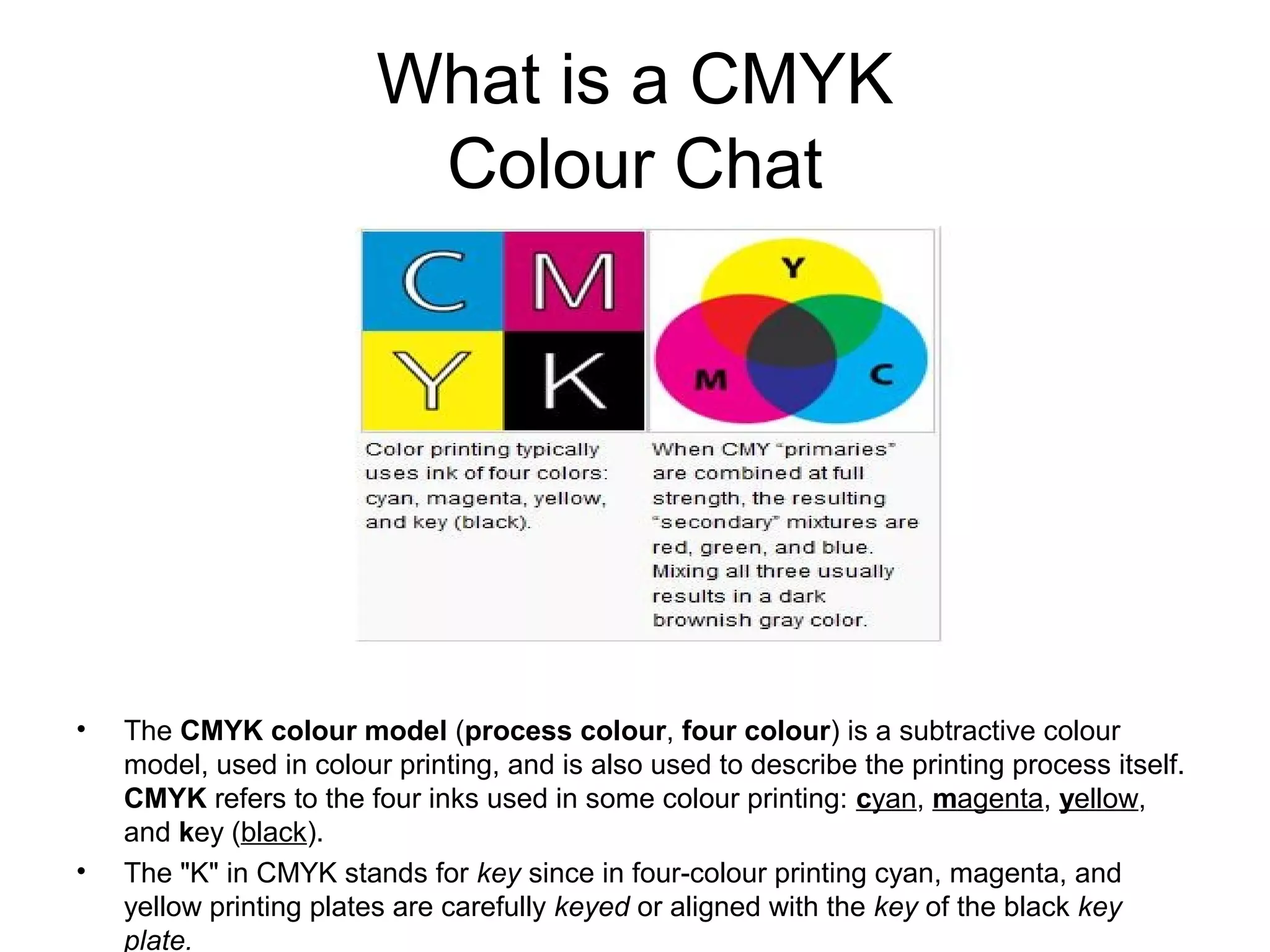
What is a CMYK
Colour Chat
• The CMYK colour model (process colour, four colour) is a subtractive colour
model, used in colour printing, and is also used to describe the printing process itself.
CMYK refers to the four inks used in some colour printing: cyan, magenta, yellow,
and key (black).
• The "K" in CMYK stands for key since in four-colour printing cyan, magenta, and
yellow printing plates are carefully keyed or aligned with the key of the black key
plate.
The End

Colour 1 theory 2014

  • 1.
  • 2.
    What is Colour? (Noun) •the property possessed by an object of producing different sensations on the eye as a result of the way it reflects or emits light. • synonyms: hue, shade, tint, tone, tinge, cast, tincture "the lights flickered and changed colour"
  • 5.
    • Introducing colourto the words changes the way that you read things, some even becomes painful. Illegible and hurts, it moves it wobbles it shifts. If you use colour use it responsibly, this is why its so important, if you get the colour wrong it ruins the design
  • 7.
    • It coverssuch as spectrum, billions of variation of colour, we don't all see colour the same. • The ability to perceive colour, is from the principle that different colours have different length and strength wave lengths. As light travels in waves, the different frequency of each wave shows different colours.
  • 8.
    What effects cancolour have? • Blue...... is the colour of harmony and peace. • Red....... is the colour of vitality, energy and aggressiveness • Yellow.... is the colour intellect and creative energy.
  • 9.
    Colours as seenin Nature • And their application
  • 10.
    Summer QuickTime™ and a TIFF(Uncompressed) decompressor are needed to see this picture. QuickTime™ and a TIFF (Uncompressed) decompressor are needed to see this picture.
  • 11.
    Autumn QuickTime™ and a TIFF(Uncompressed) decompressor are needed to see this picture. QuickTime™ and a TIFF (Uncompressed) decompressor are needed to see this picture.
  • 12.
    Winter QuickTime™ and a TIFF(Uncompressed) decompressor are needed to see this picture. QuickTime™ and a TIFF (Uncompressed) decompressor are needed to see this picture.
  • 13.
    Spring QuickTime™ and a TIFF(Uncompressed) decompressor are needed to see this picture. QuickTime™ and a TIFF (Uncompressed) decompressor are needed to see this picture.
  • 14.
  • 22.
  • 23.
    The Effects ofColour. • Colour is one of the most powerful tools available to the designer. • It can affect our emotions, our responses and the way others react to us. Colour is everywhere – in nature and in the man made world around us. • It is used to communicate information such as danger zones or identify eye conditions such as colour blindness. • The physiological effect of colour in interior design is important to the Designer. The Interior Designer uses colour to create environments that have a certain ambience or impact, appropriate to the needs of the client. • Colour is always planned, regardless of how “casually” finishes appear to have been thrown together.
  • 24.
    • The abilityto perceive colour is different colours have different length and strength wave lengths. • As light travels in waves, the different frequency of each wave shows different colours.
  • 26.
  • 27.
  • 28.
    What happens whenwe start mixing them ?
  • 29.
  • 30.
    And mixing themfurther ?
  • 31.
  • 32.
  • 34.
  • 35.
    A VALUABLE TOOLFOR THE INTERIOR DESIGNER
  • 36.
  • 37.
    A Colour wheellayout starts with yellow at the top then runs clock wise to Red then Blue Warm colours to cool
  • 38.
    Advancing and RecedingColour Schemes
  • 39.
  • 40.
  • 41.
    THE ATTRIBUTES OFCOLOUR HUE = the name for the actual colour yellow blue red
  • 43.
    THE ATTRIBUTES OFCOLOUR VALUE = the relative lightness or darkness of colour. ◄ Tint Shade ►
  • 45.
    THE ATTRIBUTES OFCOLOUR CHROMA OR SATURATION = the relative intensity of the colour determined by how little gray is added to a colour.
  • 47.
    • Saturation ishow much of a colour is present in its purest form. • Look at different dimensions of this colour by desaturating it by pushing the blue towards the grey. Also you could push it through to black. The palest and the darkest is one dimension. • You can push it towards a different colour by desaturating the colour by pushing it towards the violet, this removed the blue.
  • 48.
  • 49.
    TONAL VALUES OFCOLOUR • The estimated lightness of a surface colour. • A series of greys is imagined to run along a vertical axis with a perfect black (value 0) at the bottom and a perfect white (value 10) at the top. The greys lighten – or increase in value - in steps that are subjectively equal. Colours of the same lightness as a given grey are assigned the same value and arranged in the same horizontal level. • Synonyms: greyness, reflectance, tonal value, weight.
  • 50.
  • 51.
    Munsell System • TheMunsell System as developed by Albert Munsell, is a method of colour notation which allows one to accurately specify a colour and have it reproduced exactly. For example,if a group of students were asked to mix a rose-pink, they may all have a similar understanding of what rose-pink looks like, but would all mix a different pink. • Using the Munsell system of colour notation, an identical rose pink can be mixed every time, simply based on hue, value and Chroma.
  • 52.
    Colour Planning Considerations 1.Preferences 2. Fixed Colours 3. Juxtaposition Effects 4. Lighting Effects 5. Tonal Value 6. Optical Effects 7. Room Orientation
  • 53.
    8. A Balanceof Cool and Warm colours 9. Architectural Features 10.The Function of the Space 11.The Balance of colour in an area of space
  • 54.
    Proportion of Colour 0 10 20 30 40 50 60 70 80 SCHEMEA SCHEME B ACCENT SUB- DOMINANT DOMINANT
  • 55.
  • 56.
  • 57.
    Complimentary Colour Scheme Yellowgreen/ Red Purple Green & Red
  • 58.
  • 59.
  • 60.
  • 61.
  • 62.
  • 63.
  • 64.
    Analogous Analogous colours( 3or 4 with an accent) are groups of colours that are adjacent to each other on the colour wheel, with one being the dominant colour, which tends to be a primary or secondary colour, and two on either side complimenting, which tend to be tertiary.
  • 65.
    What is theRGB colour Chart What is it used for? The RGB colour model is an additive colour model in which red, green, and blue light is added together in various ways to reproduce a broad array of colours. The name of the model comes from the initials of the three additive primary colours, red, green, and blue. The main purpose of the RGB colour model is for the sensing, representation, and display of images in electronic systems, such as televisions and computers.
  • 66.
    What is aCMYK Colour Chat • The CMYK colour model (process colour, four colour) is a subtractive colour model, used in colour printing, and is also used to describe the printing process itself. CMYK refers to the four inks used in some colour printing: cyan, magenta, yellow, and key (black). • The "K" in CMYK stands for key since in four-colour printing cyan, magenta, and yellow printing plates are carefully keyed or aligned with the key of the black key plate.
  • 67.