Shashi Bhushan
Assistant Professor BVP
Color vision
&
its test
9/28/2022
• COLOR VISION
• COLOR VISION THEORIES
• COLOR VISION DEFECTS
• COLOR VISION TESTS
INTRODUCTION
9/28/2022
Color vision
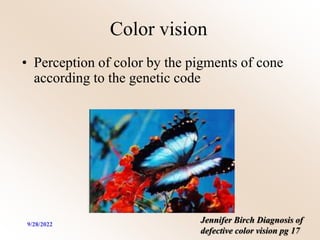
• Perception of color by the pigments of cone
according to the genetic code
9/28/2022
Jennifer Birch Diagnosis of
defective color vision pg 17
Characteristics of color vision
• Hue :- capacity of the eye to discriminate
between the adjacent wavelength
• Brightness:- depend on luminous flux
• Saturation :- it measure the minimum
quantity of given wavelength that must be
added to the white light for change in
appearance to be detected
9/28/2022
Jennifer Birch Diagnosis of
defective color vision pg 18
Theories of color vision
1. Additive color theory
2. Subtractive color theory
3. Thomas Young theory
4. Young Helmholtz theory
5. Herring's opponent theory
6. Tetrachromatic theory
9/28/2022
Additive color theory
• Based on 3 primary color – red , green & yellow
• Mixture of 2 primary color give rise to secondary
color
A+B=Y (Yellow)
A+C=M (Magenta)
B+C= C (Cyan)
A+B+C=W (White)
W
RED
GREEN
BLUE
M C
A
C
B
Y
9/28/2022 Paul L. Pease- CR Borish’s, 250
Subtractive color theory
CYAN
M
A
G
E
N
T
A
BLUE
RED
YELLOW
G
R
E
E
N
BLACK
• Mixing of paints, dyes, inks & natural colorant to
create a range of colors
• Color mixture absorbing some wavelength of light
& reflecting others
9/28/2022
Paul L. Pease- CR Borish’s, 251
Thomas Young theory
• For every color one nerve fiber present in the
retina
9/28/2022
Jennifer Birch Diagnosis of
defective color vision pg10
Young Helmholtz theory
• 3 cone photoreceptors on the retina which is
sensitive to different wavelength
Erythropsin
Chloropsin
Cyanoipsin
9/28/2022
Jennifer Birch Diagnosis of
defective color vision pg 10
Herring’s opponent theory
• Based on 4 primary colors – Red, Green, Blue &
Yellow arranged in opponent pairs
Red – Green
Yellow -Blue
White- Black
9/28/2022 Paul L. Pease- CR Borish’s, 259
Tetrachromatic theory
• Based on 4 primary colors – Red, Green, Blue &
Yellow
• Yellow is not a combination of Red & Green
9/28/2022
Jennifer Birch Diagnosis of
defective color vision pg 11
Color vision deficiency
• Lack of any color sensation
• It effects either the photoreceptor or the channels
results in the ability to discriminate color
9/28/2022
Jennifer Birch Diagnosis of
defective color vision pg15
Consequences of color deficiency
• The retina is made of rods and cones .
• The rods give us night vision
• Cone give us color vision & day vision
• Each cone contains light sensitive pigments.
• Gene contains coding instruction for these
pigments .
9/28/2022
Jennifer Birch Diagnosis of
defective color vision pg15
Consequences of color deficiency
• If the coding instructions are wrong the
wrong pigments will be produced.
• And the cone will be sensitive to different
wavelength of light.
9/28/2022
Jennifer Birch Diagnosis of
defective color vision pg 15
Types of color vision deficiency
1. Congenital color vision deficiency
2. Acquired color vision deficiency
9/28/2022
Jennifer Birch Diagnosis of
defective color vision pg 17
Trichromatism:all three systems are present
Dichromatism: one system is absent.
Monochromatism:two system are absent
The three systems are :
Red ,Green & Blue.
9/28/2022
Jennifer Birch Diagnosis of
defective color vision pg 27
Classification of color Vn defect
Congenital Acquired
Anomalous
trichromatism
Dichromatism Monochromatism
Protenomaly
Deuteranomaly
Tritanomaly
Protanopia
Deutranopia
Tritanopia
Rod monochromatism
Cone monochromatism
Type 1 R-G
deficiency
Type 2 R-G
deficiency
Type 3 B-Y
deficiency
9/28/2022
Anomalous trichromatism
• People with anomalous trichromat vision
use all three color receptors but reception of
one pigment is misaligned.
1. Protanomaly: reduced red sensitivity
2. Deuteranomaly: reduced green sensitivity
3. Tritanomaly: reduced blue sensitivity.
9/28/2022
Jennifer Birch Diagnosis of
defective color vision pg 27
Dichromatism
• People with dichromatism use only two of the
three visual pigments.
1. Protanopia: unable to receive red.
2. Deuteranopia: unable to receive green.
3. Tritanopia: unable to receive blue.
9/28/2022
Jennifer Birch Diagnosis of
defective color vision pg 27
Monochromatism
• Two type
1. Rod monochromatism- decrease visual acuity
nystagmus, central scotoma & photophobia
2. Cone monochromatism- normal visual acuity
9/28/2022 Paul L. Pease- CR Borish’s,268
Acquired color vision defect
• There are 3 types
1. Type -1 red-green deficiency
2. Type -2 red-green deficiency
3 . Type -3 blue-yellow deficiency
9/28/2022
Jennifer Birch Diagnosis of
defective color vision pg 110
Colour appearance
NORMAL
PROTANOPES
DUETRANOPES
TRITANOPES
9/28/2022
Clinical test for color vision assessment
1. Pseudo-isochromatic plate
• Ishihara color Vn chart
• AOHRR plate
2. Arrangement test
• Farnsworth Munsell – 100 hue test
• Farnsworth D-15 test
3. Anamoloscope
• Nagel’s anamoloscope
4. Occupational test
• Lantern test
9/28/2022
Ishihara color vision chart
• Based on the color confusion
(Pseudoisochromatism)
• Each pseudoisochromatic plate is crowded
with colored spots
• Use to determine red -green deficiency
• Available in 16, 24 & 38 plates
9/28/2022
Jennifer Birch Diagnosis of
defective color vision pg 56
1. Demostration plate (1)
• 12 no. plate
• Both normal & color Vn defect pt. can read
2. Transformation plate (2-9)
• 8, 6, 29, 57, 5, 3, 15 & 74
• Normal person can read correctly
• Red – green deficiency person can read them as
3, 5, 70, 35, 2, 5, 17 & 21
• Total color Vn defect person can’t read any no.
Ishihara color vision chart
9/28/2022
Jennifer Birch Diagnosis of
defective color vision pg 56
3. Vanishing plate (10-17)
• 2, 6, 97, 45, 5, 7, 16 & 73
• Normal person will read correctly
• Red– green deficiency person not able to read
( either completely or incompletely )
• Total color Vn defect person can’t read any no.
Ishihara color vision chart
9/28/2022
Jennifer Birch Diagnosis of
defective color vision pg 56
9/28/2022
4. Hidden plate (18-21)
• 5, 2, 45 & 73
• Normal & total color Vn defect person not able
to read any no.
• Red –green deficiency person will read correctly
Ishihara color vision chart
Jennifer Birch Diagnosis of
defective color vision pg 56
5. Diagnostic plate (22-25)
• 26, 42, 35 & 96
• Normal person able to read correctly
• Strong protenomaly & protenopia read only
6, 2, 5 & 6
• For mild protenomaly - 6, 2, 5 & 6 are clearer
than other
• Strong deuteranomaly & deutranopia read only
2, 4, 3 & 9
• For mild deuternomaly -2, 4, 3 & 9 are clearer
than other
Ishihara color vision chart
9/28/2022
Jennifer Birch Diagnosis of
defective color vision pg 56
Protan & deutran deficiency
Ishihara color vision chart
9/28/2022
6. Tracing plate (26-38)
• It contains the pathways
• It is use in illiterate person & children
Ishihara color vision chart
9/28/2022
Jennifer Birch Diagnosis of
defective color vision pg 56
Analysis of result
• Normal – if the 17 or more plate are read correctly
• Color Vn defect – if the 13 or less than 13 plates
are read
• Repeat test – if between 13-17 plates are read
Ishihara color vision chart
9/28/2022
Jennifer Birch Diagnosis of
defective color vision pg 57
Method for ishihara color vision test
• Good room Illumination as day light.
• Patient should wear appropriate spectacle
correction & occlude one eye.
• The test plate is held at a distance of 75cm.
• Plane of the plate & line of the sight of vision
should be perpendicular ( tilted 45˚)
• Ask to patient to read the plates.
• For illiterate pt. ask to trace the line between
two X’s.
9/28/2022
Jennifer Birch Diagnosis of
defective color vision pg 57
American Optical Hardy Rand
Rittle Plate (AOHRR)
• Based on pseudoisochromatic test
• To determine red green and blue yellow color
vision defect
• Consist of 24 plates with vanishing design
containing geometrical shape
• 4 introducing plates ,6 screening plate,10 plates
for grading severity of protan &deutan, 4 plates
for grading severity of tritan defect
9/28/2022 Paul L. Pease- CR Borish’s,268
Holmgren Wool Test
• Based on color matching
• the aim is to determine isochromatism color
confusion by encouraging child to select wool
sample which appears similar in hue
• 3 test skeins yellow-green, pink & red
• Wools are placed on gray surface & person select
matching shades for each test skeins
• Viewing time of 1min
9/28/2022
Jennifer Birch Diagnosis of
defective color vision pg 52
9/28/2022
Holmgren Wool Test
Farnsworth-Munsell 100 hue test
• It provides most sensitive assessment of hue
discrimination
• It is use for red-green & blue-yellow deficiency
• Four 20˝×1.75˝×1.25˝ trays, housed in a
21.5˝×6.12˝×2.5˝ carrying case
• Total of 85 numbered disks with varying hues
• Color reference size is 7/16˝ diameter
• Each disk is numbered to facilitate scoring
9/28/2022 Paul L. Pease- CR Borish’s,269
Farnsworth-Munsell 100 hue test
9/28/2022
Farnsworth Munsell 100 Hue
Scoring Software
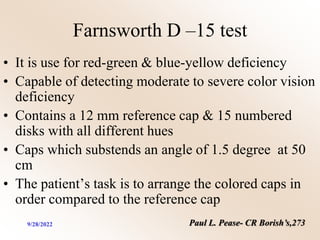
Farnsworth D –15 test
• It is use for red-green & blue-yellow deficiency
• Capable of detecting moderate to severe color vision
deficiency
• Contains a 12 mm reference cap & 15 numbered
disks with all different hues
• Caps which substends an angle of 1.5 degree at 50
cm
• The patient’s task is to arrange the colored caps in
order compared to the reference cap
9/28/2022 Paul L. Pease- CR Borish’s,273
9/28/2022
Anomaloscope
• Based on color match known as Rayleigh equation
R+G=Y
• it is use to determine red-green defect
• On the instrument monochromatic yellow light is
presented in half of a 2˚ circular field & a mixture of
monochromatic red-green light is presented in other
half
• Patient tasks is to match mix spectral red green lights
to other half the yellow light
9/28/2022
Jennifer Birch Diagnosis of
defective color vision pg 53
Paul L. Pease- CR Borish’s,275
Nagel’s Anamaloscopes
• 2 knobs : one changes the brightness of yellow &
other changes the mixture of red & green
• The matching range recorded from matching
limits obtained on red/green mixture scale
9/28/2022
Jennifer Birch Diagnosis of
defective color vision pg 53
Paul L. Pease- CR Borish’s,275
9/28/2022
Nagel’s Anamaloscopes
Yellow
light
Mixture of
red & green
light
Lantern test
• Light used are either red,green or white
• Two light are presented at a time in any combination
• Call out immediately name of the color 1st top then
bottom
• Nine pairs of lights are presented
• Test is failed if the average error on last 2
administration is >1
9/28/2022 Paul L. Pease- CR Borish’s,280
Lantern test
9/28/2022
9/28/2022
Lantern test
1st run
2nd run
3rd run
1
GR
3
GW
4
GG
5
RG
6
WR
7
WW
8
RW
9
RR
2
WG
# of error/
run
Score form for the Lantern Test
REFERENCE
• Paul L. Pease -Borish’s clinical refraction,
Chap. 9, Pg 243- 291
• Jennifer Birch – Diagnosis of defective color
vision , Pg 3-110
9/28/2022
9/28/2022

colour vision .pptx

  • 1.
    Shashi Bhushan Assistant ProfessorBVP Color vision & its test 9/28/2022
  • 2.
    • COLOR VISION •COLOR VISION THEORIES • COLOR VISION DEFECTS • COLOR VISION TESTS INTRODUCTION 9/28/2022
  • 3.
    Color vision • Perceptionof color by the pigments of cone according to the genetic code 9/28/2022 Jennifer Birch Diagnosis of defective color vision pg 17
  • 4.
    Characteristics of colorvision • Hue :- capacity of the eye to discriminate between the adjacent wavelength • Brightness:- depend on luminous flux • Saturation :- it measure the minimum quantity of given wavelength that must be added to the white light for change in appearance to be detected 9/28/2022 Jennifer Birch Diagnosis of defective color vision pg 18
  • 5.
    Theories of colorvision 1. Additive color theory 2. Subtractive color theory 3. Thomas Young theory 4. Young Helmholtz theory 5. Herring's opponent theory 6. Tetrachromatic theory 9/28/2022
  • 6.
    Additive color theory •Based on 3 primary color – red , green & yellow • Mixture of 2 primary color give rise to secondary color A+B=Y (Yellow) A+C=M (Magenta) B+C= C (Cyan) A+B+C=W (White) W RED GREEN BLUE M C A C B Y 9/28/2022 Paul L. Pease- CR Borish’s, 250
  • 7.
    Subtractive color theory CYAN M A G E N T A BLUE RED YELLOW G R E E N BLACK •Mixing of paints, dyes, inks & natural colorant to create a range of colors • Color mixture absorbing some wavelength of light & reflecting others 9/28/2022 Paul L. Pease- CR Borish’s, 251
  • 8.
    Thomas Young theory •For every color one nerve fiber present in the retina 9/28/2022 Jennifer Birch Diagnosis of defective color vision pg10
  • 9.
    Young Helmholtz theory •3 cone photoreceptors on the retina which is sensitive to different wavelength Erythropsin Chloropsin Cyanoipsin 9/28/2022 Jennifer Birch Diagnosis of defective color vision pg 10
  • 10.
    Herring’s opponent theory •Based on 4 primary colors – Red, Green, Blue & Yellow arranged in opponent pairs Red – Green Yellow -Blue White- Black 9/28/2022 Paul L. Pease- CR Borish’s, 259
  • 11.
    Tetrachromatic theory • Basedon 4 primary colors – Red, Green, Blue & Yellow • Yellow is not a combination of Red & Green 9/28/2022 Jennifer Birch Diagnosis of defective color vision pg 11
  • 12.
    Color vision deficiency •Lack of any color sensation • It effects either the photoreceptor or the channels results in the ability to discriminate color 9/28/2022 Jennifer Birch Diagnosis of defective color vision pg15
  • 13.
    Consequences of colordeficiency • The retina is made of rods and cones . • The rods give us night vision • Cone give us color vision & day vision • Each cone contains light sensitive pigments. • Gene contains coding instruction for these pigments . 9/28/2022 Jennifer Birch Diagnosis of defective color vision pg15
  • 14.
    Consequences of colordeficiency • If the coding instructions are wrong the wrong pigments will be produced. • And the cone will be sensitive to different wavelength of light. 9/28/2022 Jennifer Birch Diagnosis of defective color vision pg 15
  • 15.
    Types of colorvision deficiency 1. Congenital color vision deficiency 2. Acquired color vision deficiency 9/28/2022 Jennifer Birch Diagnosis of defective color vision pg 17
  • 16.
    Trichromatism:all three systemsare present Dichromatism: one system is absent. Monochromatism:two system are absent The three systems are : Red ,Green & Blue. 9/28/2022 Jennifer Birch Diagnosis of defective color vision pg 27
  • 17.
    Classification of colorVn defect Congenital Acquired Anomalous trichromatism Dichromatism Monochromatism Protenomaly Deuteranomaly Tritanomaly Protanopia Deutranopia Tritanopia Rod monochromatism Cone monochromatism Type 1 R-G deficiency Type 2 R-G deficiency Type 3 B-Y deficiency 9/28/2022
  • 18.
    Anomalous trichromatism • Peoplewith anomalous trichromat vision use all three color receptors but reception of one pigment is misaligned. 1. Protanomaly: reduced red sensitivity 2. Deuteranomaly: reduced green sensitivity 3. Tritanomaly: reduced blue sensitivity. 9/28/2022 Jennifer Birch Diagnosis of defective color vision pg 27
  • 19.
    Dichromatism • People withdichromatism use only two of the three visual pigments. 1. Protanopia: unable to receive red. 2. Deuteranopia: unable to receive green. 3. Tritanopia: unable to receive blue. 9/28/2022 Jennifer Birch Diagnosis of defective color vision pg 27
  • 20.
    Monochromatism • Two type 1.Rod monochromatism- decrease visual acuity nystagmus, central scotoma & photophobia 2. Cone monochromatism- normal visual acuity 9/28/2022 Paul L. Pease- CR Borish’s,268
  • 21.
    Acquired color visiondefect • There are 3 types 1. Type -1 red-green deficiency 2. Type -2 red-green deficiency 3 . Type -3 blue-yellow deficiency 9/28/2022 Jennifer Birch Diagnosis of defective color vision pg 110
  • 22.
  • 23.
    Clinical test forcolor vision assessment 1. Pseudo-isochromatic plate • Ishihara color Vn chart • AOHRR plate 2. Arrangement test • Farnsworth Munsell – 100 hue test • Farnsworth D-15 test 3. Anamoloscope • Nagel’s anamoloscope 4. Occupational test • Lantern test 9/28/2022
  • 24.
    Ishihara color visionchart • Based on the color confusion (Pseudoisochromatism) • Each pseudoisochromatic plate is crowded with colored spots • Use to determine red -green deficiency • Available in 16, 24 & 38 plates 9/28/2022 Jennifer Birch Diagnosis of defective color vision pg 56
  • 25.
    1. Demostration plate(1) • 12 no. plate • Both normal & color Vn defect pt. can read 2. Transformation plate (2-9) • 8, 6, 29, 57, 5, 3, 15 & 74 • Normal person can read correctly • Red – green deficiency person can read them as 3, 5, 70, 35, 2, 5, 17 & 21 • Total color Vn defect person can’t read any no. Ishihara color vision chart 9/28/2022 Jennifer Birch Diagnosis of defective color vision pg 56
  • 26.
    3. Vanishing plate(10-17) • 2, 6, 97, 45, 5, 7, 16 & 73 • Normal person will read correctly • Red– green deficiency person not able to read ( either completely or incompletely ) • Total color Vn defect person can’t read any no. Ishihara color vision chart 9/28/2022 Jennifer Birch Diagnosis of defective color vision pg 56
  • 27.
    9/28/2022 4. Hidden plate(18-21) • 5, 2, 45 & 73 • Normal & total color Vn defect person not able to read any no. • Red –green deficiency person will read correctly Ishihara color vision chart Jennifer Birch Diagnosis of defective color vision pg 56
  • 28.
    5. Diagnostic plate(22-25) • 26, 42, 35 & 96 • Normal person able to read correctly • Strong protenomaly & protenopia read only 6, 2, 5 & 6 • For mild protenomaly - 6, 2, 5 & 6 are clearer than other • Strong deuteranomaly & deutranopia read only 2, 4, 3 & 9 • For mild deuternomaly -2, 4, 3 & 9 are clearer than other Ishihara color vision chart 9/28/2022 Jennifer Birch Diagnosis of defective color vision pg 56
  • 29.
    Protan & deutrandeficiency Ishihara color vision chart 9/28/2022
  • 30.
    6. Tracing plate(26-38) • It contains the pathways • It is use in illiterate person & children Ishihara color vision chart 9/28/2022 Jennifer Birch Diagnosis of defective color vision pg 56
  • 31.
    Analysis of result •Normal – if the 17 or more plate are read correctly • Color Vn defect – if the 13 or less than 13 plates are read • Repeat test – if between 13-17 plates are read Ishihara color vision chart 9/28/2022 Jennifer Birch Diagnosis of defective color vision pg 57
  • 32.
    Method for ishiharacolor vision test • Good room Illumination as day light. • Patient should wear appropriate spectacle correction & occlude one eye. • The test plate is held at a distance of 75cm. • Plane of the plate & line of the sight of vision should be perpendicular ( tilted 45˚) • Ask to patient to read the plates. • For illiterate pt. ask to trace the line between two X’s. 9/28/2022 Jennifer Birch Diagnosis of defective color vision pg 57
  • 33.
    American Optical HardyRand Rittle Plate (AOHRR) • Based on pseudoisochromatic test • To determine red green and blue yellow color vision defect • Consist of 24 plates with vanishing design containing geometrical shape • 4 introducing plates ,6 screening plate,10 plates for grading severity of protan &deutan, 4 plates for grading severity of tritan defect 9/28/2022 Paul L. Pease- CR Borish’s,268
  • 34.
    Holmgren Wool Test •Based on color matching • the aim is to determine isochromatism color confusion by encouraging child to select wool sample which appears similar in hue • 3 test skeins yellow-green, pink & red • Wools are placed on gray surface & person select matching shades for each test skeins • Viewing time of 1min 9/28/2022 Jennifer Birch Diagnosis of defective color vision pg 52
  • 35.
  • 36.
    Farnsworth-Munsell 100 huetest • It provides most sensitive assessment of hue discrimination • It is use for red-green & blue-yellow deficiency • Four 20˝×1.75˝×1.25˝ trays, housed in a 21.5˝×6.12˝×2.5˝ carrying case • Total of 85 numbered disks with varying hues • Color reference size is 7/16˝ diameter • Each disk is numbered to facilitate scoring 9/28/2022 Paul L. Pease- CR Borish’s,269
  • 37.
    Farnsworth-Munsell 100 huetest 9/28/2022 Farnsworth Munsell 100 Hue Scoring Software
  • 38.
    Farnsworth D –15test • It is use for red-green & blue-yellow deficiency • Capable of detecting moderate to severe color vision deficiency • Contains a 12 mm reference cap & 15 numbered disks with all different hues • Caps which substends an angle of 1.5 degree at 50 cm • The patient’s task is to arrange the colored caps in order compared to the reference cap 9/28/2022 Paul L. Pease- CR Borish’s,273
  • 39.
  • 40.
    Anomaloscope • Based oncolor match known as Rayleigh equation R+G=Y • it is use to determine red-green defect • On the instrument monochromatic yellow light is presented in half of a 2˚ circular field & a mixture of monochromatic red-green light is presented in other half • Patient tasks is to match mix spectral red green lights to other half the yellow light 9/28/2022 Jennifer Birch Diagnosis of defective color vision pg 53 Paul L. Pease- CR Borish’s,275
  • 41.
    Nagel’s Anamaloscopes • 2knobs : one changes the brightness of yellow & other changes the mixture of red & green • The matching range recorded from matching limits obtained on red/green mixture scale 9/28/2022 Jennifer Birch Diagnosis of defective color vision pg 53 Paul L. Pease- CR Borish’s,275
  • 42.
  • 43.
    Lantern test • Lightused are either red,green or white • Two light are presented at a time in any combination • Call out immediately name of the color 1st top then bottom • Nine pairs of lights are presented • Test is failed if the average error on last 2 administration is >1 9/28/2022 Paul L. Pease- CR Borish’s,280
  • 44.
  • 45.
    9/28/2022 Lantern test 1st run 2ndrun 3rd run 1 GR 3 GW 4 GG 5 RG 6 WR 7 WW 8 RW 9 RR 2 WG # of error/ run Score form for the Lantern Test
  • 46.
    REFERENCE • Paul L.Pease -Borish’s clinical refraction, Chap. 9, Pg 243- 291 • Jennifer Birch – Diagnosis of defective color vision , Pg 3-110 9/28/2022
  • 47.