SUSPENSIONS
SUSPENSIONS 1
Prepared by:JatinIsher
(B.pharm 3rd year)
Global Group of
Institutes Amritsar
SUSPENSIONS 2
SUSPENSIONS
Definition
A Pharmaceutical suspension is a coarse dispersion in
which internal phase (therapeutically active ingredient)
is dispersed uniformly throughout the external phase.
SUSPENSIONS 3
 The internal phase consisting of insoluble solid particles
having a range of size (0.5 to 5 microns).
 The external phase (suspending medium) is generally
aqueous in some instance, but may be an organic or oily
liquid for non oral use.
SUSPENSIONS 4
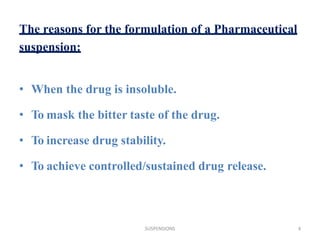
The reasons for the formulation of a Pharmaceutical
suspension:
• When the drug is insoluble.
• To mask the bitter taste of the drug.
• To increase drug stability.
• To achieve controlled/sustained drug release.
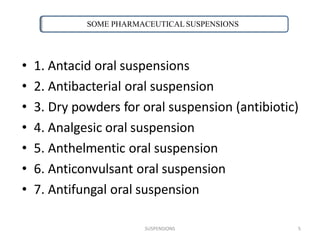
• 1. Antacid oral suspensions
• 2. Antibacterial oral suspension
• 3. Dry powders for oral suspension (antibiotic)
• 4. Analgesic oral suspension
• 5. Anthelmentic oral suspension
• 6. Anticonvulsant oral suspension
• 7. Antifungal oral suspension
SOME PHARMACEUTICAL SUSPENSIONS
SUSPENSIONS 5
SUSPENSIONS
6
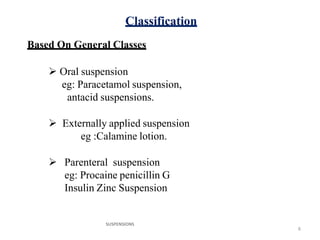
Based On General Classes
 Oral suspension
eg: Paracetamol suspension,
antacid suspensions.
 Externally applied suspension
eg :Calamine lotion.
 Parenteral suspension
eg: Procaine penicillin G
Insulin Zinc Suspension
Classification
SUSPENSIONS 7
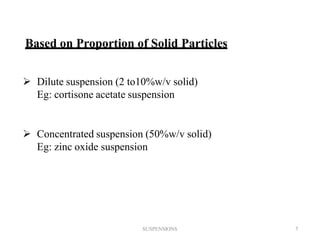
Based on Proportion of Solid Particles
 Dilute suspension (2 to10%w/v solid)
Eg: cortisone acetate suspension
 Concentrated suspension (50%w/v solid)
Eg: zinc oxide suspension
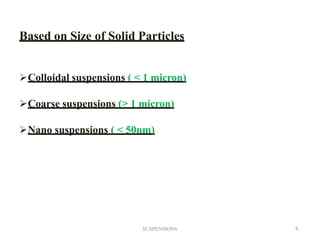
Based on Electrokinetic Nature of Solid Particles
 Flocculated suspension
 Deflocculated suspension
SUSPENSIONS 8
SUSPENSIONS 9
Based on Size of Solid Particles
Colloidal suspensions ( < 1 micron)
Coarse suspensions (> 1 micron)
Nano suspensions ( < 50nm)
Drug in suspension exhibits higher rate of bioavailability than solid
dosage forms.
Solution > Suspension > Capsule > Compressed Tablet > Coated tablet
Suspension can improve chemical stability of certain drug.
Controlled drug release
Suspension can mask the unpleasant/ bitter taste of drug.
 Ease of administration.
Advantages
SUSPENSIONS 10
 Physical stability , sedimentation and compaction can causes
problems.
 It is bulky, sufficient care must be taken during handling and
transport.
 It is difficult to formulate.
Uniform and accurate dose can not be achieved unless
suspension are packed in unit dosage form.
Disadvantages
SUSPENSIONS 11
SUSPENSIONS 12
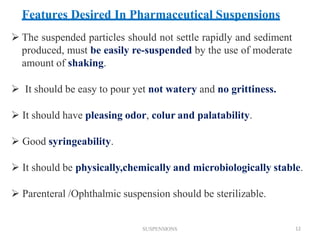
 The suspended particles should not settle rapidly and sediment
produced, must be easily re-suspended by the use of moderate
amount of shaking.
 It should be easy to pour yet not watery and no grittiness.
 It should have pleasing odor, colur and palatability.
 Good syringeability.
 It should be physically,chemically and microbiologically stable.
 Parenteral /Ophthalmic suspension should be sterilizable.
Features Desired In Pharmaceutical Suspensions
SUSPENSIONS 13
FORMULATION OF SUSPENSIONS
INGREDIENTS FOR
.
Suspending agents CMC, gums , sodium alginate.
Wetting agents Polysorbate 80 , acacia , tracaganth
Buffers
and pH adjusting agents
Phosphate , and carbonate buffers
Osmotic
agents
Dextrose , mannitol , sorbitol etc.
Coloring
agents
Amaranth , Titanium dioxide,
Preservatives
Disodium EDTA, Butyl paraben , propylene
glycol
SUSPENSIONS 14
SUSPENSIONS 15
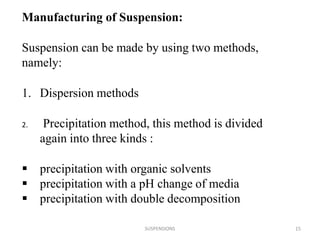
Manufacturing of Suspension:
Suspension can be made by using two methods,
namely:
1. Dispersion methods
2. Precipitation method, this method is divided
again into three kinds :
 precipitation with organic solvents
 precipitation with a pH change of media
 precipitation with double decomposition
SUSPENSIONS 16
Precipitated method
1. Organic solvent precipitation :
E.g Prednisolone is precipitated from a methanolic solution to
produce a suspension in water.
2. Precipitation effected by changing the pH of the medium:
E.g Estradiol is readily soluble in potassium or sodium
hydroxidesolutions. If a concentrated solution of estradiol is
thus prepared and added to a weakly acidic solution of
hydrochloric, citric or acetic acids, the estradiol
is precipitaed.
3. Double decomposition method :
E.g: White ointment by dissolving
sulphurated potash.
zinc sulphate soln. in
SUSPENSIONS 17
Introduction
 Pharmaceutical suspensions for oral use are generally packed
in wide mouth container having adequate space above the
liquid to ensure proper mixing.
 Parenteral suspensions are packed in either glass ampoules or
vials.
Packaging of Suspensions
SUSPENSIONS 18
 Sedimentation method
 Rheological method
 Electro kinetic method
 Micromeritic method
Evaluation of Suspensions
SUSPENSIONS 19
Sedimentation method :
Two parameters are studied for determination of sedimentation.
1. Sedimentation volume,
2. Degree of flocculation.
Sedimentation volume
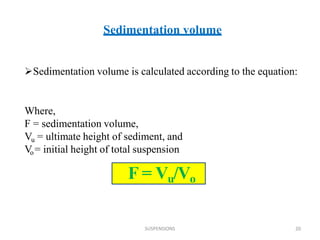
Sedimentation volume is calculated according to the equation:
Where,
F = sedimentation volume,
Vu = ultimate height of sediment, and
V
o= initial height of total suspension
F = Vu/Vo
SUSPENSIONS 20
SUSPENSIONS 21
Rheological method
 It provide information about Settling behaviour .
The arrangement of the vehicle and the particle structural
features.
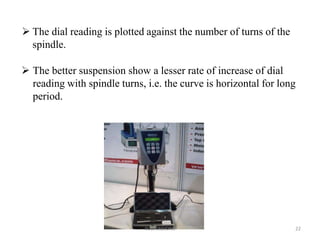
 Brookfield viscometer is used to study the viscosity of the
suspension .
 It is mounted on heli path stand and using T-bar spindle.
 The dial reading is plotted against the number of turns of the
spindle.
 The better suspension show a lesser rate of increase of dial
reading with spindle turns, i.e. the curve is horizontal for long
period.
SUSPENSIONS 22
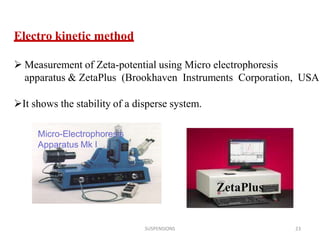
Electro kinetic method
 Measurement of Zeta-potential using Micro electrophoresis
apparatus & ZetaPlus (Brookhaven Instruments Corporation, USA
It shows the stability of a disperse system.
Micro-Electrophoresis
Apparatus Mk I
ZetaPlus
SUSPENSIONS 23
SUSPENSIONS 24
Micromeritic method :
The stability of suspension depends on the particle size of the
dispersed phase.
Change in the particle size with reference to time will provide
useful information regarding the stability of a suspension.
Achange in particle size distribution and crystal habit studied by
 microscopy
 coulter counter method
FREEZE- THAW TEST
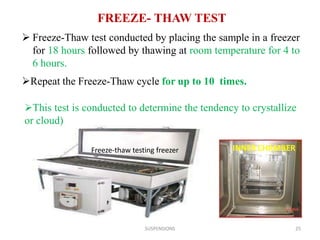
Freeze-thaw testing freezer
SUSPENSIONS 25
 Freeze-Thaw test conducted by placing the sample in a freezer
for 18 hours followed by thawing at room temperature for 4 to
6 hours.
Repeat the Freeze-Thaw cycle for up to 10 times.
This test is conducted to determine the tendency to crystallize
or cloud)
INNER CHAMBER
pH MEASUREMENT
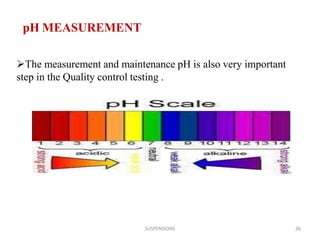
The measurement and maintenance pH is also very important
step in the Quality control testing .
SUSPENSIONS 26
Subramanyam C.V.S., Text Book of Physical Pharamaceutics,
PageNo. 374-387.
Aulton M.E 2nd edition, Pharmaceutics-
The Science of Dosage Form Design, Page No. 298-307.
Martin A. Fourth edition, Physical Pharmacy, Page No. 479-481.
 Remington, Twentieth edition, The Science and Practice of
Pharmacy ,
Page No. 298-307.
REFERENCES
SUSPENSIONS 27

Suspensions

  • 1.
    SUSPENSIONS SUSPENSIONS 1 Prepared by:JatinIsher (B.pharm3rd year) Global Group of Institutes Amritsar
  • 2.
    SUSPENSIONS 2 SUSPENSIONS Definition A Pharmaceuticalsuspension is a coarse dispersion in which internal phase (therapeutically active ingredient) is dispersed uniformly throughout the external phase.
  • 3.
    SUSPENSIONS 3  Theinternal phase consisting of insoluble solid particles having a range of size (0.5 to 5 microns).  The external phase (suspending medium) is generally aqueous in some instance, but may be an organic or oily liquid for non oral use.
  • 4.
    SUSPENSIONS 4 The reasonsfor the formulation of a Pharmaceutical suspension: • When the drug is insoluble. • To mask the bitter taste of the drug. • To increase drug stability. • To achieve controlled/sustained drug release.
  • 5.
    • 1. Antacidoral suspensions • 2. Antibacterial oral suspension • 3. Dry powders for oral suspension (antibiotic) • 4. Analgesic oral suspension • 5. Anthelmentic oral suspension • 6. Anticonvulsant oral suspension • 7. Antifungal oral suspension SOME PHARMACEUTICAL SUSPENSIONS SUSPENSIONS 5
  • 6.
    SUSPENSIONS 6 Based On GeneralClasses  Oral suspension eg: Paracetamol suspension, antacid suspensions.  Externally applied suspension eg :Calamine lotion.  Parenteral suspension eg: Procaine penicillin G Insulin Zinc Suspension Classification
  • 7.
    SUSPENSIONS 7 Based onProportion of Solid Particles  Dilute suspension (2 to10%w/v solid) Eg: cortisone acetate suspension  Concentrated suspension (50%w/v solid) Eg: zinc oxide suspension
  • 8.
    Based on ElectrokineticNature of Solid Particles  Flocculated suspension  Deflocculated suspension SUSPENSIONS 8
  • 9.
    SUSPENSIONS 9 Based onSize of Solid Particles Colloidal suspensions ( < 1 micron) Coarse suspensions (> 1 micron) Nano suspensions ( < 50nm)
  • 10.
    Drug in suspensionexhibits higher rate of bioavailability than solid dosage forms. Solution > Suspension > Capsule > Compressed Tablet > Coated tablet Suspension can improve chemical stability of certain drug. Controlled drug release Suspension can mask the unpleasant/ bitter taste of drug.  Ease of administration. Advantages SUSPENSIONS 10
  • 11.
     Physical stability, sedimentation and compaction can causes problems.  It is bulky, sufficient care must be taken during handling and transport.  It is difficult to formulate. Uniform and accurate dose can not be achieved unless suspension are packed in unit dosage form. Disadvantages SUSPENSIONS 11
  • 12.
    SUSPENSIONS 12  Thesuspended particles should not settle rapidly and sediment produced, must be easily re-suspended by the use of moderate amount of shaking.  It should be easy to pour yet not watery and no grittiness.  It should have pleasing odor, colur and palatability.  Good syringeability.  It should be physically,chemically and microbiologically stable.  Parenteral /Ophthalmic suspension should be sterilizable. Features Desired In Pharmaceutical Suspensions
  • 13.
    SUSPENSIONS 13 FORMULATION OFSUSPENSIONS INGREDIENTS FOR
  • 14.
    . Suspending agents CMC,gums , sodium alginate. Wetting agents Polysorbate 80 , acacia , tracaganth Buffers and pH adjusting agents Phosphate , and carbonate buffers Osmotic agents Dextrose , mannitol , sorbitol etc. Coloring agents Amaranth , Titanium dioxide, Preservatives Disodium EDTA, Butyl paraben , propylene glycol SUSPENSIONS 14
  • 15.
    SUSPENSIONS 15 Manufacturing ofSuspension: Suspension can be made by using two methods, namely: 1. Dispersion methods 2. Precipitation method, this method is divided again into three kinds :  precipitation with organic solvents  precipitation with a pH change of media  precipitation with double decomposition
  • 16.
    SUSPENSIONS 16 Precipitated method 1.Organic solvent precipitation : E.g Prednisolone is precipitated from a methanolic solution to produce a suspension in water. 2. Precipitation effected by changing the pH of the medium: E.g Estradiol is readily soluble in potassium or sodium hydroxidesolutions. If a concentrated solution of estradiol is thus prepared and added to a weakly acidic solution of hydrochloric, citric or acetic acids, the estradiol is precipitaed. 3. Double decomposition method : E.g: White ointment by dissolving sulphurated potash. zinc sulphate soln. in
  • 17.
    SUSPENSIONS 17 Introduction  Pharmaceuticalsuspensions for oral use are generally packed in wide mouth container having adequate space above the liquid to ensure proper mixing.  Parenteral suspensions are packed in either glass ampoules or vials. Packaging of Suspensions
  • 18.
    SUSPENSIONS 18  Sedimentationmethod  Rheological method  Electro kinetic method  Micromeritic method Evaluation of Suspensions
  • 19.
    SUSPENSIONS 19 Sedimentation method: Two parameters are studied for determination of sedimentation. 1. Sedimentation volume, 2. Degree of flocculation.
  • 20.
    Sedimentation volume Sedimentation volumeis calculated according to the equation: Where, F = sedimentation volume, Vu = ultimate height of sediment, and V o= initial height of total suspension F = Vu/Vo SUSPENSIONS 20
  • 21.
    SUSPENSIONS 21 Rheological method It provide information about Settling behaviour . The arrangement of the vehicle and the particle structural features.  Brookfield viscometer is used to study the viscosity of the suspension .  It is mounted on heli path stand and using T-bar spindle.
  • 22.
     The dialreading is plotted against the number of turns of the spindle.  The better suspension show a lesser rate of increase of dial reading with spindle turns, i.e. the curve is horizontal for long period. SUSPENSIONS 22
  • 23.
    Electro kinetic method Measurement of Zeta-potential using Micro electrophoresis apparatus & ZetaPlus (Brookhaven Instruments Corporation, USA It shows the stability of a disperse system. Micro-Electrophoresis Apparatus Mk I ZetaPlus SUSPENSIONS 23
  • 24.
    SUSPENSIONS 24 Micromeritic method: The stability of suspension depends on the particle size of the dispersed phase. Change in the particle size with reference to time will provide useful information regarding the stability of a suspension. Achange in particle size distribution and crystal habit studied by  microscopy  coulter counter method
  • 25.
    FREEZE- THAW TEST Freeze-thawtesting freezer SUSPENSIONS 25  Freeze-Thaw test conducted by placing the sample in a freezer for 18 hours followed by thawing at room temperature for 4 to 6 hours. Repeat the Freeze-Thaw cycle for up to 10 times. This test is conducted to determine the tendency to crystallize or cloud) INNER CHAMBER
  • 26.
    pH MEASUREMENT The measurementand maintenance pH is also very important step in the Quality control testing . SUSPENSIONS 26
  • 27.
    Subramanyam C.V.S., TextBook of Physical Pharamaceutics, PageNo. 374-387. Aulton M.E 2nd edition, Pharmaceutics- The Science of Dosage Form Design, Page No. 298-307. Martin A. Fourth edition, Physical Pharmacy, Page No. 479-481.  Remington, Twentieth edition, The Science and Practice of Pharmacy , Page No. 298-307. REFERENCES SUSPENSIONS 27