Pharmaceutical suspension
Faysal Ahmed
Id:151-29-760
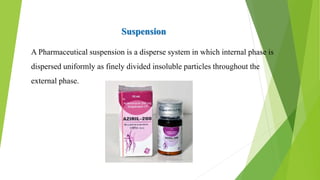
A Pharmaceutical suspension is a disperse system in which internal phase is
dispersed uniformly as finely divided insoluble particles throughout the
external phase.
Suspension
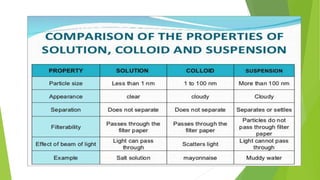
The Difference Between Solution & Suspensions:
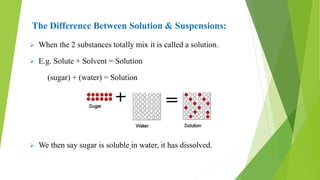
 When the 2 substances totally mix it is called a solution.
 E.g. Solute + Solvent = Solution
(sugar) + (water) = Solution
 We then say sugar is soluble in water, it has dissolved.
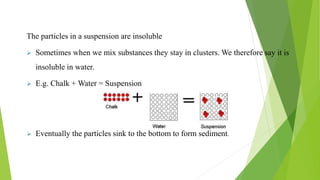
The particles in a suspension are insoluble
 Sometimes when we mix substances they stay in clusters. We therefore say it is
insoluble in water.
 E.g. Chalk + Water = Suspension
 Eventually the particles sink to the bottom to form sediment.
Types of pharmaceutical suspensions:
 Antacid oral suspensions
 Antibacterial oral suspension
 Dry powders for oral suspension (antibiotic)
 Analgesic oral suspension
 Anthelmentic oral suspension
 Anticonvulsant oral suspension
 Antifungal oral suspension
 Classification:
 Based on General Classes :
Oral suspension
Externally applied suspension
Parenteral suspension
 Based on Proportion of Solid Particles:
Dilute suspension (2 to10%w/v solid)
Concentrated suspension (50%w/v solid)
 Based on Electro kinetic Nature of Solid Particles:
Flocculated suspension
Deflocculated suspension
 Based on Size of Solid Particles:
Colloidal suspension (< 1 micron)
Coarse suspension (>1 micron)
Nano suspension (10 ng)
 Formulating Consideration of Suspensions:
 Wetting agents
 Particle Size
 Particle shape
 Particle- particle Interaction
 Suspending agent
 Wetting agent:
 A substance is referred to as a wetting agent if it lowers the surface tension of a liquid
and thus allows it to spread more easily.
 It is the important factor to be considered for formulation of suspension because the
more the wetable particle the more stable the suspension.
 Wetting ability depends upon the angle of contact between the particle and the solvent
which should be less than 90 C.
 e.g: Polysorbate 80 etc.
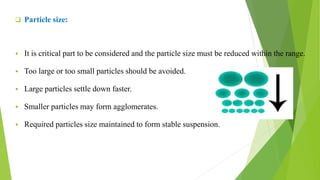
 Particle size:
 It is critical part to be considered and the particle size must be reduced within the range.
 Too large or too small particles should be avoided.
 Large particles settle down faster.
 Smaller particles may form agglomerates.
 Required particles size maintained to form stable suspension.
 Particle shape:
 Spherical shape particles form the more viscous with low rate of sedimentation
of suspension that's why it is preferable over needle shaped particles.
 Particle- Particle Interaction:
A. Zeta potential
B. Deflocculation and
C. Flocculation.
 The zeta potential is defined as "the difference in potential between the surface of
tightly bound layer."
 If the zeta potential is reduced, the attractive forces exceed the repulsive forces and the
particles come together, this phenomena is known as flocculation
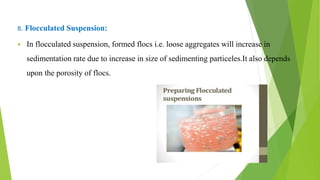
B. Flocculated Suspension:
 In flocculated suspension, formed flocs i.e. loose aggregates will increase in
sedimentation rate due to increase in size of sedimenting particeles.It also depends
upon the porosity of flocs.
C. Deflocculated Suspension:
 In this, individual particles are settling, rate of sedimentation is slow, which prevents
entrapping of liquid medium which makes it difficult to redisperse by agitation. This
phenomena known as caking.
 The larger particles settle fast and smaller remain in supernatant so supernatent appears
cloudy.
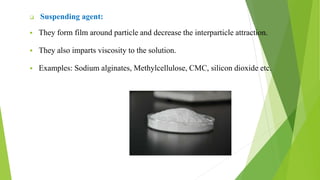
 Suspending agent:
 They form film around particle and decrease the interparticle attraction.
 They also imparts viscosity to the solution.
 Examples: Sodium alginates, Methylcellulose, CMC, silicon dioxide etc.
 Reasons for the formulation of a suspension:
 when the drug is insoluble in the delivery vehicle.
 To mask the bitter taste of the drug.
 To increase drug stability.
 To achieve sustained drug release.
 Quality Control of Suspensions:
 Appearance Color, odor and taste
 Sedimentation rate and
 Zeta Potential measurement
 Sedimentation volume
 pH
 Redispersibility and Centrifugation tests
 Rheological measurement
 Stress test
 Advantages of Suspension:
 Suspension can improve chemical stability of certain drug. E.g. Procaine penicillin G
 Drug in suspension exhibits higher rate of bioavailability than other dosage forms.
 Bioavailability is in following order:
Solution > Suspension > Capsule > Compressed Tablet > Coated tablet
 Duration and onset of action can be controlled. E.g. Protamine Zinc-Insulin
suspension
 Suspension can mask the unpleasant/ bitter taste of drug. E.g. Chloramphenicol
palmitate
 Disadvantages of Suspension:
 Physical stability, sedimentation and compaction can causes problems.
 It is bulky, therefore sufficient care must be taken during handling and transport.
 It is difficult to formulate.
 Uniform and accurate dose can not be achieved unless suspension are packed in
unit dosage form .
 Pharmaceutical Application of suspension:
 Suspension is usually applicable for drug which is insoluble or poorly soluble.
E.G. Prednisolone
 Suspension to prevent degradation of drug or to improve stability of drug. E.G.
Ox tetracycline suspension
 To mask the taste of bitter of unpleasant drug. E.G. Chloramphenicol
palmitate suspension
 Suspension of drug can be formulated for topical application E.G. Calamine
lotion.

pharmaceutical suspension-ppt

  • 1.
  • 2.
    A Pharmaceutical suspensionis a disperse system in which internal phase is dispersed uniformly as finely divided insoluble particles throughout the external phase. Suspension
  • 3.
    The Difference BetweenSolution & Suspensions:  When the 2 substances totally mix it is called a solution.  E.g. Solute + Solvent = Solution (sugar) + (water) = Solution  We then say sugar is soluble in water, it has dissolved.
  • 4.
    The particles ina suspension are insoluble  Sometimes when we mix substances they stay in clusters. We therefore say it is insoluble in water.  E.g. Chalk + Water = Suspension  Eventually the particles sink to the bottom to form sediment.
  • 5.
    Types of pharmaceuticalsuspensions:  Antacid oral suspensions  Antibacterial oral suspension  Dry powders for oral suspension (antibiotic)  Analgesic oral suspension  Anthelmentic oral suspension  Anticonvulsant oral suspension  Antifungal oral suspension
  • 6.
     Classification:  Basedon General Classes : Oral suspension Externally applied suspension Parenteral suspension  Based on Proportion of Solid Particles: Dilute suspension (2 to10%w/v solid) Concentrated suspension (50%w/v solid)
  • 7.
     Based onElectro kinetic Nature of Solid Particles: Flocculated suspension Deflocculated suspension  Based on Size of Solid Particles: Colloidal suspension (< 1 micron) Coarse suspension (>1 micron) Nano suspension (10 ng)
  • 9.
     Formulating Considerationof Suspensions:  Wetting agents  Particle Size  Particle shape  Particle- particle Interaction  Suspending agent
  • 10.
     Wetting agent: A substance is referred to as a wetting agent if it lowers the surface tension of a liquid and thus allows it to spread more easily.  It is the important factor to be considered for formulation of suspension because the more the wetable particle the more stable the suspension.  Wetting ability depends upon the angle of contact between the particle and the solvent which should be less than 90 C.  e.g: Polysorbate 80 etc.
  • 11.
     Particle size: It is critical part to be considered and the particle size must be reduced within the range.  Too large or too small particles should be avoided.  Large particles settle down faster.  Smaller particles may form agglomerates.  Required particles size maintained to form stable suspension.
  • 12.
     Particle shape: Spherical shape particles form the more viscous with low rate of sedimentation of suspension that's why it is preferable over needle shaped particles.  Particle- Particle Interaction: A. Zeta potential B. Deflocculation and C. Flocculation.
  • 13.
     The zetapotential is defined as "the difference in potential between the surface of tightly bound layer."  If the zeta potential is reduced, the attractive forces exceed the repulsive forces and the particles come together, this phenomena is known as flocculation
  • 14.
    B. Flocculated Suspension: In flocculated suspension, formed flocs i.e. loose aggregates will increase in sedimentation rate due to increase in size of sedimenting particeles.It also depends upon the porosity of flocs.
  • 15.
    C. Deflocculated Suspension: In this, individual particles are settling, rate of sedimentation is slow, which prevents entrapping of liquid medium which makes it difficult to redisperse by agitation. This phenomena known as caking.  The larger particles settle fast and smaller remain in supernatant so supernatent appears cloudy.
  • 16.
     Suspending agent: They form film around particle and decrease the interparticle attraction.  They also imparts viscosity to the solution.  Examples: Sodium alginates, Methylcellulose, CMC, silicon dioxide etc.
  • 17.
     Reasons forthe formulation of a suspension:  when the drug is insoluble in the delivery vehicle.  To mask the bitter taste of the drug.  To increase drug stability.  To achieve sustained drug release.
  • 18.
     Quality Controlof Suspensions:  Appearance Color, odor and taste  Sedimentation rate and  Zeta Potential measurement  Sedimentation volume  pH  Redispersibility and Centrifugation tests  Rheological measurement  Stress test
  • 19.
     Advantages ofSuspension:  Suspension can improve chemical stability of certain drug. E.g. Procaine penicillin G  Drug in suspension exhibits higher rate of bioavailability than other dosage forms.  Bioavailability is in following order: Solution > Suspension > Capsule > Compressed Tablet > Coated tablet  Duration and onset of action can be controlled. E.g. Protamine Zinc-Insulin suspension  Suspension can mask the unpleasant/ bitter taste of drug. E.g. Chloramphenicol palmitate
  • 20.
     Disadvantages ofSuspension:  Physical stability, sedimentation and compaction can causes problems.  It is bulky, therefore sufficient care must be taken during handling and transport.  It is difficult to formulate.  Uniform and accurate dose can not be achieved unless suspension are packed in unit dosage form .
  • 21.
     Pharmaceutical Applicationof suspension:  Suspension is usually applicable for drug which is insoluble or poorly soluble. E.G. Prednisolone  Suspension to prevent degradation of drug or to improve stability of drug. E.G. Ox tetracycline suspension  To mask the taste of bitter of unpleasant drug. E.G. Chloramphenicol palmitate suspension  Suspension of drug can be formulated for topical application E.G. Calamine lotion.