
PURIFICATION OF COLLOIDAL
DISPERSION
Sruthi Prabha k
Assistant Professor
Karuna College of Pharmacy, Palakkad
PURIFICATION OF COLLOIDAL
DISPERSION
• Colloidal dispersion contain impurities like low molecular
weight water soluble substances and electrolytes
• These should be removed to obtain a pure sol
• Methods used for purification of colloids are
1.Dialysis
2.Electrodialysis
3.Ultrafiltration
DIALYSIS
PRINCIPLE:-
• Ions or molecules are removed from a colloidal dispersion by
diffusion through a semi permeable membrane
DIALYSIS
DIALYSIS
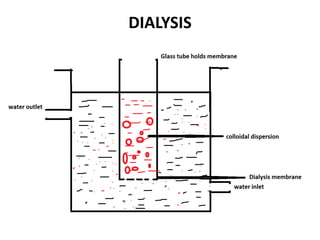
• The semi permeable membrane is fixed tightly to one end of
the hollow glass tube
• The colloidal dispersion is placed in the glass tube and which
is suspended in the vessel of water
• Low molecular weight solute or ions diffuse out of the tube in
to water while the colloidal particles remain inside the tube
ELECTRODIALYSIS
PRINCIPLE :-
• Similar to dialysis
• Diffusion of ions or molecules are enhanced by applying a
potential difference across the membrane. This method is
called electro dialysis
ELECTRODIALYSIS
ELECTRODIALYSIS
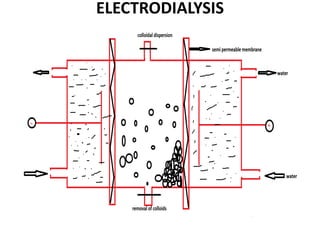
• An electro dialysis cell consists of three compartments,
two outer and one center compartment
• The center compartment is separated from the outer
compartments by two dialysis membrane supported by screens
• The outer compartments contain water and electrodes
ELECTRODIALYSIS
• The center compartment contain colloidal sol
• When an electric potential is applied, the anions from the sol
move towards the anode compartment and cations from the sol
move towards the cathode compartment
• Based on the charge on the colloidal particles they move
towards any of the membrane
• Non electrolyte impurities diffuse in to both the outer
compartments
ELECTRODIALYSIS
• As the density of the colloidal particles increases due to its
accumulation, they settled at the bottom of the compartment
• The supernatant liquid can be decanted to get the purified
colloidal sol
ULTRA FILTRATION
• Colloidal particles can easily pass through an ordinary filter
paper.
• If this filter paper is impregnated with colloidon or cellophane
or cellulose acetate, the pore size reduces. such modified filter
papers are called ultra filters
ULTRA FILTRATION
ULTRA FILTRATION
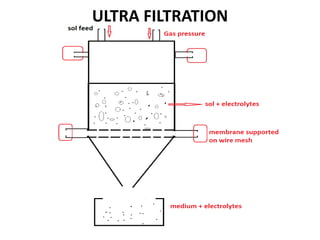
• Colloidal sol is placed in a compartment, that is closed by a
dialysis membrane having pore size 0.003 micron
• Pressure applied on the sol, liquid and low molecular weight
solutes are forced through the membrane
• Colloidal particles are retained within the compartment
• This separation process is called ultra filtration
THANK YOU

Purification of colloidal dispersion

  • 1.
    PURIFICATION OF COLLOIDAL DISPERSION SruthiPrabha k Assistant Professor Karuna College of Pharmacy, Palakkad
  • 2.
    PURIFICATION OF COLLOIDAL DISPERSION •Colloidal dispersion contain impurities like low molecular weight water soluble substances and electrolytes • These should be removed to obtain a pure sol • Methods used for purification of colloids are 1.Dialysis 2.Electrodialysis 3.Ultrafiltration
  • 3.
    DIALYSIS PRINCIPLE:- • Ions ormolecules are removed from a colloidal dispersion by diffusion through a semi permeable membrane
  • 4.
  • 5.
    DIALYSIS • The semipermeable membrane is fixed tightly to one end of the hollow glass tube • The colloidal dispersion is placed in the glass tube and which is suspended in the vessel of water • Low molecular weight solute or ions diffuse out of the tube in to water while the colloidal particles remain inside the tube
  • 6.
    ELECTRODIALYSIS PRINCIPLE :- • Similarto dialysis • Diffusion of ions or molecules are enhanced by applying a potential difference across the membrane. This method is called electro dialysis
  • 7.
  • 8.
    ELECTRODIALYSIS • An electrodialysis cell consists of three compartments, two outer and one center compartment • The center compartment is separated from the outer compartments by two dialysis membrane supported by screens • The outer compartments contain water and electrodes
  • 9.
    ELECTRODIALYSIS • The centercompartment contain colloidal sol • When an electric potential is applied, the anions from the sol move towards the anode compartment and cations from the sol move towards the cathode compartment • Based on the charge on the colloidal particles they move towards any of the membrane • Non electrolyte impurities diffuse in to both the outer compartments
  • 10.
    ELECTRODIALYSIS • As thedensity of the colloidal particles increases due to its accumulation, they settled at the bottom of the compartment • The supernatant liquid can be decanted to get the purified colloidal sol
  • 11.
    ULTRA FILTRATION • Colloidalparticles can easily pass through an ordinary filter paper. • If this filter paper is impregnated with colloidon or cellophane or cellulose acetate, the pore size reduces. such modified filter papers are called ultra filters
  • 12.
  • 13.
    ULTRA FILTRATION • Colloidalsol is placed in a compartment, that is closed by a dialysis membrane having pore size 0.003 micron • Pressure applied on the sol, liquid and low molecular weight solutes are forced through the membrane • Colloidal particles are retained within the compartment • This separation process is called ultra filtration
  • 14.