
COLLOIDS
Renz Cabiling
   Bisquera
III – Kindness
Lucretius says…..
“Observe what happens when sunbeams are
  admitted into a building and shed light on its
  shadowy places. You will see a multitude of
  tiny particles mingling in a multitude of ways
  in the empty space… They all derive the
  restlessness from the atoms. It originates with
  the atoms, which move of themselves”
Between Suspension & Colloid
• Suspension
 Homogeneous Mixture

• Colloid

 Heterogeneous Mixture
Destabilisation Phenomena of a
          Dispersion
Migration phenomena whereby the difference
     in density between the continuous and
  dispersed phase leads to gravitational phase
             separation. In the case of
    suspensions sedimentation occurs as the
 dispersed phase is denser than the continuous
 whereby the suspended particles join together
 and increase in size. Below are the two types
       of this phenomenon, reversibly and
                   flocculation.
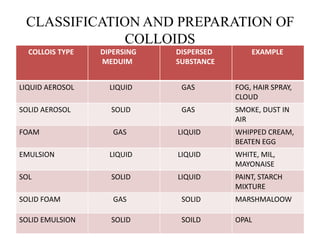
CLASSIFICATION AND PREPARATION OF
              COLLOIDS
  COLLOIS TYPE   DIPERSING   DISPERSED       EXAMPLE
                 MEDUIM      SUBSTANCE


LIQUID AEROSOL     LIQUID     GAS        FOG, HAIR SPRAY,
                                         CLOUD
SOLID AEROSOL      SOLID      GAS        SMOKE, DUST IN
                                         AIR
FOAM                GAS      LIQUID      WHIPPED CREAM,
                                         BEATEN EGG
EMULSION           LIQUID    LIQUID      WHITE, MIL,
                                         MAYONAISE
SOL                SOLID     LIQUID      PAINT, STARCH
                                         MIXTURE
SOLID FOAM          GAS       SOLID      MARSHMALOOW

SOLID EMULSION     SOLID      SOILD      OPAL
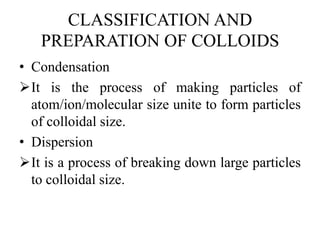
CLASSIFICATION AND
   PREPARATION OF COLLOIDS
• Condensation
It is the process of making particles of
  atom/ion/molecular size unite to form particles
  of colloidal size.
• Dispersion
It is a process of breaking down large particles
  to colloidal size.
CLASSIFICATION AND
   PREPARATION OF COLLOIDS
• Emulsifying Agent
Stabilizes an emulsion so that it does not
  separate into its component.
Tyndall Effect
 also known as Tyndall scattering is light
  scattering by particles in a colloid or particles in a
  fine suspension. It is named after the 19th century
  physicist John Tyndall. It is similar to Rayleigh
  scattering, in that the intensity of the scattered
  light depends on the fourth power of the
  frequency, so blue light is scattered much more
  strongly than red light. An example in everyday
  life is the blue color sometimes seen in the smoke
  emitted by motorcycles particularly two
  stroke machines where the burnt engine oil
  provides the particles.
Example of TYNDALL EFFECT
BROWNIAN MOVEMENT
BROWNIAN MOVEMENT
• If a colloid is viewed in a special
  microscope, you will see particles moving in
  erratic, haphazard motion.
• Brownian Movement is due to the constant
  bombardment of the dispersed particles by rhe
  dispersion medium.
ELECTROPHORESIS

• A process whereby the changed protein
  particles migrate at varying rates to electrodes
  of opposite charge.
DIALYSIS and HEMODIALYSIS


• Dialysis


Process of separating solute particles from
 colloidal particles by means of a semi
 permeable membrane.
DIALYSIS and HEMODIALYSIS


• Hemodialysis

A method that is used to achieve the
 extracorporeal removal of waste products such
 as Creatinine and urea and free water from
 the blood when the kidneys are in a state
 of renal failure.
HEMODIALYSIS in Progress
Colloid

Colloid

  • 1.
    COLLOIDS Renz Cabiling Bisquera III – Kindness
  • 2.
    Lucretius says….. “Observe whathappens when sunbeams are admitted into a building and shed light on its shadowy places. You will see a multitude of tiny particles mingling in a multitude of ways in the empty space… They all derive the restlessness from the atoms. It originates with the atoms, which move of themselves”
  • 3.
    Between Suspension &Colloid • Suspension  Homogeneous Mixture • Colloid  Heterogeneous Mixture
  • 4.
  • 5.
    Migration phenomena wherebythe difference in density between the continuous and dispersed phase leads to gravitational phase separation. In the case of suspensions sedimentation occurs as the dispersed phase is denser than the continuous whereby the suspended particles join together and increase in size. Below are the two types of this phenomenon, reversibly and flocculation.
  • 6.
    CLASSIFICATION AND PREPARATIONOF COLLOIDS COLLOIS TYPE DIPERSING DISPERSED EXAMPLE MEDUIM SUBSTANCE LIQUID AEROSOL LIQUID GAS FOG, HAIR SPRAY, CLOUD SOLID AEROSOL SOLID GAS SMOKE, DUST IN AIR FOAM GAS LIQUID WHIPPED CREAM, BEATEN EGG EMULSION LIQUID LIQUID WHITE, MIL, MAYONAISE SOL SOLID LIQUID PAINT, STARCH MIXTURE SOLID FOAM GAS SOLID MARSHMALOOW SOLID EMULSION SOLID SOILD OPAL
  • 7.
    CLASSIFICATION AND PREPARATION OF COLLOIDS • Condensation It is the process of making particles of atom/ion/molecular size unite to form particles of colloidal size. • Dispersion It is a process of breaking down large particles to colloidal size.
  • 8.
    CLASSIFICATION AND PREPARATION OF COLLOIDS • Emulsifying Agent Stabilizes an emulsion so that it does not separate into its component.
  • 9.
    Tyndall Effect  alsoknown as Tyndall scattering is light scattering by particles in a colloid or particles in a fine suspension. It is named after the 19th century physicist John Tyndall. It is similar to Rayleigh scattering, in that the intensity of the scattered light depends on the fourth power of the frequency, so blue light is scattered much more strongly than red light. An example in everyday life is the blue color sometimes seen in the smoke emitted by motorcycles particularly two stroke machines where the burnt engine oil provides the particles.
  • 10.
  • 11.
  • 12.
    BROWNIAN MOVEMENT • Ifa colloid is viewed in a special microscope, you will see particles moving in erratic, haphazard motion. • Brownian Movement is due to the constant bombardment of the dispersed particles by rhe dispersion medium.
  • 13.
    ELECTROPHORESIS • A processwhereby the changed protein particles migrate at varying rates to electrodes of opposite charge.
  • 14.
    DIALYSIS and HEMODIALYSIS •Dialysis Process of separating solute particles from colloidal particles by means of a semi permeable membrane.
  • 15.
    DIALYSIS and HEMODIALYSIS •Hemodialysis A method that is used to achieve the extracorporeal removal of waste products such as Creatinine and urea and free water from the blood when the kidneys are in a state of renal failure.
  • 16.