UNIT-II-RADIATION MECHANISMS
AND DESIGN ASPECTS
1
Antenna Definition
Antenna is a Metallic device for radiating and receiving
electromagnetic waves(By IEEE).
Accelerated and decelerated of chargers on a
conductor can generate Electro magnetic waves.
All types of conductors which is carrying time varying
current are sources of electromagnetic waves.
Effective radiator can be considered as good antenna.
2
Basic Types of Antennas
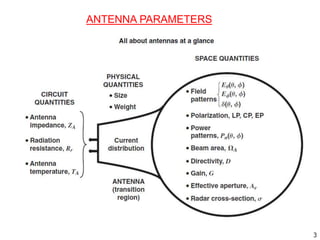
ANTENNA PARAMETERS
3
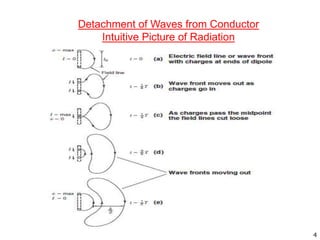
Detachment of Waves from Conductor
Intuitive Picture of Radiation
4
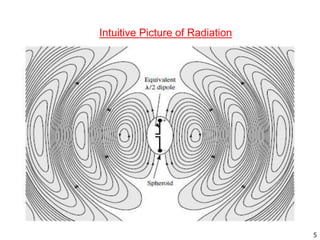
Intuitive Picture of Radiation
5
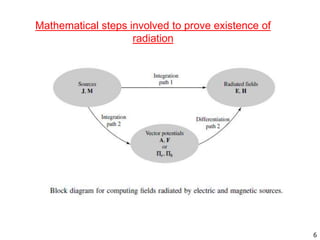
Mathematical steps involved to prove existence of
radiation
6
Electric scalar and Magnetic vector potentials
7
Classification of Antennas
Wire-Type Antennas Aperture-Type Antennas
Dipoles Horn and open waveguide
Monopoles Reflector antennas
Biconical antennas Slot antennas
Loop antennas Microstrip antennas
Helical antennas
Linearly polarised antennas Circularly polarised antennas
Element antennas Antenna array
Narrow-band Broad-band
Transmitting Receiving
8
9
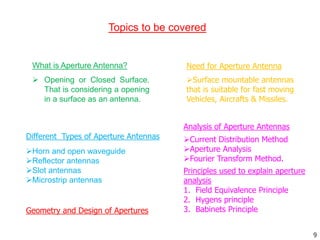
What is Aperture Antenna?
 Opening or Closed Surface.
That is considering a opening
in a surface as an antenna.
Topics to be covered
Need for Aperture Antenna
Surface mountable antennas
that is suitable for fast moving
Vehicles, Aircrafts & Missiles.
Different Types of Aperture Antennas
Horn and open waveguide
Reflector antennas
Slot antennas
Microstrip antennas
Analysis of Aperture Antennas
Current Distribution Method
Aperture Analysis
Fourier Transform Method.
Principles used to explain aperture
analysis
1. Field Equivalence Principle
2. Hygens principle
3. Babinets Principle
Geometry and Design of Apertures
APERTURE ANTENNAS
10

Aperture Antennas.pptx

  • 1.
  • 2.
    Antenna Definition Antenna isa Metallic device for radiating and receiving electromagnetic waves(By IEEE). Accelerated and decelerated of chargers on a conductor can generate Electro magnetic waves. All types of conductors which is carrying time varying current are sources of electromagnetic waves. Effective radiator can be considered as good antenna. 2
  • 3.
    Basic Types ofAntennas ANTENNA PARAMETERS 3
  • 4.
    Detachment of Wavesfrom Conductor Intuitive Picture of Radiation 4
  • 5.
  • 6.
    Mathematical steps involvedto prove existence of radiation 6
  • 7.
    Electric scalar andMagnetic vector potentials 7
  • 8.
    Classification of Antennas Wire-TypeAntennas Aperture-Type Antennas Dipoles Horn and open waveguide Monopoles Reflector antennas Biconical antennas Slot antennas Loop antennas Microstrip antennas Helical antennas Linearly polarised antennas Circularly polarised antennas Element antennas Antenna array Narrow-band Broad-band Transmitting Receiving 8
  • 9.
    9 What is ApertureAntenna?  Opening or Closed Surface. That is considering a opening in a surface as an antenna. Topics to be covered Need for Aperture Antenna Surface mountable antennas that is suitable for fast moving Vehicles, Aircrafts & Missiles. Different Types of Aperture Antennas Horn and open waveguide Reflector antennas Slot antennas Microstrip antennas Analysis of Aperture Antennas Current Distribution Method Aperture Analysis Fourier Transform Method. Principles used to explain aperture analysis 1. Field Equivalence Principle 2. Hygens principle 3. Babinets Principle Geometry and Design of Apertures
  • 10.