 Multiple access schemes allow many mobile users to
share a finite amount of radio spectrum in efficient
manner
 High quality of communications must be maintained
during the sharing process
 Duplexing scheme provides us mechanism to
support simultaneous DL and UL communication
 FDD: UL and DL communication are separated in
frequency domain by assigning two different
frequency
 TDD : UL and DL communication takes place
over same frequency but different instant of time
but this time is too small to perceived by us.
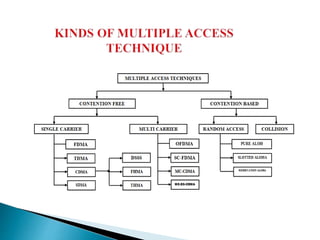
•Frequency Division Multiple Access (FDMA)
•Time Division Multiple Access (TDMA)
•Code Division Multiple Access (CDMA)
•Space Division Multiple Access (SDMA)
CONTENTION FREE MULTIPLE ACCESS TECHNIQUE ARE
BASED ON FREQUENCY, TIME ,CODE AND SPACE
DOMAIN.
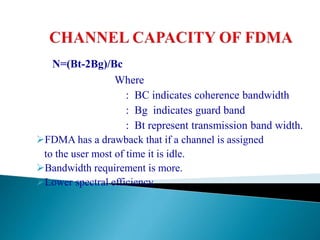
N=(Bt-2Bg)/Bc
Where
: BC indicates coherence bandwidth
: Bg indicates guard band
: Bt represent transmission band width.
FDMA has a drawback that if a channel is assigned
to the user most of time it is idle.
Bandwidth requirement is more.
Lower spectral efficiency.
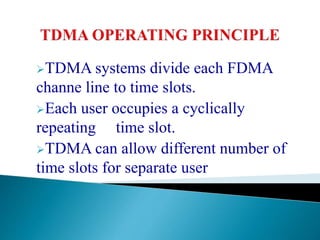
TDMA systems divide each FDMA
channe line to time slots.
Each user occupies a cyclically
repeating time slot.
TDMA can allow different number of
time slots for separate user
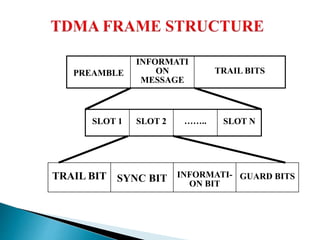
PREAMBLE
INFORMATI
ON
MESSAGE
TRAIL BITS
SLOT 1 SLOT 2 …….. SLOT N
TRAIL BIT SYNC BIT INFORMATI-
ON BIT
GUARD BITS
 Data Transmission for user of TDMA system occurs in
discrete bursts
 The result is low battery consumption
 Handoff process is simpler
 TDMA has higher data rate compare to FDMA
 For high data rate implies small symbol duration which
is more prone to ISI .
 Since different slots are used for T and R, duplexers are
not required.
 Using nonlinear power amplifier in FDMA creates
undesirable effect such effect are very less in TDMA.
 It enables more efficient use of spectrum as there is no
need of guard band.
 TDMA incurs high synchronization overhead compare
to FDMA.
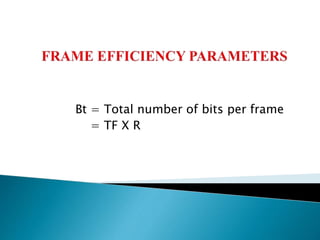
Bt = Total number of bits per frame
= TF X R
 The actual transmission bandwidth of an individual
signal is made many times wider intentionally.
 Several users are allowed to access same wider band
simultaneously.
 Band width of individual
 Bandwidth of an individual signal is Bs and after it
spreading it become Bss. Then gain processing is
defined as
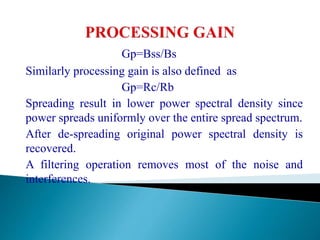
Gp=Bss/Bs
Similarly processing gain is also defined as
Gp=Rc/Rb
Spreading result in lower power spectral density since
power spreads uniformly over the entire spread spectrum.
After de-spreading original power spectral density is
recovered.
A filtering operation removes most of the noise and
interferences.
 Spreading of signal seems to inefficient utilization of
bandwidth since a single user uses much wider
bandwidth than it actually requires. However spread
spectrum is designed to use multiuser ,where multi
users access same spectrum, without interfering one
another, result in a bandwidth efficient system.
 Spread spectrum technique offer much higher tolerance
to noise and interference.
 It is much difficult to detect, intercept, anr jam the
spread signal compare to narrowband original signal.
Therefore spread spectrum technique can be used to
defeat enemy jamming or any intentional or
unintentional interference.
 The frequency reuse distance is limited by co-channel
interference in system using TDMA and FDMA.
In DSSS technique before transmission , the high data rate
pseudorandom sequence is directly used as a spreading
code.
Each user is given a unique PN sequence, which is used at
receiver by intended user to de-spread the received
bandwidth.
The multiple access technique based on DSSS is known as
code division multiple access scheme.
In CDMA full frequency band is available to a user for
entire duration of time .
There is no division in frequency domain or time domain.
Unique codes are assigned to different user, on the basis of
which the users are distinguished from one another.
In CDMA, in order to spread the digital data is multiplied
by PN sequence before transmission. At the receiver end ,
the received signal is again multiplied by the de-spreading
code, which is same as PN sequence
•CDMA offers soft capacity. In CDMA number of users
are determined by numbers of orthogonal code but
practically it is not true.
•In CDMA system as the number of user increases noise
increasing level of noise causes degradation in system
performance
•CDMA is affected by near far effect.
•CDMA permits using same set of frequency in all the cell
. This eliminate the frequency planning.
 In FHSS, total system bandwidth is divided into a
number of smaller bandwidth. During transmission a
user does not stick to particular sub-band rather it
keeps changing from ine sub band to another.
 In FHSS, different user are identified based on their
frequency hop pattern. There is dynamic change in
transmission frequency takes place so it becomes
robust in case of jamming and interferences.
When interval of frequency hopping is larger than the
symbol duration then it is said to be SFH. In this case
frequency hopping rate is slower than transmission rate.
Fast frequency hop takes place when the frequency
hoping rate is equal or exceed the transmission rate or
in one symbol duration one or more frequency hopping
takes place.
 In THSS a transmission frame is divided into a number
of equal intervals of time slots. During transmission it
does not stick to a particular time slot rather it keep
changing in from one slot to another.
 In FHSS scheme intended receiver must have the
knowledge of time hop pattern in order to de-hop and
recover the transmitted signal.
 SDMA is a multiple access technique, takes the
advantage of the directional nature of space. Using a
directional antenna the transmission power is focused
in a desired direction and reduces the interferences.
 SDMA can be used in combination with other multiple
access technique, since user in different space domain
can use the same frequency, time and code resources,
without creating interferences.
 FDMA/TDMA indicates a hybrid multiple access
technique, which includes combination of both TDMA
and FDMA.
 FDMA/TDMA/FDD scheme as used in GSM.
 TDMA/FHMA , this hybrid technique is also known as
TDFH .
 DSMA/FHMA this hybrid technique is also known as
DS/FHMA.
 MCMA is unlike FDMA where the system bandwidth
is not divided in sub-band rather different independent
sub-carrier constitute a composite wider system
bandwidth.
 There is no frequency hopping in MCMA but the
subcarrier frequency of a particular user can be
changed.
 Orthogonal supports orthogonal relationship among the
subcarrier which permits subcarrier to be packed
together with minimum adjacent channel interference
between them. OFDM is considered as the key
technology for higher spectral efficiency and operation
over scalable bandwidth. In OFDMA different subset of
sub-carrier are to the different users in dynamic
manner in a multi user scenario.
 It is modified version of OFDMA.
 The main disadvantage of OFDMA is high peak to
average power ratio, which result in low power
amplifier efficiency.
 More power consumption.
 SC-FDMA permits only adjacent subcarrier to be
allocated together so the lowering of PAPRSC-
OFDMA has been used in UL of LTE cellular system.
MC-CDMA combines OFDMA with frequency domain
spreading, while MC-DS-CDMA combines OFDMA with time
division spreading.
Both the schemes are advantageous in term of spectral
efficiency , flexibility and narrow band interference rejection
capabilities
Data stream is subdivided into number of sub stream each sub
stream is spreading in time using the spreading code and then
transmitted over the orthogonal subcarrier.
 The contention based multiple access scheme helps to
serve a large number of user with minimum overhead.
 It offer flexibility and freedom for in order to gain
access only when required. Such flexibility and
freedom result in collision and may require
retransmission.
 The contention based multiple access scheme follows
certain protocol.
It may function without co-ordinator or with limited
coordinator to realize to realize collision resolution.
The random access protocol does not require any call
set up procedure and is based on ALOHA protocol.
Contention based multiple access scheme is known as
packet radio multiple access scheme.
The performance of contention based multiple access
scheme is generally evaluated in term of delay and
throughput.
In ALOHA each user transmits its data whenever it has
data to send. The ALOHA based protocol may be placed
in three categories , pure ALOHA , slotted ALOHA, and
reserved ALOHA.
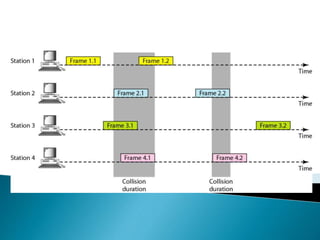
 Pure ALOHA assumes that there are number of users
operating independently. A user transmit data packet
when it has data to sent and a simple procedure.
 After transmitting the packet the user wait for an
acknowledgment ACK from the receiver. The waiting
period is called round trip delay. If the ACK is received
it is assumed that data is received.
 If ACK is not received the packet is assumed to be lost
and retransmit the data.
 All the data packet are assumed to be of equal length L,
arriving randomly from a large number of users. If the
average transmission rate is
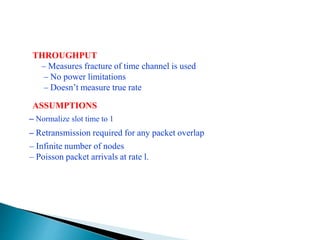
THROUGHPUT
– Measures fracture of time channel is used
– No power limitations
– Doesn’t measure true rate
ASSUMPTIONS
– Retransmission required for any packet overlap
– Normalize slot time to 1
– Infinite number of nodes
– Poisson packet arrivals at rate l.
B.I.T , MESRA [M.Tech] Assignment  : MULTIPLE ACCESS TECHNIQUES FOR WIRELESS COMMUNICATION

B.I.T , MESRA [M.Tech] Assignment : MULTIPLE ACCESS TECHNIQUES FOR WIRELESS COMMUNICATION

  • 2.
     Multiple accessschemes allow many mobile users to share a finite amount of radio spectrum in efficient manner  High quality of communications must be maintained during the sharing process  Duplexing scheme provides us mechanism to support simultaneous DL and UL communication
  • 3.
     FDD: ULand DL communication are separated in frequency domain by assigning two different frequency  TDD : UL and DL communication takes place over same frequency but different instant of time but this time is too small to perceived by us.
  • 5.
    •Frequency Division MultipleAccess (FDMA) •Time Division Multiple Access (TDMA) •Code Division Multiple Access (CDMA) •Space Division Multiple Access (SDMA) CONTENTION FREE MULTIPLE ACCESS TECHNIQUE ARE BASED ON FREQUENCY, TIME ,CODE AND SPACE DOMAIN.
  • 6.
    N=(Bt-2Bg)/Bc Where : BC indicatescoherence bandwidth : Bg indicates guard band : Bt represent transmission band width. FDMA has a drawback that if a channel is assigned to the user most of time it is idle. Bandwidth requirement is more. Lower spectral efficiency.
  • 7.
    TDMA systems divideeach FDMA channe line to time slots. Each user occupies a cyclically repeating time slot. TDMA can allow different number of time slots for separate user
  • 8.
    PREAMBLE INFORMATI ON MESSAGE TRAIL BITS SLOT 1SLOT 2 …….. SLOT N TRAIL BIT SYNC BIT INFORMATI- ON BIT GUARD BITS
  • 9.
     Data Transmissionfor user of TDMA system occurs in discrete bursts  The result is low battery consumption  Handoff process is simpler  TDMA has higher data rate compare to FDMA  For high data rate implies small symbol duration which is more prone to ISI .  Since different slots are used for T and R, duplexers are not required.
  • 10.
     Using nonlinearpower amplifier in FDMA creates undesirable effect such effect are very less in TDMA.  It enables more efficient use of spectrum as there is no need of guard band.  TDMA incurs high synchronization overhead compare to FDMA.
  • 11.
    Bt = Totalnumber of bits per frame = TF X R
  • 12.
     The actualtransmission bandwidth of an individual signal is made many times wider intentionally.  Several users are allowed to access same wider band simultaneously.  Band width of individual  Bandwidth of an individual signal is Bs and after it spreading it become Bss. Then gain processing is defined as
  • 13.
    Gp=Bss/Bs Similarly processing gainis also defined as Gp=Rc/Rb Spreading result in lower power spectral density since power spreads uniformly over the entire spread spectrum. After de-spreading original power spectral density is recovered. A filtering operation removes most of the noise and interferences.
  • 14.
     Spreading ofsignal seems to inefficient utilization of bandwidth since a single user uses much wider bandwidth than it actually requires. However spread spectrum is designed to use multiuser ,where multi users access same spectrum, without interfering one another, result in a bandwidth efficient system.
  • 15.
     Spread spectrumtechnique offer much higher tolerance to noise and interference.  It is much difficult to detect, intercept, anr jam the spread signal compare to narrowband original signal. Therefore spread spectrum technique can be used to defeat enemy jamming or any intentional or unintentional interference.  The frequency reuse distance is limited by co-channel interference in system using TDMA and FDMA.
  • 16.
    In DSSS techniquebefore transmission , the high data rate pseudorandom sequence is directly used as a spreading code. Each user is given a unique PN sequence, which is used at receiver by intended user to de-spread the received bandwidth. The multiple access technique based on DSSS is known as code division multiple access scheme.
  • 17.
    In CDMA fullfrequency band is available to a user for entire duration of time . There is no division in frequency domain or time domain. Unique codes are assigned to different user, on the basis of which the users are distinguished from one another. In CDMA, in order to spread the digital data is multiplied by PN sequence before transmission. At the receiver end , the received signal is again multiplied by the de-spreading code, which is same as PN sequence
  • 18.
    •CDMA offers softcapacity. In CDMA number of users are determined by numbers of orthogonal code but practically it is not true. •In CDMA system as the number of user increases noise increasing level of noise causes degradation in system performance •CDMA is affected by near far effect. •CDMA permits using same set of frequency in all the cell . This eliminate the frequency planning.
  • 19.
     In FHSS,total system bandwidth is divided into a number of smaller bandwidth. During transmission a user does not stick to particular sub-band rather it keeps changing from ine sub band to another.  In FHSS, different user are identified based on their frequency hop pattern. There is dynamic change in transmission frequency takes place so it becomes robust in case of jamming and interferences.
  • 20.
    When interval offrequency hopping is larger than the symbol duration then it is said to be SFH. In this case frequency hopping rate is slower than transmission rate. Fast frequency hop takes place when the frequency hoping rate is equal or exceed the transmission rate or in one symbol duration one or more frequency hopping takes place.
  • 21.
     In THSSa transmission frame is divided into a number of equal intervals of time slots. During transmission it does not stick to a particular time slot rather it keep changing in from one slot to another.  In FHSS scheme intended receiver must have the knowledge of time hop pattern in order to de-hop and recover the transmitted signal.
  • 22.
     SDMA isa multiple access technique, takes the advantage of the directional nature of space. Using a directional antenna the transmission power is focused in a desired direction and reduces the interferences.  SDMA can be used in combination with other multiple access technique, since user in different space domain can use the same frequency, time and code resources, without creating interferences.
  • 23.
     FDMA/TDMA indicatesa hybrid multiple access technique, which includes combination of both TDMA and FDMA.  FDMA/TDMA/FDD scheme as used in GSM.  TDMA/FHMA , this hybrid technique is also known as TDFH .  DSMA/FHMA this hybrid technique is also known as DS/FHMA.
  • 24.
     MCMA isunlike FDMA where the system bandwidth is not divided in sub-band rather different independent sub-carrier constitute a composite wider system bandwidth.  There is no frequency hopping in MCMA but the subcarrier frequency of a particular user can be changed.
  • 25.
     Orthogonal supportsorthogonal relationship among the subcarrier which permits subcarrier to be packed together with minimum adjacent channel interference between them. OFDM is considered as the key technology for higher spectral efficiency and operation over scalable bandwidth. In OFDMA different subset of sub-carrier are to the different users in dynamic manner in a multi user scenario.
  • 26.
     It ismodified version of OFDMA.  The main disadvantage of OFDMA is high peak to average power ratio, which result in low power amplifier efficiency.  More power consumption.  SC-FDMA permits only adjacent subcarrier to be allocated together so the lowering of PAPRSC- OFDMA has been used in UL of LTE cellular system.
  • 27.
    MC-CDMA combines OFDMAwith frequency domain spreading, while MC-DS-CDMA combines OFDMA with time division spreading. Both the schemes are advantageous in term of spectral efficiency , flexibility and narrow band interference rejection capabilities Data stream is subdivided into number of sub stream each sub stream is spreading in time using the spreading code and then transmitted over the orthogonal subcarrier.
  • 28.
     The contentionbased multiple access scheme helps to serve a large number of user with minimum overhead.  It offer flexibility and freedom for in order to gain access only when required. Such flexibility and freedom result in collision and may require retransmission.  The contention based multiple access scheme follows certain protocol.
  • 29.
    It may functionwithout co-ordinator or with limited coordinator to realize to realize collision resolution. The random access protocol does not require any call set up procedure and is based on ALOHA protocol. Contention based multiple access scheme is known as packet radio multiple access scheme. The performance of contention based multiple access scheme is generally evaluated in term of delay and throughput.
  • 30.
    In ALOHA eachuser transmits its data whenever it has data to send. The ALOHA based protocol may be placed in three categories , pure ALOHA , slotted ALOHA, and reserved ALOHA.
  • 31.
     Pure ALOHAassumes that there are number of users operating independently. A user transmit data packet when it has data to sent and a simple procedure.  After transmitting the packet the user wait for an acknowledgment ACK from the receiver. The waiting period is called round trip delay. If the ACK is received it is assumed that data is received.  If ACK is not received the packet is assumed to be lost and retransmit the data.
  • 33.
     All thedata packet are assumed to be of equal length L, arriving randomly from a large number of users. If the average transmission rate is
  • 34.
    THROUGHPUT – Measures fractureof time channel is used – No power limitations – Doesn’t measure true rate ASSUMPTIONS – Retransmission required for any packet overlap – Normalize slot time to 1 – Infinite number of nodes – Poisson packet arrivals at rate l.