Structural Organisation In Animals
Cockroach
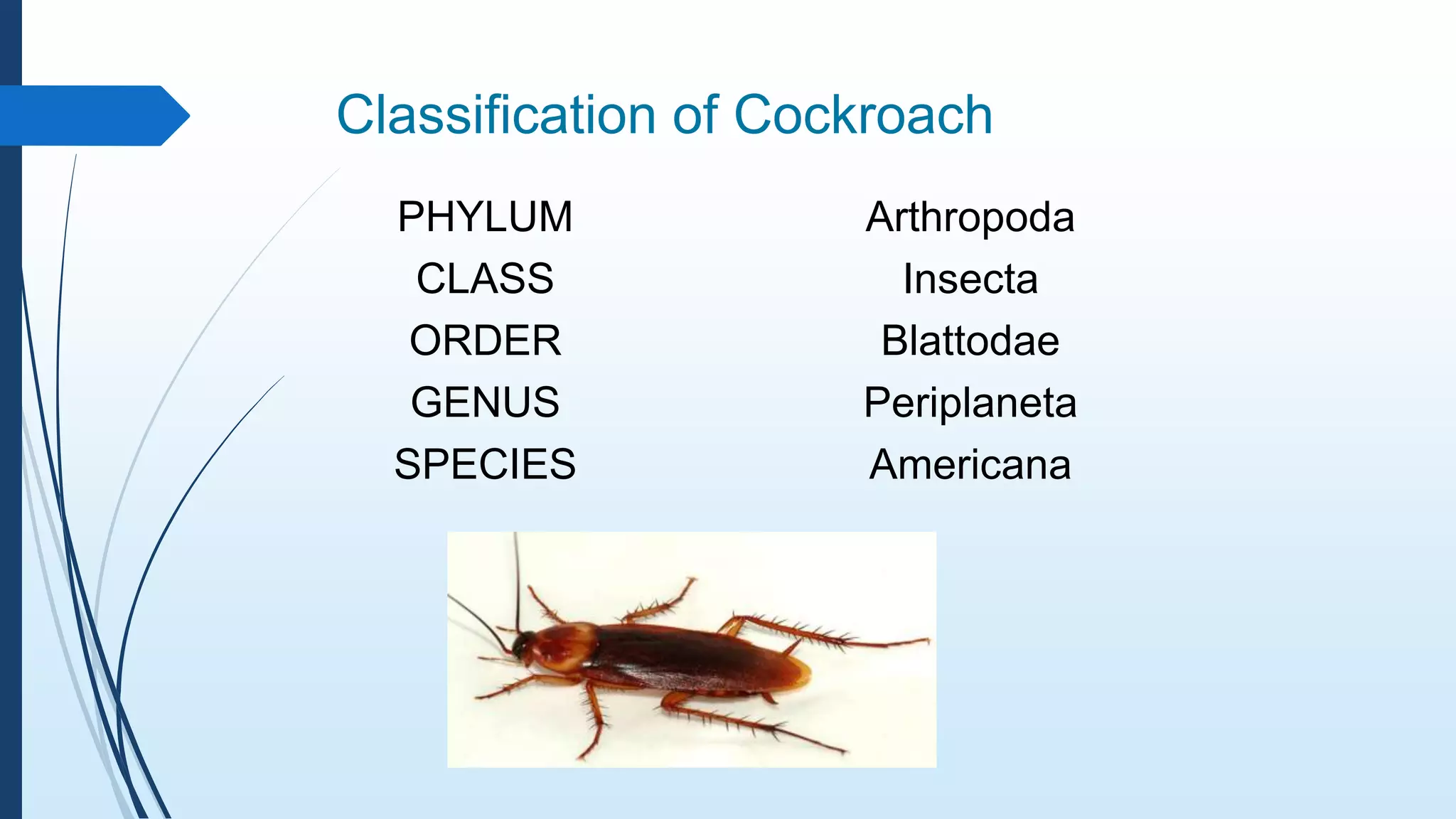
Classification of Cockroach
PHYLUM Arthropoda
CLASS Insecta
ORDER Blattodae
GENUS Periplaneta
SPECIES Americana
Features Of Cockroach
 Cockroaches are brown or black bodied animals.
 Bright yellow , red and green coloured cockroaches have also been reported
in tropical region.
 Their size ranges from ¼ inches to 3 inches (0.6-7.6 cm) and have long
antenna , legs and flat extension of the upper body wall that conceals head.
 They are nocturnal omnivores that live in damp places throughout the world.
 They are serious pests and vectors of several diseases.
(Cockroaches are nocturnal omnivore means they are active at night and they
can eat both plant and animal products)
Morphology
 Periplaneta Americana are about 34-53 mm long with wings that extend
beyond the tip of the abdomen in males.
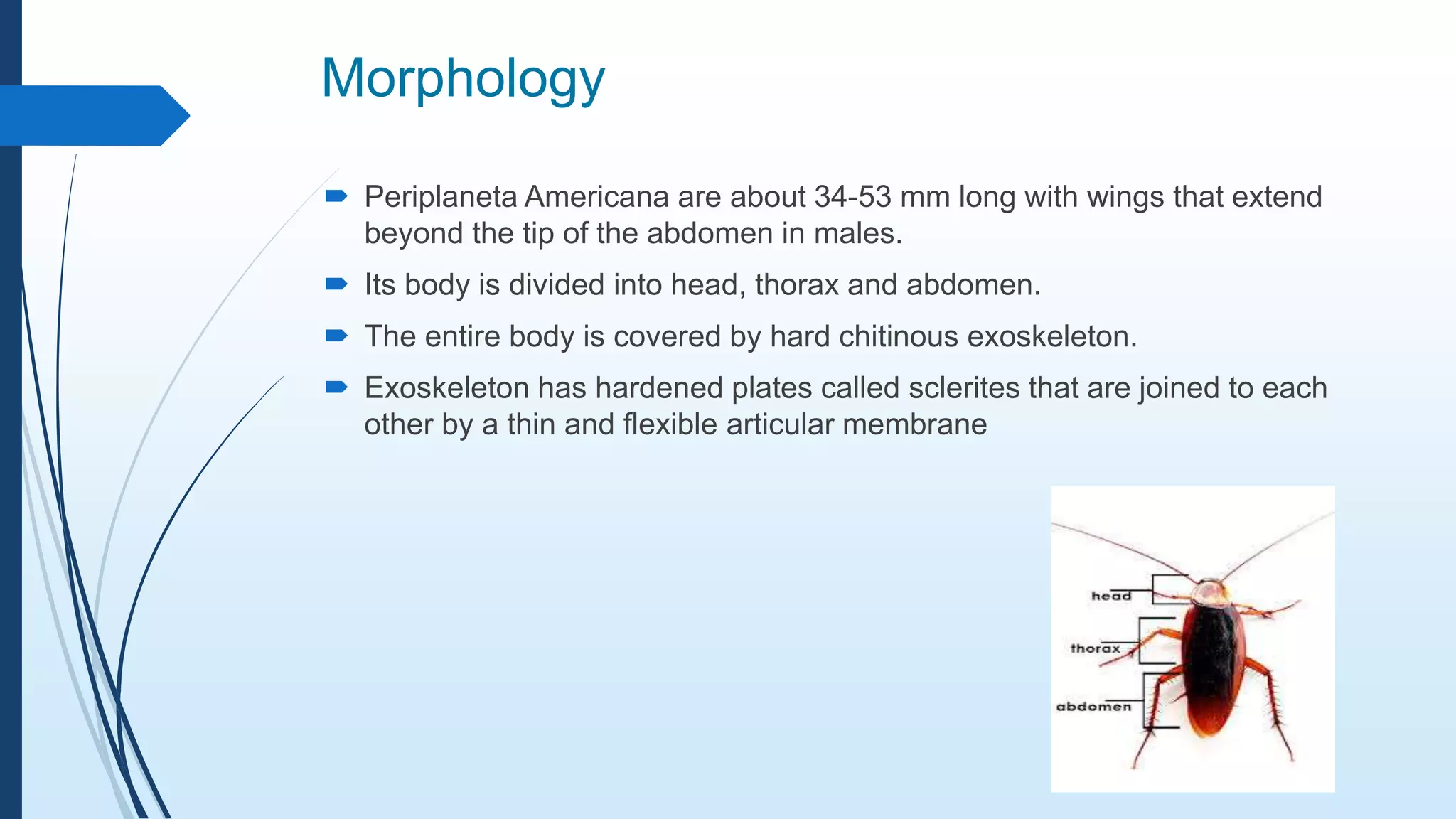
 Its body is divided into head, thorax and abdomen.
 The entire body is covered by hard chitinous exoskeleton.
 Exoskeleton has hardened plates called sclerites that are joined to each
other by a thin and flexible articular membrane
Head
 It is pear shaped and is six segmented.
 It lies at right angle to the body with the broad side upwards.
 It articulates with the thorax by flexible neck.
 On each side of the head is a large compound eye.
 They have a pair of antennae articulate in pits close to the notches of the
compound eyes.
 The top of the head is termed as vertex.
 Antennae have sensory receptors that helps in monitoring the
environment.
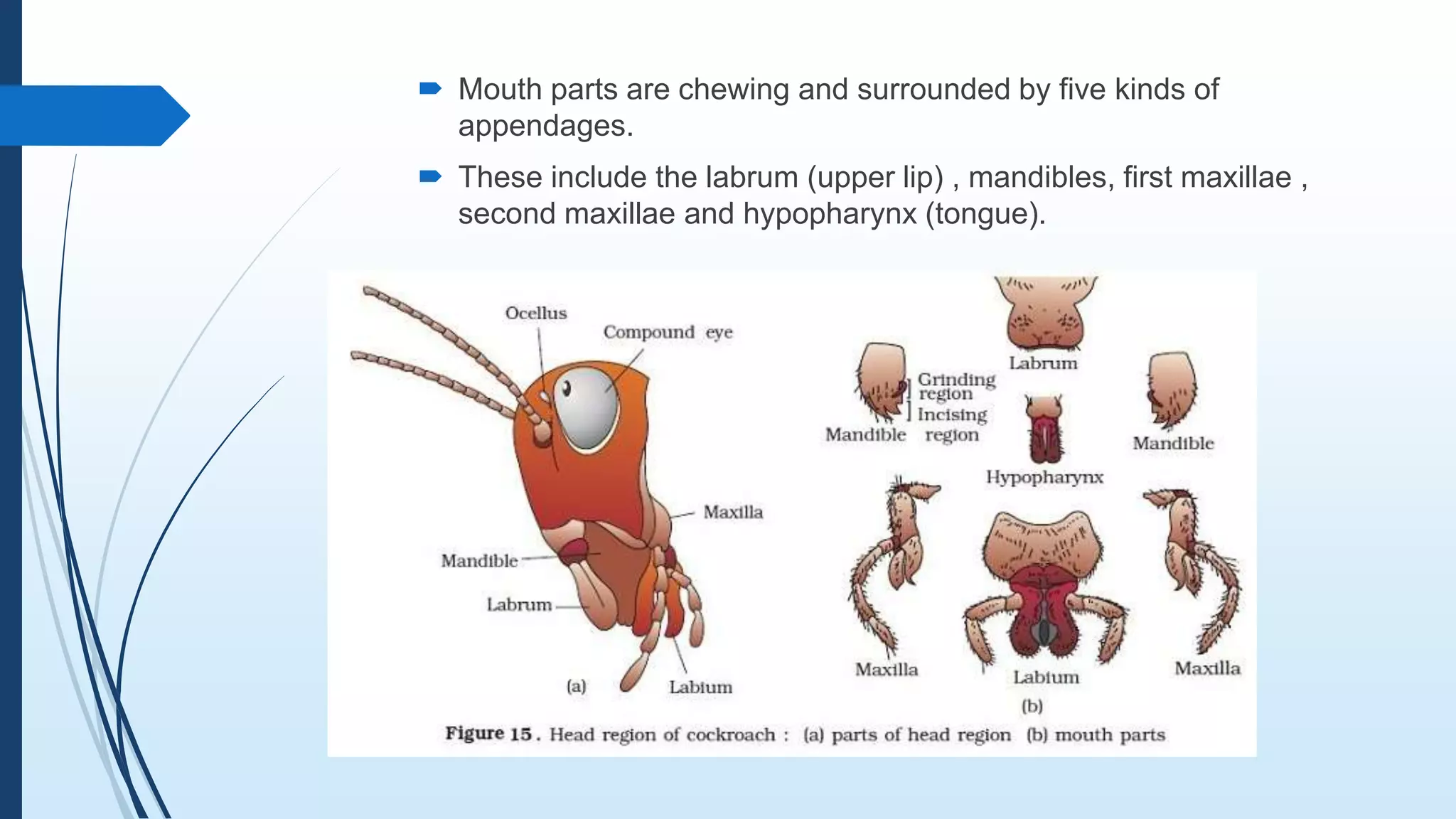
 Mouth parts are chewing and surrounded by five kinds of
appendages.
 These include the labrum (upper lip) , mandibles, first maxillae ,
second maxillae and hypopharynx (tongue).
Thorax
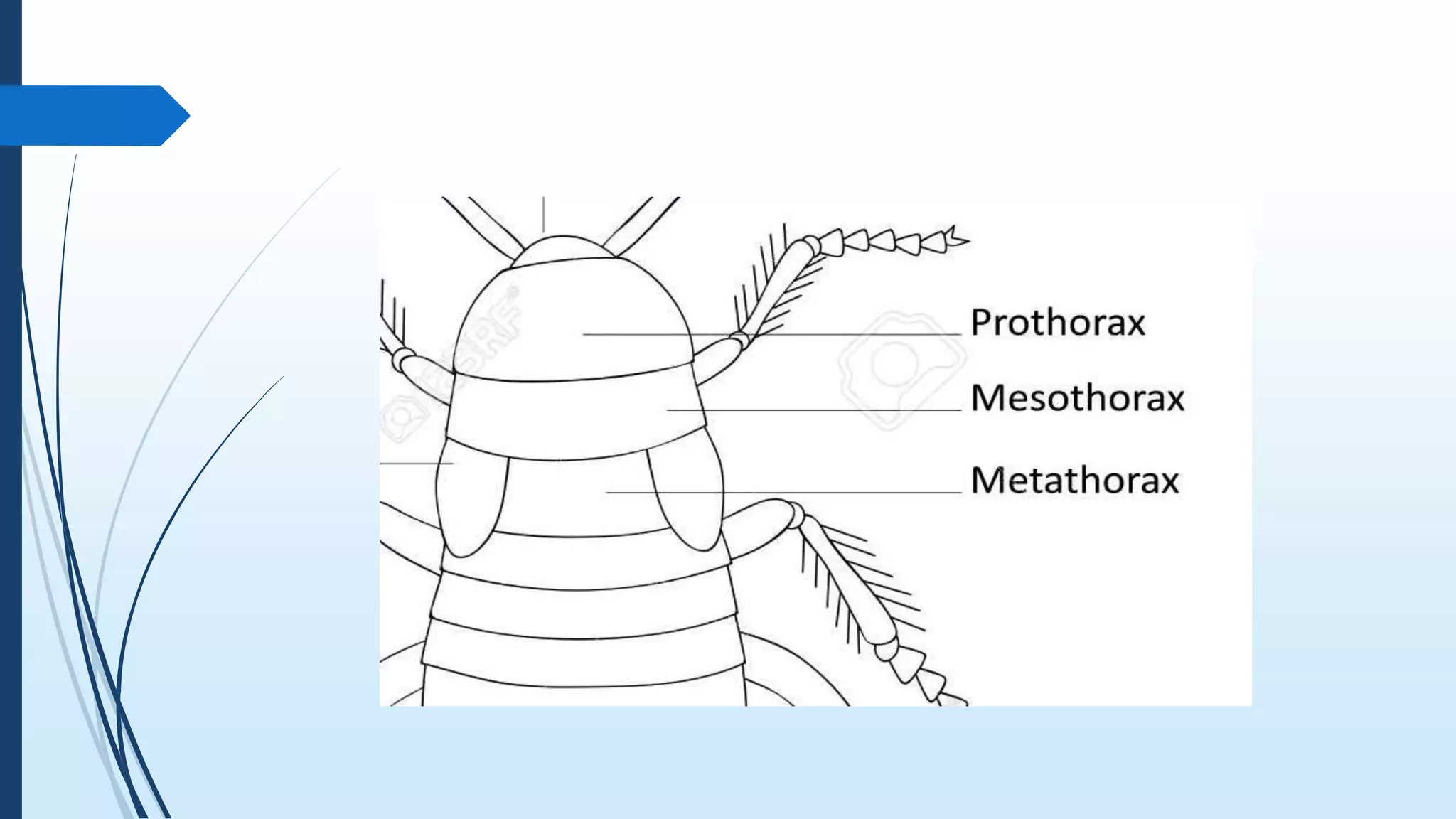
 The thorax consists of three segments – Prothorax, Mesothorax and
metathorax.
 The head is connected with the thorax by a short extensions of the
prothorax known as neck.
 Each thoracic segment bear a pair of walking legs.
 The first pair of wings arises from mesothorax and the second pair from
metathorax.
 Forewings called tegmina are opaque dark and leathery and cover the
hind wings when at rest.
 The hind wings are transparent , membranous, and are used in flight.
Abdomen
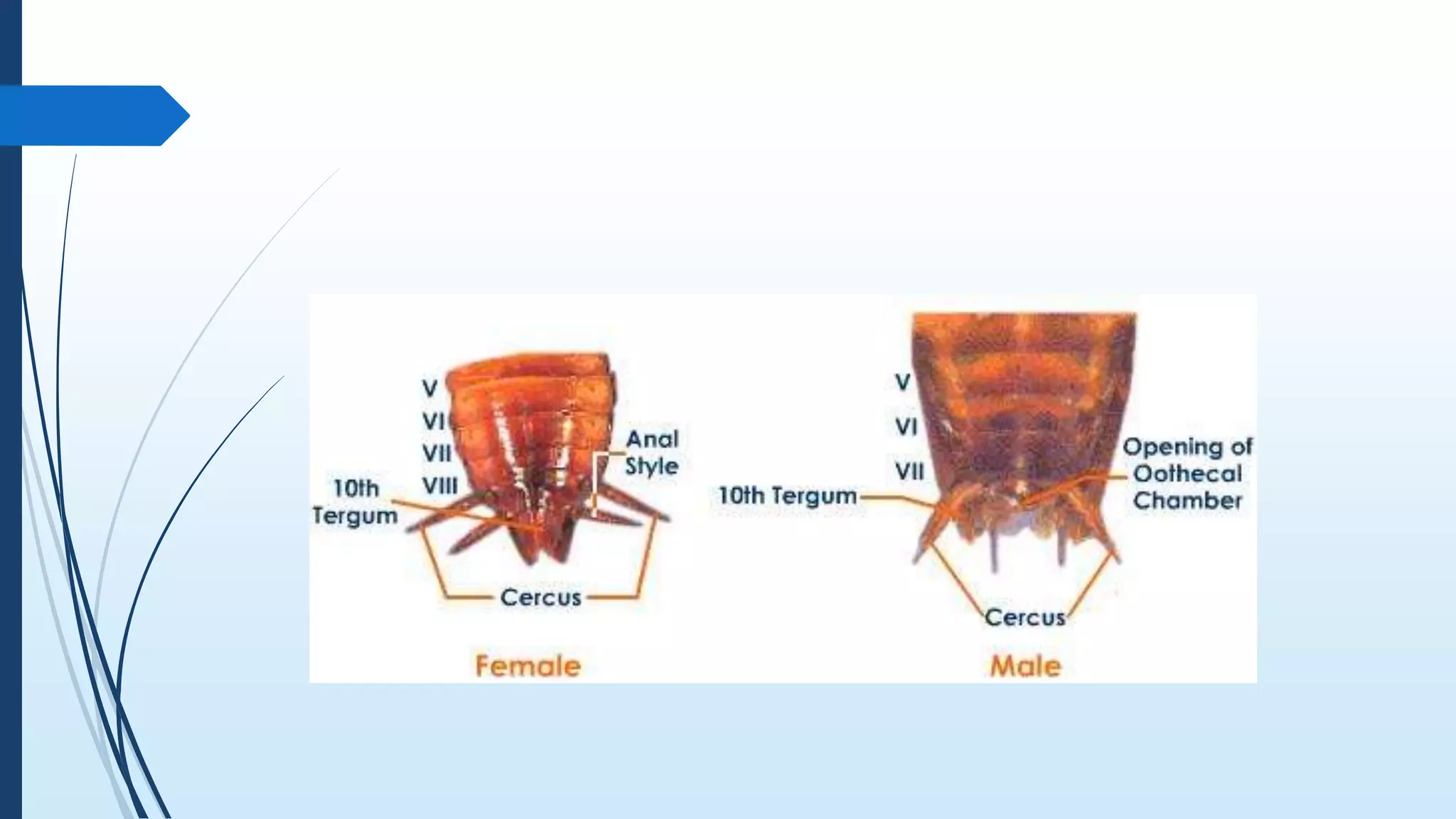
 In both males and females abdomen consists of 10 segments.
 In females, the 7th sternum is boat shaped and together with the 8th and
9th sterna forms a brood or gential pouch whose anterior part contains
female gonopore , spermathecal pores and collateral glands.
 In males, gential pouch or chamber lies at the hind end of abdomen
bounded dorsally by 9th and 10th terga and ventrally by the 9th sternum.
 It contains dorsal anus, ventral male gential pore and gonapophysis .
 Males bear a pair of short, thread like anal styles which is absent in
females.
 In both sexes, the 10th segment bears a pair of jointed filamentous
structures called anal cerci.
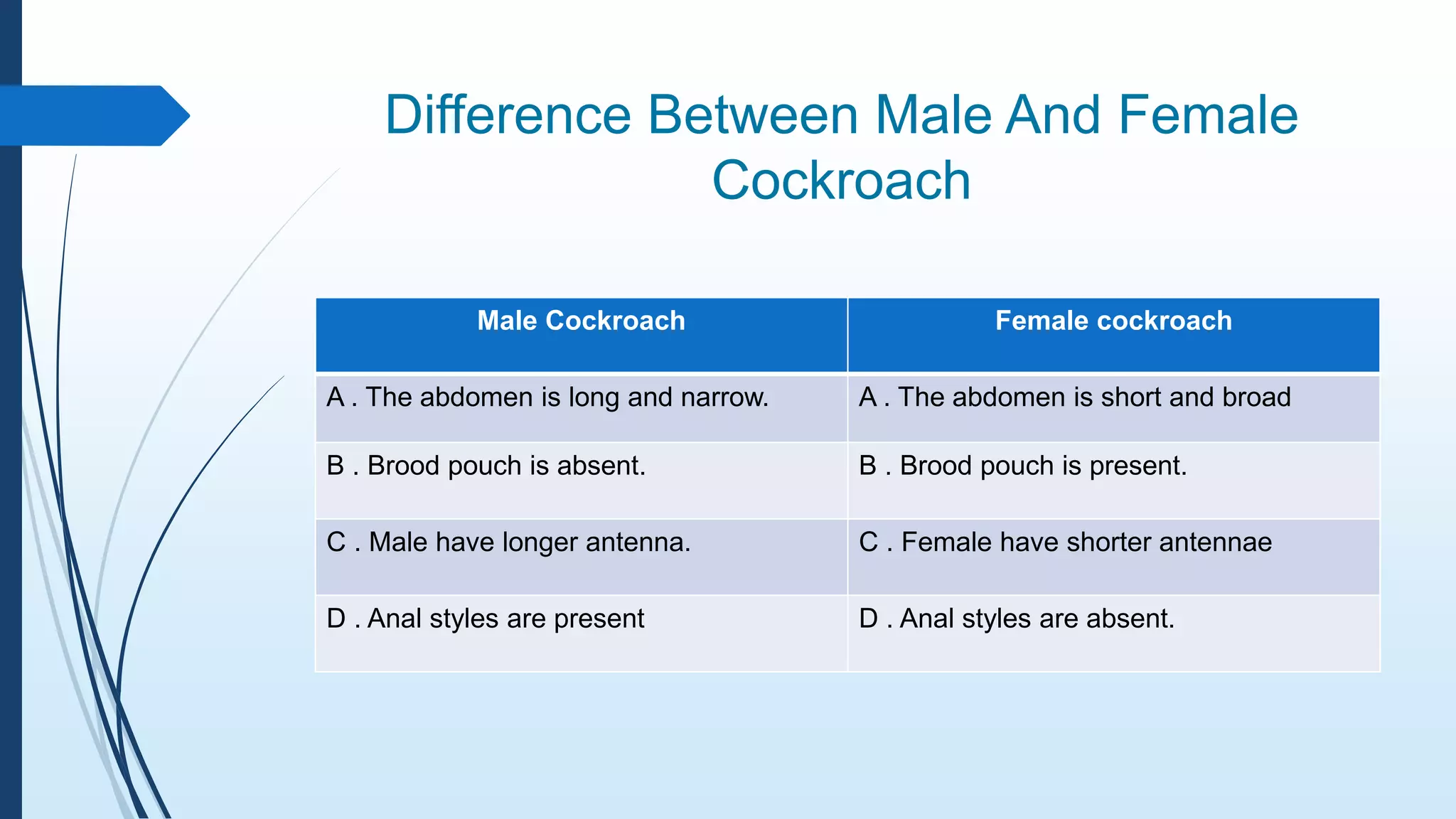
Difference Between Male And Female
Cockroach
Male Cockroach Female cockroach
A . The abdomen is long and narrow. A . The abdomen is short and broad
B . Brood pouch is absent. B . Brood pouch is present.
C . Male have longer antenna. C . Female have shorter antennae
D . Anal styles are present D . Anal styles are absent.
Anatomy
 In anatomy of cockroach we will learn about
 Digestive system
 Blood circulatory system
 Respiratory system
 Excretion
 Nervous system
 Reproductive system
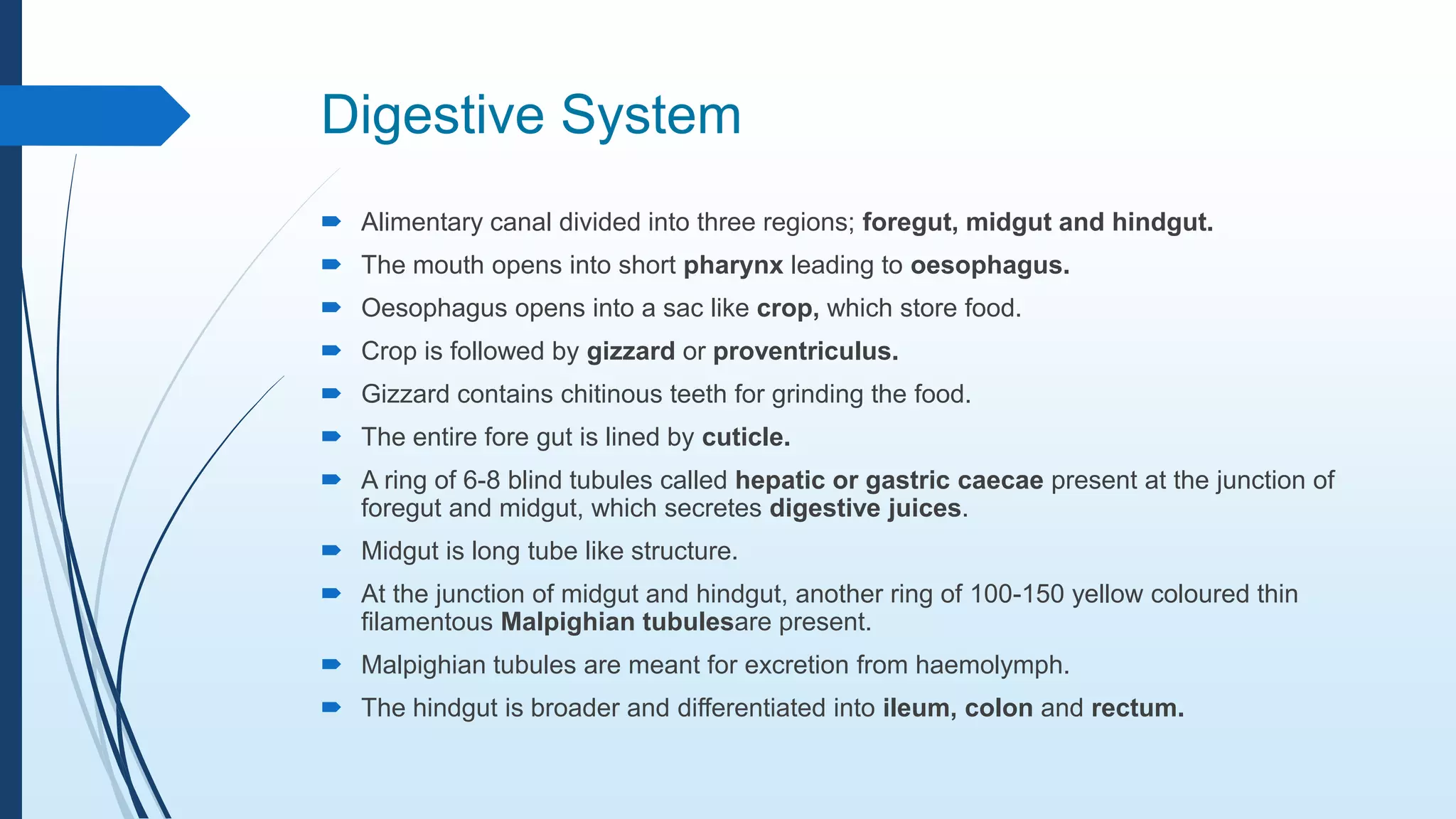
Digestive System
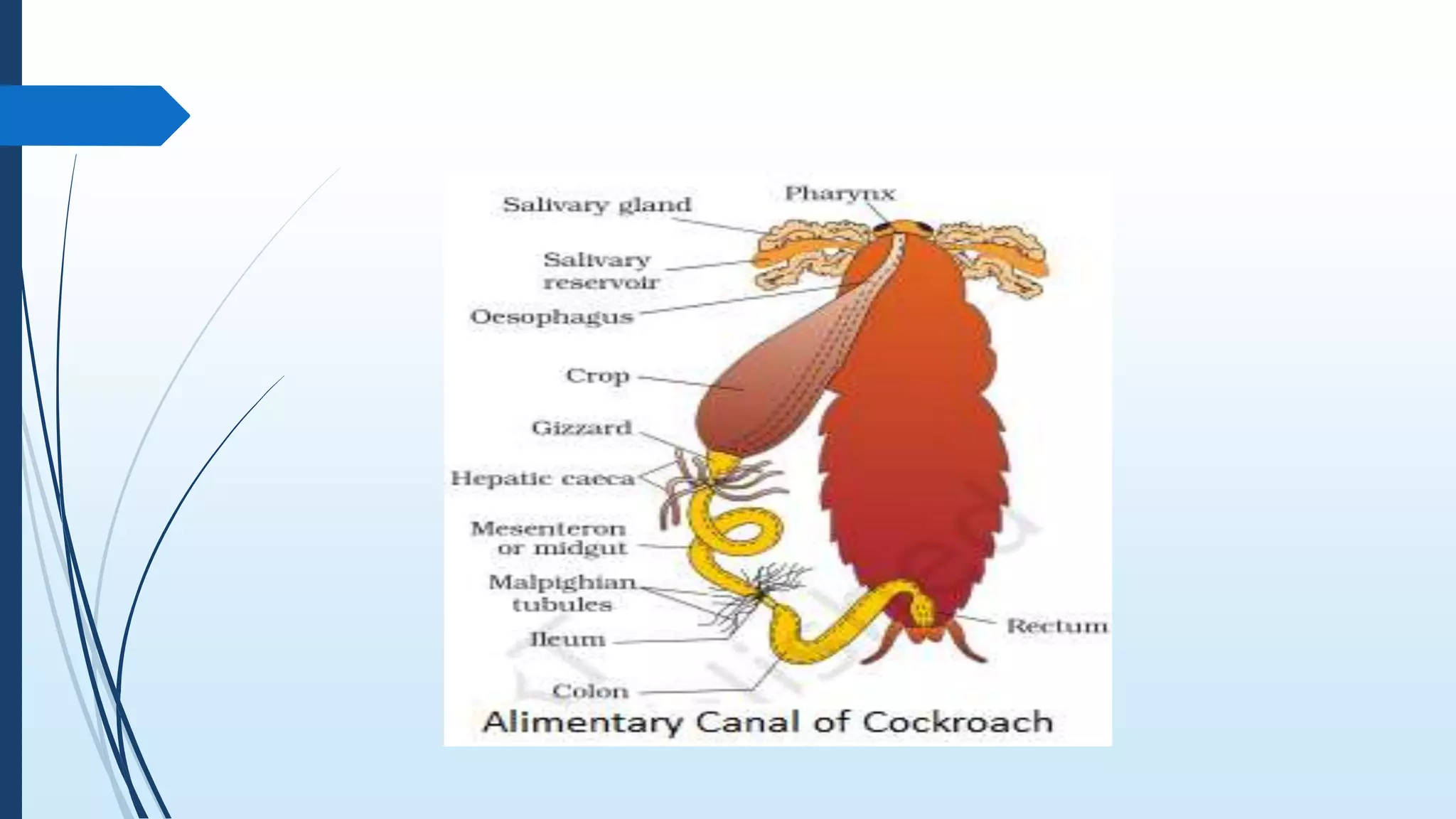
 Alimentary canal divided into three regions; foregut, midgut and hindgut.
 The mouth opens into short pharynx leading to oesophagus.
 Oesophagus opens into a sac like crop, which store food.
 Crop is followed by gizzard or proventriculus.
 Gizzard contains chitinous teeth for grinding the food.
 The entire fore gut is lined by cuticle.
 A ring of 6-8 blind tubules called hepatic or gastric caecae present at the junction of
foregut and midgut, which secretes digestive juices.
 Midgut is long tube like structure.
 At the junction of midgut and hindgut, another ring of 100-150 yellow coloured thin
filamentous Malpighian tubulesare present.
 Malpighian tubules are meant for excretion from haemolymph.
 The hindgut is broader and differentiated into ileum, colon and rectum.
Blood Vascular System
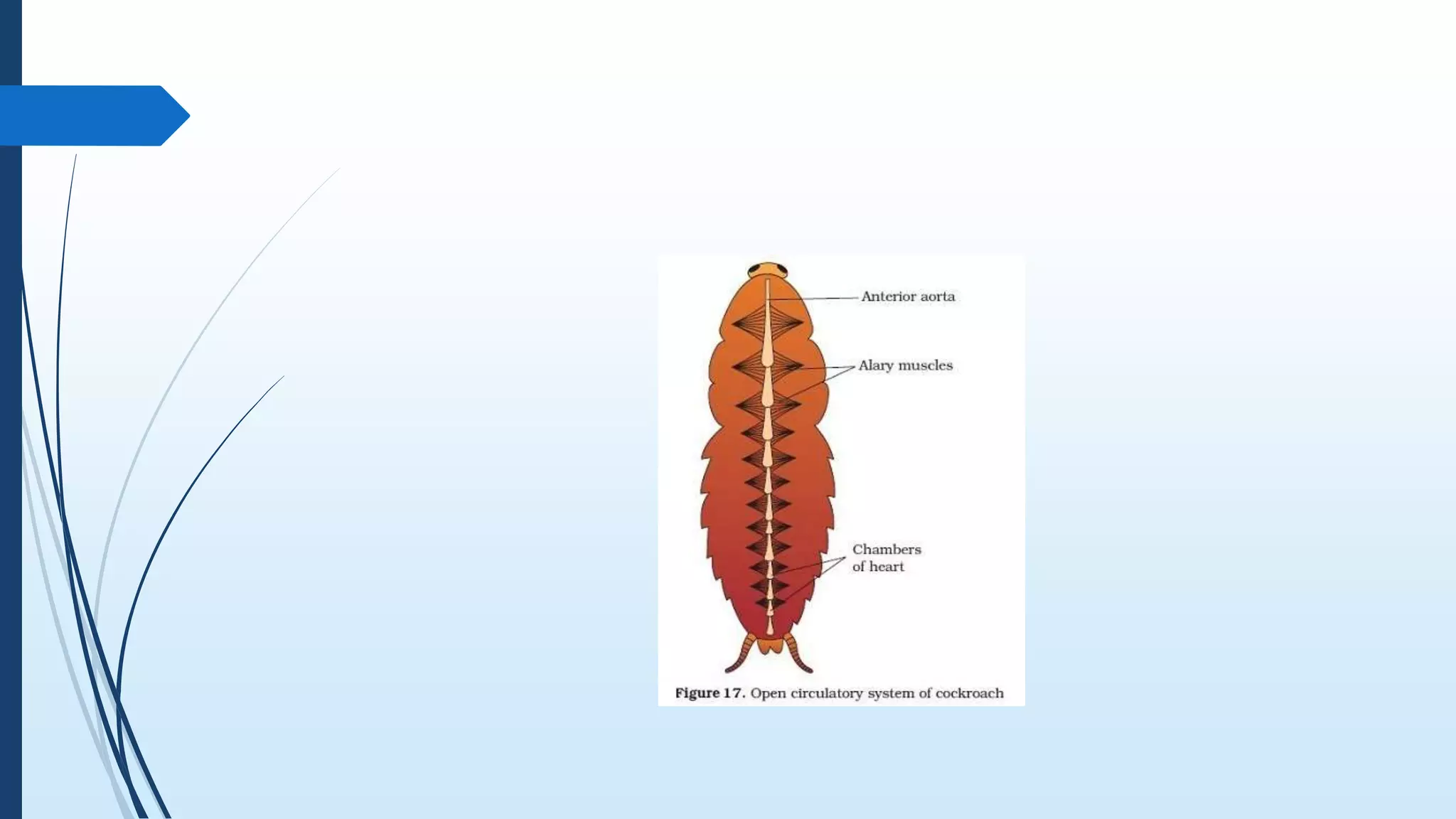
 Blood vascular system is open type.
 Blood vessels are poorly developed and open into space called haemocoel.
 Visceral organs located in the haemocoel and bathed in blood called haemolymph.
 The haemolymph composed of colourless plasma and haemocytes.
 Heart is elongated multichambered, funnel shaped with ostia.
 Blood enter into the heart through ostia and is pumped anteriorly into the sinuses.
 The haemocoel differentiated into three sinuses;
 Pericardial sinus.
 Perivisceral sinus.
 Perineural sinus.
Respiratory System
 The respiratory system consists of a network of trachea.
 Trachea opens to outside by 10 pairs of small holes called spiracles on lateral side
of the body.
 Trachea gives rise to branching tubes called tracheal tubes which subdivided into
tracheoles.
 Opening of spiracles regulated by valves.
 Movement of air takes place by diffusion and directly to the body cell.
Excretion
 Excretion is performed by malpighian tubules.
 Each tubule is lined by glandular and ciliated cells.
 They absorb nitrogenous wastes from the haemocoel and converted into uric acid
and poured into the hindgut.
 Hence cockroach is uricotelic in nature.
 Nephrocytes and uricose glands also assist in excretion.
Nervous System
 Consists of a series of segmentally arranged ganglia joined by paired longitudinal
double ventral nerve cord.
 Three ganglia lie in thorax and six in the abdomen.
 Head contain a bit of nervous system.
 The brain is represented by supra-oesophageal ganglion which innervates the
compound eye and antennae.
 The sense organs are antennae, eyes maxillary palps, labial palps, anal cerci etc.
 Each compound eye consists of about 2000 hexagonal ommatidia.
 Each ommatidium forms a part of the image, called mosaic vision.
Reproductive System
 Cockroaches are dioecious and sex organs are well developed.
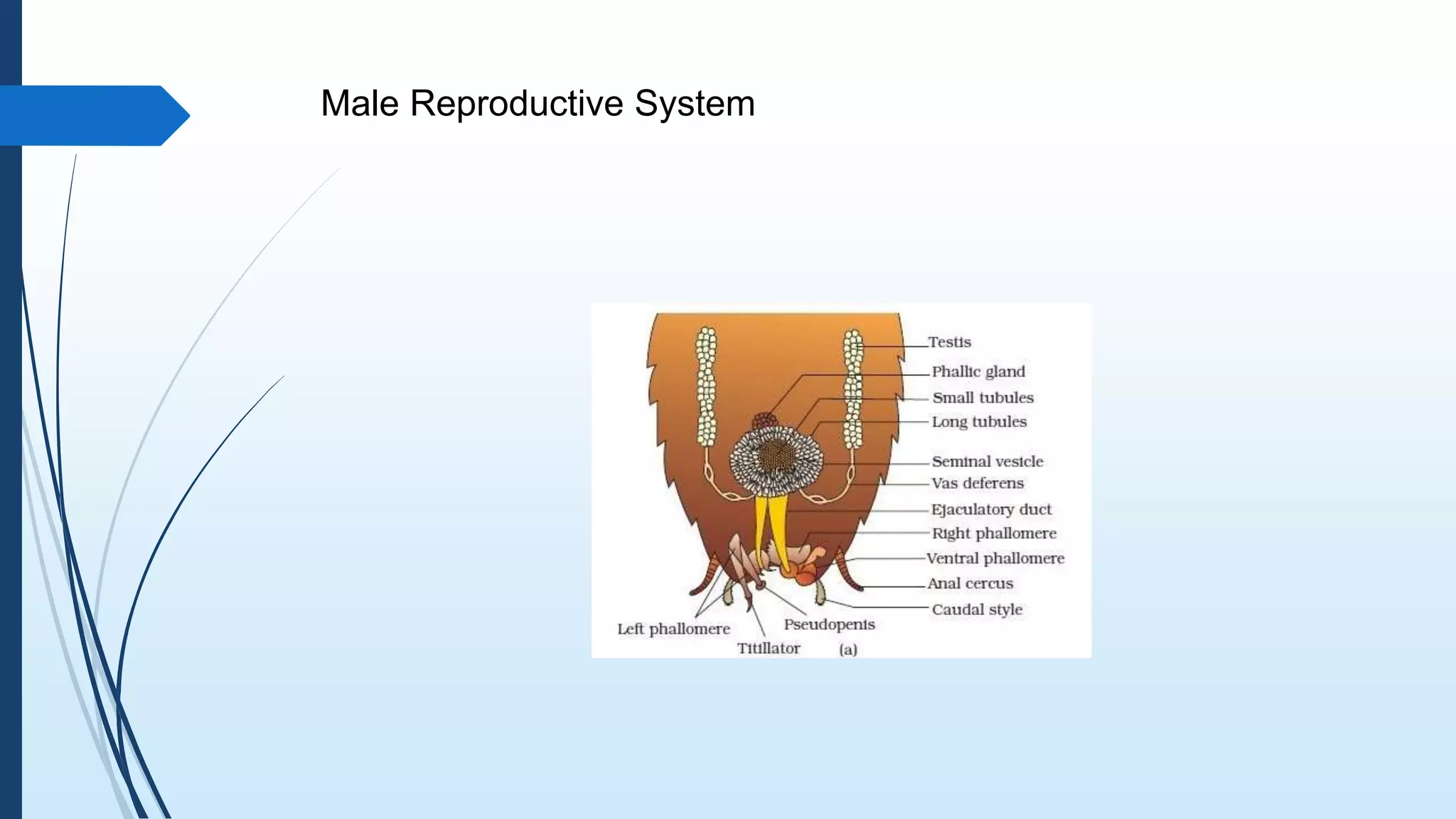
 Male reproductive system consists of a pair of testes lying one on each in 4th
and 6th segments.
 Vas deferens arises from each testis, opens into ejaculatory duct through seminal
vesicle.
 Ejaculatory duct opens into the male gonopore situated ventral to anus.
 Accessory reproductive gland called mushroom gland present on 6th-7th segment.
 External genitalia represented by male gonopophysis or phallomere.
 Sperms are sorted in the seminal vesicles and are glued together in the form of bundles
called spermatophores which are discharged during copulation.
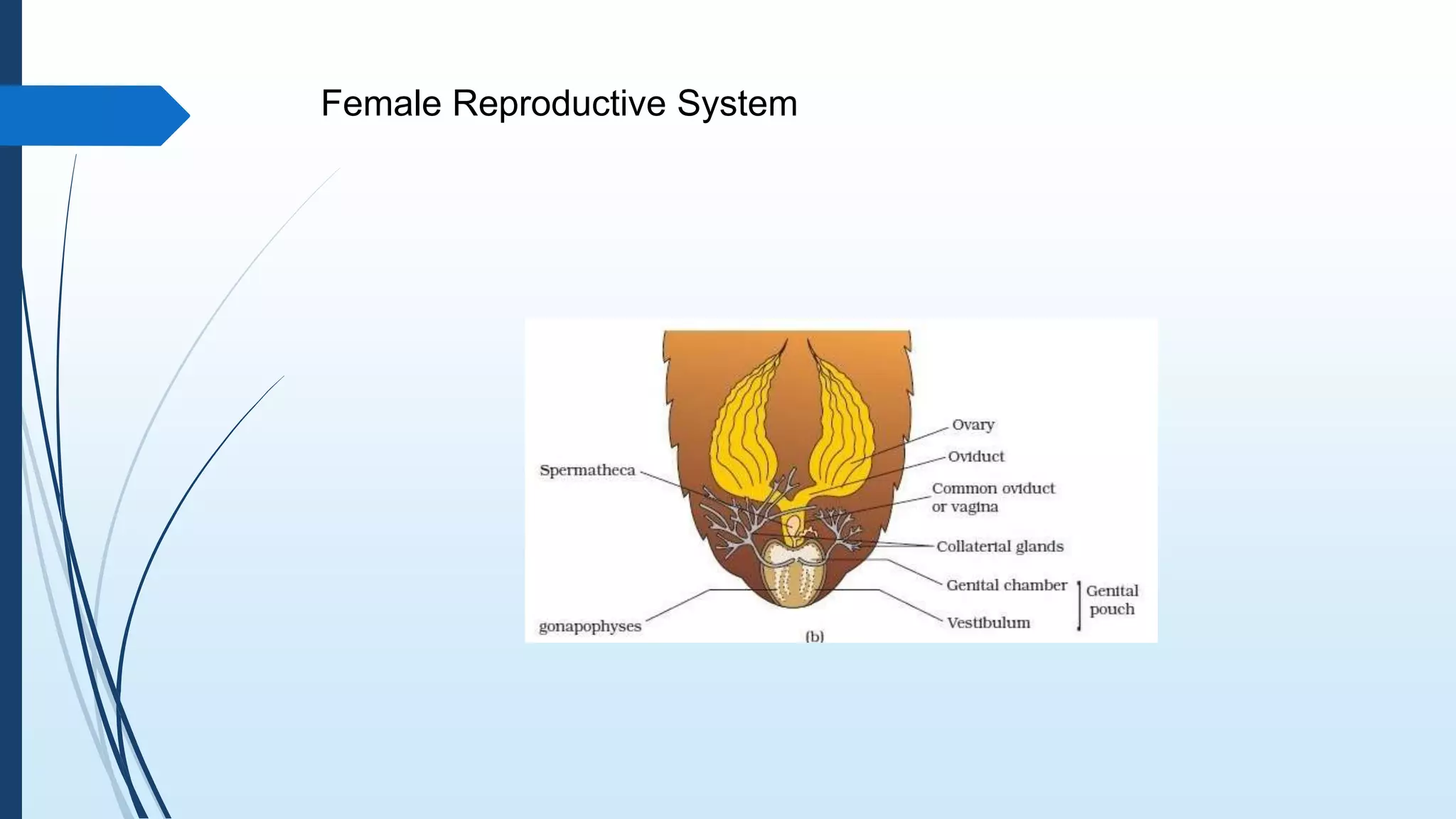
 The female reproductive system consists of two large ovaries present in 2nd –
6th abdominal segments.
 Each ovary is formed a group of eight ovarian tubules or ovarioles, containing chain of
developing ova.
 Oviduct of each ovary fused to form single median oviduct or vagina, which opens into
genital chamber.
 A pair of spermatheca is present in the 6th segment which opens into genital chamber.
 Sperms are transferred through spermatophores.
 The fertilized eggs are encased in capsules called oothecae.
 Ootheca is dark reddish to blackish brown capsule about 3/8” long.
 On average, female produce 9-10 oothecae, each containing 14-16 eggs.
 Development is pourometabolous i.e development through nymphal stages.
 The nymph grows by molting about 13 times to reach the adult form.
Male Reproductive System
Female Reproductive System
Quiz Time
1. What is the scientific name of cockroach?
2. What is the position of ovaries in cockroach?
3. How many segments are present in the abdomen of cockroach?
4. What is the function of malpighian tubules?
5. Name the locomotory appendages of cockroaches on the basis of external
morphology
Answers
1. Periplaneta Americana
2. Ovaries in cockroaches lie in the 4th, 5th and 6th segment.
3. Ten segment
4. The malpighian tubules help in the removal of excretory product present in the
haemolymph of the cockroach
5. Three pairs of legs and 2 pairs of wings.
THANK YOU
By -
Samriddhi Singh
XI A
Kendriya Vidyalaya No.1 Hubli

Cockroach

  • 1.
    Structural Organisation InAnimals Cockroach
  • 2.
    Classification of Cockroach PHYLUMArthropoda CLASS Insecta ORDER Blattodae GENUS Periplaneta SPECIES Americana
  • 3.
    Features Of Cockroach Cockroaches are brown or black bodied animals.  Bright yellow , red and green coloured cockroaches have also been reported in tropical region.  Their size ranges from ¼ inches to 3 inches (0.6-7.6 cm) and have long antenna , legs and flat extension of the upper body wall that conceals head.  They are nocturnal omnivores that live in damp places throughout the world.  They are serious pests and vectors of several diseases. (Cockroaches are nocturnal omnivore means they are active at night and they can eat both plant and animal products)
  • 4.
    Morphology  Periplaneta Americanaare about 34-53 mm long with wings that extend beyond the tip of the abdomen in males.  Its body is divided into head, thorax and abdomen.  The entire body is covered by hard chitinous exoskeleton.  Exoskeleton has hardened plates called sclerites that are joined to each other by a thin and flexible articular membrane
  • 5.
    Head  It ispear shaped and is six segmented.  It lies at right angle to the body with the broad side upwards.  It articulates with the thorax by flexible neck.  On each side of the head is a large compound eye.  They have a pair of antennae articulate in pits close to the notches of the compound eyes.  The top of the head is termed as vertex.  Antennae have sensory receptors that helps in monitoring the environment.
  • 6.
     Mouth partsare chewing and surrounded by five kinds of appendages.  These include the labrum (upper lip) , mandibles, first maxillae , second maxillae and hypopharynx (tongue).
  • 7.
    Thorax  The thoraxconsists of three segments – Prothorax, Mesothorax and metathorax.  The head is connected with the thorax by a short extensions of the prothorax known as neck.  Each thoracic segment bear a pair of walking legs.  The first pair of wings arises from mesothorax and the second pair from metathorax.  Forewings called tegmina are opaque dark and leathery and cover the hind wings when at rest.  The hind wings are transparent , membranous, and are used in flight.
  • 9.
    Abdomen  In bothmales and females abdomen consists of 10 segments.  In females, the 7th sternum is boat shaped and together with the 8th and 9th sterna forms a brood or gential pouch whose anterior part contains female gonopore , spermathecal pores and collateral glands.  In males, gential pouch or chamber lies at the hind end of abdomen bounded dorsally by 9th and 10th terga and ventrally by the 9th sternum.  It contains dorsal anus, ventral male gential pore and gonapophysis .  Males bear a pair of short, thread like anal styles which is absent in females.  In both sexes, the 10th segment bears a pair of jointed filamentous structures called anal cerci.
  • 12.
    Difference Between MaleAnd Female Cockroach Male Cockroach Female cockroach A . The abdomen is long and narrow. A . The abdomen is short and broad B . Brood pouch is absent. B . Brood pouch is present. C . Male have longer antenna. C . Female have shorter antennae D . Anal styles are present D . Anal styles are absent.
  • 13.
    Anatomy  In anatomyof cockroach we will learn about  Digestive system  Blood circulatory system  Respiratory system  Excretion  Nervous system  Reproductive system
  • 14.
    Digestive System  Alimentarycanal divided into three regions; foregut, midgut and hindgut.  The mouth opens into short pharynx leading to oesophagus.  Oesophagus opens into a sac like crop, which store food.  Crop is followed by gizzard or proventriculus.  Gizzard contains chitinous teeth for grinding the food.  The entire fore gut is lined by cuticle.  A ring of 6-8 blind tubules called hepatic or gastric caecae present at the junction of foregut and midgut, which secretes digestive juices.  Midgut is long tube like structure.  At the junction of midgut and hindgut, another ring of 100-150 yellow coloured thin filamentous Malpighian tubulesare present.  Malpighian tubules are meant for excretion from haemolymph.  The hindgut is broader and differentiated into ileum, colon and rectum.
  • 16.
    Blood Vascular System Blood vascular system is open type.  Blood vessels are poorly developed and open into space called haemocoel.  Visceral organs located in the haemocoel and bathed in blood called haemolymph.  The haemolymph composed of colourless plasma and haemocytes.  Heart is elongated multichambered, funnel shaped with ostia.  Blood enter into the heart through ostia and is pumped anteriorly into the sinuses.  The haemocoel differentiated into three sinuses;  Pericardial sinus.  Perivisceral sinus.  Perineural sinus.
  • 18.
    Respiratory System  Therespiratory system consists of a network of trachea.  Trachea opens to outside by 10 pairs of small holes called spiracles on lateral side of the body.  Trachea gives rise to branching tubes called tracheal tubes which subdivided into tracheoles.  Opening of spiracles regulated by valves.  Movement of air takes place by diffusion and directly to the body cell.
  • 20.
    Excretion  Excretion isperformed by malpighian tubules.  Each tubule is lined by glandular and ciliated cells.  They absorb nitrogenous wastes from the haemocoel and converted into uric acid and poured into the hindgut.  Hence cockroach is uricotelic in nature.  Nephrocytes and uricose glands also assist in excretion.
  • 22.
    Nervous System  Consistsof a series of segmentally arranged ganglia joined by paired longitudinal double ventral nerve cord.  Three ganglia lie in thorax and six in the abdomen.  Head contain a bit of nervous system.  The brain is represented by supra-oesophageal ganglion which innervates the compound eye and antennae.  The sense organs are antennae, eyes maxillary palps, labial palps, anal cerci etc.  Each compound eye consists of about 2000 hexagonal ommatidia.  Each ommatidium forms a part of the image, called mosaic vision.
  • 24.
    Reproductive System  Cockroachesare dioecious and sex organs are well developed.  Male reproductive system consists of a pair of testes lying one on each in 4th and 6th segments.  Vas deferens arises from each testis, opens into ejaculatory duct through seminal vesicle.  Ejaculatory duct opens into the male gonopore situated ventral to anus.  Accessory reproductive gland called mushroom gland present on 6th-7th segment.  External genitalia represented by male gonopophysis or phallomere.  Sperms are sorted in the seminal vesicles and are glued together in the form of bundles called spermatophores which are discharged during copulation.
  • 25.
     The femalereproductive system consists of two large ovaries present in 2nd – 6th abdominal segments.  Each ovary is formed a group of eight ovarian tubules or ovarioles, containing chain of developing ova.  Oviduct of each ovary fused to form single median oviduct or vagina, which opens into genital chamber.  A pair of spermatheca is present in the 6th segment which opens into genital chamber.  Sperms are transferred through spermatophores.  The fertilized eggs are encased in capsules called oothecae.  Ootheca is dark reddish to blackish brown capsule about 3/8” long.  On average, female produce 9-10 oothecae, each containing 14-16 eggs.  Development is pourometabolous i.e development through nymphal stages.  The nymph grows by molting about 13 times to reach the adult form.
  • 26.
  • 27.
  • 28.
    Quiz Time 1. Whatis the scientific name of cockroach? 2. What is the position of ovaries in cockroach? 3. How many segments are present in the abdomen of cockroach? 4. What is the function of malpighian tubules? 5. Name the locomotory appendages of cockroaches on the basis of external morphology
  • 29.
    Answers 1. Periplaneta Americana 2.Ovaries in cockroaches lie in the 4th, 5th and 6th segment. 3. Ten segment 4. The malpighian tubules help in the removal of excretory product present in the haemolymph of the cockroach 5. Three pairs of legs and 2 pairs of wings.
  • 30.
    THANK YOU By - SamriddhiSingh XI A Kendriya Vidyalaya No.1 Hubli