MORPHOLOGY OF
COCKROACH
Presented by
B. Aravind
CLASSIFICATION
Phylum – Arthropoda
Class – Insecta- one or two pairs of wings attached to the
thorax
Order- Dictyoptera-insects with filiform antenna with many
segments
Family- Blattidae folding of hind wings, spines in femor
Genus –Periplaneta
Species- americana
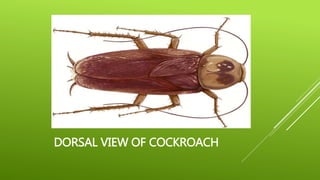
DORSAL VIEW OF COCKROACH
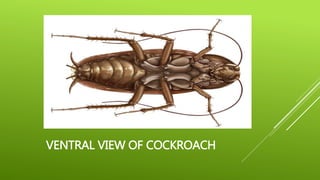
VENTRAL VIEW OF COCKROACH
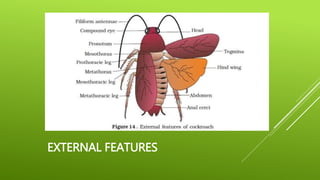
EXTERNAL FEATURES
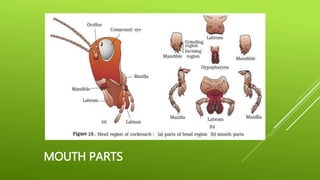
MOUTH PARTS
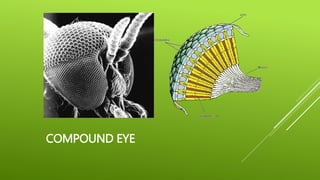
COMPOUND EYE
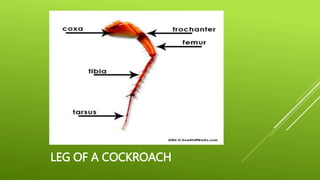
LEG OF A COCKROACH
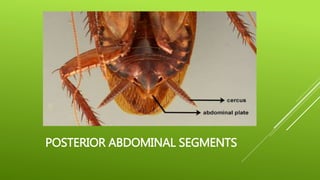
POSTERIOR ABDOMINAL SEGMENTS
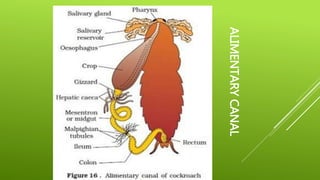
ALIMENTARYCANAL
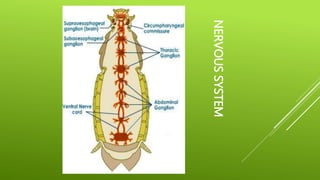
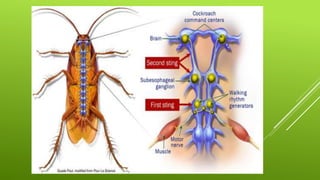
NERVOUSSYSTEM
SENSORY STRUCTURES
Thigmoreceptors: touch and feel receptors.
Olfactory receptors: sence of smell.
Gustatory receptors: sense of taste.
Thermoreceptors: detect changes in temperature.
Auditory receptors: sense of hearing.
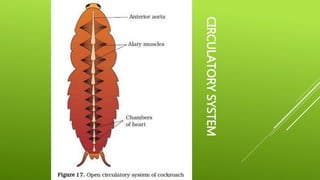
CIRCULATORYSYSTEM
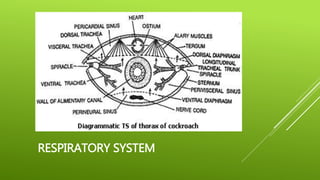
RESPIRATORY SYSTEM
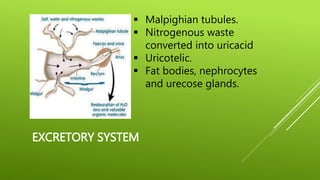
EXCRETORY SYSTEM
 Malpighian tubules.
 Nitrogenous waste
converted into uricacid
 Uricotelic.
 Fat bodies, nephrocytes
and urecose glands.
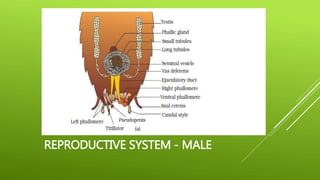
REPRODUCTIVE SYSTEM - MALE
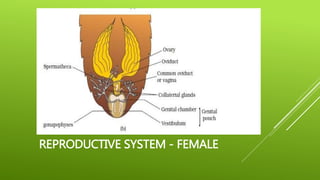
REPRODUCTIVE SYSTEM - FEMALE
GROWTH AND DEVELOPMENT
Young ones are called nymphs, emerge from
ootheca and lacks wings and mature sex
organs.
Metamorphosis is regulated by two
hormones, ecdysone secreted by prothoracic
glands and juvenile hormone secreted by
corpora allata.
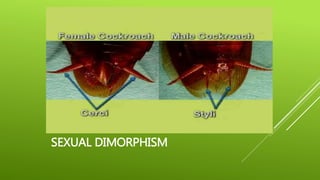
SEXUAL DIMORPHISM
ECONOMIC IMPORTANCE
Cockroaches are nocturnal omnivores.
Cockroaches have become residents of
human homes.
vectors of several diseases.
It is a serious storage pest.
REFERENCE
 NCERT BOOKS.
 WIKEPEDIA.
THANK YOU

Morphology of cockroach

Editor's Notes

  • #6 Body – elongated , colour , exoskeleton - wax Body – head , thorax , abdomen. Three pair legs , two pair wings. Fore wing- tegmina ,hindwing membranous,
  • #7 Labrum – broad flattened terminal sclerite in dorsal side of the head. Epipharynx(chemoreceptors) on inner side. Mandibles : Thick hard and triangular appendages beneath the labrum, on each lateral side of the mouth, which bear pointed, teeth like processes called denticles. First maxillae: Located on each side of the mouth next to mandibles for cutting and chewing. They also bear olfactory receptors. Labium: The second maxillae are fused together forming a single large structure which covers the mouth from ventral side, hence called the 'lower lip' or labium. It bears tacticle and gustatory sensory setae. Hypopharynx: It is a small, cylindrical mouthpart, sand witched between first maxillae and covered by labrum and labium on dorsal and ventral sides respectively.
  • #8 The compound eyes are situated at the dorsal surface of the head. consists of about 2000 hexagonal ommatidia  kind of vision is known as mosaic vision  with more sensitivity but less resolution, being common during night (hence called nocturnal vision).
  • #9 Cursorial legs. Pro thoracic, meso , meta . Coxa – attachment, Trochanter – knee, Femur and tibia – thigh and shin bones. Tarsus – ankle and foot.
  • #11 Fore gut , mid , hind. Fore gut(stomadaeum) Gizzard - muscular and internally provided with six cutical teeth which crushes the food. Midgut (mesenteron or ventriculus) Hindgut (proctodaeum) comprises ileum, colon and rectum. Omnivorous Most of the nutrients of food are digested in the crop.
  • #12 1.Central Nervous System 2.Peripheral Nervous System 3.Sympathetic or Visceral System
  • #13 Central Nervous System: brain , Peripheral Nervous System: nerves, which are given off from the ganglia so as to innervate all the parts of the body. Visceral Nervous System: frontal ganglion , visceral ganglion  The frontal ganglion is jointed with the central nervous system by nerves, which connect the circumoesophageal commissures.
  • #14 Thigmoreceptors:  body, antenna, maxillary palps and legs. Olfactory receptors: antenna and palps. Gustatory receptors: maxilla and labial palps. Thermoreceptors:  present on the pads between the first four tarsals. Auditory receptors: anal cerci respond to air or earth borne vibrations.
  • #15 body cavity or haemocoel the dorsal pericardial sinus , the middle perivisceral sinus and the ventral perineural sinus.
  • #16 network of trachea, 10 pairs of spiracles. – lateral sides. Opening of the spiracles – spinchter Exchange – tracheoles – diffusion.
  • #18 Testes – abdominal segment 4,5 and 6.. Seminal vessels are associated with mushroom glands.
  • #19 Female genitalia consists of 3 pairs of chitinous processes hanging from the roof of oothecal chamber into its cavity. Ootheca of cockroach contains sixteen fertilized eggs. Ootheca of cockroach is formed of a protein secreted by colleterial glands.