BIOCONTROL OF COCKROACH
ARUNKUMAR AKKANNA
PALB5125
1
Introduction
 Cockroaches are insects of the order Blattodea,
 Currently, there are 4,600 species described and over 460 genera
worldwide.
 Four species are important.
 The earliest cockroach-like fossils ("blattopterans" or "roachids")
are from the Carboniferous period 320 million years ago, as are
fossil roachoid nymphs.
 Cockroaches are generalized insects, with few special adaptations,
and may be among the most primitive living neopteran insects.
2
CLASSIFICATION
Kingdom Animalia
Phylum Arthropoda
Sub phylum Hexapoda
Class Insecta
Subclass Pterygota
Infra class Neoptera
Superorder Dictyoptera
Order Blattodea
Families
Blaberidae,Blattellidae
Blattidae,Cryptocercidae
Polyphagidae
Nocticolidae
Tryonicidae
Lamproblattidae
3
TYPES OF COCKROACHES
American cockroach Periplanata
americana Linnaeus.
German cockroach Blatella
germanica Linnaeus
Brown banded cockroach Supella
longipalpa Linnaeus
Oriental cockroach Blatella
orientalis Linnaeus
4
AMERICAN COCKROACH Periplanata americana
 The American cockroach is the largest of the
house-infesting cockroaches.
 Despite its name, the American cockroach is
not native to North America,
 but was probably introduced via ships from
Africa in the 1600s.
 believed to be of North African origin,
 Oriental roaches are sometimes called
"waterbugs" because they come out of
drains, and "black beetle cockroaches"
because of their smooth, dark bodies.
 They are known for their strong,
unpleasant, "roachy" odor
Oriental cockroach Blata orientalis
5
Supella longipalpa (BROWN BANDED COCKROACH)
 two lighter bands they have across
their dark brownish bodies.
 Male brown-banded roaches have
full wings that reach beyond the tip of
their pointed abdomens, but females
have underdeveloped wings that
prohibit them from flying.
 the brown-banded cockroach can live
for about 206 days.
German cockroach Blattella germanica
 The German cockroach is the most
common species of the cockroach.
 German cockroaches can breed at a
rate of up to six generations per year.
 The German cockroach can fit through
an opening as small as 3/8 inch in
width.
6
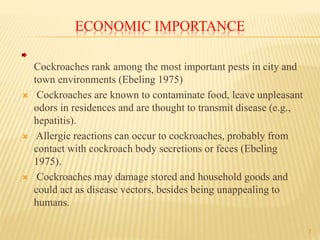
ECONOMIC IMPORTANCE
Cockroaches rank among the most important pests in city and
town environments (Ebeling 1975)
 Cockroaches are known to contaminate food, leave unpleasant
odors in residences and are thought to transmit disease (e.g.,
hepatitis).
 Allergic reactions can occur to cockroaches, probably from
contact with cockroach body secretions or feces (Ebeling
1975).
 Cockroaches may damage stored and household goods and
could act as disease vectors, besides being unappealing to
humans.
7
HISTORY OF BIOCONTROL
 LeBeck (1985) reviewed natural control of cockroaches,
pointing out that Hymenoptera which were associated with
cockroaches as either parasitoids or predators are found in the
families Ampulicidae, Evaniidae and the chalcidoid families
Encyrtidae, Eulophidae, Eupelmidae and Pteromalidae (Roth &
Willis 1960).
 Most species are parasitoids of cockroach oothecae, while
members of the Ampulicidae are predators of cockroach
nymphs.
8
COCKROACH NATURAL ENEMIES CONSIDERED BY FAMILY
Ampulicidae:
 Ampulicids are all predators of
cockroaches (Krombein 1979).
 Piek et al. (1984) determined
that Ampulex compressa Fab.
stings its prey twice.
 The first sting in the thorax area
causes a short,a reversible
paralysis, while the second sting
near the subesophageal ganglion
results in submissive, lethargic
behavior.
9
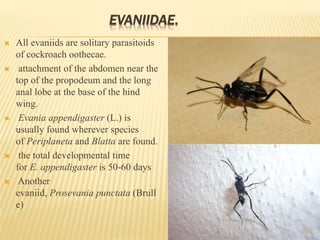
 All evaniids are solitary parasitoids
of cockroach oothecae.
 attachment of the abdomen near the
top of the propodeum and the long
anal lobe at the base of the hind
wing.
 Evania appendigaster (L.) is
usually found wherever species
of Periplaneta and Blatta are found.
 the total developmental time
for E. appendigaster is 50-60 days
 Another
evaniid, Prosevania punctata (Brull
e)
EVANIIDAE.
10
EUPELMIDAE.-
 Roth & Willis (1960)
identified different
eupelmid species as
parasitoids of cockroach
oothecae.
 Anastatus blattidifurax
Girault,(aus)
 Eupelmus atriflagellum(
aus)
 Anastatus umae sp.
nov.(ind)
11
 a eupelmid reared from the oothecae
of Neostylopyga rhombifolia in India by Narasimham &
Sankaran (1979), reported parasitization rates of 27-84%
from 164 oothecae.
 when offered a choice
between N. rhombifolia and Periplaneta sp., A. umae al
ways chose the former.
 N. rhombifolia which is a domestic pest in India,
especially in thatched huts. There the roach deposits
oothecae only on the inner side of palm leaves which
form the roof.
12
ENCYRTIDAE
 The biology of only one encyrtid
oothecal parasitoid of
cockroaches, Comperia merceti(Com
pere) has been studied (Roth &
Willis 1960, LeBeck 1985).
 all studies indicate that C. merceti is
host specific for the oothecae
of Supella longipalpa (LeBeck
1985).
13
 The egg parasitoid,Comperia merceti (Compere)
has potential for use in biological control.
 This parasitoid seems to have a significant impact
on brown banded cockroach when densities of
oothecae are high (Coler et al. 1984).
 Comperia merceti has been used for brownbanded
cockroach control with great success (Slater 1980).
14
 The first mass culture and experimental release
of C. merceti against brownbanded cockroaches was attempted by
Slater et al. (1980) on the campus of the University of California,
Berkeley.
 During Jan 1978-Dec 1979, over 20,000 parasitoids were released
in offices, classrooms, animal rearing rooms and
laboratories. Results showed that C. merceti successfully became
established.
 It was suggested that periodic augmentation of the parasitoid
might increase parasitization rates which only reached 19% in one
location.
 Similar natural parasitization rates (19.5%) for C. merceti were
reported by Narasimham & Sankaran 1979) in India.
15
EULOPHIDAE.
Two genera such as
1Tetrastichus hagenowii
2Syntomosphyrum blattae, contain several gregarious parasitoids of
cockroach oothecae.
 Tetrastichus hagenowii (Ratzeburg), has the broadest host range,
including the most cosmopolitan cockroach pests (LeBeck 1985).
 Tetrastichus hagenowii has a broad host range, but it laboratory tests
showed that prefers to the oothecae ofPeriplaneta spp.,
especially P. americana ( Narasimham 1984).
 Host searching of T. hagenowii was studied by Narasimham
(1984), showing that parasitoids first seek the proper habitat.
16
 They are attracted to relatively dry environments, became inactive at
19°C and avoided high temperatures (>34°C).
 Visual stimuli did not appear to function in host location, and
following trials that included oothecal extracts, Narasimham (1984)
concluded that the female was not attracted to the host by chemical
stimuli either.
 There were random movements of the female observed until she was
within 2-3 mm of an ootheca.
 Oothecae up to 30 days old were acceptable for oviposition, but
those close to hatching were rejected (Roth & Willis 1954b).
17
Entomopathogenic fungi
 Metarhizium anisopliae(metschnikoff)
 Beauveria bassiana (Balsamo) Vuillemin
Green muscardine,metarhizium White muscardine. 18
EFFECT OF Metarhizium anisopliae(metschnikoff) ON
GERMAN COCKROACH.
 Virulence of Metarhizium anisopliae(Metschnikoff)
against the German Cockroach, Blatella germanica(L.),
was determined using four concentrations ranging from
4.2x10⁶to 4.2x10⁹spores per millilitre.
 The LD50 value was 1.4x10⁷ spores per millilitre (56,000
spores per cockroach) and LT50 values were 14.8 days
and 5.3 days for4.2x108and 4.2x10⁹ spores per millilitre,
respectively.
 Potential of this strain to be horizontally transmitted and
to rapidly spread the infection in the insect population.
E. Moraga,et al(2004) 19
 The mean number of oothecae laid by female
was progressively and significantly reduced by
fungal treatment from second oviposition period
onwards.
 Oothecal hatch of fungally challenged females
was reduced by 46–49%, oothecal viability by
48–85%, and nymphal production by 22–35%.
E. -Moraga,et al
(2004)
20
PATHOGENICITY OF Metarhizium anisopliae AND Beauveriabassiana TO THE
AMERICAN COCKROACH (DICTYOPTERA: BLATTIDAE)
 The entomopathogenic fungus Beauveria bassiana Vuillemin
1912 and Metarhizium anisopliae (Metschnikoff) Sorokin
1976 were tested against Periplaneta americana cockroach
under laboratory conditions (1.1 x 10⁶ conidia/cockroach, 24
± 2°C and 50
 The isolates tested against nymphs and adults of P.
americana showed low pathogenic potential and significant
mortality differences ± 10% RH).
 Adults exhibited less mortality than nymphs, which showed
behavioral changes once they received a conidial suspension.
21
 A second experiment evaluated if different mortality could exist
in adult cockroach under controlled conditions (85 ± 10 % RH,
27°C).
 Cockroach adults were susceptible to infection by M. anisopliae
and B. bassiana; under high relative humidity conditions these
fungi caused more mortality (47%), compared with laboratory
conditions).
G. HERNANDEZ-RAMIREZ,et al(2008)
22
23

bio control of cockroach

  • 1.
  • 2.
    Introduction  Cockroaches areinsects of the order Blattodea,  Currently, there are 4,600 species described and over 460 genera worldwide.  Four species are important.  The earliest cockroach-like fossils ("blattopterans" or "roachids") are from the Carboniferous period 320 million years ago, as are fossil roachoid nymphs.  Cockroaches are generalized insects, with few special adaptations, and may be among the most primitive living neopteran insects. 2
  • 3.
    CLASSIFICATION Kingdom Animalia Phylum Arthropoda Subphylum Hexapoda Class Insecta Subclass Pterygota Infra class Neoptera Superorder Dictyoptera Order Blattodea Families Blaberidae,Blattellidae Blattidae,Cryptocercidae Polyphagidae Nocticolidae Tryonicidae Lamproblattidae 3
  • 4.
    TYPES OF COCKROACHES Americancockroach Periplanata americana Linnaeus. German cockroach Blatella germanica Linnaeus Brown banded cockroach Supella longipalpa Linnaeus Oriental cockroach Blatella orientalis Linnaeus 4
  • 5.
    AMERICAN COCKROACH Periplanataamericana  The American cockroach is the largest of the house-infesting cockroaches.  Despite its name, the American cockroach is not native to North America,  but was probably introduced via ships from Africa in the 1600s.  believed to be of North African origin,  Oriental roaches are sometimes called "waterbugs" because they come out of drains, and "black beetle cockroaches" because of their smooth, dark bodies.  They are known for their strong, unpleasant, "roachy" odor Oriental cockroach Blata orientalis 5
  • 6.
    Supella longipalpa (BROWNBANDED COCKROACH)  two lighter bands they have across their dark brownish bodies.  Male brown-banded roaches have full wings that reach beyond the tip of their pointed abdomens, but females have underdeveloped wings that prohibit them from flying.  the brown-banded cockroach can live for about 206 days. German cockroach Blattella germanica  The German cockroach is the most common species of the cockroach.  German cockroaches can breed at a rate of up to six generations per year.  The German cockroach can fit through an opening as small as 3/8 inch in width. 6
  • 7.
    ECONOMIC IMPORTANCE Cockroaches rankamong the most important pests in city and town environments (Ebeling 1975)  Cockroaches are known to contaminate food, leave unpleasant odors in residences and are thought to transmit disease (e.g., hepatitis).  Allergic reactions can occur to cockroaches, probably from contact with cockroach body secretions or feces (Ebeling 1975).  Cockroaches may damage stored and household goods and could act as disease vectors, besides being unappealing to humans. 7
  • 8.
    HISTORY OF BIOCONTROL LeBeck (1985) reviewed natural control of cockroaches, pointing out that Hymenoptera which were associated with cockroaches as either parasitoids or predators are found in the families Ampulicidae, Evaniidae and the chalcidoid families Encyrtidae, Eulophidae, Eupelmidae and Pteromalidae (Roth & Willis 1960).  Most species are parasitoids of cockroach oothecae, while members of the Ampulicidae are predators of cockroach nymphs. 8
  • 9.
    COCKROACH NATURAL ENEMIESCONSIDERED BY FAMILY Ampulicidae:  Ampulicids are all predators of cockroaches (Krombein 1979).  Piek et al. (1984) determined that Ampulex compressa Fab. stings its prey twice.  The first sting in the thorax area causes a short,a reversible paralysis, while the second sting near the subesophageal ganglion results in submissive, lethargic behavior. 9
  • 10.
     All evaniidsare solitary parasitoids of cockroach oothecae.  attachment of the abdomen near the top of the propodeum and the long anal lobe at the base of the hind wing.  Evania appendigaster (L.) is usually found wherever species of Periplaneta and Blatta are found.  the total developmental time for E. appendigaster is 50-60 days  Another evaniid, Prosevania punctata (Brull e) EVANIIDAE. 10
  • 11.
    EUPELMIDAE.-  Roth &Willis (1960) identified different eupelmid species as parasitoids of cockroach oothecae.  Anastatus blattidifurax Girault,(aus)  Eupelmus atriflagellum( aus)  Anastatus umae sp. nov.(ind) 11
  • 12.
     a eupelmidreared from the oothecae of Neostylopyga rhombifolia in India by Narasimham & Sankaran (1979), reported parasitization rates of 27-84% from 164 oothecae.  when offered a choice between N. rhombifolia and Periplaneta sp., A. umae al ways chose the former.  N. rhombifolia which is a domestic pest in India, especially in thatched huts. There the roach deposits oothecae only on the inner side of palm leaves which form the roof. 12
  • 13.
    ENCYRTIDAE  The biologyof only one encyrtid oothecal parasitoid of cockroaches, Comperia merceti(Com pere) has been studied (Roth & Willis 1960, LeBeck 1985).  all studies indicate that C. merceti is host specific for the oothecae of Supella longipalpa (LeBeck 1985). 13
  • 14.
     The eggparasitoid,Comperia merceti (Compere) has potential for use in biological control.  This parasitoid seems to have a significant impact on brown banded cockroach when densities of oothecae are high (Coler et al. 1984).  Comperia merceti has been used for brownbanded cockroach control with great success (Slater 1980). 14
  • 15.
     The firstmass culture and experimental release of C. merceti against brownbanded cockroaches was attempted by Slater et al. (1980) on the campus of the University of California, Berkeley.  During Jan 1978-Dec 1979, over 20,000 parasitoids were released in offices, classrooms, animal rearing rooms and laboratories. Results showed that C. merceti successfully became established.  It was suggested that periodic augmentation of the parasitoid might increase parasitization rates which only reached 19% in one location.  Similar natural parasitization rates (19.5%) for C. merceti were reported by Narasimham & Sankaran 1979) in India. 15
  • 16.
    EULOPHIDAE. Two genera suchas 1Tetrastichus hagenowii 2Syntomosphyrum blattae, contain several gregarious parasitoids of cockroach oothecae.  Tetrastichus hagenowii (Ratzeburg), has the broadest host range, including the most cosmopolitan cockroach pests (LeBeck 1985).  Tetrastichus hagenowii has a broad host range, but it laboratory tests showed that prefers to the oothecae ofPeriplaneta spp., especially P. americana ( Narasimham 1984).  Host searching of T. hagenowii was studied by Narasimham (1984), showing that parasitoids first seek the proper habitat. 16
  • 17.
     They areattracted to relatively dry environments, became inactive at 19°C and avoided high temperatures (>34°C).  Visual stimuli did not appear to function in host location, and following trials that included oothecal extracts, Narasimham (1984) concluded that the female was not attracted to the host by chemical stimuli either.  There were random movements of the female observed until she was within 2-3 mm of an ootheca.  Oothecae up to 30 days old were acceptable for oviposition, but those close to hatching were rejected (Roth & Willis 1954b). 17
  • 18.
    Entomopathogenic fungi  Metarhiziumanisopliae(metschnikoff)  Beauveria bassiana (Balsamo) Vuillemin Green muscardine,metarhizium White muscardine. 18
  • 19.
    EFFECT OF Metarhiziumanisopliae(metschnikoff) ON GERMAN COCKROACH.  Virulence of Metarhizium anisopliae(Metschnikoff) against the German Cockroach, Blatella germanica(L.), was determined using four concentrations ranging from 4.2x10⁶to 4.2x10⁹spores per millilitre.  The LD50 value was 1.4x10⁷ spores per millilitre (56,000 spores per cockroach) and LT50 values were 14.8 days and 5.3 days for4.2x108and 4.2x10⁹ spores per millilitre, respectively.  Potential of this strain to be horizontally transmitted and to rapidly spread the infection in the insect population. E. Moraga,et al(2004) 19
  • 20.
     The meannumber of oothecae laid by female was progressively and significantly reduced by fungal treatment from second oviposition period onwards.  Oothecal hatch of fungally challenged females was reduced by 46–49%, oothecal viability by 48–85%, and nymphal production by 22–35%. E. -Moraga,et al (2004) 20
  • 21.
    PATHOGENICITY OF Metarhiziumanisopliae AND Beauveriabassiana TO THE AMERICAN COCKROACH (DICTYOPTERA: BLATTIDAE)  The entomopathogenic fungus Beauveria bassiana Vuillemin 1912 and Metarhizium anisopliae (Metschnikoff) Sorokin 1976 were tested against Periplaneta americana cockroach under laboratory conditions (1.1 x 10⁶ conidia/cockroach, 24 ± 2°C and 50  The isolates tested against nymphs and adults of P. americana showed low pathogenic potential and significant mortality differences ± 10% RH).  Adults exhibited less mortality than nymphs, which showed behavioral changes once they received a conidial suspension. 21
  • 22.
     A secondexperiment evaluated if different mortality could exist in adult cockroach under controlled conditions (85 ± 10 % RH, 27°C).  Cockroach adults were susceptible to infection by M. anisopliae and B. bassiana; under high relative humidity conditions these fungi caused more mortality (47%), compared with laboratory conditions). G. HERNANDEZ-RAMIREZ,et al(2008) 22
  • 23.