Chapter-7
Structural Organisation in Animal
Morphology and Anatomy of Frog
Lecture no.-5
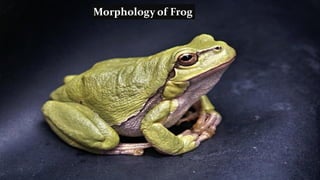
Morphology of Frog
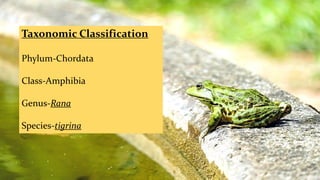
Taxonomic Classification
Phylum-Chordata
Class-Amphibia
Genus-Rana
Species-tigrina
General Characteristics
 They do not have constant body
temperature
 They are cold blooded animal or
poikilotherms.
 They have the ability to change the
colour to hide them from their enemies
(camouflage).
 This protective coloration is called
mimicry.
 They take shelter in deep burrows to
protect them from extreme heat and
cold.
 This is known as summer sleep
(aestivation) and winter sleep
(hibernation) respectively.
The skin is smooth and slippery due to
the presence of mucus.
 The skin is always maintained in a moist
condition.
 The colour of dorsal side of body is
generally olive green with dark irregular
spots.
On the ventral side the skin is uniformly
pale yellow. The frog never drinks water
but absorb it through the skin
Morphology
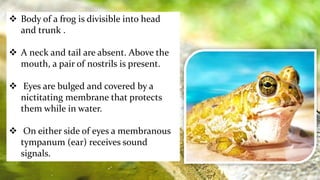
 Body of a frog is divisible into head
and trunk .
 A neck and tail are absent. Above the
mouth, a pair of nostrils is present.
 Eyes are bulged and covered by a
nictitating membrane that protects
them while in water.
 On either side of eyes a membranous
tympanum (ear) receives sound
signals.
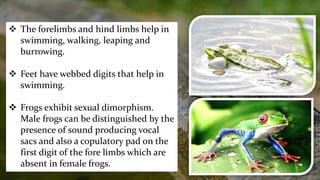
 The forelimbs and hind limbs help in
swimming, walking, leaping and
burrowing.
 Feet have webbed digits that help in
swimming.
 Frogs exhibit sexual dimorphism.
Male frogs can be distinguished by the
presence of sound producing vocal
sacs and also a copulatory pad on the
first digit of the fore limbs which are
absent in female frogs.
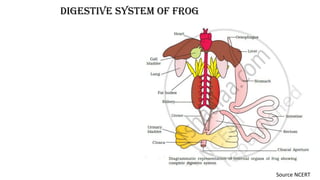
Digestive system of frog
Source NCERT
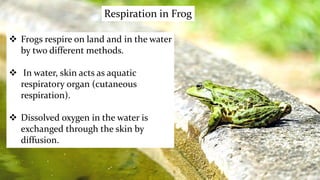
 Frogs respire on land and in the water
by two different methods.
 In water, skin acts as aquatic
respiratory organ (cutaneous
respiration).
 Dissolved oxygen in the water is
exchanged through the skin by
diffusion.
Respiration in Frog
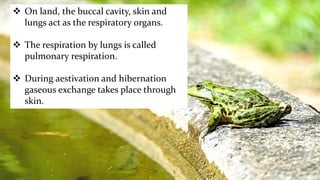
 On land, the buccal cavity, skin and
lungs act as the respiratory organs.
 The respiration by lungs is called
pulmonary respiration.
 During aestivation and hibernation
gaseous exchange takes place through
skin.
Circulatory System in Frog
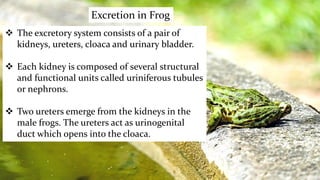
Excretion in Frog
 The excretory system consists of a pair of
kidneys, ureters, cloaca and urinary bladder.
 Each kidney is composed of several structural
and functional units called uriniferous tubules
or nephrons.
 Two ureters emerge from the kidneys in the
male frogs. The ureters act as urinogenital
duct which opens into the cloaca.
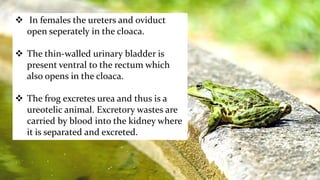
 In females the ureters and oviduct
open seperately in the cloaca.
 The thin-walled urinary bladder is
present ventral to the rectum which
also opens in the cloaca.
 The frog excretes urea and thus is a
ureotelic animal. Excretory wastes are
carried by blood into the kidney where
it is separated and excreted.
Nervous System
Brain:
 Fore brain
 Mid Brain
 Hind Brain
The nervous system is organized
into:
 Central nervous system
 Peripheral nervous system
 Autonomic nervous system
 Frogs cranial nerve- 10 pairs
 Human Cranial nerve- 12 pairs
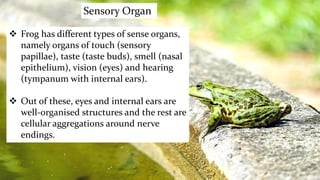
 Frog has different types of sense organs,
namely organs of touch (sensory
papillae), taste (taste buds), smell (nasal
epithelium), vision (eyes) and hearing
(tympanum with internal ears).
 Out of these, eyes and internal ears are
well-organised structures and the rest are
cellular aggregations around nerve
endings.
Sensory Organ
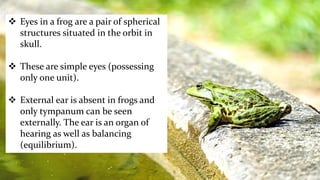
 Eyes in a frog are a pair of spherical
structures situated in the orbit in
skull.
 These are simple eyes (possessing
only one unit).
 External ear is absent in frogs and
only tympanum can be seen
externally. The ear is an organ of
hearing as well as balancing
(equilibrium).
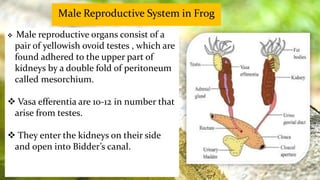
 Male reproductive organs consist of a
pair of yellowish ovoid testes , which are
found adhered to the upper part of
kidneys by a double fold of peritoneum
called mesorchium.
 Vasa efferentia are 10-12 in number that
arise from testes.
 They enter the kidneys on their side
and open into Bidder’s canal.
Finally it communicates with the
urinogenital duct that comes out of the
kidneys and opens into the cloaca.
 The cloaca is a small, median chamber
that is used to pass faecal matter, urine
and sperms to the exterior
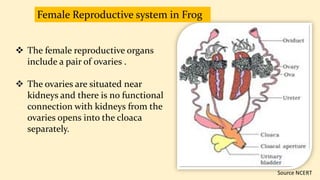
Female Reproductive system in Frog
 The female reproductive organs
include a pair of ovaries .
 The ovaries are situated near
kidneys and there is no functional
connection with kidneys from the
ovaries opens into the cloaca
separately.
 A mature female can lay 2500
to 3000 ova at a time.
 Fertilisation is external and
takes place in water.
 Development involves a
larval stage called tadpole.
Tadpole undergoes
metamorphosis to form the
adult
Frogs are beneficial for mankind because
 They eat insects and protect the crop.
 Frogs maintain ecological balance
because these serve as an important
link of food chain and food web in the
ecosystem.
 In some countries the muscular legs of
frog are used as food by man.
Benefits of Frog
Class 11 Biology Structural Organisation in Animals

Class 11 Biology Structural Organisation in Animals

  • 2.
    Chapter-7 Structural Organisation inAnimal Morphology and Anatomy of Frog Lecture no.-5
  • 3.
  • 4.
  • 5.
    General Characteristics  Theydo not have constant body temperature  They are cold blooded animal or poikilotherms.  They have the ability to change the colour to hide them from their enemies (camouflage).
  • 6.
     This protectivecoloration is called mimicry.  They take shelter in deep burrows to protect them from extreme heat and cold.  This is known as summer sleep (aestivation) and winter sleep (hibernation) respectively.
  • 8.
    The skin issmooth and slippery due to the presence of mucus.  The skin is always maintained in a moist condition.  The colour of dorsal side of body is generally olive green with dark irregular spots. On the ventral side the skin is uniformly pale yellow. The frog never drinks water but absorb it through the skin Morphology
  • 9.
     Body ofa frog is divisible into head and trunk .  A neck and tail are absent. Above the mouth, a pair of nostrils is present.  Eyes are bulged and covered by a nictitating membrane that protects them while in water.  On either side of eyes a membranous tympanum (ear) receives sound signals.
  • 10.
     The forelimbsand hind limbs help in swimming, walking, leaping and burrowing.  Feet have webbed digits that help in swimming.  Frogs exhibit sexual dimorphism. Male frogs can be distinguished by the presence of sound producing vocal sacs and also a copulatory pad on the first digit of the fore limbs which are absent in female frogs.
  • 11.
    Digestive system offrog Source NCERT
  • 12.
     Frogs respireon land and in the water by two different methods.  In water, skin acts as aquatic respiratory organ (cutaneous respiration).  Dissolved oxygen in the water is exchanged through the skin by diffusion. Respiration in Frog
  • 13.
     On land,the buccal cavity, skin and lungs act as the respiratory organs.  The respiration by lungs is called pulmonary respiration.  During aestivation and hibernation gaseous exchange takes place through skin.
  • 14.
  • 15.
    Excretion in Frog The excretory system consists of a pair of kidneys, ureters, cloaca and urinary bladder.  Each kidney is composed of several structural and functional units called uriniferous tubules or nephrons.  Two ureters emerge from the kidneys in the male frogs. The ureters act as urinogenital duct which opens into the cloaca.
  • 16.
     In femalesthe ureters and oviduct open seperately in the cloaca.  The thin-walled urinary bladder is present ventral to the rectum which also opens in the cloaca.  The frog excretes urea and thus is a ureotelic animal. Excretory wastes are carried by blood into the kidney where it is separated and excreted.
  • 17.
    Nervous System Brain:  Forebrain  Mid Brain  Hind Brain The nervous system is organized into:  Central nervous system  Peripheral nervous system  Autonomic nervous system  Frogs cranial nerve- 10 pairs  Human Cranial nerve- 12 pairs
  • 18.
     Frog hasdifferent types of sense organs, namely organs of touch (sensory papillae), taste (taste buds), smell (nasal epithelium), vision (eyes) and hearing (tympanum with internal ears).  Out of these, eyes and internal ears are well-organised structures and the rest are cellular aggregations around nerve endings. Sensory Organ
  • 19.
     Eyes ina frog are a pair of spherical structures situated in the orbit in skull.  These are simple eyes (possessing only one unit).  External ear is absent in frogs and only tympanum can be seen externally. The ear is an organ of hearing as well as balancing (equilibrium).
  • 20.
     Male reproductiveorgans consist of a pair of yellowish ovoid testes , which are found adhered to the upper part of kidneys by a double fold of peritoneum called mesorchium.  Vasa efferentia are 10-12 in number that arise from testes.  They enter the kidneys on their side and open into Bidder’s canal.
  • 21.
    Finally it communicateswith the urinogenital duct that comes out of the kidneys and opens into the cloaca.  The cloaca is a small, median chamber that is used to pass faecal matter, urine and sperms to the exterior
  • 22.
    Female Reproductive systemin Frog  The female reproductive organs include a pair of ovaries .  The ovaries are situated near kidneys and there is no functional connection with kidneys from the ovaries opens into the cloaca separately.
  • 23.
     A maturefemale can lay 2500 to 3000 ova at a time.  Fertilisation is external and takes place in water.  Development involves a larval stage called tadpole. Tadpole undergoes metamorphosis to form the adult
  • 24.
    Frogs are beneficialfor mankind because  They eat insects and protect the crop.  Frogs maintain ecological balance because these serve as an important link of food chain and food web in the ecosystem.  In some countries the muscular legs of frog are used as food by man. Benefits of Frog