Topic: Larval forms of Echinodermata
SCHOOL OF STUDIES IN ZOOLOGY
Jiwaji University Gwalior
Dr. Ramkumar Lodhi
Conservation Biology Unit
Contents
• Introduction
• Larva
• LARVAL FORMS OF DIFFERENT CLASSES
– BIPINNARIA LARVA
– BRANCHOLARIA LARVA
– OPHIOPLUTEUS LARVA
– ECHINOPULTEUS LARVA
– AURICULARIA LARVA
– DOLIOLARIA LARVA
• Significance of Echinoderm larva
• References
Introduction
• The phylum Echinodermata represents the largest animal phylum of exclusively
marine animals.
• They include morphologically diverse animals.
• In most cases fertilization takes place in open water, the larvae hatch in water and
through successive larval stages metamorphose to become adults.
• Larvae of Echinoderms are bilaterally symmetrical but they looses their symmetry
during the process of metamorphosis.
• Different classes of Echinoderms show different larval forms.
• Echinoderms are unisexual animal with no sexual dimorphism.
• Echinoderms are deuterostomes and hence cleavage is radial, holoblastic and
indeterminate.
• The development may be direct or indirect.
• If the development is indirect it includes larva stages.
• In different classes of echinoderms, different types of larvae complete the
development.
• It undergoes metamorphosis and radial symmetrical adult is developed.
Larva
• The larvae hatch in water, feed and grow through
successive larval stages to become adults.
• Larvae of Echinoderms are bilaterally symmetrical
but lose symmetry during metamorphosis.
• Different classes of Echinoderms show structurally
different larval stages.
• Comparison of the larval stages of different classes
can reveal their evolutionary ancestry.
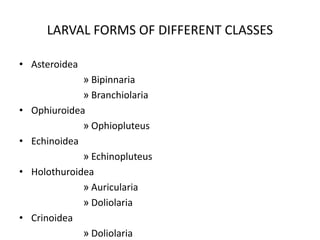
LARVAL FORMS OF DIFFERENT CLASSES
• Asteroidea
» Bipinnaria
» Branchiolaria
• Ophiuroidea
» Ophiopluteus
• Echinoidea
» Echinopluteus
• Holothuroidea
» Auricularia
» Doliolaria
• Crinoidea
» Doliolaria
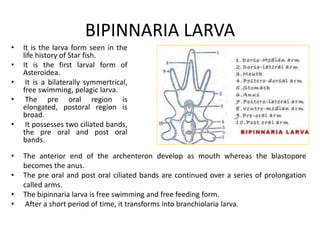
BIPINNARIA LARVA
• It is the larva form seen in the
life history of Star fish.
• It is the first larval form of
Asteroidea.
• It is a bilaterally symmertrical,
free swimming, pelagic larva.
• The pre oral region is
elongated, postoral region is
broad.
• It possesses two ciliated bands,
the pre oral and post oral
bands.
• The anterior end of the archenteron develop as mouth whereas the blastopore
becomes the anus.
• The pre oral and post oral ciliated bands are continued over a series of prolongation
called arms.
• The bipinnaria larva is free swimming and free feeding form.
• After a short period of time, it transforms into branchiolaria larva.
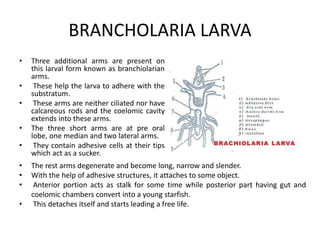
BRANCHOLARIA LARVA
• Three additional arms are present on
this larval form known as branchiolarian
arms.
• These help the larva to adhere with the
substratum.
• These arms are neither ciliated nor have
calcareous rods and the coelomic cavity
extends into these arms.
• The three short arms are at pre oral
lobe, one median and two lateral arms.
• They contain adhesive cells at their tips
which act as a sucker.
• The rest arms degenerate and become long, narrow and slender.
• With the help of adhesive structures, it attaches to some object.
• Anterior portion acts as stalk for some time while posterior part having gut and
coelomic chambers convert into a young starfish.
• This detaches itself and starts leading a free life.
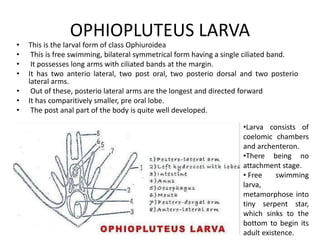
OPHIOPLUTEUS LARVA
• This is the larval form of class Ophiuroidea
• This is free swimming, bilateral symmetrical form having a single ciliated band.
• It possesses long arms with ciliated bands at the margin.
• It has two anterio lateral, two post oral, two posterio dorsal and two posterio
lateral arms.
• Out of these, posterio lateral arms are the longest and directed forward
• It has comparitively smaller, pre oral lobe.
• The post anal part of the body is quite well developed.
•Larva consists of
coelomic chambers
and archenteron.
•There being no
attachment stage.
• Free swimming
larva,
metamorphose into
tiny serpent star,
which sinks to the
bottom to begin its
adult existence.
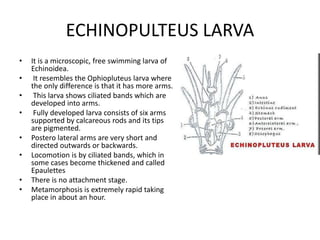
ECHINOPULTEUS LARVA
• It is a microscopic, free swimming larva of
Echinoidea.
• It resembles the Ophiopluteus larva where
the only difference is that it has more arms.
• This larva shows ciliated bands which are
developed into arms.
• Fully developed larva consists of six arms
supported by calcareous rods and its tips
are pigmented.
• Postero lateral arms are very short and
directed outwards or backwards.
• Locomotion is by ciliated bands, which in
some cases become thickened and called
Epaulettes
• There is no attachment stage.
• Metamorphosis is extremely rapid taking
place in about an hour.
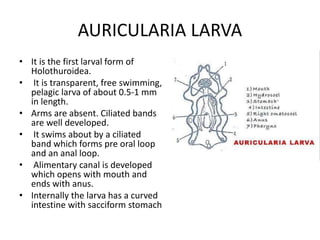
AURICULARIA LARVA
• It is the first larval form of
Holothuroidea.
• It is transparent, free swimming,
pelagic larva of about 0.5-1 mm
in length.
• Arms are absent. Ciliated bands
are well developed.
• It swims about by a ciliated
band which forms pre oral loop
and an anal loop.
• Alimentary canal is developed
which opens with mouth and
ends with anus.
• Internally the larva has a curved
intestine with sacciform stomach
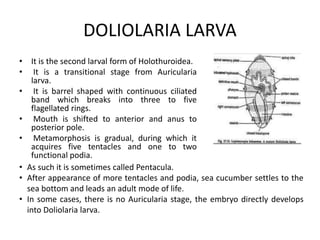
DOLIOLARIA LARVA
• It is the second larval form of Holothuroidea.
• It is a transitional stage from Auricularia
larva.
• It is barrel shaped with continuous ciliated
band which breaks into three to five
flagellated rings.
• Mouth is shifted to anterior and anus to
posterior pole.
• Metamorphosis is gradual, during which it
acquires five tentacles and one to two
functional podia.
• As such it is sometimes called Pentacula.
• After appearance of more tentacles and podia, sea cucumber settles to the
sea bottom and leads an adult mode of life.
• In some cases, there is no Auricularia stage, the embryo directly develops
into Doliolaria larva.
Significance of Echinoderm larva
• The larval forms of all classes in Echinodermata will
show general resemblance.
• The crinoidea larva differs from this pattern.
• In general all the larvae show that they might have
come from same ancestor.
• Hence the common ancestor is coelomate, bilaterally
symmetrical and free swimming.
• These larvae also show resemblance with Toronaria of
Balanoglossus.
• Thus the study of Echinoderm larva has a phylogenetic
significance.
References
» http://ppup.ac.in/download/econtent/pdf/LARVAL%20FORMS
» Google
» Barnes = The Invertebrates
Thank You

Echinodermata

  • 1.
    Topic: Larval formsof Echinodermata SCHOOL OF STUDIES IN ZOOLOGY Jiwaji University Gwalior Dr. Ramkumar Lodhi Conservation Biology Unit
  • 2.
    Contents • Introduction • Larva •LARVAL FORMS OF DIFFERENT CLASSES – BIPINNARIA LARVA – BRANCHOLARIA LARVA – OPHIOPLUTEUS LARVA – ECHINOPULTEUS LARVA – AURICULARIA LARVA – DOLIOLARIA LARVA • Significance of Echinoderm larva • References
  • 3.
    Introduction • The phylumEchinodermata represents the largest animal phylum of exclusively marine animals. • They include morphologically diverse animals. • In most cases fertilization takes place in open water, the larvae hatch in water and through successive larval stages metamorphose to become adults. • Larvae of Echinoderms are bilaterally symmetrical but they looses their symmetry during the process of metamorphosis. • Different classes of Echinoderms show different larval forms. • Echinoderms are unisexual animal with no sexual dimorphism. • Echinoderms are deuterostomes and hence cleavage is radial, holoblastic and indeterminate. • The development may be direct or indirect. • If the development is indirect it includes larva stages. • In different classes of echinoderms, different types of larvae complete the development. • It undergoes metamorphosis and radial symmetrical adult is developed.
  • 4.
    Larva • The larvaehatch in water, feed and grow through successive larval stages to become adults. • Larvae of Echinoderms are bilaterally symmetrical but lose symmetry during metamorphosis. • Different classes of Echinoderms show structurally different larval stages. • Comparison of the larval stages of different classes can reveal their evolutionary ancestry.
  • 5.
    LARVAL FORMS OFDIFFERENT CLASSES • Asteroidea » Bipinnaria » Branchiolaria • Ophiuroidea » Ophiopluteus • Echinoidea » Echinopluteus • Holothuroidea » Auricularia » Doliolaria • Crinoidea » Doliolaria
  • 6.
    BIPINNARIA LARVA • Itis the larva form seen in the life history of Star fish. • It is the first larval form of Asteroidea. • It is a bilaterally symmertrical, free swimming, pelagic larva. • The pre oral region is elongated, postoral region is broad. • It possesses two ciliated bands, the pre oral and post oral bands. • The anterior end of the archenteron develop as mouth whereas the blastopore becomes the anus. • The pre oral and post oral ciliated bands are continued over a series of prolongation called arms. • The bipinnaria larva is free swimming and free feeding form. • After a short period of time, it transforms into branchiolaria larva.
  • 7.
    BRANCHOLARIA LARVA • Threeadditional arms are present on this larval form known as branchiolarian arms. • These help the larva to adhere with the substratum. • These arms are neither ciliated nor have calcareous rods and the coelomic cavity extends into these arms. • The three short arms are at pre oral lobe, one median and two lateral arms. • They contain adhesive cells at their tips which act as a sucker. • The rest arms degenerate and become long, narrow and slender. • With the help of adhesive structures, it attaches to some object. • Anterior portion acts as stalk for some time while posterior part having gut and coelomic chambers convert into a young starfish. • This detaches itself and starts leading a free life.
  • 8.
    OPHIOPLUTEUS LARVA • Thisis the larval form of class Ophiuroidea • This is free swimming, bilateral symmetrical form having a single ciliated band. • It possesses long arms with ciliated bands at the margin. • It has two anterio lateral, two post oral, two posterio dorsal and two posterio lateral arms. • Out of these, posterio lateral arms are the longest and directed forward • It has comparitively smaller, pre oral lobe. • The post anal part of the body is quite well developed. •Larva consists of coelomic chambers and archenteron. •There being no attachment stage. • Free swimming larva, metamorphose into tiny serpent star, which sinks to the bottom to begin its adult existence.
  • 9.
    ECHINOPULTEUS LARVA • Itis a microscopic, free swimming larva of Echinoidea. • It resembles the Ophiopluteus larva where the only difference is that it has more arms. • This larva shows ciliated bands which are developed into arms. • Fully developed larva consists of six arms supported by calcareous rods and its tips are pigmented. • Postero lateral arms are very short and directed outwards or backwards. • Locomotion is by ciliated bands, which in some cases become thickened and called Epaulettes • There is no attachment stage. • Metamorphosis is extremely rapid taking place in about an hour.
  • 10.
    AURICULARIA LARVA • Itis the first larval form of Holothuroidea. • It is transparent, free swimming, pelagic larva of about 0.5-1 mm in length. • Arms are absent. Ciliated bands are well developed. • It swims about by a ciliated band which forms pre oral loop and an anal loop. • Alimentary canal is developed which opens with mouth and ends with anus. • Internally the larva has a curved intestine with sacciform stomach
  • 11.
    DOLIOLARIA LARVA • Itis the second larval form of Holothuroidea. • It is a transitional stage from Auricularia larva. • It is barrel shaped with continuous ciliated band which breaks into three to five flagellated rings. • Mouth is shifted to anterior and anus to posterior pole. • Metamorphosis is gradual, during which it acquires five tentacles and one to two functional podia. • As such it is sometimes called Pentacula. • After appearance of more tentacles and podia, sea cucumber settles to the sea bottom and leads an adult mode of life. • In some cases, there is no Auricularia stage, the embryo directly develops into Doliolaria larva.
  • 12.
    Significance of Echinodermlarva • The larval forms of all classes in Echinodermata will show general resemblance. • The crinoidea larva differs from this pattern. • In general all the larvae show that they might have come from same ancestor. • Hence the common ancestor is coelomate, bilaterally symmetrical and free swimming. • These larvae also show resemblance with Toronaria of Balanoglossus. • Thus the study of Echinoderm larva has a phylogenetic significance.
  • 13.
  • 14.