Life Cycles of Insects! Continue clicking to find out more.
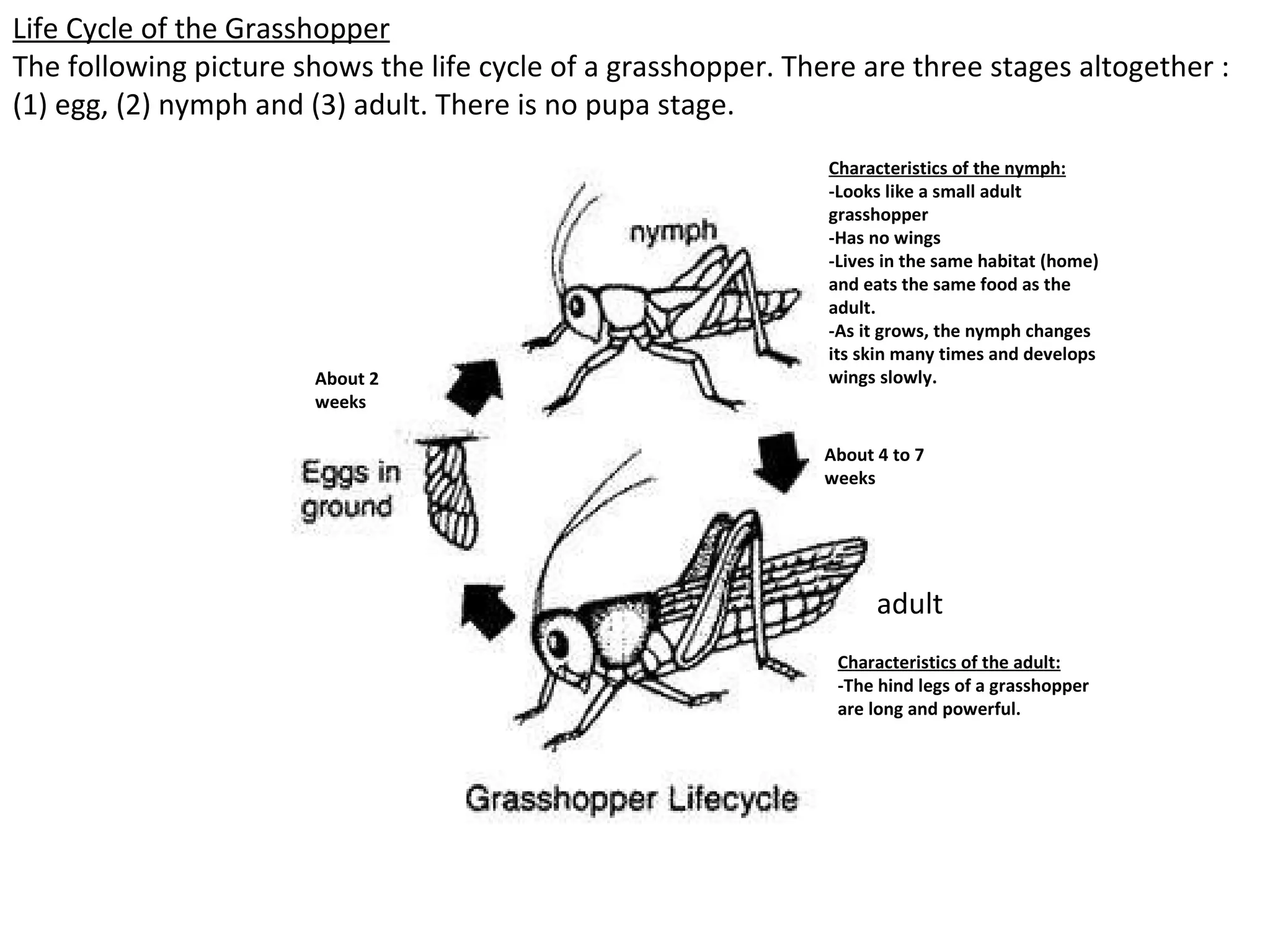
Life Cycle of the Grasshopper The following picture shows the life cycle of a grasshopper. There are three stages altogether : (1) egg, (2) nymph and (3) adult. There is no pupa stage.  
 About 2 weeks Characteristics of the nymph: -Looks like a small adult grasshopper -Has no wings -Lives in the same habitat (home) and eats the same food as the adult. -As it grows, the nymph changes its skin many times and develops wings slowly. Characteristics of the adult: -The hind legs of a grasshopper are long and powerful. adult About 4 to 7 weeks
Qu estions Name the life cycle of the insect your group is writing about. What is the total number of stages in the life cycle of the grasshopper? What happened  in the beginning ? What happened  after a few weeks ? Then , what did the nymph do after it hatched from the egg? What did it become  next ?  Name the characteristics of the adult grasshopper. Life Cycle of the Grasshopper
Life Cycle of the Mosquito The following picture shows the life cycle of a mosquito. There are four stages altogether : (1) eggs, (2) larva (3) pupa and (4) adult. 
 2 to 3 days 8 to 10 days 1 to 2 days Eggs are laid on the surface of stagnant water -Larva wriggles about in the water -Feeds on tiny food particles, dead plants and algae -Changes skin as it grows -Pupa is comma-shaped -rolls and tumbles in the water -does not eat -Adult mosquitoes can fly -Female mosquitoes feed on blood -Male mosquitoes feed on plant nectar and juices
Qu estions Name the life cycle of the insect your group is writing about. What is the total number of stages in the life cycle of the mosquito? What happened  in the beginning ? What happened after  a few days ? Then , what did the larva do after it hatched from the egg? What did it become  next ?  Name the characteristics of the pupa. After some time , what happened after the pupa stage? Life Cycle of the Mosquito
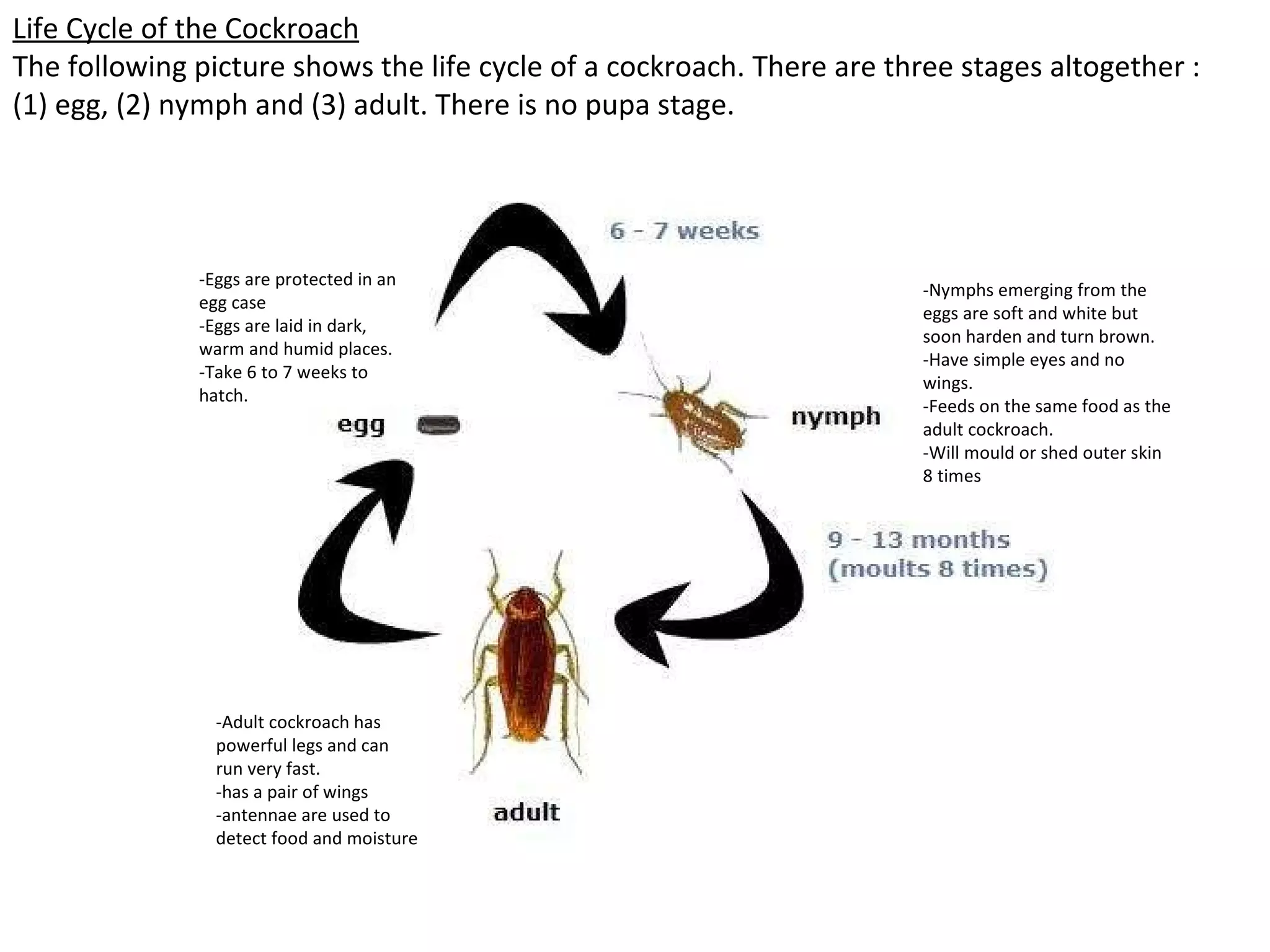
Life Cycle of the Cockroach The following picture shows the life cycle of a cockroach. There are three stages altogether :  (1) egg, (2) nymph and (3) adult. There is no pupa stage.
 -Nymphs emerging from the eggs are soft and white but soon harden and turn brown. -Have simple eyes and no wings. -Feeds on the same food as the adult cockroach. -Will mould or shed outer skin 8 times -Adult cockroach has powerful legs and can run very fast. -has a pair of wings -antennae are used to detect food and moisture -Eggs are protected in an egg case -Eggs are laid in dark, warm and humid places. -Take 6 to 7 weeks to hatch.
Qu estions Name the life cycle of the insect your group is writing about. What is the total number of stages in the life cycle of the cockroach? What happened  in the beginning ? What happened  after a few weeks ? Then , what did the nymph do after it hatched from the egg? What did it become  next ?  Name the characteristics of the adult cockroach. Life Cycle of the Cockroach
Life Cycle of the Housefly A housefly's life cycle is divided into four stages: (1) egg, (2) larva, (3) pupa and (4) adult. At each stage, the housefly's appearance changes completely.
 -Female housefly will lay the eggs on soft and wet surfaces. -eggs are very tiny. -Egg hatched into white larva or maggot. -A larva spends all its time eating and growing. -Moult or shed its skin many times as it grows. -Pupa does not eat and remains still. -in the pupa case, the larva will continue changing. -The adult housefly has reached its full size when it came out from the pupa case. -Able to reproduce after 2 or 3 days. -Takes in only liquid food.
Qu estions Name the life cycle of the insect your group is writing about. What is the total number of stages in the life cycle of the housefly? What happened  in the beginning ? What happened  within 24 hours ? Then , what did the larva or maggot do after it hatched from the egg? What did it become  next ?  Name the characteristics of the pupa. After some time  , what happened after the pupa stage? Life Cycle of the Housefly
Life Cycle of the Mealworm (Darkling Beetle) A mealworm life cycle is divided into four stages: (1) egg, (2) larva, (3) pupa and (4) adult. 
 -During larva stage, it moves about by crawling. -It sheds its skin several times  -The pupa is white in color.  -It sleeps and does not eat at all -As the beetle grows older, it gets darker in color -This 'beetle stage' is the most active  -To protect themselves from their enemies in this stage, they bite hard and move very fast 7–14 days 30–90 days 10–20 days 5–10 days
Qu estions Name the life cycle of the insect your group is writing about. What is the total number of stages in the life cycle of the mealworm? What happened  in the beginning ? What happened  after a few days ? Then, what did the larva or mealworm do after it hatched from the egg? What did it become  next ?  Name the characteristics of the pupa. After some time , what happened after the pupa stage? Life Cycle of the Mealworm (Darkling Beetle)

Life cycles of insects

  • 1.
    Life Cycles ofInsects! Continue clicking to find out more.
  • 2.
    Life Cycle ofthe Grasshopper The following picture shows the life cycle of a grasshopper. There are three stages altogether : (1) egg, (2) nymph and (3) adult. There is no pupa stage. 
 About 2 weeks Characteristics of the nymph: -Looks like a small adult grasshopper -Has no wings -Lives in the same habitat (home) and eats the same food as the adult. -As it grows, the nymph changes its skin many times and develops wings slowly. Characteristics of the adult: -The hind legs of a grasshopper are long and powerful. adult About 4 to 7 weeks
  • 3.
    Qu estions Namethe life cycle of the insect your group is writing about. What is the total number of stages in the life cycle of the grasshopper? What happened in the beginning ? What happened after a few weeks ? Then , what did the nymph do after it hatched from the egg? What did it become next ? Name the characteristics of the adult grasshopper. Life Cycle of the Grasshopper
  • 4.
    Life Cycle ofthe Mosquito The following picture shows the life cycle of a mosquito. There are four stages altogether : (1) eggs, (2) larva (3) pupa and (4) adult. 
 2 to 3 days 8 to 10 days 1 to 2 days Eggs are laid on the surface of stagnant water -Larva wriggles about in the water -Feeds on tiny food particles, dead plants and algae -Changes skin as it grows -Pupa is comma-shaped -rolls and tumbles in the water -does not eat -Adult mosquitoes can fly -Female mosquitoes feed on blood -Male mosquitoes feed on plant nectar and juices
  • 5.
    Qu estions Namethe life cycle of the insect your group is writing about. What is the total number of stages in the life cycle of the mosquito? What happened in the beginning ? What happened after a few days ? Then , what did the larva do after it hatched from the egg? What did it become next ? Name the characteristics of the pupa. After some time , what happened after the pupa stage? Life Cycle of the Mosquito
  • 6.
    Life Cycle ofthe Cockroach The following picture shows the life cycle of a cockroach. There are three stages altogether : (1) egg, (2) nymph and (3) adult. There is no pupa stage.
 -Nymphs emerging from the eggs are soft and white but soon harden and turn brown. -Have simple eyes and no wings. -Feeds on the same food as the adult cockroach. -Will mould or shed outer skin 8 times -Adult cockroach has powerful legs and can run very fast. -has a pair of wings -antennae are used to detect food and moisture -Eggs are protected in an egg case -Eggs are laid in dark, warm and humid places. -Take 6 to 7 weeks to hatch.
  • 7.
    Qu estions Namethe life cycle of the insect your group is writing about. What is the total number of stages in the life cycle of the cockroach? What happened in the beginning ? What happened after a few weeks ? Then , what did the nymph do after it hatched from the egg? What did it become next ? Name the characteristics of the adult cockroach. Life Cycle of the Cockroach
  • 8.
    Life Cycle ofthe Housefly A housefly's life cycle is divided into four stages: (1) egg, (2) larva, (3) pupa and (4) adult. At each stage, the housefly's appearance changes completely.
 -Female housefly will lay the eggs on soft and wet surfaces. -eggs are very tiny. -Egg hatched into white larva or maggot. -A larva spends all its time eating and growing. -Moult or shed its skin many times as it grows. -Pupa does not eat and remains still. -in the pupa case, the larva will continue changing. -The adult housefly has reached its full size when it came out from the pupa case. -Able to reproduce after 2 or 3 days. -Takes in only liquid food.
  • 9.
    Qu estions Namethe life cycle of the insect your group is writing about. What is the total number of stages in the life cycle of the housefly? What happened in the beginning ? What happened within 24 hours ? Then , what did the larva or maggot do after it hatched from the egg? What did it become next ? Name the characteristics of the pupa. After some time , what happened after the pupa stage? Life Cycle of the Housefly
  • 10.
    Life Cycle ofthe Mealworm (Darkling Beetle) A mealworm life cycle is divided into four stages: (1) egg, (2) larva, (3) pupa and (4) adult. 
 -During larva stage, it moves about by crawling. -It sheds its skin several times -The pupa is white in color. -It sleeps and does not eat at all -As the beetle grows older, it gets darker in color -This 'beetle stage' is the most active -To protect themselves from their enemies in this stage, they bite hard and move very fast 7–14 days 30–90 days 10–20 days 5–10 days
  • 11.
    Qu estions Namethe life cycle of the insect your group is writing about. What is the total number of stages in the life cycle of the mealworm? What happened in the beginning ? What happened after a few days ? Then, what did the larva or mealworm do after it hatched from the egg? What did it become next ? Name the characteristics of the pupa. After some time , what happened after the pupa stage? Life Cycle of the Mealworm (Darkling Beetle)