Dr. Lanin Chen
Resident, Dept. of Ophthalmology
D. Y. Patil Medical College, Navi Mumbai.
INTRODUCTION
 First described by George Coats in 1908.
 Coats’ disease is an idiopathic condition
characterized by retinal vascular changes and
exudation caused by a defect in retinal
vasculature development.
 Increased permeability of abnormal retinal
vessels causes leakage into the intraretinal
and subretinal spaces.
 Males: Females :: 3:1
 80% are unilateral
 2/3rd cases present before 10 years of age
 No predilection for race
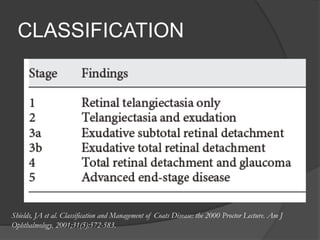
CLASSIFICATION
Shields, JA et al. Classification and Management of Coats Disease: the 2000 Proctor Lecture. Am J
Ophthalmology. 2001;31(5):572-583.
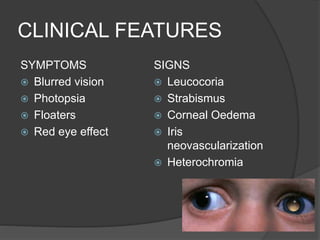
CLINICAL FEATURES
SYMPTOMS
 Blurred vision
 Photopsia
 Floaters
 Red eye effect
SIGNS
 Leucocoria
 Strabismus
 Corneal Oedema
 Iris
neovascularization
 Heterochromia
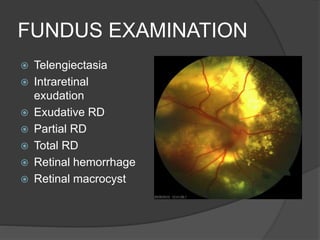
FUNDUS EXAMINATION
 Telengiectasia
 Intraretinal
exudation
 Exudative RD
 Partial RD
 Total RD
 Retinal hemorrhage
 Retinal macrocyst
DIFFERENTIAL
DIAGNOSIS
 Retinoblastoma
 Retinal detachment
 Persistent hyperplastic primary vitreous
 Congenital cataract
 Norrie’s disease
 Eale’s disease
 Vasculitis
 Tumour with exudation
 Idiopathic juxtafoveal telangiectasia
DIAGNOSTIC TESTS
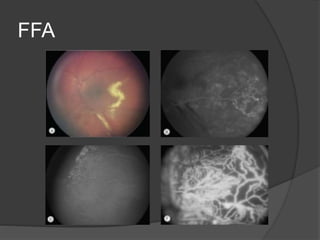
 FFA
 USG - Hyperechoic mass in the posterior vitreous without
posterior acoustic shadowing. Vitreous and subretinal
hemorrhage may be seen.
 CT Scan - The globe appears hyperdense compared to the
normal vitreous due to the proteinaceous exudate, which may
obliterate the vitreous space in advanced disease. The anterior
margin of the subretinal exudate enhances with contrast. Since
the retina is fixed posteriorly at the optic disc, this enhancement
has a V-shaped configuration.
 MRI - The subretinal exudate shos high signal intensity on both
T1 and T2 weighted images. The exudate may appear
heterogenous if hemorrhage or fibrosis is present. The
subretinal space does not enhance with gadolinium constrast.
Mild to moderate linear enhancement may be seen between the
exudate and the remaining vitreous.
FFA
TREATMENT
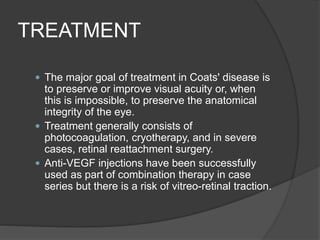
 The major goal of treatment in Coats' disease is
to preserve or improve visual acuity or, when
this is impossible, to preserve the anatomical
integrity of the eye.
 Treatment generally consists of
photocoagulation, cryotherapy, and in severe
cases, retinal reattachment surgery.
 Anti-VEGF injections have been successfully
used as part of combination therapy in case
series but there is a risk of vitreo-retinal traction.
TREATMENT MODALITIES
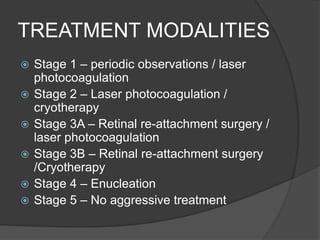
 Stage 1 – periodic observations / laser
photocoagulation
 Stage 2 – Laser photocoagulation /
cryotherapy
 Stage 3A – Retinal re-attachment surgery /
laser photocoagulation
 Stage 3B – Retinal re-attachment surgery
/Cryotherapy
 Stage 4 – Enucleation
 Stage 5 – No aggressive treatment
TREATMENT
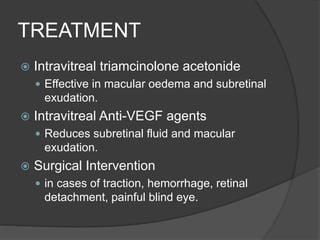
 Intravitreal triamcinolone acetonide
 Effective in macular oedema and subretinal
exudation.
 Intravitreal Anti-VEGF agents
 Reduces subretinal fluid and macular
exudation.
 Surgical Intervention
 in cases of traction, hemorrhage, retinal
detachment, painful blind eye.
REFERENCES:
1. Shields, JA et al. Classification and Management of
Coats Disease: the 2000 Proctor Lecture. Am J
Ophthalmology. 2001;31(5):572-583.
2. Kanski, Jack J. Clinical Ophthalmology: A Systematic
Approach. 6th ed. Elsevier Ltd., 2007.

Coat’S Disease

  • 1.
    Dr. Lanin Chen Resident,Dept. of Ophthalmology D. Y. Patil Medical College, Navi Mumbai.
  • 2.
    INTRODUCTION  First describedby George Coats in 1908.  Coats’ disease is an idiopathic condition characterized by retinal vascular changes and exudation caused by a defect in retinal vasculature development.  Increased permeability of abnormal retinal vessels causes leakage into the intraretinal and subretinal spaces.  Males: Females :: 3:1  80% are unilateral  2/3rd cases present before 10 years of age  No predilection for race
  • 3.
    CLASSIFICATION Shields, JA etal. Classification and Management of Coats Disease: the 2000 Proctor Lecture. Am J Ophthalmology. 2001;31(5):572-583.
  • 4.
    CLINICAL FEATURES SYMPTOMS  Blurredvision  Photopsia  Floaters  Red eye effect SIGNS  Leucocoria  Strabismus  Corneal Oedema  Iris neovascularization  Heterochromia
  • 5.
    FUNDUS EXAMINATION  Telengiectasia Intraretinal exudation  Exudative RD  Partial RD  Total RD  Retinal hemorrhage  Retinal macrocyst
  • 6.
    DIFFERENTIAL DIAGNOSIS  Retinoblastoma  Retinaldetachment  Persistent hyperplastic primary vitreous  Congenital cataract  Norrie’s disease  Eale’s disease  Vasculitis  Tumour with exudation  Idiopathic juxtafoveal telangiectasia
  • 7.
    DIAGNOSTIC TESTS  FFA USG - Hyperechoic mass in the posterior vitreous without posterior acoustic shadowing. Vitreous and subretinal hemorrhage may be seen.  CT Scan - The globe appears hyperdense compared to the normal vitreous due to the proteinaceous exudate, which may obliterate the vitreous space in advanced disease. The anterior margin of the subretinal exudate enhances with contrast. Since the retina is fixed posteriorly at the optic disc, this enhancement has a V-shaped configuration.  MRI - The subretinal exudate shos high signal intensity on both T1 and T2 weighted images. The exudate may appear heterogenous if hemorrhage or fibrosis is present. The subretinal space does not enhance with gadolinium constrast. Mild to moderate linear enhancement may be seen between the exudate and the remaining vitreous.
  • 8.
  • 9.
    TREATMENT  The majorgoal of treatment in Coats' disease is to preserve or improve visual acuity or, when this is impossible, to preserve the anatomical integrity of the eye.  Treatment generally consists of photocoagulation, cryotherapy, and in severe cases, retinal reattachment surgery.  Anti-VEGF injections have been successfully used as part of combination therapy in case series but there is a risk of vitreo-retinal traction.
  • 10.
    TREATMENT MODALITIES  Stage1 – periodic observations / laser photocoagulation  Stage 2 – Laser photocoagulation / cryotherapy  Stage 3A – Retinal re-attachment surgery / laser photocoagulation  Stage 3B – Retinal re-attachment surgery /Cryotherapy  Stage 4 – Enucleation  Stage 5 – No aggressive treatment
  • 11.
    TREATMENT  Intravitreal triamcinoloneacetonide  Effective in macular oedema and subretinal exudation.  Intravitreal Anti-VEGF agents  Reduces subretinal fluid and macular exudation.  Surgical Intervention  in cases of traction, hemorrhage, retinal detachment, painful blind eye.
  • 12.
    REFERENCES: 1. Shields, JAet al. Classification and Management of Coats Disease: the 2000 Proctor Lecture. Am J Ophthalmology. 2001;31(5):572-583. 2. Kanski, Jack J. Clinical Ophthalmology: A Systematic Approach. 6th ed. Elsevier Ltd., 2007.