The Orbit
Thorsang R1
Neuroradiology topic
04.06.2014
Outline
• Orbit overview
• Imaging techniques
• Orbital anatomy
• Diseases of the orbit
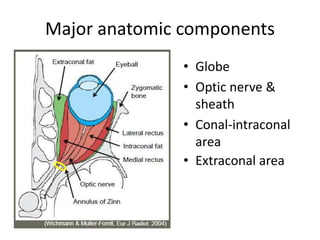
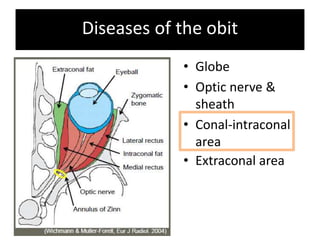
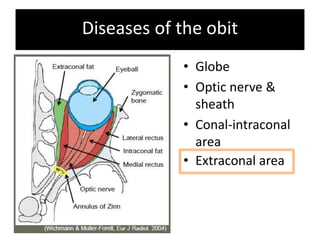
Major anatomic components
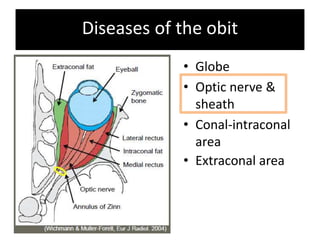
• Globe
• Optic nerve &
sheath
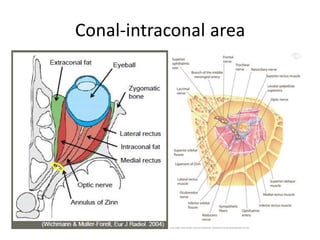
• Conal-intraconal
area
• Extraconal area
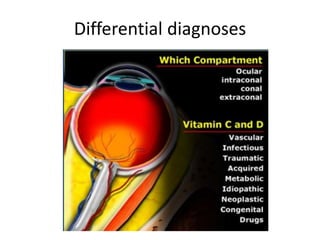
Differential diagnoses
Imaging techniques
MRI
• Initial imaging sequence of
choice for the orbit and CN
II
– Intraaxial, sellar, parasellar
lesions
– More sensitive
CT
• An adjunctive tool:
calcifications
– Small meningioma
– Retinoblastoma with
calcification
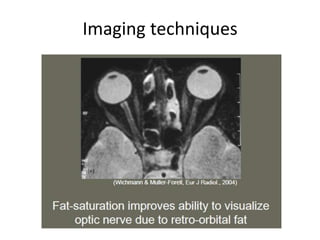
Imaging techniques
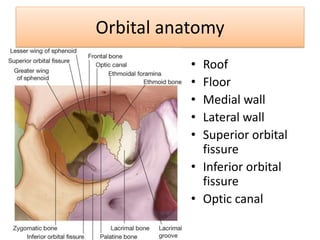
Orbital anatomy
• Roof
• Floor
• Medial wall
• Lateral wall
• Superior orbital
fissure
• Inferior orbital
fissure
• Optic canal
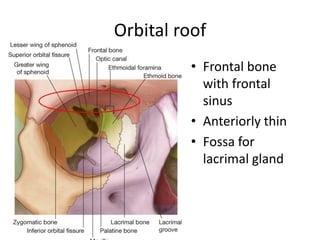
Orbital roof
• Frontal bone
with frontal
sinus
• Anteriorly thin
• Fossa for
lacrimal gland
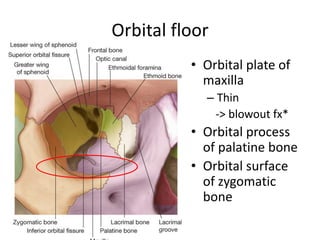
Orbital floor
• Orbital plate of
maxilla
– Thin
-> blowout fx*
• Orbital process
of palatine bone
• Orbital surface
of zygomatic
bone
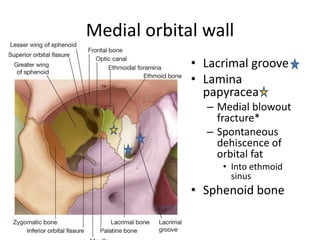
Medial orbital wall
• Lacrimal groove
• Lamina
papyracea
– Medial blowout
fracture*
– Spontaneous
dehiscence of
orbital fat
• Into ethmoid
sinus
• Sphenoid bone
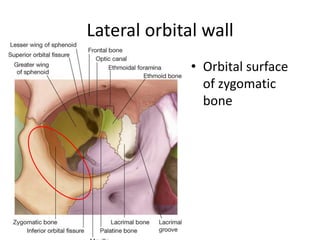
Lateral orbital wall
• Orbital surface
of zygomatic
bone
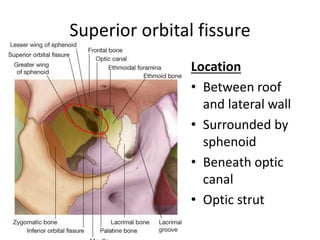
Superior orbital fissure
Location
• Between roof
and lateral wall
• Surrounded by
sphenoid
• Beneath optic
canal
• Optic strut
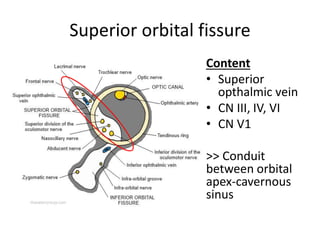
Superior orbital fissure
Content
• Superior
opthalmic vein
• CN III, IV, VI
• CN V1
>> Conduit
between orbital
apex-cavernous
sinus
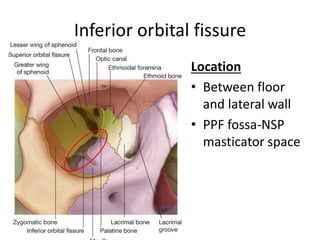
Inferior orbital fissure
Location
• Between floor
and lateral wall
• PPF fossa-NSP
masticator space
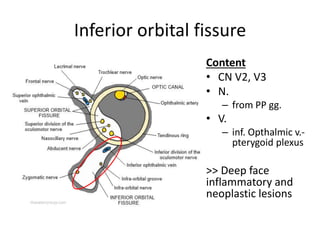
Inferior orbital fissure
Content
• CN V2, V3
• N.
– from PP gg.
• V.
– inf. Opthalmic v.-
pterygoid plexus
>> Deep face
inflammatory and
neoplastic lesions
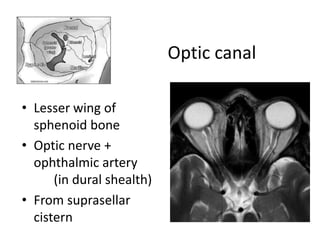
Optic canal
• Lesser wing of
sphenoid bone
• Optic nerve +
ophthalmic artery
(in dural shealth)
• From suprasellar
cistern
Conal-intraconal area
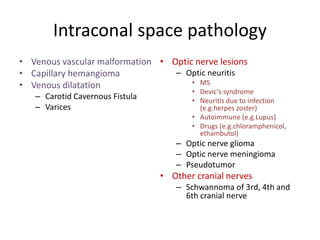
Intraconal space pathology
• Venous vascular malformation
• Capillary hemangioma
• Venous dilatation
– Carotid Cavernous Fistula
– Varices
• Optic nerve lesions
– Optic neuritis
• MS
• Devic's syndrome
• Neuritis due to infection
(e.g.herpes zoster)
• Autoimmune (e.g.Lupus)
• Drugs (e.g.chloramphenicol,
ethambutol)
– Optic nerve glioma
– Optic nerve meningioma
– Pseudotumor
• Other cranial nerves
– Schwannoma of 3rd, 4th and
6th cranial nerve
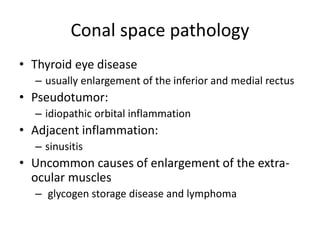
Conal space pathology
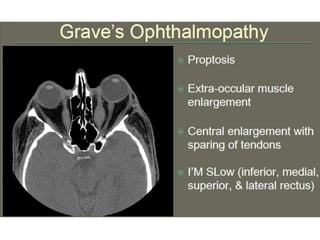
• Thyroid eye disease
– usually enlargement of the inferior and medial rectus
• Pseudotumor:
– idiopathic orbital inflammation
• Adjacent inflammation:
– sinusitis
• Uncommon causes of enlargement of the extra-
ocular muscles
– glycogen storage disease and lymphoma
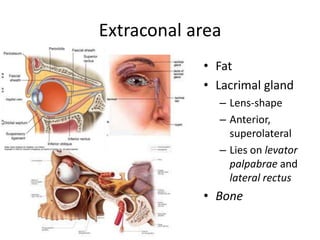
Extraconal area
• Fat
• Lacrimal gland
– Lens-shape
– Anterior,
superolateral
– Lies on levator
palpabrae and
lateral rectus
• Bone
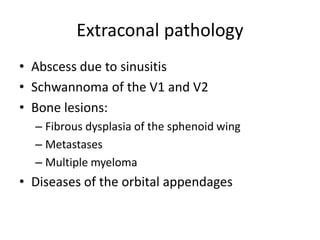
Extraconal pathology
• Abscess due to sinusitis
• Schwannoma of the V1 and V2
• Bone lesions:
– Fibrous dysplasia of the sphenoid wing
– Metastases
– Multiple myeloma
• Diseases of the orbital appendages
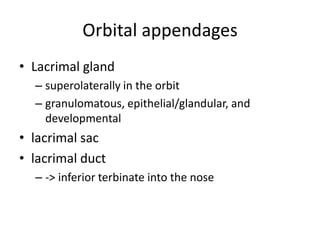
Orbital appendages
• Lacrimal gland
– superolaterally in the orbit
– granulomatous, epithelial/glandular, and
developmental
• lacrimal sac
• lacrimal duct
– -> inferior terbinate into the nose
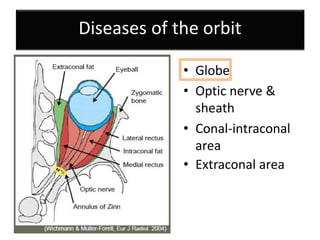
Diseases of the orbit
• Globe
• Optic nerve &
sheath
• Conal-intraconal
area
• Extraconal area
The ocular space
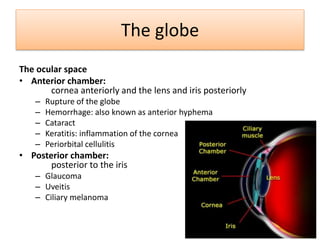
• Anterior chamber:
cornea anteriorly and the lens and iris posteriorly
– Rupture of the globe
– Hemorrhage: also known as anterior hyphema
– Cataract
– Keratitis: inflammation of the cornea
– Periorbital cellulitis
• Posterior chamber:
posterior to the iris
– Glaucoma
– Uveitis
– Ciliary melanoma
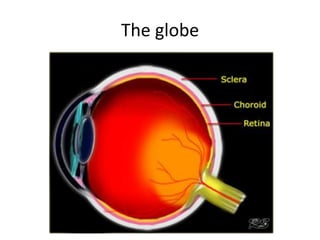
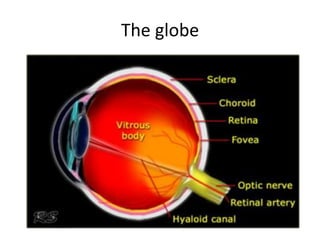
The globe
The globe
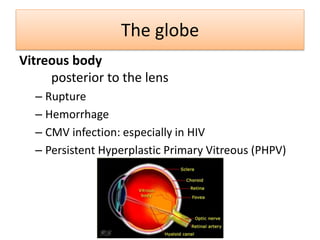
Vitreous body
posterior to the lens
– Rupture
– Hemorrhage
– CMV infection: especially in HIV
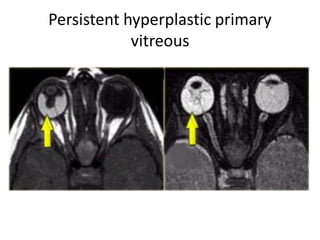
– Persistent Hyperplastic Primary Vitreous (PHPV)
Persistent hyperplastic primary
vitreous
• Unilateral leukokoria in male infants
• Persistent hyaloid canal
• Persistence of the primary vascular vitreous
• Hyperplasia of the residual embryonic
connective tissue
• PHPV is the second most common cause of
leukocoria
• Also develops glaucoma and cataract
• Findings:
– Microphtalmic globe with enhancing increased
density in the vitreous humor.
– Unilateral/bilateral tissue density band from back
of the lens to the posterior inner globe (Persistent
Cloquet’s canal)
– Retinal detachment (occurs in 30-55%)
Persistent hyperplastic primary
vitreous
Persistent hyperplastic primary
vitreous
The globe
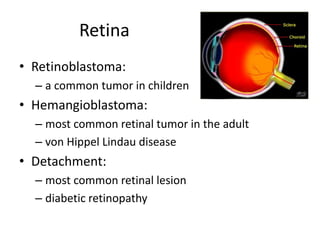
Retina
• Retinoblastoma:
– a common tumor in children
• Hemangioblastoma:
– most common retinal tumor in the adult
– von Hippel Lindau disease
• Detachment:
– most common retinal lesion
– diabetic retinopathy
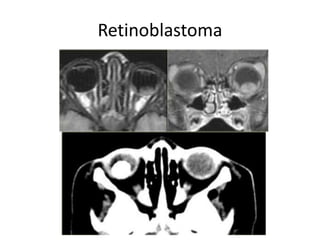
Retinoblastoma
• Common tumor in the first year of life
• Child < 3 years of age (98%)
• Other presentations: leukokoria, strabismus,
decreased visual acuity, family hx, eye pain,
proptosis
• Believed to arise from neuroectodermal cells
• 75% unilateral; 25% bilateral
• All bilateral cases are hereditary (AD) >>
deficient tumor suppression gene on
chromosome 13
• 90% calcified
Retinoblastoma
Retinoblastoma
• The other tumors in this age group are
– Neuroblastoma
– Wilm's tumor
– Leukemia
– Teratoma.
Retinoblastoma
• Techniques
– CT is prefered to detect calcification
– MR serves an adjunctive role
• Findings:
– CT: an intraocular mass with calcification
in a child<3 yr -> should consider retinoblastoma
– Extraocular spreading along the optic nerve
– Together with pinealoma
-> trilateral retinoblastoma
Retinoblastoma
DDx in a child with leukokoria
• Toxocara endophthalmitis
• Persistent hyperplastic vitreous
• Retinopathy of prematurity
• Coat’s disease
Calcifications
• In adults
– most common at the annulus of Zinn
– at the optic nerve head within the eye -> optic
disc drusen
(asymptomatic, but pseudo-papilledema from PE)
• In children
– retinoblastoma until proven otherwise
Coat’s disease
• A rare eye disorder: congenital non-hereditary
vascular malformation of the retina
– multiple telangiectatic vessels -> exudate leakage ->
retinal detachment
• A 6-to-8-year-old boy with unilateral leukokoria
• Symptoms occurs when the retina detaches ->
central visual loss
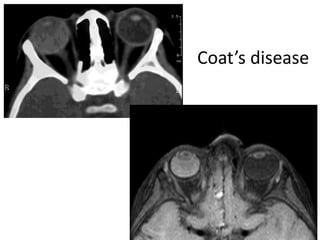
• Findings:
– Increased density of the vitreous
– Normal globe size, lack of calcification
Coat’s disease
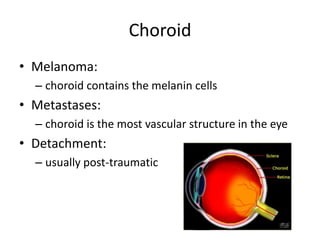
Choroid
• Melanoma:
– choroid contains the melanin cells
• Metastases:
– choroid is the most vascular structure in the eye
• Detachment:
– usually post-traumatic
Uveal melanoma
• The most common primary intraocular
malignancy in adult
• A 50-to-70-year old with unilateral ocular
complaint
• 85% from choroid, 9% from ciliary body, and
6% from iris
• Dx from PE + U/S
• CT/MR when opaque ocular media prevents a
clear view
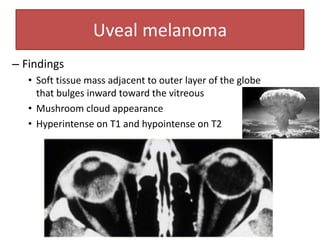
Uveal melanoma
– Findings
• Soft tissue mass adjacent to outer layer of the globe
that bulges inward toward the vitreous
• Mushroom cloud appearance
• Hyperintense on T1 and hypointense on T2
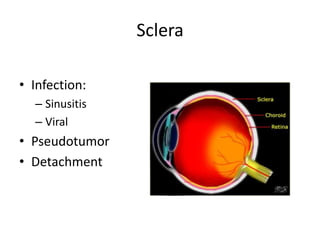
Sclera
• Infection:
– Sinusitis
– Viral
• Pseudotumor
• Detachment
Scleritis
• granulomatous inflammatory disorder
• Erythema and chemosis
• Characteristics
– optic disk edema
– exudative retinal detachment
– Choroidal folds and scleral thickening >> elevated mass
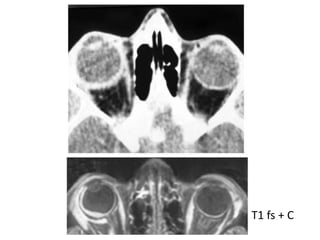
• Findings:
– CT:
• thickened posterior sclera, may enhanced
• Thickening of extraocular muscles can also be seen
– Magnetic resonance imaging
• nodular elevation into the vitreous
• Iso-to-hyperintense to normal sclera on T1
• Hypointense on T2
• moderate to marked inhomogeneous enhancement with Gd
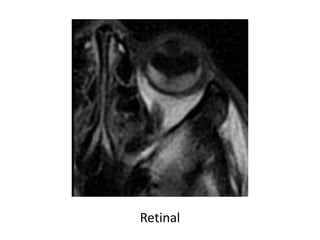
• A retinal detachment appears as a crescent-shaped area that is
hyperintense on both T1 and T2
Scleritis
T1 fs + C
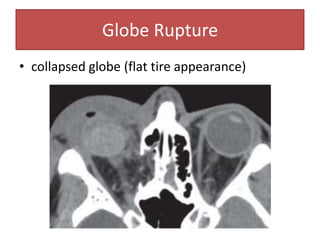
• collapsed globe (flat tire appearance)
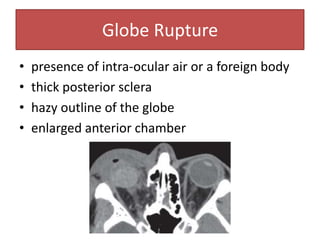
Globe Rupture
• presence of intra-ocular air or a foreign body
• thick posterior sclera
• hazy outline of the globe
• enlarged anterior chamber
Globe Rupture
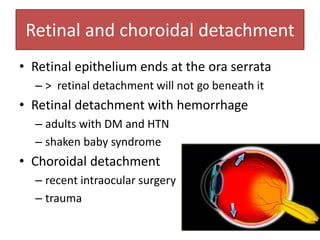
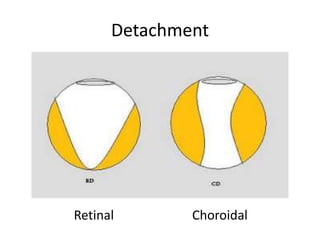
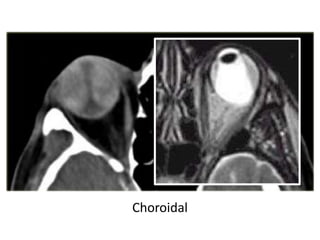
Retinal and choroidal detachment
• Retinal epithelium ends at the ora serrata
– > retinal detachment will not go beneath it
• Retinal detachment with hemorrhage
– adults with DM and HTN
– shaken baby syndrome
• Choroidal detachment
– recent intraocular surgery
– trauma
Detachment
Retinal Choroidal
Retinal
Choroidal
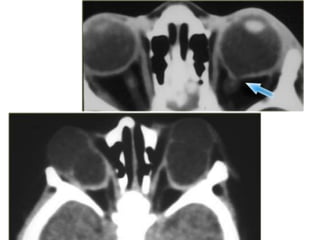
Coloboma
• A congenital globe defect, usually at the optic
nerve insertion point
• Often there is microphtalmia and the eye
protrudes inferiorly.
• 10% also have other CNS anomalies.
• Findings:
– a small globe with a cystic outpouching of vitreous
at the optic nerve attachment site.
– Retroocular cyst
Coloboma
• Coloboma can be part of the CHARGE syndrome:
– Coloboma
– Heart anomalies
– choanal Atresia
– Retardation of growth and development
– Genital and Ear anomalies.
• Coloboma can also be part of the COACH syndrome:
– Cerebellar vermis hypoplasia,
– Oligophrenia (MR)
– congenital Ataxia
– Coloboma
– Hepatic fibrosis.
Diseases of the obit
• Globe
• Optic nerve &
sheath
• Conal-intraconal
area
• Extraconal area
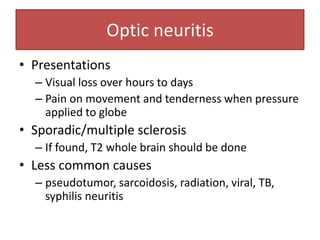
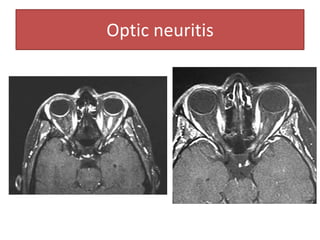
Optic neuritis
• Presentations
– Visual loss over hours to days
– Pain on movement and tenderness when pressure
applied to globe
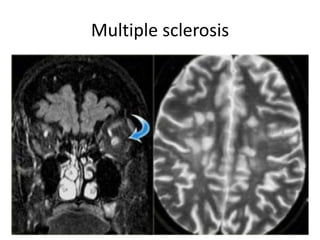
• Sporadic/multiple sclerosis
– If found, T2 whole brain should be done
• Less common causes
– pseudotumor, sarcoidosis, radiation, viral, TB,
syphilis neuritis
Optic neuritis
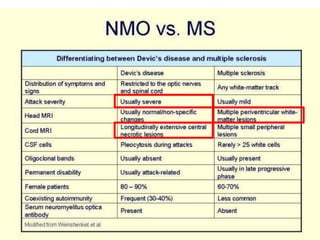
Multiple sclerosis
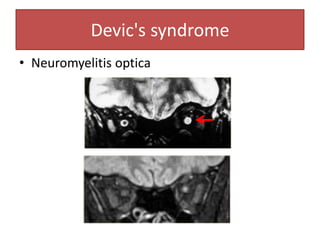
Devic's syndrome
• Neuromyelitis optica
Optic nerve/sheath tumor
• Optic nerve sheath meningioma
• Optic nerve glioma
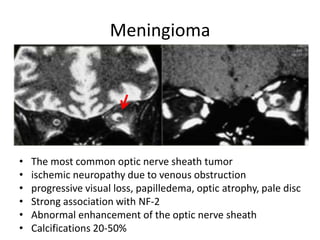
Meningioma
• The most common optic nerve sheath tumor
• ischemic neuropathy due to venous obstruction
• progressive visual loss, papilledema, optic atrophy, pale disc
• Strong association with NF-2
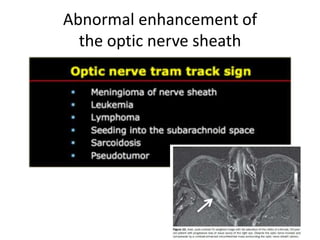
• Abnormal enhancement of the optic nerve sheath
• Calcifications 20-50%
Abnormal enhancement of
the optic nerve sheath
Optic nerve glioma
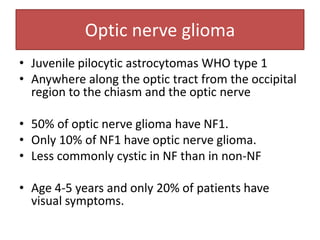
• Juvenile pilocytic astrocytomas WHO type 1
• Anywhere along the optic tract from the occipital
region to the chiasm and the optic nerve
• 50% of optic nerve glioma have NF1.
• Only 10% of NF1 have optic nerve glioma.
• Less commonly cystic in NF than in non-NF
• Age 4-5 years and only 20% of patients have
visual symptoms.
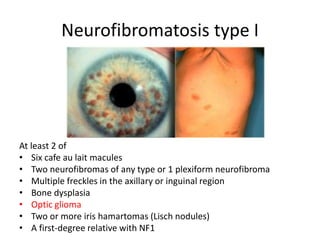
Neurofibromatosis type I
At least 2 of
• Six cafe au lait macules
• Two neurofibromas of any type or 1 plexiform neurofibroma
• Multiple freckles in the axillary or inguinal region
• Bone dysplasia
• Optic glioma
• Two or more iris hamartomas (Lisch nodules)
• A first-degree relative with NF1
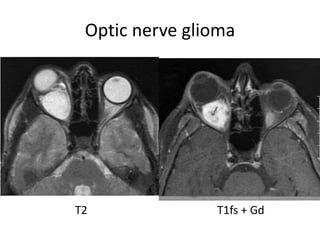
Optic nerve glioma
T2 T1fs + Gd
Diseases of the obit
• Globe
• Optic nerve &
sheath
• Conal-intraconal
area
• Extraconal area
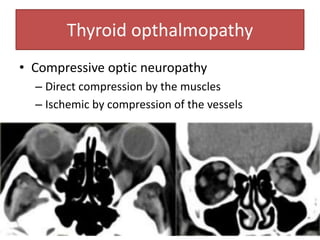
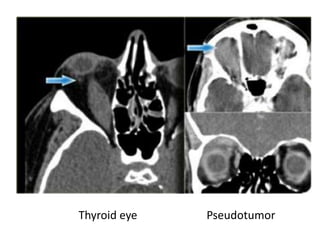
Thyroid opthalmopathy
• Compressive optic neuropathy
– Direct compression by the muscles
– Ischemic by compression of the vessels
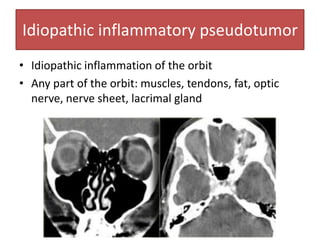
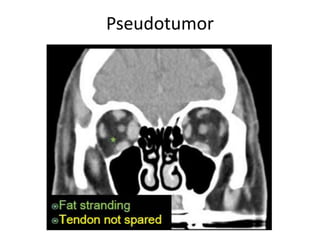
Idiopathic inflammatory pseudotumor
• Idiopathic inflammation of the orbit
• Any part of the orbit: muscles, tendons, fat, optic
nerve, nerve sheet, lacrimal gland
Pseudotumor
Thyroid eye Pseudotumor
Diseases of the obit
• Globe
• Optic nerve &
sheath
• Conal-intraconal
area
• Extraconal area
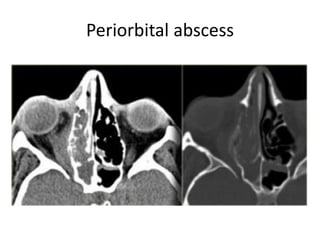
Periorbital abscess
Periorbital abscess
• Complications
– Venous thrombosis of the superior and inferior
ophthalmic vein
– Cavernous sinus thrombosis and cavernous-
carotid fistula in certain fungal sinusitis
(e.g.aspergillosis)
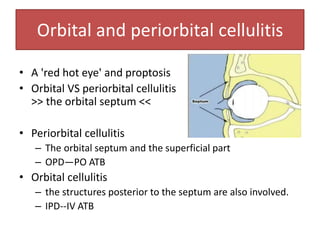
Orbital and periorbital cellulitis
• A 'red hot eye' and proptosis
• Orbital VS periorbital cellulitis ->
>> the orbital septum <<
• Periorbital cellulitis
– The orbital septum and the superficial part
– OPD—PO ATB
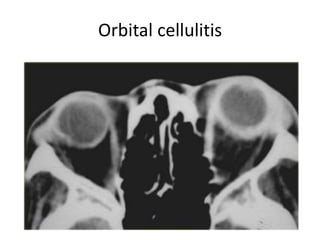
• Orbital cellulitis
– the structures posterior to the septum are also involved.
– IPD--IV ATB
Orbital cellulitis
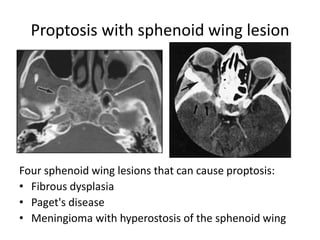
Proptosis with sphenoid wing lesion
Four sphenoid wing lesions that can cause proptosis:
• Fibrous dysplasia
• Paget's disease
• Meningioma with hyperostosis of the sphenoid wing
Orbital appendages
• Lacrimal gland
• lacrimal sac
• lacrimal duct
Lesions of the lacrimal gland
• Inflammation
– The most common lesions of the lacrimal gland
– i.e. Sjoegren's, TB, fungus, pseudotumor
– Do not cause masses
Children
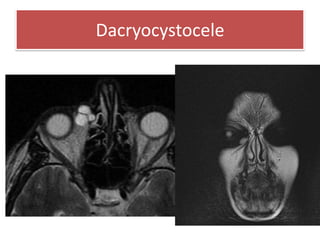
– congenital obstructions of the valves in the
lacrimal duct -> dacryocystoceles
adults
– strictures from ethmoid sinusitis or stones ->
epiphera or increased tearing
Dacryocystocele
• Lacrimal gland mass
– Lymphoma
– Pleomorphic adenoma
– Epithelial tumors (adenoid cystic tumor)
Lesions of the lacrimal gland
Tumors
• Epidermoid and dermoid tumors
– Developmental
– Usually arises anteriorly between the globe and
orbital periosteum
– Well-circumscribed cystic masses containing
debris
– Dermoid may contain fat, teeth, and hair
Vascular malformation
• Carotid cavernous sinus fistula
• Cavernous hemangioma
• Capillary hemangioma
• Lymphangioma
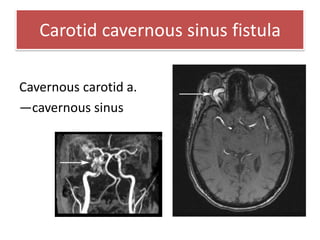
Carotid cavernous sinus fistula
Cavernous carotid a.
—cavernous sinus
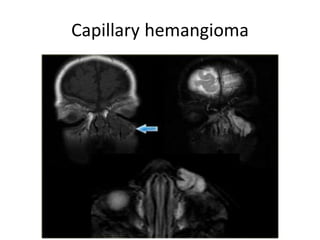
Capillary hemangioma
• 6-12 months of age
• Involutional at 5-7 years of age
• Mostly skin, but also in the extraconal of the eye
• PHACE-syndrome:
– Posterior fossa malformations,
– Hemangiomas
– Arterial anomalies
– Cardiac malformation
– Eye abnormalities such as coloboma, glaucoma
• CT—irregular margin
Capillary hemangioma
Venous vascular malformations
• The most common intraconal mass in an adult
• 45-year-old women with slow progressive
proptosis, diplopia, visual loss
• Most are unilocular
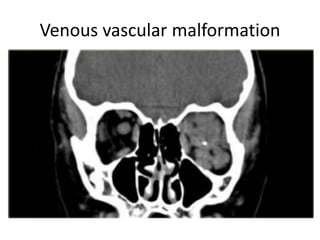
• CT
– Phleboliths
– sharply circumscribed, round, dense mass
– Spare apex
– Bony erosion
Venous vascular malformation
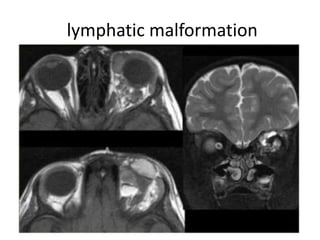
lymphatic malformation
• Lymphangioma
• Childhood onset (60% before 16 y/o)
• May abruptly hemorrhage resulting in fluid-fluid
levels
• May be extraconal or multicompartmental
• Association with intracranial malformations
– Turner's
– fetal alcohol syndrome
• Absence of contrast enhancement in pure
lymphatic lesions
lymphatic malformation
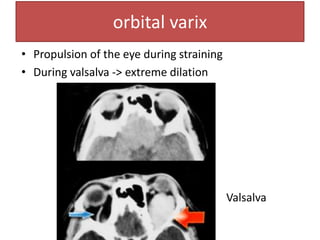
orbital varix
• Propulsion of the eye during straining
• During valsalva -> extreme dilation
Valsalva
Conclusion
• Orbital anatomy
• Disease approach
• Diseases of the orbit
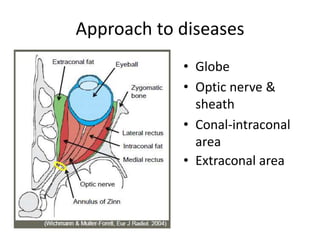
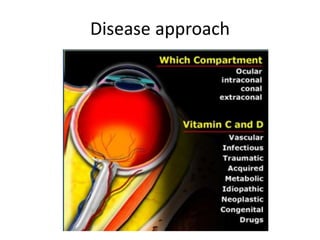
Approach to diseases
• Globe
• Optic nerve &
sheath
• Conal-intraconal
area
• Extraconal area
The globe
Disease approach
Q & A
References
• Harnsberger, H. Ric., and H. Ric.
Harnsberger. Handbook of Head and Neck
Imaging. St. Louis: Mosby, 1995. Print.
• Grossman, Robert I., and David M.
Yousem. Neuroradiology. Philadelphia, PA:
Mosby Elsevier, 2010. Print.
• "Orbita - Pathology." The Radiology Assistant :.
N.p., n.d. Web. 20 May 2014
Thank You

The Imaging of the Orbit

  • 1.
  • 2.
    Outline • Orbit overview •Imaging techniques • Orbital anatomy • Diseases of the orbit
  • 3.
    Major anatomic components •Globe • Optic nerve & sheath • Conal-intraconal area • Extraconal area
  • 4.
  • 5.
    Imaging techniques MRI • Initialimaging sequence of choice for the orbit and CN II – Intraaxial, sellar, parasellar lesions – More sensitive CT • An adjunctive tool: calcifications – Small meningioma – Retinoblastoma with calcification
  • 6.
  • 7.
    Orbital anatomy • Roof •Floor • Medial wall • Lateral wall • Superior orbital fissure • Inferior orbital fissure • Optic canal
  • 8.
    Orbital roof • Frontalbone with frontal sinus • Anteriorly thin • Fossa for lacrimal gland
  • 9.
    Orbital floor • Orbitalplate of maxilla – Thin -> blowout fx* • Orbital process of palatine bone • Orbital surface of zygomatic bone
  • 10.
    Medial orbital wall •Lacrimal groove • Lamina papyracea – Medial blowout fracture* – Spontaneous dehiscence of orbital fat • Into ethmoid sinus • Sphenoid bone
  • 11.
    Lateral orbital wall •Orbital surface of zygomatic bone
  • 12.
    Superior orbital fissure Location •Between roof and lateral wall • Surrounded by sphenoid • Beneath optic canal • Optic strut
  • 13.
    Superior orbital fissure Content •Superior opthalmic vein • CN III, IV, VI • CN V1 >> Conduit between orbital apex-cavernous sinus
  • 14.
    Inferior orbital fissure Location •Between floor and lateral wall • PPF fossa-NSP masticator space
  • 15.
    Inferior orbital fissure Content •CN V2, V3 • N. – from PP gg. • V. – inf. Opthalmic v.- pterygoid plexus >> Deep face inflammatory and neoplastic lesions
  • 16.
    Optic canal • Lesserwing of sphenoid bone • Optic nerve + ophthalmic artery (in dural shealth) • From suprasellar cistern
  • 17.
  • 18.
    Intraconal space pathology •Venous vascular malformation • Capillary hemangioma • Venous dilatation – Carotid Cavernous Fistula – Varices • Optic nerve lesions – Optic neuritis • MS • Devic's syndrome • Neuritis due to infection (e.g.herpes zoster) • Autoimmune (e.g.Lupus) • Drugs (e.g.chloramphenicol, ethambutol) – Optic nerve glioma – Optic nerve meningioma – Pseudotumor • Other cranial nerves – Schwannoma of 3rd, 4th and 6th cranial nerve
  • 19.
    Conal space pathology •Thyroid eye disease – usually enlargement of the inferior and medial rectus • Pseudotumor: – idiopathic orbital inflammation • Adjacent inflammation: – sinusitis • Uncommon causes of enlargement of the extra- ocular muscles – glycogen storage disease and lymphoma
  • 20.
    Extraconal area • Fat •Lacrimal gland – Lens-shape – Anterior, superolateral – Lies on levator palpabrae and lateral rectus • Bone
  • 21.
    Extraconal pathology • Abscessdue to sinusitis • Schwannoma of the V1 and V2 • Bone lesions: – Fibrous dysplasia of the sphenoid wing – Metastases – Multiple myeloma • Diseases of the orbital appendages
  • 22.
    Orbital appendages • Lacrimalgland – superolaterally in the orbit – granulomatous, epithelial/glandular, and developmental • lacrimal sac • lacrimal duct – -> inferior terbinate into the nose
  • 23.
    Diseases of theorbit • Globe • Optic nerve & sheath • Conal-intraconal area • Extraconal area
  • 24.
    The ocular space •Anterior chamber: cornea anteriorly and the lens and iris posteriorly – Rupture of the globe – Hemorrhage: also known as anterior hyphema – Cataract – Keratitis: inflammation of the cornea – Periorbital cellulitis • Posterior chamber: posterior to the iris – Glaucoma – Uveitis – Ciliary melanoma The globe
  • 25.
    The globe Vitreous body posteriorto the lens – Rupture – Hemorrhage – CMV infection: especially in HIV – Persistent Hyperplastic Primary Vitreous (PHPV)
  • 26.
    Persistent hyperplastic primary vitreous •Unilateral leukokoria in male infants • Persistent hyaloid canal • Persistence of the primary vascular vitreous • Hyperplasia of the residual embryonic connective tissue • PHPV is the second most common cause of leukocoria • Also develops glaucoma and cataract
  • 27.
    • Findings: – Microphtalmicglobe with enhancing increased density in the vitreous humor. – Unilateral/bilateral tissue density band from back of the lens to the posterior inner globe (Persistent Cloquet’s canal) – Retinal detachment (occurs in 30-55%) Persistent hyperplastic primary vitreous
  • 28.
  • 29.
  • 30.
    Retina • Retinoblastoma: – acommon tumor in children • Hemangioblastoma: – most common retinal tumor in the adult – von Hippel Lindau disease • Detachment: – most common retinal lesion – diabetic retinopathy
  • 31.
    Retinoblastoma • Common tumorin the first year of life • Child < 3 years of age (98%) • Other presentations: leukokoria, strabismus, decreased visual acuity, family hx, eye pain, proptosis • Believed to arise from neuroectodermal cells
  • 32.
    • 75% unilateral;25% bilateral • All bilateral cases are hereditary (AD) >> deficient tumor suppression gene on chromosome 13 • 90% calcified Retinoblastoma
  • 33.
    Retinoblastoma • The othertumors in this age group are – Neuroblastoma – Wilm's tumor – Leukemia – Teratoma.
  • 34.
    Retinoblastoma • Techniques – CTis prefered to detect calcification – MR serves an adjunctive role • Findings: – CT: an intraocular mass with calcification in a child<3 yr -> should consider retinoblastoma – Extraocular spreading along the optic nerve – Together with pinealoma -> trilateral retinoblastoma
  • 35.
  • 36.
    DDx in achild with leukokoria • Toxocara endophthalmitis • Persistent hyperplastic vitreous • Retinopathy of prematurity • Coat’s disease
  • 37.
    Calcifications • In adults –most common at the annulus of Zinn – at the optic nerve head within the eye -> optic disc drusen (asymptomatic, but pseudo-papilledema from PE) • In children – retinoblastoma until proven otherwise
  • 38.
    Coat’s disease • Arare eye disorder: congenital non-hereditary vascular malformation of the retina – multiple telangiectatic vessels -> exudate leakage -> retinal detachment • A 6-to-8-year-old boy with unilateral leukokoria • Symptoms occurs when the retina detaches -> central visual loss • Findings: – Increased density of the vitreous – Normal globe size, lack of calcification
  • 39.
  • 40.
    Choroid • Melanoma: – choroidcontains the melanin cells • Metastases: – choroid is the most vascular structure in the eye • Detachment: – usually post-traumatic
  • 41.
    Uveal melanoma • Themost common primary intraocular malignancy in adult • A 50-to-70-year old with unilateral ocular complaint • 85% from choroid, 9% from ciliary body, and 6% from iris • Dx from PE + U/S • CT/MR when opaque ocular media prevents a clear view
  • 42.
    Uveal melanoma – Findings •Soft tissue mass adjacent to outer layer of the globe that bulges inward toward the vitreous • Mushroom cloud appearance • Hyperintense on T1 and hypointense on T2
  • 43.
    Sclera • Infection: – Sinusitis –Viral • Pseudotumor • Detachment
  • 44.
    Scleritis • granulomatous inflammatorydisorder • Erythema and chemosis • Characteristics – optic disk edema – exudative retinal detachment – Choroidal folds and scleral thickening >> elevated mass
  • 45.
    • Findings: – CT: •thickened posterior sclera, may enhanced • Thickening of extraocular muscles can also be seen – Magnetic resonance imaging • nodular elevation into the vitreous • Iso-to-hyperintense to normal sclera on T1 • Hypointense on T2 • moderate to marked inhomogeneous enhancement with Gd • A retinal detachment appears as a crescent-shaped area that is hyperintense on both T1 and T2 Scleritis
  • 46.
  • 47.
    • collapsed globe(flat tire appearance) Globe Rupture
  • 48.
    • presence ofintra-ocular air or a foreign body • thick posterior sclera • hazy outline of the globe • enlarged anterior chamber Globe Rupture
  • 49.
    Retinal and choroidaldetachment • Retinal epithelium ends at the ora serrata – > retinal detachment will not go beneath it • Retinal detachment with hemorrhage – adults with DM and HTN – shaken baby syndrome • Choroidal detachment – recent intraocular surgery – trauma
  • 50.
  • 51.
  • 52.
  • 53.
    Coloboma • A congenitalglobe defect, usually at the optic nerve insertion point • Often there is microphtalmia and the eye protrudes inferiorly. • 10% also have other CNS anomalies. • Findings: – a small globe with a cystic outpouching of vitreous at the optic nerve attachment site. – Retroocular cyst
  • 55.
    Coloboma • Coloboma canbe part of the CHARGE syndrome: – Coloboma – Heart anomalies – choanal Atresia – Retardation of growth and development – Genital and Ear anomalies. • Coloboma can also be part of the COACH syndrome: – Cerebellar vermis hypoplasia, – Oligophrenia (MR) – congenital Ataxia – Coloboma – Hepatic fibrosis.
  • 56.
    Diseases of theobit • Globe • Optic nerve & sheath • Conal-intraconal area • Extraconal area
  • 57.
    Optic neuritis • Presentations –Visual loss over hours to days – Pain on movement and tenderness when pressure applied to globe • Sporadic/multiple sclerosis – If found, T2 whole brain should be done • Less common causes – pseudotumor, sarcoidosis, radiation, viral, TB, syphilis neuritis
  • 58.
  • 59.
  • 60.
  • 62.
    Optic nerve/sheath tumor •Optic nerve sheath meningioma • Optic nerve glioma
  • 63.
    Meningioma • The mostcommon optic nerve sheath tumor • ischemic neuropathy due to venous obstruction • progressive visual loss, papilledema, optic atrophy, pale disc • Strong association with NF-2 • Abnormal enhancement of the optic nerve sheath • Calcifications 20-50%
  • 64.
    Abnormal enhancement of theoptic nerve sheath
  • 65.
    Optic nerve glioma •Juvenile pilocytic astrocytomas WHO type 1 • Anywhere along the optic tract from the occipital region to the chiasm and the optic nerve • 50% of optic nerve glioma have NF1. • Only 10% of NF1 have optic nerve glioma. • Less commonly cystic in NF than in non-NF • Age 4-5 years and only 20% of patients have visual symptoms.
  • 66.
    Neurofibromatosis type I Atleast 2 of • Six cafe au lait macules • Two neurofibromas of any type or 1 plexiform neurofibroma • Multiple freckles in the axillary or inguinal region • Bone dysplasia • Optic glioma • Two or more iris hamartomas (Lisch nodules) • A first-degree relative with NF1
  • 67.
  • 68.
    Diseases of theobit • Globe • Optic nerve & sheath • Conal-intraconal area • Extraconal area
  • 70.
    Thyroid opthalmopathy • Compressiveoptic neuropathy – Direct compression by the muscles – Ischemic by compression of the vessels
  • 71.
    Idiopathic inflammatory pseudotumor •Idiopathic inflammation of the orbit • Any part of the orbit: muscles, tendons, fat, optic nerve, nerve sheet, lacrimal gland
  • 72.
  • 73.
  • 74.
    Diseases of theobit • Globe • Optic nerve & sheath • Conal-intraconal area • Extraconal area
  • 75.
  • 76.
    Periorbital abscess • Complications –Venous thrombosis of the superior and inferior ophthalmic vein – Cavernous sinus thrombosis and cavernous- carotid fistula in certain fungal sinusitis (e.g.aspergillosis)
  • 77.
    Orbital and periorbitalcellulitis • A 'red hot eye' and proptosis • Orbital VS periorbital cellulitis -> >> the orbital septum << • Periorbital cellulitis – The orbital septum and the superficial part – OPD—PO ATB • Orbital cellulitis – the structures posterior to the septum are also involved. – IPD--IV ATB
  • 78.
  • 79.
    Proptosis with sphenoidwing lesion Four sphenoid wing lesions that can cause proptosis: • Fibrous dysplasia • Paget's disease • Meningioma with hyperostosis of the sphenoid wing
  • 80.
    Orbital appendages • Lacrimalgland • lacrimal sac • lacrimal duct
  • 81.
    Lesions of thelacrimal gland • Inflammation – The most common lesions of the lacrimal gland – i.e. Sjoegren's, TB, fungus, pseudotumor – Do not cause masses Children – congenital obstructions of the valves in the lacrimal duct -> dacryocystoceles adults – strictures from ethmoid sinusitis or stones -> epiphera or increased tearing
  • 82.
  • 83.
    • Lacrimal glandmass – Lymphoma – Pleomorphic adenoma – Epithelial tumors (adenoid cystic tumor) Lesions of the lacrimal gland
  • 84.
    Tumors • Epidermoid anddermoid tumors – Developmental – Usually arises anteriorly between the globe and orbital periosteum – Well-circumscribed cystic masses containing debris – Dermoid may contain fat, teeth, and hair
  • 85.
    Vascular malformation • Carotidcavernous sinus fistula • Cavernous hemangioma • Capillary hemangioma • Lymphangioma
  • 86.
    Carotid cavernous sinusfistula Cavernous carotid a. —cavernous sinus
  • 87.
    Capillary hemangioma • 6-12months of age • Involutional at 5-7 years of age • Mostly skin, but also in the extraconal of the eye • PHACE-syndrome: – Posterior fossa malformations, – Hemangiomas – Arterial anomalies – Cardiac malformation – Eye abnormalities such as coloboma, glaucoma • CT—irregular margin
  • 88.
  • 89.
    Venous vascular malformations •The most common intraconal mass in an adult • 45-year-old women with slow progressive proptosis, diplopia, visual loss • Most are unilocular • CT – Phleboliths – sharply circumscribed, round, dense mass – Spare apex – Bony erosion
  • 90.
  • 91.
    lymphatic malformation • Lymphangioma •Childhood onset (60% before 16 y/o) • May abruptly hemorrhage resulting in fluid-fluid levels • May be extraconal or multicompartmental • Association with intracranial malformations – Turner's – fetal alcohol syndrome • Absence of contrast enhancement in pure lymphatic lesions
  • 92.
  • 93.
    orbital varix • Propulsionof the eye during straining • During valsalva -> extreme dilation Valsalva
  • 94.
    Conclusion • Orbital anatomy •Disease approach • Diseases of the orbit
  • 95.
    Approach to diseases •Globe • Optic nerve & sheath • Conal-intraconal area • Extraconal area
  • 96.
  • 97.
  • 98.
  • 99.
    References • Harnsberger, H.Ric., and H. Ric. Harnsberger. Handbook of Head and Neck Imaging. St. Louis: Mosby, 1995. Print. • Grossman, Robert I., and David M. Yousem. Neuroradiology. Philadelphia, PA: Mosby Elsevier, 2010. Print. • "Orbita - Pathology." The Radiology Assistant :. N.p., n.d. Web. 20 May 2014
  • 100.